“The use of proverbs,” said Mr. Hay, “is characteristic of an unlettered people. The common sense of the lower classes is condensed into these terse and convenient phrases, and they pass from hand to hand as the pence and farthings of conversation. They give a semblance of wit to the speech of the dull. Especially among a people who have no literature these traditional refrains are employed and valued.” The following are some of the most pertinent every-day proverbs of the Spanish people:—
“The web will grow no wider when you have killed the spider.”
“God helps the early riser.”
“The wolf and the fox never come to hard knocks.”
“He who goes to bed with dogs will get up with fleas.”
“Let the giver be silent, and the taker speak.”
“Do not squeeze the orange until the juice is bitter.”
“He has spent everything to the wax in his ears.”
“Bread is a cure for every grief.”
“Stabs heal, but bad words never.”
“A still baby gets no milk.”
“A peach that is spotted will never be potted.”
“Wed with a maid that all your life
You've known and have believed.
Who rides ten leagues to find a wife
Deceives or is deceived.”
“If you take a cat to bed, do not complain of her claws.”
“Every man in his own house, and God in everybody's.”
“A long tongue weaves a short web.”
“Vineyards and maidens are hard to guard.”
“Pray! but swing your hammer.”
“When we lie in wait for our neighbor, the devil lies in wait for us.”
“God sends the cold according to our rags.”
Summary of the Young People’s Work for Quarter Ending June 30, 1906
By L. Flora Plummer
Name of Conference
No. Societies
Membership
Isolated members
Miss. letters written
Miss. letters rec’d
Missionary visits
Bible readings
Subscriptions taken
Papers sold
Papers given away
Books sold
Books loaned
Pages tracts sold
Pages tracts given away
Hours Christian Help work
Persons fed
Clothing given
Used in Home Missionary Work
Given to Mission Fields
Alberta
1
26
...
2
...
...
...
...
96
32
7
1
...
187
...
...
...
$1.00
British Union Conf.
3
45
...
35
5
80
10
20
3380
101
57
10
...
33372
169
9
$8.52
...
California
14
339
17
137
40
689
437
10
32364
3379
105
34
6478
17089
250
237
27.00
13.50
Central New England
4
102
...
31
17
62
64
120
3217
3276
698
500
880
314
1012
26
16.00
3.25
Chesapeake
4
98
...
39
13
11
...
8
...
1431
...
...
...
1815
...
6
2.50
10.00
Colorado
21
436
6
58
47
148
11
33
558
1174
177
71
21
10063
57
17
6.04
29.51
Cumberland
3
70
10
66
16
500
92
6
2180
1712
120
6
450
1997
85
17
14.25
15.00
District of Columbia
2
55
...
25
10
58
38
3
869
1649
4
5
38
170
40
18
7.32
...
East Michigan
7
134
...
8
4
222
112
3
338
1447
8
26
64
3180
48
7
2.26
4.12
Eastern Pennsylvania
2
25
...
23
2
151
60
24
334
28
62
1
152
14
2
...
2.00
6.48
Florida
3
30
...
134
67
68
25
6
50
348
12
2
...
5002
6
40
3.00
5.00
Georgia
...
...
5
63
1
104
12
5
107
17
12
...
...
8
3
4
.15
.10
Greater New York
3
45
...
19
5
154
22
13
80
651
14
10
180
12129
46
6
11.11
9.30
Indiana
11
152
4
1
4
55
...
...
386
411
2
3
...
6468
...
17
3.44
1.55
Iowa
10
126
19
87
45
109
73
9
295
988
3
8
563
41589
431
114
10.10
15.44
Louisiana
4
72
...
18
13
122
124
35
1097
494
40
10
...
2161
67
31
6.15
4.80
Maine
2
69
...
114
77
11024
12
60
4677
500
...
...
1171
2268
7
3
8.50
10.00
Maritime
2
44
...
6
...
12
...
1
476
739
7
14
560
6110
...
...
4.53
5.05
Minnesota
1
12
...
57
31
44
5
...
...
117
...
...
...
6900
12
6
...
...
Mississippi
6
57
5
24
27
33
48
...
380
268
...
3
48
352
20
...
.10
1.45
Newfoundland
1
25
...
3
3
5
...
...
70
50
...
...
...
...
...
2
.50
7.50
New York
7
59
14
68
10
48
20
57
2025
512
16
9
2
1630
187
41
7.75
3.10
North Carolina
3
55
1
2
2
13
15
...
71
490
236
8
...
315
...
150
1.50
4.39
North Michigan
15
173
11
59
42
169
131
7
504
510
415
26
3121
6747
209
...
6.15
8.45
Oklahoma
10
500
5
12
2
5
17
2
1900
294
48
12
1080
556
...
40
16.35
...
Ontario
2
27
...
7
...
14
21
2
230
201
52
9
550
2224
36
...
8.41
4.01
Quebec
...
...
4
8
...
...
1
...
8
160
...
3
338
...
...
...
...
...
Southern California
4
104
...
120
26
163
176
36
899
2813
5
48
...
6428
143
651
3.40
60.25
Southern Illinois
4
30
1
...
...
2
6
...
436
...
5
1
...
...
...
12
.87
...
Texas
3
112
...
33
18
288
33
22
924
650
68
11
94
114
30
19
11.03
.75
Upper Columbia
5
147
38
33
6
17
22
5
166
431
35
21
...
197
40
15
.40
1.00
Utah
2
29
3
11
10
20
...
8
495
569
2
3
72
1400
67
10
6.00
1.90
Vermont
2
30
5
3
2
...
...
...
...
...
10
1
...
158
...
...
...
...
Western Oregon
5
120
...
19
6
503
33
4
746
818
242
4
...
6510
52
1
1.15
3.48
Western Pennsylvania
7
116
10
10
4
39
9
16
300
72
8
2
...
330
2
2
8.00
...
Western Washington
4
98
...
2
...
1
...
...
447
112
...
1
...
75
...
...
...
...
Totals
177
3562
158
1337
555
14933
1629
515
60105
26454
2460
863
15862
177872
3021
1501
$204.48
$230.38
L. Flora Plummer.
The Brown Towel
“One who has nothing can give nothing,” said Mrs. Sayers, the sexton’s wife, as the ladies of the sewing society were busily engaged in packing the contents of a large box, destined for a Western missionary.
“A person who has nothing to give must be poor, indeed,” said Mrs. ——, as she deposited a pair of warm blankets in the already well-filled box.
Mrs. Sayers looked at the last-named speaker with a glance which seemed to say, “You who never have known self-denial, can not feel for me,” and remarked, “You surely think one can be too poor to give?”
“I once thought so, but have learned from experience that no better investment can be made, even from the depths of poverty, than lending to the Lord.”
CLIMB, THOUGH THE WAY BE RUGGED
Seeing the ladies listening attentively to the conversation, Mrs. —— continued: “Perhaps, as our work is finished, I can do no better than to give you my experience on the subject. It may be the means of showing you that God will reward the cheerful giver.”
“During the first twenty-eight years of my life, I was surrounded with wealth; and not until I had been married for nine years did I know a want which money could satisfy, or feel the necessity of exertion. Reverses came with fearful suddenness, and before I had recovered from the blow, I found myself the wife of a poor man, with five little children dependent upon our exertions.
“From that hour I lost all thought of anything but the care of my family. Late hours and hard work were my portion, and to my unskilled hands it seemed at first a bitter lot. My husband strove anxiously to gain a subsistence, and barely succeeded. We changed our place of residence several times, hoping to do better, but without improvement.
“Everything seemed against us. Our well-stocked wardrobe had become so exhausted that I felt justified in absenting myself from the house of God with my children for want of suitable apparel. While in this low condition, I went to church one evening, when my poverty-stricken appearance would escape notice, and took my seat near the door. An agent from the West preached, and begged contributions to the Home Missionary cause. His appeal brought tears to my eyes, and painfully reminded me of my past days of prosperity, when I could give of my abundance to all who called upon me. It never entered my mind that the appeal for assistance in any way concerned me, with my poor children banished from the house of God by poverty, while I could only venture out under the friendly protection of darkness. I left the church more submissive to my lot, with a prayer in my heart that those whose consciences had been addressed might respond. I tried in vain to sleep that night. The words of the text, ‘Give, and it shall be given unto you; good measure, pressed down, and shaken together, and running over, shall men give into your bosom,’ seemed continually sounding in my ears. The eloquent entreaty of the speaker to all, however poor, to give a mite to the Lord, and receive the promised blessing, seemed addressed to me. I rose early the next morning, and looked over all my worldly goods in search of something worth bestowing, but in vain; the promised blessing seemed beyond my reach.
“Hearing that the ladies of the church had filled a box for the missionary’s family, I made one more effort to spare something. All was poor and threadbare. What should I do? At last I thought of my towels. I had six, of coarse brown linen, but little worn. They seemed a scanty supply for a family of seven; and yet I took one from the number, and putting it into my pocket, hastened to the house where the box was kept, and quietly slipped it in.
“I returned home with a light heart, feeling that my Saviour’s eye had seen my sacrifice, and would bless my effort to do right.
“From that day success attended all my husband’s efforts in business. In a few months our means increased so that we were able to attend church and send our children to Sunday-school, and before ten years had passed, our former prosperity had returned fourfold. ‘Good measure, pressed down, and shaken together, and running over,’ had been given us.
“It may seem superstitious to you, my dear friends, but we date all our success in life to God’s blessing, following that humble gift out of deep poverty. He may not always think best to reward so signally those who give to him, but he is never unmindful of the humblest gift or giver.
“Wonder not that from that day I deem few too poor to give, and that I am a firm believer in God’s promise that he will repay with interest, even in this life, all we lend to him.”
Glances of deep interest, unmixed with envy, were cast from the windows at Mrs. ——, as, after bidding the ladies adieu, she stepped into her carriage.
Her consistent benevolence had proved to all that in her prosperity she retained the same Christian spirit which, in her days of poverty, had led to the bestowal of the brown towel.
“Well,” exclaimed Mrs. Sayers, “if we all had such a self-denying spirit, we might fill another box at once. I’ll never again think that I am too poor to give.” — Our Young Folks.
Early and Late
By W. S. Reed
Go to bed early — wake up with joy;
Go to bed late — cross girl or boy.
Go to bed early — ready for play;
Go to bed late — moping all day.
Go to bed early — no pains or ills;
Go to bed late — doctors and pills.
Go to bed early — grow very tall;
Go to bed late — stay very small.
— W. S. Reed, in St. Nicholas.
God's Little Errand Girl
HESTЕР loved to do errands for her mother, and have her call her a faithful servant when she did them well. One day she had been talking with her mother about God, when she quickly raised her head, with a bright look in her eyes, and said: “Why, mother, then God is sending us on errands all the time. I am his little errand girl, too.”
“Yes, dear; he has given us errands to do, and plenty of time to do them, and a book written full to show us how. Every day we can tell him how we try to do them, and ask him to help us; so when he calls us, we will run to meet him and give him our account.”
“I like that,” the child said, nestling back in her comfortable seat; “I like to be God's little errand girl.”
“One of my errands is to take care of you,” said her mother.
“And one of mine is to honor and obey you,” said Hester, quickly.—Selected.
A Hymn for the Tired and Old
By Anna J. Granniss
“A song, a song!” cries the eager world
When young life is at its best;
But the world-worn heart begs for a hymn,
Just before it goes to rest.
Sing, you who may, for the world to hear,
Its ballads I do not know;
I'll croon a hymn to the tired and old,
When the lights are burning low.
— Anna J. Granniss.
Copying with a Common Camera
By Edison Driver
Something About Photography—No. 5.
Copying with a Common Camera
The instruction books tell us that we can not use the common short-focus camera for making pictures of objects closer than, say, six or eight feet. If we do, we are “sure to make a badly blurred picture that will be quite worthless.” How to overcome this difficulty is a real puzzle to many a photographer who wishes to do just this class of work.
There is a way to do it with the short-focus camera. We all know that the smaller the stop before the lens, the sharper the resulting picture will be. Objects that are quite out of focus and blurry with the full open lens are sharp and clear when a small stop is before the lens.
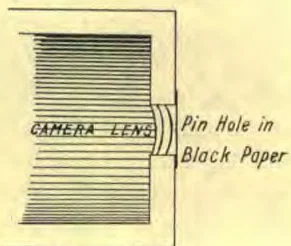
Now most cameras have small stops as well as large ones, but none are small enough for this class of work to which we refer. To get one we must make it. A piece of thin black paper is taken, and a pin or needle hole pricked through it. (If the hole is burned through with a very hot needle, it will be better, for then there will be no burr left.) This piece of black paper is now pasted just before the lens like a regular stop, and the picture of any close object may be taken with your short-focus camera. See Fig. 1. The exposure will be perhaps a hundred or more times as long as with the usual stop, but the picture will come out as sharp and clear as one can wish for. In this way pictures of fruit, flowers, and other objects can be made that would be wholly impossible with the open lens.
A Good Fixing Bath Is Made as Follows
Sulphuric acid 1 dram, hypo soda 16 ounces, Sulphite soda 2 ounces, chrome alum 1 ounce (in cold weather ½ ounce), warm water 64 ounces.
Dissolve the hypo in 48 ounces of the water, the sulphite soda in 6 ounces of water, mix the sulphuric acid with 2 ounces of water, and pour slowly into the sulphite soda solution, and add to the hyposulphite, then dissolve the chrome alum in 8 ounces of water and add to the bulk of solution, and the bath is ready. Unlike plain hypo, this bath will not discolor till after long usage, and is also a hardener of the film and a preventive against staining.
An Overexposed Plate and How to Develop It
Just what is an overexposed plate?—It is one that has been exposed too long a time to light in the camera. It develops evenly, very fast, and the shadows blacken almost as fast as the high-lights. The finished negative is wanting in contrast, full of detail, but lacking sufficient intensity in the high-lights. It is what photographers call “flat.” Of course such a negative will make but a flat and poor print.
There are several ways of making a good negative, or at least a fair one, from an overexposed plate or film. As a general thing these ways and methods will work, but they are uncertain. One plan only is adapted to the every-day beginner in photography, and is capable of yielding good average results. Let us proceed to develop an overexposed plate by it.
Presently, on pouring the developer over the plate, we notice that it begins to blacken very quickly; and all parts of it blacken almost at once. No part of it remains clear and white for a considerable time after the rest has blackened. This is an infallible sign of overexposure. The question now is, What shall we do with the overexposed plate? “Add a few drops of potassium bromide to the developer,” says one. Very well, you may do this, but you will thereby spoil your developer for any other properly exposed plates you may wish afterward to develop in it. Another photographer will say, “Remove the plate at once to another tray, containing a developer strong in pyro and bromide of potassium.” This also is good, and will work well, but either process is more or less troublesome, and there is an easier way.
Now the longer a plate remains in the developer, the more contrast it gains; that is to say, the blacker parts of the plate will get blacker and blacker, but the lighter and whiter parts will not darken as fast proportionately; and thus great contrast is possible by long development. It does not matter whether the plate is underexposed, correctly exposed, or overexposed, the longer it remains in the developer, the more contrast it will gain. Now, the common trouble with an overexposed negative being lack of contrast, we can go back and finish developing the one we just left.
The whole image has flashed up suddenly, and is rapidly growing blacker and blacker, but we neither add bromide, use strong developer, nor fix it before “it gets too black.” Remembering what we have learned about contrast, we simply leave the plate in the developer till it acquires the contrast we wish it to have, and if it has not been greatly overexposed, it will come out all right.
However, do not expect an overexposed negative developed in this way to look like a commonly exposed and developed one. No, indeed! for it will really be very, very dense. It will require a long time to print, but the chances are, it will print well. If one is impatient and really “must” make a quick-printing negative out of it, he will be able to reduce its density any desired amount in the following manner:—
Reducing Negatives
If, for any reason, a negative has been made too dense and strong, so that it requires a very long time to print, it can be made less strong and dense. The remedy is to reduce it by the following method:—
First soak the negative ten minutes in water, so as to thoroughly soften the film, then immerse in the following solution:—
Water .............................. 5 ounces
Hypo-sulphite Soda ............ ½ ounce
Red Prussiate Potash (saturated sol.) 20 drops
Rock the tray as when developing, until negative has been reduced to the desired density, then wash ten minutes in several changes of water. A properly developed overexposed negative, is nearly always too dense, and may have its printing qualities much improved by this method.
Two Kinds of Developing Paper
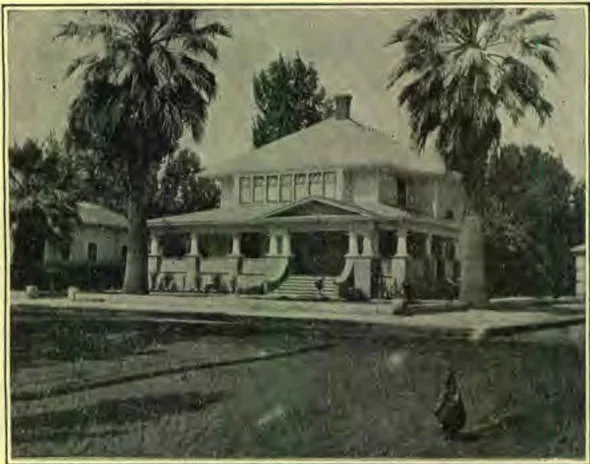
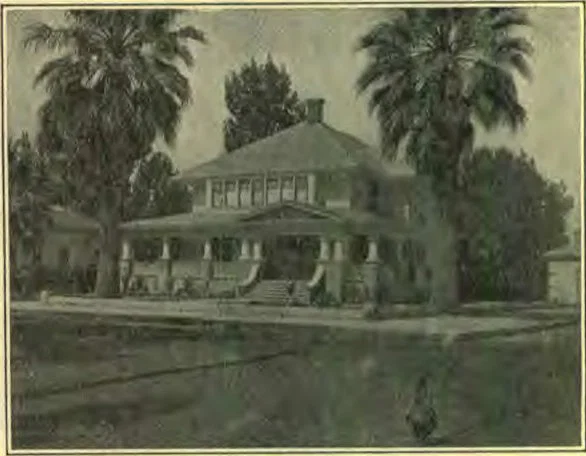
The two pictures shown herewith were printed from the same negative. One is printed on what is known as “carbon,” or “contrast,” developing paper, and the other is on “special portrait,” or “detail,” developing paper. The contrast paper yields a contrasty print, while the detail paper makes a much less contrasty one. These two papers are intended to be used with the two great classes of negatives—the contrast paper with negatives that are flat and lack contrast, and the detail paper with negatives that already have too much contrast. It is well to have a package of each on hand, and good prints can be made from almost any negative. These papers are for sale by all the dealers.
Fig. 1.
Don’t Hurry Too Much
Nearly every one appreciates beauty. If I place two pictures before you,—both good photographs, both of the same subject, but one taken from the true artist’s standpoint, and the other from the careless snap-shooter’s,—I know that you will recognize in an instant the better, more beautiful picture. And if you can do it in pictures, you can also do it in nature when you are taking pictures, if you will. That is just where the artist-photographer differs from the mere camera user: he looks at the scene and studies it till he has found the place from which it looks the best. It takes time and patience to do that way, but it pays him, and it will be profitable to you; for we who follow photography or art in a small way can not do better than use the successful methods of men whose lives are given to practical work of the same kind.
EDISON DRIVER.
1714 K St., Fresno, California.
Don't Give up the Fight
By Benjamin Keech
LET not your heart be worried,
And do not be afraid;
Your doubts should all be hurried
Away from you, and laid
So deep that they will never
Again cause you to grieve;
For wrong will go forever
When God once makes it leave.
“Let not your heart be troubled,”
For there is peace ahead;
And care is always doubled
When you declare hope dead.
Don't let the weight of sorrow
O'erwhelm you with its might;
'Twill all come right to-morrow,
So don't give up the fight.
Let not your heart be saddened,
For present woes will flee;
And, on the morrow, gladdened
By coming joys you'll be.
Confess your faults, dear sinner;
Forsake them, every one;
If you would be a winner,
Keep fighting till you've won.
Let not your heart be hardened
When things go wrong with you;
And, if you'd still be pardoned,
Keep living right and true.
With hate and gloom forsaken,
The future ways look bright;
Then, God's sweet pity waken,
And don't give up the fight.
BENJAMIN KEECH.
INTERMEDIATE LESSON
X — Signs of His Coming
(December 8)
MEMORY VERSE: “And there shall be signs in the sun, and in the moon, and in the stars.” Luke 21:25.
REVIEW.—Jesus said he was going away to —. He promised to —. When he was taken up, a — received —. As the — were gazing into — two — stood by them, and said —. They said that as — was taken — he would —. Jesus will appear to those who —. He will come with —, and every — shall see —. All kindreds of earth shall —. Some will say in that day —. The coming of Jesus can be seen like —. He will send —, and they shall gather —. He will have — with him, and will give —.
Questions
1. What question did the disciples ask Jesus as he sat on the Mount of Olives? Matt. 24:3.
2. Of what did he tell them to take heed? Verse 4.
3. How did he say they might know when his coming was near? Luke 21:25.
4. Where did he say these signs should be seen? Matt. 24:29.
5. What was the sign to be seen in the sun? How would the moon appear?
6. Give the date when these signs were fulfilled. Answer.—May 19, 1780. What does Webster’s dictionary say of this dark day? Give other testimony concerning it. How did the people who saw this darkness feel concerning it?
7. How did the moon appear on the night following the dark day?
8. What other sign was to be seen in the sky? Mark 13:25.
9. To what were the falling stars compared? Rev. 6:13.
10. When was this sign fulfilled? Ans.—Nov. 13, 1833.
11. In what part of the earth did the stars fall? To what was their first appearance compared? How thickly did they fall? How did the whole heavens appear? Give the experience of one boy who saw the stars fall.
12. How long a time has passed since the stars fell?
13. What takes place after all these signs are fulfilled? Mark 13:26.
14. Though the Saviour does not come as soon as we might expect, what should his people do? Hab. 2:3; Heb. 10:36, 37.
Lesson Story
A short time before Jesus died, as he sat upon the mount of Olives, the disciples came to him privately, saying, “Tell us, when shall these things be? and what shall be the sign of thy coming, and of the end of the world? And Jesus answered and said unto them, Take heed that no man deceive you.”
Then he answered their question by saying, “There shall be signs in the sun, and in the moon, and in the stars.” “The sun shall be darkened, and the moon shall not give her light, and the stars shall fall from heaven.” Speaking of the same signs, the prophet Joel says, “The sun shall be turned into darkness, and the moon into blood, before the great and the terrible day of the Lord come.” Isaiah wrote, “The sun shall be darkened in his going forth, and the moon shall not cause her light to shine.”
The sun was darkened May 19, 1780. In his Dictionary, Noah Webster said:—
The dark day, May 19, 1780, so called on account of a remarkable darkness on that day, extending over all New England. In some places, persons could not see to read common print in the open air for several hours together. . . . The true cause of this remarkable phenomenon is not known.
Elam Potter, M. A., says:—
People left their work in the house and in the field. Travelers stopped; schools broke up at eleven o’clock; people lit candles at noonday, and the fire shone as at night. . . . A great part of the following night was singularly dark. The moon, though in the full, gave no light.
Milo Bostwick wrote:—
The nineteenth of May, in the year 1780, I well remember. The morning was clear and pleasant, but somewhere about eight o’clock my father came into the house and said there was an uncommon appearance in the sun. There were not any clouds, but the air was thick, having a smoky appearance, and the sun shone with a pale, yellowish hue, but kept growing darker and darker, until it was hid from sight. . . . My father and mother thought the day of judgment was near. They sat up that night, during the latter part of which they said the darkness disappeared, and then the sky seemed as usual, but the moon, which was at its full, had the appearance of blood.
“And the stars of heaven fell unto the earth even as a fig-tree casteth her untimely figs, when she is shaken of a mighty wind.” The stars fell the night of Nov. 13, 1833. In “Burritt’s Geography of the Heavens,” is found this description of the falling stars:—
But the most sublime phenomenon of shooting stars, of which the world has furnished any record, was witnessed throughout the United States on the morning of the thirteenth of November, 1833. The entire extent of this astonishing exhibition has not been precisely ascertained; but it covered no inconsiderable part of the earth’s surface. The first appearance was that of fire-works of the most imposing grandeur, covering the entire vault of heaven with myriads of fire-balls resembling sky-rockets.
Horace Greeley said:—
While a mere lad, I was waked in the night to see a pale, frightened face bending over me, and to hear, “Get up! get up! the day of judgment has come, I believe, for the stars are falling.”
“And then shall they see the Son of man coming in the clouds of heaven with power and great glory.” The signs Jesus gave to show when his coming is near are all past. If he tarries, we are to wait for him; “for yet a little while, and he that shall come will come, and will not tarry.”
Scripture Enigma
1. SWEET home! from whence the feet of Jesus sped,
With tender sympathy to raise the dead.
2. ’Twas Rezin’s mighty king this city chose,
To give Syria, driving thence her foes.
3. From out these vineyards came a lion wild,
In angry rage, ’gainst Manoah’s favored child.
4. Within this city’s walls they mourned for shame,
When evil tidings of Damascus came.
5. An aged patriarch, ere he closed his life,
Bade his loved son go seek from thence a wife.
6. Oh! woe was thine, for those who dwelt in thee
Through Israel’s sword, entered captivity.
7. This city of the Jews, in peace he trod,
Waiting in faith the kingdom of his God.
8. There the disciples saw their risen Lord,
And worshiped him, though not with one accord.
9. “Go to this land,” he said, “there corn to buy;
Hasten, my sons, or we shall surely die.”
Nearing Jerusalem, to this place they came
(My nine initial letters tell its name)
Where Jesus bade his two disciples speed,
To loose a colt, and say, “The Lord hath need;”
Thine, mighty God, is all on land and sea;
Yet wondrous love! the Lord has need of thee.