The Youth’s Instructor, Vol. 54, No. 48.

What is Denatured Alcohol?
Earlier text: Spanish Proverbs

X — Testimony of the Ages

(December 8)
MEMORY VERSE: “We have also a more sure word of prophecy; whereunto ye do well that ye take heed, as unto a light that shineth in a dark place, until the day dawn, and the day star arise in your hearts.” 2 Peter 1: 19.

Questions

1. From the very beginning, what has God done? Isa. 46: 9, 10.
2. When we see these things being fulfilled, what may we know? John 13: 19.
3. What was one of the first prophecies given to men? Gen. 3: 15.
4. To what extent has this prophecy been fulfilled? Gal. 4: 4.
5. When will it be entirely fulfilled? Heb. 2: 14; Rev. 20: 10.
6. With what promise was this prophecy repeated more in detail in Isaiah’s day? Isa. 7: 14.
7. What can you tell about its fulfilment? Matt. 1: 18, 22, 23.
8. In what city did the prophet say Jesus would be born? Micah 5: 2.
9. Did the Jews expect this prophecy to be fulfilled? Matt. 2: 3–5.
10. How literally was it fulfilled, and by what means? Luke 2: 1–6.
11. How definitely was the time of Christ’s anointing and crucifixion foretold? Dan. 9: 24–27; note.
12. What prophecy was fulfilled in Jesus’ triumphal entry into Jerusalem? Zech. 9: 9. See Matt. 21: 1–11.
13. What did the prophet foretell concerning the death and burial of Jesus? Isa. 53: 8, 9.
14. Trace the fulfilment of these words. Matt. 26: 57; 27: 2, 57–60.
15. How were the prophecies given? 2 Peter 1: 21.
16. Seeing the prophetic word concerning Christ was fulfilled, what may we know of the prophecies found in God’s Word?
17. In view of this, what are we exhorted to do? 2 Peter 1: 19.

Note

In the prophecy of the 2300 days of Dan. 8: 14, the exact date of the crucifixion of our Lord was foretold. This period began with the “going forth of the commandment to restore and to build Jerusalem.” This decree went forth 457 B. C. See Ezra 7. At the end of sixty-nine weeks, or 483 years, the “anointed One, the Prince,” was to appear. Christ was anointed at his baptism with the Holy Spirit, A. D. 27, and began his work as the Messiah. After his baptism he came into Galilee, “preaching the gospel of God, and saying, The time is fulfilled.” No doubt he referred to prophetic time. In the midst, or middle, of the week, or three and one-half years later—A. D. 31—he was to be cut off, or be crucified, thus causing the “sacrifice and the oblation to cease.” It would be well in this connection to make a careful study of the 2300 days. See “Thoughts on Daniel and the Revelation,” or “The Sanctuary and Its Cleansing.”

Secrecy of Messages

Wireless Telegraphy—No. 3

Secrecy of Messages

Without secrecy no system of wireless telegraphy can ever become a commercial success, or compete with the present telegraph or cable systems. For this reason it is necessary to employ a system of tuning, or syntonizing, so that only the receiver in tune with the transmitter sending the message can take up the message. Were it not possible to do this, every receiver could read any message that came its way. Mr. Marconi has given much attention to this phase of the work, and has succeeded in constructing a receiver which responds only to a certain transmitter. If the transmitter sends out waves which vibrate at the rate of two hundred million times a second, the corresponding receiver is syntonized to receive waves of that vibration alone.
An illustration or two will show the success of Mr. Marconi’s efforts better, perhaps, than anything else could do. He has two stations thirty miles apart, one near Poole, and the other near St. Catherine’s on the Isle of Wight. Mr. Marconi’s latest appliances are installed at these places. They are so adjusted that each receiver at one station responds only to its corresponding transmitter at the other. Two operators at St. Catherine’s sent at the same time two different wireless messages to Poole, and without delay or mistake the two were correctly recorded at the same time on the tapes of the two corresponding receivers at Poole. In this case each receiver was connected to its own independent aerial wire hung from the same mast. Mr. Marconi then had the receivers at Poole placed one on top of the other, and connected them both to the same wire, about forty feet in length, attached to a mast. Two messages were then sent at the same time, one in English and one in French, by the operators at St. Catherine’s. Again each receiver at Poole rolled out its paper tape, the message in English on one and that in French on the other. It is a wonderful phenomenon, for those dots and dashes recorded by the receivers were “the result of trains of intermingled electric waves rushing with the speed of light across the intervening thirty miles, caught on one and the same short wire, and disentangled and sorted out automatically by the two machines into intelligible messages in different languages.”

Station Wires

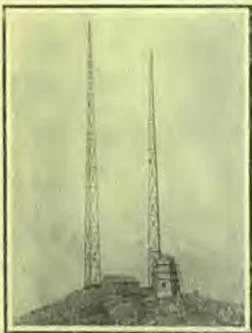
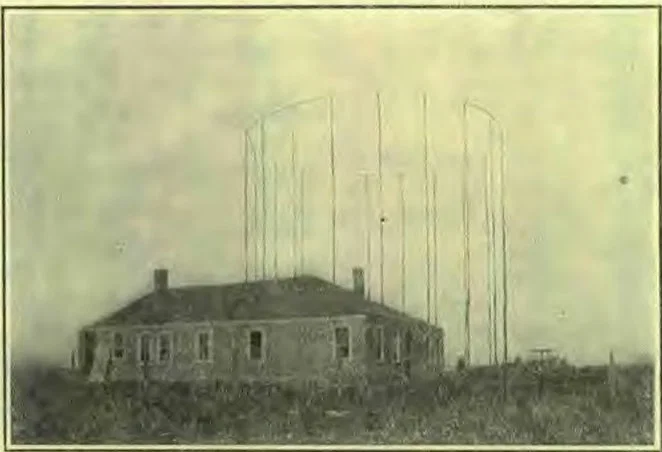
One of the important features of the wireless apparatus is the employment of an elevated conductor, which generally takes the form of a wire suspended from a mast. The tops of the long poles used at the Cape Cod station are about three hundred and sixty-five feet above the level of the sea, and are placed in a circle, as the illustration shows. For extreme distances, like that between the American and British coasts, there is used a large connection of wires hung from immense towers. Those of the new station on Mount Tamalpais, California, are gigantic. The bases of the towers are twenty-six hundred feet above sea-level, and the apexes twenty-nine hundred feet. They can be seen for a radius of fifteen miles in clear weather. The hoisting of these immense towers weighing sixty tons each was a most difficult and daring feat, for each was hoisted intact—all complete. From these towers an electric current will flash signals which may be heard not only in Hawaii and far-off Samoa, but even on the eastern shores of Japan and the Philippines.
WIRELESS TOWERS
WIRELESS TOWERS

Uses of Wireless Telegraphy

It is of special value for military and naval purposes. All the navies of the world have adopted it. Communication by two bodies of troops within several days’ marching distance of each other is possible, portable stations being used. Each station comprises three two-wheel carts,—the power cart, the apparatus cart, and the tool cart. A very light portable wireless outfit to be used by the German army in Africa has been devised. It is a bicycle fitted up with a dynamo, and all the other necessary appliances. During the late Russo-Japanese war a very considerable use was made of wireless telegraphy by both combatants, and it was also used most successfully by the London Times, whose special correspondent on board a small steamer equipped with a De Forest apparatus was able to send dispatches from the scene of action around Port Arthur direct to the Chinese coast. This work was, however, stopped summarily by the Russian military authorities.
A Boston inventor has devised a means whereby vessels can under all conditions of weather determine their bearings. Being provided with charts that give the location of all lighthouses and prominent landmarks, the navigator receiving a message from a lighthouse which is invisible from fog or distance can easily determine his exact location, as each lighthouse has a distinctive name or number, and is provided with a transmitting instrument adapted to continually repeat its name or number. The vessel’s receiving instrument takes up the Hertzian waves from two or more of these, and thus gives to the captain the ship’s exact location.
STATION AT CAPE COD
STATION AT CAPE COD
Vessels can communicate with one another, and with the mainland, if they carry wireless outfits. Ships one thousand miles or more apart in mid-ocean have kept in communication by wireless telegraphy. The Cape Cod station has made it possible for travelers crossing the ocean to be constantly informed of the news of the world. Daily papers are now printed on board vessels.
Ship owners find it a great convenience. A captain bringing his ship home five years ago could not possibly ascertain what docking arrangements had been made for him in New York by the owners until he met the pilot-boat. To-day by means of wireless telegraphy a vessel far out on the Atlantic can be informed of all detailed arrangements, so that baggage and cargo can be gotten ready for immediate landing on the arrival of the vessel in port.
The application of wireless telegraphy to burglar alarms for safes has been carried out successfully by a well-known firm of British safe builders. There are no wires for the burglar to cut before tampering with the safe, so it is more dependable than other forms of electric alarms.
Official reports from some of the stations show that wireless telegraphy has already been the means of lessening and averting many disasters on the sea. The naval torpedo station at Newport, Rhode Island, reported eleven messages received during the year 1905 from disabled vessels. One vessel was jammed in the ice, another had run down a schooner, one had her low-pressure piston broken, another had a collision with a steamer in a fog, and all were in a serious condition. Help was immediately dispatched to these vessels, and though in some instances the ships finally sank, all lives were saved.
Wireless telegraphy is still in its infancy, yet it has accomplished wonderful things, and is destined when perfected to be one of the world’s best servants.

Trouble with Japan

THE San Francisco Board of Education a few weeks ago adopted a resolution providing that all children of Oriental parentage should be excluded from the public schools, and required to attend schools set apart for them. This was enforced on the fifteenth of October. The Chinese and Koreans acted upon the decision of the board, but the Japanese kept their children at home, and sent in a protest to the school board.
Before the fire the Chinese and Koreans were restricted to their own school, but the Japanese were admitted to any of the public schools of the city. The labor unions and the Japanese and Chinese Exclusive League are held responsible for this unwise discrimination.
Japan resented this action on the part of the San Francisco authorities, and Ambassador White sent a report to Washington. In reply to this, Secretary Root said:—
The purely local and occasional nature of the San Francisco school question should be appreciated when the Japanese remember that Japanese students are welcomed at hundreds of schools and colleges all over the country. You may assure the government of Japan in most positive terms that the government of the United States will not for a moment entertain the idea of any treatment toward the Japanese people other than that accorded to the people of the most friendly European nation, and that there is no reason to suppose that the people of the United States desire our government to take any different course. The President has directed the Department of Justice to make immediate and full investigation.
The Japanese ambassador at Washington called upon the Secretary and asked in behalf of his government that the Japanese in California be accorded their full right under the treaty of 1894.
The President has been quite concerned over the situation. According to the Constitution the central government has no authority over the schools of San Francisco. They are managed by the State. The President has, however, asked Mr. Metcalf, a member of the cabinet, to visit the local authorities to see if an immediate revision can not be secured.
These two nations have long been on too friendly terms to allow so useless and unwise a measure to estrange them, and possibly result in war.

Seventy-Third Anniversary of the Falling Stars
To-day, November 13, 1906, marks the seventy-third anniversary of the falling of the stars foretold by the Word of God as one of the signs of the coming of the Saviour. Behold, our redemption draweth nigh.

You have reached the end of this edition.

The Youth’s Instructor · Nov 27, 1906