IN the Scriptures we read, "Behold, how great a matter a little fire kindleth!" Until a few years ago the world was giving but little attention to that tiny insect called the mosquito. But since the Spanish-American War, and since the visitation of yellow fever to New Orleans, this little creature has been occupying a realm of such great importance as to involve a remarkable revolution in medical knowledge of the etiology and prevention of yellow fever.
This little pest to-day is commanding the respect and dread of the scientific world for its ability to propagate and transmit disease; and a war is being waged in behalf of its extermination. In the present instance, there is arrayed on one side the medical branch of the general government in conjunction with the local authorities of Louisiana, besides the combined forces of local citizenship, hundreds of thousands of dollars, tons of sulphur and pyrethrum, scores of barrels of oil, salt, and other agencies of destruction; while on the other side is to be found the tiny mosquito. What has brought about this [[FIGURE]]
spectacle upon which the eyes of the whole world are looking?
It has been demonstrated that yellow fever and other diseases may be propagated and transmitted by mosquitoes, of which there are at least three species, the culex, anopheles, and stegomyia fasciata. The culex, or gutter mosquito, and the anopheles, or swamp species of the insect, elaborates and transmits by inoculation malarial fever. The stegomyia fasciata, which is a fresh-water mosquito, is the intermediary host which carries yellow fever parasites from a patient to a well person. It has been shown that, in order to carry on her deadly work, the stegomyia fasciata (the Latin name of this mosquito) must bite a yellow-fever patient within the first three days of the appearance of the disease; then a period of twelve days must intervene for elaboration before the disease can be imparted to another body. After that time, and during the life of the creature, sometimes 150 days, it is prepared to deal a bite which will cause yellow fever. It has been demonstrated that in no other way can the fever be contracted, and this is why there is such a warfare being waged against the mosquito.
The mosquito theory was brought before the world as the result of careful and ceaseless study and research of physicians, who gave the subject of tropical fevers special attention. In 1881 Dr. Carlos J. Finlay, a British subject born in Cuba, promulgated the theory of the transmission of yellow fever by the stegomyia mosquito. His study, research, and demonstrations were conducted in Cuba, the chief focus and home of the disease, Havana being never without it from 1762 to September, 1901, a period of 140 years. As a result of his demonstrated conclusions in connection with other scientists, he recommended the very measures which are being used against the propagation of the fever, viz.:
To prevent those insects from stinging yellow fever patients.
To destroy, as far as possible, the mosquitoes which have been infected.
Finally, to consider any place unsafe so long as the last mosquitoes which have stung yellow-fever patients may be alive in it.
Dr. Finlay's theory was not accepted at first in general, and it required more argument. At the close of the Spanish-American War, a commission, known as the United States Army Yellow Fever Commission, composed of Major Walter Reed and Drs. Carroll, Lazear, and Agramonte, was sent to Cuba to study the conditions, and report its findings.
The first visit was in the early summer of 1900. Their conclusions fully corroborated the mosquito theory. Dr. Lazear died a martyr to the cause of science, having submitted himself for experiment's sake. During this and other experiments it was demonstrated that the disease was not contagious, that is to say, the fever could not be communicated from person to person, or from contact with clothing or atmosphere surrounding patients. Non-immunes were placed in rooms specially screened from mosquitoes, in which were the bed and bedding of deceased patients, and, in every conceivable way, attempt was made to contract the disease by contact with possible infection. Failure to take the fever was invariably the result. On the other hand, non-immunes were placed under a mosquito netting in which were placed infected stegomyia mosquitoes, resulting in the person's taking the yellow fever.
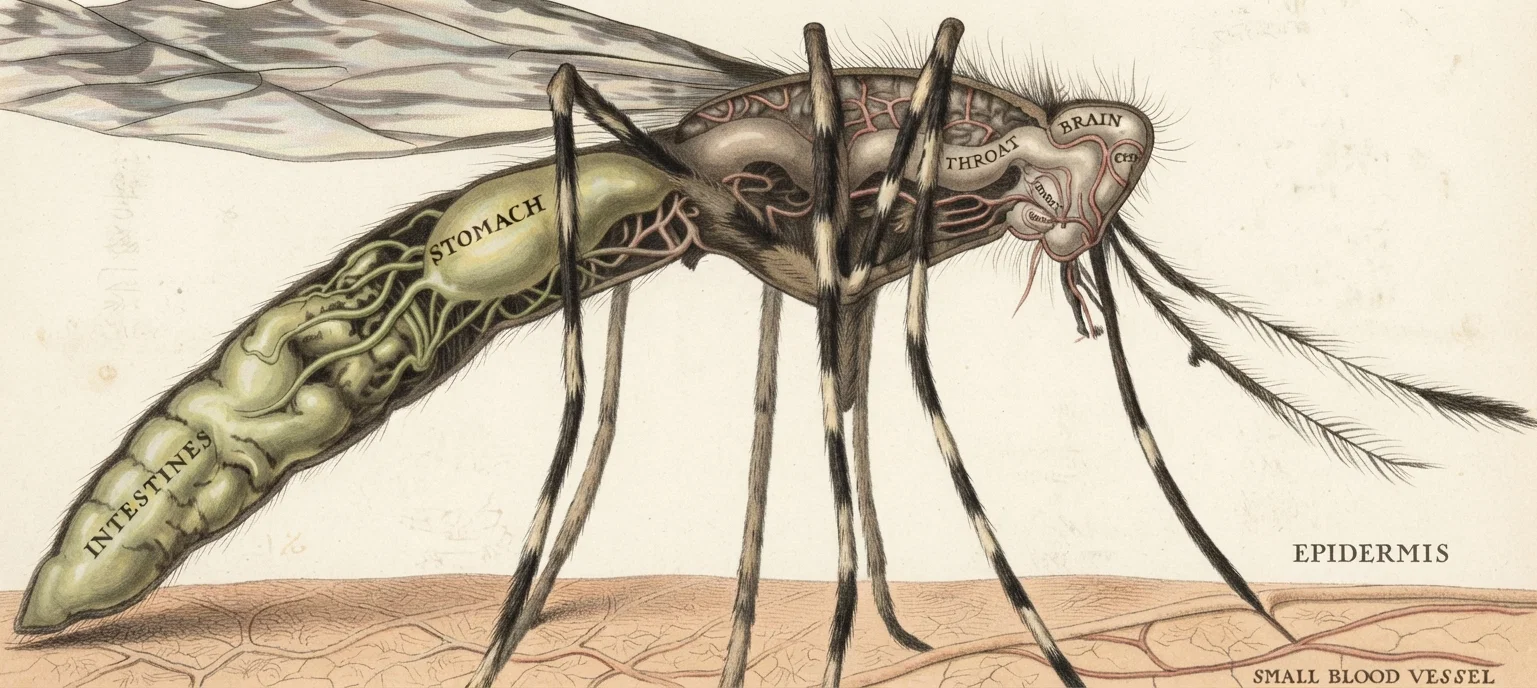
Stegomyia fasciata, the yellow fever mosquito, very greatly enlarged.
It has been generally thought that yellow fever was a filth disease. But this has been demonstrated to be an error, for the disease may be contracted by the most careful in diet and general hygiene. It must be said in this connection that the patient who has been in general good health, whose blood is not filled with the poisons of a wrong dietary of meat and drink, do not permit the fever to linger long in their systems. The daughter of the writer had the fever, but the physician had no occasion to administer medicine, and said that her general condition was such that the fever could not make the inroads which were so general in persons having other conditions.
In demonstration of the fact that the mosquito theory is an established matter, some figures are given, and comparison made with other epidemics. In 1878 the medical fraternity were working in the dark for the most part in waging war against the spread of yellow fever in New Orleans. The mosquito was not taken into account, and the totalities of that year were as follows: Total number of cases, 25,000; total number of deaths, 4,046.
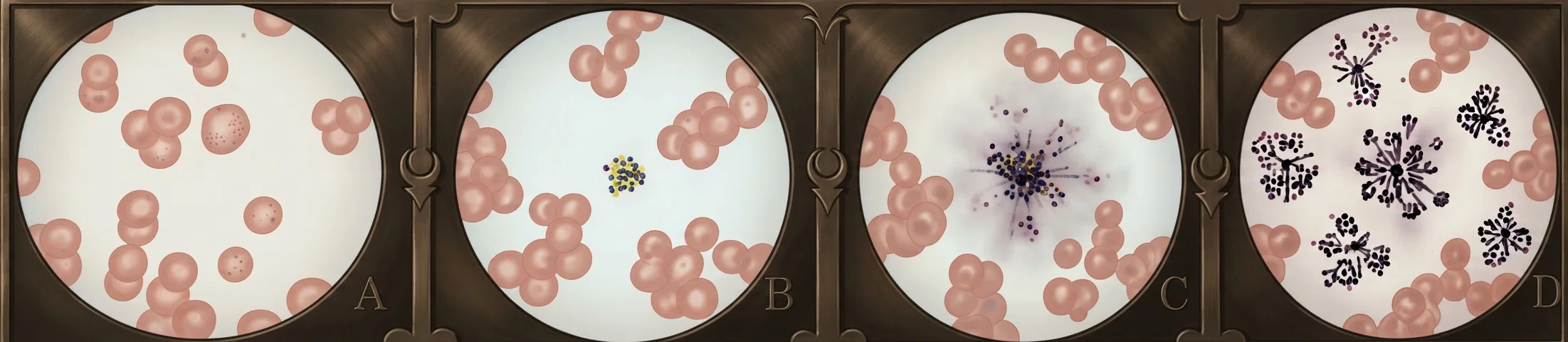
These cuts illustrate the growth of the yellow fever germ colonies in the blood of one stricken with that disease.
In 1897, total cases, 1,907; total deaths, 298. Fever began September 16.
The present situation shows that there were 100 cases on July 20, 21, the first reporting made. On that date there were reported 21 deaths. Up to September 20, involving a period of 76 days, the figures are as follows: Cases, 3,000; deaths, 388; discharged, 2,372; under treatment, last date, 240.
It will be seen that the fever situation is under control, and there is no other way to account for it than upon the hypothesis that the mosquito is the known propagator and transmitter of the disease.
The campaign against the fever has been somewhat difficult, because of the failure to secure full and accurate reports of new cases, sometimes the first news of yellow fever in a home being the death of the patient, which must be reported before a burial permit is issued. Ordinances and laws have been resorted to, in order to help stamp out the scourge. Tons of sulphur have been used to fumigate homes in destroying the stegomyia, for the stegomyia mosquito is a house insect. Cisterns, which contain the family supply of drinking water, must now be screened, for in them the mosquito lays its eggs, producing the larvae, from which comes the pupa, and finally the mosquito. Besides screening, oil must be put into the cisterns, about a quart being ample to cover the surface. The oil closes access to the air which the embryo must have, resulting in its death. Thus do we see what a remarkable insect the stegomyia is, and to what great trouble in labor and talent and time man is put by this erstwhile insignificant and tiny creature.
There are many lessons growing out of this campaign, the most important of which is that, if we obey nature's laws, we may be enabled to ward off the evil, or to control and defeat it, if inoculated, instead of permitting disease so to fasten itself as to control us.
New Orleans, La.
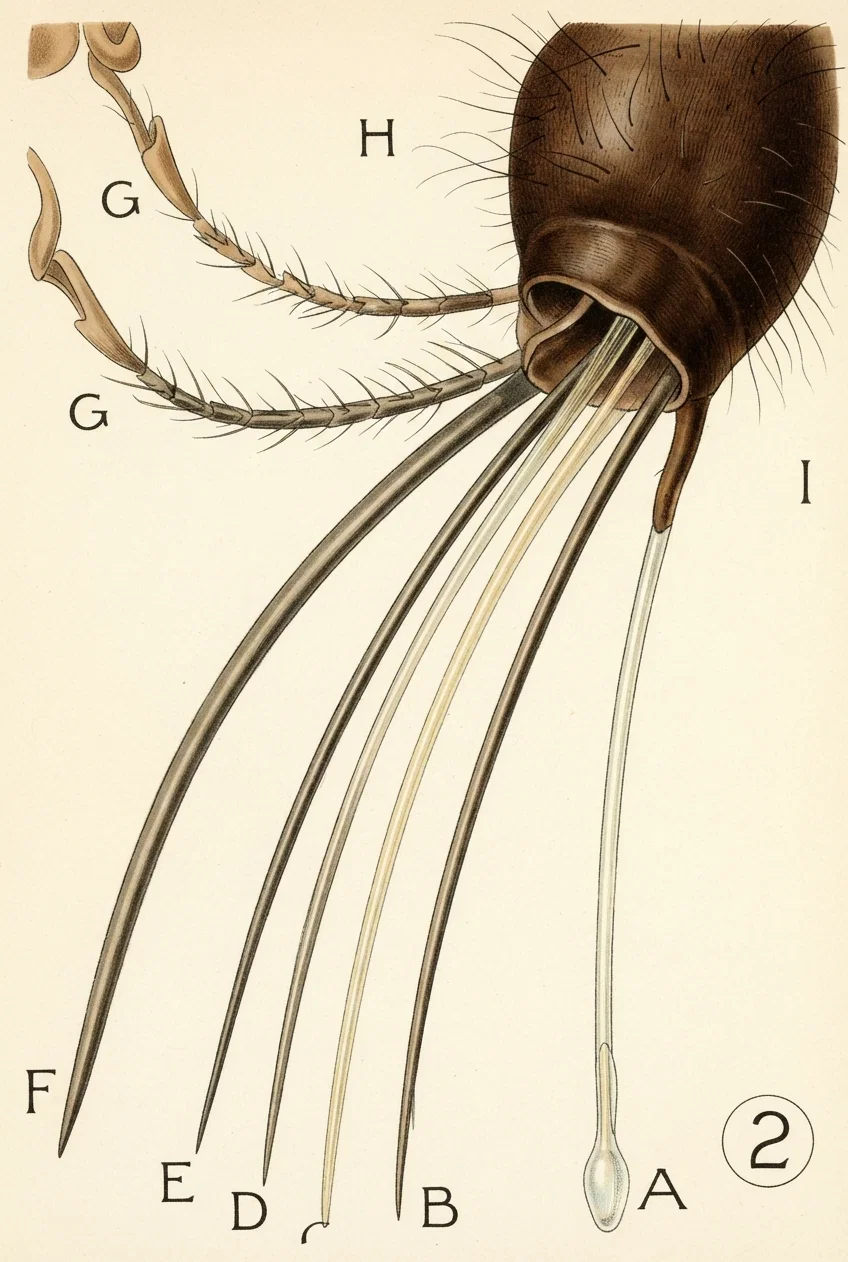
The weapon of the mosquito separated into its parts. The part of the bill with the bulb at the end contains the irritating poison.
STILL FOR PERSECUTION.
THE organ of the National Reform Association still openly endorses persecution for people and states who do not believe in the association's idea of Sunday observance. It passes judgment upon the various states by means of a map, illustrating the character of their Sunday laws. It paints California, Idaho, and Arizona, as black as tar, because they have no general Sunday laws. Yet prominent ministers7from the East have spoken very favorably of the orderly manner in which the day is observed in California; and if the daily news is any criterion, the morals of the people of this state will compare favorably with those of the inhabitants of the state that has been the headquarters of the National Reform Association for forty years.
National Reform is especially a religious-political move, and with its strenuous home work for a period of forty years, backed by a Sunday law of a veritable Puritan character, its home state has a record for political darkness second to none in the Union. California never began to make such a record, much less to keep it up for years.
In the aforesaid map the states that have been foremost in persecuting people who quietly performed honest labor on Sunday, after religiously observing the Sabbath of the Lord the previous day, are marked as pure and white. All states having "strong" Sunday laws are marked white; while those whose Sunday laws "are weakened by numerous exceptions, or are inherently weak," are shaded. Two of the states that formerly did persecuting work, but for some reason relaxed their laws, are shaded.
These things go to prove that the association still maintains the theory that persecution for dissenters is legitimate reform; this, too, altho one of its foremost and most aggressive spirits, when hard pressed for a temporary retreat, admitted that the states which a few years ago had persecuted orderly citizens under the Sunday law, were "backward states."
Furthermore, it must not be forgotten that leading men in the National Reform movement have placed on record some very radical declarations of intention when the movement shall have succeeded in putting them and their class in control of the government. These declarations include, in emphasized language, disfranchisement, banishment, and even the death penalty, for dissenters from National Reform law. And these utterances were not merely the words of individuals, but of representative men, whose words have not been repudiated, in jot or tittle, by the association; while the men still hold exalted position in the movement, recognized as authoritative spokesmen.
Yes, be it known to all that the National Reform Association still stands for church-and-state union of the most radical form—and for relentless persecution of dissenters.
WHAT "THE THUNDERER" SAYS.
By Editor
Nearly always an anti-temperance sheet has been the great, conservative London Times, yclept "the Thunderer." But now, in view of recent discussion, it feels called upon to speak on the question. According to a London despatch of October 1, it says:
According to recent developments of scientific opinion, it is not impossible that a belief in the strengthening and supporting qualities of alcohol will eventually become as obsolete as a belief in witchcraft. . . .
The whole question really turns upon the consciousness that alcoholic drinks satisfy some kind of temporary want, or produce some temporary comfort or exhilaration, coupled with a belief, which modern physiology is doing her best to dispel, that they are at least essentially harmless when consumed in moderation. It may be stated as an opinion
upon which most, if not all, physiologists are agreed, that alcohol contributes nothing to the permanent powers of the healthy organism, whether physical or intellectual. No man, it is said, is the stronger for taking it, and no man is the wiser. The experience, now very extensive, of insurance offices seems to place it beyond doubt that even the moderate regular use of alcohol, in any form, is, on the whole, contributory to the shortening of life. When these views come to be fairly balanced against temporary gratifications of the palate, or temporary stimulation of the brain, they will be likely to lead, not to a single "wave" of sobriety, but to a gradual change in the habits of the more intelligent portion of mankind.
These words are wise words. May they be heeded.
CHINA'S DISTRUST OF "CHRISTIAN NATIONS."
THE pagan nations are not seeking to emulate the so-called Christian nations because of their Christianity, excepting as they understand that Christianity is a help to a higher grade of national power. They want to compete in the matters of military, commercial, and territorial prestige, and are willing to encourage Christianity to the extent that it can be made a means to that end. Japan has sought to imitate the professed Christian nations, and to encourage Christian teachers in her army, but it was because of the idea that it would make her people better soldiers and more astute statesmen and diplomats. China has been somewhat inclined the same way; but, now that Japan has made such a good military and naval showing against their common "Christian" enemy, Russia, China is looking to Japan for the instruction that she longs for in military skill and statehood. If China can get the help she wants to develop her latent forces from a somewhat kindred people, imbued with a similar religion, she will not so highly regard the Christian religion. This tendency to look to Japan as an example, and for education, is manifest in a renewed hostility to the encroachments of the Western foreigners, even including Americans. The real reason for this reversal of confidence in Buddhistic Japan lies in the fact that the "Christian" nations with which China has had to deal have sought only their own selfish interests, and have taken advantage of every opportunity to exploit the country—even looking forward to a dismemberment of the empire altogether. There is little wonder that the Chinese are skeptical regarding the religion of the "Christian nations." G.
SIMPLEST SURGERY AT ITS BEST.
MAJOR LOUIS L. SEAMAN told us months ago of the wonderful saving results of Japanese military surgery. Surgeon-General Suzuki, of the Japanese navy, addressing an assembly of American doctors in this city, ascribes these marvels of healing to a scarcely less marvelous simplicity of treatment. The Mikado's doctors permitted nature to do her share. That is about all.
As little as possible was done to injured men on the fields of battle. Limbs were not hurriedly cut off. Angry wounds were not aggravated by probing after bullets or pieces of shell. There were prompt washings of the edges of wounds with aseptic cotton dipped in sterilized water. Then the bandaged patients were hurried to comfortable hospitals, where healings "by first intention" were encouraged by the simple process of letting things alone.
With ready courage the Japanese adapted to field purposes methods which, as Dr. Suzuki said, are perfectly familiar to our surgeons in ordinary practise. By the theories of practitioners who believe radically in the use of antiseptics, or poison-killers, such reliance on the mere cleanliness of aseptic washes and bandages should be many times fatal. In the Japanese instance it worked in happy conjunction with a system of field and hospital hygiene through which mortality by preventable disease, usually greater than by shot and shell, became the smaller percentage.
Unthinkable numbers of limbs and lives have been sacrificed on and after battle-fields, while the world waited for some such common-sense surgery as the Japanese employed.—N. Y. World.
THE COST OF INTOXICATING LIQUOR.
An Appeal to President Roosevelt.
THE National Congress of the Lewis and Clark Exposition declares that the Internal Revenue system has developed and fostered the liquor traffic beyond the fondest dreams of its early promoters, until its invested capital exceeds $500,000,000, and its retail cash income from the people of the United States is nearly $1,000,000,000 yearly.
That the Internal Revenue receipts from all alcoholic liquors is less than $200,000,000, and the license and tax receipts of all state and local governments is less than $200,000,000 annually, while its cost directly and indirectly to the whole people exceeds $2,000,000,000 yearly in money value alone; and—
That the highest religious, educational, scientific, insurance, and commercial authorities of the age have unequivocally condemned and denounced the liquor traffic as the greatest and most terrible curse of modern civilization, and the Supreme Court of the United States, recognizing this judgment of the world, has officially declared (Dec. 5, 1887) that "we can not ignore the fact, established by statistics accessible to every one, that the disorder, pauperism, and crime prevalent in the country are in large measure directly traceable to this evil."
In view of this President Roosevelt is asked to break the silence of the White House for forty years, and in his "magnificent courage and manly independence," champion the people's right in his next message.
Russia and Rome.
Speaking of Russian internal life the California Christian Advocate says:
"When Christianity was first introduced into Russia it was in a wholesale fashion. The nation was practically baptized by order of the Emperor Vladimir. Christianity has never been understood, never penetrated and changed the Russian heart. Superficially, Russia has some knowledge of Christian principles, but provoke her and she is a savage pagan. Religiously, Russia has never been sincere. Take as an example her so-called religious tolerance. She gives out that Russia tolerates all religious sects. It must be understood, however, that no one can change his creed to any form of faith except the Orthodox Greek Church, on penalty of being banished from his home."
"Christianity" was introduced into Rome in the same manner in which the Advocate says it was introduced into Russia—"in a wholesale fashion." The nation was practically baptized by order of Emperor Constantine. It was that kind of "Christianity" that gave us the Sunday institution as a substitute for the Sabbath of the Lord. It is the Russian Orthodox Church that gives Russia her intolerant, tyrannical character, and the Roman Church, wherever she has the power, is just as intolerant as she ever was—is the very counterpart of the Greek Church. Rome has already boasted that she will do for the United States what she has done for other countries, and by the help of compromising Protestants and catering officials she is fast getting into position to make her proposition effective. Both of these forces are pressing Rome's distinctive "mark"—the Sunday-sabbath—to the fore with increasing persistence.
News of the World
United States Attorney Breckons, of Hawaii, has brought suit against the Hawaiian Beef Trust. It is charged that an unlawful combination is controlling the meat market of the islands, and is charging oppressive and exorbitant prices for meat. The list of defendants includes men in the highest official positions in the islands, one of whom is the president of the territorial senate. The attorney has issued indictments against seventy-eight in all.
The packers of the United States have raised the price of leather to such an extent that the price of every pair of shoes, it is reported, will be increased from fifty cents to one dollar.
The agreement that has been reached between France and Germany in regard to Morocco has virtually ended the independence of the Sultan of Morocco's rule.
The American Bible Society has decided to publish an edition of the Gospels and Acts in Chamorro, the language spoken by the people of Guam.
War and Civilization
There is a proverb that says, "War is the science of barbarians." The proverb is certainly true to the letter, but the people who pose as being civilized wage the most destructive warfare. The so-called civilized nations either instigate, or by their selfishness provoke, all the wars of any considerable magnitude. Does civilization make people more barbarous? One thing is certain, all the civilization that is not prompted and sustained by the Spirit of Christ makes men more selfish, and more ambitious and shrewd in gratifying their selfishness. War is simply the result of aggregated selfishness. It is undeniable that our boasted great universities are giving much encouragement, directly and indirectly, to the "science of barbarians."
EVOLUTION AND GEOLOGY
By Geo. McCready Price
HISTORICAL SKETCH.
(Continued.)
Smith, Cuvier, and Hutton.
On another page, where Zittel speaks of Werner's habits of exact observation, he complains that he failed to recognize the value of fossils as revealing the age of rocks.
Great tho the advantages of Werner's method were, it was not without its weaknesses. The chronological succession of the individual members of a formation was not determined with sufficient precision, the fossils were scarcely used in determining the age of a rock stratum, and the history of organic creation was not even recognized as a subject of investigation in geognosy.
In this respect the great pioneer was the English engineer, William Smith. He was the first to make known on incontestable evidence that the stratified rocks of England could be most securely identified and arranged in chronological order according to their organic contents. Smith's method of determining the age of rock-strata from the organic remains found in them provided an inestimable complement to Werner's system, since the latter rested in the main upon mineralogical distinctions. William Smith has received the merited appellation of
"Father of Historical Geology."
Two French scientists, Alexandre Brongniart and Cuvier, attained similar results [not from the same part of the great "phylogenic series," but an entirely different one], independently of William Smith, from their examination of the fossils in the rocks of the Paris basin.—"History," pages 47, 48.
William Smith (1769-1839) was, as the quotation given above indicates, a civil engineer, or land surveyor, who conceived the idea of determining the relative ages of strata by their fossils. Just how far he carried this idea it is impossible for me to determine. Lyell says nothing along this line about him, save that he followed the leading divisions of the secondary strata as outlined by Werner, tho he claims "independently" of the latter. ("Principles," page 50, 8th Ed.) As for Zittel, he remarks that "Smith confined himself to the empirical investigation of his country, and was never tempted into general speculations about the history of the formation of the earth,"—words which to my mind are the very highest praise, and which seem to indicate that he was only in a very limited way responsible for the unscientific and illogical scheme of a "phylogenic series" or complete "life-history of the earth" which now masquerades as the science of geology. Doubtless like his little bright-eyed German contemporary, A. G. Werner, he had enough of the logical faculty to see the absurdity of first assuming your premises and then proving them by means of your conclusion, i. e., first assuming that there has been a gradual development on the earth from the lowest to the highest, and then arranging the fossils from widely-separated localities over the earth in such a way that they can not fail to testify to the fact.
His observations began about 1791, and continued for twenty-five years in all parts of England:
He entered his observations in colored geological maps, and compiled them from time to time in the form of tables or as explanatory notes to his maps. He also carried out a scheme of arranging a collection of fossils according to the succession of strata; his own collection was acquired by the British Museum, and is still exhibited there. After his long period of field observations, William Smith came to the conclusion that one and the same succession of strata stretched through England from the south coast to the east, and that each individual horizon could be recognized by its particular fossils, that certain forms reappear in the same beds in the different localities, and that each fossil species belongs to a definite horizon of rock.—"History Geology," page 110.
It is not my purpose to question this generalization of Smith's; but, granting its perfect accuracy, I fail to see how it is one whit ahead of Werner's scheme which we have seen that Zittel characterizes as "weak" and narrow.
Quoting again this author's criticism of Werner's work, we can say that Smith's observations also were "limited to a small district," and "his chronological scheme of formations was founded upon the mode of occurrence of the rocks [fossils] within these narrow confines." There is, as we have shown, a monstrous jump from this to the conclusion that even these particular fossils must always occur in this manner over the whole earth. How can any one deny that if we had a complete collection of all the fossils laid down during the last thousand years—when all admit that the so-called "phylogenic series" is complete—we could still arrange them in this same order from the lowest to the highest forms of life, and might even happen to find "small districts" where the "mode of occurrence of the rocks within these narrow confines" would have all the appearance of showing a true "phylogenic" order. This of itself ought to be sufficient to show any one the purely hypothetical and imaginary value of the fossils in determining the age of rock deposits.
Smith's famous geological map of England and Wales appeared in 1815, "and was the model of all subsequent geological maps."
But while Smith was thus working out the details of the Jurassic and Cretaceous systems in England, the rocks of the Paris Basin were being detailed in the same way on the basis of their organic contents, tho, as Zittel says, quite independent of Smith's work. This was due to the combined labors of Alex. Brongniart, Professor of Mineralogy in the Natural History Museum in Paris, and Georges Cuvier, afterwards Baron Cuvier, the famous zoologist and palaeontologist. Their joint work appeared in 1808, and a second and larger one on the same lines in 1811.
Afterwards it was demonstrated that many of the fossils of the Paris basin agreed with the fossils in the deposits near Verona [Italy] which Arduino had termed Tertiary deposits. And the series was then incorporated in the chronological succession of the rocks as the Tertiary formations.—"History," page 105.
Soon after their publication, Smith's researches were productive of results which he could never have anticipated. It was found that the strata described by him from the Lias to the Purbeck horizons filled the great gap between the Muschelkalk and the Cretaceous formations in Werner's system. European geology was thus enriched by the accurate knowledge of an important series of fossiliferous geological horizons, and the equivalents of the English Lias, Cornbrash, Portland, and Purbeck series were sought for and discovered in various parts of Europe.—Id., page 112.
The details of these were all well worked out, and then there only remained a small part, the beginning or little end, of their great succession of life, to make the whole thing practically complete as we have it to-day—with a single exception shortly to be mentioned.
The part of the geological record which still remained very obscure was the so-called "Transitional" series below the Carboniferous rocks, embracing the thick graywacke formation with interbedded shales, slates, conglomerates, and limestones. . . . No complete sub-division of the immense complex of strata between the crystalline schists and the coal measures had been attempted.—Id., page 432.
These rocks also were then straightened out in chronological order according to their fossils by Adam Sedgwick and Roderick Murchison—giving rise in the process to the notorious "Cambro-Silurian Controversy"—and the chain of life was complete, with the exception of where it joined on to the "modern" period, the truly inductive method being thus reversed, and the most important of all, viz., the rocks containing human remains and other living species, being left for a score or more of years after the others were all tabulated off according to their pretty scheme.
But thus by piecing together "the record" from distant localities, and by ingenious dove-tailing here and there, assuming all the while—
That over all the earth the fossils must always occur in the particular order in which they were found to occur in a few corners of Western Europe; and—
That in the long ago totally different kinds of fossils from separated localities could not possibly be contemporaneous with one another as we know they are to-day in "recent" deposits;
—we have the general evolutionary outline of Buffon elaborated into the complete "phylogenic series" from the Cambrian to the Pleistocene. But one of the most astonishing things about it is that, during all these subsequent years, no one, so far as I know, has ever pointed out the horrible logic in taking this "immense complex" of guesses and assumptions as the starting point for new departures, the solid foundation for renewed "investigations" as to just how this wonderful phenomenon of development has occurred. There really seems to me little hope of reaching with any arguments a generation of scientists who can elaborate genealogical trees of descent for the different families and genera of the animal kingdom, including man himself, based wholly on such a series of childish assumptions and blind guesses, and then palm off their work on a credulous world as the latest results of science.
Triumph and Truth
"He who strives for triumph misses truth."
A True Friend in Trouble
"He is a true friend who stands by in time of need and trouble."
Do Not Borrow Tomorrow’s Troubles
"Too often we try to crowd to-morrow's troubles into to-day."
Conversation Reveals Our Principles
“A MAN’s conversation usually reveals the principles in which he is mostly interested.