The Youth’s Instructor, Vol. 27, No. 45.

GRINDING AT THE MILL

The Youth’s Instructor

Nov 12, 1879

S. D. A. Publishing Association · Battle Creek, Mich. · Nov 12, 1879

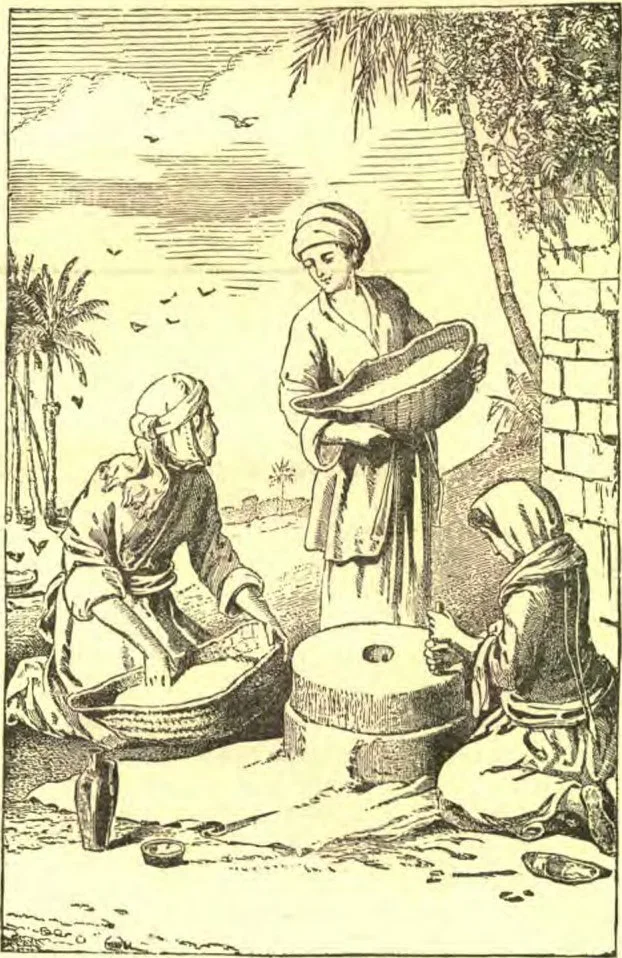
GRINDING AT THE MILL.

The hand-mills still in use in the East vary little from those employed thousands of years ago. Here is a picture of a scene which might have been witnessed in the time of Moses, and which you might now behold at dawn of day in almost every household, were you in some oriental land.
A lady, writing from India, gives the following description of the manner in which grain is ground in that country:—
Grinding the wheat or rice is the work of women. Among the wealthy it is performed by slaves or the lowest servants. In this warm climate the bread must be baked just before it is to be eaten, and in the morning the first care of the women is to grind flour for the day’s use. Then they must bring water and fuel, and prepare their fire-place, etc., before they can cook breakfast. The men do not wait to take breakfast before going to their work, but return for it or have it sent to them.
The people of the East have usually but two meals a day. The morning meal is taken at any time between nine and one o’clock, and the evening meal after the farmer leaves his work at dusk, or the shopkeeper his shop.
The hand grist-mill, which is found at every house, consists of two flat, circular stones, placed one over the other, and called the upper and nether millstones. They are from fifteen inches to two feet in diameter, and about six inches thick. From the center of the lower stone rises a pivot on which the upper stone revolves. Near the edge of the upper stone is the handle by which it is turned, and in the center is a hole for the pivot, and also for the grain to fall through upon the stone below. Sometimes one woman grinds alone, but oftener two work together, sitting on the ground with the millstones between them, and both taking hold of the handle and moving it entirely around, to and from them.
In the city there are a few mills which grind flour for market. These are larger, and are turned by oxen, but work on the same principle as the hand-mill. In the mountains I have seen a few small water-mills of very simple contrivance, for grinding corn and wheat. But I have never seen a steam grist-mill in India.
The poor women at the mills often sing cheerfully over their hard task, and the grinding of the millstones gives a low, continuous sound quite pleasant to the ear, more especially pleasing to those who anticipate a refreshing meal from it. To these grateful sounds allusion is made in Jer. 25:10. The Lord told his people, the Jews, that he would “take from them the voice of mirth, and the voice of gladness, and the sound of the millstones.” They would be heard no more in Jerusalem, because the people were to be carried away as captives to Babylon.
Grinding is considered too menial a service for men; hence, when Samson was degraded by the Philistines he was made to “grind in the prison-house.” Judg. 16:21. Jeremiah laments that “they took the young men to grind.” Lam. 5:13.
Since the millstones are so necessary to every household, we can see what a merciful command was that in the Mosaic law, “No man shall take the nether or the upper millstone to pledge; for he taketh a man’s life to pledge;” his family would be deprived of the means of preparing their daily food.
When our Lord would represent the severing of very close relations at the day of Judgment, he says, “Two women shall be grinding at the mill; the one shall be taken, and the other left.” God grant that we may all be found at that day among his chosen.—Exchange.

BEGINNING AGAIN.

When, sometimes, our feet grow weary, On the rugged hills of life— The path stretching long and dreary With trial and labor rife— We pause on the toilsome journey, Glancing backward in valley and glen, And sigh with an infinite longing To return and begin again.
For behind is the dew of the morning, In all its freshness and light; And before are doubts and shadows, And the chill and gloom of the night. We remember the sunny places We passed so carelessly then, And ask, with a passionate longing, To return and begin again.
Ah, vain, indeed, is the asking! Life’s duties press all of us on, And who dare shrink from the labor, Or sigh for the sunshine that’s gone! And it may not be far on before us Wait fairer places than then; Life’s paths may yet lead by still waters, Though we may not begin again.
Forevermore upward and onward Be our paths on the hills of life, And soon will a radiant dawning Transfigure the toil and the strife, And our Father’s hand will lead us Tenderly upward then; In the joy and peace of a fairer world, He’ll let us begin again.

Religion: Right Feelings Toward God

Religion.

Dear Children: I have written to you about many different things, and given you much instruction concerning the air, the ocean, and the wonderful world in which you live; and now I desire to talk to you, through the Instructor, about another subject, far more interesting than any I have mentioned, although the heading of this article may not seem very attractive.
Children sometimes imagine that religion is something gloomy and sad; but I think I can show you that this is not the case. The word religion means right feelings toward God. You all believe that there is a God. The earth with its myriad productions, adapted to the wants of man, the sun, the moon, and the stars twinkling in the firmament,—all must have been formed by some mighty creative power. You have learned much concerning the wisdom and goodness of the great Creator and Designer whom we call God. “This God is our God.” He is a being of power and of love.
You all know the story of Adam and Eve, how they sinned and were driven from Eden, thus dooming the whole human race to a death having no resurrection.
You have also heard how God’s Son, Jesus Christ, came into this world and died for us, thus opening a way by which we can obtain everlasting life.
Unless Jesus returns to this earth in a few years, we must all die. The grave is a cold, dreary place; there is no light, no warmth there. You have doubtless had friends die. You have seen them close their eyes and lie, oh, so still! You have shuddered as you touched their clay-cold faces, and wondered what death meant.
By-and-by, when Jesus comes, he will unlock the dark chambers of death, and all the dead will come out of their graves. Those who, during their lives, were good and true and noble, will receive “rich and unending rewards;” while those who were wicked will be burned up with devouring fire.
God has given us a book called the Bible, which tells us about the future.
The things I have mentioned are familiar to you, and I will not dwell upon them; but I want to call your attention to the importance of taking them home to your hearts. Religion concerns you. It means life or death, happiness or woe.
Every one of you must stand alone in this matter. No one but Jesus can help you or save you from an awful fate at last. Oh, the terrors of the Judgment day! When earth burns, and the whole sky is lighted up with a lurid glare, you will need shelter.
I do not wish to frighten you, my dear young friends, but these things are true. I want you to think of Christ as a dear friend. He loves you, and asks you to love him. If you love and serve him here, he will shield you from all harm hereafter.
I want to ask you one question: Have you right feelings toward God?
Will you please learn this verse: “GOD SO LOVED THE WORLD THAT HE GAVE HIS ONLY BEGOTTEN SON, THAT WHOSOEVER BELIEVETH IN HIM SHOULD NOT PERISH, BUT HAVE EVERLASTING LIFE.”
Think over the following sentences: That whosoever means me. If God loves me, I ought to love him. If I believe on Jesus, I shall live forever.
As a friend, and one who loves little children, I ask you to think about these things. Eliza H. Morton.

HONESTY REWARDED.

WHEN the French poet Moliere once gave a beggar a gold-piece by mistake, the mendicant would not accept it. “You have made a mistake, sir,” he said.
“Well, keep it, my friend, and add this to it,” exclaimed Moliere, giving him a piece of silver as well.
“Where will virtue at last hide itself?” he exclaimed to a friend who was a witness of this action.
A similar circumstance occurred at the court of a German prince. The prince, who was very fond of music, was entreated by a widow to give her some assistance, as her late husband, a musician, left her nothing, having been unfortunate in his profession.
The prince listened to the widow’s request, as she appeared, accompanied by her daughter. Tears on their pale cheeks confirmed her words.
“How much do you want, my good woman?”
The widow hesitated, but at last she said, “Five thalers would save us.”
The prince hastily wrote a few lines on a piece of paper and gave it to the widow, with the words, “Take that to my pay-master.”
With feelings of deepest gratitude, the happy pair hastened to the pay-master without reading the note. The official cast a glance over the paper, and at once counted out fifty thalers on the table.
“Take this,” he said, “and sign your name here under this receipt.”
The widow was amazed when she saw so much money. “Sir, there is a mistake here,” she said; “you say I am to take fifty thalers; I can’t do so, I have asked for only five.”
The pay-master shook his head and pointed the widow to the prince’s note, where it was plainly written fifty thalers.
“It’s a mistake, indeed,” said the widow. The pay-master asked her to wait a few minutes while he went to the prince that he might settle the matter.
A glance at the note, and the words, “Yes, I have made a mistake. I have written fifty instead of five. Were I richer I would put another cipher and make it five hundred. But give the good woman one hundred thalers at once, for such honesty is poorly rewarded with even that sum.”
The pay-master obeyed his direction with great joy. Two hearts beat with deep gratitude for this kindness—with the one hundred thalers mother and daughter were able to set up a little business, which soon increased, for Heaven’s blessing rested on the money.

“SOME DAY.”

THE thoughts expressed in the following paragraphs, from the Sunday-School Classmate, may be applied with profit to the work of the Christian life. It is not safe to put off till some future time the duty of seeking an interest in Christ, nor is it enough merely to start in his service. Only those who “endure to the end” will be saved.
There are people who are always beginning, but who never reach an end. Do you know any such? Some new work is taken up with great zeal. For a little time it is pursued with eager interest, and then it grows tiresome, and presently it drops, and you hear no more about it.
“Some day,” all the dropped stitches are to be picked up; “some day” all the wrongs are to be set to rights; “some day” all the neglected and waste places are to be made to blossom like the rose! When will that day come? It will need to be a very long day, will it not? Are you sure that you will be there when it comes? Perhaps when the long-looked-for “some day” dawns, you will not know it from any other day. There is a risk, you see, in “putting off” to another day.
Are any of our readers forming such a habit as we have hastily sketched? Don’t do it! Make beginnings, but make endings as well. If the work that you have undertaken is difficult, so much the more reason why you should work hard, and so much the more will you rejoice over the end. Suppose it is not a perfect end. Make it as perfect as you can, and try to be satisfied with that until you can do better. Hold fast to the work in hand, whatever it may be, so that it be a right and true work, until it is completed, unless you can satisfy your conscience that it should be dropped.
The people who falter and begin over again, and finally conclude to try something else, are the ones who do not succeed. Do not join the ranks! Resolve to do what you attempt to do if it is at all possible, and so doing you will find each completed work a stepping-stone to something higher.
If “to labor is to pray,” then to labor perseveringly is to pray effectually.
M. A. D.

LESSONS FOR CHILDREN.

LESSON XLV.—DAVID'S FLIGHT.

And all the people of Jerusalem followed David, weeping to see their king so dishonored. The priests also followed, taking the ark with them; but David told them to go back, and put the ark in its place, saying, “If I shall find favor in the eyes of the Lord, he will bring me again, and show me both it, and his habitation. . . .” And David went up by the ascent of Mount Olivet, and wept as he went up, and had his head covered, and he went barefoot; and all the people that was with him covered every man his head, and they went up, weeping as they went up.
Ahithophel was a wise man, who gave counsel to the king. When David heard that Ahithophel had joined Absalom, he prayed God to turn his counsel into foolishness. Hushai was another wise man. David sent him to join Absalom, so that when Ahithophel gave counsel, Hushai might persuade Absalom not to follow it. He was also to tell Zadoc and Abiathar, the priests, all Absalom’s plans, and the priests were to send their sons to tell David.
When David came to Bahurim, Shimei, who was of the family of Saul, came out and cursed David, saying, “Come out, come out, thou bloody man, and thou man of Belial; the Lord hath returned upon thee all the blood of the house of Saul, in whose stead thou hast reigned; and the Lord hath delivered the kingdom into the hand of Absalom, thy son; and, behold, thou art taken in thy mischief, because thou art a bloody man.”
Then David’s men wanted to kill Shimei, but David would not allow it, saying, “Let him curse, because the Lord hath said unto him, Curse David.” So Shimei followed on, still cursing David, and throwing stones and dust at him.
David knew that he himself deserved to die for his sin in causing the death of Uriah, and he was willing to bear anything which the Lord might suffer to come upon him.
Ahithophel counseled Absalom to send an army of soldiers to overtake David that very night, while David and his men were weary, and before others had time to join them. He said that the people would be afraid, and leave the king alone, and that when the king was slain, the people would all serve Absalom. But Hushai said that this counsel was not good; that David and his men were mighty in war, and at this time were so chafed in their minds that to come upon them now would be like meeting a bear robbed of her whelps.
Absalom took the counsel of Hushai, and this gave David time to escape.

QUESTIONS.

  1. Who followed David when he fled before Absalom? 2 Sam. 15: 17.
  2. What did the priests undertake to do?
  3. What did David tell them? Verse 25.
  4. What did David think the Lord would do for him if he found favor in his sight?
  5. Tell how David and the people showed their grief as they went up Mount Olivet. Verse 30.
  6. Who was Ahithophel?
  7. What did David do when he heard that Ahithophel had joined Absalom?
  8. Who was Hushai?
  9. What did David tell him to do?
  10. How was David to know Absalom’s plans?
  11. When David came to Bahurim, who came out and cursed him? Chap. 16: 5.
  12. What did he say to David?
  13. Were these things true?
  14. What did David’s men want to do to Shimei?
  15. Why would not David allow them to harm him?
  16. As Shimei followed on, what did he still continue to do? Verse 13.
  17. Why do you think the Lord allowed David to be so treated?
  18. What counsel did Ahithophel give Absalom?
  19. How did Hushai try to show that this counsel was not good?
  20. Whose counsel did Absalom follow?
  21. What prayer was thus answered?
  22. What did this give David time to do?

BIBLE LESSONS FOR YOUTH.

LESSON LXXI.—SOLOMON'S REIGN.

1. WHEN David had conquered all his enemies, and peace and plenty reigned throughout the land, how did he show his gratitude? 2 Sam. 22.
2. Where is this remarkable psalm found?
3. After this, what did David propose to do? Chap. 24: 1, 2.
4. Who remonstrated against it?
5. Did David heed these suggestions?
6. How many men of war were numbered? Verse 9.
7. How did David feel after this work was completed?
8. What confession did he make?
9. Among what evils was David obliged to make a choice?
10. Which did he choose?
11. How many people died by the pestilence?
12. What was David permitted to see? Verse 16.
13. On seeing the angel what plea did he make?
14. How did David's son Adonijah exalt himself? 1 Kings 1: 5.
15. Who took part with him?
16. What did Nathan do?
17. How did he assist Bathsheba?
18. What was done at the command of David?
19. What course did Adonijah pursue?
20. How did Solomon heed his father's instructions? 1 Kings 3: 3.
21. Describe his reign.
22. What called forth the wonder and admiration of all nations?
23. What did Solomon build on Mount Moriah? 2 Chron. 3: 1.
24. What were the principal apartments of the temple?
25. What was kept in the second apartment?
26. What can you say of the other holy vessels?
27. How was Solomon's heart turned away from the Lord? 1 Kings 11.
28. What did he do in his old age?

SYNOPSIS.

When David had conquered all his enemies, and peace and plenty reigned throughout the land, he sang a psalm of thanksgiving to the Lord. This remarkable song is found in 2 Sam. 22. After this, David proposed to number the people, and notwithstanding the remonstrances of Joab and the captains of the hosts, he persisted in carrying out his intentions. There were found to be thirteen hundred thousand men of war.
After the work was completed, David's conscience troubled him, and he cried to God to forgive him, confessing that he had sinned and done very foolishly in numbering the people. Then the Lord gave him the choice of three evils,—seven years of famine, to flee before his enemies three months, or three day's pestilence. David chose the latter. After seventy thousand were slain, the plague was stayed. David was permitted to see the hand of the angel stretched out over Jerusalem to destroy it. Then he cried to the Lord to spare the people and to inflict punishment upon him, saying, “I have sinned, and I have done wickedly; but these sheep, what have they done?”
Then one of David's sons, named Adonijah, “exalted himself, saying, I will be king; and he prepared him chariots and horsemen, and fifty men to run before him.” Joab, the captain of the host, and Abiathar the priest helped Adonijah; but Nathan the prophet knew that it was not the mind of the Lord that Adonijah should reign; so he went to Bathsheba, the mother of Solomon, and told her to go to David and remind him of his promise that Solomon should reign after him.
While Bathsheba was telling David what Adonijah had done, and urging the fulfillment of the promise concerning her son, Nathan came in, and confirmed her words. So Solomon, by order of his father David, was proclaimed king, and Adonijah at once relinquished his claim.
Solomon carried out the wishes of his father, and had a long and peaceful reign. The wisdom of his sayings, and the magnificence of his court, were the wonder and admiration of all nations. The temple built by him on Mount Moriah in Jerusalem was beautiful and costly almost beyond description. It contained two holy places, the same as the tabernacle built by Moses. The most holy place contained the ark, in which were deposited the tables of God's law. The other holy vessels were the same as those in the tabernacle, but more in number.
“But King Solomon loved many strange women, together with the daughter of Pharaoh, women of the Moabites, Ammonites, Edomites, Zidonians, and Hittites.” And “it came to pass, when Solomon was old, that his wives turned away his heart after other gods; and his heart was not perfect with the Lord his God, as was the heart of David his father. For Solomon went after Ashtoreth, the goddess of the Zidonians, and after Milcom, the abomination of the Ammonites. And Solomon did evil in the sight of the Lord, and went not fully after the Lord, as did David his father.” G. H. BELL.

BUSY PEOPLE.

It is wonderful how much a man can do when he makes all his hours and his powers fall into line under the marshalship of a single, central purpose. Let us hear no more excuses from the busy men and women when we make our appeal to them to lay hold and help in the labors of the Sabbath-school. The very best workers that we have already are those that are the busiest in their secular engagements. Our foremost men are, most of them, foremost also in the ranks of business; and our modern Priscillas and Dorcases, as a rule, have been women who were compassed about with all sorts of domestic cares; and yet, while faithfully performing all the duties of the home, they still, somehow, found time for the most efficient service in the house of the Lord. So far from finding it a weariness, they have rejoiced in it as a refreshment. The Webster who is famous as the maker of a great dictionary, used to say that he found his rest in a change of occupation; and the over-driven merchant, or mechanic, and the tired house-wife, after trudging in the tread-mill through that weary week, will find inexpressible relief in the readjustment of their whole being, which they get in going to the house of God, and being led through the green pastures and beside the still waters of his blessed word.
Let us, then, while casting about for Christian people who ought to be engaged in Sabbath-school work, not limit ourselves to those who may be supposed to have plenty of leisure; but let us strike for the busy men and women; and let the busy men and women strike for the salvation of souls and the glory of God.—Baptist Teacher.

A Christian's Experience Like a Rainbow

A CHRISTIAN'S experience is like a rainbow, made of drops of the grief of earth, and beams of the bliss of Heaven.—Spurgeon.

“LOOK OUT FOR THE ENGINE.”

SUPPOSE most of the children who see this picture have also seen the great engine, puffing and whistling, and have been glad they were not in front of it, to be crushed by its big wheels. It is a very dangerous thing to get in the way of a locomotive, and so signs are put up near the track, that read, “Look out for the Engine.”
People sometimes pay no heed to the sign, and carelessly go on the track when the train is coming, and so are run over and killed. A few weeks ago, a gentleman and his wife, who were riding in a carriage, crossed the railroad track without “looking out for the engine,” and the great train came rumbling along and crushed them to death.
All who are trying to serve God, even the children, are on the road to Heaven; but if we venture out of the way, and step on to the track of sin, we are in danger, and need to “look out for the engine;” not the great, iron locomotive, but the engines that Satan uses to destroy souls.
One of the devil’s engines is intemperance, and it crushes and destroys many more people every year than the iron locomotive ever killed. And thousands are in danger from it still. Every smoker and chewer of tobacco, every drinker of stimulants, and all who indulge in hurtful things, are on the track, and need to “look out for the engine.”
There are many other engines that are running on this broad road to ruin, which we will not now mention; but whenever you feel tempted to do that which is wrong, remember the warning, and “look out for the engine.” W. C. G.

A SCIENTIFIC WONDER.

The Journal of Photography speaks of a photograph which is a wonder in the way of science. It is the Lord’s Prayer photographed on a minute piece of glass. Many of us have seen photographs in which the Ten Commandments, the Declaration of Independence, or some other remarkable document, has been photographed on so diminutive a scale that it can be read only by a powerful magnifying-glass. Generally, a microscope of 20 to 50 diameters will bring out all the letters so clearly that they can be easily read.
In the present case, however, the Lord’s Prayer has been perfectly photographed on THE TEN-THOUSANDTH PART OF A SQUARE INCH, and so fine is the work that it will bear inspection with a good 1/6 objective and B eye-piece (i. e., a microscope that will magnify about 360,000 times).
To give the reader a clearer idea of this scientific marvel, the editor of the journal mentioned presents the following interesting facts:—
The Lord’s Prayer, as recorded by Luke, contains 222 letters, and the whole Bible contains 3,566,480 letters. Consequently, by a very simple mathematical calculation, the Bible, if written in just the same sized letters, would fill a space 16,065 times that required for the Lord’s Prayer. Therefore, if the Lord’s Prayer can be photographed on the ten-thousandth part of a square inch, the whole Bible could be photographed on a trifle more than one and a half square inches! How wonderful! According to this, a surface equal in area to the two sides of a common silver dollar would more than contain a photograph of every word in the Bible, so plain that it could be read by a powerful microscope!
A common postal card contains 15.39 square inches. On this, says the authority mentioned above, the entire Bible, from Genesis to Revelation, could be photographed nearly ten times!
Truly, the present is an age of scientific wonders. The words of prophecy are fulfilled,—“Many shall run to and fro, and knowledge shall be increased.” But far more precious and wonderful is the thought that “God so loved the world that he gave his only begotten Son, that whosoever believeth in him should not perish, but have everlasting life.”
Youthful reader, is the image of Jesus photographed on your heart? G. W. A.

THE WORD KINDNESS.

The word kindness comes from the word kinned; that is, one of the same kin or race; acknowledging and reminding us of the fact that all men are brethren—all of the same blood—and therefore they should all act as brethren. All that are of the same kindred should be kind.

Not Believed Even When Speaking Truth

It is recorded in history that a certain philosopher of ancient times was one day asked, “What does a man gain by telling a lie?”—“Not to be believed,” said he, “even when he speaks the truth.”

SPEAK THE TRUTH.

Be the matter what it may, Always speak the truth; Whether work or whether play, Always speak the truth.
Never from this rule depart, Grave it deeply on your heart; Written ’tis in Virtue’s chart, Always speak the truth.

LETTER BUDGET.

BURLINGAME, KAN.
DEAR EDITORS: I took the monthly INSTRUCTOR last year; this year I am taking the weekly paper, and am much pleased with it. I am trying to keep the Sabbath with my parents and brother. My pa is away preaching. I attend Sabbath-school nearly every Sabbath, a distance of eight miles. I want to be an overcomer, that I may walk the streets of gold in the New Jerusalem.
Yours, in hope of eternal life.
WILLIE A. ROGERS.

DIXVILLE, P. Q

DEAR EDITORS: Having never seen a letter in the “Letter Budget” from Canada, I thought I would write one. I am nine years old. I keep the Sabbath with my parents. We have a good Sabbath-school, of about thirty-five scholars. I have taken the INSTRUCTOR about seven months, and like the paper much. I learn my lessons from the INSTRUCTOR. I want to be good and do good.
Yours truly,
BERNICE B. TERRILL.

BURNSIDE, WIS

Dear Editors: I go to Sabbath-school with my parents. I like the INSTRUCTOR very much. I like to read the little letters. I am only seven years old, and haven't learned to write, so I print my letter on a slate, and get my ma to write it for me. I save my pennies and put them in the Sabbath-school treasury. I want to be a good girl, and meet the INSTRUCTOR family in Heaven. Please pray for us.
Yours truly, OLIVE E. Mc GLATHELIN.

GOD SEES US.

“God sees us,” little Robbie mused, Repeating thoughtfully The verse which on his lesson-page That morning chanced to be: “God sees us every day and hour; He knows whate’er we do, Not only when our deeds are good, But when we’re naughty, too.”
“Oh, yes, I know, and when I’m good, I’m glad he sees me, too; But, oh, I’m sorry God must know Each naughty thing I do; I’m sure I want to please him, but It’s very hard to be At every time, the kind of boy The good God likes to see.”
Here Robbie paused; a moment sad, Then suddenly he cried Right joyfully, “There is a way I never yet have tried: When I am going to do wrong, ‘God sees me,’ I will say; I’m sure it’s just the plan to try, And I’ll begin to-day.”
Oh, think “God sees me,” children all, And strive right hard to be Always the kind of little folks The good God loves to see! Such habit formed in early years, With practice will grow strong, And often, in the future days, Keep you from doing wrong.

You have reached the end of this edition.

The Youth’s Instructor · Nov 12, 1879