The Youth’s Instructor, Vol. 49, No. 23.

In a Mountain Snow-Storm

The Youth’s Instructor

Jun 6, 1901

Review and Herald Publishing Company · Battle Creek, Mich. · Jun 6, 1901

In a Mountain Snow-Storm
For years I have been interested in glaciers and glacial phenomena; but an opportunity to make as careful a study of the subject as I should enjoy has ever been lacking. When I planned a trip through the Cascades, however, I expected to spend the first two weeks in September photographing one of the many glaciers found on the high peaks of that range, and studying its phenomena. Once during the trip I was called home, and that put me back two weeks. At two other times severe rains made the roads impassable for several days. So when I finally started for the glacier-bearing peak, September had come and gone. Already there had been a light snow-storm on the mountains, and the weather-prophets promised more rain in the valleys; but there was no telling when I should have another opportunity, so, hoping for the best, I started on my journey. The day was cloudy, but the clouds would sometimes clear away sufficiently to show the great white dome that fed the glacier for which I was bound. Several light showers fell during the day, but on the whole I had a pleasant journey to the foot of the mountain, where I camped for the night. As the sun was setting, the clouds that hung upon the mountain settled down into the valleys, leaving the peak cold and bare.
In the morning, as soon as the sun’s rays came creeping over the hills, the clouds went racing back to the snow-fields again; and I followed them more slowly, up the steep mountain trail that led to the timber-line. I had not gone far before I found that the clouds, in passing, had let fall about an inch of snow. That made the climbing rather difficult, but I took my time, and about noon reached the cabin where I expected to find shelter. The cabin stood on a high, rocky ridge, between two cañons. It commanded a splendid view of the mountain and two of its glaciers, one of which was only about an hour’s climb above. As far as the view was concerned, a better situation for the cabin could not have been chosen, but it was exposed to the fierce winds that swept down from the snow-fields.
I did no more climbing that day. The clouds clung to the mountain all day; but they were light and fleecy, and sometimes would drift apart sufficiently to give an excellent view of the glaciers. The latter looked tempting; but I concluded to wait until I had more time to observe them.
That night I suffered terribly from cold; and in the morning the wind had such a discouraging moan that I remained in my sleeping-bag until late. But when I got up, and opened the door of the cabin, I bitterly regretted my laziness; for I could see that the clouds were just beginning to gather around the mountain-top again. Had I been up with the sun, I might have secured several valuable pictures.
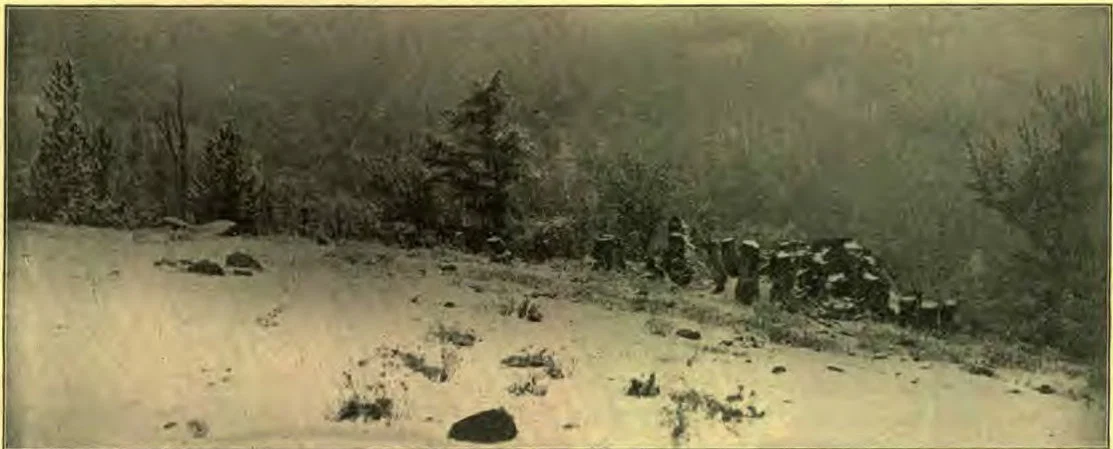
LOOKING ACROSS THE CANON DURING A LULL IN THE STORM
All day the clouds hid the mountain from view, and nearly all day the snow fell steadily at the altitude of the cabin. Early in the forenoon, however, the wind went down, and it was not very cold during the remainder of the day. On the ridge where the cabin stood, there were few trees, and those few were so stunted in growth, and so twisted from their fierce struggles with the winter winds, that they had lost all resemblance to the noble pine family to which they belonged. But on each side, the cañons were covered with splendid evergreen forests. Before night the dark-green needles of these trees were hidden under a mantle of purest white, while their branches were bent to the breaking-point beneath their heavy burden.
Next morning I was up as soon as it was light, but the clouds were already on the mountain. The wind had shaken the snow from the trees, and was playing tag with a fine, hard sleet, which was falling quite rapidly. But the wind soon went down. Then it began to snow in earnest, and all day long the great, white flakes fell thick and fast. The faster the snow fell, the lower went my hopes of being able to reach the glaciers; for I well knew that such a storm would cover many of the smaller crevasses, and make it dangerous in the extreme to venture near them. The clouds were thin above me, however,—so thin that I could see the sun all day long; and hoping that the glaciers were above the storm, I concluded to remain another day.
About the middle of the following night the wind came up with terrific fury, and between it and the cold, I was kept awake until morning. When I pushed the covers from my head, a handful of snow fell into my face, and I saw that everything in the room was covered with snow that the wind had driven in through the cracks between the logs and rocks of which the cabin was built. I wondered why that blanket of snow had failed to keep me warm,—the purpose it serves with snow-bound travelers in stories. But perhaps the writers of stories never slept under a snow blanket.
I got my breakfast, and then went out to see what the prospects were for clear weather. Things did not look very encouraging. The sun was shining, but it was still snowing and blowing furiously. Below, I could see nothing but clouds, while above, I could only dimly make out the outline of the mountain.
I floundered down into one of the cañons, through snowdrifts waist-deep. It was not very cold when I was protected from the wind; so I started up the cañon toward the glacier at its head. The snow was not drifted in the cañon, yet it came up to my knees when I started; and the higher I went, the deeper I found it. I finally gave up all hope of reaching the glaciers that season, and reluctantly turned back.
Of course there was no use to remain longer in that inhospitable cabin, so I began at once to prepare for the return trip. I extemporized a toboggan, on which I loaded my belongings, and started down the mountain. The toboggan did not run well, and I was compelled to rearrange the load while exposed to the fury of the wind. Though I was quite warmly dressed, the wind had no regard for my clothing, and seemed to go through my very body. It chilled me to the marrow, and set me to shivering so that I could hardly bind my pack upon the toboggan again. But when once I got into the shelter of the timber, I found wading through the deep snow such hard work that I was soon panting and perspiring, and wishing for some of that wind to fan me! I had gone only a short distance when I noticed that the depth of the snow was rapidly decreasing. Within a mile it was only deep enough for good tobogganing; and before I had gone two miles from the cabin, I was dragging the toboggan through the mud in a pouring rain!
J. Edgar Ross.

THE STATE FLOWER OF ARIZONA

The Arizona Legislature has chosen as the official State flower one of the most curious blossoms in the United States. If you were to guess a week, it is doubtful if you would hit on the right flower. The Indians have an odd name for it. They call it the “suwarrow,” and it is generally known by that name in Arizona and California. The flower is a member of the cactus family, and is a second cousin to the night-blooming cereus. The plant was named the “giant cactus” over fifty years ago by a St. Louis botanist. So complete was his description of it, that he has become the leading authority on this subject.
The plant makes an ambitious emblem for Arizona, because it is the most colossal of all the cactus family, rearing its straight stems often to a height of sixty feet, and branching out toward the top. As one botanist has described it, “The plants stand like petrified giants, stretching out their arms as if in speechless pain, while others are like lonely sentinels keeping their dreary watch on the edge of precipices.”
When the outer covering peels off, the woody interior breaks into a crown of brush-like fragments, which wave weirdly in the wind. These giant cacti are the most striking figures on the Arizona landscape, so greatly do they differ from other forms of vegetation. In southwestern Arizona the plants gather in immense groups, in irregular order, over miles of desert; and when the wind plays among them, they have the appearance of a forest. To a solitary traveler, in the unfrequented Apache country, these plants on the sky-line of a far-away ridge have an almost too human aspect, especially as they sway in the breeze.
The growth of the giant cactus is very slow. When it has attained a height of about twelve feet, it begins to bloom. On reaching a height of sixty feet, some of the plants are two feet in diameter near the ground. When the stems are old, they are as strong as iron.
May and June are the months when the blossoms appear. The flowers are about four inches in diameter. The petals are of a light cream-color, very thick, and somewhat curled toward the ends. The supports of the flower are light-green. The flowers open day and night for several days in succession. The fruit, which follows the flowers, is much prized by the Mexicans and Indians. Indeed, the fresh fruit is quite pleasant to the taste. The Indians are accustomed to make from the juice a syrup of which they are very fond.
The Apaches have a curious way of gathering the fruit. They take a pole, with a forked twig on the end of it, and bring the stems down within reach, before the fruit is so ripe as to drop of its own accord. The Indians also make a beverage from the juice, which is slightly intoxicating.—Young People’s Weekly.

WATER CHANGED INTO WINE

(Concluded)

THE WINE OF WRATH

At the marriage feast of Cana, the excellent wine which Jesus had miraculously provided was served at the last of the feast. Its superiority over the other wine is evidenced by the words of the ruler of the feast, “Every man at the beginning doth set forth good wine; and when men have well drunk, then that which is worse: but thou hast kept the good wine until now.” But at the banquet which is spread by Satan and his agents, as they serve to man the wine of wrath, this order is reversed. The devil’s plan is: first the good wine (that which seems good), and afterward the bad. That this is Satan’s rule, thousands have learned from sad experience.
1. Worldly Pleasure.—The wine of worldly compromise, often so pleasant to the taste of the Christian whose feet have begun to slip, is the satanic draft whose first taste is sweet, but which afterward becomes the gall of bitterness and the bond of iniquity. That which began in sweet drafts of worldly pleasure and sinful indulgence too often ends in vicious pleasure,—in the bitterness of sin of the deepest dye and lowest forms.
2. Yielding to Appetite.—The practice of the Evil One in placing the best first and afterward that which is worse, is clearly seen in the realm of diet. To the taste, the food may be extremely pleasant, and very agreeable; but later the sour stomach, dyspepsia, and a long train of evils tell again, in other words, that Satan gives that which is pleasant first, and that which is bitter last.
3. Mental Food.—Much of the wine of wrath is brought to man in the form of cheap, trashy literature, and sensational fiction. Although to the youthful mind, such reading may have a very agreeable flavor, and be most fascinating, in the end it will prove to be the means of subverting one virtue of character after another until the forces for good are well-nigh overcome, and the soul has sustained an almost irreparable damage. The novel may taste sweet at first, but the end thereof is depression and disappointment of the bitterest sort.
4. Pride.—Sweet is the morsel of pride to the youth as they first indulge in its display and vanity, but afterward how bitter, oh, how bitter! the humiliations and disappointments which await them when pride falls. Sweet may be the indulgence of pride to the carnal heart, but most bitter is the fall in which it terminates; showing once more that in giving the wine of wrath to the children of disobedience, Satan gives first the best and afterward the worse.
5. Drug Habits.—So in the whole realm of drug habits, intoxicants, narcotics, etc. Whisky, morphine, tobacco, tea, and coffee are but types of the wine of wrath. They are marked illustrations of that which is sweet in the mouth and afterward bitter; of that which seems good at first, but whose end is sorrow and bitterness. At first, morphine and whisky will banish pain, sorrow, and care; but when their victims have drunk of the wine which seems good, instead of finding a still better draft awaiting them, they find the despair of habitual drunkenness and the wretchedness of morphinism.

THE WINE OF GRACE

In contrast with Satan’s rule of giving that which is sweet first and afterward that which is bitter, Christ reserves the best of the wine until the last of the feast. This is evidenced throughout the entire experience of the Christian life.
1. Cross before Crown.—We must lift the cross first, endure its hardships, and drink the bitter cup of trial, affliction, and ostracism, even to the dregs. After the cross comes the crown.
2. Suffering.—We must suffer with Christ if we would reign with him. It is in drinking the wine of grace from the cup of suffering that the sincere Christian learns true obedience. After having drunk of affliction’s cup, we may drink the wine of grace from the cup of eternal bliss.
3. Persecution.—“In the world ye shall have tribulation;” “Blessed are ye when men shall persecute you,” etc., said the Master. There is not only a blessing in the persecution itself; but the experience which follows,—the draft of the wine of grace,—is an experience that lifts the persecuted soul nearer and nearer God, burns out more and more of the carnal dross, and shows forth brighter and brighter the image of his Creator and Redeemer.
4. Grows Better and Better.—The wine of grace, the wine which Jesus provides, grows better and sweeter with each and every draft. Bitter as was the first draft the sinner took,—bitter because of the sin of the one who drank it,—it grows sweeter and sweeter, until salvation’s cup is filled to the brim with the sweetest water of life. David said, “I will take the cup of salvation,” and in another place, “My cup runneth over.” At the banquet of heaven, at the gospel table spread for hungry mortals here on earth, Christ’s rule is: first the wine that seems poor; afterward that which is very good. The world gives us its best things first, and afterward follow remorse of conscience, sorrow of heart, and sadness of soul. The reverse of this was true in this first miracle that Jesus wrought. They had the best of the wine at the last of the feast. God gives us first trial and tribulation, and then glory and honor and immortality. “If we suffer, we shall also reign with him.”
W. S. SADLER.

THE EFFECT OF KINDNESS

There is an old man who makes a visit to Prospect Park, Brooklyn, every fine morning during the summer, and spends an hour or two feeding birds and squirrels with bread and crumbs which he brings in his pocket. He is a kindly-faced, white-haired old man, and all the birds and squirrels know him, and run or fly to meet him whenever he comes in sight. They go right up to him, and take the crumbs from his hand.
A policeman, speaking about it, said: “I've been in the park for twenty years and I don't know a bird or a squirrel, but he knows them all. It certainly beats me how he ever got acquainted.”
There is a wise saying in the book of Proverbs which declares that if a man would have friends, “he must show himself friendly.” It is kindness, first in our heart, then on our lips and at our finger tips, which wins the affection not only of beasts and birds, but also of men and women and children. If we would have friends, we must show ourselves friendly. We must give if we would receive.—Well Spring.

Self-Forgetfulness and the Root of Unselfishness

RELIGION is not self-culture. Self-forgetfulness is the very root of unselfishness, and no deed can be truly done for others that is done for the primary purpose of improving our own souls. Self is the most subtle and insidious enemy of the spiritual life. It must be forgotten, put out of sight, left behind, before we can learn love to God and love to man. The unconscious growth of a soul that forgets itself in serving others is the only true growth. In the deepest sense, only he that loseth his life shall save it. Any other plan of Christian attainment is a mistake,—a mistake that always ends in failure.—Selected.

WHY DO WE WAIT?

Why do we wait till ears are deaf Before we speak the kindly word, And only utter loving praise When not a whisper can be heard?
Why do we wait till hands are laid Close-folded, pulseless, ere we place Within them roses sweet and rare, And lilies in their flawless grace?
Why do we wait till eyes are sealed To light and love in death’s deep trance— Dear, wistful eyes—before we bend Above them with impassioned glance?
Why do we wait till hearts are still, To tell them all the love in ours, And give them such late meed of praise, And lay above them fragrant flowers?
How oft we, careless, wait till life’s Sweet opportunities are past, And break our alabaster box Of ointment at the very last.
O, let us heed the living friend, Who walks with us life’s common ways, Watching our eyes for look of love, And hungering for a word of praise!
— Our Young Folks.

Good Thoughts Welcomed and Treasured

Good thoughts are blessed guests, and should be heartily welcomed, well fed, and much sought after. Like rose leaves, they give out a sweet smell if laid up in the jar of memory.—Spurgeon.

UNQUESTIONING OBEDIENCE

In a vision of the night, in his home at Beer-sheba, when he was one hundred and twenty years old, Abraham received the startling command: “Take now thy son, thine only son Isaac, whom thou lovest, and get thee into the land of Moriah; and offer him there for a burnt-offering upon one of the mountains which I will tell thee of.”
There was no more sleep for Abraham that night. The voice of God had spoken, and had been heard. Isaac, his only son, the son of promise, must be sacrificed.
God had promised Abraham that in his old age he should have a son, and this promise had been fulfilled. But now God says: “Take now thy son, . . . and offer him there for a burnt-offering.” God left Ishmael out of the question saying, “Thine only son Isaac.”
Had Abraham been a selfish, cold-hearted man, absorbed in ambitious projects, with no affection for his son, he would not have felt so deeply this terrible summons; but he loved his son tenderly. It seemed like sacrificing his own life to give up Isaac.
As Abraham stepped out into the night, he seemed to hear the divine voice that called him out of Chaldea fifty years before, saying, “Look now toward heaven, and tell the stars, if thou be able to number them. . . . So shall thy seed be.” Can it be the same voice that commands him to slay his son? He remembers the promise: “I will make thy seed as the dust of the earth: so that if a man can number the dust of the earth, then shall thy seed also be numbered.” Is it not the voice of a stranger that commands him to offer his son as a sacrifice? Can God contradict himself? Would he cut off the only hope of the fulfillment of the promise?
But Abraham does not reason; he obeys. His only hope is that the God who can do all things will raise his son from the dead.
The knife was raised; but it did not fall. God spoke, saying, “It is enough.” The faith of the father and the submission of the son had been fully tested. The Lord said, “Now I know that thou fearest God, seeing thou hast not withheld thy son, thine only son from me.”
Abraham’s test was the most severe that could come to a human being. Had he failed under it, he would never have been registered as the father of the faithful. Had he deviated from God’s command, the world would have lost an inspiring example of unquestioning faith and obedience.
The lesson was given to shine down through the ages, that we may learn that there is nothing too precious to be given to God. It is when we look upon every gift as the Lord’s, to be used in his service, that we secure the heavenly benediction. Give back to God your intrusted possession, and more will be intrusted to you. Keep your possessions to yourself, and you will receive no reward in this life, and will lose the reward of the life to come.
God tries his people to-day to test their faith and obedience. There are many who have never made an unreserved surrender of themselves to God. They have not a right idea of the infinite sacrifice made by God to save a ruined world. If God should speak to them as he did to Abraham, they would not be sufficiently acquainted with his voice to know that he was calling upon them to make a sacrifice, in order to test the depth of their love and the sincerity of their faith.
The plague spot of selfishness is as contagious as leprosy. Those who enter the heavenly courts must be purified from every vestige of this plague. Look at the world’s Redeemer, and remember that as he sacrificed, so must we. He did a work so large and broad that it included the world. His was the ministry of love, yet he said, “The foxes have holes, and the birds of the air have nests; but the Son of man hath not where to lay his head.”
The Lord has a great work for us to do, and he invites us to look to him, to trust in him, to walk with him, to talk with him. He invites us to make an unreserved surrender of all that we have and are to him, that when he shall call upon us to sacrifice for him, we may be ready and willing to obey. We shall enjoy the fullness of divine grace only as we give all to Christ. We shall know the meaning of true happiness only as we keep the fire burning on the altar of sacrifice. God will bequeath the most in the future to those who have done the most in the present. He chooses his helpers in accordance with their unselfish endeavor. Each day, under different circumstances, he tries us; and in each true-hearted endeavor he chooses his workers, not because they are perfect, but because they are willing to work unselfishly for him, and he sees that through connection with him they may gain perfection.
MRS. E. G. WHITE.

EVERYBODY UNDERSTANDS A SMILE

Two children, one French, one Italian, met at a steamboat landing where passengers were waiting. Each held his mother by the hand, at the same time looking with curiosity and interest into the other's face. Presently one of them began smiling radiantly. The other responded, and put out a dimpled hand to smooth the cheek that leaned toward him. The two babies were friends at once.
“Everybody understands a smile,” said a lady who was looking on; and the sentiment was responded to by more than one bystander.
We often speak of being misunderstood even by our nearest and dearest; but do we smile enough? Each soul speaks its own language, a speech foreign to every other: but smiles full of good-will, of self-forgetfulness, of serenity, are a universal language that explains, harmonizes, smooths, communicates, draws hearts together. Why should we not smile more? Thus we should become better acquainted with each other; the dim corners of the heart would be illuminated, warmed, and blessed; the timid would be reassured, the weak strengthened as a plant with sunshine. Then, however obscure the language of any life, there would be the joy, perhaps sweeter than any other, of being understood.—Selected.

EVERY DAY

TAKE a little holy time Every day; Lift your heart into the light On your way; Take a little resting spell As you go; Watch the clouds against the sky Hanging low.
There is always peace somewhere, Deep and still. You will come to it, and know ’Tis His will. Enter at the shining gate Open wide, Deeply breathe and gently wait— There abide.
Strange how eagerly we grasp, For a day, That which perishes and falls In decay. Only trust the Father’s love And his care; Life will be all heaven to you Everywhere.
— Emma Miner.

CANVASSING IN THE SIERRAS

III

“Hello! what you got down there?” and the angry speaker thrust her head through a second-story window.
“Something very interesting, which I should be pleased to show you, if you can spare a moment.”
“No,” she replied, “I don't want anything. Git out!”
What a contrast was this reception to that given by her neighbor, who invited me in, rehearsed all the faults of her neighbors, all her own virtues, agreed in every particular with the book, and then flatly refused to subscribe!
The road between Crescent Mills and Quincy is, for the most part, a grade on the sides of many precipices, blue sky above, and dashing creek below. Four miles out is “Shoofly,” an old-time tavern, where travelers often stop for lunch. Thence one must climb a long, steep grade, then gradually descend into the American Valley.
Had not every one been busily preparing for the fourth-of-July celebration, I might have taken more orders. Long tables were constructed under a palm-leaf canopy, for a free dinner was a prominent feature of the program. In another part of the court-house grounds, seats were constructed, where we sat listening to a program overflowing with patriotic enthusiasm.
After a pleasant eight-mile ride on Sunday morning, I entered an ideal valley of the Sierras. The nature of the people is in harmony with the cheerful generosity of Dame Nature herself. Eight orders were secured in a few hours. Though I had to reach Quincy that night on foot, it was with a light heart.
I paid my board bill, and having a few cents left, set out for Beckwith, a distance of forty-two miles. As darkness came on, I trudged up a heavily wooded grade, leading my bicycle, which was once more a cripple.
God alone could provide shelter, so I talked it over with him as I toiled on. Soon I noticed a light. The folks were having supper, and invited me in, urging me to stay overnight. It was the only house on the road for many miles.
As the sun set on the following day, I entered a town tucked up on the mountains, like an eagle’s eyrie, at an elevation of nine thousand feet. On the surrounding mountain-sides were many giant pines, their cones scattered on the ground. It is amusing to watch a chipmunk jerking off the scales, and digging out the pine-nuts. He uses his fore-paws with all the ease and alertness of a monkey. He would run up a tree as easily as if it were lying flat on the ground. Though little larger than a gopher, his squirrel-like appearance and remarkable agility command every traveler’s attention.
Johnstown, an exalted place, as far as altitude is concerned, is a mining settlement. Every one is busy. Large streams in aqueducts flow in various directions through the town. In the stream below are large machines looking like merry-go-rounds. The force of the flowing water keeps them turning round and round, thus separating the gold from the water.
With nine more orders on my list, I once more set out for Beckwith. It will certainly be a good-sized town, I thought, as I noticed the numerous sign-boards proudly pointing the way. Nevertheless, it seemed hard to reach. At length, almost discouraged, I rushed into a hotel in a little settlement of six or eight houses, and asked for further directions. “This is Beckwith,” said the proprietor, and so it was.
Obtaining one order, I left next day for a trip around Sierra Valley, a level plain thirty-five miles in length, a large portion of which is good farming land. Loyalton, a town on the farther side, is renowned for its lumber, the Loyalton lumber camp being but nine miles up the mountains. It would take a long story to tell all there is of interest connected with lumbering in the Sierras.
On my return trip around the valley I passed through Sierraville and Satly. About Sierraville are large patches of wild berries, especially of prickly gooseberries. Some of these, covered with long, sharp prickles, reminding one of a porcupine, are as large as an English walnut. The pulp resembles the gooseberry in appearance, but is very sweet.
The road beyond Satly is desolate. Tired, warm, covered with alkali dust, and almost overcome with thirst, I rushed up to an artesian well with great eagerness. Thrusting my hand into the water, I just as quickly jerked it out, for the water did not lack many degrees of the boiling-point. It had been heated by the action of certain minerals in the earth, and well symbolized a few of the difficulties to be encountered in my first delivery of books in this region.
WILLIAM YARNELL.

Only a Little Service

“ONLY a little service By the way; He’ll reward the smallest effort In that day.”

IS YOUR FRIENDSHIP HELPFUL?

WHILE we estimate the value of the friendships we enjoy by their influence on us, it is no less important to remember that our own conduct in this relationship has to stand the same test. Is it good for my friend that I am his friend? In the maturity of his fully formed judgment, will he look back on the connection with approval? At the judgment-seat and in eternity, will he prize it? A man will hesitate to answer these questions; but surely there is no object worthier of intense desire and earnest prayer than that our friendship may never be detrimental to him we love; that it may never pull him down, but help to raise and sustain him. Would it not be a prize better than any earthly distinction if, in the distant years, when we are old and gray-headed, or perhaps beneath the sod, there were one or two who could say: “His influence was a redeeming element in my life; he made me believe in goodness and think highly of human nature; and I thank God I ever knew him”?—Selected.

HOW THE RABBIT ESCAPED

The majority of persons consider the timid rabbit as being far lower in intelligence than either the dog or the cat, and hardly to be compared, as regards sagacity, with his predatory contemporary, the woodchuck, or ground-hog.
But this low esteem for the rabbit may come of a lack of understanding of the limitations which nature has imposed upon him. At any rate, I once witnessed a memorable exhibition of pluck and generalship on the part of a rabbit.
While riding up some steep bluffs on the plains of Colorado near the foothills of the Rocky Mountains a few years ago, my attention was attracted to the unusual behavior of a golden eagle, which suddenly pounced down from the sky and disappeared. Almost immediately the great bird reappeared again, only to swoop downward and vanish as before.
Spurring my horse to the top of the bluff, I saw before me a level table-land, some hundreds of yards in extent, flanked upon its farther side by a deep and tortuous ravine. The table-land was entirely devoid of vegetation or cover of any sort; not so much as a clump of cactus or a bunch of soapweed relieved the monotony.
Some fifty yards away toward the ravine lay an object, almost the color of the prairie itself, which at first I thought was a stone, but which on a second look I discovered to be a jack-rabbit. He was squatting down, his long ears folded back along his body, motionless. The mystery of the eagle’s queer movements was revealed. The bird intended to dine on rabbit-meat.
Whether the eagle would decide to have dinner on the spot, or, true to story-book traditions, would carry its living victim to some inaccessible fastness before dispatching him, I was curious to know.
My horse had hardly come to a stop when the eagle, apparently oblivious to my presence, swooped fiercely down upon its prey. The rabbit passively awaited the onslaught. Straight as a falling shell the great bird pounced down. It was almost upon the rabbit, and seemed about to seize him, when suddenly the long ears unfolded, and a streak of gray flashed upward through the air. It was a tremendous leap,—five feet at the very least,—and so correctly timed that the huge bulk of the eagle swept on beneath him, and he dropped back unharmed. The rabbit instantly darted at full speed toward the ravine. He ran some twenty-five or thirty yards before the eagle was able to turn and renew the attack.
The jack-rabbit was apparently watching every move of his enemy; for at the very instant the eagle made toward him, he stopped, and squatting down as before, again awaited the foe.
As the eagle swept downward for the second time, I saw that the bird would pass far enough above the rabbit to seize him should he attempt to leap upward, as before. But the rabbit instantly divined the eagle’s purpose, and this time merely flattened himself against the earth. The eagle passed too far above him to reach him. Again the rabbit darted toward the ravine, and again, at the proper moment, stopped to await the onslaught.
Time after time these tactics were repeated, always with the result that the rabbit kept unharmed, and gradually approached the ravine. At last, with one final dash, he sprang over the precipitous side of the ravine and disappeared. The great bird, balked of its prey, hung, disappointed, over the ravine for a moment, and then circled majestically skyward.
The unequal contest had lasted nearly half an hour. During that entire time, had the rabbit once yielded to panic, or had he in one instance failed to foresee the eagle’s method of attack, he would have paid the penalty with his life.—F. W. Hawkes, in Youth’s Companion.

If You Would Please Men, Please God

“If you would please men, please God.”

THE MESSAGE

I LIE at ease in the valley, More blessed than song can say, Beholding the skies bend over The beautiful hills of May.
They are pink where the orchards flower, They are white where the dogwoods sway, Or blue where the violets cover The beautiful hills of May.
They are low that the heart may love them, They are far that the thought may stray, They are near that the feet may climb them, The beautiful hills of May.
Though better than song be silence, Yet, ah! that song could convey To December news of the beauty That blooms on the hills of May!
— Selected.

A CLEAR PATH

KEEP the path of honor, dear, Clear and bright before you, Though a thousand signs appear, Falsely to allure you. They will vanish; never fear; Keep the path of honor clear.
Though the crown of usefulness Sometimes seems uncertain, And the star of brave success Slips behind a curtain, Still, undaunted and sincere, Keep the path of honor clear.
Though the thistle and the weed Fill the traveled highway, Though a host of fears impede Shorter road and by-way, Every day throughout the year Keep the path of honor clear.
—Frank Walcott Hutt.
Continue reading: THE SILENT SCHOOL