The Youth’s Instructor, Vol. 38, No. 31.

THE CHILDREN'S HOUR

The Youth’s Instructor

Jul 30, 1890

S. D. A. Publishing Association · Battle Creek, Mich. · Jul 30, 1890

THE CHILDREN'S HOUR.

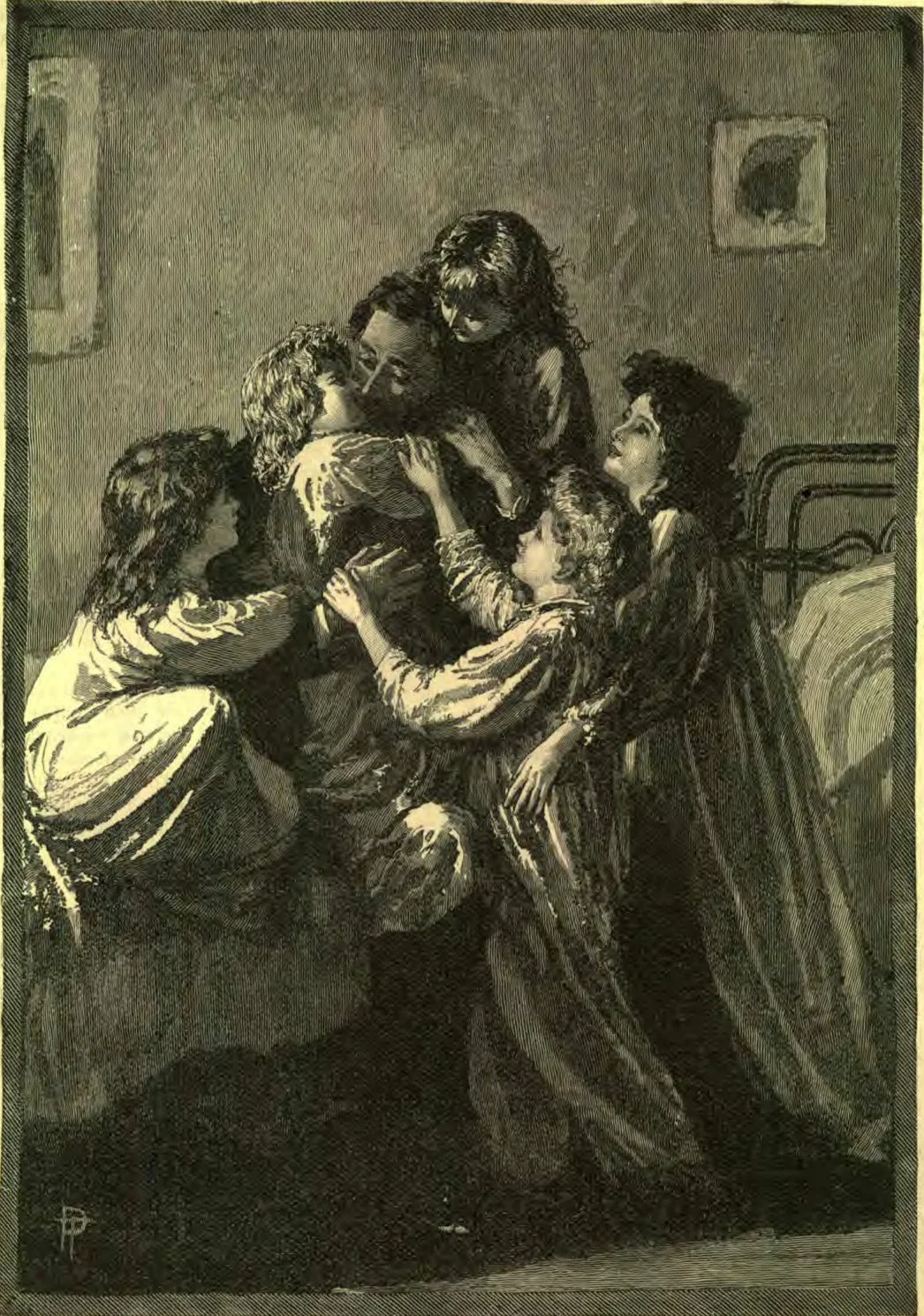
Between the dark and the daylight, When the night is beginning to lower, Comes a pause in the day's occupations, That is known as the Children's Hour.
I hear in the chamber above me The patter of little feet, The sound of a door that is opened, And voices soft and sweet.
A whisper, and then a silence; Yet I know by their merry eyes, They are plotting and planning together To take me by surprise.
A sudden rush from the stairway, A sudden raid from the hall! By three doors left unguarded They enter my castle-wall!
They climb up into my turret, O'er the arms and back of my chair; If I try to escape, they surround me; They seem to be everywhere.
They almost devour me with kisses, Their arms about me entwine, Till I think of the Bishop of Bingen In his mouse-tower on the Rhine!
Do you think, O blue-eyed banditti, Because you have scaled the wall, Such an old mustache as I am Is not enough for you all?
I have you fast in my fortress, And will not let you depart, But put you down in the dungeon In the round-tower of my heart.
And there I will keep you forever, Yes, forever and a day, Till the walls shall crumble to ruin, And molder in dust away! —Longfellow.

ONLY A LITTLE MORE CUTTING.

How strange the words sounded, and then I heard the ring of the farmer’s ax as he cut away at the lilac-bushes. They were very close to the windows, and kept out the sunlight and air; more, they obstructed the view. We watched the process, and, as one bush after another fell, one who was looking on remarked: “Only a little more cutting, and we shall get it.” These lilac-bushes actually shut out the view of the White Mountains.
I said to myself, May be this is the meaning of much in life. We need air, and sunlight, and better views, and the Great Husbandman cuts away the hindrances. These bushes were so close to the window that we could not see the road, and as one said of the room we occupied, “It has the peculiar smell of earth.” Ah, how much there may be in our lives to obstruct our prospect, and to impart to us the savor of the earth!
So I gleaned my lesson, and when, a little later, I looked out from the window, and saw the beauty that had been hidden, I continued my meditation. As I recalled the sound of the farmer’s ax, I seemed to hear other painful sounds, one blow after another removing so much. Money gone! Loved ones we held so close removed! Health impaired! But oh! how we have caught sight of the delectable mountains, and felt the air and sunshine from the everlasting hills, which we had never enjoyed, and still would have lacked but for these removals. And how plain the path to heaven appeared when all this earthly greenness had been cut away.
I was glad the farmer did the cutting that day, so much was brought out by the absence of the bushes, and suggested by the exclamations that followed: “How lovely that little tree is! I did not see it before.” What a beautiful evergreen that is! I never noticed it until now.” Have we not heard similar explanations after severe cuttings and removals in our lives? Have we not said, “I never saw the beauty of such and such a passage of Scripture till now”? “I never loved God so much as I have since he took my little one”?
Ah! He knows! He doeth all things well; even when he seems most severe. We shall see it all in the clear light sometime.—Selected.

THE WRITER OF “THE HAPPY LAND.”

The other day I heard a little boy going along the street singing, “There is a happy land, far, far away.” And at once I wondered if he, or some of the other boys, would not like to hear a story about the man who wrote that hymn.
The name of the man who composed those lines was Andrew Young, and he lived in Scotland. He had a long title, F. R. S. E., added to his name, which means, “Fellow of the Royal Society, Edinburgh.” He studied hard at school and at college, and grew to be a wise man. Afterwards he taught in college himself a good many years. He died in Edinburgh, in the early part of last December.
Mr. Young loved children, and for many years he was the busy and faithful superintendent of a large Sunday-school. It was a touching sight, on the day of his funeral, to see the children from his Sabbath-school gathered around the open grave, and to hear their sweet voices ring out the cheering words of “The Happy Land:”—
“Bright in that happy land Beams every eye; Kept by a Father's hand, Love cannot die. On, then, to glory run; Be a crown and kingdom won, And bright above the sun, Reign, reign, for aye.”
Mr. Young had a warm, tender heart for all God's creatures. A custom that he kept up every day until the week he died, will show you that this is so. In Edinburgh there stands a splendid monument to the great Sir Walter Scott. Every day, at the hour of noon, Mr. Young paid a visit to the monument. But he did not go to admire it, though it no doubt pleased his eye. You can hardly imagine what called him there. It was to feed the sparrows!
The tiny birds all knew their friend and comforter, and when they saw him coming toward the usual place of feeding, they flocked around him from far and near. Gently Mr. Young would call, “Dicky! dicky! dicky!” several times, and the sparrows would come in troops. Soon the grass was white with crumbs. In a minute the feast was over; then with a flutter of wings and a chirp of thanks, the little birds flew away.
But Mr. Young was not yet ready to go. As soon as the last little sparrow was well away, he would call, “Caw! caw! caw!” and then four or five crows would appear. The bill of fare was changed for the crows; they were feasted on a cooky, and Mr. Young would explain to those who asked, that he couldn't afford cookies for so many sparrows, but the little that the crows took was nothing. The sparrows and the crows came, and flew away contented, and their benefactor returned more contented than they all, and with the warm glow at his heart that a good deed brings.
Can you not learn a good lesson from this story? Do you not suppose a person would feel happier in doing such deeds of kindness than he would if he took delight in tormenting these helpless creatures? Jesus said that not one tiny sparrow ever fell dead anywhere in this great world but that his heavenly Father noticed it. If God takes such tender care of even the little sparrows, do you think it right for you to shoot them, or to shy stones at them, or in any way to hurt or frighten them? Would it not please your Father in heaven more if you should try to be merciful as he is merciful? W. L. K.

ROUND THE WORLD.—21.

INDIA IN GENERAL.
BEFORE giving a description of our tour through the Indian Empire, we thought that a few general remarks about the people, place, and climate would make what follows more appreciable to the reader.
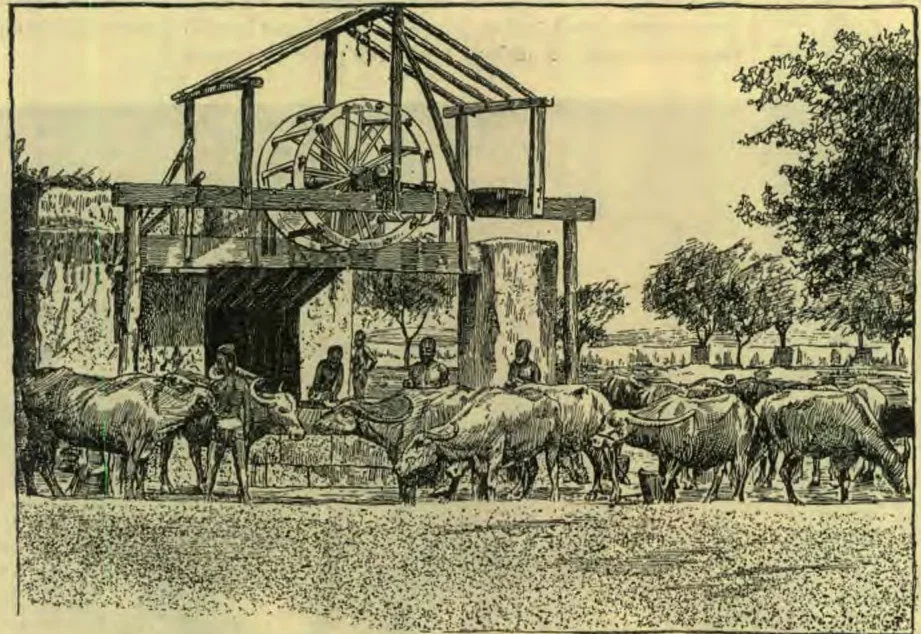
UP-COUNTRY BEASTS OF BURDEN AT THE WELL.
India is a great three-cornered country, stretching southward from mid-Asia into the ocean. To the north it is separated from Tartary by the great chain of the Himalaya Mountains, extending eastward to the frontiers of China, and to the west and northwest into Central Asia, thence by a succession of smaller ranges, elevated plateaus, and table-lands, the mountains descend into the sea eastward toward the River Indus. Into the great country of India the descent is broken and precipitous. Deep, rugged ravines, and beds of rivers separate one chain of mountains from another, leaving in a few instances stupendous natural passes, which have served as a means of communication between India and the countries lying beyond it. On the northeast, Burmah, the stronghold of Buddhism, has been lately annexed, and on the northwest the Mohammedan States of Afghanistan and Baluchistan. Thus two streams of widely diverse types of humanity have poured into India by the passes of these northeastern and northwestern corners.
To the north and east, means of access to India are comparatively few. The footpaths lead over mountain ridges which are covered with perpetual snow, and rise to an immense hight, some of them being from 15,000 to 20,000 feet above the sea. Himalaya means in Sanskrit “the abode of snow.” The southernmost wall of this range terminates in Mount Everest, which is 29,002 feet high.
These paths are therefore practicable but for a brief period in summer, and then only to bold parties of traders, who, wrapped in sheepskin, force their way across the passes. The bones of worn-out mules and ponies mark their way. The little Yak Cow, whose bushy tail is manufactured in Europe into lace, is employed in the Himalayas as a beast of burden, and patiently toils up the steepest gorges, with a heavy load on her back. Sheep are also used to carry borax to markets near the plains, where it is transferred to the buffalo, which, thus laden, journey to the more favored places, where the iron horse relieves them of all further toil. After the sheep have laid down the burden of borax, they are shorn of their wool, and eaten as mutton. A few, laden with sugar and cloth, return into the inner mountains.
These mountains, inaccessible as they appear, are inhabited by various races and tribes; some Thebetian, and others mixed or purely Indian. The rigor of the climate does not affect them, and they are, for the most part, a robust, peaceful, and industrious people, subsisting by agriculture.
To the north and northwest, however, the character of the inhabitants changes. They are fierce and warlike, and have been so since the earliest ages. The passes leading from India into Central Asia are for horses and cattle, and in some instances for wheeled vehicles, and it is through these passes and by this warlike population that the greatest invasions of India have taken place, and by means of which the largest trade with Central Asia is carried on.
Most of the mountains up to the limit of the growth of trees are richly clothed with forests, and above these tower the magnificent snow-clad peaks and glacier hollows of the upper ranges, which far exceed in sublimity the most gigantic of the Alpine chains of Switzerland.
There are several sanitariums in the Himalayas. Chief among these are Simla Mussoorie and Darjeeling. They are all said to be “beautiful for situation” and picturesque in the extreme. With the exception of the sea-ports, the large towns on the plains are in summer practically deserted by the Anglo-India population, who close their stores and places of business, and flee from the heat to the hills, where they can recuperate their exhausted energies in as healthful spots, and among as charming scenery, as Nature has blessed the earth with. Thickets of trees, ferns, and bamboo adorn parts of the ranges, together with tracts of rhododendron, which here grow like a forest tree, and blaze red and pink in the spring, while the deodar, or Himalaya cedar, rises in dark but stately masses. The branches of the trees are themselves clothed with mosses, ferns, and flowering creepers or orchids. In the autumn, crops of red and yellow millet run in ribbons of brilliant color down the hillsides.
The chief saleable products of the Himalaya Mountains are timber and charcoal, potatoes and other vegetables, barley, and small grains or millet grown in the hot valleys and upon terraces formed with much labor on the slopes.
The rugged Himalayas, while thus keeping out enemies, are a source of food and wealth to the Indian people. They collect and store the water for the hot plains below. Throughout the summer, vast quantities of moisture are exhaled from the distant tropical seas. This moisture gathers into vapor, and is carried northward by the “monsoon,” or regular wind, which sets in from the south in the month of June. The monsoon drives the masses of vapor northward before it, across the length and breadth of India,—sometimes in the form of long processions of clouds, which a native poet has likened to flights of great white birds; sometimes in the shape of rainstorms, which crash through the forests, and leave a line of unroofed villages and flooded fields on their track. The moisture which does not fall as rain on its aerial voyage over India, is at length dashed against the Himalayas. These stop its farther progress northward, and it either descends as rain on the outer slopes, or is frozen into snow in its attempts to cross into their inner hights. Very little moisture passes beyond them, so that while their southern slopes receive the heaviest rainfall in the world, and pour it down in torrents to the Indian rivers, the great plain of Thibet on the north gets scarcely any rain.
The best authorities give the size of India as 1,900 miles for its greatest breadth, east and west, and the same for its length north and south. But it tapers off with a pear-shaped curve to a point at Cape Comorin, its southern extremity. It extends from the eighth to the thirty-sixth degree north latitude, that is to say, from the hottest region of the equator to far within the temperate zone.
We find our mind often wending its way back to our old home at Battle Creek, and wondering what our friends are doing at the time of our meditations. This, however, naturally involves mathematical calculations as, for example,—Calcutta lies in 88 degrees east longitude, so that when it is twelve o’clock in the day here, and the sun is in its zenith, we know that in New York it is about one o’clock and forty minutes A. M., and at Battle Creek that it is about twelve forty A. M. P. T. M.

FOR GINGER-BREAD OR FOR MISSIONS.

DR. CYRUS HAMLIN, who was for many years a missionary in Turkey, tells about a contribution he made for missions when he was a little boy. His mother often read him about heathen lands and the missionaries, and there was a missionary contribution-box in town, where the people placed their offerings. He says:—
“When the fall muster came, every boy had some cents given to him to spend. My mother gave me seven cents, saying as she gave them, ‘Perhaps you will put a cent or two into the contribution-box in Mrs. Farrar’s porch on the common.’ So I began to think as I went along, shall I put in one? or shall it be two? Then I thought two cents was pretty small, and I came up to three—three cents for the heathen, and four cents for ginger-bread; but that did not sound right, it did not satisfy me, so I turned it the other way, and said, Four cents shall go for the heathen. Then I thought, The boys will ask me how much I have to spend, and three cents is rather too small a sum to talk about. ‘Hang it all,’ I said, ‘I’ll put the whole in.’ So in it all went. When I told my mother some years later that I was going to be a missionary, she broke down, and said, ‘I have always expected it.’”

HOW TO KEEP YOUR FRIENDS.

“I’m a great one for making friends,” said a girl I know. It sounded as though she ought to be very happy, but when I had a minute to think, I wondered if she were good at keeping them. Making friends is easy to the girl who is bright and happy, whose society gives pleasure, and who is genial. But the keeping of them demands more than this.
If you want to keep a friend, don’t get too intimate with her.
Have your own thoughts, and permit her to have hers.
Do not demand too much of her in the way of confidence.
And do not be wanting to know why she hasn’t done this or that, and why she doesn’t think as you do.
If you think your friend’s style of dress is not beautiful, don’t tell her; you only offend her, because deep down in her heart she is convinced that she knows a great deal more about it than you do.
To sum it up in one sentence, preserve the courtesy of the beginning, if you wish to keep your friendship to the end.—Ladies’ Home Journal.

LUCK AND LABOR.

COBDEN wrote proverbs about luck and labor. It would be well for boys to memorize them. Luck is waiting for something to turn up; labor, with keen eyes and strong will, will turn up something. Luck lies in bed, and wishes the postman would bring him news of a legacy; labor turns out at six o'clock, and with busy pen or ringing hammer, lays the foundation of a competence. Luck whines; labor whistles. Luck relies on chances; labor on character. Luck strides down to indigence; labor strides upward to independence.

FAITH

MANY people have puzzled their heads to define faith, but it is a very simple thing, after all. One of George McDonald’s characters explains it by saying, “When God tells ye to gang into the mirk, lassie,—gang!” A Christian sailor, when asked why he remained so calm in a fearful storm, replied, “I am not sure that I can swim; but if I sink, I shall only drop into the hollow of my Father’s hand; for he holds all these waters there.” A little Sunday-school girl gave as her definition of faith, “It is doing as God tells you, and asking no questions.”

Free Will as the Power to Do Right

FREE will is not the liberty to do whatever one likes, but the power of doing whatever one sees ought to be done, even in the face of otherwise overwhelming impulse. There lies freedom indeed.

BONY, THE BEAR.

Not a very long time ago I got a letter from a little boy.
The little boy’s mamma wrote the letter, but she wrote just what the little boy told her to write, and this is what the letter said:—
“If you please, won’t you tell some of the stories for little boys, and not all of ’em for little girls? because I like ’em about bears best, and monkeys and wild elephants, and some about going fishing.”
So this is the true story of a bear.
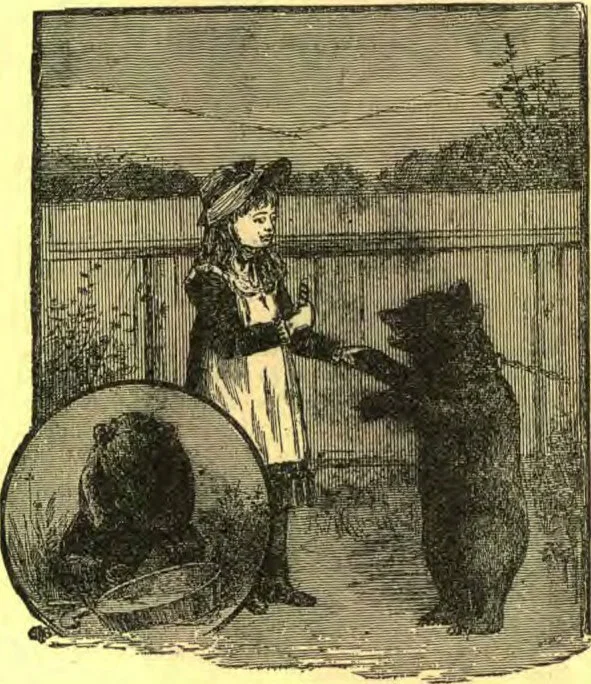
He was a performing bear, and his coat, which had once been black, was ragged, and faded to a rusty brown.
His name was Napoleon Bonaparte, and all through the long, hot summer days he went tramping about from village to village, with a hand-organ and a man and a little girl.
The man played the organ, and the little girl, whose name was Lisette, shook her tambourine, and the bear danced, and presented arms, and went through with his broom-drill and all his droll tricks a good many times in a day—so many times that it was no wonder that the three got very tired of it all.
Some days they reaped a rich harvest of pennies, and some other days, when everything seemed out of joint, they tramped long distances without getting a pleasant word or the smallest gift of money.
It was at such times that Lisette’s black eyes would grow big and wistful, and her father’s face would wear a scowl, and Bony, the bear, would tug restlessly at his chain, as if he knew that things were not going just as they should, and as if he were longing for the shady forests and a taste of freedom.
Then the father would give his chain into Lisette’s wee brown hand, because Bony would always mind Lisette’s voice, and follow where she led. They were such good friends—the black bear and the little brown girl; at night she often slept with her curly head resting on his shaggy coat.
But times were not often so hard. One day the three came to a little village between two hills, where very few hand-organs, and never a dancing bear, had found the way before.
And when Bony came with Lisette and her father and the tambourine and the hand-organ, the children all flocked to see, and the fathers and mothers came to look after the children.
So Bony, feeling the cheering prospect, danced as he hadn’t danced for a long, long time; and Lisette shook her tambourine with a great deal of spirit; and her father turned the organ-crank vigorously; and just as Bony with his wooden musket was presenting arms in his very best style, a dreadful cry was raised,—
“The dog is mad! M-a-d do-og! Clear the way!” Lisette’s father was collecting pennies. The little crowd parted, and scattered here and there, until, in less time than I can tell you of it, little Lisette and Bony, the bear, stood all alone in the midst of the grassy village square,—all alone, with a great savage dog, almost as big as Bony himself, coming upon them.
Bony dropped his musket, and Lisette crept close to him as he stood upon his haunches, straight as a soldier.
And when the dog sprang, with a fierce snarl, at Bony’s throat, the bear caught him in a mighty squeeze, and he hugged him tighter and tighter, and the people cheered.
And Lisette’s father shouted, “Run, Lisette!” But she did not.
It was over in a minute, and of course brave Bony had the best of it.
He had hardly a scratch to show for his battle, either, thanks to the thick leather collar about his neck.
And of course Bony was praised, and Lisette was petted, and they were all treated so kindly that they haven’t gone away from the little village between the hills yet: neither Lisette nor her father nor Bony, the bear.
I saw Bony last summer while I was staying in that little village, and he licked my hand with his rough tongue, and seemed very well pleased with his new home in the inn-keeper’s orchard, where every day Lisette comes to play with him for awhile.—Selected.

THE COWSLIPS DOWN BY THE CREEK.

“Do you think, Johnnie, that what Miss Slocum said yesterday was just true?”
“What?” asked Johnnie.
“That there’s hardly a moment of the day but that we are given a chance to show what kind of stuff we are made of?”
The two were washing cowslips down by the stream back of the house, and as Lottie said this, she straightened, and placed her hand upon her back, which ached slightly from having been bent so long at the water’s edge.
“Now here are these things; I don’t think there is much chance to show what stuff is in us while we are washing greens.” She brought this out a little slightingly.
A color came to Johnnie’s face, and then he, too, straightened up as he said,—
“There, you’ve done it now! To tell the truth, I was just thinking, Lottie—” and then he stopped.
“But pshaw! what’s the use of telling everything?” And grabbing a pan of greens already washed, he plunged them beneath the clear, running water again, and brought the overflowing pan to rest beside him on the white stone.
“Why, Johnnie Waite! those were all done.”
John laughed.
“If you hadn’t said what you did, may be they would have been—but there! I’ll have to tell you, I suppose. The fact is, I haven’t been washing them very nice; I thought mother would finish them, and we are in such a hurry to get those May flowers. But I can’t slight them now, after what you’ve said, so you’ll have to bear the blame if the flowers are gone when we get to the hill.”
“But the greens will be clean,” said Lottie, as she began to help her brother with the second washing.
“I thought all the time, Johnnie Waite, that you weren’t doing them very carefully. I pulled an angle-worm out of one cluster.”
“You won’t find another,” said John, sturdily.
And it was with a very proud, beaming face, a half-hour later, that he bore the greens to his mother’s pine table, while his sister waited outside with the basket for May flowers.
“I do declare!” said Mrs. Waite, “you two have done those just as well as I could. Now run away, and have a nice time, but don’t be gone too long; you want your share.”
No laugh was there which rang out more merrily than Johnnie Waite’s that morning, as the children scattered here and there through the brown woods in search of the shy May flowers hiding under the leaves; but then, Johnnie had proved of what sort of stuff he was made before he entered on the search for May flowers, and the proving was very satisfactory in results, both to himself and to his mother. He had a right to laugh.—Selected.

DIGGING FOR CHINA.

“Hello, Tom! digging through to China?” asked Ben, as he saw Tom with a shovel digging a very deep hole in the ground.
“Not exactly,” answered Tom, “but the next thing to it. I’m digging for China.”
“You don’t mean to say that you are trying to dig China up through the ground?” said Ben.
“No,” answered Tom, “I don’t expect to find China in that way, but I am digging to help China. I went to the missionary meeting last evening, and I heard speeches there that stirred my heart, and made me determine to help in the good cause. But what could I do? I had no money, and nothing that I could sell to bring me money; so I had to go to work to earn some. I heard my father say that he wanted to hire a man to dig post-holes for the new fence. I asked him to let me do it and pay me instead of a man. When he found out what I was going to do with the money, he said that he would give me twenty-five cents a hole, and I could take my time. There are twelve holes, so that will be three dollars.”
By working before and after school-hours, and on the day when there was no school, Tom finished his work in a week, and he was a happy boy when he carried his hard but honest-earned money to give to the missionary society. But he did not stop there. He kept on doing all he could to help the cause, and when he grew to be a man, he went to China as a missionary, where he still continues his work for the heathen.—Selected.

TOO MUCH OF A GOOD THING.

JOHN PERCIVAL was a boy about nine years old, who, like many other boys, had not learned that one might have too much of a good thing.
One day he said to his mother, “I wish I were a man!”
“Why, Johnny!”
“So that I could have as much blackberry pie as I want.”
“Don’t you have as much now as you want? You always share with us.”
“Yes, mother, I have one piece, sometimes two pieces, but I want a whole one, and when I get to be a man, I mean to have a whole blackberry pie to myself.”
“Well, Johnny, you need not wait to be a man for that. You may have one now.”
“What, mother! A whole one all to myself?”
“Yes; you go and pick the berries, and I will make the pie for you, and you may have it all to yourself.”
“Oh, goody!” exclaimed Johnny, and in great glee he ran off to pick the berries. He brought them home, and his mother made a nice, fat berry pie. When baked, it was handed over to Johnny, who sat down in a corner to eat it. He began with a hearty relish, smacked his lips, and said it was a real good pie, and soon had half of it devoured. But such a pie is a great deal for one boy to eat at once; he attacked the latter half with much less eagerness. His mother saw his failing appetite, and pleasantly said,—
“Johnny, you need not eat it all if you do not want it.”
But Johnny had undertaken to eat a whole pie, and did not mean to give it up, so he answered,—
“Yes, mother, I do want to eat it all, but this part is not quite as good as the other half.”
“That can’t be, my son; for it was all made together. One part must be just as good as another.”
Johnny kept on eating, but slower and slower, and with less relish. He persevered, however, till he swallowed the last mouthful. Then he pushed the empty tin away, and said aloud,—
“I wouldn’t give a cent for a blackberry pie.”
This true story is not a strange one at all. Many a boy thinks that if he only had a man’s liberty, he would be happy; but if he should have a man’s liberty without a man’s judgment to guide him, he would only make himself miserable. Be thankful that you cannot always do just what you please.—Children’s Friend.

GOOD-MORNING

A SONG for good-morning; Wake up, little girl! The sweet-hearted flowers To sunshine uncurl, In the meadow, in clover Half way to the knee, The fleecy white lambkins Are frisking in glee.
The birds have been out Since the first peep of dawn; The fairies spun lace All over the lawn. 'Tis a world full of beauty, Of perfume, of cheer; Make haste, little lassie! You'll lose it, I fear.
A song for good-morning, For work, and for play, The morning is here, But 'tis fleeting away As fast as the water That rushes down hill, As fast as the foam Drifting under the mill.
Ere we know it, dear child, Why, our mornings have fled! 'Tis noon lying hot On the pathway ahead. The morning, my darling, Is dewy and sweet; 'Tis later we bow to The burden and heat.
So wake, little lady! God sends a new day; Don't lose its bright hours From work or from play.
—M. E. Sangster.
Continue reading: Nan’s Visit