Your ShelfYour Projects

The Youth’s Instructor, Vol. 63, No. 37.

— R. S. Owen

The Youth’s Instructor

Sep 14, 1915

Review and Herald Publishing Assn. · Takoma Park Station, Washington, D. C. · Sep 14, 1915

— R. S. Owen

SEVENTY-SIX orders in one day for “The World's Crisis” by a student is a record not to be ashamed of.
THE Navy Department has recently issued and placed on sale a book containing engraved reproductions in colors of the flags of all maritime nations.
WITH a powerful wireless station, erected in Russia since the outbreak of the war, direct communication has been established between that country and England.
IN writing the sentence, “He will lose this opportunity,” why do you write loose for lose? A surprisingly large number of fairly good spellers make this mistake.
ONE hundred tons of the leaves used in making absinth have been publicly burned at Pontarlier, France, in accordance with the new legislation prohibiting the manufacture of this beverage.
As heat always travels to the top of an inclosure, it does so also within the walls of a refrigerator; hence, if a piece of ice is not large enough to fill the ice space, lay it in such a position that the largest portion is at the bottom of the cavity. This will save considerable ice where a small quantity is used at a time.
ONE of the best ways, I am told, by which to cure stuttering is to give the afflicted person a piece of poetry, and require him to read it, carefully giving the proper rhythm to it, and continually keeping up that rhythm. One does not stutter while singing. There is something in the rhythm that destroys the stuttering.

— R. S. Owen

ELDER A. G. DANIELLS, in giving an account of his recent trip around the world, said of Australia: “We now have six thousand believers in Australia; and I tell you, dear friends, if an earthquake should sink North America, or anything else should happen to put us out of existence, the Australian brethren and sisters would take hold of this message and carry it forward to the ends of the earth.”
As evidence of the democratic spirit which is manifesting itself in many of our State educational institutions, students at the University of Montana who were in need of part-time employment during the winter months, accepted the work of building a road to the top of Mt. Sentinel, at the foot of which the university campus is situated. The forestry school of the university is now to build a lookout for forest fires on the mountain.

Across-Country Canoe Trip Planned

Two Eastern sportsmen contemplate starting from Jersey City, New Jersey, for the Pacific coast on what is one of the most unusual canoe trips ever attempted in this country. The men expect to make their way across the continent by plying various rivers, lakes, and canals that will gradually lead them westward until they strike the Columbia River, down which they plan to paddle to the ocean. From Jersey City the route goes by way of canal to the Delaware River, thence to Delaware Bay, and through Chesapeake Canal to the Potomac. It then extends up the latter stream to the Chesapeake and Ohio Canal, through that to Cumberland, Maryland, from where small rivers will be followed to near the headwaters of the Monongahela River, which leads the party to Pittsburgh, from where the Ohio River is followed to Cairo, Illinois. From Cairo they expect to make their way against the current of the Mississippi to the Missouri, thence to the mouth of the North Platte and on to the Yellowstone and Snake Rivers. Then by following intervening streams the route extends to the Columbia. A lightly rigged eighteen-foot canoe equipped with a portable motor is to be used. The men expect to spend five months in making the trip.—Popular Mechanics.

Changing the Home

For one to have a lively interest in a location one is about to leave in exchange for another can scarcely be expected, but nothing should tempt one to leave the place in disorder and uncleanness, for it is not manifesting a spirit of kindness toward those who follow. To do so would be greatly to the discredit of the one doing it, to the church of which he is a member, and, most important of all, to the truth he professes to love.
Jesus is soon coming to take us from this home to a better one. If we are candidates for that home, we shall not have so much interest in this earthly one as if we expected to remain here a long time.
That we do not expect to live here very long is no reason why our houses and premises should be in a state of uncleanness and disorder. The manner in which our surroundings are kept tell our neighbors of a slackness or tidiness in the character. Except in cases of sickness, the Christian will see that his environments are so conditioned that the inspecting angels will not observe a scene very opposite to those in heaven.
When about to journey to a new home, the prudent man will refrain from purchasing new furniture or other goods; he will wisely dispose of anything which may prove an encumbrance. As we near the time we are to move to the New Jerusalem, is it not the part of wisdom “to bind about our wants,” to live in simplicity, retain less of earthly goods, and remember that in food, raiment, and equipage the real needs of humanity are few? MRS. D. A. FITCH.

Time Changes All: A Poem on Parting

“Time changes all!” So sighs the flying hour; “Time changes all,” and we must feel its power; Most keenly feel, when friend with friend must part, And snapped must be those ties that bind the heart. — W. A. Engle.

ELVIRA ANDREWS WEBBER

Peace

ELVIRA ANDREWS WEBBER

The mists drift damp over field and weed, The pale fire dies in the level west, And cool, where the rushes stir and nod, The lilies float on the marsh’s breast.
Across the slope comes a cowboy’s plaint, And close at my feet the cricket’s call, But deep in the darkening forest glades The richest, dearest note of all.
It is one with the silence, one with the night, One with the Presence that said, “Be still!” And it breathes of love, and it breathes of rest, This roundelay of the whippoorwill.
The shadows grow;—the song swings on;— I marvel, almost, such peace can be! For the din and terror of battle rage On the other side of the tossing sea;
And serried hosts of set, stern men Leap throat at throat; and missiles dire Plow merciless through human walls; And wives and babes flee shell and fire
That wreck their homes. I thank thee, God, For the hour of peace and the little spot Where pain, and fear, and strife, are not! I thank thee, God!

The Value of Good Books

If you were to be taken into a room filled with orderly stacks of metal bars,—lead, iron, copper, aluminium, silver, and gold,—and told that you might take away with you all that you could carry, which would you choose? Would you lift a piece of iron, and carry it off in triumph? or would you fill your arms with copper or lead? The aluminium and the silver look much alike—would you choose the former because you could carry a larger bulk of it? Indeed, no; you would pass all these baser metals by, and fix your eyes on the real treasure of the place, the golden ingots, and use all your energy and strength in carrying away as many as possible.
No such choice as this will come to you, you say. No; but as you walk through the beautiful rooms of life, you have an opportunity for choice that is vastly more momentous and far-reaching in its results. We live in an age of many books; there is indeed “no end” to them. Many of these are dross; others are commonplace; and still others are pure gold. Who would content himself with the baser when he might as easily secure books whose value is only faintly expressed by comparing it to the most precious metal we know?
Books, says Richard de Bury (1344), “are the masters who instruct us without rods and ferules, without hard words and anger, without clothes and money. If you approach them, they are not asleep; if investigating you interrogate them, they conceal nothing; if you mistake them, they never grumble; if you are ignorant, they never laugh at you.”
“The only true equalizers in the world are books,” says John Langford; “the only treasure house open to all comers is a library; the only wealth which will not decay is knowledge; the only jewel which you can carry beyond the grave is wisdom. To live in this equality, to share in these treasures, to possess this wealth, and to secure this jewel may be the happy lot of every one. All that is needed for the acquisition of these inestimable treasures is the love of books.”
And Charles Kingsley says: “We ought to reverence books, to look at them as mighty and useful things. If they are good and true, . . . they are the message of Christ, the Maker of all things, the Teacher of all truth.”
One of the most important decisions we can make is in regard to what books we shall read. On every hand, in attractive guise, are books and magazines whose reading will break down the defenses of the soul, and prepare the way for the entrance of evil. They are pernicious, their influence is degrading, and they must be shunned. Along with these are great numbers of so-called “harmless books,—books that may entertain, and teach, and that contain good moral lessons,—but he who is determined to choose wisely will pass these by also. No one can ever hope to read all the good books; therefore we must choose the best, those that will purify the motives, exalt the purpose, and refine and enrich the life.
Robert Southey, the poet, once made some suggestions to guide the young in their choice of books: “Young readers,—you whose hearts are open, whose understandings are not yet hardened, and whose feelings are not yet exhausted nor incrusted with the world,—take from me a better rule than any professors of criticism will teach you. Would you know whether the tendency of a book is good or evil, examine in what state of mind you lay it down. Has it induced you to suspect that what you have been accustomed to think unlawful may after all be innocent, and that may be harmless which you have hitherto been taught to think dangerous? Has it tended to make you dissatisfied and impatient under the control of others? . . . Has it addressed itself to your pride, your vanity, your selfishness, or any other of your evil propensities? Has it defiled the imagination with what is loathsome, and shocked the heart with what is monstrous? Has it disturbed the sense of right and wrong which the Creator has implanted in the human soul? If so, if you are conscious of any or all of these effects, . . . throw the book in the fire, whatever name it may bear in the title-page.”
John Ruskin, himself a master of English prose, gives this good advice to the young: “It is of the greatest importance to you, . . . in these days of book deluge, to keep out of the salt swamps of literature, and live on a little rocky island of your own, with a spring and a lake on it, pure and good.”
Instances of the influence of good books might be cited almost without number. We are told that by a tract brought in a peddler’s pack to the door of Richard Baxter’s father, the “preacher of Kidderminster” was converted. Later, Baxter’s “The Saint’s Everlasting Rest” was blessed to the conversion of Doddridge, whose “Rise and Progress” brought Wilberforce to the Saviour. The circle widened still farther, and as the result of a few written words thousands were converted.
In contrast with this it has been said that the reading of Homer’s “Iliad” inspired Alexander the Great to become “the wholesale robber and murderer of the world;” and that, in later years, reading the life of Alexander inspired the great Roman Cæsar to his course.
Every one should try to own a few good books. Such may be read again and again. Martin Luther says: “All who would study with advantage in any art whatsoever ought to betake themselves to the reading of some sure and certain books oftentimes over.” And Quintilian advises that when a good book has been diligently read, “it is to be gone through again from the beginning.”
No matter how poor you may be, you need not be without the uplifting influence of good books. Even one book, if wisely chosen and properly read, may be an inspiration to your whole life. More, it will awaken the desire and strengthen the purpose to obtain others. Soon you will have the “little library, growing larger every year,” which Beecher says “is an honorable part of every man’s history.” Such books, read “with method,” will be a blessing not only to your own life, but to the lives of others. A. B. E.

Methods of Work in a China Mountain Town

IN Fu-chau, southern China, a city of a million inhabitants, we have union normal schools and a union medical school, and, strange to say, we have a union theological school. And the most successful union school is the union theological school. We find we have more in common than we have at variance.
We traveled three and a half days from that city up the most glorious river my eyes ever beheld, and I have seen the rivers of the New World and of the Old World. We arrived at a little town on the banks of the river where the rapids begin, and there we found a man holding forth about medicine. He said he had been in a great city four hundred miles away, and the chief magistrate of that city had been sick for ten years, and no doctor could give him ease until he came, and he cured him in half an hour and received five hundred dollars. A great man in another city two hundred miles away was sick, but nobody could cure him until this man happened to be passing through there, and he healed him at once.
Of course, he was not there to do any business, because the folks of this little town could not afford to do business with him, and he couldn’t afford to stay there. But he would like to help them if he could, and so he said, “If any man who has rheumatism will step forward, I will give him the first treatment free.” Finally one man had something wrong with his shoulder, and the rest of them pushed him forward; so his coat was taken off, and out came the paraphernalia of the quack—a bamboo cup, some soft paper, a dirty needle, and some matches. Then he took a little stick and said, “There is not another stick in all China like that.” This stick cost him years of research and a great deal of money; it was a stick that could do a great deal of work, and he was going to take out the rheumatism from this man’s shoulder.
He commenced massaging it vigorously with the stick until it got black and blue. Then he laid out the cup, cut the paper into it, started a little fire, put the dirty needle into the black-and-blue place, started a drop of blood, and put the cup on, and the cup hung there and brought out a little of the blood; he then said to the man, “Is not the rheumatism gone?”
But it happened that the poor fellow hadn’t come to yet, and didn’t acknowledge that the rheumatism was cured. But the quack said, “There is the rheumatism in that black blood clot, and I have got it all out of him, and the man will be well.” After arguing awhile, the man acknowledged that he was better.
As we traveled up into the mountains, we were meeting all the while the diseases which dirt is heir to. The hills were one mass of wild azalea, and the wistaria was growing wild, with masses of violets. We smelled the violets, and found the odor just the same here as elsewhere. Before we reached our city, we heard the beating of the tom-toms and the drums at the temple. By and by we turned a corner and came to the leper village. That leper village was erected by Christian money, and these lepers with their great big leonine faces, came out and said, “Possibly you are a doctor. Where do you come from? How long have you been on the journey? Come and talk to us.”
We entered the city with walls that were rebuilt at the time Columbus was looking for America. At that time those folks in China stamped every brick with the maker’s name. As one enters the gates of the city, which is known as one of the cleanest cities in China, he gets acquainted with fifty-eight varieties of smell. The sewers are all closed up because the people use the sewage to fertilize their fields. They have three crops a year, and rotate. They raise rice, then a catch crop of beans, then of wheat; then rice, then wheat, then beans; and so on. They make that triple rotation year after year, and strange to say, the crops are about as good one year as another. Coming up to my hospital, I found the chapel, the clinic rooms, and the dispensary, and a brick building with some ward rooms and a part of the furniture. I went to look for the equipment, and found two old, half-worn scalpels with wooden handles. The doctor who came home to die, wrote me and said, “Doctor, I suppose when you saw the equipment, you said it was worth ten cents.” I wrote back that the equipment I found was worth only two cents; but really it was not fit to use.
There was just one thing to do. There was no money to rebuild; there was no organization in the great Methodist Episcopal Church to take care of medical missions. The hospital had been looted. I was once red-headed, and I could have sat down there and cried; but that was not what a red-headed Chicago man would do, and I knew the only thing to do was to get right down to business and see that things were made right. I thank God we now have a beautiful chapel and a fine brick dispensary with partial equipment. We are not aiming at a great hospital, but I do aim, as I think all medical men ought to aim, to make any hospital into which they go, an efficient place for caring for the bodies as well as the souls of men. Whether we go to China as teachers, preachers, or doctors, we go there as preaching evangelists, nothing less. Indeed, I think the doctor can get hold of the raw heathen in his hospital, who are ignorant and anxious to learn all about the new system, but who will not go to a preacher outside of the hospital.
We had no educated helpers, so I started a medical school with just three young widows from Christian homes. They were educated, and their fathers did not care to sell them, but let them study medicine. Then there were six young men who will be graduated just as soon as I go back. I had to educate them, to provide a force of help in the hospital. The young men are most of them local preachers, and the young women have learned music and take turns at the organ, while the young men take turns preaching the gospel twice a day and once a week three times a day.
The chapel and Bible women are always at their work; and when any woman or man goes home from the hospital, a letter is sent from the Bible woman or the chaplain to one or two of the Bible women or pastors where the patient lives. In this way we get good results; because once a person has been in the hospital, all the distrust is gone.
There came a man from a mountain village with his son. The man was about fifty-three years of age, and the son about twenty-eight. He was from a big village or unwalled city. Twenty years before there commenced to grow a little tumor underneath his tongue, and at the end of five years it had mechanically shut off his speech by throwing the tongue back into the throat. Then for fifteen years after that the man did not speak, and this tumor slowly grew until he had fits of choking and was emaciated because he could not swallow. He faced death. He made his will, made all his arrangements, bought his graveclothes, and said, “I am going to die in the foreign hospital, for the foreign doctors cannot do more than kill me.” So he came. I thought it was cancer, but found it was not; and we went after it without ether or chloroform, using only a little cocaine. The old gentleman said he could stand it. He began to put up his two thumbs. If a Chinaman puts up his thumb, you are good; if he puts up his two thumbs, you are superlatively good; but if he puts up his little finger, you are of all men the most contemptible. The tumor came out most beautifully, and the old gentleman was smiling all over his face. He stayed there two weeks; and as the swelling went down, the tongue came back and the cavity began to heal. When this man went home, he went with Jesus Christ in his heart, and went to open the great ancestral temple of his village to the teaching of the gospel. When I came away, I found we had no money to place a preacher in that place where the opportunity was open. Later I heard that he himself had established two Christian schools, one each for boys and girls; and that is the way our hospitals work in China.—Thomas Coole, M. D.

A Dream That Helped

I DREAMED that I was with a company who were expecting Jesus soon to come to earth. We were congregated in a large building devoid of ornamentation or even common conveniences. The day was dull, but we were all watching the sky to discover, if possible, the sign of the Lord’s appearing. At last the cloud was seen, and as it came nearer and seemed to increase in size, we distinctly recognized the Saviour and his attending angels.
Suddenly I remembered friends for whom I had not prayed as I might have done, and to whom I had not diligently told the gospel story. Frantically I rushed toward the descending cloud, and beckoned Jesus to return to heaven until I should have time to tell these people of my serious mistake in withholding from them so much knowledge of the plan of salvation which I might have given them.
I have always been glad that I awoke before events proceeded any farther, and well I may be; for when Jesus is on his way to earth, it is entirely too late for us to be of any use to our fellow men. The dream has proved helpful in that it set me to work more earnestly for all sin-burdened souls with whom my lot has been cast, and may it have the same effect upon those who read it. MRS. D. A. FITCH.

Visiting the Sick

PASTOR CLARK once met a member of his church, whom he had not seen for some time. His pleasant greeting was answered icily. He asked the cause. She replied, “I was ill three weeks, and you did not visit me once.” “Indeed,” said he, “I am sorry you were ill. Did you have a physician?” “Of course, he came daily!” “But how did he know you were ill?” “Why, I sent for him.” “Indeed,” said the pastor, “and if you had sent for me, I should have come, too.”

Just a Wee Bit Finer

WHEN the gentle little blind woman came into our home for a few weeks, we young girls were all sympathy, all interest, all curiosity. We watched her at first with tender pity, which later changed to wide-eyed amazement as we observed her skill and cleverness, in spite of the terrible handicap. One day she was busily crocheting a gaudy footstool covering, with bright-colored yarn, blue and red. And, as usual, we clustered about her, admiring her perfect work. We noticed that when she wanted blue, she found blue. When she wanted red, she found red. Apparently, the blue yarn and red were exactly the same except for color, which was no guidance for her. Yet often she lifted one skein, then laid it aside for another.
“How do you do it, Phallie?” we asked her. “How can you tell red from blue?”
She passed them out to us for examination. “Are they just the same?” she asked. We felt of them critically, the four of us in turn. “Yes,” we said, unanimously, “they are just the same, except the color.”
“Oh, no,” she said, “you are wrong! The blue is just a wee bit finer, not enough difference for an outsider to notice, maybe, but I can feel the difference in a minute.” Then she smiled at us roguishly. “It’s the same with people, girls,” she said. “The girls in a family may seem about the same—all nice, fine, cheery girls. But the ones inside the family can tell which one is just a wee bit finer! Outsiders may not notice—the outsiders do not count! The inside folks are the ones that count, and they can pick out the girl that is just a wee bit finer.”
Yes, we thought, and unconsciously we squared our shoulders and felt a little throbbing wish that we might be “just a wee bit finer” for the inside folks to notice.—Young People’s Weekly.

Friendship's Sacred Lot: A Verse on Hope Above

How sweet is friendship's sacred lot, Where sordid feelings harbor not— To feel that we are unforgot By those we dearly love; And though unheeding oceans roar 'Twist us and those whom we adore, To hope, when life's short journey's o'er. That we shall meet above. — W. A. Engle.

A New America — Alaska

JOHN G. MITCHELL
FORTY-EIGHT years ago the government of the United States considered it was returning a favor, as it were, when it paid $7,200,000 for Alaska. This seemed but thanking Russia for her favors during the Civil War. While some saw the value of having less European dominance in the Western Hemisphere, and some saw the value of the seal fisheries, yet few, very few, if any, realized at the time, the real worth of the “New America.”
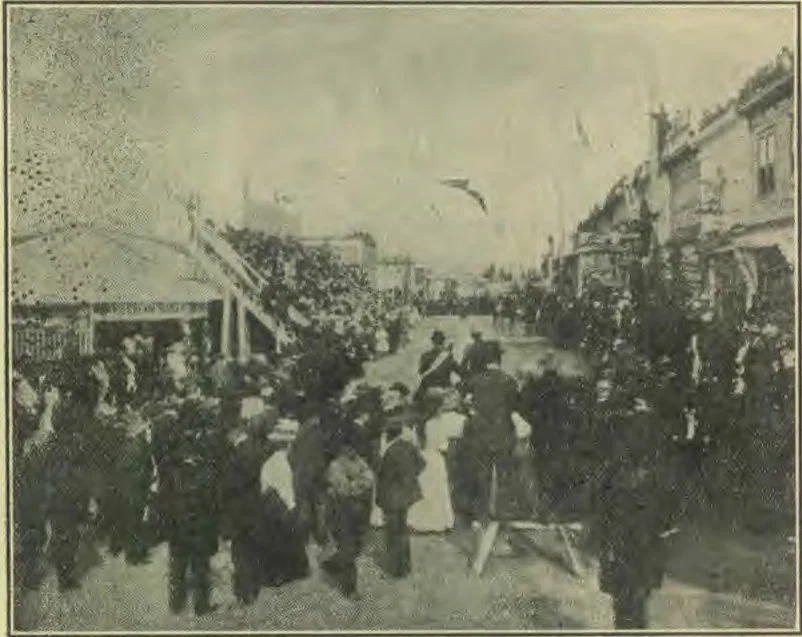
FAIRBANKS, ALASKA, ON JULY 4, 1908
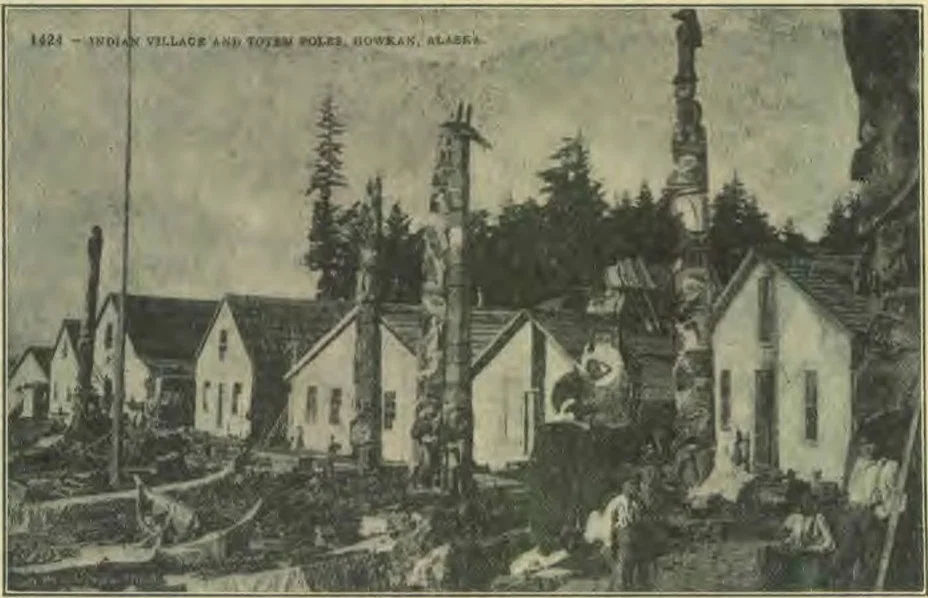
INDIAN VILLAGE AND TOTEM POLES, ALASKA
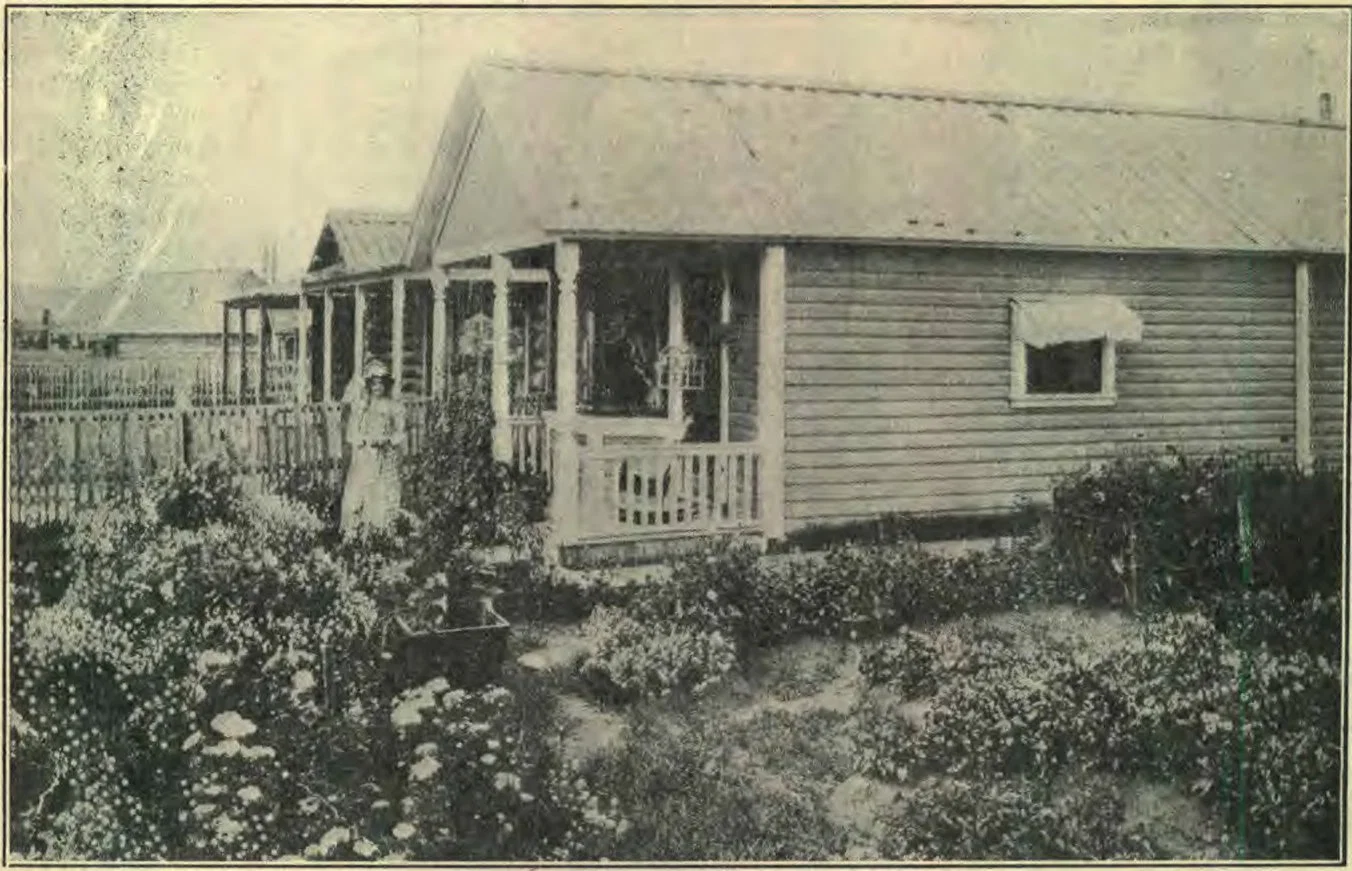
HOME GARDENING AT FAIRBANKS, ALASKA, TANANA VALLEY
Many today think of Alaska as a vast field of ice; or a cold, bleak mining country, where winter lasts twelve months each year; or a good hunting ground; or a new, wild, unattractive, mountainous territory. But Alaska deserves to be regarded more worthily. The region about Sitka has an excellent climate, akin to that of British Columbia. It permits an abundant vegetation. Here is situated one of the four experiment stations in Alaska of the United States Department of Agriculture.
Farther north and west is Alaska proper, and the climate is cold; but journeying north from Sitka by water, scenes rivaling those of the beautiful fiords of Norway and Sweden are seen. Glaciers extending down into the ocean, great forests, and barren coasts lie farther north. Leaving the coast and traveling inward toward Mt. McKinley, one finds, during the summer months, myriads of beautiful flowers, “countless in number and beautiful beyond description,” according to enthusiastic tourists.
But why call Alaska a “New America”? In size Alaska is one sixth as large as the United States, “is larger than all our Atlantic States taken together, and could be split into about ten countries each the size of England.” It has a population of nearly 65,000, about one half of whom are Eskimos and Indians.
Gold, silver, copper, and tin are found in its mines. The Territory is noted for its lumber and coal. One seventh of all the lumber in the National Reserve Forests is found in Alaska. The fishing industry is of considerable consequence, and agriculture is making wonderful progress in this new country. Government reports show that Alaska has between two and three million acres of tillable land. Wonderful crops of wheat, rye, oats, potatoes, turnips, and berries can be grown in the fertile valleys of the Yukon and Tanana Rivers.
Alaska has far exceeded the expectation of its purchasers. In the year 1910 alone, over $7,500,000 worth of gold was taken from its mines. Alaskan fisheries yield over $8,000,000 annually, and the other industries are growing proportionately.
In this vast country, one sixth the size of the United States, we have but one missionary. It is not likely that there is a more promising field with fewer workers. Shall we not work and pray that those northern homes may soon rejoice in the light of present truth, and in the love of a Saviour?

Useful Farm Machine

THE rural telephone, strung along as a part of wire fences, homemade in many instances, using cheap instruments, has been the best employment agent the State of Kansas has found in getting the army of harvest hands to the places where the men were needed. Kansas has 328,000 telephones, or approximately one for every family, and in recent weeks the phone has been the most useful machine on the Kansas farm. During a time of high water and floods, it is estimated that the telephones saved $5,000,000 worth of farm property from damage. The central operators were notified of high water in the streams, and they in turn notified thousands of farmers to get their furniture out of their first floors, and get the live stock and poultry on high ground.—Selected.

The Poverty of Jesus

BEFORE our Saviour left the realms of glory, he possessed the numerous and varied riches of heaven. While there he could say: “Every beast of the forest is mine, and the cattle upon a thousand hills. I know all the fowls of the mountains: and the wild beasts of the field are mine. If I were hungry, I would not tell thee: for the world is mine, and the fullness thereof.” Ps. 50: 10-12. Of money he had no need; for he declared, “The silver is mine, and the gold is mine.” Haggai 2: 8. Of companions, raiment, food, and all that makes life happy, he had no lack; for the resources of the universe were at his command.
But in the “fullness of time” he left his bright home in glory for us who were “dead in trespasses, and sins.”
“My Father’s house of light, My glory-circled throne, I left for earthly night, For wanderings sad and lone.”
Love for dying man prompted him to leave that home, and although equal with God, to take upon himself the form of a servant and be made in the likeness of men. He “emptied himself,” the Scripture says. For our sakes all the power and right of divinity were laid aside, all the riches of heaven and the pleasant surroundings of a home with unfallen beings were given up. Think of the contrast! Mortals can only feebly compare the glories of the other world with the transient and decaying things of the present; for of the former it is written, “Eye hath not seen, nor ear heard.”
We ourselves speak of poverty, but can we realize the depth of poverty to which Jesus went?—so poor that at one time in his ministry he said, “The foxes have holes, and the birds of the heaven have nests; but the Son of man hath not where to lay his head;” so poor that he invited himself to dinner, calling to his host, “Zaccheus, make haste, . . . for today I must abide at thy house;” so poor that he sent Peter to the seashore to gather his poll tax from the fish’s mouth; so poor that, when in the height of his earthly glory, he sent his disciples to borrow the colt of a stranger, upon which he made his triumphal entry into Jerusalem; so poor that he afforded no home, but ate the Passover supper in the home of a friend; so poor that he made no provision for his mother during his life, and when dying on the cross, he sent her to John’s home; so poor that his body would have gone to the potter’s field had not a rich man interposed.
Speaking of this phase of our Lord’s life, Paul says: “Ye know the grace of our Lord Jesus Christ, that, though he was rich, yet for your sakes he became poor, that ye through his poverty might be rich.” 2 Cor. 8:9. Do you understand, then, that these lines are written to help you to appreciate our Lord’s sacrifice and to be contented if yours is the lot of the poor? “Hearken, my beloved brethren; did not God choose them that are poor as to the world to be rich in faith, and heirs of the kingdom which he promised to them that love him?” M. G. CONGER.

When People Seek the Church

In my boyhood a large frame church building was burned down in my native village. Although it had not been a very active church, it had a large membership, and there was much interest in the catastrophe. The fire occurred at night, and, as the building was large, it made an immense bonfire, and of course people flocked from far and near to see it. A member of the church said, somewhat peevishly, to a known skeptic who was in the crowd, “I never saw you come near this church before.” “No,” replied the other, “but then I never saw this church on fire before.”— W. B. Hutchinson.
Continue reading: The Story of the Rebellion Against the Government of King Jehovah