The Youth’s Instructor, Vol. 30, No. 33.

PONTOON BRIDGES

The Youth’s Instructor

Aug 16, 1882

S. D. A. Publishing Association · Battle Creek, Mich. · Aug 16, 1882

PONTOON BRIDGES.

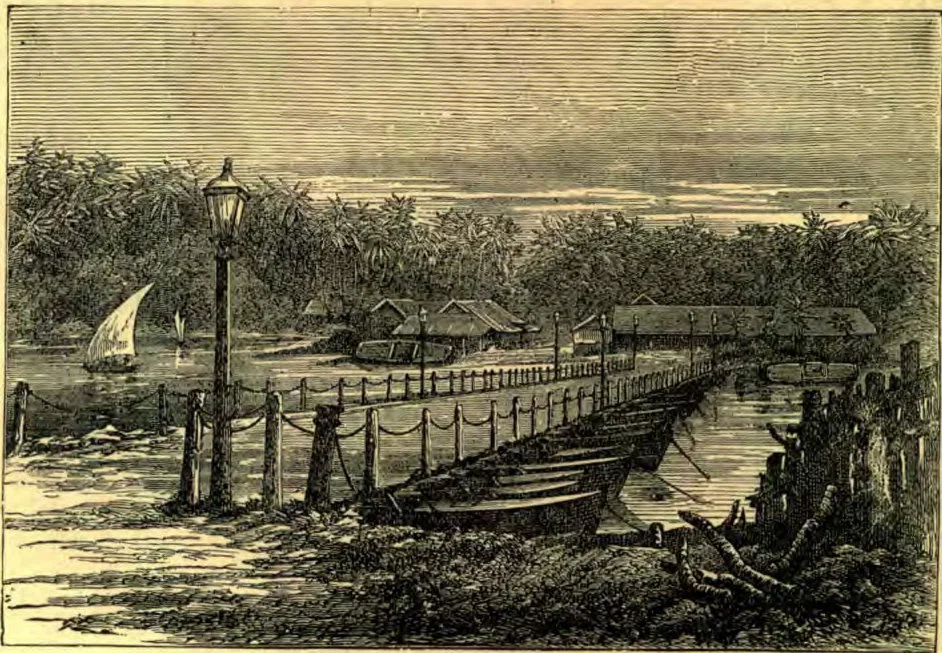
GREAT many hundred years ago Xerxes, a Persian king, collected the largest number of men ever known to have assembled at any one time. He was going over into Greece to conquer the people of that country. But he failed to accomplish his object, for the Grecians were a very brave and determined people, while the Persians were accustomed to ease and luxury. A great many things happened in connection with this expedition, which are very interesting to read about. Among the rest is the way in which Xerxes carried his immense army over the Hellespont, a wide strait of stormy water, separating Asia from Europe. His army was so vast that it would have taken weeks and weeks to carry them over in boats, and yet the water was too deep, and the strait too wide to think of building a bridge. So Xerxes ordered his men to place two lines of boats, lying side by side, across the strait, and then to build a floor, using the boats for piers, or supports. When this was done, the baggage and horses were taken across on one bridge, while the men crossed on the other. Although both men and beasts were hurried across by being driven with the lash, yet so mighty was the host that they were seven days and seven nights in crossing.
Since the days of Xerxes, many other generals have made use of boats to build bridges upon, and now scarcely any army thinks of starting out on a campaign without carrying the timber necessary to build a “pontoon bridge,” as they are called. With such a bridge they can cross rivers at any point they choose, and can carry off their bridge with them, and not leave it for their enemies to use. The picture will give some idea of how these bridges are built, and how they look. C. H. G.

THE TRUE RING.

“WANTED—A clerk, at 650 Washington street.”
This was an advertisement that appeared in one of the morning papers of a large city.
Many a young fellow who had been seeking employment for weeks, felt his hopes rise as he read it.
Fred Barker heard it at the breakfast table the day after it appeared. His sister Louise said: “O Fred! I forgot to tell you what I saw in yesterday’s paper—that Mitchell & Tyler want a clerk. That will be the place above all others for you; it’s a splendid store. Of course you can get the place if you’re not too late. You can take a letter from Uncle Horace; his influence and your appearance will settle the matter. I heard Mr. Mitchell was real fussy about his clerks, but I’m sure he can find nothing to object to in my handsome, well-dressed brother,” and the elder sister looked admiringly at Fred’s face, smooth locks, and well fitting suit.
“Perhaps I’ll call around there after awhile,” Fred said carelessly.
“Please hurry and go now, won’t you?” his sister said; “I’m afraid somebody has snatched up the place before this time.”
Fred finished his breakfast in a leisurely way, put a few extra touches to his already careful toilet, lighted a cigar, and sauntered forth.
“Better throw away your cigar before you go in. Mr. Mitchell may object to that,” said Louise, who stood in the front door as he passed out.
“He’ll have to take me just as I am,” Fred said with a lofty air; “all gentlemen smoke. I do not propose to be a slave to any man.”
He called at his uncle’s office on his way and procured a letter of recommendation. Thus equipped, he felt confident of success.
Just behind him there walked with a brisk step a boy of fifteen, a year or two younger than himself. This was David Gregg. He, too, had seen the advertisement, and was on his way that very minute to 650 Washington street. He was the eldest of a family of children whose father had died at the beginning of the winter. David had risen very early that morning, made the fire, and while his mother was preparing breakfast, put himself in the neatest possible order to go to Mitchell & Tyler’s.
When he appeared at the breakfast table looking so bright and neat, his mother thought he was a son to be proud of, the handsomest boy in the whole city; yet his face was actually homely as far as beauty of features was concerned; his clothes were coarse, and he had no fancy necktie, no flashing pin, or gold cuff buttons, like the elegant young gentleman who now walked before him.
What was the reason that among the large number of boys who filed in and out of Mitchell & Tyler’s private office, no one of them had yet been selected to fill the vacant clerkship? Mr. Mitchell, the senior partner of the firm, had asked some plain, straight-forward questions of them,—“Where do you spend your evenings? Do you play cards, go to the theater?” etc.; for Mr. Mitchell had declared to his partner, “If there is a boy in the world who has good habits and right principles, I’m going to hunt him up if it takes all winter.” So it turned out that many of the boys could not give satisfactory answers to the searching questions, and others, when Mr. Mitchell sounded their knowledge of figures, were not ready reckoners.
They came and went one whole day, and as soon as the door was opened the next morning, candidates came flocking in like birds.
And now it was Fred Barker’s turn. He stood before Mr. Mitchell, his hat on his head, his cigar removed from his mouth, it is true, but the smoke thereof curling upward into the merchant’s face. He presented his letter of introduction. Mr. Mitchell read it, then asked a few questions. Meanwhile his practical eye was taking it all in—the cigar, the imitation diamond, the large seal ring, the flashing neck-tie. He knew in a twinkling where Fred Barker usually spent his evenings, and that it would take more money to indulge his tastes than he could honestly earn.
To Fred’s astonishment he presently heard, “I do not think, young man, that you are just the one we have in mind for this place.” Then, before he knew it, he was bowed out.
The next boy who was admitted did not advance with such an over-confident air. He held his hat in his hand, and spoke in a modest, respectful manner.
“Have you any recommendation?”
“No, sir, I have none,” David answered, a little dejectedly. “We have not been long in the city.”
“Well, you need none, if I can trust my eyes,” Mr. Mitchell remarked to himself. The bright frank face and manly air of the boy impressed him most favorably; he was still more pleased when he drew him into conversation and learned what books he was fond of, and how he was going on with his studies of evenings, although he had been obliged to leave the high school to earn his living.
Mr. Mitchell had very sharp eyes; he took note of the well brushed garments, the shining boots, the snowy collar and cuffs, the delicately clean finger-nails—even by such small things as these is character read—and above all, the look of sincerity and honesty shining from the blue eyes.
“Well, David,” Mr. Mitchell said, as he got up and walked back and forth, “what if I were to tell you that you can have the situation providing you will work a part of every Sabbath?”
It was a most cruel test. The boy hesitated—just a moment—then he said, while his color rose and his voice choked, “I should say, sir, that I cannot accept it.”
“Not even when your mother needs money so badly?”
“No, sir; my mother would not use money so earned. She has always taught me to obey God and trust him, come what will.”
“That has the true ring,—pure gold,” said Mr. Mitchell, bringing his hand down on David’s shoulder. “My dear boy, I want you, and I do not want you to do any work for me on the Sabbath. I will pay you ten dollars more a month than the last clerk received, because I am glad to find one boy out of a hundred who remembers his mother’s teachings, and fears to disobey his Lord.”—Sel.

SOWING THE SEED.

Out in the garden of life, God bids us sow the seed, Each in the place he has given, By word or deed.
Within the Master's vineyard There's work for great and small,— Sowing the seeds of heavenly truth, Where He may call.
Over the fields of sin, He guides the faithful hand, To scatter abroad the golden grain For the joyous harvest land.

SANDWICH, ENGLAND.

This place is twelve miles from Canterbury. Its name is derived from that given to it by the early Saxons. Because it was situated low in the sands near the sea, it was called Sondwych. It was one of the “Cinque Ports” of the Normans. The word “cinque” in French means five. The five ports were Sandwich, Dover, Hythe, Romney, and Hastings, on the coast of Kent and Sussex. Of the Cinque Ports, Sondwych was the most important, as it was the sea-port of London, being only sixty-eight miles distant by road.
Until the time of Henry VII., about the close of the fifteenth century, the crown had no permanent navy: the Cinque Ports furnished nearly all the shipping required for the purposes of the State. In the time of Edward I., near the close of the thirteenth century, the Cinque Ports were required to furnish the State fifty-seven fully equipped ships at their own cost, but the period of gratuitous service of these ships was limited to fifteen days each. These ports on their part were severed from the civil administration of Kent and Sussex into a sort of independency, with its seat of power civil, military, and naval at the Castle of Dover.
Sandwich, on the south side of the Stour, at its entrance into the Pegwell Bay, once had a fine harbor, which has become so filled up with sand that only vessels of small draft can now approach the town. It has an interesting history in connection with the Danish and Norman occupancy, as well as in later times. In 851, Athelstan fought here, at sea, and defeated the invaders; but they returned in greater numbers, and devastated the surrounding country. Down to the time of the Norman conquest, the Danes landed here several times. Even during the reign of Canute, the town was plundered by some of his piratical countrymen.
From the time of the Norman conquest, the town enjoyed peace, and rose in importance. Most of the traffic to and from the Continent passed through the place. Richard I. landed here after his captivity. In 1217, Louis, the Dauphin of France, came with a fleet of seven hundred vessels, and burnt a part of the town. Edward III. made this his port during his war with France; in 1357, Edward, the Black Prince, landed here with his prisoner, John, King of France. In 1435 it was burnt by the French, and again in 1456. It was fifty years before it recovered its former state, but then had ninety-five ships belonging to it. The harbor had become so choked up with sand that it soon lost its importance as a sea-port, but it was chosen as a residence by great numbers of refugees from France and Holland, to whom Queen Elizabeth gave a welcome. These established factories and breweries.
The Queen visited the place in 1573, and was entertained at the school-house. The Brewers were enjoined to “brew good beer against her coming.” At the entertainment she became “very merrye,” and “after eating from divers dishes, caused certain to be reserved, and carried to her lodgings.”
The town walls, made of earth, are still standing, but of the five original gates only one remains. In ancient time felons condemned to death here, were killed by drowning. In 1315 a complaint was made that they could no longer drown them, as there was insufficient water to do it, or to carry their bodies into the sea. The town has a number of times suffered by the plague, and in 1703 it was severely damaged by a great storm.
J. N. LOUGHBOROUGH.

SCENES IN THE LIFE OF CHRIST.

LESSON 32.—THE TALENTS.

“And as they heard these things, he added and spake a parable, because he was nigh to Jerusalem, and because they thought that the kingdom of God should immediately appear. He said therefore, A certain nobleman went into a far country to receive for himself a kingdom, and to return. And he called his ten servants, and delivered them ten pounds, and said unto them, Occupy till I come. But his citizens hated him, and sent a message after him, saying, We will not have this man to reign over us. And it came to pass, that when he was returned, having received the kingdom, then he commanded these servants to be called unto him, to whom he had given the money, that he might know how much every man had gained by trading. Then came the first, saying, Lord, thy pound hath gained ten pounds. And he said unto him, Well, thou good servant: because thou hast been faithful in a very little, have thou authority over ten cities. And the second came, saying, Lord, thy pound hath gained five pounds. And he said likewise to him, Be thou also over five cities. And another came, saying, Lord, behold, here is thy pound, which I have kept laid up in a napkin; for I feared thee, because thou art an austere man; thou takest up that thou layedst not down, and reapest that thou didst not sow. And he saith unto him, Out of thine own mouth will I judge thee, thou wicked servant. Thou knewest that I was an austere man, taking up that I laid not down, and reaping that I did not sow. Wherefore then gavest not thou my money into the bank, that at my coming I might have required mine own with usury? And he said unto them that stood by, Take from him the pound, and give it to him that hath ten pounds. (And they said unto him, Lord, he hath ten pounds.) For I say unto you, That unto every one which hath shall be given; and from him that hath not, even that he hath shall be taken away from him. But those mine enemies, which would not that I should reign over them, bring hither, and slay them before me. And when he had thus spoken, he went before, ascending up to Jerusalem.”
The nobleman is Christ; the far country is heaven; the kingdom that he is to receive is this earth restored to its Eden beauty, and peopled by all the righteous who have ever lived in it. The servants are those who have enlisted as Christians in the service of their Lord. The pound that each receives may be termed his power to do good. This power comes from God, chiefly through the gift of his Spirit, and does not depend solely upon intellect or wealth. Those who will not enter the service of God show that they hate him; and by neglecting to keep his commandments, they say that they will not have him to reign over them. Any one who continually makes use of his talent for doing good will improve it,—will increase his power for doing good; and so he trades with his pound, and makes it gain ten pounds. The more we improve our talents here, the greater will be our capability for enjoying the life to come. This is represented by saying that one is to rule over ten cities, another over five, etc. Those who do not improve their talent will lose it. Life and its opportunities for doing good will be taken from them.
It will be a joy in the next world to know that we have done good in this life; but he who does no good here, can never enter into the joy of his Lord; the “well done” can never be spoken to him. As there was no excuse for the man whose pound had not gained anything; so there will be no excuse for any who do not improve their talent for doing good.

QUESTIONS.

  1. What did the disciples think about the coming of the kingdom of God? Luke 19 : 11.
  2. What parable did Jesus give for the purpose of correcting their error? Verse 12.
  3. What did the nobleman do before starting on his journey? Verse 13.
  4. What were the feelings of his citizens?
  5. What message did they send after him?
  6. When he returned, what command did the nobleman give? Verse 15.
  7. For what purpose did he have the servants called?
  8. What report did the first servant give? Verse 16.
  9. What did his Lord say to him? Verse 17.
  10. What did the second servant say?
  11. What reward was promised him?
  12. What very different report was given by another? Verse 20.
  13. What reason did he give for neglecting his talent? Verse 21.
  14. How did his Lord say he would judge him?
  15. How did the nobleman then show that his slothful servant was without excuse?
  16. In Matthew’s account of this parable, how does he speak of the reward promised to the faithful servants? Matt. 25 : 21-23.
  17. What did he say about the fate of the unfaithful servant? Verse 30.
  18. What command did the nobleman give concerning his enemies that were unwilling he should reign over them? Luke 19 : 27.
  19. Who is represented by the nobleman?
  20. What is the far country?
  21. What is the kingdom that Christ is to receive?
  22. Who are the servants that receive the talents?
  23. What may be regarded as the “pound” which each receives?
  24. From whom does this come?
  25. How is the power chiefly conferred?
  26. Who show that they hate God?
  27. How do they by their actions show that they will not have him to reign over them?
  28. How does the Christian trade with his pound, and make it gain ten pounds?
  29. What effect will the improvement of our talents have upon our enjoyment of the world to come?
  30. How is this represented in the parable?
  31. How will it be with those who do not improve their talent?
  32. What will be a joy in the next world?
  33. What will be the condition of those who do no good here?
  34. Will they have any excuse for their neglect?

A TOUCHING INCIDENT.

A LITTLE boy came to one of our city missionaries, and holding out a dirty and well-worn bit of printed paper, said, “Please, sir, father sent me to get a clean paper like that.”
Taking it from his hand, the missionary unfolded it, and found it was a page containing that beautiful hymn of which the first stanza is as follows:—
“Just as I am, without one plea But that Thy blood was shed for me, And that Thou bid’st me come to Thee, O Lamb of God, I come!”
The missionary looked down with interest into the face earnestly upturned to him, and asked the little boy where he got it, and why he wanted a clean one.
“We found it, sir,” said he, “in sister’s pocket after she died; and she used to sing it all the time when she was sick, and loved it so much that father wanted to get a clean one to put in a frame to hang it up. Won’t you give us a clean one, sir?”
The little page with a single hymn on it, had been cast upon the air like a fallen leaf, by Christian hands humbly hoping to do some possible good. In some little mission Sabbath-school, probably, this poor girl had thoughtlessly received it, afterward to find in it, we hope, the gospel of her salvation. Could she, in any probability, have gone down to death, sweetly singing that hymn of penitence and faith in Jesus to her latest breath, without the saving knowledge of him, which the Holy Spirit alone imparts?—Home Mission Herald.

Faithfulness to Present Duty

He who is false to present duty breaks a thread in the loom, and will see the effect when the weaving of a life-time is unveiled.

VALUE OF GOOD HABITS.

On the 15th of February, about five o’clock, Horace B. Claflin, a prominent New York merchant, was sitting alone in his private office, when a young man, pale and careworn, timidly knocked and entered.
“Mr. Claflin,” said he, “I am in need of help. I have been unable to meet certain payments, because certain parties have not done as they agreed by me, and I would like to have $10,000. I come to you because you were a friend to my father, and might be a friend to me.”
“Come in,” said Claflin; “come in and have a glass of wine.”
“No;” said the young man, “I don’t drink.”
“Have a cigar then?”
“No, I never smoke.”
“Well,” said the merchant, “I would like to accommodate you, but I don’t think I can.”
“Very well,” said the young man, as he was about to leave the room, “I thought perhaps you might. Good day, sir.”
“Hold on,” said Mr. Claflin; “you don’t drink?”
“No.” “Nor smoke?” “No.”
“Nor gamble, nor anything of the kind?”
“No, sir; I am superintendent of the —— Sabbath-school.”
“Well,” said Claflin, with tears in his eyes, “you shall have it; and three times the amount if you wish. Your father let me have $5,000 once, and asked me the same questions. He trusted me, and I will trust you. No thanks. I owe you for your father’s trust.”—American Christian Review.

NEW-TESTAMENT HISTORY.

LESSON 95.—INSTITUTION OF THE LORD'S SUPPER.

As they sat, eating the Paschal Supper, Jesus was troubled in spirit, and said, “Verily I say unto you, One of you which eateth with me shall betray me. And they began to be sorrowful, and to say unto him one by one, Is it I? and another said, Is it I? And he answered and said unto them, It is one of the twelve, that dippeth with me in the dish. The Son of man indeed goeth, as it is written of him; but woe to that man by whom the Son of man is betrayed! good were it for that man if he had never been born.” But Peter, being very inquisitive, was not satisfied, and beckoning to John, who was leaning upon the bosom of Jesus, asked him to inquire more particularly. Then John said to his Master, “Lord, who is it?” And Jesus said, “He it is to whom I shall give a sop when I have dipped it.”
“And when he had dipped the sop, he gave it to Judas Iscariot, the son of Simon.” Then Judas spoke, saying, “Master, is it I?” And Jesus replied, “Thou hast said.”
“And after the sop Satan entered into him. Then said Jesus unto him, That thou doest, do quickly. Now no man at the table knew for what intent he spake this unto him. For some of them thought, because Judas had the bag, that Jesus had said unto him, Buy those things that we have need of against the feast; or, that he should give something to the poor. He then having received the sop went immediately out; and it was night. Therefore, when he was gone out, Jesus said, Now is the Son of man glorified, and God is glorified in him. If God be glorified in him, God shall also glorify him in himself and shall straightway glorify him. Little children, yet a little while I am with you. Ye shall seek me; and as I said unto the Jews, whither I go, ye cannot come; so now I say to you. A new commandment I give unto you, that ye love one another; as I have loved you, that ye also love one another. By this shall all men know that ye are my disciples, if ye have love one to another.”
And as they were eating, Jesus took bread, and blessed it, and brake it, and gave it to the disciples, and said, “Take, eat: this is my body which is broken for you: this do in remembrance of me.” And when supper was ended “he took the cup and gave thanks, and gave it to them, saying, Drink ye all of it, for this is my blood of the new testament which is shed for many for the remission of sins. But I say unto you, I will not drink henceforth of this fruit of the vine, until that day when I drink it new with you in my Father's kingdom.”
“Then saith Jesus unto them, All ye shall be offended because of me this night: for it is written, I will smite the shepherd, and the sheep of the flock shall be scattered abroad. But after I am risen again, I will go before you into Galilee.” “Simon Peter said unto him, Lord, whither goest thou? Jesus answered him, Whither I go, thou canst not follow me now; but thou shalt follow me afterwards. Peter said unto him, Lord, why cannot I follow thee now?” “Though all men shall be offended because of thee, yet will I never be offended.” Then Jesus said, “Simon, Simon, behold, Satan hath desired to have you, that he may sift you as wheat; but I have prayed for thee, that thy faith fail not: and when thou art converted, strengthen thy brethren. And he said unto him, Lord, I am ready to go with thee, both into prison, and to death.” “I will lay down my life for thy sake.” Jesus answered him, Wilt thou lay down thy life for my sake? Verily, verily, I say unto thee, The cock shall not crow, till thou hast denied me thrice.” “But he spake the more vehemently, If I should die with thee, I will not deny thee in any wise. Likewise also said they all.”
And Jesus said unto them, “When I sent you without purse, and scrip, and shoes, lacked ye anything?” and they said, Nothing. Then said he unto them, “But now, he that hath a purse, let him take it, and likewise his scrip; and he that hath no sword, let him sell his garment, and buy one. For I say unto you, that this that is written must yet be accomplished in me, And he was reckoned among the transgressors: for the things concerning me have an end.” And they said, Lord, behold, here are two swords. And he said unto them, It is enough.”

QUESTIONS.

  1. As they sat eating the Paschal Supper, what caused Jesus to be troubled in spirit?
  2. What did he say to his disciples? Mark 14 : 18.
  3. How were they affected by his words?
  4. What question did they severally ask?
  5. How did he answer this question?
  6. What did he say of the man who should betray him?
  7. Was Peter satisfied with the answer given?
  8. How did he try to obtain a more definite answer?
  9. What did Jesus say in reply to John's question? John 13 : 26.
  10. How did he then point out his betrayer?
  11. What question did Judas ask? Matt. 26 : 25.
  12. What reply did he receive?
  13. How was Judas then instigated to carry out his cruel purpose? John 13 : 27.
  14. What did Jesus say to him?
  15. What did the disciples think that Jesus meant by these words?
  16. After Judas had gone out, what did Jesus say with reference to the great event that was about to take place? Verses 31, 32.
  17. What did he say about his departure? Verse 33.
  18. What new commandment did he give them?
  19. Of what does the keeping of this commandment give the strongest proof?
  20. As Jesus and his disciples were eating the Passover Supper, how did he introduce the solemn ceremony known as the Lord's Supper? Matt. 26 : 26; Mark 14 : 22; Luke 22 : 19; 1 Cor. 11 : 23, 24.
  21. What did he say as he gave the broken bread to his disciples?
  22. When did he give them the cup as an emblem of his blood?
  23. What did he say as he gave it to them?
  24. How did he explain the significance of this ceremony? Matt. 26 : 28.
  25. What did he say about drinking of it himself?
  26. What prediction did Jesus make in regard to what his disciples would do before morning? Matt. 26 : 31.
  27. What did Jesus probably mean by this?—That they would become so frightened and dismayed as to desert him in the hour of trial just before them.
  28. What prophecy would thus be fulfilled?
  29. What question did Simon Peter ask? John 13 : 36.
  30. How did Jesus answer him?
  31. With what earnestness did Peter still urge his request? Verse 37; Matt. 26 : 33.
  32. What did Jesus then tell him? Luke 22 : 31, 32.
  33. What admonition did he give him?
  34. What assurance of faithfulness did Peter then give? Verse 33; John 13 : 37.
  35. What reply did Jesus make?
  36. What vehement protestations were then made by Peter and the other disciples? Mark 14 : 31.
  37. What question did Jesus ask them? Luke 22 : 35.
  38. What instructions did he afterward give them?
  39. What prophecy did he refer to?
  40. How small an equipment served to meet the demand of our Lord?

NOTE.
With reference to the last topic in lesson ninety-four, Mr. Gardner, the able scholar and harmonist, says, “In St. Matthew and St. Luke, the incidents of this section follow the mention of their going out to the Mount of Olives, (Matt. 26 : 30; Mark 14 : 26); in St. Luke and St. John, they precede the corresponding statement (Luke 22 : 39; John 18 : 1). Hence it has sometimes been thought that the fall of Peter was foretold twice. It is better to suppose that the two former Evangelists mention the going out, and then pause to record this omitted incident, and then resume their narrative. In the verse immediately following this section (Matt. 26 : 36; Mark 14 : 32), both speak of their coming to Gethsemane.”
“It is, however, quite possible that this section should be placed after leaving the room in which they had partaken of the supper, and before their arrival at the gate of the city. The objection to this arrangement is the great length of the following discourse in St. John.”
As will be seen from the foregoing, it is not possible, in some instances, to determine with absolute certainty the exact order of all the incidents occurring in this part of our Lord's history; but the place given them in the lessons seems as probable as any; and accords with the views of leading harmonists.

CECIL'S LESSON.

Cecil was going to run away. Perhaps you will think it was a strange thing for a boy five years old to do; but he had been thinking of it for several days, not all the time, but whenever mamma called him to rock the baby or to drive the hens off the garden. These were very busy days at the farmhouse; and Mrs. Stone was in the kitchen a good deal, helping Ann pick over and can the bright red currants and cherries and raspberries. So Cecil had to stay in the sitting-room and mind the baby altogether too much to please him; and it seemed to him that as sure as he did get a chance to play, the hens were in the peas. He made up his mind that no little boy ever had so hard a time as he; and so this afternoon he was going to run away.
Cecil waited till he was sure his mamma was not looking, and then slipped out through the little vine covered porch. But now that he had fairly started to run away, he hardly knew where to go. He could not go down the road, for his father was at work in the field that way; and if he went up the road, he would have to go by grandma's house, and she would be sure to see him, though she did wear glasses. So he made up his mind that he would go to the woods, and he ran as fast as he could through the garden and orchard; but when he got to the little brook that flowed through the meadow, he stopped to catch minnows. Soon he heard his mother calling him, and on he ran, and climbed over the fence into the woods.
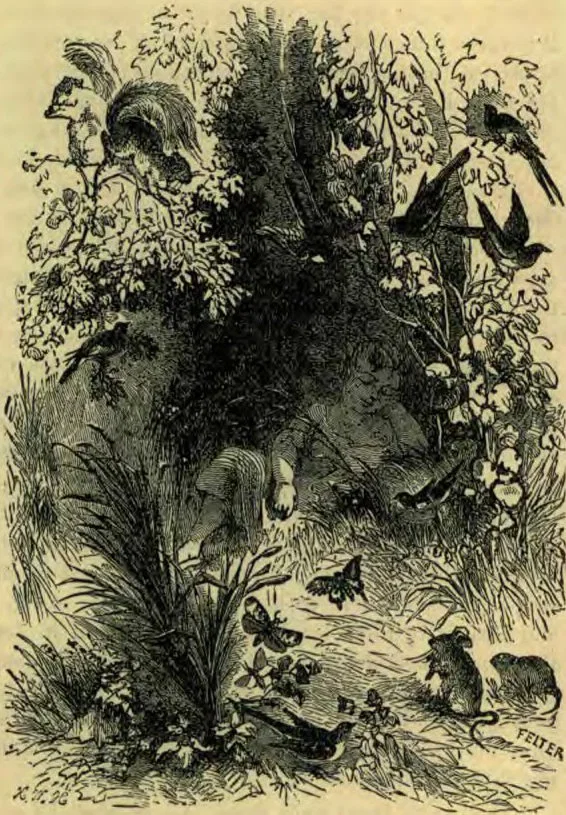
For a while Cecil amused himself by chasing squirrels and butterflies and picking the bright flowers; and then he began to be tired and lonesome. He had hurt his bare feet on the sticks, and was getting hungry; and altogether he was about sick of running away. But he thought if he went home, his mother would punish him, so he sat down under an old tree to rest; and pretty soon he saw the strangest sight. Squirrels, mice, butterflies, bees, and birds of every kind came flocking around him, and began chattering and talking to each other,—yes, really talking so Cecil could understand,—and it was all about a little boy who had run away. He had a pleasant home and a kind father and mother and a little baby brother, they said; and he had run away because he was lazy and did not want to rock this little brother. And the baby had cried, and his mother had had to leave her work; and they had called and called him, and he did not come; and Ann had been to bring his father to look for him, and still they could not find him—and all this because a little boy had run away.
And now what was to be done to punish this bad little boy? The squirrel thought one thing and the mouse another, and the birds chattered and scolded; but after a while they all agreed that he should never go back to his pleasant home again, but that he must go to live in a cave with the “Old Man of the Mountains,” whom Ann had often told him about.
Then Cecil began to rub his eyes and cry; and as he looked around, the birds, the squirrels, and the mice were all gone, and he was left alone under the big tree. The sun had gone down, and night was coming on, and Cecil started toward home as fast as his tired feet would carry him. And just as Mr. Stone was about to start out again to look for him, a forlorn looking little boy stole in at the door, and running to his mother, hid his face in her lap, sobbing as if his heart would break. Then he told her how bad he had been and what the animals had all said about him. But the mother only stroked the little flaxen head tenderly, and her face wore an odd smile as she said, “I guess my little boy has been dreaming.”
And this was the last of Cecil's running away. Now, children, how do you think he learned his lesson? E. B.

LENTILES

GROWING in the fields are the lentiles, from which the same kind of pottage is still made which cost Esau his birthright. Returning from the field, weary with hunting, and faint with hunger, Esau smelt the savory pottage his brother Jacob had made, and asked for it. Jacob, instead of feeling sorry for his brother’s sufferings, and gladly giving him the pottage, took advantage of his necessity, and required Esau to sell his birthright in exchange for a mess of red pottage.
In the southern part of Egypt, where corn is very scarce, lentiles are mixed with a little barley, and made into a kind of bread called “bettau.” This bread is of a yellow golden color, and although rather heavy, is said not to taste badly, and to be almost the only kind of bread eaten by the poorer people. Old writers often mention the lentile; indeed, so much attention, so much care was bestowed on its cultivation, that several varieties of it became remarkable for their excellence. The lentiles of Pelusium, in Egypt, were highly esteemed, not only in Egypt, but also in foreign countries. Large quantities of them were exported from Alexandria.
The lentile does not grow more than six or eight inches high, and is an annual, resembling, when green, a young pea-runner, except that its leaves are smaller and more delicate. At intervals along the parent stalk, which is not very strong, small stems branch out and end in tendrils; the leaves are set with great regularity along these stems, and with the tendrils the lentile supports itself, clinging to other plants, or anything near it.
Branching from the main stalk are small stems on which purple flowers bloom in May, and from which in July hang the short, ripe pods, each containing three flat, round seeds. In harvest the lentiles are pulled up like flax, not cut with a sickle like wheat.—Children’s Guest.

BOYS, READ AND HEED.

MANY people seem to forget that character grows: that it is not something to put on ready-made with womanhood, or manhood—but day by day, here a little and there a little, grows with the growth and strengthens with the strength, until, good or bad, it becomes a coat of mail. Look at a man of business so prompt, reliable, conscientious, yet clear-headed and energetic. When do you suppose he developed all those admirable qualities? When he was a boy. Let us see how a boy of ten years gets up in the morning, works, plays, studies, and we will tell you just what kind of a man he will make. The boy that is too late at breakfast and late at school, stands a poor chance to be a prompt man. The boy who neglects his duties, be they ever so small, and then excuses himself by saying, “I forgot! I didn’t think!” will never be a reliable man. And the boy who finds pleasure in the suffering of weaker things, will never be a noble, generous, kind man—a gentleman.

THE LONG NIGHT.

LAPLAND has a long winter night, beginning in early October, ending in June. What a long gloomy cavern those eight months are! Not wholly gloomy, either, for moon and stars and northern lights hang their glory in the earth’s dark roof. The last day that the sun appears in October, the inhabitants of a village join in a procession, that somberly winds up to some hill-top, and there they look off upon the setting sun. It burns like a candle-flame on the edge of the horizon; and then, as if some mighty hand had covered it with an extinguisher, it goes out! In June, all go up the hill again to see the sun come over the eastern slopes.
Continue reading: HAPPY-ING BABY