The Youth’s Instructor, Vol. 27, No. 39.

WHAT THE TEA-KETTLE TAUGHT

The Youth’s Instructor

Sep 24, 1879

S. D. A. Publishing Association · Battle Creek, Mich. · Sep 24, 1879

WHAT THE TEA-KETTLE TAUGHT.

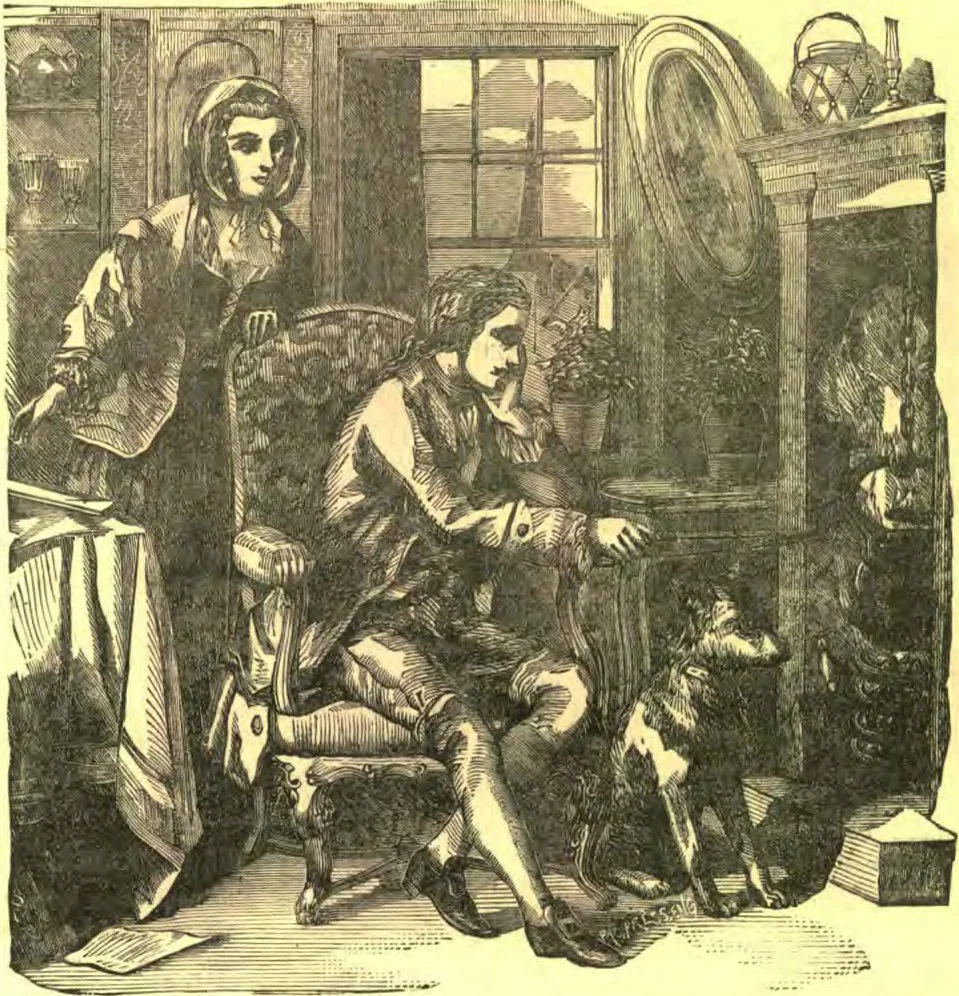
“What do you suppose,” said papa, “that the boy in the picture is doing?”
“He’s playing with the tea-kettle,” replied Lucy.
And Johnny, who is a little more observing, said, “He’s holding the tongs over the nozzle to make the cover dance;” for Johnny had done the same thing himself.
“Yes,” said papa, “and he is learning a great lesson from that tea-kettle.”
“What kind of a lesson?” asked Lucy. “I always thought lessons had to be learned from books, and I don’t see any book.”
“Ah!” said papa, “some of the grandest lessons ever taught have been learned without books. That boy is James Watt; and instead of playing with the tongs and tea-kettle, as you thought, he is learning a lesson about the power of steam. That old black tea-kettle, smoked by the open fire, is to the studious, thinking boy, the germ of the mighty steam-engine.”
“Oh, yes!” cried Johnny, “I read about that in my reader; and when the neighbors thought he was idling his time away by the fire, he was studying out great improvements in steam power.”
“Yes,” said papa, “and when you ride on the cars or on a steamboat, or see the ponderous machinery driven by the steam-engine, you can look back in imagination to the boy by the fire, and the tea-kettle on the hearth, as the starting-point of it all.”
“But,” inquired Lucy, who was still troubled about the lesson without books, “how did the tea-kettle teach him a lesson?”
“I am glad you asked that question,” replied papa, “for I want my children to form the habit of learning by observation. The boy had often seen the lid of the tea-kettle lifted by the steam, and he reasoned that there must be much power in it. When he held the blade of the tongs over the nozzle, he found that the cover was lifted with much more force; and so he reasoned that confined steam was more powerful than free steam.”
“Is the steam confined in the engine?” inquired Lucy.
“Yes, until it has done its work. The steam you see escaping in puffs has exerted its force in pushing the piston of the engine, and is then free to escape into the air. The great roaring fire under the boiler keeps making more steam from the water, and so the engine is kept running.”
“And so,” said Johnny, “we can ride on the lightning express, instead of the stage-coach, because James Watt studied the tea-kettle when people thought he was playing with it.”
“Yes,” returned papa, “and did you ever think what a power for good the steam has become? It carries the preachers of God’s truth from State to State, and from country to country; it drives the presses on which the papers, tracts, and books are printed, and the machinery by means of which they are bound, and then it propels the cars and the steamships that carry them to thousands of readers all over the world.”
“I never thought of that before,” said Johnny.
“Well,” said papa, “I hope you will learn to think on all subjects that are worthy of thought; for thinking, united to earnest work, has given us nearly all the inventions which add so much to our happiness and do so much good in the world.
W. C. G.

THE WATER-MILL.

Listen to the water-mill through the livelong day; How the clanking of the wheel wears the hours away. Languidly the autumn wind stirs the greenwood leaves, From the fields the reapers sing, binding up the sheaves. And a proverb haunts my mind,—like a spell is cast: “The mill will never grind with the water that has passed.”
Take the lesson to thyself, loving heart and true; Golden years are fleeting by—youth is passing, too. Learn to make the most of life, lose no happy day; Time will never bring thee back chances swept away. Power, intellect, and strength may not always last: “The mill will never grind with the water that has passed.”
Oh, the wasted hours of life, that have drifted by! Oh, the good we might have done—lost without a sigh! Love that once we might have saved, with but a single word! Thoughts conceived, but never penned, perishing unheard! Take this proverb to thine heart, take and hold it fast: “The mill will never grind with the water that has passed.”

THE PRIVILEGE OF PRAYER.

PRAYER is not a consultation with the highest wisdom which this world can supply. It is not intercourse with an angel. But it is an approach to the living God. It is access to the High and Holy One who inhabiteth eternity. It is detailing in the ear of divine sympathy every sorrow. It is consulting with divine wisdom on every difficulty. It is asking from divine resources the supply of every want. And this is not once in a life-time, or for a few moments on a stated day of each year, but at any moment, at every time of need. Whatever be the day of your distress, it is a day when prayer is allowable. Whatever be the time of your calamity, it is a time when prayer is available. However early in the morning you seek the gate of access, you find it already open; and however deep the midnight moment, winged prayer can bring an instant Saviour near. And this wherever you are. It needs not that you should ascend some special Pisgah or Moriah. It needs not that you should enter some awful shrine, or put off your shoes on some holy ground. Could a memento be reared on every spot from which an accepted prayer has risen, and on which a prompt answer has come down, we should find Jehovah-shammah,—“the Lord hath been here,” inscribed on many a cottage hearth and many a dungeon floor. We should find it not only in Jerusalem’s proud temple and David’s cedar galleries, but in the fisherman’s cottage by the brink of Gennesaret, and in the upper chamber where Pentecost began.—Hamilton.

A BRAVE BOY.

I was sitting by a window in the second story of one of the large boarding-houses at Saratoga Springs, thinking of absent friends, when I heard shouts of children from the piazza beneath me.
“Oh yes, that’s capital! so we will! Come on, now! There’s William Hale! Come on, William, we’re going to have a ride on the railway. Come with us.”
“Yes, if my mother is willing. I will run and ask her,” replied William.
“Oh, oh! so you must run and ask your ma. Great baby—run along and ask your ma! An’t you ashamed? I didn’t ask my mother.”
“Nor I—nor I,” added half a dozen voices.
“Be a man, William,” cried the first voice. “Come along with us if you don’t wish to be called a coward so long as you live. Don’t you see we are all waiting?”
I leaned forward to catch a view of the children, and saw William standing with one foot advanced, and his hand firmly clenched, in the midst of the group. His flushed brow, flashing eye, compressed lip, and changing cheek, all told how the word coward was rankling in his breast. With breathless interest I listened for his answer, for I feared that the evil principle in his heart would be stronger than the good. But no.
“I will not go without asking my mother,” said the noble boy, his voice trembling with emotion, “and I am no coward, either. I promised her I would not go from the house without her leave, and I should be a base coward if I were to tell her a lie.”
There was something commanding in his tone, which made the noisy children mute. It was the power of a strong soul over the weaker, and they could not help yielding him the tribute of respect.
I saw him in the evening among the gathered multitude in the parlor. He was walking by his mother’s side—a stately matron, clad in widow’s weeds. It was with evident pride that she looked on her graceful boy, whose face was one of the finest I ever saw, fairly radiant with animation and intelligence. Well might she be happy in such a son—one who could dare to do right, when all were tempting him to do wrong.—Sel.

MAKING A BEGINNING.

“If we do not begin, we shall never come to the end.” A great deal depends upon the beginning of any enterprise. The first weed pulled in the garden, the first seed planted, the first dollar earned and saved, the first mile in a journey, in fact, the first step in any undertaking,—these are all important things, inasmuch as they give a hope, a promise for the future, an assurance that we are in earnest.
A few years ago I was, at one time, unexpectedly obliged to walk five miles, in order to reach home. I had a heavy valise to carry, the day was hot, and the roads dusty; but go home I must in some way. I had determined that I would not stop to rest until one mile of my journey was finished, so although very tired, and almost overcome with the heat, I toiled on. It was up hill and down all the way; and as soon as one large hill was climbed, there was another before me. How long the way seemed, and how the August sun did beat upon my head! My advancement seemed very slow; but at last I reached the cross-road which marked the end of the mile; and after resting a few moments, and drinking of a cool way-side spring, I went on with better courage. Someway the next mile was much easier; and really the last four miles together did not seem much longer than the first one,—that hard beginning.
I then thought that I might learn a useful lesson from that little experience; for the same principle will hold good in things of more importance. Though at the outset there may seem to be impassable barriers in our path, yet if we take hold bravely to remove the difficulty, success will certainly be more likely to crown our efforts than if we hesitate to make a beginning, because of the greatness of the undertaking. God helps those who help themselves; and the performance of one duty gives strength for the next. How many a poor idle outcast is creeping his way through the world, of no use to himself or any one else, who if he had held up his head, and carried out his good resolutions,—had only made a beginning,—might to-day have been happy and prosperous, a blessing to himself and others.
E. B.

EXAGGERATION

The habit of exaggeration is a very pernicious one, and has often been productive of serious evils. It would be well for all to adopt, not merely for a single day, but for a life-time, the plan described in the following paragraphs, by a correspondent of the Intelligencer:—
One morning, as we sat at our breakfast table, the conversation turned on strict truthfulness of statement, and as the discussion grew more and more lively, it was proposed by one member of the family that we should all pledge ourselves to the sternest veracity of speech for that day, and see what would come of it. The motion was seconded and carried unanimously, and as a first-fruit of the resolve we asked the one who had suggested it, “What made you so late at breakfast this morning?”
She hesitated, began with, “Because I couldn’t”—and then, true to her compact, said, “The truth is, I was lazy and didn’t hurry, or I might have been down long ago.” Presently another one remarked that she had been very cold, adding, “I never was so cold in my life.” An inquiring look caused the last speaker to modify this statement instantly, with, “Oh, I don’t mean that, of course; I’ve been much colder many times, and I don’t think it was so cold, after all.”
A third remark, to the effect that “Miss So-and-so was the homeliest girl in the city,” was recalled as soon as made, the speaker being compelled to own that Miss So-and-so was only rather plain instead of excessively homely.
So it went on throughout the day, causing much merriment, which was good-naturedly accepted by the subjects, and giving rise to constant corrections in the interest of truth. One thing became more and more surprising, however, to each of us, and that was the amount of cutting down which our most careful statements demanded under this new rule. More and more we realized the unconscious exaggeration of our daily speech, and the distance between it and truth; and each one acknowledged at the close of the day that the lesson had been salutary as well as startling.
Such a day may be of service in more ways than one, since it enforces good humor as well as strict truthfulness.

LESSONS FOR CHILDREN.

LESSON XXXIX.—DAVID DESIRES TO BUILD THE TEMPLE.

Then David went down to Kirjath-jearim with thirty thousand chosen men of Israel, and took the ark from the house of Abinadab, to bring it up to Jerusalem. The ark was placed upon a new cart, drawn by oxen, and David and all the house of Israel played before the Lord on all kinds of instruments. As they were going along, the oxen stumbled, and Uzzah, who was driving them, put out his hand to steady the ark. Now the Lord had said plainly that none but the priests must touch the ark, lest they should die. So the Lord smote Uzzah, because he put his hand to the ark, and he died there by the ark of God.
And David was afraid of the Lord that day, and carried the ark aside, and put it in the house of Obed-edom, the Gittite, where it remained three months. And the Lord blessed the house of Obed-edom, and all that he had. When David heard this, he gathered the priests and Levites together to go and bring up the ark, and put it in a tent which he had pitched for it at Jerusalem. “So the priests and the Levites sanctified themselves to bring up the ark of the Lord God of Israel. And the children of the Levites bare the ark of God upon their shoulders with the staves thereon, as Moses commanded, according to the word of the Lord.”
David had brought cedar from the forests of Lebanon, which were a long way off, and had built him a beautiful palace on Mount Zion in Jerusalem. Then David wanted to build a house for the Lord, where the ark and all the vessels should be kept. So when the Lord had given him rest from all his enemies, he said to Nathan the prophet, “Lo, I dwell in a house of cedars, but the ark of the covenant of the Lord remaineth under curtains. Then Nathan said unto David, Do all that is in thy heart; for God is with thee.”
“And it came to pass the same night, that the word of the Lord came to Nathan, saying, Go and tell David my servant, Thus saith the Lord, Thou shalt not build me a house to dwell in.” The Lord told David that he must not build him a house, because he had shed so much blood; but that he would raise him up a son whose name should be Solomon, and that Solomon should build him a house. The Lord made known to David the plan of this house, or temple, as it was called, and from this time onward, David laid up gold and silver, brass and iron, etc., in great abundance, for the building of the temple.

QUESTIONS.

1. Whom did David take with him to bring up the ark of God from Kirjath-jearim? 2 Sam. 6:1, 2; 1 Chron. 13:5.
2. On what did they put the ark?
3. How was the cart drawn?
4. How did Uzzah lose his life?
5. Why did the Lord smite him for this?
6. What effect had this upon David?
7. Where was the ark left for three months?
8. How did the Lord prosper Obed-edom while the ark was in his house?
9. How was the ark finally brought up to Jerusalem?
10. Where was it put?
11. What did David build for himself?
12. What kind of wood did he use in building it?
13. Where was the cedar obtained?
14. What did he want to build for the Lord?
15. What did he say to Nathan? 1 Chron. 17:1.
16. What reply did Nathan make?
17. What instruction did the Lord give Nathan that night?
18. Why was not David permitted to build a house for the Lord? 1 Chron. 22:8; 28:3.
19. Whom did the Lord appoint to build it? 1 Chron. 22:9, 10.
20. To whom did he make known the plan of the house?
21. What preparation did David make for the building of the temple? 1 Chron. 22.

BIBLE LESSONS FOR YOUTH.

LESSON LXV.—DAVID PERSECUTED BY SAUL.

  1. WHY was David called to play before Saul? 1 Sam. 16:14–23.
  2. What effect had his playing?
  3. With whom did Israel have war at this time? Chap. 17:1, 2.
  4. Describe the situation of the armies.
  5. What painful sight did David behold, when he came down to the camp?
  6. How were the men of Israel affected at the sight of Goliath?
  7. How was the giant slain?
  8. What honors did Saul confer upon David? Chap. 18:2, 5.
  9. What soon awakened Saul’s envy? Verses 6–8.
  10. What did he determine to do?
  11. How did Saul first try to kill David? Verses 10, 11.
  12. What was his next plan? Verse 17.
  13. How did this succeed?
  14. Who rescued David when Saul had given his servants command to kill him? Chap. 19.
  15. In what other ways was he protected?
  16. Where did he wander? Chap. 22–26.
  17. Where was he finally obliged to go? Chap. 27.
  18. What compelled him to go there to dwell?
  19. Describe David’s generous course toward Saul. Chap. 24, 26.
  20. What effect had Saul’s conduct upon his own character?
  21. How did he exercise this cruelty toward the priests of the Lord? Chap. 22.
  22. What had they done to provoke such treatment?
  23. What was the fate of this wicked man? Chap. 31.

SYNOPSIS.

The Spirit of the Lord departed from Saul, and an evil spirit troubled him. Then Saul, by the advice of his servants, sent for David to come and play before him on the harp, and when he did so, Saul was refreshed, and was well, and the evil spirit departed from him.
And there was war with the Philistines. “And the Philistines stood on a mountain on the one side, and Israel stood on a mountain on the other side; and there was a valley between them. And there went out a champion out of the camp of the Philistines, named Goliath, of Gath, whose height was six cubits and a span. . . . And the Philistine said, I defy the armies of Israel this day; give me a man, that we may fight together. When Saul and all Israel heard those words of the Philistine, they were dismayed, and greatly afraid.”
One day, when David went down to the camp to take supplies to his brothers who were in the army, he saw Goliath come forth, and defy the armies of Israel. “And all the men of Israel, when they saw the man, fled from him, and were sore afraid.” Then David, by the permission of Saul, went out to meet the giant, and killed him with a stone thrown from a sling. With the head of the Philistine in his hand, David was then brought before Saul, who was so pleased with him that he gave him a command in his army. But when they were returning from the slaughter of the Philistines, the women came out from the cities of Israel, singing, and dancing, and playing upon instruments. They said, “Saul hath slain his thousands, and David his ten thousands.” At these words, Saul’s envy was awakened, and he determined to take David’s life. This he tried to do in various ways, but was always foiled; for the Lord was with David, and protected him. When Saul sent him out to fight against the Philistines, hoping he would fall by their hand, he gained new fame by his courage and wisdom. This increased Saul’s hatred, and he ordered his servants to kill him; but Jonathan, who loved David dearly, interposed and saved his life. Twice, Saul tried to thrust him through with a javelin while he was playing before him. For a time, David was protected by Samuel, and the other prophets that were with him. At other times, attended by a few followers, he wandered among the mountains, or hid in caves. But Saul, accompanied by his soldiers, hunted him continually, until he was obliged to go and dwell with the Philistines.
At different times, David might have easily taken the life of Saul, but he would not lift his hand against the Lord’s anointed. As would be expected, Saul became more and more cruel. At one time, he slew eighty-five priests of the Lord, because Abimelech, who served in the tabernacle at Nob, had given David and his men some bread. Finally, Saul and three of his sons were slain on Mount Gilboa in a battle with the Philistines. G. H. BELL.

THE S. S. WORK AT VASSAR CAMP-MEETING.

Friday afternoon, Sept. 5, the S. S. officers and teachers held a short meeting to consider briefly the standing and wants of the Sabbath-school work in this part of the State. After some introductory remarks, Bro. Bell called upon the S. S. officers to speak relative to the work in their respective schools. Bro. Littlejohn made some excellent remarks upon the importance of a good Sabbath-school in every church, upon the adaptation of the present lessons to our wants as a people, and upon the best methods of thorough, successful study.
Immediately after this meeting, all of the family tents were visited for the purpose of ascertaining how many members there would be in each of the divisions of the school to be held the next morning, and to supply them with Lesson Sheets and INSTRUCTORS.
A second teachers’ meeting was held at 8 o’clock Sabbath morning, when teachers were selected for the different divisions of the school; and at 8:30 the entire school came together to be classified. One hundred and eighty members were arranged into twenty-four classes, each class supplied with a teacher, and all was quiet and orderly at 8:45, when the school opened with the usual exercises, a record of the Ohio camp-meeting Sabbath-school being read as the secretary’s report. During the recitations, cards bearing numbers were quietly passed to those members of the youth’s division who were prepared to take part in general exercises, and these numbers were called by the person who questioned this division. Those called upon responded to their numbers by rising, and giving prompt answers to the questions.
The children and the little ones were questioned in general exercise by calling for “hands up;” and often, when all raised their hands, a concert answer was called for. These exercises were quite interesting. The children’s lessons were remarkably well learned. The recitations, both on the lesson of the day and in review, were almost perfect. The simple, ready answers of the little ones, with their bright, happy faces, dispelled all embarrassment and stiffness, and closed the exercises of the school with a good effect.
As was announced in the Review, a contribution box was placed near the entrance of the tent; it was taken away, bearing a burden of silver and copper to the amount of $12.18.
On Sunday morning another meeting was held, during which the interests of the Sabbath-schools were thoroughly canvassed. Bro. Bell spoke upon all of the most important points, and was followed by Bro. Miller and Reavis. Eld. Littlejohn made some very appropriate closing remarks, in which he approved what had been said, and expressed a deep interest in the growth of this branch of the cause. This meeting had its influence upon all that were present. It seemed to be the source of a livelier interest.
Dinner was scarcely over when it was announced that the officers and teachers would occupy the time until the regular afternoon services, in asking Bro. Bell questions upon the Sabbath-school work. The meeting was well attended, and Bro. Bell had all the questions he could answer in the limited time.
All the meetings held in behalf of the Sabbath-schools, excepting the one held on Sunday morning, were worked in between meetings of a more general character. The work did not cease with the meetings. More good was brought about by private consultation with officers and teachers, as well as with the children and all members of the school, than it would have been possible to accomplish through public meetings.
The record books of secretaries and teachers, so far as they were passed in for examination, were found to be well kept. Subscriptions were received from several schools which had not before taken a club of the Instructor. There was a very perceptible growth of interest during the meeting, and it is hoped that some permanent good was accomplished.
D. W. REAVIS.

LETTER BUDGET

OTTAWA, KAN.
DEAR EDITORS: This is the second time I have ever written for the INSTRUCTOR. I went with pa to his last two appointments, and I got fifteen signers for the te-total pledge. I do not live near any Sabbath-school, but we hope for a church here soon. I keep the Sabbath with my pa and ma, and am trying to be a good girl. I hope you will pray for me. METTIE SHARP.
CLEBURNE, TEXAS.
DEAR EDITORS: I am a little boy, not yet six years old, and cannot read or write, but every time I get your dear paper I feel that I would like to write and tell you how much I love it. I have begged mamma to write for me now.
We have a nice Sabbath-school; sometimes there are twelve children in my class. Our teacher tries to explain the lessons so that we can understand them; and after the lessons are over, she teaches us a verse out of the Bible. I love the Sabbath-school. There I get the INSTRUCTOR, and bring it home, and mamma reads it to me, and very often some of the neighbors' children come in to listen, too. Mamma tells me I must not play on the Sabbath, as it is God's holy day. I have learned to repeat the Lord's prayer, the ten commandments, and many other verses of the Bible. I want to be a good boy, and do God's holy will. Please pray for me. WILLIE MOORE.

THE EAGLE.

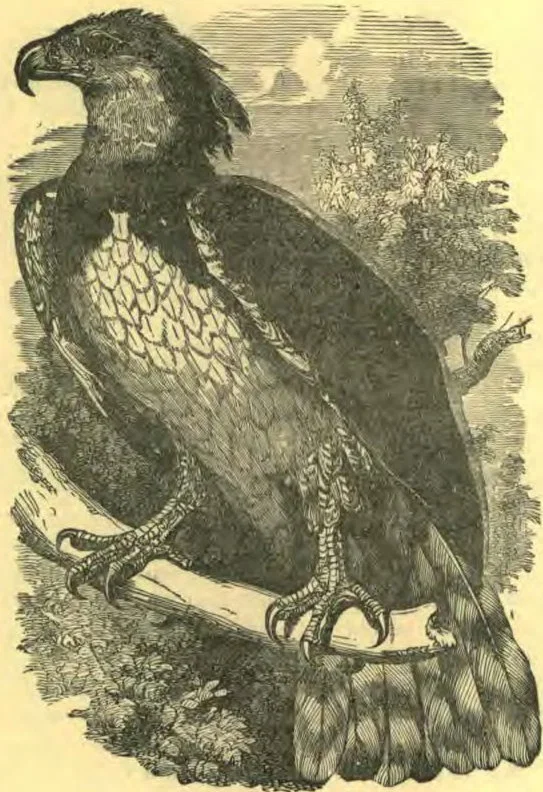
DID you ever see an eagle? Perhaps not, for the “king of birds” does not come to visit us, like the robin and the sparrow. His home is on some cliff among the mountains, or in the top of a tall forest tree. He delights to soar far up toward the blazing sun, where no other bird can follow him. With his keen, bright eyes he can look on the sun at noon-day; and when far beyond our sight in the blue sky, he can see the animals moving on the plain below him, and he will rapidly descend, to pounce upon his prey. What powerful muscles he must have, to endure such flights day after day for many years, and still be as strong as in youth!
Eagles are supposed to be very long-lived, reaching, perhaps, a hundred years.
After the eagle has chosen his mate, he remains true and kind to her till death. The old birds are very fond of their eaglets, and will defend them with their lives. But the eagle is fierce and cruel toward other creatures, and in spite of his royal title he is a robber and a coward. He often obtains his food by stealing from other birds, and he has so little courage that a bird no larger than a sparrow will attack him boldly and put him to flight.
A story is told of an eagle which caught a wild duck, and fearing that some friend might want a bite, took it off by himself on an iceberg, where he ate it alone in his selfishness; but it cost him his life, for when he would go back to his friends, he found his feet frozen to the ice, and all his fluttering and screaming could not release him; he died before the next morning.
Selfishness brings its own punishment, with birds as well as with human beings.

COST OF TOBACCO.

THE money spent every year for tobacco, opium, and hasheesh, is said to be more than one billion dollars ($1,000,000,000). This sum is so large that boys and girls, and even older people, are not able to comprehend it. But let us see how many pairs of boots, suits of clothes, and barrels of flour, it would buy; then, perhaps, we can better understand what a vast amount of money it is.
At $3 a pair, it would buy 333,333,333 pairs of boots, or a pair for every man and boy in North and South America, Europe, and Africa. It would buy a pair of shoes for every lady and little girl in the world. And at $10 a suit it would pay for one hundred million warm suits of clothes.
At $5 a barrel, it would buy two hundred million (200,000,000) barrels of flour. If you should set these just as close together as you could, they would cover twenty square miles. If put on wagons, driven tolerably close together, they would reach from New York City to San Francisco twenty-six times, or around the whole world nearly three and one-half times.
If the flour was made into bread, it would give every man, woman, boy, and girl in the world twenty-eight loaves apiece.
Boys, resolve never to have a part in wasting so much money.
GEO. B. STARR.

THE WHITE MARK.

AMONG the Vaudois the guides of travelers in the night are indicated by strips of white cloth, or by pieces of decayed wood in which there is bright phosphorescent light. All that the followers have to do is to watch the white sign of the guide. We are pilgrims in the night, marching through this world. Only one guide can show us the way. This guide is the Lord Jesus, and he shines with an everlasting light. Follow him!

Sound Travels Farther Over Water Than Land

SOUNDS are distinct at twice the distance on water that they are on land.

The Lambs of Jesus

THE lambs of Jesus—who are they But children that believe and pray; That keep God’s laws, and ask his grace, And seek a heavenly dwelling-place?

GATHERING APPLES.

Down! down! down! Down under the tree, See the apples falling, As ripe as they can be.
Beautiful golden apples, Yellow, brown, and red; Down, down they fall in showers, And over the green grass spread.
Come, little girls and boys, Leave your books and play; Help to gather the apples— No more school to-day.
Some we'll keep till winter, Till the merry Christmas days, When friends are met together, Around the bright wood blaze.
So help to gather the apples, Working while you play; Put away the lessons— No more school to-day.

You have reached the end of this edition.

The Youth’s Instructor · Sep 24, 1879