The Youth’s Instructor, Vol. 30, No. 21.

HOW ENGLAND WAS REFORMED

The Youth’s Instructor

Jun 7, 1882

S. D. A. Publishing Association · Battle Creek, Mich. · Jun 7, 1882

HOW ENGLAND WAS REFORMED.

HUGH Latimer, who was mentioned some weeks ago as one of the Reformers during King Edward’s time, was born in 1472, and during his youth made such progress in his studies that at the age of fourteen he entered Cambridge University. During the first years of his stay at the University, he was a zealous Catholic, and felt very bitter toward any in the University who did not think the doctrines and practices of the Romish church were perfect. But he finally made the acquaintance of a man named Bilney, who had given the Scriptures much study, and who convinced Latimer that many of his beliefs and practices were contrary to the word of God. These two men spent much time together, and the place in the fields where they were the most accustomed to walk, was known long afterward as the Heretics’ Hill.
After receiving his degree, Mr. Latimer remained in Cambridge, where he became a public preacher. He soon became very famous for his eloquence, and the people thronged to hear him. But he was not afraid to tell them what he thought was truth, or to show them how different the lives of their priests and bishops were from that of Christ, their pattern. Of course he made many enemies by preaching these things, although they who hated him most, envied his eloquence. He was arraigned for heresy several times before the bishops, but he so confounded them by his eloquence that he was discharged with the admonition to preach no doctrines contrary to the church. But he was not to be frightened by their threats, and was finally arrested and imprisoned in the Tower of London.
Here he remained until the time of King Edward VI., when he was released. During the six years of this king’s reign, though past seventy-five years of age, Latimer worked incessantly, preaching every morning throughout the year, and twice on Sunday. Soon after Mary came to the throne, his enemies procured his arrest, and he was again committed to the Tower, where, though in extreme feebleness of health, he was treated very cruelly, even being denied the comfort of a fire.
After suffering this confinement for a long time, he was taken to Oxford to dispute with a large gathering of bishops. You may have some idea of the treatment he there received, by the following words which he addressed to the conductor of the meeting: “O, sir, you may chance to live till you come to the age and weakness that I am of. I have spoken in my time before two kings more than once, two or three hours together, without interruption. But now I could not be suffered to declare my mind before you, no, not by the space of a quarter of an hour; without snatches, revilings, checks, rebukes, taunts, such as I have not felt the like, in such an audience, all my life long.” It would seem that the age and feebleness of this venerable servant of God, would have spared his life; but the same spirit that caused the bones of John Wyckliffe to be dug up and burned, thirsted for the blood of Hugh Latimer, and at the age of eighty-four the same council with whom he disputed sentenced him to be burned alive. When informed of his fate, he said: “I thank God most heartily, that he has prolonged my life to this end, that I may in this cause glorify God by that kind of death.”
The same council that condemned Mr. Latimer, passed a like sentence of death upon Dr. Ridley. This man was twenty-eight years younger than Mr. Latimer, and was educated at the same place. After serving as chaplain to the king for some time, he was made bishop of London. While Latimer was best known for his piety and eloquence, Ridley was famous for his deep learning. He wrote much, and was especially loved by those under his care.
When Mary became Queen, he too was imprisoned in the Tower during the same time that Latimer was there; and after defeating all the arguments of his enemies, at their council in Oxford, he was sentenced to suffer with Latimer. Both men were bound to the same stake. As they stood there waiting for the man to fasten the chain, Ridley exclaimed, “O Heavenly Father, I give unto thee the most hearty thanks, for that thou hast called me to be a professor of thee, even unto death; I beseech thee, Lord God, take mercy upon this realm of England, and deliver the same from all her enemies.” As the lighted fagot was brought and touched to the pile, Mr. Latimer turned and said to his fellow martyr, “Be of good cheer, Mr. Ridley, and play the man: we shall this day light such a candle, by God’s grace, in England, as, I trust, shall never be put out.” Death came quickly to Latimer, but Ridley suffered long and terribly, the flames not reaching his vitals until his limbs were burned to a cinder.
By their death these men gave to the world a more telling sermon in favor of the truth of God than any they had preached during life; and their enemies by thus showing themselves destitute of all humane feeling, injured their cause far more than they helped it. C. H. G.

Jealous for a Day.

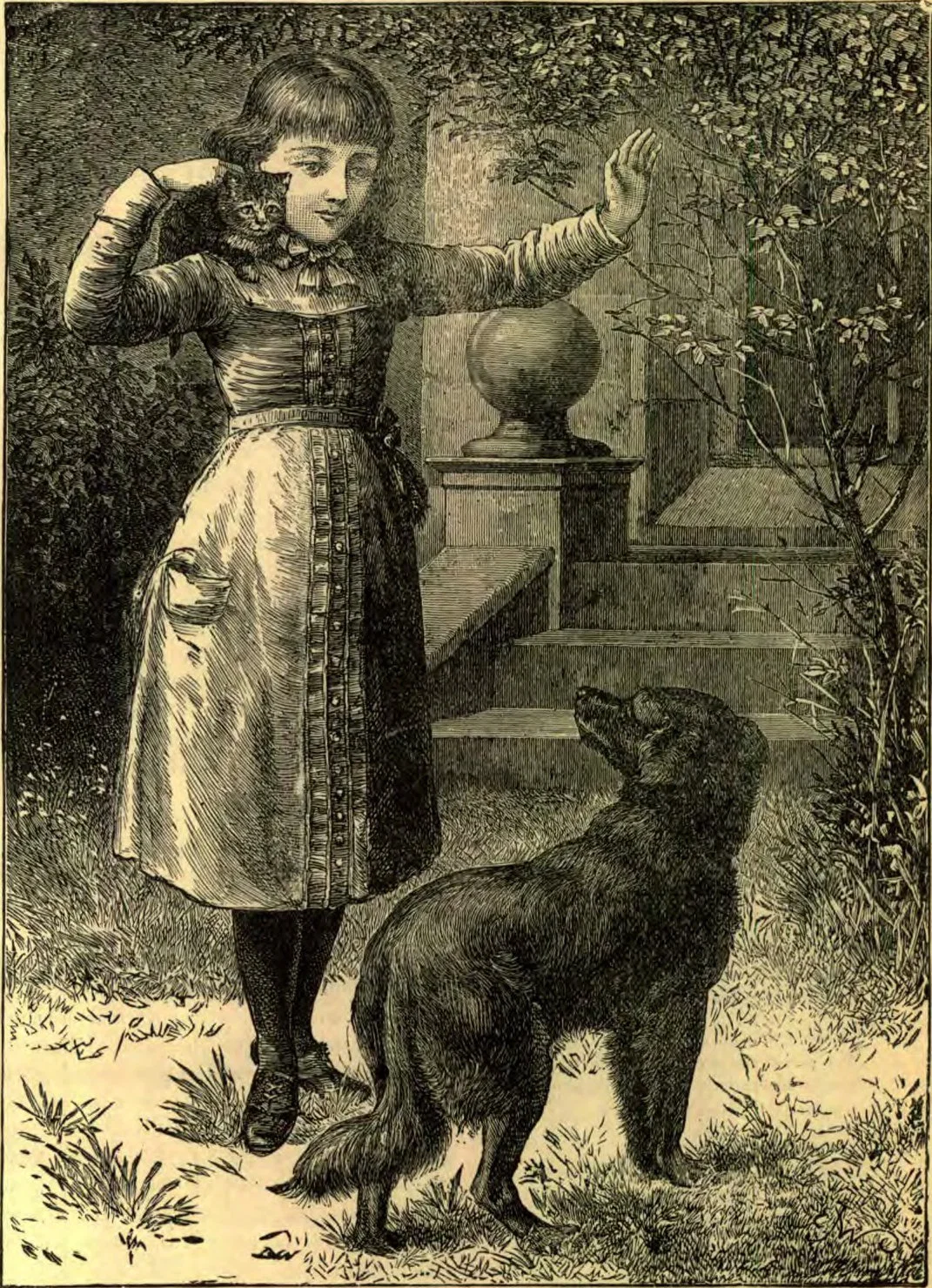
One day, when the blossoming branches strayed, All milk-white over the orchard wall, And the thrushes were singing a serenade, Gyp waited long for his queen to call, And when at last she came to the door, One birthday gift on her arm she bore; Through breezy rustle, and chant, and whirr, Poor Gyp, faint-hearted, could hear it purr. No growl did he utter, no bark or whine, In his eyes more sorrow lurked than blame; But he went and he hid all day from the shine In a broken shed where no one came.
If we brood away from the light on our wrongs, Maybe they are keener at set of sun: Long ere the thrushes had hushed all their songs, Gyp had been fain that his life were done. The kitten should really have been in bed, But off it went to the pond instead: One step more down the slippery bank, And its silky hair would hang all lank, Its eyes would be closed to light and love— Gyp could just see from his shed above. He came, and he snatched it from death away, And carried it home all lithe and gay: See! he carries it back to his friend so dear, The hour is won, she may fondle it o’er; In his faithful eyes is the story made clear, He gambols again—he is jealous no more!
—Little Folks.

THE YOUNG MARTYR.

On the afternoon of August 1, 1853, a little Norwegian boy, named Knud Iverson, who lived in the city of Chicago, Ill., was going to the pasture for his cow, as light-hearted, I suppose, as boys usually are when going to the pasture on a summer afternoon. He came at length to a stream of water, where there was a gang of idle, ill-looking, big boys, who, when they saw Knud, came up to him and said they wanted him to go into Mr. Elston’s garden and steal some apples.
“No,” said Knud, promptly, “I cannot steal, I am sure.”
“Well, but you’ve got to,” they cried.
“No,” persisted Knud, “I cannot steal for anybody.”
They threatened to duck him, for these wicked big boys had often before frightened little boys into robbing gardens for them. Little boys, they thought, were less likely to get found out.
The threat did not frighten Knud; so, to make their words good, they seized and dragged him to the river, and, in spite of his cries and struggles, plunged him in. But the heroic boy, even with the water gurgling and choking in his throat, never flinched, for he knew that God had said, “Thou shalt not steal,” and God’s law he had made his law; and no cursing, or threats, or cruelty of the big boys would make him give up.
Provoked by his firmness, they determined to see if they could not conquer. So they ducked him again, but still it was “No, no,” and they kept him under water.
Was there no one near to hear his distressing cries, and rescue the poor child from their cruel grip? No, there was no one to rescue him, and gradually the cries of the drowning child grew fainter and fainter, and his struggles less and less, and the boy was drowned. He could die, but would not steal.
A German boy who had stood near, much frightened by what he saw, ran home to tell the news. The agonized parents hastened to the spot, and all night they searched for the lifeless body of their lost darling. It was found the next morning, and who shall describe their feelings! Early piety had blossomed in this little life. Knud loved his Bible and his Saviour. His seat was never vacant at Sabbath-school; and so intelligent, conscientious and steadfast had he been, that it was expected he would soon be received into the church of his parents.
Perhaps the little boy used to think how, when he grew up, he would like to be a preacher or a missionary, and do something for his Lord and Master. He did not know what post he might be called to occupy, even as a little child; and as he left home that afternoon and looked his last look in his mother’s face, he thought he was only going after his cow; and other boys, and the neighbors, if they saw him, thought so too. They did not then know that, instead of going to the pasture, he was going to preach one of the most powerful sermons in favor of Bible law and Bible principles the country ever heard. They did not know that he was going to give an example of steadfastness of purpose and of unflinching integrity, such as should thrill the heart of the nation with wonder and admiration.
He was then only a Norwegian boy, Knud Iverson, thirteen years old, but his name was soon to be reckoned with martyrs and heroes. And as the story of his moral heroism winged its way from city to city, and village to village, how many mothers cried, with a full heart, “May his spirit rest upon my boy!” And strong men wept over it, and exclaimed, “God be praised for the lad!” And rich men put their hands in their pockets and said, “Let us build him a monument; let his name be perpetuated, for his memory is blessed.” May there be a generation of Knud Iversons, strong in their integrity, true to their Bibles, ready to die rather than do wrong!—Selected.

WINDSOR CASTLE, LONDON.

THERE is much to interest the visitor of the ancient castles of England. This is emphatically true, if he has in mind the history of their origin, their royal occupants, and the important events which have transpired there.
Windsor Castle is the country residence of Her Majesty, Queen Victoria, while at London, and is twenty-five miles from the city. The castle is easily reached from the city either by the Great Western or South-western railways. It was when seated in her carriage, with Princess Beatrice, at Windsor Station, a few weeks since, as she was starting for the castle, that she was fired upon by an insane wretch.
This castle is kept in a good state of repair, and is, undoubtedly, the most attractive of the royal palaces, far exceeding Balmoral, Scotland, where the queen spends most of the summer, or Osborn, Isle of Wight, where she passes much of the time during the winter. At the latter place she is sure to spend her Christmas, to distribute, with her own hands, presents to her numerous train of servants, a custom which serves greatly to bind them to her motherly heart.
The history of Windsor Castle reaches back to the time of the Norman conquest. At Old Windsor—two miles away—the Anglo-Saxon kings had a palace, centuries before that time. The first castle on the present site was erected by William the Conqueror. Other kings have made additions, and strengthened its fortifications. Henry III. fortified it against his turbulent barons, into whose hands it finally fell. Edward III., called Edward of Windsor, was born there, and did much to improve and beautify his birthplace. Henry VII., Henry VIII., and Elizabeth, all made Windsor a favorite residence. In 1648, Charles I. was imprisoned in the castle. During the civil war it was garrisoned for the Parliament, and ineffectually attacked by Prince Rupert.
After the restoration, Charles II. having repaired and richly furnished the castle, made it his summer residence. A few additions and repairs have been made by some of the rulers since Charles's time, and some of the kings and queens have frequently resided there. The external portions, and those which most impress the visitor, are the Round Tower, St. George's Chapel, and Queen Elizabeth's Terrace. In the interior are courts, dungeons, armories, richly furnished State Apartments, and numerous works of art, and curious relics. These afford both instruction and amusement.
It was at this castle, on April 27 of this year, that Prince Leopold, Duke of Albany, the youngest son of Queen Victoria, was married to the Princess Helen Frederick of Waldeck-Pyrmount.
At the castle apartments for State entertainments, the Queen gave a luncheon and evening dinner to the numerous wedding guests. On the sideboards and screens was displayed the massive gold plate, worth thousands of dollars, and which is said to excite the envy of all foreign potentates save the Czar of Russia. In the midst of all this, grinned the famous golden tiger heads taken from Tippo Sultan. In one of the drawing-rooms was also displayed the great gold vase, sometimes used as a font for christening the royal children.
J. N. LOUGHBOROUGH.

Responding to Reports of Evil Speech

WHEN evil is reported of you, if it is true, correct it; if it be false, laugh at it.

BY THE WAYSIDE WELL.

We stopped at the wayside well, Where the water was cool and deep; There were feathery ferns ’twixt the mossy stones, And gray was the old well-sweep;
He left his carriage alone; Nor could coachman nor footman tell Why the master stopped in the dusty road To drink at the wayside well.
He swayed with his gloved hands The well-sweep, creaking and slow, While from seam and scar in the bucket’s side The water splashed back below.
He lifted it to the curb, And bent down to the bucket’s brim; No furrows of time or care had marked The face that looked back at him.
He saw but a farmer’s boy As he stooped over the brim to drink, And ruddy and tanned was the laughing face That met his over the brink.
The eyes were sunny and clear, And the brow undimmed with care, While from under the brim of the old straw hat, Strayed curls of chestnut hair.
He turned away with a sigh; Nor could coachman or footman tell Why the master stopped in his ride that day To drink at the wayside well. —Selected.

Lesson 71.—The Danger of Rejecting Christ.

The more the Jews talked with Jesus, the more angry they became, and the more anxious they were to take him and destroy him; but the great God looked down, as he always does, and gave Jesus the protecting care of mighty angels, so that no harm could befall him till the time should come for him to give his life for the world. So Jesus escaped from these cruel persecutors, and went away again beyond Jordan to the place where John baptized. Here he abode for some time. While he was in this place great numbers of people came to him; and when they heard his words of wisdom, many believed on him, saying, “John did no miracle, but all things that John spoke of this man were true.”
Soon Jesus began to travel through the country, on the east side of the Jordan, visiting the principal cities and villages, teaching the people and healing the sick as he went, and steadily making his way toward Jerusalem. “Then said one unto him, Lord, are there few that be saved? And he said unto them, Strive to enter in at the strait [narrow] gate; for many, I say unto you, will seek to enter in, and shall not be able. When once the master of the house is risen up, and has shut to the door, and ye begin to stand without, and to knock at the door, saying, Lord, Lord, open unto us, and he shall answer and say unto you, I know you not whence ye are; then shall ye begin to say, We have eaten and drunk in thy presence, and thou hast taught in our streets. But he shall say, I tell you, I know you not whence ye are; depart from me, all ye workers of iniquity. There shall be weeping and gnashing of teeth, when ye shall see Abraham, and Isaac, and Jacob, and all the prophets, in the kingdom of God, and ye yourselves thrust out. And they shall come from the east, and from the west, and from the north, and from the south, and shall sit down in the kingdom of God.” Now Jesus did not mean to teach that there are any who cannot gain a home in heaven if they strive for it in the way that God has marked out; but many will fail because they will be careless, and take their own way instead of being diligent, and doing exactly as God has commanded us to do. They may think that, because they have met and worshiped with the people of God, have made a good profession, and have done many good things, the Lord will, for this reason, certainly accept them; but still they will be shut out of heaven if they have tried to serve God in their own way, instead of taking the way that he has recommended in his word. When God has told us how we ought to do, it is not safe to think that some other way will do just as well.
Jesus was now journeying and preaching in the country where Herod Antipas ruled. This was the Herod who had beheaded John the Baptist; and the Pharisees tried to frighten Jesus by saying to him, “Get thee out, and depart hence; for Herod will kill thee.” Jesus, however, gave them to understand that all things would go on just as God had decreed, and that he, like the prophets, would perish in Jerusalem, a city over which Herod had no control.
“And it came to pass, as he went into the house of one of the chief Pharisees to eat bread on the Sabbath-day, that they watched him. And, behold, there was a certain man before him which had the dropsy.” And Jesus said to the lawyers and Pharisees that were present, “Is it lawful to heal on the Sabbath-day?” These men, fearing to answer either way, said nothing. Then Jesus took the man, and healed him, and let him go. After the miracle was performed, Jesus said, “Which of you shall have an ass or an ox fallen into a pit, and will not straightway pull him out on the Sabbath-day?” The proud Jewish teachers were so confounded by these words of Jesus, that they could say nothing against what he had done; yet they were ashamed to acknowledge that he was right, and would not accept him as their Saviour; so they went on in their stubborn course, hardening their hearts, and making it more difficult every day to yield their will to the will of God. Let us all be careful not to do as they did.

Questions.

  1. How were the unbelieving Jews affected by disputing with Jesus?
  2. How was he preserved from their wrath?
  3. Where did Jesus go when he had escaped from his cruel persecutors? John 10 : 39, 40.
  4. How was he honored in that country?
  5. What did the people say when they had heard the teachings of Jesus?
  6. Where did Jesus soon begin to travel? Luke 13 : 22.
  7. What places was he especially careful to visit?
  8. What did he do wherever he went?
  9. Toward what place did he gradually make his way?
  10. What question was asked by one who had been listening to the words of Jesus? Luke 13 : 23.
  11. What did Jesus say about the exertion that must be made in order to be saved in the kingdom of heaven?
  12. What will be said to those who try to seek the favor of God after probation has closed, and the door of mercy is shut? Verse 25.
  13. What plea will some make? Verse 26.
  14. How will the Lord reply? Verse 27.
  15. Describe the feelings of those who will see the patriarchs in the kingdom of heaven, and yet find themselves shut out. Verse 28.
  16. What encouraging words did he speak to those who will strive earnestly for the kingdom of heaven? Verse 29.
  17. When Jesus said, “Many will seek to enter in and shall not be able,” did he mean to teach that there are some who cannot gain the kingdom of heaven if they try?
  18. Why will many fail?
  19. Why will some suppose that God will certainly accept them?
  20. Why will some of these be shut out of the kingdom of heaven?
  21. What course is unsafe, when God has told us what to do?
  22. Who ruled over the country where Jesus was now preaching?
  23. What cruel thing had this Herod done?
  24. How did the Pharisees try to frighten Jesus?
  25. What did Jesus give them to understand?
  26. On what occasion did the Pharisees watch Jesus to see what he would do? Luke 14 : 1.
  27. What did Jesus say to these lawyers and Pharisees?
  28. Why did not these men answer him?
  29. What did Jesus then do?
  30. After performing the miracle, what question did Jesus ask those who were inclined to find fault because he healed on the Sabbath-day?
  31. How were these proud Jewish teachers affected by these words of Jesus?
  32. Why would not they accept him as their Saviour?
  33. What was the consequence of their rejecting the truth?
  34. What should we all learn from their unwise course?

NEW-TESTAMENT HISTORY.

LESSON 35.—REVIEW.

1. DESCRIBE the journey of Jesus from Bethany to Jerusalem on Sunday morning, the next day after he was anointed by Mary.
2. Tell how he obtained the animal on which he rode.
3. What song of praise and rejoicing burst from the procession as they began to descend the Mount of Olives toward Jerusalem?
4. What caused the people to give him such a reception?
5. How did the Pharisees manifest their displeasure and impatience?
6. What did Jesus say when they asked him to rebuke his disciples?
7. As Jesus looked down upon the city, how did he manifest his compassion?
8. To what prophetic words did he give utterance?
9. Describe the commotion caused in the city by this triumphal entry of Jesus.
10. To what place did he retire at evening?
11. Relate the circumstances connected with the cursing of the fig-tree.
12. Tell how he cleansed the temple.
13. What did he say to those who had desecrated this holy place?
14. What miracles did he perform?
15. Who sung praises to him in the temple?
16. How did the priests and scribes express their astonishment?
17. What did Jesus say in reply to their question?
18. Where did Jesus and his disciples lodge every night? Matt. 21: 17; Mark 11: 19; Luke 21: 37, 38.
19. When did the disciples notice that the fig-tree that Jesus had cursed was already withered?
20. What did Jesus say when they called his attention to the withered tree?
21. What condition of pardon did he lay down?
22. What demand was made upon him one day as he was preaching the gospel in the temple?
23. On what condition did Jesus propose to answer their question?
24. Could they regard this as an unreasonable question?
25. What difficulties did they encounter in answering it?
26. What parable did Jesus relate to show that these religious teachers were more guilty in the sight of God than many whom they despised?
27. How did Jesus show them plainly what he meant by the parable?
28. Relate the parable of the householder and the husbandmen.
29. What did the priests and scribes think ought to be done to these cruel husbandmen?
30. In giving such a decision how did they condemn themselves?
31. How did he intimate that in rejecting him they were rejecting the Son of God, who was yet to rule over the whole earth?
32. How did he show them that because the Jews, as a nation, had rejected him, the peculiar privileges which the Jews had enjoyed would be extended to the Gentiles?
33. Why were the enemies of Jesus afraid to lay hands upon him?

HAVE YOU REPORTED?

We print this week a list of the State Secretaries of the several S. S. Associations. It is time that every individual school should have reported to the Secretary of its State. If any have not received the proper blanks for reporting, write to your State Secretary at once, and one will be sent you. The one first sent you may have been lost in the mail. The names and addresses of Secretaries, as given below, is up to the latest information which the Secretary of the Gen. Asso. has been able to obtain. If there are any errors in it, she would be glad to be informed of them.
CALIFORNIA.—E. A. Chapman, Petaluma.
DAKOTA.—M. M. Olsen, Sunny Side, Union Co.
INDIANA.—Miss Leanna Morrell, Ligonier.
ILLINOIS.—Lizzie S. Campbell, Belvidere.
IOWA.—J. H. Durland, Forest City.
KANSAS.—Mrs. Clara Gibbs, Lindsay.
MISSOURI.—D. E. Jones, Kingsville, Johnson Co.
MINNESOTA.—E. S. Babcock, Claremont, Dodge Co.
NEW YORK.—Mrs. N. J. Walsworth, No. 2 Cherry St., Syracuse.
MAINE.—Hattie Fairfield, Fairfield.
NORTH PACIFIC.—R. D. Benham, Salem, Oregon.
NEW ENGLAND.—Mrs. E. D. Robinson, South Lancaster, Mass.
NEBRASKA.—Mrs. Mary Clausen, Blair, Washington Co.
OHIO.—Miss Verna Null, Delaware.
PENNSYLVANIA.—Mrs. F. C. Oviatt, Wellsville, N. Y.
TENNESSEE.—Martha C. Moor, Goodlettsville, Davidson Co.
TEXAS.—Miss Sue Dickerson, Dennison.
UPPER COLUMBIA.—Mrs. M. O. Beck, Walla Walla, W. T.
VERMONT.—Miss Ann E. Smith, Troy.
WISCONSIN.—Mrs. Nellie Taylor, Neillsville, Clark Co.

Young Teachers in the Sabbath-School

The Sunday-School Times, defending the employment of young teachers in the Sabbath-school, says: “Young teachers are commonly the more successful teachers. When you find a successful old teacher, you find one who has kept young, and who feels young to-day. The aim of the superintendent should be to find teachers with young hearts—however old they are.”

WILLING WORKERS.

In a cosy corner between the barn and the hen-house, two little country boys were playing marbles. After a while, John said to his brother,—“Say, Ruby, I’m tired of this play. Are you?” “Rather,” replied Reuben; “but what shall we do next?”
“Let’s play little Samuel.”
“What! a tableau of Samuel praying?”
“No,” answered John. “Don’t you remember what Miss Jones said yesterday in the Sabbath-school class about Samuel’s ministering?”
“O yes,” replied Reuben, “he did things for Eli, and that was ministering to the Lord; because he was so kind and obedient that it was minding God, and God loved him. But then, he lived in a temple, and took care of the holy vessels. It don’t seem just like us.”
“No,” said John; “but everybody can’t live in a temple, and teacher said God had some work for everybody, even the youngest.”
“O yes,” replied Reuben. “She said we could minister to the Lord by doing things at home for mother.”
“And this long vacation, it does seem too bad to play all the time,” said the elder brother.
“That’s so!” replied Reuben. “What shall we do first, Johnny?”
“We’ll soon find out,” said John.
They went to the house, and, entering the porch, saw their mother and sister in the kitchen, and heard the mother say,—
“It would be nice to have some peas for dinner; but we will not have time to gather and shell them.”
“That’s a pity, too,” said Martha. “They ought to be gathered before they get too ripe.”
“We’ll go!” exclaimed the brothers; “and we’ll shell them, too.”
“Will you? What nice little boys! That will be helping us ever so much,” said their mother.
So the little fellows scampered off to the pea-vines. When they had gathered enough, they shelled the peas, finishing in time for them to be cooked.
Everybody laughed, when the meal was finished, to hear little Reuben say, “The dinner was just splendid. I feel good inside and out.”
“So much for working for it, my little lad,” said his father. “You’ve earned your dinner; and nothing gives a better relish for food than this.”
Mamma said, “Somebody else feels good too, for having such nice little helpers.”
How much these boys enjoyed their play-time that afternoon! They thought they never before had so pleasant a day.
Those words of mamma about her “little helpers” paid them for all their work.—Well-Spring.

THE UNDERGROUND WORKERS.

THE glad spring-time is here, and I wonder if the boys and girls watch as early as I do, for every little plant that first breaks ground in our garden beds.
What a change a few weeks of warm sunshine will make on the dark mold. But did you ever think, while the flowers were springing above, what a curious work was going on below ground? How strange that each little root knows just what to do to find the proper food for the plant it nourishes! You may plant the different kinds as close together as you please, each one knows his vocation. The grass roots run along just below the surface of the ground. The beets and carrots send their spindle roots, like wedges, down into the very heart of the soil. The tall trees send forth a thousand rootlets far and wide, and a main root trunk down very deep to the water springs. So, no matter how dry the surface of the ground may get, they will still have nourishment. The thirsty willows seem to know by instinct the side on which the water may be found, and send their roots in one direction in order to touch the pond or river. I have a friend who was obliged every year to clear out from his well great basketfuls of willow roots, which came from a tree several rods distant. Every root knows just what product to take up. The wheat gathers up the silica in the soil to make into its brittle stalk. Another vegetable chooses largely of lime, and none of God's works ever makes a mistake.
I think the world below the soil is quite as wonderful, if not as beautiful, as the world above it. Certainly without these humble little workers, who go on mining in the darkness, we would never have the beautiful flowers, choice fruits, and grateful shade of our noble trees.
If we are humble workers in God's world, let us be content, and labor on. Perhaps the work which we do will seem of great importance when we look upon it in the light of eternity.—The Nursery.

I KNOW A THING OR TWO.

“My dear boy,” said a father to his only son, “you are in bad company. The lads with whom you associate indulge in bad habits. They drink, smoke, swear, play cards, and visit theaters. They are not safe company for you. I beg you to quit their society.
“You needn’t be afraid of me, father,” replied the boy, laughing. “I guess I know a thing or two. I know how far to go, and when to stop.”
The lad left his father’s house, twirling his cane in his fingers, and laughing at the “old man’s notions.”
A few years later, and that lad, grown to manhood, stood at the bar of a court, before a jury which had just brought in a verdict of guilty against him for some crime in which he had been concerned. Before he was sentenced, he addressed the court, and said, among other things: “My downward course began in disobedience to my parents. I thought I knew as much of the world as my father did, and I spurned his advice; but as soon as I turned my back on my home, temptations came upon me like a drove of hyenas and hurried me to ruin.”
Mark that confession, ye boys who are beginning to be wiser than your parents! Mark it, and learn that disobedience is the first step on the road to ruin. Don’t take it!—Selected.

Whatever We Place in God's Hands

LUTHER said: “I have had many things in my hands, and I have lost them all; but whatever I have been able to place in God’s hands I still possess.”

Letter Budget.

HERE is a neatly printed letter from our little friend, Russia Clark: “I am seven years old. I go to Sabbath-school every Sabbath, and get my lessons well. I keep the Sabbath with my father and mother. I do not take the INSTRUCTOR, but my sister does. I wish it would come every day. You must excuse my printing, for I have not learned to write yet.”
WILLIE F. ATWATER writes from Clinton Falls, Minnesota: “I am thirteen years old. I go to school most of the time; but one of the big boys threw me down and hurt my shoulder, so I have not been for a week. I have four brothers and two sisters; we all keep the Sabbath with papa and mamma. We have to go about five miles to Sabbath-school. I have my lessons good every time.”
HERE is a letter from Maud Grubb, Broughton, Ohio. She says: “My sister Pauline has been taking the INSTRUCTOR, but her time is out now. We missed our dear little paper very much last Sabbath when we did not have it to get our lessons from, so papa gave me seventy-five cents to send for it again. I have a little flower garden of my own, and I intend to raise flowers this summer. I go to school on week days, but I have no Sabbath-school to go to. We have one at home in our own family though. We live in a little new town on the railroad, and we hope some one who keeps the Sabbath will move in before long. I send my love to all the INSTRUCTOR family.”
DANDELION BLOSSOMS.
DANDELION BLOSSOMS.

DANDELION BLOSSOMS.

Dandelion blossoms, Yellow as gold, The meadows within their Green arms now enfold. In the grass in the orchard, On the banks of the stream, Like stars in the night-time They brilliantly gleam; The bright little blossoms, The fresh starry blossoms, Now lifting their heads From their long winter’s dream.
Dandelion blossoms; The robin hops down, And peeps in their faces, With eyes soft and brown; And the swallows bend low, With a nod and a smile, While the brooklet keeps laughing, And dimpling the while, At the bright little blossoms, The fair yellow blossoms, Now lifting their heads In each green sunny isle.
Dandelion blossoms! The little ones shout, And clap their wee hands As, while roaming about, They catch the bright gleam Of their leaflets of gold, Peeping from under The grass and the mold; The bright little blossoms, The fresh dewy blossoms, Half of their praises Have not yet been told.
—Mrs. Annie Howe Thomson.

You have reached the end of this edition.

The Youth’s Instructor · Jun 7, 1882