The Youth’s Instructor, Vol. 29, No. 31.

GETHSEMANE

The Youth’s Instructor

Aug 3, 1881

S. D. A. Publishing Association · Battle Creek, Mich. · Aug 3, 1881

GETHSEMANE

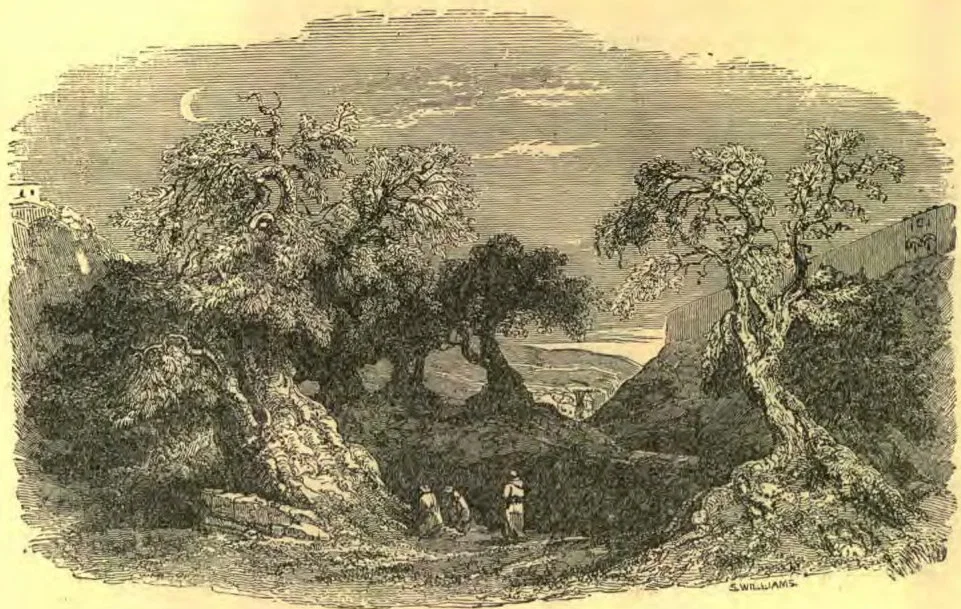
The so-called garden of Gethsemane is a retired place; containing about half an acre of land, on the western side of Mount Olivet, and commanding a full view of the city of Jerusalem. It was called “a garden,” though it was probably a grove, laid out in walks and furnished with fountains, affording shade and seclusion to those who resorted thither from the noise and distraction of the city. It is at present a plot of ground nearly square and inclosed by an ordinary stone wall, which the Latin monks at Jerusalem have built. In the garden are several venerable olive trees—some of which are shown in the view given in the picture—with stones thrown together around their trunks; and the monks have of late years planted it with trees, laid out hedges and flower-beds, and seem disposed to make it like a modern pleasure ground rather than the secluded spot one naturally supposes it was when the Saviour retired thither with his disciples on that mournful night of his agony.
But whether this is the real site of the garden of Gethsemane is a matter of question among travelers. Dr. Robinson says: “There is nothing peculiar in this plot to mark it as Gethsemane, for adjacent to it are other similar inclosures, and many olive trees equally old.” “But,” says he further, “giving myself up to the impressions of the moment, I sat down here for a time alone beneath one of the aged trees. All was silent and solitary around; only a herd of goats were feeding not far off, and a few flocks of sheep grazing on the side of the mountain. High above, towered the dead walls of the city, through which there penetrated no sound of human life. It was almost like the stillness and loneliness of the desert. Here, or at least not far off, the Saviour endured that ‘agony and bloody sweat’ which was connected with the redemption of the world; and here in deep submission he prayed, ‘O my Father, if this cup may not pass away from me except I drink it, thy will be done!’”
If the present garden be the true site of Gethsemane, in no place on the earth, perhaps, would reverential silence be more becoming than here, where the Son of God was crushed to the earth in that mysterious agony. “He trod the wine-press alone, and of the people there was none with him.” Though we cannot comprehend the full significance of that hour, we can meditate in wonder, and adore.
“’Tis midnight; in the garden now The suffering Saviour prays alone.”
“’Tis midnight; and from all removed, The Saviour wrestles lone with fears; E’en that disciple whom he loved Heeds not his Master’s grief and tears.”
“’Tis midnight; and for others’ guilt The Man of Sorrows weeps in blood; Yet he that hath in anguish knelt Is not forsaken by his God.”
E. B.

PHIL HARMON'S CROSS.

THERE was a bustle of putting away books and arranging desks in preparation for the closing bell at school in the little, square, red school-house with its four-roofed, pointed top, looking just for all the world as if it had been dropped down sometime by the hand of some mighty giant between the two hills that lifted themselves proudly upon either side of it.
By the way, what capital hills they were for sliding in the sharp winter days when childhood's young blood ran so warmly through the veins that Jack Frost and all his attendants were defied. Jennie Green's dinner pail sat beside her, ready to be taken home, and the teacher himself was putting away books, cleaning chalk marks from the black-board and arranging his own desk. Nellie Cashman's mittens lay meekly in her lap beneath the folded hands that were ready to take them as soon as the bell should sound! So also were Phil Harmon's books and slate lying on the top of his desk as if to be taken home, and many eyes turned his way as if by intuition they understood that something sad was going to happen. And sure enough there was, for Phil's father was very ill, unable to work, and his mother had been obliged to decide to take him from school to assist her. Phil was a great favorite at school, as elsewhere, and all the day had seemed a sober one, not only to scholars but teacher, because it was to be Phil's last with them.
He was very sorry to leave, for he loved his books, was an excellent scholar, and hated to get behind his mates in his studies; but he had something to help him bear his disappointment, for only a month ago the Saviour had called him, and he had given himself to him, and this had brought a joy to his heart that lightened and brightened everything.
He had been praying that the Lord would make him useful, and had thought that perhaps, if he got on well with his studies, the way might by-and-by open for him to be a preacher and a teacher of heavenly things, like dear old Parson Blethen, who had pointed him to the Saviour. But duty and usefulness seemed to lie in another pathway just now, and he felt that it should be a pleasure to him to aid his dear parents in their time of need.
And yet he longed to do something for his Saviour right here among his mates before he left them. He had been thinking it over and over, and his plans were as yet very indefinite. He thought he would like to have a meeting of prayer there after school, but something said to him, “Everybody will laugh to see little Phil Harmon start a prayer-meeting.” How he wished the teacher would happen to suggest just this thing he wanted so much.
Another voice seemed to say, “You wanted to work for Jesus, and do you refuse to do this little thing to help him?” That settled it. He folded his hands tighter, and firmly pressed his lips together, as much as to say, Nothing shall tempt me again.
Just now the bell rings, and he hastens to the teacher's side, and with tremulous lips, asks him if he would object to their having a little “good-bye meeting,” as he called it, and a season of prayer, and if the teacher approved of it, if he would be so kind as to ask the scholars to remain for a few minutes.
The teacher entered heartily into the arrangement, for he was a good Christian himself, and seeing how great was the cross dear little Phil was taking, he introduced the matter for him, and prayed and talked with them, singing also some old, familiar pieces that all could join in; then he asked others to pray, and Phil took the precious opportunity in a few words to present his mates to the dear Saviour he so much loved.
He seemed to forget himself and his embarrassment, and prayed as if he knew the answer would come.
And how else should a Christian pray, to whom the promise is, “Whatsoever ye shall ask the Father in my name, he will give it you?” Many tears were shed, and some hearts taught to pray, who had never before prayed in very truth.
At the close, the teacher asked any to rise who wished to be Christians, and ten stood upon their feet. The interest was so great that the teacher decided to appoint another meeting, and another, and another, and the little fire spread until it reached all the churches in town, and many learned to love the Saviour.
Three of these afterward became ministers of the gospel, as did also little Phil, whose father at length recovered, and was able to help him to a liberal education.
Eternity alone can measure the result of that first meeting. Who can tell how much would have been lost to Heaven had Phil listened to the tempter, and refused to bear the cross that night for his Heavenly Father? —The Little Star.

TRIFLES

Only a white feather, downy and fair, Drifting along on the pure, balmy air; But a little bird sees it while winging her way Down to the orchard with May bloom so gay. She catches it up with her tiny brown bill, And, chattering soft to herself all the while, Says she, “Ah, this comes just in time To help make a home for those birdies of mine.”
Only a blossom, so fairy and sweet, Peeping from brown leaves under one’s feet That with tint of the sea-shell and glossy green Heralds the coming of our welcome spring. But the invalid, on her couch of pain, Sighing because health comes not again, Smiles as she kisses the blossom so fair, And a brighter look her pale face will wear.
Only a violet, heavenly blue, Lifting its modest, sweet face to you; Only a violet—yet if you go Down to the place where those you loved so Are laid, with blue eyes lifted up, Holding a tear in each tiny cup, Somehow they ease your heart of its pain, And leave there a ray of sunshine again.
Only a slender, worn circlet so old, But brilliants rare and nuggets of gold Could never buy the wee simple thing. ’T was placed on your hand in life’s happy spring By one who, almost before manhood’s prime, With tears in his voice, said good-by for all time. Only a turf, but it hides from our view The fond and loving, the brave heart and true.
Only an angry word hastily spoken, But oft, so often, a heart it has broken. Only a tear-drop shed by a friend, But the memory of it never will end. Trifles make up the sum of our life,— Wee bits of pleasure, pain, and of strife, Glimpses of happiness seen through a cloud, Rifts in the darkness enfolding us round.
—Selected.

MOZART

Doubtless all the readers of the INSTRUCTOR have heard of the wonderful musician, Wolfgang Amadeus Mozart. He was born in Salzberg, Germany, Jan. 27, 1756. Wolfgang, or Woferl, as he was familiarly called, had a sister Nannerl, five years older than himself. When very young, both these children showed evidence of great musical capabilities.
Woferl wrote some music in his exercise book when only five years old, and once his father surprised him while composing a concerto so difficult that no one in the world could have played it. His sister, too, made extraordinary progress in music; and when they were six and ten years of age, their father began to travel with them, “to let the world see,” he said, “these wonders of God.”
In his sixth year, young Mozart learned to play the violin, and soon after that, the organ. In Heidelberg, Woferl’s little feet flew about on the pedals so rapidly that the clergyman made a record of it on the organ itself.
In 1764, he visited London, where he was enthusiastically received. His first symphonies were written during this long stay here. After this journey with his father and sister, which lasted two years, he returned to Salzberg. He had kept a diary during the whole of his journey, and the lessons he learned from his contact with so many different nations and styles of music, were of the greatest benefit to him in after years.
Mozart was a Roman Catholic, but a good Christian, and when twelve years old, he conducted a solemn mass at the consecration of a church. At the same time the Emperor Joseph of Italy engaged him to write an opera, La Finta Semplice, “Simulated Simplicity.” This opera awoke much malicious envy among his fellow-musicians, which caused him great sorrow, and helped to bring his life to an early close.
From this time until he was twenty years old, he wrote music and studied the art among the different nations; and ere long his fame was world-wide.
Now he had learned all there was to be learned from the masters, and henceforth he must dispense his gifts to the world. He composed many operas and other instrumental pieces, among which was his crowning work, Figaro. His biographer, Louis Nohl, says of this opera, “In it we have a perfect whole, a gem which shines with dazzling brightness.” It was first acted in Vienna, Italy, and the hearers, “intoxicated with pleasure,” cried “bravo! bravo! maestro! Long live the great Mozart!” Nohl says,— “Never was there greater triumph than that of Mozart and his Figaro.”
On the 28th of May, 1787, he lost his beloved father, and from this time he grew more sad and meditative, and wrote many touchingly sad pieces about death and the better life beyond. His last effort was the Requiem, a funeral dirge, but he died before it was completed. One of his pupils, however, finished it according to the instructions Mozart had given him before his death, and it was sung at his own funeral.
Thus ended the life of one of the greatest and grandest men that ever lived. And when Jesus shall call his sleeping ones from their lowly graves, I hope to see Mozart, and hear from his own lips the grand music that has died away in the mists of time.
MARY A. STEWARD.

THE QUEEN OF HOME.

Honor the dear old mother. Time has scattered snowy flakes on her brows, plowed deep furrows on her cheeks; but is she not sweet and beautiful yet? The lips are thin and shrunken, but those are the lips which have kissed many a hot tear from the childish cheeks, and they are the sweetest lips in the world. The eye is dim, yet it glows with the soft radiance that can never fade. Ah! yes, she is a dear old mother. The sands of life are nearly run out, but feeble as she is, she will go further, and reach down lower for you than any other upon earth. You cannot enter a prison whose bars can keep her out. You cannot mount a scaffold too high for her to reach, that she may kiss and bless you in evidence of her deathless love when the world shall despise and forsake you. When it leaves you by the wayside to perish unnoticed, the dear old mother will gather you in her feeble arms and carry you home, and tell you all your virtues, until you almost forget your soul is disfigured by vices. Love her tenderly, and cheer her declining years with holy devotion.

A CARPET-RAG LESSON.

Mamie Miller gathered up a basketful of carpet-rags, and carrying them out to the big apple-tree, sat down in the shade to sew them.
The bright needle flashed in and out, the hand that drew the thread moved rapidly, and by-and-by the needle was tucked away in its cushion and the sewed rags were wound into a ball.
“It’s just like a life, as Aunt Ruth said the other day, this ball of carpet-rags. It’s made up of some very bright spots, and some very dark spots, and a great many medium spots. Mine’s been about all medium. I wonder how ’t would seem to have one great big bright spot like that long red rag in there. Some lives are not so hit-or-miss after all, I guess. Anyway, mine has been about one thing so far.”
“I’ll stay out here and finish these rags,” she continued, as she tucked the end into the new-made ball; “it’s ever so much nicer out here than in the house.”
Up above her the pink apple-blossoms were nodding and smiling, and the bees were humming their drowsy song. It was pleasant out there, “ever so much nicer,” as Mamie said, than in the house. Mamie’s thoughts ran on in the way of carpet-rags and lives.
“I suppose some people’s lives are just all red rags. My! that must be fine; but then I’ve heard that all brightness gets as monotonous after a while as all sober gray. I guess medium with bright spots is about the best. But, dear me! it must be awful where it is just about all black.
“I wonder if any one here in Salem has that kind of a life. Why, it must be something like that for Rachel Davis, because she’s blind. Oh dear! I never thought before how much brightness that does shut out.”
Just then Mamie raised her eyes, and saw a woman at the window of the house opposite bending over her sewing.
“Now, there’s Mrs. Rogers, she must know a good deal about the black spots. They say she has to work hard all the time to get enough to live on, and Carrie is sick so much, too. Dear! when I come to think of it, I do not know but my life has been every bit like the red rags, after all.”
At that moment something suggested last week’s golden text: “By love serve one another.”
“I’m going right over and see if I can’t do something for Mrs. Rogers that will put even a little bit of a bright spot into her life; and to-morrow I’ll run down and see Rachel Davis.”
A moment later Mrs. Rogers raised her head to welcome a bright-faced caller, and—well, no matter about the conversation which followed. It was not long, however, until the woman who had been kept too closely in the house for several weeks because she could not leave her sick child alone, had laid aside her work and was out of doors in the sunshine and fresh air, while Mamie was stationed beside the bed of the little invalid.
The next day Mamie discovered that Rachel Davis had been longing for some time to keep up with the Sabbath-school lessons, but no one seemed to have time even to read them to her, and the last quarter had gone by with scarcely a word of its lessons for her to think about. After that, Mamie’s preparation for Sabbath-school was made with the blind girl; and very often she found time to drop in to read a bright little poem or story to Rachel, which helped wonderfully to cheer the darkened life.
God gives even to children many opportunities of keeping the black and the gray from the lives of their friends by working in the brighter colors; and it is one of the best of ways to get the bright into our own lives.—William Norris Burr.

Go, Labor On; Spend and Be Spent

Go, labor on; spend and be spent, Thy joy to do the Father's will; It is the way the Master went, Should not the servant tread it still?

Be True to Yourself, Young Man

Be true to yourself at the start, young man, Be true to yourself and God; Ere you build your house, mark well the spot; Test well the ground, and build you not On the sand or the shaking sod.

A Curious Trade

There are men in New York who search for things that fall from vessels in the harbor. One of the most noted of these is the son of Henry Linesburgh, who was for fifty years acknowledged to be the best wrecker, grappler, and searcher in America, who raised 36,000 bars of railroad iron; recovered no end of anchors that were supposed to be lost; made $50 an hour for twenty hours at a stretch by fishing up eighty-four iron plates, weighing 1400 pounds each, that were made for the first iron monitor by Delamater. His son pursues the same business, having thoroughly learned where all the holes, crevices, and notches in the rocks are. Several days ago a merchant lost in the river a valuable watch, the turquoise shell chain suddenly breaking. Mr. Linesburgh went down to the slip in a row-boat and put down a pair of tongs twenty-six feet long into a hole he happened to know near the end of the pier, and fished up the watch, and sent it back to its owner. He knew the tide swept all the heavy articles into the hole when the ebb set in.

Feelings Must Deepen Into Decision

—For a few brief days the orchards are white with blossoms. They soon turn to fruit, or else float away, useless and wasted, upon the idle breeze. So will it be with present feelings. They must be deepened into decision or be entirely dissipated by delay.—Theodore Cuyler.

SCENES IN THE LIFE OF CHRIST.

LESSON 28.—THE TWELVE APOSTLES ORDAINED.

When Jesus knew that the Pharisees were laying plans to destroy him, he withdrew himself, and great multitudes followed him to hear his sayings and to be healed of their diseases. And his fame went throughout all Syria; and they brought unto him many who were possessed with devils, and those who were lunatics, and those who had the palsy; and he healed them.
His fame became so great that not only the people of Galilee, but also people from Jerusalem and other parts of Judea, from beyond Jordan, and from the region about Tyre and Sidon, hearing what great things he did, came unto him. “And he spake to his disciples, that a small ship should wait on him because of the multitude, lest they should throng him. For he had healed many; insomuch that they pressed upon him for to touch him, as many as had plagues. And unclean spirits, when they saw him, fell down before him, and cried, saying, Thou art the Son of God! And he straitly charged them that they should not make him known.” Thus he fulfilled the words of the prophet Isaiah, who said, “Behold my servant, whom I have chosen; my beloved, in whom my soul is well pleased: I will put my Spirit upon him, and he shall show judgment to the Gentiles. He shall not strive, nor cry; neither shall any man hear his voice in the streets. A bruised reed shall he not break, and smoking flax shall he not quench, till he send forth judgment unto victory. And in his name shall the Gentiles trust.”
“And it came to pass in those days, that he went up into a mountain to pray, and continued all night in prayer to God. And when it was day, he called unto him his disciples; and of them he chose twelve, whom also he named apostles.” Jesus chose these men to be with him, “that he might send them forth to preach, and to have power to heal sicknesses, and to cast out devils.” “Now the names of the twelve apostles are these; the first, Simon, who is called Peter, and Andrew his brother; James the son of Zebedee, and John his brother; Philip and Bartholomew; Thomas and Matthew the publican; James the son of Alphaeus, and Lebbeus, whose surname was Thaddeus, Simon the Canaanite, and Judas Iscariot, who also betrayed him.”

QUESTIONS.

  1. What did Jesus do when he knew that the Pharisees were laying plans to destroy him? Matt. 12: 14, 15.
  2. Who followed him?
  3. How far did the fame of Jesus spread?
  4. Who were brought to him?
  5. What did he do for them?
  6. From what countries did people come to Jesus? Mark 3: 8.
  7. What brought them from such far-off places?
  8. What did Jesus have to ask his disciples to do?
  9. Why was he obliged to do this?
  10. Why did the people press upon him so closely?
  11. What did the unclean spirits do when they saw him?
  12. What charge did he give them?
  13. Whose words did Jesus fulfill by being so quiet and modest in working his miracles? Matt. 12: 17.
  14. Where may these words be found?—Isa. 42: 1–4.
  15. Does Matthew give the words just as they are found in Isaiah?—The words are different, but the meaning is the same.
  16. What does God say in speaking of Jesus? Matt. 12: 18.
  17. What did he say he would put upon him?
  18. What did he say Jesus should do?
  19. What did he say Jesus should not do? Verse 19.
  20. Who were to trust in his name?
  21. Do these words apply to us?
  22. Where and how did Jesus spend a night in those days? Luke 6: 12.
  23. What did he do in the morning?
  24. How many of his disciples did he choose to be apostles?
  25. What were these men to do? Mark 3: 14, 15.
  26. What were their names? Matt. 10: 2–4.

SKETCHES IN THE HOLY LAND.

The following extract from Thomson’s “Land and the Book” cannot, we think, fail to interest all students of the Holy Land, although there is nothing in it specially bearing on the lessons of the week. Mr. Thomson, having spent more than forty years as a missionary in Palestine and Syria, is better prepared to speak of the country than those travelers who have given it merely a passing visit. His book is in the form of a journal, as if actually written day by day while resting from travel; and this gives to it an air of thorough reality. To those who will take the trouble as they read to look up the places referred to in the following, the picture must be very vivid:—
“The tent was never more welcome to me than at the close of this long day’s ride. I am glad we have taken it, but do not wish to repeat it. The reasons for this unusual weariness are that we have actually been in the saddle more than twelve hours, and then for the greater part of the day the ride has been in the hot and depressed region of the Dead Sea. The fact is, our visit is nearly a month too late both for pleasure and health. But the fatigue is over, and we may review at our leisure this interesting excursion.
“Among the multiplicity of sights and scenes which drew my attention hither and thither in rapid succession, only a few points have impressed their features upon my memory. In the morning I climbed to the top of the tower of the convent of Santa Saba, on the south of the ravine. From there my eyes roamed over a wilderness of rusty brown hills, the most dreary and blasted that I ever beheld. Beyond and below it was the Dead Sea, bordered on the east by the abrupt cliffs of Moab. Turning to what was beneath, the wonderful chasm of the Kidron struck me with amazement. We have seen nothing so profound or so wild in all our travels.
“The ride from Santa Saba to the Dead Sea one cannot easily forget, nor the path along the perpendicular cliffs of Wady en Nâr—Valley of Fire, as the wonderful gorge of the Kidron is called—nor the long descent into and ascent from it, nor the barren hills over which we toiled in the broiling sun for seven hours, frequently losing the path amidst tangled ravines and shelving gullies washed out of sand-hills; nor will you cease to remember the gallop over the plain after we have escaped from the perplexing network of wadies.
“I remember, also, attempting to shelter my head from the burning sun under a stunted juniper-tree at lunch time. And in my disappointment I said that if Elijah’s juniper afforded no better shade, it was not at all surprising that he requested for himself that he might die. And certainly those straggling bushes cast but a doubtful shade at all times, and lend no effectual protection against such a sun and wind as beat upon us in that wilderness. Still, the prophet slept under one, and the Bedouins do the same when wandering in the desert, where they often furnish the only shelter that can be found. Job has a curious reference to this tree in the thirtieth chapter of his remarkable dialogues. He says that those contemptible children whose fathers he would have disdained to set with the dogs of his flock, flee into the wilderness, and for want and famine “cut up mallows by the bushes, and juniper-roots for their meat.” These mallows are a coarse kind of greens, which the poor boil as a relish for their dry bread. I have often seen the children of the poor cutting them up under the hedges and by the bushes in early spring, so that this rendering seems natural and appropriate to us who reside in the country; and therefore I accept it without noticing the arguments of learned critics against it. But what sort of juniper-roots can be used for food is more than I can discover or comprehend. They are excessively bitter, and nothing but the fire will devour them. Burckhardt found the Bedouins of Sinai burning them into coal, and says that they make the best of charcoal, and throw out the most intense heat. The same thing seems to be implied in Psalms 120:4, where David threatens the false tongue with “sharp arrows of the mighty, with coals of juniper.” Perhaps the meaning of Job is, that the poor cut up mallows to eat, and juniper-roots with which to cook them. This would give a sense in accordance with the known use of these roots, and still preserve the connection with the food of the poor.
“The unexpected appearance of Mount Hermon, towering to the sky far, far up the ghor [valley of the Jordan] to the north, afforded me a practical proof that Moses could also have seen it from the mountains of Moab; nor shall I soon forget the somber and shadowy surface of the Dead Sea, nor the indescribable feeling of disappointment at the Jordan. While approaching it over that melancholy desert of soft, deep sand, I eagerly watched the line of willow-trees which marked out the course of the river, expecting it to burst on my delighted eyes at every turn; but not until we were actually on the very brink did I see water enough to fill a thimble, and when there, it was hard to believe that what I saw was the whole Jordan. Finding, however, that it was, I endeavored to reconcile my previous anticipations with the ensmalled reality by noticing the rapidity of the current and the depth of the stream.
“The surprise and disappointment are quite natural, and though one looks at the Upper Jordan a hundred times with pleasure and satisfaction, yet down here at Jericho he is always disappointed. When boys, we used to sing with enthusiasm, ‘On Jordan’s stormy banks I stand,’ and suppose that it was as large as the Ohio at least, and stormy as the North-west Passage; and something like this must have been in the mind of Watts when he applied the word ‘stormy’ to this river rambling over the low plain where everlasting summer abides. It is not an epithet which personal acquaintance would have suggested. I begin to feel that there is more fancy than fact in the costume and drapery of many of our hymns; but that is allowable perhaps. I find, however, that my traditional notions in regard to matters of fact were about equally fanciful. What, for example, becomes of one’s hereditary ideas of the celebrated fertility of the plain of Jericho? For many a mile northward from the shore of the Dead Sea, and westward from the banks of the Jordan, there is nothing but a most unprofitable extension of simmering sand, bare and barren of everything except stunted thorn-bushes and ugly black lizards.
“The day has been excessively hot, and more than all, the cultivated part of the plain has just been shorn of its luxuriant harvests, and the vegetation elsewhere has entirely dried up, except the “summer crops,” which are irrigated from ’Ain Hajla, the brook Cherith, and the fountain of Elisha. I have never seen this so entirely deserted as it is at present. Even the few inhabitants of Erîha [modern Jericho] have gone to other parts to labor, since their own harvests are already gathered. On my first visit here the whole valley was lively enough, for I was one of several thousand pilgrims drawn hither from all parts of the world to bathe in the river Jordan.”

NEW-TESTAMENT HISTORY.

LESSON 41.—REVIEW.

  1. WHERE, and under what circumstances, did Jesus perform his first miracle?
  2. What great feast did he attend soon after this?
  3. What did he do there?
  4. With what noted man did he have an interview?
  5. What fundamental truth did he teach this leader of the people?
  6. Through what part of the country did Jesus travel and teach immediately after this passover?
  7. Who accompanied him?
  8. Who was cast into prison about this time?
  9. For what cause?
  10. What occurred at Sychar, as Jesus and his disciples were on their way to Galilee?
  11. What miracle did Jesus perform on reaching Cana?
  12. Describe his visit to Nazareth.
  13. Where did he afterward fix his abode?
  14. Describe the calling of the fishermen.
  15. What miracles did Jesus perform in Capernaum about this time?
  16. What tour did he take immediately after?
  17. Which of the many miracles performed on this tour is described in the Bible?
  18. Tell how he healed the paralytic after returning to Capernaum.
  19. What disciple was called about this time?
  20. What miracle did Jesus perform on the second passover after the beginning of his public ministry?
  21. On what other occasions did the Pharisees accuse him of breaking the Sabbath?
  22. Describe the setting apart of the twelve apostles.
  23. Enumerate the most important acts of our Lord, from the sermon on the mount to the healing of Jairus’s daughter. Luke 7; 8: 1-3; Matt. 12: 22-45; Luke 11: 14-36, 12: 10; Mark 3: 19-35; Mark 4: 1-25; Luke 8: 4-18; Matt. 13: 24-53; Mark 4: 26-34; Matt. 8: 18, 23-27; Mark 4: 35-41; Luke 8: 22-25; Matt. 8: 28-34; Mark 5: 1-21; Luke 8: 26-40.
  24. As soon as Jesus had recrossed the sea from the country of the Gadarenes, what urgent demand was made upon him?
  25. What miracle did he perform while on the way to the ruler’s house?
  26. What word was brought to Jairus?
  27. What did Jesus say to the ruler?
  28. Describe the miracle which he performed on reaching the house.
  29. Describe the healing of the blind man.
  30. Tell how the dumb man was made to speak.
  31. Describe the visit which our Lord made to Nazareth about this time.
  32. What awakened his compassion as he was making his third circuit in Galilee?
  33. Describe the sending forth of the twelve disciples.
  34. What charge did Jesus give them?
  35. What success did they have on their mission?
  36. What did Herod say when he heard of the fame of Jesus?
  37. Relate the circumstances that led to the execution of John the Baptist.
  38. Tell where and how the five thousand were miraculously fed.

Covetousness and the Things We Cannot Keep

Let the covetous remember that of all the things they can grasp and hold with their greedy hands, they can take nothing along when they leave this world. “I have had many things in my hands,” said Luther, “and I have lost them all; but whatever I have been able to place in God’s, I still possess.”

A Little Boy's Answer About Where God Is
A LITTLE boy in the Sabbath-school being asked by his teacher if he could mention a place where God was not, made the following reply: “He is not in the thoughts of the wicked.”

HAPPY SUSIE.

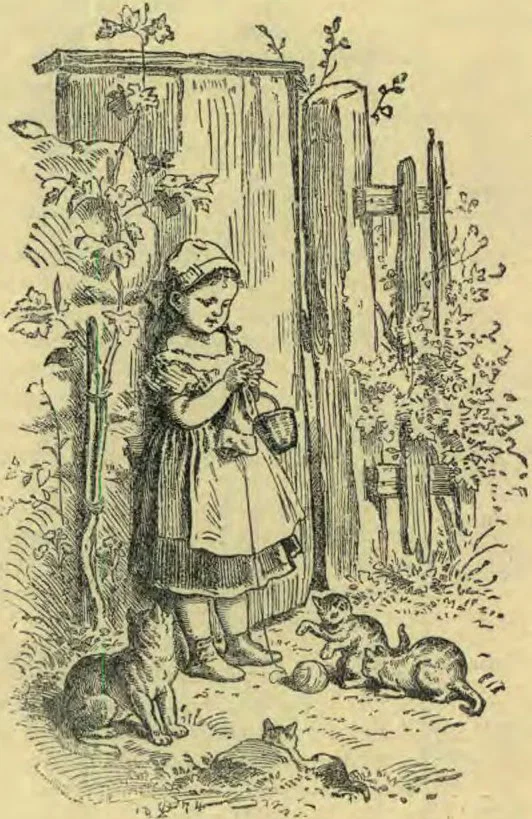
Do you really wish to know what I am doing, my dear old pussy cat?” said Susie May, as she leaned against the garden gate.
Pussy looked up at her with a “Meow” which Susie took to mean “Yes,” and she continued,
“Well! I’ll tell you, pussy-cat, I’m knitting a pair of suspenders for Grandpa Simons. You know he’s very poor, pussy cat, and he has n’t anybody to make little nice things for him; and I am going to play that I am his little grandchild, and I’m going to do ever so many things to make him happy.”
To this remark pussy said again, “Meow,” and Susie continued again:
“There, I knew that you would think it was nice, pussy. You always like to have everybody do what is right, don’t you?”
Again pussy said, “Meow.”
Just at this interesting part of the conversation, Susie dropped the ball of yarn out of her pocket, and the playful kittens flew at it, and boxed it about as only kittens can when a plaything falls within their reach.
“There, there, pussy cat. I wish you would call your kittens away.”
“Meow,” says pussy cat again, as if she were saying, “I think they are trying to help you.” At least that was what Susie thought she said, and so, like the good-natured little girl that she is, she replied,
“Well, dear little things, perhaps they are trying to help. I’d better think so, any way, and be thankful to them, and keep happy, than to get cross, and scold, and fret at them for pulling my yarn, as they box the ball about. So play away, and I will play that you are helping, and we’ll have a real good time with our play.”
So the sport went on, and kittens, cat, and little girl, all were happy in making grandfather Simons’s suspenders.—E. M. B.
Continue reading: Pleasant Letters No. 1: Crabs and a Minnow