WHEN the great Protestant Reformation came, like the breath of the morning, over Europe, papal vices and tyrannies had well-nigh suspended the last operations of civilization. Political reformers had tried to weaken the power of Rome and clear her political atmosphere, at least. The Austrian ruler had tried it and failed. The House of Hohenstaufen, imperial family of Germany, and heroes every one of them, sought to deliver the empire from the papal bondage. Henry IV. had thrown all his courage, power, and patriotism into the struggle, to humiliate Rome and save Germany the humiliation of a vassalage to the profligate popes. He bent every energy, taxed every resource, exhausted every means, and at last was compelled to bear the most shameful humiliation to which ruler was ever driven by the Papacy. In the trenches of the Italian castle of Canossa, in midwinter, barefoot, with loose garment about him, upon his knees, he spent three days and nights, imploring the forgiveness of the pope.
Political reform would not reach the case. It had to be a religious reformation. No man contributed so much to the working forces of the new era as Martin Luther, the honest monk. The sixteenth century was fairly begun when from the ranks of the common people came this leader, who was to usher in the mightiest moral and political reformation the world had known, while he was to become one of the most monumental men of all the centuries. Carlyle’s estimate of Luther is no less true to history than it is matchless in elegance: “I will call Luther a true, great man—great in intellect, in courage, in affection, and integrity; one of our most lovable and precious men. Hero and prophet, a true son of nature and fact, for whom these centuries, and many that are yet to come, will be thankful to Heaven.”
I must take no time for the highly interesting incidents of his boyhood, home, and education. He one day found a Bible, read it, began to think, to see, to feel, and the thunderbolt which Europe needed was being forged. Then came a journey to Rome. Some difficulty had arisen in one of the monastic orders, and he was deputized to Rome to settle it. On his way to the papal capital he lodged in a convent in Lombardy. He was amazed at the magnificence of the apartments, the richness of the dresses, and the delicacy of the viands. Marble, silk, and luxury all about him—and his heart sinks.
In Rome he was startled at the profane and heartless way in which the sacraments were celebrated, and at the jokes and buffoonery of the prelates, while he was profoundly shocked at the evident hypocrisy displayed at the mass. He listened to abominations, profanities, and blasphemies he had never dreamed possible with any class. He says, “It is incredible what sins and atrocities are committed in Rome.” The excessive corruption of the papal society must have been so general and obtrusive as to convince him of the fundamental evil of the Papacy. “If there be a hell,” he writes, “Rome is built above it; it is an abyss from whence all sins proceed.”
One day while in Rome, Luther ascended Pilate’s stairway on his knees, as was the custom. But his thoughts were on the light he had received out of the Bible. Suddenly a voice seemed to say to him, “The just shall live by faith.” He sprang to his feet and fled from the place of such folly.
Luther’s heart was right when he went to Rome; now his conscience was aroused. The great truth of justification by faith, which is one of the mighty foundation stones of living Christianity, which flooded his soul with marvelous light, awoke his whole moral being.
Then the pope opened in Germany the great market for the sale of indulgences. This merchandise was simply a traffic in sins. The people believed that as soon as their money was given they were certain of forgiveness, and by the same means they could deliver the souls of their dead friends from the fires of purgatory.
When Luther first heard of the work of the auctioneer of these indulgences in Germany, he exclaimed, “God willing, I will make a hole in his drum.” He did. One day a number of persons came to him to confess their sins. They confessed to the grossest vices and the most enormous crimes. He rebuked and instructed them. His astonishment increased when they declared that they did not intend to abandon any of their sins, and boldly produced their certificates of pardon which they had received for money paid. Luther at once went into the pulpit and delivered a powerful sermon. It was circulated throughout the empire. It brought on a storm.
It was while that storm was brewing that Luther determined upon a bold thing. He determined to cast himself into the conflict, and stand between the people and the shameful impositions practiced upon them under the sanction of the pope. He threw down the gauge of battle when, on the memorable evening of October 31, 1517, he went to the cathedral door at Wittenberg and nailed to the panel thirty-five arguments against the corruptions and errors of Rome. It was practically an impeachment of the papal authority.
The most stupendous moral struggle the world ever felt was on. Luther became the great teacher of national independence. The pope excommunicated Luther. The people burned the bull. Luther addressed an affectionate letter to the pope, promising such obedience as was right in scriptural things. But he was the keeper of his own conscience. The whole power of the Papacy was called into play to crush him. The work of the papal envoy and the story of Augsburg and Worms are familiar to all.
From the whole line of Rome’s fortifications, persecution poured its galling fire. But persecution failed, as did all the arguments of Romish doctors and nuncios. Luther successfully controverted the right of Rome to rule above the conscience in the church, or above the state in public affairs. He led the church into the light of a spiritual faith and scriptural doctrine. Martin Luther is the crowning glory of the Reformation.
Boston, Mass.
The Nature of the Millennial Reign
By J. G. Matteson
THE MILLENNIAL REIGN. NO. 2.
BY ELDER J. G. MATTESON.
The Nature of the Millennial Reign.
We have seen that the saints shall reign with Christ a thousand years, and that they shall reign with him in the everlasting kingdom, of which “there shall be no end.” Now since this reign begins when the saints of the Most High receive the kingdom with Christ, and sit with him in his throne (Rev. 3:21), then the millennial reign must be distinguished from the other part of this reign by some difference in its nature; and we will find that the most distinguishing feature is that the saints during this time sit on thrones of judgment with Christ:—
“And I saw thrones, and they sat upon them, and judgment was given unto them; and I saw the souls of them that were beheaded for the witness of Jesus, and for the word of God, and which had not worshiped the beast, neither his image, neither had received his mark upon their foreheads, or in their hands; and they lived and reigned with Christ a thousand years.” Rev. 20: 4.
The work here spoken of, which is given to the saints during the millennial reign, is to sit in judgment, not to preach the Gospel. This being the only time when such a work is given to them, it must be the time when the saints shall judge the world. 1 Cor. 6: 2. Then shall the saints be joyful in glory; and when the judgment is finished and written, they shall share with Christ in executing upon the people the judgment written. Ps. 149: 5-9.
This judgment cannot be in the time of probation, for men must first finish their probation, and do all the works, and speak all the words, for which they must give an account, before they can be judged for these actions. Neither can this judgment be in session after the thousand years throughout eternity, for then there would never be any restitution when God would make all things new. Rev. 21: 4, 5. But if this judgment cannot be before the thousand years, during the time of probation, neither after the thousand years, during the new earth state, then it must be during the thousand years. And this is plainly stated in the Holy Scriptures. Thus the judgment is the main feature of the millennial reign.
The saints who sit in judgment reign with Christ. “But the rest of the dead lived not again until the thousand years were finished. This is the first resurrection. Blessed and holy is he that hath part in the first resurrection; on such the second death hath no power, but they shall be priests of God and of Christ, and shall reign with him a thousand years.” Rev. 20: 5, 6.
All the saints have part in the first resurrection. The judgment begins with it, and all have part in the judgment, and they continue to have part in it until it is finished. The same persons who judge and reign with Christ at the beginning of the thousand years, continue to reign with him until the close of that time. And there is no evidence that any one later on is added to their number. Only those who have part in the first resurrection can have part in the millennial reign and judgment. No new convert is gained during this time, for the number of the saved is made up at the beginning.
In the whole chapter there is not found the least hint that the saints shall preach the Gospel, or that any one during that time is converted. The last part of the chapter speaks also very plainly of the judgment, and of that only:—
“And I saw the dead, small and great, stand before God; and the books were opened; and another book was opened, which is the book of life; and the dead were judged out of those things which were written in the books, according to their works. And the sea gave up the dead which were in it; and death and hell delivered up the dead which were in them; and they were judged every man according to their works. And death and hell were cast into the lake of fire. This is the second death. And whosoever was not found written in the book of life was cast into the lake of fire. Rev. 20: 12-15.
The subject of Revelation 20 is indeed important and glorious; and it is easily seen that the main subject is the judgment in connection with the heavenly reign of the saints.
Events Distinguishing the Beginning of the Eternal Reign of the Saints.
We have already seen that the millennial reign begins at the same time with the eternal reign, and that it is the first part thereof. Only two general resurrections are mentioned in the Bible. “There shall be a resurrection of the dead, both of the just and unjust.” Acts 24: 15. All that are in the graves shall hear the voice of the Son of God, and come forth; “they that have done good, unto the resurrection of life; and they that have done evil, unto the resurrection of damnation.” John 5: 28, 29.
The resurrection of the just is the first in order; the resurrection of the unjust is the second. The eternal reign and the millennial reign both begin with the first resurrection; consequently the same events distinguish the beginning of both.
The Lord himself shall descend from heaven, and the dead in Christ shall rise first. Then the living saints are changed, and all the righteous, clothed with immortality, ascend to meet the Lord. 1 Thess. 4: 16, 17; 1 Cor. 15: 51-53. The wicked shall also see Christ when he comes; but they will call upon rocks and mountains to fall upon them and hide them from the presence and the wrath of the Lamb, who is then revealed in flaming fire, sitting on his glorious throne. Rev. 6: 16, 17.
The voice of the Lord shall shake once more, “not the earth only, but also heaven.” Heb. 12: 26. “The Lord also shall roar out of Zion, and utter his voice from Jerusalem; and the heavens and the earth shall shake; but the Lord will be the hope of his people, and the strength of the children of Israel.” Joel 3: 16. The psalmist says: “Our God shall come, and shall not keep silence; a fire shall devour before him, and it shall be very tempestuous round about him. He shall call to the heavens from above, and to the earth, that he may judge his people.” Ps. 50: 3, 4.
Then the Lord shall send his angels with a great sound of a trumpet, and they shall gather his elect. Matt. 24: 31. But all the wicked inhabitants of the earth shall perish when the great whirlwind of destruction breaks loose. Jer. 25: 30-32. Then the day of the Lord will come as a thief in the night, with sudden destruction upon all who say, “Peace and safety,” and neglect to watch. 1 Thess. 5: 2, 3; Mark 13: 34-37.
Another wonderful event, transpiring at the beginning of the thousand years, is the binding of Satan, after which he is cast into the bottomless pit until the end of the millennial reign. Rev. 20: 1-3. The bottomless pit or abyss is evidently the same as the “deep” spoken of in the beginning. Gen. 1: 2. The Greek has the word abussos in both places. In the Danish translation we find abyss (afgrunden) in both places.
In the beginning of the first day of creation the earth was an abyss, without form and void. It was still in its chaotic condition, and there was darkness upon the face of the deep. Gen. 1: 1, 2. When Christ comes the second time, and the wicked are destroyed, the earth will return to this chaotic condition, until, at the end of the thousand years, the new earth comes forth from the darkness of the old, to shine with everlasting light.
Of the final desolate condition of the earth the prophet says, “I beheld the earth, and, lo, it was without form, and void; and the heavens, and they had no light.” Jer. 4: 23. Many other texts speak of this desolate condition of the earth.
No one will insist that the great chain used for the binding of Satan is a literal chain of iron or copper, any more than that the key of the bottomless pit is a key of iron. These terms are figurative, and they simply show that the activity of Satan is checked. He is bound by the wonderful things which are transpiring at this time. They form a chain of events which surrounds him in such a manner that he can no more tempt the children of God or deceive and lead the wicked.
(To be continued.)
Sydney, N. S. W
By Elder G. T. Wilson
THE WORK OF THE HOLY SPIRIT. NO. I.
BY ELDER G. T. WILSON.
“HAVE ye received the Holy Ghost since ye believed?” Acts 19:2. This is an important question, and one which we should be able to answer in the affirmative. Christ has said, “Ye shall receive power, after that the Holy Ghost is come upon you; and ye shall be witnesses unto me.” Acts 1:8. He has also declared, “Without me ye can do nothing.” John 15:5. The apostle Paul tells us that “if any man have not the Spirit of Christ, he is none of his.” Rom. 8:9. By studying the Bible only a little it will be seen that God is anxious for each believer to have the Holy Spirit, and know its power, and become a living witness for our Lord and Saviour.
The promise of the Spirit has been given: “If ye love me, keep my commandments. And I will pray the Father, and he shall give you another Comforter, that he may abide with you forever; even the Spirit of truth; whom the world cannot receive, because it seeth him not, neither knoweth him; but ye know him; for he dwelleth with you, and shall be in you.” John 14:15-17. This is the promise of the Spirit. But some seem to think that the Holy Ghost is only to be given to certain ones among believers, and is not intended for all who would follow our Redeemer. It is needed by everyone, and may be received by us all, if we will yield to its operations. “The Spirit indeed is willing, but the flesh is weak,” and fails in many cases to let the Holy Spirit have its course. How much we all need its help! It is needed to convict us of sin, and reveal our secret sins, that we may see our sinfulness.
The Holy Spirit is the oil which lights the lamp of God’s law, and throws its piercing rays into the darkest chamber of the soul, showing all its idols and filthiness. See John 16:7, 8; Heb. 4:12, 13. “When he is7come, he will reprove [“convince,” margin] the world of sin,” and yet draw to the Father at the same time, if the soul yield to that drawing. Shall we not say, “Draw me, and I will run after thee”? It is not happy flights of feeling for which we are to pray, because “we walk by faith,” not by sight, and “the just shall live by faith,” not by feeling. It may fill us with shame to have our sins and errors exposed, but if we confess and forsake them, would it not be the means of placing us where the Holy Spirit may come as a comforter instead of a reprover, abiding in the soul that has been cleansed from all defilement.
When the rays of the Sun of Righteousness have pierced the heart, we may heed the words of the Spirit of truth, “Repent, and be baptized every one of you in the name of Jesus Christ for the remission of sins, and ye shall receive the gift of the Holy Ghost. For the promise is unto you, and to your children, and to all that are afar off, even as many as the Lord our God shall call.” Acts 2: 38, 39. For whom is the promise of the Holy Spirit given? Please mark the answer: “The promise is unto you, and to your children, and to all that are afar off, even as many as the Lord our God shall call.” We see by these words that the Spirit of Christ is intended to be given to every soul who receives Jesus as his Saviour. Blessed assurance! Shall we not all eagerly embrace it, receive of its fullness, be taught, guided, and comforted by this all-powerful agent? We are the instruments through which the Spirit acts to accomplish the purpose of God. We are not to receive the Spirit to use it, but it is to come unto us to control and work in us to magnify the Lord among men. By its power we are born again, and transformed into Christ’s likeness. Then how pertinent the question, “Have ye received the Holy Ghost since ye believed?” Those to whom this question was first asked, answered, “We have not so much as heard whether there be any Holy Ghost.” Acts 19:2. The reason they did not receive the Spirit was because of their ignorance of it, and its operations. “Who had been teaching these men down at Ephesus what they knew of religion?—That eloquent man called Apollos, mighty in the Scriptures, and full of spiritual zeal. He taught the Gospel as far as he knew it, but he did not have it in the latest phase of its developments, which had come through the many fulfilments of prophecy since the days of John the Baptist.
This case illustrates the fact that ministers may, like Apollos, be learned, mighty in their knowledge of the Bible, zealous workers, and yet leave their converts ignorant of the very power with which they should be best acquainted. They may themselves need that some Aquilla and Priscilla take them in and expound unto them the way of God more perfectly. The believers whom Apollos had brought out, when Paul met them, were as eager for more light and as ready to receive it as was Apollos, and accepted the latest phase of the Gospel as taught by the apostle to the gentiles. They readily accepted Jesus as their Saviour, were baptized in his name, and received the gift of the Holy Ghost. What a noble example of godly sincerity is seen in these men at Ephesus; and may we like them accept the truth as it comes to us, walk in the light, and become the instruments of the Holy Ghost as did they, to show forth the praises of our Redeemer!
Sydney, N. S. W
DOUBT AND MURDER.
By Ellet Joseph Waggoner
BY ELDER E. J. WAGGONER.
When Jesus read the prophecy of Isaiah, in the synagogue at Nazareth, and began to say to the people, whose eyes were fastened upon him, “This day is this scripture fulfilled in your ears,” they “all bare him witness, and wondered at the gracious words which proceeded out of his mouth.” Luke 4: 21, 22. The Spirit of the Lord was indeed upon him, and as the result his words produced conviction. Involuntarily they responded to the power of the Spirit.
Then came in another feeling. They said, “Is not this Joseph’s son?” They gave place to doubt. True, the words which Jesus had read and spoken had come with the force of the Holy Spirit, and they had acknowledged their gracious power; but they could not make the gracious words harmonize with their reason and experience, and so they lost the blessing.
The same thing is repeated again and again in these days. People hear burning words of truth, which cause their own hearts to burn in response, and then doubt comes in under the guise of “prudence” and “caution.” “We must not be too quick to accept new things,” “Have any of the rulers or of the Pharisees believed on him?” “We will not commit ourselves until we see how this thing is going to turn,” “We cannot be too cautious”—these and many other things hold many people back from following the convictions produced by the Holy Spirit. Looking at the matter from a worldly critical point of view, they conclude that the influence of the Spirit was only a sudden impulse, which it would be most unwise to yield to. They are confirmed in this view by the fact that, as the result of their unbelieving calculation, the Spirit’s voice has been silenced, and they no longer feel that response in their hearts to the words of truth. And thus carnal wisdom proves their ruin.
But this is not the end. The Gospel narrative tells us that the very people who at first bore witness to the gracious words of Jesus, seized him a few minutes later, and attempted to throw him down headlong from a precipice. Murder was in their hearts. That they did not kill Jesus was only because they had not the power.
What caused this change?—Nothing but the cherishing of a single doubt. Here is a warning for those who think that doubt is a trivial matter. Every doubt has murder concealed in it. Those doubts which seem so perfectly “natural” that you scarcely call them doubts, but only the manifestation of proper “caution,” are the things which, if cherished, will place you in the front ranks of those who cry, “Crucify him.” It is not a light thing to doubt the witness of the Spirit of God. One of the things which made David a man after God’s own heart, was the fact that he “made haste, and delayed not” to keep the commandments of God, when they were made known to him. Ps. 119: 60. Take heed not to quench the Spirit by doubt.
DEPTH OF MERCY.
By Charles Wesley
DEPTH of mercy! Can there be
Mercy still reserved for me?
Can my God his wrath forbear—
Me, the chief of sinners, spare?
I have long withstood his grace,
Long provoked him to his face,
Would not hearken to his calls,
Grieved him by a thousand falls.
Now incline me to repent;
Let me now my sins lament,
Now my foul revolt deplore,
Weep, believe, and sin no more.
Kindled his relentings are;
Me he now delights to spare,
Cries, “How shall I give thee up?”
Lets the lifted thunder drop.
There for me the Saviour stands,
Shows his wounds and spreads his hands.
God is love, I know, I feel.
Jesus weeps, and loves me still.
—Charles Wesley.
THE PSALMS AND THE LOVE OF NATURE
By James Stalker, D.D.
The careful study of the Psalms will promote the development of some parts of piety which are apt to be neglected. Among these is the religious contemplation of nature. Spiritual as the Psalms are—and they are intensely spiritual—their spirituality is not solely associated, as perhaps it is in some minds, with gathered congregations and crowded meetings. They do not smell, as do some of the productions with which our spirituality is stimulated, of the midnight oil and the musty study.
They were written by men who lived in the open air. David sang some of them to his harp in the fields of Bethlehem, when the flocks were resting at noon; others of them rushed through his stormy heart when he was in flight from Saul, like a partridge upon the mountains of Judea. They are full of sunshine and breezy fresh air, and all the sights and sounds of the country. One is a description of the royal course through the heavens of the sun by day; another is a soliloquy beneath the starry heavens at night. One of great sublimity is a word picture of the successive phases of a thunderstorm, and there are several which may be panoramic scene paintings of the whole field of nature. Besides those thus expressly devoted to the description of nature, there are scattered all over the book glimpses of scenery and sketches of natural objects which show how deeply the psalmist had drunk at the well of pleasure supplied in the scenery of his native land.—James Stalker, D.D.
Faithfulness in Present Duty Leads to Promotion
If you are ambitious to be promoted, the surest way is to be very faithful and efficient where you are. To shirk and neglect duty because you imagine that you ought to be in a higher place, may be an effectual means of getting out of your present position, but it is not a sure way of reaching a more honorable one. “Whatsoever thy hand findeth to do, do it with thy might.”
A Fairer World Above: Setting Christ Before Us
“It is an important principle that none can tread the world beneath their feet until they see a fairer world above their heads. When the Lord Jesus, in all his love and grace, is set before us, our eyes are dim to lower objects. The beauty of the all-beauteous One makes other loveliness unlovely.”
Filled With Love and Longing to Do Right
By Phillips Brooks
JESUS did not spend his life in trying not to do wrong. He was too full of the earnest love and longing to do right—to do his Father’s will.—Phillips Brooks.
LESSON IN GRAMMAR.
Careless habits of speech are among the prominent faults of our young people, even those young people who have advantages of schools and intelligent home surroundings. Recognizing this, the professor of English literature at Wellesley College has prepared a list of “words, phrases, and expressions to be avoided,” from which the young (and old) readers will receive many serviceable hints: Guess, for suppose or think. Fix, for arrange or prepare. Ride and drive, interchangeably. (Americanism.) Real, as an adverb, in expressions real good, for really or very good, etc. Some, or any, in an adverbial sense, for example, “I have studied some,” for somewhat. “I have not studied any,” for not at all. Some ten days, for about ten days. Not as I know, for not that I know. Storms, for it rains or snows moderately. Try an experiment, for make an experiment. Singular105subject with contracted plural verb; for example, “She don't skate well.” Plural pronoun with singular antecedent: “Every man or woman should do their duty;” or, “If you look anyone straight in the face, they will flinch.” Expect, for suspect. First-rate, as an adverb. Nice, indiscriminately. (Real nice may be doubly faulty.) Had rather, for would rather. Had better, for would better. Right away, for immediately. Party, for person. Promise, for assure. Posted, for informed. Post graduate, for graduate. Depot, for station. Stopping, for staying. Try and do, for try to do. Try and go, for try to go. Cunning, for small, dainty. Cute, for acute. Funny, for odd or unusual. Above, for foregoing, more than, or beyond. Does it look good enough, for well enough. Somebody else's, for somebody's else. Like I do, for as I do. Not as good as, for not so good as. Feel badly, for feel bad. Feel good, for feel well. Between seven, for among seven. Seldom or ever, for seldom if ever, or seldom or never. Taste and smell of, when used transitively. Illustration: We taste a dish which tastes of pepper. More than you think for, for more than you think. These kind, for this kind. Nicely, in response to an inquiry for health. Healthy, for wholesome. Just as soon, for just as lief. Kind of, to indicate a moderate degree. The matter of, for the matter with.—Boston Transcript.
YELLOWSTONE PARK.
By Walter Harper
BY WALTER HARPER.
On the forenoon of Thursday, September 27, 1894, after having spent the previous day in preparation, getting a suitable private conveyance, I, in company with Mr. A. T. French, begun what had been for years a cherished desire,—the tour of the wonderland of earth—Yellowstone National Park. It was getting rather late in the season for such a trip, for in that vast elevated region the snows begin quite early and continue till late in the spring; in fact, as late as June the early visitors encounter in places almost impassable drifts of snow. But I knew that if I did not avail myself of the present opportunity, it was highly probable that another would never be presented.
I spent some seven or eight days on the trip, and even then the weather was uncomfortably cold. On the night of September 30 it began snowing quite hard, and for the next two days we encountered quite a fall of snow. This trip necessitated traveling about one hundred and fifty miles, and even then we could see but a small portion of the park, as its area is nearly five thousand square miles.
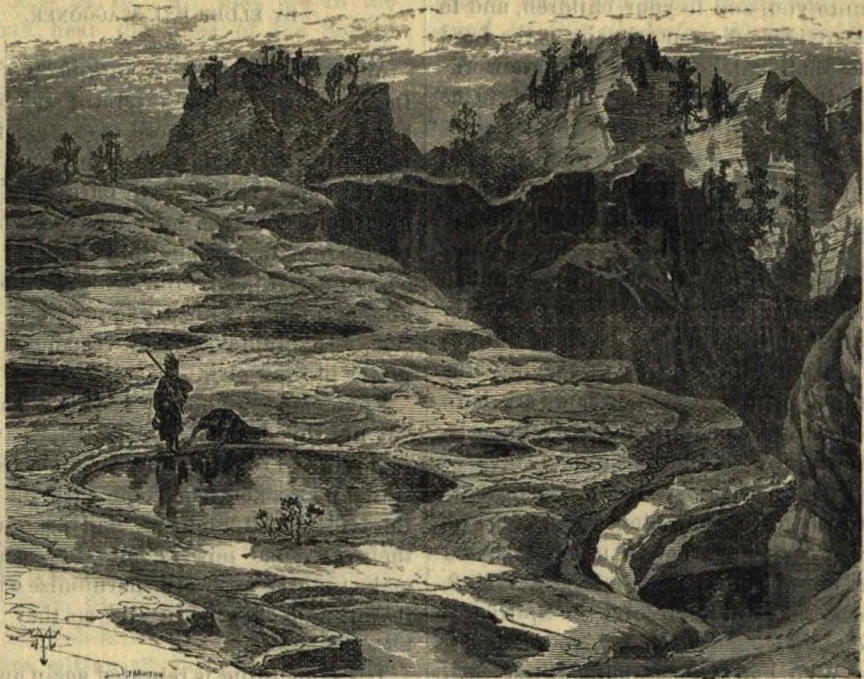
Hot Springs, Yellowstone National Park.
Wild game is abundant in the park, notably elk, deer, bear, bison, antelope, etc., and the lakes and rivers teem with the finny tribe. No one is allowed to shoot or molest any of the wild animals; in fact, firearms are not even allowed in the park, except under the most restricted conditions, but one may fish ad libitum. The bears in the park are very numerous, and as no one is permitted to harm them, they get very tame, and at times show an audacity that is surprising, and not always the most pleasant, as we can speak from experience. There are a number of the Park Association’s hotels, located at convenient distances apart, and it is the habit of bruin at some of these places to regale himself nightly with the contents of the swill barrel.
At the lunch station at Norris, Geyser Basin, where there are located during the tourist season a number of tent houses, one night during the past summer a bear invaded the quiet of the house. He came into the large dining room and had things all his own way until he was induced to leave the house. In the bustle and excitement of the occasion “Larry,” the Irish landlord, came rushing in to learn the cause of the disturbance, and came very near running over the bear before he knew that there was such a creature near. It is safe to say that he lost no time in retreating to a position of safety.
At one of the large hotels in the park, a bear entered the building during the evening, went behind the desk in the office, and climbed up into the telegraph operator’s chair. Quite often a wild bear is herded or driven around in front of a hotel for the amusement of the guests. On the night of September 30, at the outlet of Yellowstone Lake, where we had camped, it began snowing very hard, and about 1:30 A.M. we moved into a cabin near by to spend the remainder of the night. After we left our tent a bear entered it, turned things upside down, helped himself to what he wanted to eat, unloosed the fastening at one corner of our tent, and then left.
In a trip like this it is best to go in the interval from the 1st of August to the 15th of September, as sooner or later than these dates one has to meet many natural disadvantages, which makes it anything but pleasant. In a mild, open autumn there is much fine weather till about October 1, so you see the season for visiting the park is very limited. The way to see the park to the best advantage is to have a private rig, and camp out, and stop and travel at your pleasure. To see all one wants, he needs to spend from three to six weeks. This is the plan adopted by a large number, especially families, and it is said that this is the only way to see the park.
In my trip we had all necessary equipments; so we camped out, stopped where we pleased, and on Sabbath, September 29, we were camped in Upper Geyser Basin, only a few rods from “Old Faithful” Geyser, and could hear and see it from our camp. The afternoon of Sabbath, September 29, I studied my Sabbath school lesson, “Christ’s Triumphant Entry into Jerusalem,” Luke 19:28-48. I sat on one of the wooden benches for visitors, arranged at a convenient distance from and facing this grand old geyser. I could see its hourly eruptions in the bright, beautiful sunshine, whose clear rays add a charm and embellishment to the display, which makes it a vision of bewitching beauty.
Justly celebrated as is the North American Continent for mountain, woodland, lake, and seaside resorts calculated to conduce to the health and recreation of mankind, it has been left to the last quarter of the nineteenth century to roll away the barriers of inaccessibility, and dispel the mists of misinformation and skepticism that have hedged in and enshrouded the Yellowstone Park.
In general topography Yellowstone Park is a vast tableland, about seventy by seventy miles in extent, of an average elevation of about seven thousand feet above the sea, the whole environed round about by mountain spurs, whose glistening peaks, clad in eternal snow, rear their crests from three thousand to five thousand feet higher than the tableland itself.
It would be difficult indeed to find a like area presenting a greater diversity of character; and, aside from its curious hot springs and awe-inspiring geysers, the lover of the sublime in nature will find sufficient in a study of the majestic falls and the grand cañon of the Yellowstone River to amply repay a visit, to say nothing of picturesque mountain lakes, wild gorges, and dancing cascades, with which the reservation abounds.
Within the boundaries of this wondrous geyser land are upward of three thousand hot mineral springs and seventy-one active and powerful geysers, grouped in basins, which from June 1 to October 1 are daily traversed by the stages of the Yellowstone Park Association.
BABY'S COMPLIMENT.
His father and mother were both away,
And baby and I had been friends all day;
Many and gay were the games we played;
Baby ordered and I obeyed;
We cared not at all for the rainy sky,
We built up a block house three feet high;
We threw pine knots on the nursery fire,
And watched the flames mount higher and higher
We hid in the most improbable nooks;
We looked at the pictures in all his books;
We ran in “tag” till his cheeks were red
And his curls were tangled about his head;
So when the twilight was closing down
Over the fields and the woodlands brown,
And nurse declared we must say good-night,
He clung to me still in the firelight—
He trampled my gown with his rough little feet,
He climbed on my lap and kissed me sweet,
And, as he scrambled from off my knee,
“You’d make a good mama,” said baby to me.
I have had compliments, now and then,
From grown-up women and grown-up men.
Some were commonplace, some were new;
Never was one of them rung so true,
Never was one seemed half so real—
Baby compared me to his ideal.
—Selected.
HEALTH HINTS.
By C. W. Lyman
BY DR. C. W. LYMAN.
THOUSANDS of people otherwise nice in their personal habits bathe but once a week, after cold weather sets in, and others but once in ten days or two weeks. Especially is this the case in country houses heated by stoves, in which the bedrooms and the bath room, if there is one, have no provisions for being warmed. Among the less refined it is not uncommon to find that “about once a month” is the custom for bathing in winter. Some change the underclothing oftener, and some do not. But few of these abstainers use a flesh brush.
Duty or not, bathing is certainly no pleasure when floors are cold and windows frosted; the kitchen fire seems both more attractive and more beneficial. Some have conscientiously forced themselves to take frequent “cold baths,” and have found themselves not as well off as without them, and even chilly and tired for some hours. Surely some helpful suggestions are needed if winter bathing is to be made both beneficial and pleasurable.
Take, first, the case of persons in fairly good health, and having a bath room or bedroom that can be comfortably warmed. On rising from bed, or some hours after breakfast, fill the bath tub or bath pan ankle deep with water as hot as can be endured, strip, and step in, go over the body very vigorously and rapidly with a rough cloth saturated with soap. A little ammonia and alcohol make a useful addition, and help get a glow. This should bring the color fairly to the surface on chest, back, and limbs within two minutes or less. Then dip a large sponge in cool water and squeeze it out at the back of the neck, so that a sudden drench of cool water will descend over the whole body. It can be poured out from a dipper as well, if no sponge is at hand. Do this but once the first time; afterward it can be repeated five or six times, and with progressively colder water as the skin becomes educated. It should put one into a delightful glow, and not over three minutes should have passed since stepping into the hot water. Immediately step out onto a rug covered with a towel and wrap the body in a sheet, and with vigorous rubbing through the sheet dry the body instantly. Follow this by rubbing with a clean, dry crash towel, till a glow comes; dress immediately and warmly, and go out for a brisk walk.
Success will usually be found to depend on rapidity and strict adherence to the plan here presented, whether the reason of each detail is understood or not. Beginners or delicate persons can use cool instead of cold water for the drench, but merely sponging off is not to be substituted; indeed, the drench is the chief factor in the nervous effect.—Housewife’s Club.