Your ShelfYour Projects

Review and Herald, Vol. 61, No. 30.

DUTIES AND PRIVILEGES OF THE CHRISTIAN LABORER

Review and Herald

Jul 22, 1884

Seventh-day Adventist Publishing Association · Battle Creek, Mich. · Jul 22, 1884

DUTIES AND PRIVILEGES OF THE CHRISTIAN LABORER

BY MRS. E. G. WHITE.
It is a privilege to express my gratitude to God for these meetings now in the past. This is the best general meeting I have ever attended. We know that we have had the presence and blessing of God. He has breathed upon us his Holy Spirit. To me and to many others, Heaven has seemed very near; and we have been led to rejoice with joy unspeakable and full of glory.
Through the Bible-readings the truth has been brought out with clearness and power. Deeper, broader views have been taken of divine truth and of our responsibility to God. Hearts have been subdued and softened by the love of God. Through grace the capacity to understand and appreciate the truth has been enlarged; and as we continue to advance in grace, our ability will still further increase, and we shall better understand the ways of God and the plan of redemption.
Never feel that there is no need of applying yourself diligently to the study of the word. If you search for truth as for hid treasures, the Scriptures will unfold to you more and more. Many of you might be far in advance of what you now are. Young men who are just beginning to labor are in danger of thinking that because they have become familiar with a few subjects, they are qualified to present the truth anywhere. These lose much by wasting precious, golden moments that should be spent in studying the prophecies or the practical lessons of Christ.
The morning meetings have been most precious. To me they have been a continual feast,—like heavenly manna to my soul. We have met Jesus in the assembly of his people. We have learned of him; and of his willingness to receive all who come to him in humble faith, taking God at his word. We have learned that if we would receive the dew of divine grace, we must allow nothing to come between God and our souls. We have seen many obtaining such a knowledge as they never had before of the true Source of spiritual strength and moral power. I knew that Jesus was waiting to be gracious, and that my brethren feared to take his offered mercy; and I have enjoyed seeing them receive rich blessings at his hand. I have not found it difficult to rejoice with those that rejoice, and to weep with those that weep.
We have felt sad over the cases of some who have long been under the special power of the enemy. We had hoped to see them deeply impressed and converted at these meetings; but Satan spread his snare for them. For months he has been diligently working up his plans to prevent them from being present. They do not know what they have lost. Others who have been drunken with the spirit of the world, and have been entreated and reproved, did not want to be here. In view of the little time we have in which to prepare for our future home, we should not allow indifference to keep us away from such meetings, nor entanglements to arise which will make it impossible for us to attend them.
We can never forget these good meetings. But now we are about to separate, and to be widely scattered. Our ministers go to their several fields of labor refreshed and strengthened, with broader views of the love of God, and of his willingness to work with their efforts, than they have heretofore had. Sensitive persons, as they view the conflicts and trials before them, shrink from the responsibility they must bear in warning the world of the judgments that are about to come. They fear its rude touch will stain their souls. But we are none of us to be shut up as precious perfumes, lest the fragrance shall escape. We have enjoyed a Pentecostal season; we have been warmed by the love of Jesus, invigorated by the clear, firm truths of the word of God, and refreshed by the dews of divine grace, all for a purpose, that we may shed forth to the world a sweet fragrance from Eden. We have gathered divine rays of light, that they may be reflected to others in good works.
There are souls to be won to Christ. There is a great and solemn work before us to prepare the people to stand in the day of the Lord. We have but little time here, and the best use we can make of our faculties is to consecrate them to the work of God. It is the duty of every one, not only of those who occupy the position of watchmen on the walls of Zion, but of the laymen also, to do their utmost to advance the cause of God and save their fellow-men. Opposition must be met. We shall be hated of all men for Christ’s sake, and by Satan, because he knows that a divine power attends this work which will undermine his influence. But Heaven is open before us; we may take hold of divine strength. As children of God, it is our privilege and duty to come directly to him, and claim a Father’s blessing. He will give it. Iniquity abounds, and for this very reason God is willing to give more grace and reveal himself to his people.
I beseech you, do not withhold yourselves from God. We have seen of his salvation; but I have longed to hear happy souls saying, “My cup runneth over. Jesus, precious Saviour, is the crown of my rejoicing.” The moment you surrender yourself wholly to him in simple faith, Jesus accepts you, and encircles you in his arms of love. He holds you more firmly than you can grasp him. Come to the light, and triumph in God. Then shall your peace be as a river, and your “righteousness as the waves of the sea.”
[Expel sin from your hearts; for sin caused the death of the Son of God.] Let your conversation be in heaven, “from whence also we look for the Saviour, the Lord Jesus Christ.” Never forget, wherever your lot may be cast, that you are pilgrims and strangers here, journeying to a better country, even a heavenly. The talents you possess, the property God has lent you, must be used in doing good, in laying up treasure in heaven. The work which you are doing with your hand or your brain, must stand the test of the Judgment. How will it then appear? Are you acting well your part in preparing yourselves and others for glory, honor, immortality, and eternal life? Are you doing anything that you will wish undone when the books shall be opened, and you meet your deeds as they stand registered in heaven?
“Beloved, now are we the sons of God, and it doth not yet appear what we shall be; but we know that when he shall appear, we shall be like him, for we shall see him as he is.” “The world knoweth us not because it knew him not.” We are not understood by the world, we never shall be; but we must not let this discourage us. We are not to look at present appearances, nor be angry when we are misjudged, but we should improve every opportunity of doing good.
It is wise to seek humility and meekness, and to carefully avoid raising a combative spirit, thus closing ears and hearts to the truth. Hold your mouth as with a bridle when the wicked are before you. When tempted to say sarcastic things, refrain. Censure no one; condemn no one. Let the life argue for Jesus, and the lips be opened with wisdom to defend the truth. The consistent life, the long forbearance, the spirit unruffled under provocation, is always the most conclusive argument and the most solemn appeal. We are often brought into positions that are trying, where human nature longs to break forth; but in such cases be still, do not retaliate.
We must drink deeper draughts from the well of salvation. How can we possibly enter into the spirit of Christ’s teachings unless we are partakers of the divine nature? We are seeking to vindicate the law of God. We need the energy of the Holy Spirit to accompany our efforts. Never venture to enter the desk until you have wrestled with God in prayer, and come forth as seeing Him who is invisible, with your faces lighted up with beams from the Sun of Righteousness. You will then have no tame words to offer. The divine truths which glow in your own breast will kindle the hearts of others. The men who would teach others the art of success in the sacred ministry should understand that art themselves. The best way to teach youthful laborers is to do yourself what you expect them to do.
In every prayer let the hand of living faith lay hold upon infinite help. Faith is the medium by which the renewed heart is drawn close to the great heart of love. Faith elevates the sinking soul. Faith lightens every burden and relieves every weariness by the anticipation of the mansions Jesus has gone to prepare for them that love him.
Jesus is the foundation and the author and finisher of our faith. Why are we so powerless? Jesus lives; and because he lives, we shall live also. He is to us not a Saviour in Joseph’s new tomb, closed with a great stone, and sealed with the Roman seal. Mourn not as those who are hopeless and helpless; never, under any circumstances, give way to despair; but from grateful hearts, from lips touched with holy fire, let the glad song ring out, “Jesus is risen; he lives to make intercession for us.” Grasp this hope, and it will hold the soul like a sure, tried anchor. Believe, and thou shalt “see the glory of God.”
Will it make you sad to be buffeted, despised, derided, maligned of the world? It ought not; for Jesus told us just how it would be. “If the world hate you,” he says, “ye know it hated me before it hated you.” The apostle Paul, the great hero of faith, testifies: “For I reckon that the sufferings of the present time are not worthy to be compared with the glory which shall be revealed in us.” “For our light affliction, which is but for a moment, worketh for us a far more exceeding and eternal weight of glory.” Look up, my brethren, look up. Let the love of God into your souls. Through Jesus the treasures of heaven are at our command, and what is there that he will not do for us? The Father also loves us, and is waiting to be gracious. “He that spared not his own Son, but delivered him up for us all, how shall he not with him also freely give us all things?”
Are we working to proclaim truth, righteousness, and the love of God? This is the work that is assigned us. Even in bereavements we should not stop to grieve; but let us show our love for the faithful workers who have gone to their rest, by doing the work they would have done had they lived. While we do our own work, we may also take up theirs where they left it, and firmly and courageously carry forward the banner of truth to final victory.
Brethren, your aims are altogether too low. You have not used the great moral faculties of the soul,—faith, hope, and love. These powers are given us not to lie dormant, but that through their exercise the soul may be brought into harmony with heaven; but with many of you they are paralyzed through inaction, and as a consequence you are weak and helpless. Do not let your great need discourage you. The Saviour of sinners, the Friend of the friendless, with compassion infinitely greater than that of a tender mother for a loved and afflicted child, is inviting, “Look unto me, and be ye saved.” “He was wounded for our transgressions, he was bruised for our iniquities; the chastisement of our peace was upon him, and with his stripes we are healed.” We may take hold of his strength, and make peace with God. Jesus will quicken all the faculties of the soul, and impart new life and energy.
While you should make every effort to reach the highest standard of intellectual excellence, you should avoid self-sufficiency and dependence on your own ability. Learn of Jesus. He was the greatest teacher the world ever knew; yet he spoke in the language of common life. He met the necessities of all. He adapted his instruction to all times and places, to both the rich and the poor, the educated and the ignorant. He ever dwelt upon the grandest themes that can engage the attention; and he presented them in such a form, and used such illustrations, that the feeblest intellects could grasp his meaning, while the most intelligent minds were attracted and instructed.
Let us beware lest we lose the simplicity of the gospel of Christ. We must become as little children in humility, in consciousness of our own weakness. We must learn from the Divine Teacher lessons of higher wisdom than were ever taught in the most exalted schools of human institution.
There is danger of not making Christ’s teachings a personal matter, of not receiving them as though they were addressed to us personally. In his words of instruction, Jesus means me. I may appropriate to myself his merits, his death, his cleansing blood, as fully as though there were not another sinner in the world for whom Christ died. In listening to his teachings with understanding open to receive his words, we display the highest wisdom. In being doers of the word,—obeying Christ by leading self-denying lives and forming pure and holy characters,—we shall secure the life which measures with the life of God.
There are toils and conflicts and self-denials for us all. Not one will escape them. We must tread the path where Jesus leads the way, it may be in tears, in trials, in bereavements, in sorrow for sins, or in seeking for the mastery over depraved desires, unbalanced characters, and unholy tempers. It requires earnest effort to present ourselves a living sacrifice, holy and acceptable to God. It takes the entire being. There is no chamber of the mind where Satan can hold sway, and carry out his devices. Self must be crucified. Consecration, submission, and sacrifices must be made that will seem like taking the very life-blood from the heart.
When self dies, there will be awakened an intense desire for the salvation of others, which will lead to persevering efforts to do good. There will be a sowing beside all waters; and earnest supplication, importunate prayers, will enter heaven in behalf of perishing souls. There will be an earnestness, a persistency, that will not let go. Love to Jesus will lead to ardent love for the souls of our fellow-men.
Now, as we are about to separate, the question arises, shall we all meet again in General Conference? Probably we shall not; but where, then, will be our next grand meeting? and when shall we again greet each other? We have wept and rejoiced together here; but if we never meet again on earth, shall we unite our voices in songs of triumph around the great white throne? Shall we each prove worthy of the precious boon of eternal life? God grant that not one face may be missing, not one voice wanting, when the hallelujahs are sung in the courts of heaven.

CUMBERED ABOUT MUCH SERVING.

“Come ye yourselves apart, . . . and rest awhile.” Mark 6: 31.
CHRIST never asks of us such busy labor As leaves no time for resting at his feet; The waiting attitude of expectation He ofttimes counts a service most complete.
He sometimes wants our ear, our rapt attention, That he some sweetest secret may impart; 'Tis always in the time of deepest silence That heart finds fullest fellowship with heart.
We sometimes wonder why our Lord doth place us Within a sphere so narrow, so obscure, That nothing we call work can find an entrance; There's only room to suffer, to endure!
Well, God loves patience! Souls that dwell in stillness, Doing the little things, or resting quite, May just as perfectly fulfill their mission, Be just as useful in the Father's sight,
As they who grapple with some giant evil, Clearing a path that every eye may see! Our Saviour cares for cheerful acquiescence, Rather than for a busy ministry.
And yet he does love service, where 'tis given By grateful love that clothes itself in deed; But work that's done beneath the scourge of duty, Be sure to such he gives but little heed.
Then seek to please in whatsoe'er he bids thee, Whether to do, to suffer, to lie still; 'Twill matter little by what path he led us, If in it all we sought to do his will! —Standard and Home Journal.

THE TEMPLE IN HEAVEN.

AN IMAGINARY CONVERSATION ON A VERY IMPORTANT THEME.
BY ELD. W. H. LITTLEJOHN.
Mr. Biblist.—“Maud, answer the doorbell, if you please; it seems that we are to have a call this evening.”
Miss Maud.—“Father, this is Mr. Thoughtful.”
Mr. B.—“Good evening, Mr. Thoughtful. Are you well, sir?”
Mr. T.—“I am quite well, I thank you, physically speaking; but I confess to a little embarrassment of mind on account of the nature of my mission. As I approached your door, I queried whether you would not smile when you learned the character of the errand which has brought me to your house on this dark night.”
Mr. B.—“Well, neighbor Thoughtful, of course I do not know to what I am indebted for this call, but I presume that you have come for some good purpose, and I confess that your remarks have excited in me a curiosity to know just what your errand is; so you will please divulge the secret immediately.”
“Mr. T.—Well, to be frank with you, I have been reading, of late, the five books of Moses, and for some reason which I cannot explain my mind has been particularly impressed with the account given therein of the tabernacle and its service. It struck me as being very remarkable that such a building should be reared up under such circumstances, and that the Lord should have given such minute directions for the construction of even its most unimportant parts. Why! the pins, the taches, the sockets, the loops, the needlework, and indeed everything connected with the building, is described as minutely as though the fate of the whole people depended upon their being made on just such a plan.”
“Now, to be brief, I have thought this matter over until I have become satisfied that there was a significance in the tabernacle and its service that I have never understood; and knowing your acquaintance with the Scriptures, I have called this evening to see if you can give me any light upon this subject.”
Mr. B.—“Well, neighbor Thoughtful, I am glad that you have called this evening on the errand that has brought you here. Some years ago I had an experience somewhat similar to your own. For months my mind was occupied, more or less, by thoughts very much like those you have just expressed. It occurred to me, as it did to you, that the tabernacle and the temple which succeeded it must have been designed to answer a purpose much higher than that of merely furnishing a place where victims could be offered. I do not know that I ever should have obtained any special light on the subject had it not been for an event that I have ever since looked upon as a providential occurrence.”
“While walking through the town of C. one day, my attention was attracted by a large tent that had just been pitched upon the commons. My first impression was that it was connected with some circus. I soon discovered my mistake, however. On a streamer that was flying from the top of the center pole, I read these words, ‘What Is Truth?’ In a moment I discovered that the occupants of the tent must be religionists of some sort. My curiosity was aroused, and I immediately entered the tent, that it might be satisfied. There was but one person therein. He was a young man of fair intelligence, and as he seemed disposed to be quite communicative, I began to inquire into the nature of his mission. He frankly told me that he was a Seventh-day Adventist, and that he was seeking to propagate their faith. I had heard considerable about that people, and was so far prejudiced against them that I was about to turn upon my heel and leave the tent in disgust, when my attention was attracted by a prophetic chart that was suspended behind the desk. My curiosity was aroused a second time, and I thought that I would at least approach near enough to it to get a better view of the hideous-looking creatures that were portrayed thereupon. The young man seemed to read the exercises of my mind, and wishing to hold on to me for further conversation invited me to enter the desk and examine the chart at my leisure. This I did, glancing over the representations of beasts and angels, till at last my eye rested upon a diagram purporting to present a ground plan of the tabernacle of Moses. By the way, Maud, I think I have a fac-simile of it in the book-case yonder; look it up, if you please.”
Maud.—“Yes, father, I know just where it is. This is it, is it not?”
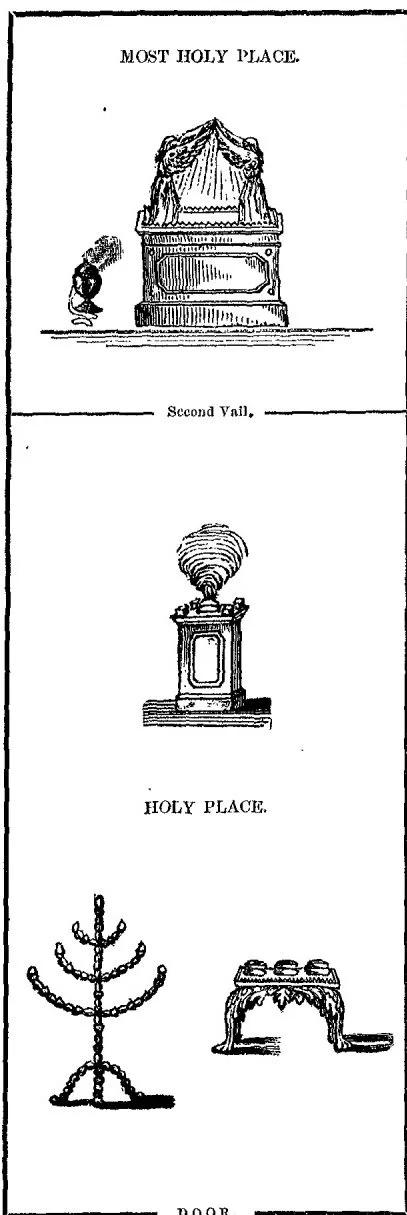
PLAN OF THE SANCTUARY.
Mr. B.—“Yes, this is the one. Now, Mr. T., if you have studied the book of the law carefully, you will perceive that this diagram, which we will place on the table before us, presents a view of the plan of the inside of the tabernacle according to the description given therein. There is the dividing wall that separates it into two apartments, which are called respectively the holy and the most holy place. You will observe that the most holy place is exactly square, and occupies one-third of the tabernacle. In it you will notice the following articles: 1. The golden censer; 2. The ark of the covenant, overlaid with gold, and containing the tables of the law of ten commandments, and the pot of manna, and Aaron’s rod that budded; 3. On the ark you will see that the cherubim are placed and are represented as overshadowing the mercy-seat, or cover of the ark, with their wings.”
“Passing now to the first apartment, you will discover that the only articles that it contains are the candlestick,—or more properly the lamp-stand with seven lamps,—the table of shewbread, and the golden altar of incense. By carefully comparing this diagram with the accounts given of the tabernacle in Exodus, chapters 25–27, you will find that it correctly outlines the building in question, and properly locates every article of furniture that it contained.”
Mr. T.—“Very good, Mr. B.; but I do not see that this diagram relieves my difficulty in the least. I have studied the question so long and so earnestly that I could have sketched the tabernacle and its furniture just as you see it there, without making a single mistake. The point which I cannot fathom is this: Granting that the tabernacle contained just what is found in the diagram, why did it contain these things rather than something else?”
Maud.—“Yes, Father, that is the very thing that I too would like to understand. I am not much of a Bible student, I confess; but the same queries which have troubled Mr. T. have suggested themselves to my mind heretofore.”
Mr. B.—“Well, I see that I have critics to deal with, and I am not averse to your questioning me at the proper time; but permit me to suggest that if you had not interrupted me in my story, I should have reached your difficulty ere long. Let me resume my account, therefore. In the meantime, you will remember that I was in just the position you now occupy; I could not comprehend the reason why the tabernacle was made just as it was made.”
“Well, as I was saying, my eye lit upon the diagram in question, and it immediately occurred to me that it was not impossible that the young preacher might be able to throw some light on the question that had perplexed my mind so long. Pointing to the diagram, I said, ‘What is this that you have here, sir?’ ‘That,’ said he, ‘is a diagram that we employ in our lectures when we wish to illustrate the sanctuary question.’ ‘But,’ I replied, ‘what do you mean by the sanctuary question?’ ‘Well,’ he remarked, ‘it would take some time to make you comprehend the sanctuary question in its full scope. If, however, you will attend my lectures regularly, and listen candidly to all I may have to say on that topic, I assure you that—little as it is understood at the present time—I will prove that it presents one of the most important themes found in all the Scriptures.’”
“Impatient at the proposed delay, and anxious to get his views of the subject, I replied, ‘I do not object particularly to listening to your lectures, sir, provided they shall be interesting and profitable; but, to tell the truth, I am so anxious to get the facts in regard to the sanctuary question that I cannot bear the thought of listening to a whole course of lectures before reaching them. Could you not by conversation, or in some other direct method, impart to me the information that I desire?’ To this the preacher replied, ‘I will tell you what I will do. You attend the lectures each evening, bringing your friends with you, and I will grant you the liberty to come to the tent each day during the forenoon, and we will spend several hours together in canvassing this subject from the Bible standpoint.’”
“I immediately accepted his proposition, and the next day we entered upon our task. The result was that I soon became convinced that he had light upon the subject in advance of anything that I had ever received. It would be impossible to even give an outline of his theory to-night, as it is already past nine o’clock; so I will make this suggestion: You return to-morrow evening, Mr. T., to this room, and I will give you some of his ideas respecting the design of the sanctuary, or the tabernacle; for these are but two terms for the same thing.”
Mr. T.—“Very good, Mr. B., I gladly accept your proposition, and as my interest in the subject is very deep, you may look for me to-morrow evening at a very early hour. Good night, Mr. B. Good night, Miss Maud.”
Mr. B.—“Good night, Mr. T.”
Maud.—“Good night, Mr. T.”
Mr. B.—“Maud, did I understand you to say that you do not comprehend the sanctuary question?”
Maud.—“No doubt you did, father; for that is what I stated.”
Mr. B.—“I am surprised that the daughter of a Seventh-day Adventist should not be posted on a topic so much discussed by our people. But never mind, my daughter, it is not too late for you to get an understanding of this subject. Be sure to be present hereafter at the interviews between Mr. B. and myself, and I think that I shall be able to make the question so plain that you cannot fail to comprehend it fully.”
Continue reading: A REMEDY PROVIDED FOR MAN