The Youth’s Instructor, Vol. 28, No. 25.

AMONG THE ROSES

The Youth’s Instructor

Jun 16, 1880

S. D. A. Publishing Association · Battle Creek, Mich. · Jun 16, 1880

AMONG THE ROSES.
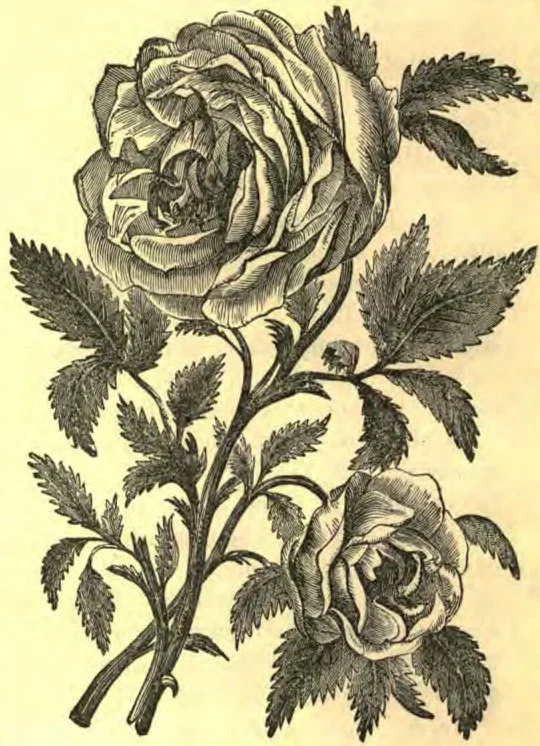
COME, let us go out among the roses. It is the month of June,—the month of roses, in the New England States at least, and we must write upon that regal flower at this season, when the air is perfumed with its sweetness, and even the school-children carry their hands filled with roses as they pass the house.
The varieties of roses are almost innumerable. In 1798 there were but forty-four species of roses known and described by botanists and florists; but now there are supposed to be between seven and eight thousand varieties, and each one is a thing of beauty.
All over the earth roses bloom and fade away in every month in the year; on the far-off Western prairies, and even on the barren islands of the North Sea, their sweet petals open to the sunlight, and where no grasses or cereals can grow, rose-bushes will thrive and bloom, and shed their sweetness on the air. Siberia, the desert land of Russia, has two varieties of roses; one with a chalice-shaped coronal, and one which bears a pulpy seed-pod that is eatable; while under the deep snows of Lapland hide the tiny sweet-scented roses, patiently awaiting the time when the sun returns to that clime, and kisses their buds into bloom for a few short weeks.
In the desert of Sahara, where infrequent springs form the only oases amid the sands, the white Moss Rose is indigenous. Within the Arctic Zone, where the year is divided into one long day and night, the rose flowers, and the wild Tungus concoct a favorite beverage from its sweet petals.
Even in North Labrador the rose adorns the short summers; and amid our own Rocky Mountains grow thousands of lovely, pale-tinted clusters of single roses as fragrant as those of our own gardens.
Thus we see that everywhere the rose is loved and cherished; but in Asia there are a greater number of species and varieties than in all the rest of the world,—thirty-nine native species being found there,—while China, the Flowery Kingdom, is renowned for its roses, and the inhabitants are very skillful in their culture.
The daily rose is very beautiful when in bud or half opening, as its pale-red petals contrast charmingly with the rich green of its foliage.
There is one variety of rose that is much esteemed by the Chinese on account of the velvety softness of the leaves. They call it Hai-tong-kong. Another variety native to China grows into a tall tree covered with clusters of red roses.
Space would fail me to enumerate the varieties of native roses scattered all over the globe. We of the north country can know but little of the wondrous glories of the rose when seen in its native habitation. During the last decade our florists have made their culture a specialty, and there are acres and acres of them planted out, and millions of strong plants sold every spring.
At Hildesheim Cathedral there is a rose-bush which is believed to be over a thousand years old. In recent years it seems to have been getting into decrepitude, and fears have been entertained that it was going to die. The help of the most renowned gardeners has been called in to prevent this, if possible, and several foreigners have been on the spot for this purpose. Whether it be due to their efforts or not, the old bush seems to have taken fresh heart again. Out of the root-knobs of the bush a new sprout has appeared, which is growing so vigorously that there is good hope that this venerable rose stock may yet “renew its youth.”—Daisy Eyebright.

Mullein: Admired Abroad, Dismissed as a Weed

The great American velvet plant (mullein) is held in high esteem by the lovers of the beautiful across the water, while with us it is ranked only as a weed. They call it noble, with its sturdy spike of yellow flowers above a wealth of bold foliage, all enwrapped in a thick coating of gray, felted hairs. We call it a coarse, stiff, ungainly intruder, unworthy the room which it too often occupies. This is another illustration of the fact that the commonness of a plant, and the ease with which it may be grown, affect the esteem in which it is held. Our common poke-root is highly valued in Europe, and it is really a most stately and beautiful plant, which would be valuable here were it costly.—Agriculturist.

The Legend of the Rosebuds.

When cruel hands that crown did twine, Which pressed the Saviour's brow divine, Unconsciously a rosebud white, Was twined amid the sharp thorns tight; And, lying on that holy hair, It saw where thorns had wounded there; So, gently from its place it slips, To kiss the wound with trembling lips; And ever since, the legend said, The blood has tinged its lips with red; The emblem of God's love and grace, Among the thorns it kept its place; So ne'er a crown of thorns we win, But has some sweet flower twined within; Search 'mid each, with fingers of care, You'll find a rosebud hidden there.

A GUILTY CONSCIENCE.

(Concluded.)
Harry soon came down-stairs, whistling, and not a trace of his disappointment upon his sunny countenance.
“Where is your brother?” asked his mother.
“Up-stairs, mother. He is tired, and says he does not want any breakfast.”
“Not want any breakfast? Why, that’s strange! I should think his zeal as fisherman would have kept him from feeling tired yet awhile, and given him an appetite too.”
“So should I, mother. Early rising, at all events, has made me as hungry as a hawk; and as these hot muffins look very inviting, I will eat his share and mine too.”
“Well, eat all you want,” replied Mr. Armstrong; “only be sure to be polite to your mother and sister first.”
Harry ate the hot muffins, and chatted with his mother and sister of the morning’s adventure, when, quite abruptly, his father said,
“Harry, are you sure your brother is well? He did not appear at all like himself when I purchased the fish from him.”
“I guess he was only lazy, father. We were up at five; and Ben hates to get up early.”
Mr. Armstrong’s words, however, set Harry to thinking. He recalled Ben’s strange, abstracted manner on their way home, and he was now more than ever perplexed by it. He lightly ran up-stairs, and softly entered their room. He found Ben lying upon the bed, his face toward the wall, or rather crushed out of sight in the pillow. Supposing he was asleep, and not wishing to disturb him, Harry took up a book, and quietly seated himself at the window. Then, fearing that his brother, who was somewhat heated, might take cold with nothing over him, he rose and laid a light spread across him. As it touched Ben’s form, there was a slight quiver, then a groan.
“Why, Ben, are you awake? What is the matter, old fellow?”
No answer; but Ben, to Harry’s great surprise, seemed to be sobbing. His form shook, and moans escaped from his lips.
“Are you sick? Do tell me.”
“Let me alone, won’t you?”
“Certainly, if you wish me to; but won’t you first tell me what is the matter?”
“How can I?” And Ben gave another, deeper groan.
More alarmed than ever, poor Harry stood bewildered. Suddenly Ben started up in bed, and in a wild, excited manner, flung his money at his brother.
“There, take it!” said he; “for it is just as heavy as lead, and I won’t have anything to do with it.”
“Why, Ben, what in the world is the matter with you? Your cheeks are flushed, and your mind is wandering. I fear you have a fever. Let me go and call mother!”
“Oh no! don’t, Harry; don’t call mother! for I am ashamed to look her in the face, or you either. Do go off and leave me!”
“What is the trouble, Ben? Out with it; for I can’t bear to see you look so crushed.”
“I may well be crushed; for, O Harry, I can’t tell what tempted me, but—”
Down went the flushed face, and once more it was deeply buried in the pillow, as though Ben felt too much ashamed to either look his brother in the face, or continue his confession.
Harry now seated himself on the bed to encourage his brother.
“Come, Ben, if there is anything upon your mind, you had better out with it. You won’t feel just right until you have made a clean breast of it. I can’t imagine, though, what should so suddenly sting your conscience, for I have seen nothing amiss in you.”
“Harry is so unsuspicious,” thought Ben. “I have been a great fool to betray myself. I might just as well have kept my secret to myself instead of making him and all the rest of the family despise me for being a downright mean fellow. Oh dear, what shall I do?”
Poor Ben! He certainly was not used to having a guilty conscience, and so could not conceal its upbraidings. On being again urged by his brother to tell what was the matter with him, he made a full confession.
“O Harry! it was too mean! When, too, you are such a kind, generous-hearted fellow. But, Harry, the truth is, I had little or no success catching fish; and you were so careless in laying yours down upon the logs, that I thought I might as well slip them into my basket as to let them get back into the water. At first I only did it for fun, and meant to return them to you. Then thoughts of the money we were to get for our fish kept me silent. But when father spoke in praise of my not exulting over you,—you, to whom all the fish, but one or two, belonged,—it was too much, and I have had no peace of mind since. I could not face the family at the breakfast table, or have my skill as fisherman talked about.”
Harry gave a surprised whistle. He was quite shocked on hearing of his brother’s theft and deceit. What could he say to Ben?
“Harry, please take the money; and oh, do forgive me, if you can!”
The pleading voice, and tear-stained eyes fixed upon him, touched Harry’s heart. He at once forgave his brother, and after a little serious talk, left him to speak to their parents, and smooth the way for Ben to make a similar confession to them of his temptation and sin.
Ben was truly penitent, and sought forgiveness of his Heavenly Father, as well as of his earthly friends. It was a long time before he recovered his usual spirits, and he never forgot the sharp stings of a guilty conscience.—Sel.

A HEART TO PRAY WILL FIND A PLACE TO PRAY.

SOME SCRIPTURE EXAMPLES.

“When thou prayest, enter into thy closet.” (Matt. 6:6.)
By his camels, Abraham’s servant prayed (Gen. 24: 11–13).
In a field, Isaac prayed (Gen. 24: 63).
By a brook, Jacob prayed (Gen. 32: 22–24).
Lying in a dungeon, Jeremiah prayed (Lam. 3: 55).
Encompassed by lions, Daniel prayed (Dan. 6).
Covered by a fig-tree, Nathaniel prayed (John 1: 48).
Lodging in a cave, David prayed (Psa. 57: 1, 2).
On a house-top, Peter prayed (Acts 10: 9).
Standing before a king, Nehemiah prayed (Neh. 2: 4).
Even in a fish, Jonah prayed (Jonah 2: 1).
Turning his face to the wall, Hezekiah prayed (Isa. 38: 2).
Solitary on a mountain, Jesus prayed (Luke 6: 12).
“Where’er we seek Thee, thou art found, And every place is hallowed ground.”
—S. S. Times.

Temper: A Good Thing in Its Place

TEMPER is a good thing if people would only keep it where it belongs.

THINGS WORTH FORGETTING.

We often hear the expression, “That’s worth remembering,” but how seldom, if ever, we hear, “That’s worth forgetting.” That some things should be forgotten, as well as that others should be remembered, all will admit to be true.
The habit of forgetting the disagreeable things of life, and remembering only the pleasant ones, is a habit that all would do well to contract. It would help to cultivate a good disposition, would soften and elevate the character, and would make one a pleasant, cheery companion.
There are a great many things that are hard to forget. It is hard to forget the harsh word spoken to us; it rankles in the breast, and seems to be determined to be retained in the memory; but if forgotten, and a lesson learned from it, not to do the same to others, it may prove a blessing.
Then, there are the “words of reproach against our neighbor” which must be forgotten, for have you not noticed that many speeches become mischievous only by being heard a second time? Forget, then, forget!
Every one has more or less faults, and these belong to the class of things worth forgetting. The easiest way to forget the faults of a friend is to remember,—remember his good qualities.
Those who have this pleasant habit of forgetting and remembering the right things, have many friends, and are loved by all who know them; for they promote the happiness of all who come within the compass of their influence.
One of the richest promises in the word of God is that where he says, in speaking of his people, “Their sins and iniquities will I remember no more.” Oh, sweet forgetfulness! There are “things worth forgetting,” and it is Godlike to forget.
V. A. M.

Lessons for Children.

Lesson LXXVII.—The Famine in Samaria.

“AND it came to pass after this, that Benhadad, king of Syria, gathered all his host, and went up, and besieged Samaria. And there was a great famine in Samaria. . . . And as the king of Israel was passing by upon the wall, there cried a woman unto him, saying, Help, my lord, O king. And he said, If the Lord do not help thee, whence shall I help thee? out of the barnfloor, or out of the winepress? And the king said unto her, What aileth thee? And she answered, This woman said unto me, Give thy son, that we may eat him to-day, and we will eat my son to-morrow. So we boiled my son, and did eat him; and I said unto her on the next day, Give thy son, that we may eat him; and she hath hid her son.”
“AND it came to pass, when the king heard the words of the woman, that he rent his clothes; and he passed by upon the wall, and the people looked, and, behold, he had sackcloth within upon his flesh. Then he said, God do so and more also to me, if the head of Elisha the son of Shaphat shall stand on him this day.”
Then the king went to see Elisha, who was sitting in his house with the elders, and Elisha said unto him, “Hear ye the word of the Lord; Thus saith the Lord, To-morrow about this time shall a measure of fine flour be sold for a shekel, and two measures of barley for a shekel, in the gate of Samaria.”
Then a lord on whose hand the king leaned said, Behold, if the Lord would make windows in heaven, then might this thing be. And Elisha said unto him, “Behold thou shalt see it with thine eyes, but shalt not eat thereof.”
There were four leprous men just outside the gate of the city, and knowing that they must starve if they stayed where they were, they went to the camp of the Syrians, thinking it possible that their enemies might let them live, and when they came to the camp, there was no man there. “For the Lord had made the host of the Syrians to hear a noise of chariots, and a noise of horses, even the noise of a great host; and they said one to another, Lo, the king of Israel hath hired against us the kings of the Hittites, and the kings of the Egyptians, to come upon us. Wherefore they arose and fled in the twilight, and left their tents, and their horses, and their asses, even the camp as it was, and fled for their life. And when these lepers came to the uttermost part of the camp, they went into one tent, and did eat and drink, and carried thence silver, and gold, and raiment, and went and hid it; and came again, and entered into another tent, and carried thence also, and went and hid it.”
Then they went to the city, and told that the Syrians had fled; but the king feared that his enemies had hidden outside of the camp, hoping to draw the Israelites out of the city, and kill them. So he sent men to search, and they went after them unto Jordan, and lo, all the way was full of vessels and garments, which the Syrians had cast away in their haste.
And the people went out, and spoiled the tents of the Syrians; so a measure of fine flour was sold for a shekel, and two measures of barley for a shekel, according to the word of the Lord.
Now the lord who had spoken so haughtily to Elisha the day before, was trodden down and killed by the people, as they crowded through the gate of the city.

Questions.

  1. What Syrian king went up with an army, and besieged the city of Samaria? 2 Kings 6:24.
  2. For what was this city noted?
  3. What caused the people of Samaria to suffer greatly during this siege?
  4. Who called to the king of Israel as he was passing by upon the wall?
  5. What did she say?
  6. Did the king think he could help her?
  7. What was her complaint?
  8. What did the king do when he heard this?
  9. What did the people notice as they saw him passing by upon the wall?
  10. What threat did the king make?
  11. What did Elisha say when the king came to him? 2 Kings 7:1.
  12. How did a lord on whose hand the king leaned show his contempt for what the man of God had said?
  13. What did Elisha say would happen to him?
  14. How did the people of Samaria find out that the Syrians had left their camp?
  15. In what condition did these lepers find the camp?
  16. How did they busy themselves for a long time?
  17. What did the king of Israel think when he heard that the camp of the Syrians was deserted?
  18. How did he make sure that the Syrians had fled?
  19. What caused the Syrian army to flee in such haste?
  20. Did Elisha’s prophecy that there should be plenty of food come to pass?
  21. Did it come to pass just when he said it would?
  22. How was it fulfilled so soon?
  23. What became of the lord who had shown such contempt for the words of the prophet?

BIBLE LESSONS FOR YOUTH.

LESSON CIII.—REVIEW OF LESSONS C–CII.

  1. What can you say of Malachi and his prophecy?
  2. In history, what name is commonly given to the Ahasuerus of the book of Esther?
  3. When did his reign begin, and when did it terminate?
  4. After Xerxes II. had reigned a few days, who succeeded to the throne of Persia?
  5. What revolt marked the reign of this king?
  6. By what magnanimous prince was he succeeded?
  7. Who tried to take the kingdom from Artaxerxes Mnemon?
  8. By whom was this Cyrus assisted?
  9. What was the result of this attempt of Cyrus to depose his elder brother?
  10. Describe the retreat of the Greeks.
  11. What were the leading events in the war with Egypt?
  12. What spirit characterized the reign of Artaxerxes Mnemon?
  13. Who succeeded him?
  14. Describe the successful wars of Ochus.
  15. To what condition was Egypt reduced?
  16. How was the reign of Ochus brought to a close?
  17. By what changes was Codomanus brought to the throne?
  18. Describe his reign.
  19. What distinguished men flourished in Greece during the fifth century B. C.?
  20. Relate the circumstances which resulted in making Philip of Macedon master of Greece.
  21. What great warlike enterprise did Philip leave for his son Alexander to carry out?
  22. What preliminary work did Alexander accomplish in Macedonia and Greece before invading Asia?
  23. What two great battles were fought in Asia Minor?
  24. Describe the reduction of Tyre.
  25. Describe Alexander’s visit to Jerusalem.
  26. Describe his expedition into Egypt.
  27. Whither did he then march?
  28. When and where was the great battle fought that decided the fate of Persia?
  29. Describe Alexander’s subsequent course.
  1. Was the history of the Jewish people marked by any striking events during the century ending with the death of Alexander?
  2. What was their general condition?
  3. To whose immediate control were they left?
  4. What laws were they, in the main, required to obey?
  5. How did Alexander regard the Jews?
  6. What inducements did he offer them for settling in Alexandria and other cities of his empire? G. H. BELL.

THE CHEERY TEACHER.

Years ago I knew a class in which a disintegrating process was always going on. It could not be kept together. Persistently the superintendent filled it up, bringing new recruits to make up the gaps which were always occurring in its ranks, but it was in vain. The boys could not stand the chill of its atmosphere, nor be natural under the influence of the good but dismal elder who taught it; and away they went to find brighter and more congenial places. It was in vain that the excellent man haunted his pastor's study, laboriously read this great book and the other, in the desire to make the lesson interesting, and devoted, yes, spent himself, in efforts to keep the young men's Bible class, where he felt it should be, in the front of the school, a sort of shining light and example. In his hands it was little more than a name, a tradition of a good thing that had been; and he at last resigned his task in absolute despair.
There followed him very quickly a gentleman not nearly so well educated, not nearly so thorough, not, at a casual glance, half so well fitted for the position. But before many Sabbaths had passed, everybody was talking about the change. The class rallied around the new leader. One young man brought another. Their blithe, eager faces, their cheery voices, their interested manner, showed that they enjoyed coming, and the good people who had been lamenting over the fact that the boys of this period so soon grew too large to go to Sabbath-school had reason to felicitate themselves on having been greatly mistaken.
Where was the secret? Both were good men. Both were anxious to teach well. The first was a failure, and the second a success.
It was no secret to any one who could read human nature. One had the magnetism of a happy, joyous, enthusiastic temperament. He bore his light aloft on a candlestick, to be seen of all; the other, by reason of a naturally moody and melancholy disposition, which had grown morose through much brooding over trouble and loss, hid his light under a bushel. Young people were repelled from the one as certainly as they were attracted by the other characteristic.
You will have no difficulty in holding your growing-up boys, and your young ladies, if you bear in mind two facts: they must have good teaching, and they must have cheery teachers. The air around us is full of stimulus.
Information abounds. Wide-awake girls and boys of this day have been, in the secular schools, under the influence of the most advanced minds, and the best text-books, and the most thorough preceptors. They will not rest contented with inefficient, half-digested, and second-hand instruction in the Sabbath-school. They are willing to be students, and they want some one able to guide them. Then they will not—and who can blame them?—submit to sitting down among the tombs when all the sweet world is full of sunshine and gladness. Let us have cheery teachers, for their sakes.—Mrs. Margaret E. Sangster, in S. S. World.

APPLE-SEED JOHN.

Poor Johnny was bended well-nigh double, With years of toil, and care, and trouble; But his large old heart still felt the need Of doing for others some kindly deed.
“But what can I do?” old Johnny said; “I who work so hard for daily bread? It takes heaps of money to do much good; I am far too poor to do as I would.”
The old man sat thinking deeply awhile, Then over his features gleamed a smile, And he clapped his hands with a boyish glee, And said to himself, “There’s a way for me!”
He worked, and he worked with might and main, But no one knew the plan in his brain. He took ripe apples in pay for chores, And carefully cut from them all the cores.
He filled a bag full, then wandered away, And no man saw him for many a day. With knapsack over his shoulder slung, He marched along, and whistled or sung.
He seemed to roam with no object in view, Like one who had nothing on earth to do; But, journeying thus o’er the prairies wide, He paused now and then, and his bag untied.
With pointed cane deep holes he would bore, And in ev’ry hole he placed a core; Then covered them well, and left them there In keeping of sunshine, rain, and air.
Sometimes for days he waded through grass, And saw not a living creature pass, But often, when sinking to sleep in the dark, He heard the owls hoot, and the prairie-dogs bark.
Sometimes an Indian of sturdy limb Came striding along and walked with him; And he who had food shared with the other, As if he had met a hungry brother.
When the Indian saw how the bag was filled, And looked at the holes that the white man drilled, He thought to himself ’t was a silly plan To be planting seed for some future man.
Sometimes a log cabin came in view, Where Johnny was sure to find jobs to do, By which he gained stores of bread and meat, And welcome rest for his weary feet.
He had full many a story to tell, And goodly hymns that he sung right well; He tossed up the babes, and joined the boys In many a game full of fun and noise.
And he seemed so hearty, in work or play, Men, women, and boys all urged him to stay; But he always said, “I have something to do, And I must go on to carry it through.”
The boys, who were sure to follow him round, Soon found what it was he put in the ground; And so, as time passed and he traveled on, Every one called him “Apple-seed John.”
Whenever he’d used the whole of his store, He went into cities and worked for more; Then he marched back to the wilds again, And planted seed on hill-side and plain.
In cities, some said the old man was crazy; While others said he was only lazy; But he took no notice of gibes and jeers, He knew he was working for future years.
He knew that trees would soon abound Where once a tree could not have been found; That a flick’ring play of light and shade Would dance and glimmer along the glade;
That blossoming sprays would form fair bowers, And sprinkle the grass with rosy showers; And the little seeds his hands had spread Would become ripe apples when he was dead.
So he kept on traveling far and wide, Till his old limbs failed him, and he died. He said at the last, “’T is a comfort to feel I’ve done good in the world, though not a great deal.”
Weary travelers, journeying west, In the shade of his trees find pleasant rest; And they often start, with glad surprise, At the rosy fruit that round them lies.
And if they inquire whence came such trees, Where not a bough once swayed in the breeze, The answer still comes, as they travel on, “These trees were planted by Apple-seed John.”
—St. Nicholas.

JUNE

The month of June is the poet’s inspiration, the artist’s despair. Nature has her hour of triumph when she is inimitable and unapproachable, and any attempt to portray the delicious sweetness of June must fall far short of the reality. “Then, if ever, come perfect days,” and there are tones, qualities, and atmospheric effects that cannot be reproduced in pictures or in poems. Green grass, blue skies, gay birds, and bright flowers weave their hues and harmonies together, and on this bit of magic carpet we are borne away into realms of ideal beauty. A sense of delicious languor steals over us. At every breath we inhale intoxicating sweets. The atmosphere is laden with fragrance that acts as an opiate upon the senses.
We visit the old familiar haunts, and are greeted by the same old faces—old, yet ever new—in whose companionship we forget the trials and vexations of the work-a-day world. Every flower has a voice of its own, and every blade of grass is an apostle of eloquence. Look at yon field of grain! It is a rippling sea of melody, moving in graceful undulations at the touch of the breeze’s baton. Floral gems are everywhere: in the grass, along the roadside, swinging from trees and vines, and surprising us by appearing in unexpected places. The rocks adorn themselves, and from many a crevice display the emerald plumes that mark the progress of the mighty host. The smile of nature broadens and deepens, until the whole earth seems shaken with musical laughter. It is frolic time. Joy is at its zenith. The cup of pleasure is full; there is scarce room for another rose-leaf.
June is the glad fruition of the year,—the fulfillment of the promises. She sits as a queen upon her throne, and leaves us grieving at the shortness of her reign. The poet throws his pen aside after a vain effort to portray her beauty in a sonnet; and the artist, having exhausted all the colors on his palette, finds himself at a loss—the wonderful tints, the ineffable glory, are still in the possession of June, the Summer Queen.—Floral Cabinet.

HENRY CLAY.

While young, Henry Clay resolved to make an orator of himself. Being poor, and having to work very hard, his education was much neglected. For some years, in early life, he was in the habit of reading a portion of history or some book upon science, and of then going out into a cornfield, or into a barn, and delivering the substance of what he had read, as a speech. Many a fine speech he delivered to an audience of oxen, horses, and pigs.
“It is,” said he once, when addressing a class of law-students, “to this early practice of the art of all arts, that I am indebted for the impulses that molded my entire destiny.”

Be Honorable and Honest in All You Do

BE honorable and honest in all you do.

Jesus Loves Children Who Obey Their Parents

JESUS loves children who love and obey their parents.

You have reached the end of this edition.

The Youth’s Instructor · Jun 16, 1880