A RE we on the eve of a new era of peace and good-will among the nations? Are armaments to cease? Will the swords be beaten into plowshares and the spears into pruning-hooks, and will the nations learn war no more? Will the pen, indeed, be acknowledged to be mightier than the sword, and is peaceful diplomacy to take the place of bloody encounters by land and sea, and arbitration to give the final word in all matters of dispute?
These are some of the questions that come into mind as we contemplate the opening of the second peace conference. It must be acknowledged that this large representative body of delegates from forty-five countries of the world is not without its significance. The great powers are here, and so are the less important ones. The delegates number nearly twice as many as the first peace conference in 1899, and there is reason to believe they have come to this gathering with a serious purpose to achieve, if possible, solid and practical results. Such a meeting as this would have been out of the question twenty years ago; it could hardly have been held in the nineteenth century. It is, then, a twentieth century development.
What does it all mean?
Are we face to face with a great millennium?
Or is it all a solemn mockery? Is it a case of "words smoother than butter," and "in the heart a drawn sword"?
Underlying Principles.
The sequel will have to decide. But it is safe to lay down some general principles at the very outset. The nations of to-day are more closely bound together by the ties of art and commerce than ever before in the history of the world. Modern facilities of travel have contributed much to bring representatives of different countries into close contact with one another and thus make for mutual friendliness. This is, moreover, a decidedly commercial and materialistic age. A religious war of the kind waged during the Middle Ages is hardly conceivable at the opening of the twentieth century. Ideals are rapidly shifting; ambitious men are seeking the material prizes offered by business and the more lucrative professions, to the neglect of the army and the church. The labor movement is exerting quite a strong influence against militarism, and the socialists are all for peace.
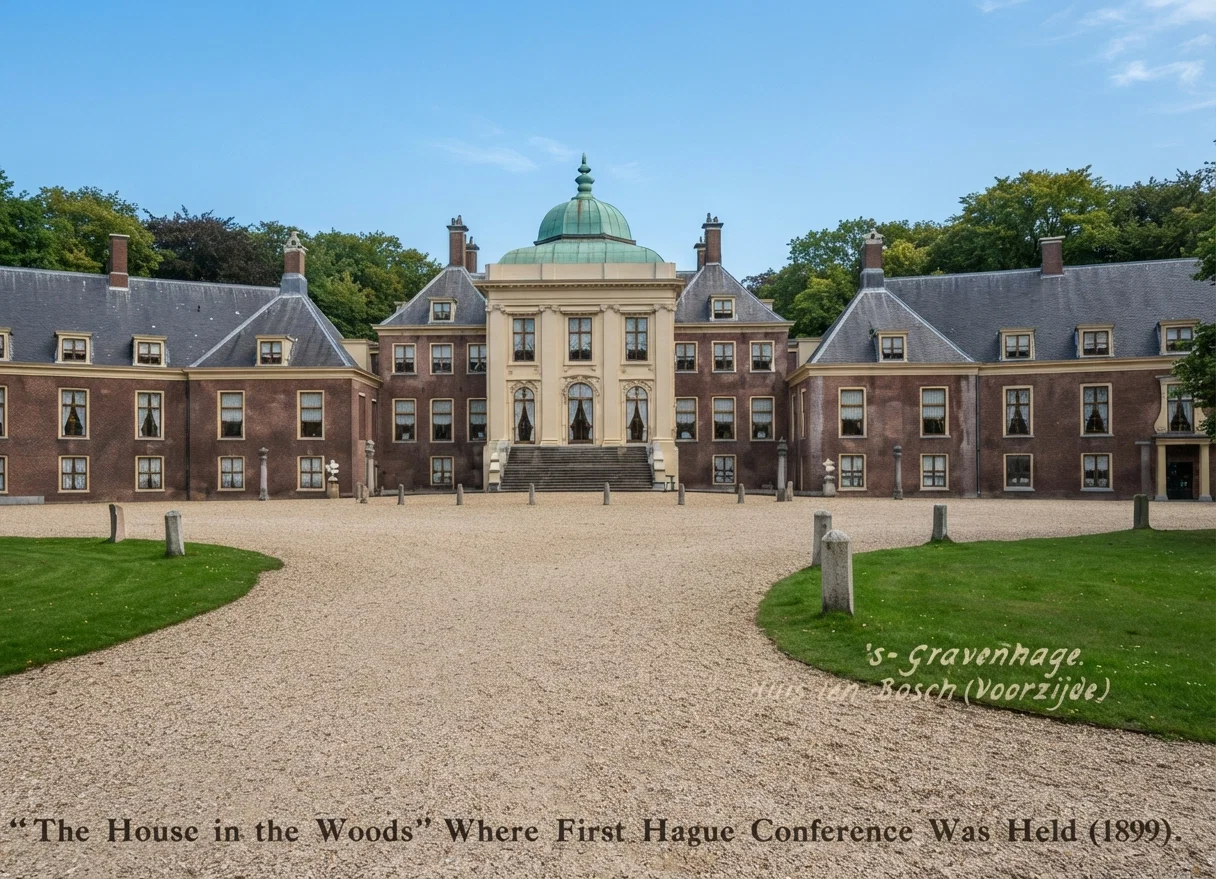
"The House in the Woods" Where First Hague Conference Was Held (1899).
Business Reasons.
Then, there is in general more at stake than there ever has been before. It takes a lot of money to carry on even a successful war, while an unsuccessful one may mean serious financial embarrassment or even ruin. Thus business men, if only for selfish reasons, are inclined toward peace. Furthermore the boundaries of the various world nations are pretty well fixed. Wars of aggression are discountenanced by general consent, and would not be tolerated. Hence, while there is much to lose in a war to-day, there is little to gain.
These are some of the general tendencies of to-day which operate in behalf of peace and amity among nations. They are not evidences of a higher idealism or a more thorough-going morality. They are, perhaps, best described as natural forces which arise out of modern conditions. Taking courage from this manifest tendency of society, the world over, certain peace organizations in England, America, and on the Continent have increased their efforts in behalf of the ideals for which they stand, making their appeal to common sense and the logic of circumstances to convince the man in the street of the utter foolishness of war. These various societies have doubtless done much to prepare the way for the international conference now sitting. Certain it is that the officers of such societies are far more optimistic of the good to be achieved thru an international court of arbitration, having power to settle all differences between nations, than have the members of the conference itself.
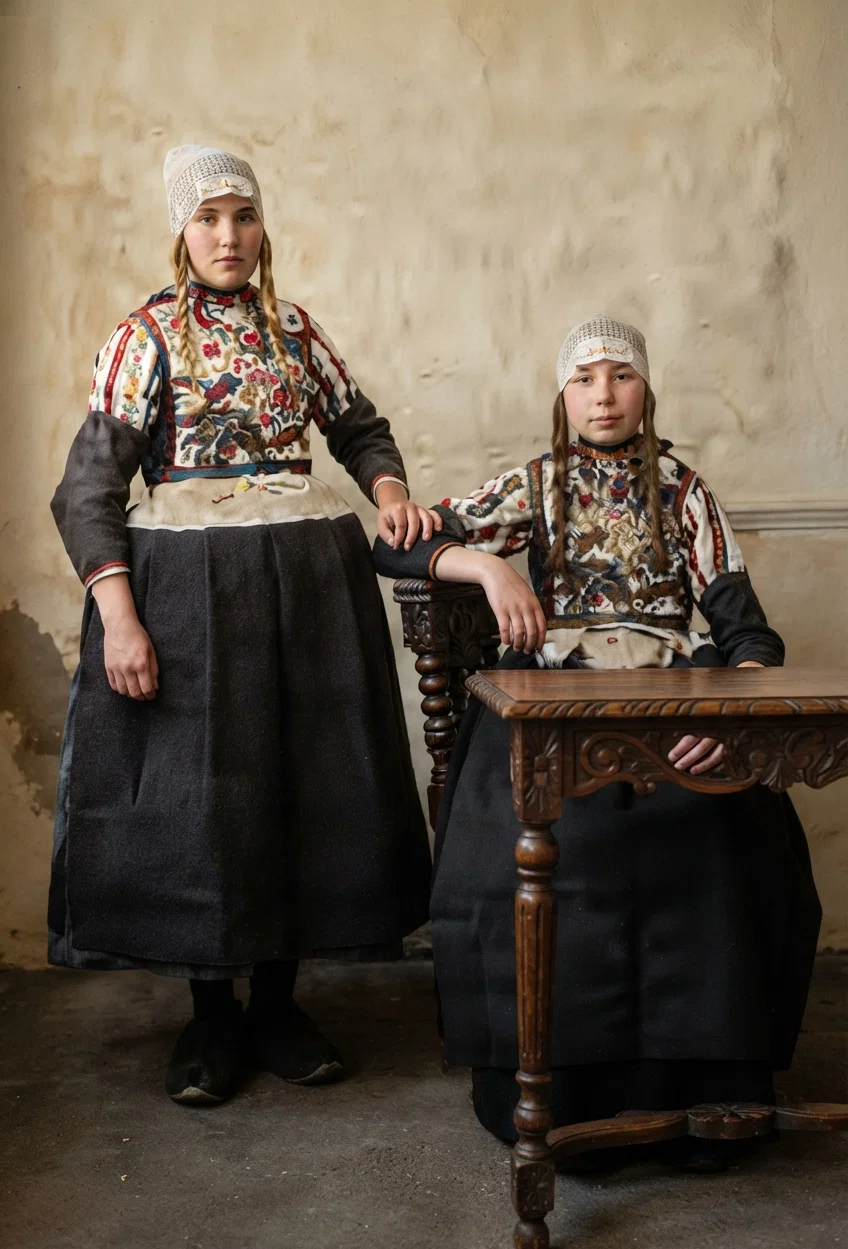
Dutch Peasant Girls, Isle of Marken.
Dutch Fisher Woman, Volendam.
Uncertainty of Political Relations.
Aside, however, from general tendencies everywhere at work, there can be no doubt that at least one great world power is more peaceably inclined to-day than in 1899. England is not proud of the Boer War, the burden of the cost of which will rest heavily on the country for years to come. The people are disposed to peace, and so also is the present Liberal Government. Probably Russia is also less inclined to war-like aggression than in the nineties.
But there are also some disturbing elements. There is nothing certain about the political relations of the great world powers except their tendency to violent extremes—in short, their extreme uncertainty. The French were hooting Englishmen in the streets during the South African War; now they love them so warmly that they almost feel jealous when England shows friendly feelings toward other nations. These powerful elements of uncertainty must be reckoned with in any estimate of the future of Europe.
Of the great world nations, Germany, perhaps, represents the largest amount of ambition, coupled with a good degree of power to realize that ambition. Her population and her wealth are both increasing much more rapidly than those of England, and she aspires to colonial possessions beyond those she now occupies. She is also building up a great navy. England is looking on with jealous eyes. There are not wanting Englishmen who view Germany's development with real concern, and believe it absolutely necessary in order to maintain the balance of the powers that England should continue to strengthen her land and naval forces.
Turkey and Austria.
Then the Turkish question may become critical at any moment, and there is no knowing what situation will be precipitated in Austria when the present emperor dies. Thus while general tendencies move in the direction of peace, this does not give any real assurance that we may not be engaged in gigantic struggles in the near future.
It must also be remembered that while trade and commerce assuredly make for peace, they may also become occasions for severe wars. Business interests sometimes clamor for war. The eagerness of the Uitlanders to have a part in the government of the Transvaal in order to facilitate the piling up of large fortunes, precipitated the South African conflict.
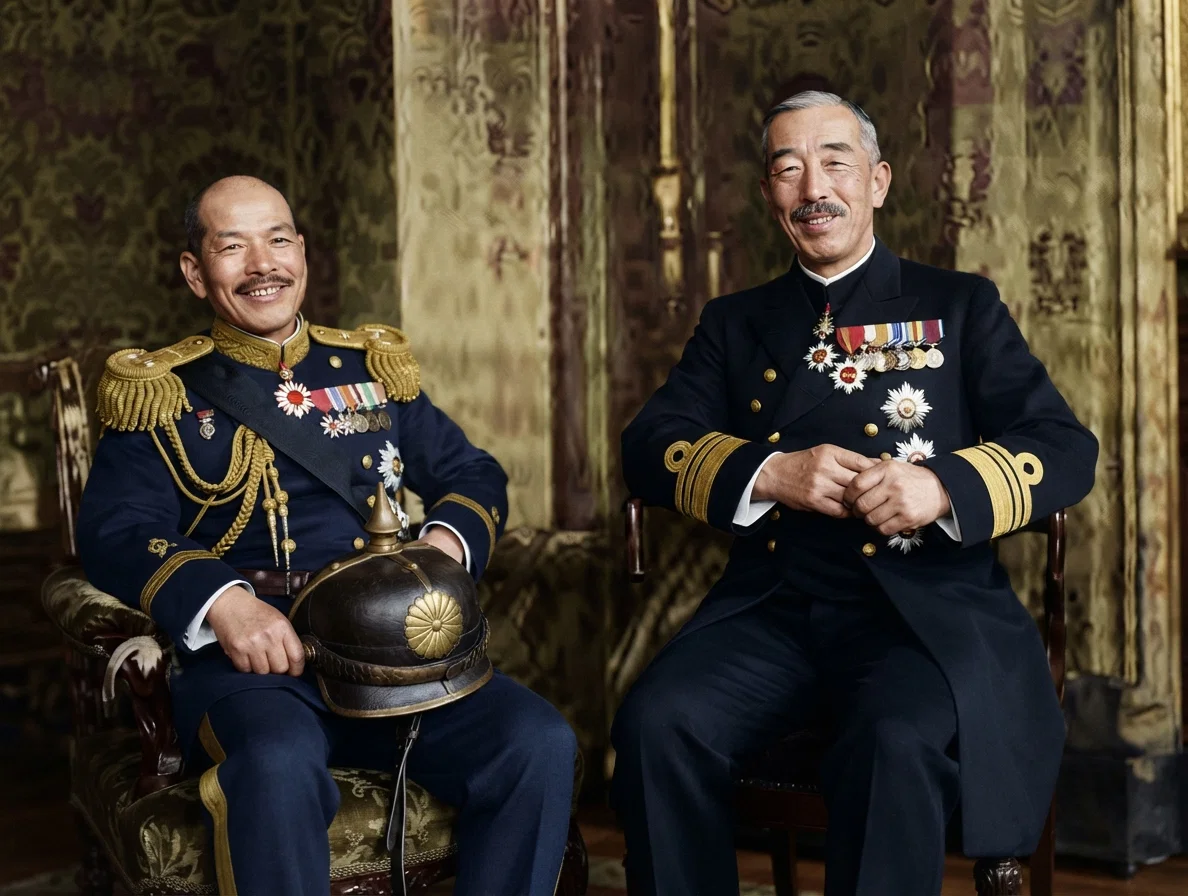
Major General Akizama, and Admiral Sjimamoera, Leaders of Japanese Delegation.
In a Nutshell.
To sum up the situation in a nutshell, the European outlook at the immediate present is favorable to peace; but a very slight shifting of the political chess-board might change the whole situation in the twinkling of an eye.11
Such, then, is the general situation at the opening of this second peace conference. Forty-five nations have sent their delegates, and the afternoon of June 15 witnessed the formal opening. It will not be needful here to go into the details of that meeting. It was very quiet and formal. The only business done was the sending of telegrams of thanks to the Czar and to Queen Wilhelmina. The presidency of the conference was entrusted to the ambassador of Russia, M. de Nelidoff, as expected, and this statesman delivered an address which may be taken as a sort of keynote to the conference. Satisfaction was expressed that so large and representative an assembly had convened. It was an idea of peace that had led so many powerful governments to send their most eminent men to discuss together the dearest interests of humanity.
The Task of the Conference.
The task before the conference was twofold: First, to seek for the means of settling amicably differences which might arise between states, and thus preventing armed conflicts. Secondly, if war did break out, to "soften its consequences" both for the combatants and those indirectly affected. These two problems had seemed to some incompatible, but the speaker did not so regard them. The first peace conference had accomplished something under both these heads, and it was for the second one to take up the work where their predecessors left it and carry it as much farther as they might.
Since 1899 thirty-three conventions of arbitration had been concluded between the different States. Four grave and complicated cases had been carried to the Hague Court, and the Commission of Inquiry created by the act of 1899 had busied itself with one serious case which might otherwise have had most dangerous consequences.
Reference was also made to Andrew Carnegie's generous gift of a building for the accommodation of a permanent conference.
At this point M. de Nelidoff introduced a word of caution. "Let us not be too ambitious," he said. "Let us not forget that our means of action are limited, that the nations are living beings just like individuals, with the same passions, aspirations, and failings. . . . Let us above all not forget that there is a whole series of cases in which honor, dignity, and essential interests are engaged for individuals as for nations, and where the one like the others would never wish, whatever be the consequences, to recognize any other authority than their own judgment and their personal feeling."
He went on to say, however, that these stern facts should not discourage us from "dreaming of the ideal of a universal peace." Is it not, he said, the essential condition of all progress to pursue an ideal toward which one ever tends, and yet can never reach? "Let us set to work bravely, then, the clear star of universal peace and justice, which we shall never reach, guiding us always for the good of humanity."
The speech was warmly applauded, and judging from the general attitude of the delegates and the remarks different ones have dropped from day to day, it represents very nearly the feelings of the conference.
Opening Speech of 1899 More Sanguine.
It will be remembered that the opening speech of the 1899 conference was far more ambitious and in a bolder spirit altogether.
The president of the first conference spoke out against the increase of armaments and adopted quite the tone of peace promoters in general. Nevertheless it is a well-known fact that the fervid opinions expressed at the opening did not take definite form in the conference, and that the ultimate results of that first coming together of the nations were reduced to working agreement in some minor matters relating to warfare as well as to providing the court of arbitration. The opinion was expressed the other day by a well-known citizen of this city that the second peace conference, tho it starts with a more modest program, would doubtless do a great deal more. This remains, of course, to be seen. There is a rumor that M. de Nelidoff's opening speech as originally written, contained a more ambitious program, but that on hearing at the last moment of the dismissal of the Douma he sat up the better part of the night previous to recast the address.
No Religious Services.
The conference was opened, by the way, without religious service of any kind. This, while wholly correct, is a little surprising in view of the custom of introducing a religious ceremony in connection with the launching of a battleship, or giving its colors to a regiment. In the former case, the engine of destruction glides into the water followed by the seemingly very inappropriate benediction: "May the Lord bless you and keep you and give you peace." The conference has done well to start its work clear of any religious entanglements, and the omission of any formal religious ceremony at the opening will not prevent Christians everywhere praying most earnestly for success to attend this effort to make wars fewer and less barbarous.
The Ridderzaal, in which the sittings of the conference take place, is a historic building looking a great deal like a church. It is about six hundred years old, and stands in the Binnenhof, with the upper and lower houses of Parliament on the right and left hand respectively. The Ridderzaal itself is ordinarily used for combined meetings of the two houses.
It would have been hard to find a better location for the conference. The Hague reminds one in its quietness and ease and freedom from bustle of a great, over-grown village. But it has magnificent environs, and the canals, shaded with enormous trees, and the exquisitely clean streets and inviting shop windows and bright, clean-looking children, and especially the picturesquely dressed peasants from the surrounding country and from the Isle of Marken, altogether make a picture of which one never tires.
The conference held its second meeting last Wednesday behind closed doors. It then organized itself into four departments, and divided the work. Telegrams were read from the Czar and the Queen of Holland expressing their deep interest in the success of the gathering. M. ELLSWORTH OLSEN.
The Hague, June 21.
(To Be Continued.)
The Beauty of Metaphysical Philosophy.
By Editor
[The following note and appropriate verse thereon appeared in the San Francisco Examiner, of July 1, under the name of Thomas Nunan. It will appeal to common-sense people who have a bit of humor.]
Professor John McTaggart Ellis McTaggart, the distinguished atheistic philosopher of Cambridge University, now lecturing at the University of California's summer school, denies the existence of matter, saying that everything so regarded is merely dream and delusion. He declares that all intelligent animals are immortal souls.
"Nothing but soul; no law but love,"
This is Professor McTaggart's text;
No earth below, no heaven above.
Himself—he's merely a soul perplexed.
All that we see or touch or hear,
These are delusions, visions, dreams.
Only the soul is anywhere near;
Nothing is anything like what it seems.
Matter is something that nothing can be;
Vainly the tangible spirit is sought;
Spirited spooks in dreams are we;
Everything known is matter of thought.
Property, houses, rocks, or trees,
Oceans or rivers or landscape spots—
Never such objects at all as these;
Not a bit real estate in lots.
Rare old fossils I thought I had;
Now the collection I've thrown away.
Ancient imaginings all are bad—
Fossilized thoughts of a dead old day.
Dainty the fern in a chunk of coal;
Years it had held my pondering gaze.
Yet, 'twas the dream of a saurian soul,
Fated to end in a so-called blaze.
Fishes are souls; as well as the boy
Fondly believing he sees a brook;
One may the other one's time employ—
Still but delusions are line and hook.
Saddle a horse and speed away!
'Tis an absurdity thus to write.
Even the rider and steed say nay,
Surely they're souls communing in flight.
Simply a seeming is all we eat.
Why should we gobble what doesn't exist?
Clothes are but fictions, souls to cheat:
Lay them aside—they'll never be missed.
Why are we toiling? Ah, we're mad!
Building delusions to call them real.
Let us throw off the clay and be glad;
Needs that are worldly the soul can not feel.
The Blasphemy of the Ages
By Editor
"The Blasphemy of the Ages."—That is what the Sacramento Union calls the application of the term Christian to the present civilization. It declares that our civilization, stripped of fair seeming, is still that of the wolf rationalized, instead of that of the sons of God Christianized. Jesus taught a civilization founded upon purity of heart and human fraternity. In His name we are striving to maintain a civilization founded upon race antipathies, international jealousies, industrial and commercial spoliation. And we insist upon calling that civilization Christian! "It is the blasphemy of the ages relieved of its enormity only by individual and associated efforts here and there to make things better than they are." And all this is true. Yet we are bound to believe that many who make the saddest failures are trying to make the world better. But they are taking the wrong way to do it. There is no other way but God's way; no way to make men Christian but to be "born again," "born from above." Calling a man Christian will not make him one. Calling the nation or civilization Christian will not make them Christian. The object of Jesus Christ, in life, death, and teaching was not to civilize the world. The object of His followers should not be to civilize the world. To evangelize, to regenerate, to save men from sin is the object of Christ and Christianity. Civilizing is incidental; and nothing in all the world will civilize so rapidly, so effectively as Christianity. The civilization of to-day is the only type possible among unregenerate men.
Liberty
By Editor
Liberty.—The third number of Liberty for 1907, is now ready for circulation—a special Christian Endeavor number. The matter of this issue sets forth the true principles of Christian liberty and the obligations of the rising generation to maintain these principles. Not antagonistic, but set forth in a Christian spirit which will make the number especially adapted to Christian Endeavor workers, who should be liberally supplied. Price, five cents a copy, twenty-five or more copies two and one-half cents a copy. Address Review and Herald Publishing Ass'n, Takoma Park Station, Washington, D. C.
Historical Sketch of the Hermit Kingdom
By F. W. Field
KOREA, the Land of the Morning Calm, once known to the outside world as the Hermit Nation, is a peninsula projecting from the eastern shores of Asia. To the northwest lies Manchuria, toward the southeast the shores of Japan are almost in sight, but a hundred and fifty miles distant; and at the extreme north the boundary line touches the territory of Russia for a distance of eleven miles. The area is somewhat more than eighty thousand square miles, or about twice the size of Ohio.
The surface is very mountainous. The main range lies to the east of the center, so that the eastern slope to the sea is quite abrupt. The western slope is longer and more gentle, and is much broken by lower transverse ranges, between which are wide, fertile valleys.
Agriculture.
The soil in the lowlands is on the whole quite fertile. But the hills and mountains in the southern half of the country have a desolate, barren appearance, being devoid of timber, except for a few scrubby pines. Farther north, along the Yalu and Tumen Rivers and their branches, quite extensive forests are found. Agriculture is by far the most important occupation. The country is believed to be rich in mineral resources, but these have not been much developed. The same may be said of the valuable fisheries along the extensive coasts.
Climate.
The climate has been described as one of the most healthful in the world. The winters in the southern part are quite mild, but farther north are more severe; even in Seoul, the capital, zero weather is sometimes experienced. The summer months are hot and rainy, but the climate on the whole is dryer than that of Japan, and so less enervating.
Race Composition.
The Koreans are evidently a Mongolian people, as indicated by their yellow color, black hair, and oblique eyes. But one often sees a face with distinctly Aryan features—oval face, high forehead, straight, well-formed nose, and thin lips. Consequently the theory has been advanced that the Koreans are a composite race, formed by the mingling of a Mongolian people with some offshoot from India. The physique is good, the average height being considerably above that of the Japanese.
There is good evidence that the Korean nation is of great antiquity. Pyeng Yang was the ancient capital, and the authentic records of this city are said to date back three thousand years, making its early rulers contemporaries of David and Solomon. These early records tell how Kitze with an army emigrated from China in the twelfth century B.C., built Pyeng Yang, and made it his capital, and established a dynasty which continued for seven centuries. The name of Kweja, one of the early rulers of this dynasty, is a household word in Korea to this day. His tomb is still shown in a small grove of pines, just outside the walls of Pyeng Yang.
Chinese Influence
A very natural result of the geographical position of Korea was that from very early times and for many centuries Chinese influence predominated. The Manchus invaded the country, and brought Chinese civilization with them. It is said of the Koreans that “their literature, superstitions, system of education, ancestral worship, culture, and modes of thinking, are Chinese.” Not only this, but for centuries Korea was under the suzerainty of China, and paid an annual tribute.
The Koreans also had intercourse with the Japanese from very early times, and from them their island neighbors received a knowledge of Chinese literature, art, and civilization in general. But the relations between these neighbors were not always peaceful. Jingo, an empress of Japan, is said to have conquered Korea in the third century, A.D.
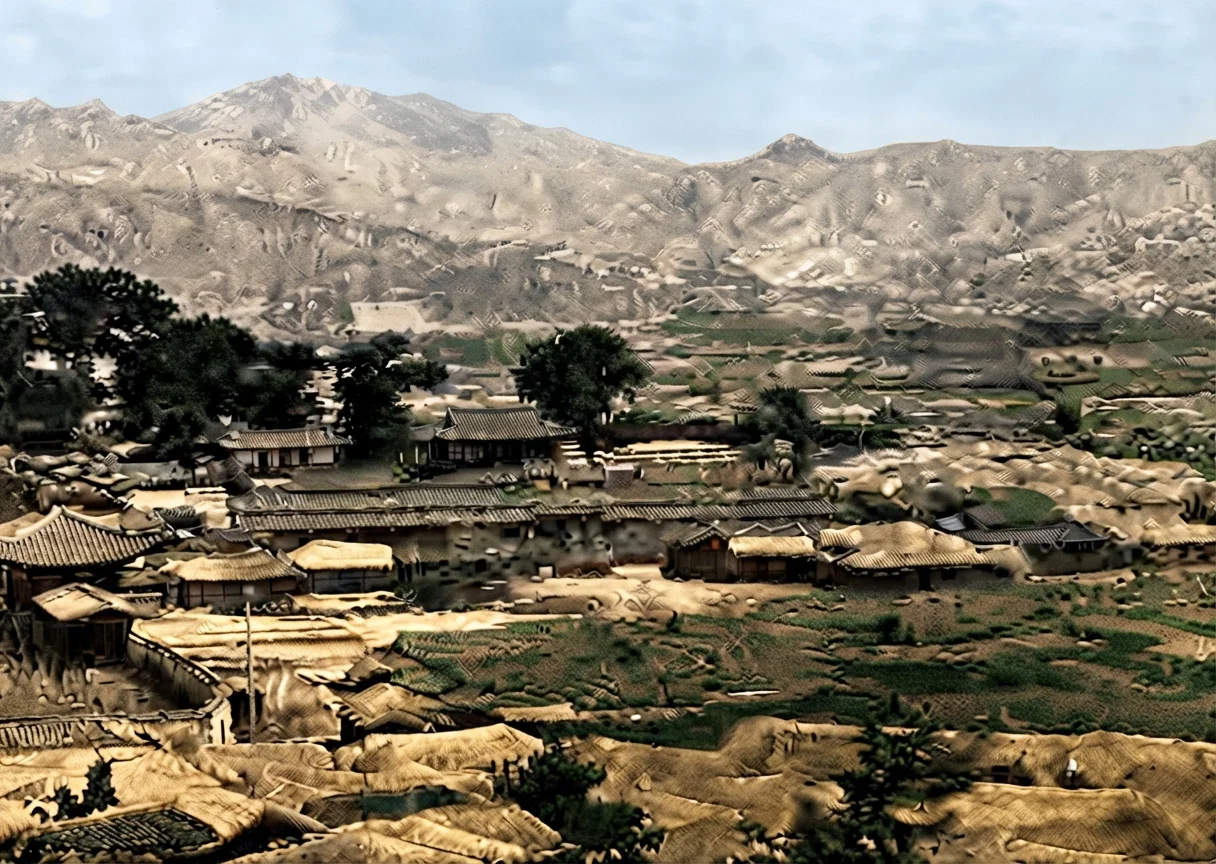
Seoul, the Korean Capital.
And altho the Japanese did not hold the Koreans in subjection, this early conquest was never forgotten. It was made the pretext for the unwarrantable invasion of Korea by Hideyoshi in the sixteenth century. The war which followed continued for years, and cost the Koreans three hundred thousand men. The sudden death of Hideyoshi put an end to the strife, but did not end the hatred of the Koreans toward the Japanese; for it continues unabated to the present time. Not that the Koreans have such remarkable memories; the hatred has been kept alive by various acts of aggression and oppression from that time to this.
With all these facts in mind, it is easy to see how Korea became a bone of contention between China and Japan. The latter was ever jealous because of the suzerainty of China. These two would-be friends of Korea finally agreed by treaty that neither would interfere with the internal affairs of Korea without the knowledge and consent of the other. In 1894, rebellion was rife in Korea, caused by the intolerable oppression of the people by the official class. In order to suppress this uprising, the Chinese government despatched troops into Korea. The Japanese claimed that this was done in violation of their treaty with China; and war between these two powers was the result. At its close China acknowledged the independence of Korea, thus bringing to an end the long period of Chinese suzerainty.
The present reigning dynasty of Korea has occupied the throne for over five hundred years, or since 1392. The government is an absolute monarchy. The country is divided into thirteen provinces, and these are subdivided into three hundred and sixty districts. The monarch is assisted in the government by a cabinet of ministers, or heads of administrative departments. Cabinet ministers, provincial and district governors, and a host of other officials, all receive their offices by appointment. And the guiding theory of the ruling class seems to be that the government exists for the enrichment of the governors rather than for the good of the governed. Accordingly there is a general scramble among the upper classes to secure desirable appointments; and when these are secured, the only limit to official rapacity is the poverty of the common people who13pay the taxes. In courts of justice bribery is very common.
Official Corruption.
This rank corruption in official circles, reacts upon all classes of society. The spoils of office are looked upon as the rightful inheritance of the upper classes, and the members of these classes live in hope of sometime securing their share. Existence while not in office is made possible by a system or custom that requires a man in prosperous circumstances to support in idleness those of his indigent relatives and friends who throw themselves upon him for maintenance. There is no shame attached to this really shameful parasitism; and because of this the results are all the more deplorable. Many a man of real ability fritters away his time and opportunities in this helpless state of dependence.
The Laboring Class Affected.
The effects upon the laboring classes are no less deplorable; for they are the objects of all this official rapacity. They are the “ultimate sponge” in the grand system of “squeezing.” Unjust extortion is carried to such an extent that men of means dare not advertise their wealth by building decent houses to live in, or by investing their means freely in profitable enterprises. And the laboring classes content themselves with eking out a bare existence, knowing that anything beyond this would simply go to enrich the ever watchful officials. The effects of such a condition can easily be imagined. There is a sad lack of thrift and enterprise, and a corresponding degree of poverty.
These conditions have prevailed so long that for some time the outside world has regarded the government as being on the verge of collapse. The country was opened to foreign intercourse in 1884; and since that time the king has called to his assistance a number of foreigners as advisers, some of whom have rendered most excellent service by introducing much needed reforms, and checking the rapacity of dishonest officials. These results serve to strengthen the opinion held by many that, much as the government needs reforming, the people are themselves unable to bring about the needed reformation. And this accounts for the policy of “benevolent assimilation” that is being pursued toward this unfortunate country at the present time.
As an indication of what the Koreans might become under just and equitable laws, attention has been called to the condition of certain communities of Koreans who have migrated into Russian territory. Almost without exception they are in a prosperous condition, living in well-built houses on well-tilled land. In business they compete successfully with the powerfully industrious Chinese. And these Korean emigrants are by no means the pick of the country; for previous to their migration they became reduced to great straits of poverty, and left their own country in the hope of bettering their condition. The inference is that their countrymen generally would prosper equally well under as favorable circumstances.
All this pertains rather to the temporal prosperity of the nation. But there is a deeper and more vital need than this. The social and moral standards of the people should be raised. In other words, what Korea needs most is the uplifting, purifying influence of the Gospel of Christ. And the events of her recent history have opened the way for the entrance of the Gospel in a most remarkable manner. No other country in the world illustrates more forcibly the fact that we are now in the time of the Lord’s preparation. The cry of the down-trodden in Korea is ascending to heaven, and is being answered by the gathering out of souls prepared for the everlasting kingdom of peace and righteousness.
Tokyo, Japan.
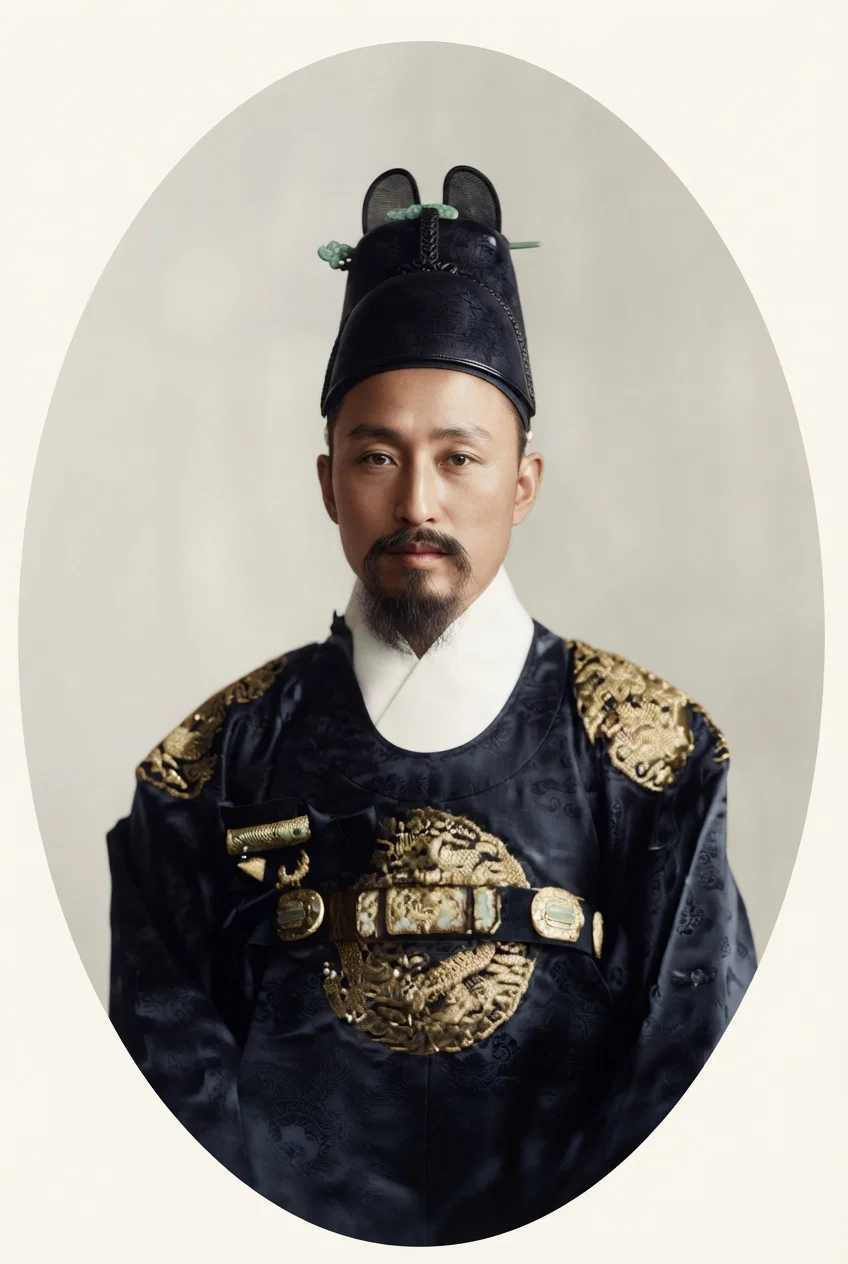
The King of Korea.
Our Work and Workers.
By Editor
At the camp-meeting held at St. Helena, Cal., twenty-four were baptized, June 30.
PRESENT truth has been preached in Bonacca, Bay Islands, for about a year by Brother Frank Carey, and nineteen have been baptized as the result.
ACCORDING to Eastern Tidings there are at the present time twelve Sabbath-schools in India and Burma, with a membership of 189. Three of these schools are in Calcutta.
FIFTEEN have received baptism in the Ontario Conference the last month, a very good record considering the small number of workers and the extreme prejudice and opposition.
Wanted for Missionary Work.
By Editor
THE following desire papers and will make good use of them in home missionary work:
Leslie Littell, Gentry, Ark., also tracts, for tent-meeting work.
Margaret Warnock, 718 W. Washington St., Guthrie, Okla.
A. L. Jenkins, R. F. D. No. 2, Blythewood, S. C.
Mrs. Jane E. Harris, 330 Plain St., Columbia, S. C.
C. F. Volz, R. F. D. No. 3, Lexington, Ind.
A. L. Manous, Decatur, Ga., desires to say that he has all the papers he can use to advantage.
Beautiful Bible Mottoes
No home complete without them
There is no better time than the present to sell them. They sell readily everywhere and agents are making good wages. An inspiration to higher living in every home. Beautiful floral designs with motto in silver and gilt letters and cord for hanging, and many other styles. Send $1.00 and name of express office and we will send prepaid sample order, $2.00 worth of mottoes. Particulars free. Address Home Art Co., Box 114, College View, Neb.
Just to Start You.
By Alfred Mallett
And to get E-Z Washing Tablets introduced, I will send you a case of 100 packages if you will promise to sell them and send me my share received for them. Give references, and send one dollar to pay freight or express charges. E-Z Washing Tablets retail at ten cents the package. This offer is only good in states west of the Rockies. Address,
E-Z WASHING TABLET CO.
Alfred Mallett, Mgr.
920 Fifth Street - - Sacramento, Cal.
Love One Another.
(Adapted, Author Unknown.)
It was Friday night, and two children small
Sat on the stairs in the lighted hall.
Vexed and troubled and sore perplexed,
To learn the Sabbath's forgotten text.
Only three words on the gilted card,
But both the children declared it hard.
' "Love" that is easy, it means, why this,
A warm embrace and a loving kiss,
But "one another," I don't see who
Is meant by another, now, Mae, do you?'
Very grandly she raised her head,
Our thoughtful darling, and slowly said,
As she fondly smiled on her little brother,
"Why I am 'one' and you are 'another,'
And this is the meaning, don't you see,
That I must love you and you must love me."