The Youth’s Instructor, Vol. 27, No. 10.

GRANDMOTHER’S VISIT

The Youth’s Instructor

Mar 5, 1879

S. D. A. Publishing Association · Battle Creek, Mich. · Mar 5, 1879

GRANDMOTHER’S VISIT.

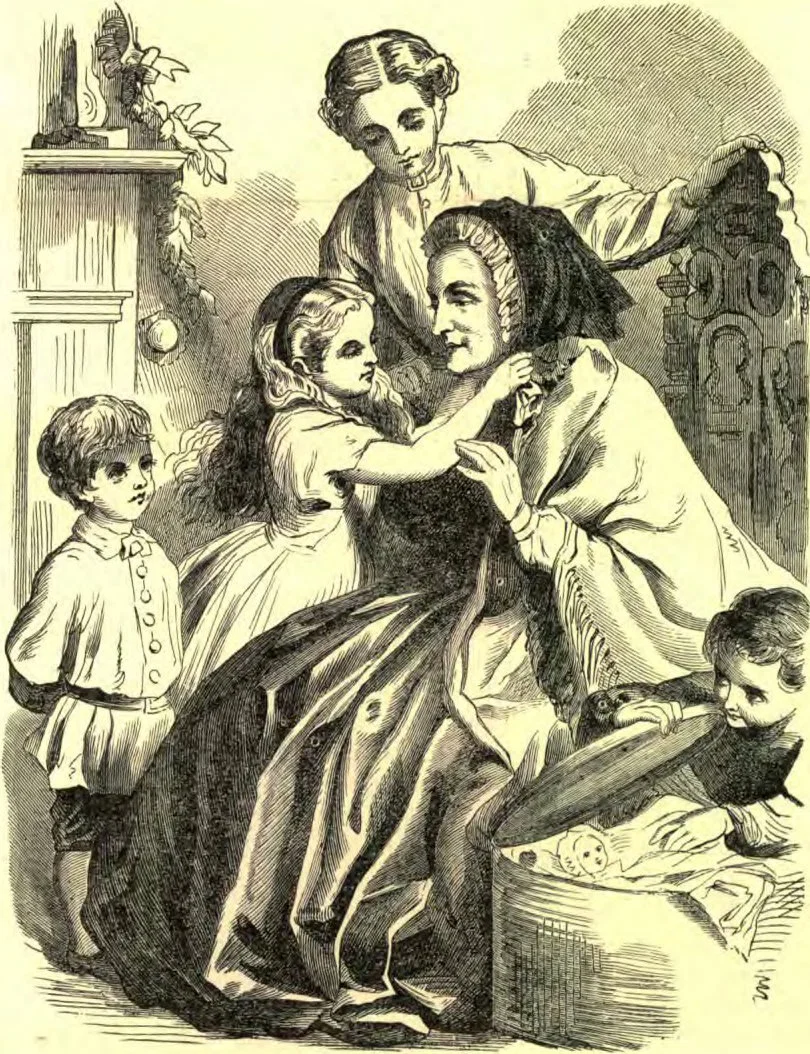
“GRANDMA has come! O mamma, grandma has come!” cried Gracie, joyfully, as she skipped to the door. Dick ran after her, shouting, “Good, now we’ll have a merry time.”
Little Neddie had forgotten all about the dear old grandma, so he stood very still and looked at her soberly, as she entered the room.
“Has Neddie forgotten grandma?” was her question as she took the little fellow in her arms, and covered his face with kisses.
“I forgetted once, but I shan’t never again,” answered Neddie, as he slipped from her arms, and shyly watched her as she tried to unfasten her bonnet.
“Let me help you, grandma,” said Gracie; and her nimble fingers soon untied the strings.
“Thank you, dear. My old fingers are cold and stiff. Yours are better. By-and-by they may open my basket.” She did not see roguish Dick peep into it.
“Yes, grandma, but I’ll carry your things away first;” and her willing feet tripped away with the wrappings.
When the last thing was put away, grandma said, “Now open my basket, Gracie.”
“Oh, what a nice dolly!” cried Gracie, as soon as she saw the pretty thing, folded so nicely in its dainty white blanket.
“I knew ’t was there before you saw it,” said Dick. “But dolls ain’t much. What have you got for me, grandma?”
“Dick,” said his mother, be patient. I think Neddie will have his present first, to-day.”
“O Neddie, see this nice horse on wheels!” exclaimed Gracie. She was almost as much delighted as Neddie with the pretty toy. His sparkling eyes showed his delight, although he said nothing then.
“Here, my boy,” said grandma at last; “here is yours at the very bottom of the basket,” and she handed Dick a handsome white-handled knife.
“Thank you; it’s just what I wanted. You are the best grandmother alive.”
“Is it worth waiting for?” asked grandma, with a quiet smile.
“I guess it is. I’ll remember to be patient next time, I’m sure I will. The best often comes last.”
After the presents had been sufficiently examined and praised, and grandma had eaten a good warm dinner prepared by her kind daughter, papa came home from his work, and the entire family gathered around the large, old-fashioned fire-place for an evening’s visit. Grandma then told them all about her home in New York, and about her long and tiresome journey. How that in one place they were delayed several days on account of heavy snows, and were finally pulled through by eight iron horses.
Thus the evening passed very pleasantly away, and all felt that the presence of grandmother had brought additional sunshine and happiness to the household. Blessed be the children who have an old-fashioned grandmother. As they hope for length of days, let them love and honor her, for we can tell them they will never find another.

HOMAGE TO OLD AGE.

Dear children, whereso'er you are, Remember you must pay Due reverence unto every one Whose locks with age are gray.
Ah! you as yet have never known The many cares and fears, The many griefs, that often come To those advanced in years.
Our God who is the God of love, Whose words and ways are truth, Who watches with unceasing care The steps of age and youth.
Hath bid the young to pay respect Unto the hoary head; And he will bless all those who do As he hath willed and said.
—Selected.

From Sea to Sea: Crossing the Sierra Nevadas by Rail

FROM SEA TO SEA.—NO. 3.

Passing Colfax station, we slowly continue our course up the Sierra Nevadas, and the ascent is so steep that our train of ten cars, although drawn by two heavy engines, moves no faster than a boy can run on level ground. We are now some nine hundred feet above the level of the sea, and in six hours, with only about fifty miles’ travel, we shall be 6100 feet higher.
Suddenly we cross a deep chasm on a bridge several hundred feet high, and we see, winding off to our right, a deep valley. This is the American River bottom. Here we come to what has been denominated, “The Cape Horn of the Nevadas.” Turning quickly around the rocks to the left, we find ourselves apparently hanging upon the edge of a rocky cliff. On our right, about two thousand feet below, flows the river; and on our left, several hundred feet above, is the peak of the mountain. It is said that when the workmen were constructing the railroad around this point, they were let down by ropes from the top of this crag, and thus held while they made a place, with a pick, for their feet. As we pass this place, we are led to admire the perseverance which led men to construct this road under such difficulties.
But what now? we exclaim, as we instantly plunge from daylight into darkness. Oh, we are only passing through a tunnel. They could not go around the edge of this mountain as they did around Cape Horn, so they dug a hole through it. Here we are several hundred feet below the peak of the mountain, but the rocks at the sides and overhead are so firm that the earth does not cave in upon us. We shall pass through a number of such tunnels in the mountains.
As we come out of this tunnel, what a sight meets our gaze! Crags and peaks, ravines and canyons, on the right hand and on the left, above us, below us, and in every direction! Here, in the winter season, the snow whirls and piles in fantastic shapes. Formerly it blocked the railroad, but they have now constructed sheds over the track, so as to keep the snow from filling the grade made by cutting through the mountains. These are called snow-sheds.
We pass in and out of these snow-sheds and tunnels for nearly forty miles; and, as by this means we are deprived of viewing the scenery, it is somewhat dreary traveling. We no sooner shoot out of one long shed and get a little sight of the romantic mountain views outside than we dash into another. They must, however, be very nice in the winter when there is danger of being snowed in, and of suffering for food and fire as some have in the past.
But here we are at the summit, and although only about one hundred miles from Sacramento, we are more than seven thousand feet higher than that city. How light the air seems. If we fill our lungs with it, it seems almost as though we had not breathed at all. This must be good for the expansion of the lungs; but I am glad we do not tarry here long, for the work of breathing is too taxing for feeble lungs.
Now that we are over the top of the mountains, and are going down at the rate of some three thousand feet in seventy miles, perhaps they will leave off one of the engines. But no! they tell us they will keep on two engines, as they wish to let us down the mountain side carefully.
The variation of the scenery on the east side of the mountains differs but little from that on the west side, only the great snow banks to be seen on that side do not appear on this. Soon after we begin to descend, we catch a glimpse of the blue waters of Donner Lake in the distance. It was at this place that a party of emigrants in early mining times, in undertaking to pass over the mountains late in the fall with ox teams, were overtaken by heavy snows. When discovered a few weeks after by a party who came from California in search of them, they were found at their camp at Donner Lake nearly all frozen or starved to death. The snow came down to the depth of twenty feet. This is now shown by stumps of trees which they then cut off for fuel above the snow.
We glide rapidly down the mountain, following along the course of the swiftly flowing Truckee River until we make a halt at Reno, Nevada. Here the conductor calls out, “Change cars for Virginia City.” As Reno is one of the most prominent stations on the Central Pacific Railroad in Nevada, and as considerable time is required to overhaul the train and to get lunch, we will make some inquiries and look about a little before resuming our journey.
J. N. Loughborough.

THE AIR WE BREATHE.

Men and animals live on the oxygen in the air, and send out from their lungs carbonic acid gas, which, when unmixed with oxygen, is a deadly poison. You may think that the breathing of the many millions of creatures in the world, would, after a time, consume all the oxygen in the air, and leave nothing but carbonic acid gas, nitrogen, and vapor. But the Creator of all things with infinite wisdom has provided for this want. Plants breathe, as well as animals; but in the daytime, when under the influence of the sun, they live on carbonic acid gas, and send out oxygen. Thus animals and vegetables meet each other's wants, and as long as the two exist together there need be no fear of their suffering for want of air.
Nitrogen was formerly called “Life destroyer,” because when unmixed with oxygen, it is destructive to animal life. It is a little lighter than oxygen, but readily unites with it, forming very different substances, according to the proportions of the mixture. Air is very mild, but aqua-fortis—a combination of the same elements—is so harsh an acid that it readily dissolves metals.
I have told you a few facts concerning the composition of the air, and I will now note some things in regard to its properties. The air is transparent; that is, it can be seen through. Vapor dims its clearness. When it is free from vapor, distant objects appear much nearer than they really are. The air is a fluid; that is, it presses in all directions, can be easily moved, and is capable of supporting light bodies.
The air has weight. A cubic foot weighs about one ounce. Every person carries the weight of about fourteen tons of air upon his head. We do not feel the pressure because it is uniform on all sides and the air within our bodies counterbalances that without. The air is elastic; that is, when compressed by force, it returns to its original shape when the pressure is removed.
The air is supposed to extend about fifty miles above the earth. It grows thinner as we ascend. Men who go up in balloons are obliged to carry much clothing with them, because the thinness of the air renders it intensely cold. Humboldt, the great traveller, says that when he attempted to ascend very high mountains, blood gushed from his eyes, ears, and lips. This was owing to the lightness of the air.
ELIZA H. MORTON.

THERE IS BUT ONE GOD.

HERE is none other God but one; for though there be that are called gods, whether in heaven or in earth (as there be gods many and lords many), but to us there is but one God, the Father.” 1 Cor. 8 : 4–6. All besides “that are called gods” are idols, the workmanship of men’s hands. They have no speech, nor knowledge, neither can they deliver in the day of trouble; yet there are millions of human beings who bow down to and worship images made of wood and stone and other perishable material.
We marvel that the heathen do not all see the utter inability of their gods to deliver or to help them in any way, and renounce their faith in them. Circumstances sometimes occur which cause them to do this. An instance is that of Deacon Thaley, a convert from idolatry in one of the Baptist missions. He relates his own experience thus:—
“When I was a heathen I bought a large idol made of light stuff, and very gaudy. One day I found some large holes in it. I performed my devotions, then pounded upon it, and behold two or three large rats ran out of it. Then I was very angry, and said, ‘What! you a god, and not able to defend yourself from rats? Do I worship a god that cannot defend himself from rats?’ I seized a club, laid him prostrate, and pounded him to pieces. The old priest came out, and exclaimed in horror, ‘Young man, what are you doing?’ ‘I am knocking to pieces my god who cannot defend himself from rats,’ said I. I never bought another idol, and when I heard the gospel, I rejoiced in it.”
With what gratitude the heathen must receive light which delivers them from such senseless worship. How thankful ought we to be that we were not born in a land of idols.
M. J. C.

BIBLE LESSONS FOR YOUTH.

LESSON XXXVI.—THE TABLES OF THE LAW.

1. AFTER the covenant had been duly ratified, what did the Lord tell Moses to do? Ex. 24 : 12.
2. What did the Lord say he would give him?
3. How long was Moses in the mount before God spoke to him? Verse 16.
4. What covered the top of the mount?
5. What appearance had the glory of God, as it was manifested upon the mount?
6. How long did Moses remain in the mount?
7. What did God give Moses when he had made an end of communing with him? Ex. 31 : 18.
8. What was written on these tables? Deut. 4 : 13 ; 5 : 22.
9. How was it written?
10. When the people saw that Moses delayed to come down from the mount, what did they say to Aaron? Ex. 32 : 1.
11. What did he do?
12. What homage did the people pay to the golden calf which Aaron had made to be their god?
13. How did some of the people exalt this idol before the congregation?
14. How did Moses know, before he came down from the mount, what the people were doing? Verse 7.
15. What did the Lord propose to do with the rebellious people, and what with Moses?
16. Was Moses pleased with this?
17. What plea did he make for the people? Verses 11–13.
18. How did the Lord regard this plea? Verse 14.
19. What did Moses then do?
20. When he came nigh to the camp, what did he hear?
21. In his discouragement and sorrow, what rash act did he perform?
22. What did he do with the calf which they had made?
23. What did he thus show them?
24. How did Aaron excuse himself when Moses reproved him?

SYNOPSIS.

After this, the Lord said unto Moses, “Come up to me into the mount, and be there: and I will give thee tables of stone, and a law, and commandments which I have written; that thou mayest teach them.”
“And Moses went up into the mount, and a cloud covered the mount: And the glory of the Lord abode upon Mount Sinai, and the cloud covered it six days; and the seventh day he called to Moses out of the cloud. And the sight of the glory of the Lord was like devouring fire on the top of the mount in the eyes of the children of Israel. And Moses went into the midst of the cloud, and gat him up into the mount; and Moses was in the mount forty days and forty nights.”
“And he gave unto Moses, when he had made an end of communing with him upon Mount Sinai, two tables of stone, written with the finger of God.” On these tables were written the ten commandments which had been spoken by the voice of God from Mount Sinai.
“And when the people saw that Moses delayed to come down out of the mount, the people gathered themselves together unto Aaron, and said unto him, Up, make us gods, which shall go before us; for as for this Moses, the man that brought us up out of the land of Egypt, we wot not what is become of him.” So Aaron took the gold ear-rings of the people, and made of them a molten calf, and the people said, “These be thy gods, O Israel, which brought thee up out of the land of Egypt.” “And they rose up early on the morrow, and offered burnt offerings, and brought peace offerings, and the people sat down to eat and to drink, and rose up to play.”
The Lord then told Moses to get him down from the mount; for the people which he had brought up out of the land of Egypt, had corrupted themselves. The anger of the Lord was kindled against the people, and he told Moses that he would utterly destroy them, and make of him a great nation; but Moses cried unto the Lord, and pleaded so earnestly for them, that “the Lord repented him of the evil which he thought to do unto his people.”
Moses then turned and went down from the mount, taking with him the tables of stone which God had written with his own finger. When he came near the camp, he heard the noise of the shouting and singing; for the people were then in the midst of their feast. “And it came to pass, as soon as he came nigh unto the camp, that he saw the dancing, and Moses’ anger waxed hot, and he cast the tables out of his hand, and brake them beneath the mount. And he took the calf which they had made, and burnt it in the fire, and ground it to powder, and strewed it upon the water, and made the children of Israel to drink of it.” Thus he showed them the utter worthlessness of the god which they had been worshiping.
Moses reproved Aaron very severely for his part in the sin, but Aaron tried to excuse himself by throwing the blame on the people.
G. H. BELL.

LESSONS FOR CHILDREN.

LESSON X.—JOSHUA'S EXHORTATION.

After Joshua had taken all the cities of the land, he divided it among the tribes, as the Lord commanded him. At Caleb’s request, Joshua gave him the land of Hebron. This was the place which Caleb and Joshua, with the other spies, had visited forty-five years before,—the land of walled cities and giants so great that the men of Israel feared to meet them in battle. But now Caleb with a few men, by the help of the Lord, took those cities that defied all the hosts of Israel.
The men of the tribe of Levi were appointed to serve in the sanctuary of the Lord; so they had no part in the land, but forty-eight cities were given them for their families to dwell in, and a small portion of land around each city to afford pasture for their cattle.
When Joshua was old and about to die, he called all Israel together and gave them good counsel. He said, “Behold, this day I am going the way of all the earth: and ye know in all your hearts and in all your souls, that not one thing hath failed of all the good things which the Lord your God spake concerning you; all are come to pass unto you, and not one thing hath failed thereof.” “Take good heed therefore unto yourselves, that ye love the Lord your God.” “Be . . . very courageous to keep and to do all that is written in the book of the law of Moses, that ye turn not aside therefrom to the right hand or to the left.” “Fear the Lord, and serve him in sincerity and in truth.”
“And it came to pass after these things, that Joshua the son of Nun, the servant of the Lord, died, being an hundred and ten years old.”
“And Israel served the Lord all the days of Joshua, and all the days of the elders that overlived Joshua, and which had known all the works of the Lord, that he had done for Israel.”

QUESTIONS.

  1. What did Joshua do after he had taken all the cities of the land?
  2. What portion was given to Caleb?
  3. Why did he choose Hebron?
  4. When had Caleb visited this land?
  5. Who were with him when he visited Hebron so long before?
  6. What report did Caleb and Joshua give?
  7. What report was given by the other ten spies?
  8. How did Caleb now take those cities that had defied the hosts of Israel?
  9. Why was no portion of the land given to the tribe of Levi?
  10. What were given them as homes for their families?
  11. What did they have around each city?
  12. What did Joshua do when he was old and about to die?
  13. What did he say about the things that God had done for them?
  14. What did he tell them that they must take heed to do?
  15. In what must they be very courageous?
  16. How did he say they should regard the Lord?
  17. How were they to serve him?
  18. How old was Joshua when he died?
  19. How long did the children of Israel continue to serve the Lord?

Report of Minnesota S. S. Association for Quarter Ending Dec., 1878.

Names of Schools Names of Superintendents Membership Average Attendance No. Under 14 No. Over 20 No. of Classes Held Before Meeting No. Instructors Taken
Mapleton David Alway 52 35 24 24 4 yes 11
Hutchinson Eunice McCart 87 57 34 37 9 " 26
Round Grove B. F. Lee 35 15 10 22 3 " ...
New Haven G. W. Samson 50 35 16 26 4 No ...
Dundas W. H. Butler 20 18 ... ... 3 yes 10
Medford J. H. Warren 46 28 19 16 6 " 12
Monticello Nettie A. Walker 20 1 7 11 3 " ...
Pleasant Grove I. Z. Lamb 43 30 17 26 3 " 11
Lake City E. H. Sanford 24 15 7 11 4 " 12
Greenwood Prairie W. I. Gibson 30 ... ... ... ... " ...
Lower Sioux Agency Ezra D. Post 22 20 ... ... 3 ... ...
West Union L. A. Chamberlain 20 15 13 7 2 " ...
Golden Gate Adeline E. Potter 25 ... ... ... ... ... ...
Beldenville A. McCutcheon 7 ... ... ... ... ... ...
Grand Meadow N. Ward 31 23 ... ... ... ... ...
Oranto A. Milne 33 ... ... ... ... ... ...
Maiden Rock Mrs. A. Benson 12 ... ... ... ... ... ...
Dodge Centre M. A. Winchell 35 23 ... ... 5 " ...
Kenyon David Akins 13 ... ... ... ... ... ...
Irving Mrs. E. Eggleston 43 ... ... ... 4 ... ...
Kingston W. B. Hill 25 20 8 17 3 " 4
No. Schools, 12 Totals 673 344 155 197 56 12 86
Names of schools that have failed to report this quarter:—
Alton, Geneva, Mankato,
Riceland, River Falls, Steele Centre,
Wrightstown, Faribault, Weston,
Eau Galle, Granite Falls, Milford,
New Auburn, Blue Earth City.
Names of churches not yet heard from that ought to have Sabbath-schools:—
Artichoke, Burnhamsville, Lake Johanna,
Sauk Rapids, Litchfield, Sauk Centre,
Home, Grove Lake, Joy,
Fair Haven, Cambridge, Chisago Lake,
Lake Ellen, Plum City, Oak Springs,
L. A. Curtis, Sec.                 H. B. Hill, Pres.

Report of Illinois S. S. Association for Quarter Ending Dec., 1878.

NAMES OF SCHOOLS. Names of Superintendents. Membership Average Attendance No. Under 15 No. Over 20 No. of Classes Held Before Meeting No. Instructors Taken.
Keenville J J Matthews 18 10 4 9 2 ye-
Aledo Mrs S H Greer 33 22 13 19 4 "
Serena I G Colcord 80 51 39 7 "
Princeville F M Bliss 29 16 9 17 3 "
Duquoin R Ridgway 84 46 61 18 1 "
Coleta O W Terpeny 28 10 12 10 2 "
Rockford W H H Bradley 26 16 12 2 "
Oakland H P Ritchey 20 15 11 8 2 "
Onarga John Havens 22 18 1 14 1 7
Belvidere Mrs N Craig 37 31 11 26 5 25
Gibson City A M Cudworth 16 12 5 9 2 4
Rutland M A Hickox 17 14 8 8 2 "
Watseka J J Carlock 17 14 3 13 1 "
Lovington M B Parrett 28 18 6 13 3 "
Eugene A L Bliss 10 8 1 8 2 "
St Anne Paul E Gros 17 14 6 11 1 "
No. Schools: 16 Totals 482 314 155 223 44 10 36
Names of schools that have failed to report this quarter:—
Webber Grove, Marshall, Carbondale,
Sadorus, Le Roy, Woodburn,
Kankakee, Durand, Mackinaw,
Chicago, Harvel,
Names of churches not yet heard from that ought to have Sabbath-schools:—
Roscoe, Greenvale, Beaverville,
Newark, McConnell's Grove, Martinsville.
L. S. CAMPBELL, Sec.         R. F. ANDREWS, Pres.

LETTER BUDGET.

Poy Sippi, Wis.
Dear Editors: I am a little girl twelve years old. We are very much pleased with your paper. We are trying to keep the Sabbath with our parents. I am trying to be a good little girl, that I may meet my little sister Emily who died last April. Pray for me. Yours truly, Mary E. Cady.
Berlin, Mich.
Dear Editors: I am a little girl eight years old. My father lives on a farm of two hundred acres. Last summer I went to Sabbath-school nearly every Sabbath. I go to school this winter. My teacher’s name is Jennie Patton. Excuse my mistakes. From your little friend, Hattie Stephens.
Dear Editors: I am keeping the Sabbath with my father, mother, brother, and a little sister five years old. I am fifteen years old. We have kept the Sabbath four months. I love to read the Instructor. I go to Sabbath-school every Sabbath. I hope to meet the Instructor family on the earth made new. Mary A. Thomas.
New London, Wis.
Dear Instructor: I am six years old. I have two little brothers, one four years old, and the other one year old. My brothers and I keep the Sabbath with mamma. I have taken the Instructor six months. I cannot read all the stories myself, but mamma reads them to me, and then sends the paper to my little cousins and friends. I am not large enough to work for God much, but I’ll try and do all that I can, so that when our Saviour comes he will take me to live with him. Mamma says that the best promise is to the little children, for “Jesus said, Suffer little children to come unto me, and forbid them not, for of such is the kingdom of Heaven.” Nellie Walker.
P. S. Mamma wrote my letter for me. I can’t write as she does, but I am learning to print. N. W.

I'LL PUT IT OFF.

Some little folks are apt to say, When asked their task to touch, “I'll put it off at least to-day; It cannot matter much.”
Time is always on the wing— You cannot stop its flight; Then do at once your little tasks, You'll happier be at night.
But little duties still put off Will end in “Never done;” And “By-and-by is time enough,” Has ruined many a one.
—Selected.

SEWING-ACHES

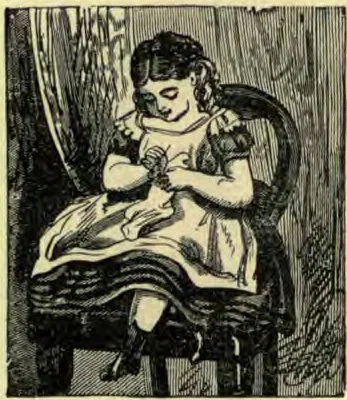
ESSIE sat down by her mother to sew. She was making a pillow-case for her own little pillow.
“All this?” she asked in a discontented tone, holding the seam out.
“That is not too much for a little girl who has a work-basket of her own,” said her mother.
“Yes,” thought Jessie, “mother has given me a work-basket, and I ought to be willing to sew,” and with that she took a few stitches quite diligently.
“I have a dreadful pain in my side,” said Jessie, in a few minutes. “My thumb is very sore,” she said after sewing a little longer.
“Oh, my hand is so tired,” that was next. And with that she laid down her work. Next there was something the matter with her foot, and then with her eye.
But at length the sewing was done, and Jessie brought it to her mother.
“Shall I not send at once for a doctor?” said her mother.
“A doctor for me, mother?” cried the little girl, as surprised as she could be.
“Certainly,” said her mother; “a little girl so full of aches and pains must be sick, and the sooner we have a doctor the better.”
“O mother!” said Jessie, laughing, “they were sewing aches. I am well enough now.”
I have heard of other little girls besides Jessie who had sewing aches and pains whenever their parents had work for them to do. These aches and pains do show sickness. They are symptoms of a bad disease which eats some people up. This disease is called “selfishness.” It makes children cross, and fretful, and disobliging, and troublesome, and unhappy; and I am sure it makes those unhappy who have the charge of them.—The Christian Child.

THE REPORTS.

On the preceding page we print a partial report of the Sabbath-schools in Minnesota and Illinois. A few weeks ago we published as full a report as we could obtain of the schools in Michigan. This report, though imperfect, has proved to be so great a help to the officers of the S. S. Association, to ministers visiting the churches reported, and to the schools themselves, that we have thought best to print the reports from several other States.
Minnesota and Illinois are large States, and it is with much labor that the State Secretaries have secured the reports as published. We hope that their efforts will be rewarded by a report, at the end of this quarter, from every school in those States. Iowa, New England, and New York will be reported next week; and Maine, Vermont, and other States as soon as more of the schools in those States fill out their blanks and send them in to the State Secretaries. Several have asked,—

OF WHAT USE ARE THESE REPORTS?

A few of the benefits of the reports are, to help the S. S. officers to become acquainted with the work, and to see what all are doing; to show the ministers of the State the standing of each of its schools, and thus point out to them the counsel or assistance each may need; and last but not least, it enables the publishers of the INSTRUCTOR to send to many of the schools the handsome present of a large bundle of weekly INSTRUCTORS to be given to the scholars.
As soon as the report from any State is received, we send to each school that has not already subscribed, a bundle of as many INSTRUCTORS as the school has scholars. We therefore make

A SPECIAL REQUEST

That the superintendent of every S. D. A. Sabbath-school, great or small, whose school has not reported, shall immediately send, or see that the secretary sends to the Secretary of their State Association, a report of their school.
If you cannot report on all the points mentioned in the table, please report what you can. There is no school that cannot give us the address of its officers and the number of members.
We give below a list of the State Secretaries with their addresses:—
MICHIGAN.—Lettie Marvin, Battle Creek. CALIFORNIA.—Alice Papworth, Oakland. MISSOURI.—D. C. Hunter, Nevada. KANSAS.—N. W. Vincent, Thayer, Neosho Co. OHIO.—E. H. Gates, North Madison, Lake Co. WISCONSIN.—O. A. Johnson, Leon, Monroe Co. MINNESOTA.—L. A. Curtis, Kingston. INDIANA.—Viola Shrock, Ligonier, Noble Co. VERMONT.—E. M. Peebles, So. Lunenburg. NEW ENGLAND.—Mrs. M. A. Buzzell, So. Lancaster. ILLINOIS.—L. S. Campbell, Belvidere. IOWA.—L. T. Nicola, Richmond, Washington Co. TEXAS.—Rosa Chrisman, Covington, Hill Co. NEW YORK.—E. E. Wallsworth, Adams, Jefferson Co. PENN.—Annia M. Oyer, East Otto, Catt. Co. MAINE.—John Allen, So. Norridgewick. NEBRASKA.—Anna M. Shepherd, Neb. City.
Schools that are in States where there is no S. S. Association may report to
YOUTH'S INSTRUCTOR, Battle Creek, Mich.

CHILDREN'S TRIALS.

LITTLE crosses, little cares, Little things that give us pain, As we bear them ill or well, Turn to endless loss or gain.
Little trials now may bring Golden lessons to the heart, Which perhaps, in after-years, Sterner sorrow must impart.

You have reached the end of this edition.

The Youth’s Instructor · Mar 5, 1879