The Youth’s Instructor, Vol. 27, No. 30.

A VISIT TO LONDON

The Youth’s Instructor

Jul 1879

S. D. A. Publishing Association · Battle Creek, Mich. · Jul 1879

A VISIT TO LONDON.

[The following interesting sketch we are kindly permitted to publish from a letter written to her mother by our young friend, EDITH ANDREWS, niece of ELD. J. N. ANDREWS, whom she accompanied to England.]
WILL not attempt to describe the beautiful scenery through which we passed on our journey from Glasgow to London. To appreciate England, you must see it, in its robe of deep, rich green. One is often reminded of the lines,—
“Sweet fields arrayed in living green, And rivers of delight.”
The climate is very different from that of America. The air is cool and damp, and it seems as natural for it to rain as for the sun to shine.
At London we were met by Eld. Jones and another gentleman, who had made arrangements for us to remain a week in the city. A part of the time we spent with the family of Eld. Jones, and we enjoyed our stay there very much. They did all in their power to make us happy, and gave us much assistance in visiting the various places of interest.
The next day after our arrival, Eld. Jones, Eld. Andrews, and myself, with several other friends, started to visit Westminster Abbey. We sailed up the Thames from London Bridge to Westminster Bridge, and then walked the remaining distance, on our way passing the famous obelisk, Cleopatra’s Needle. On reaching the Abbey we first took a view of the exterior of the venerable pile. To say that it is a most elaborate building is saying very little. Like England itself, Westminster Abbey must be seen, to be appreciated. It is believed to have been commenced in the early part of the seventh century, so, you see, it is very ancient.
We pass through the little old-fashioned doorway, to the interior, where the first thing that strikes the visitor is the immensity of the place. It appears larger than it really is, owing to the dim light which is permitted to enter through the deep-stained glass windows. The building is in the form of a somewhat irregular cross. Its length is 511 feet, and the extreme breadth 203 feet. The height varies from 100 to 140 feet, while that of the towers is 225 feet. This will give you some idea of its size; but, as I said before, you must see it in all the gloom by which it is continually haunted, if you would be impressed by its vastness and grandeur.
The Abbey contains a large number of monuments and statues of distinguished persons. The north transept [that part of the building which forms one arm of the cross] is set apart to military heroes. The north aisle is lined with naval heroes, surgeons, statesmen, etc. The south aisle is devoted to professors of theology, bishops, deans, etc., and to fill up the space, statues of a few military notorieties have been introduced, among which is a monument to Major Andre. The south transept is called “The Poets’ Corner,” and there are monuments to most of the English poets of any note.
The British sovereigns, from Edward the Confessor to Queen Victoria, have been crowned in Westminster Abbey, and many of them are buried there, some with, others without, monuments.
Perhaps the best idea I can give you of the architecture of the place will be found in the following words: “It is the admiration of the universe; such inimitable perfection appears in every part of the composure, which so far exceeds human excellence that it appears knit together by the fingers of angels, pursuant to the direction of Omnipotence.”
Leaving the Abbey, we walked over to the houses of Parliament, but had to content ourselves with a view of the exterior. They are most magnificent buildings, far surpassing anything in New York City.
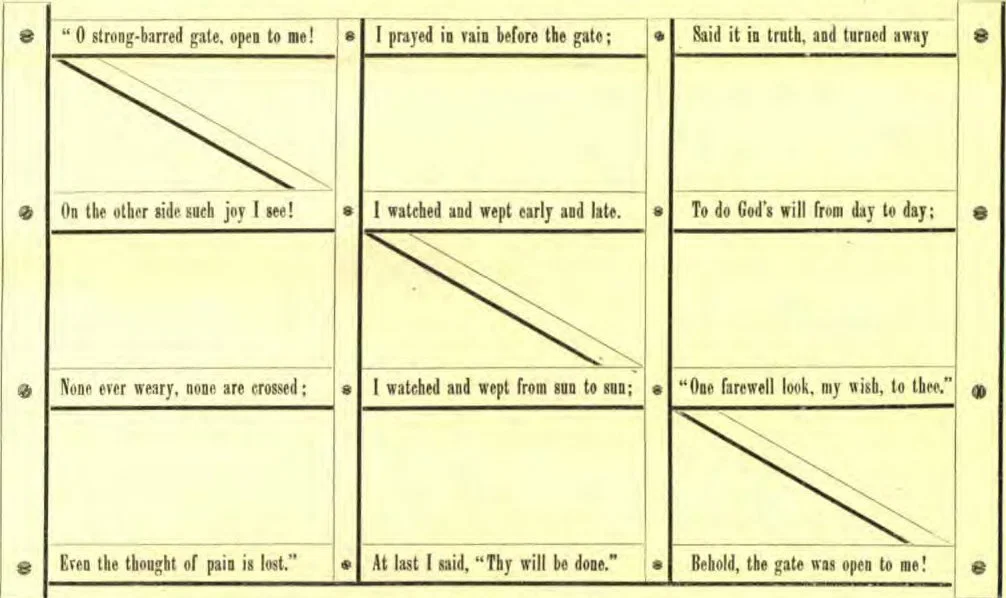
THE GATE.
THE GATE.
On Friday morning, in company with a friend, I visited the Tower. This is a collection of buildings formerly containing a state prison, but now used as an arsenal and a repository for various objects of public interest. We were first shown the armory, in which is every style of arms, from those used in the time of Adam to the most modern invention. Of course, the veritable stone and sling with which David slew Goliath is not to be found here, but they have one like it. There is, however, a large collection of very ancient arms which really did belong to the heroes to whom they are ascribed. Every known nation has been made to contribute to the vast stores which are here exhibited. In Queen Elizabeth’s armory there are 65,000 stands of arms ready for use at any moment.
We saw the state prison room; the block and ax; the instruments of torture; the green where Lady Jane Grey was beheaded; the place where the children of Edward IV. were buried by their uncle, Richard III., who had murdered them in order to obtain the crown; and also the place where the same villain stabbed Henry VI. We were next conducted to the crown jewel room, which contains jewelry to the value of £6,000,000, or about $30,000,000. Queen Victoria’s crown is a magnificent and costly “bauble,” the jewels which it contains alone being worth $500,000.
In the afternoon we visited Crystal Palace, and on our way crossed London Bridge. The descriptions of the latter structure are perfect, and I saw just what I expected,—such a crowd of people that we could hardly crowd our way through them. Crystal Palace, a building made of iron and glass, is filled with statues, birds, animals, plants, and everything to make it beautiful. We passed a very pleasant afternoon there.
(To be Continued.)

THE STINGING TREE.

In the beautiful and luxuriant forests of Queensland, Australia, grows a shrub called the stinging tree, which is very dangerous and even deadly in its effects. A writer in the Scientific American thus describes this poisonous plant:—
“If a certain proportion of one’s body is burnt by the stinging tree, death is the result. It would be as safe to pass through fires as to fall into one of these trees. They are found growing from two and three inches high to ten and fifteen feet. In the old ones the stem is whitish, and red berries usually grow on the top. It emits a peculiar, disagreeable odor, but it is best known by its leaf, which is nearly round, having a point on the top, and is jagged all round the edge, like the nettle. All the leaves are large,—some larger than a saucer. The shrub is usually found growing among palm trees.”
Says a traveler, in speaking of the stinging tree, “I was only once stung, and that was very lightly. Its effects are curious. It leaves no mark, but the pain is maddening. I have seen a man who treats ordinary pain lightly roll on the ground in agony after being stung.” The small trees, only a few inches high, are said to be as dangerous as any, being so hard to see, and seriously imperiling one’s ankles.
An ancient writer nearly three thousand years ago described a stinging tree far more deadly than that which grows in the forests of Queensland. Of its effects he says, “It biteth like a serpent, and stingeth like an adder.”
This poison plant has destroyed millions of victims. It has made their lives unspeakably wretched, and at last deprived them, not only of the present, but of the future, immortal life. It is not confined to the tropics, but flourishes on every soil and in every climate. There is not a person, young or old, who is not exposed to danger from this deadly Upas,—intemperance.
And be it remembered that, like the stinging tree first described, the smaller plants are as poisonous as any, and even more dangerous, because less readily seen. It is the first wrong step, the first cigar, the first glass, that opens the way for the long tide of evil. How many have been lured on to destruction by a seemingly harmless indulgence who would have started back in horror from the drunkard’s cup! There is only one rule of safety, that given by the wise man so long ago,— “Avoid it, pass not by it, turn from it, and pass away.”
How many of our readers will adopt this rule?
M. A. D.

LESSONS FOR CHILDREN.

LESSON XXX.—SAMUEL REPROVES AND COUNSELS THE PEOPLE.

When Samuel sent all the people away, every man to his house, Saul also went home to Gibeah; and there went with him a band of men whose hearts God had touched, but others despised him, and said, How shall this man save us?
Soon after this, Nahash the Ammonite came up with an army, and encamped against the men of Jabesh Gilead; and when the men of the city offered to become his servants, he would not make peace with them unless they would allow him to thrust out all their right eyes. When the people of Israel heard of this, they wept aloud; but Saul was full of courage, for the Spirit of the Lord came upon him. He called all the people together, a great army, more than three hundred thousand men; and fought against the Ammonites, and scattered them, so that no two of them were left together.
Then said Samuel to the people, Let us go to Gilgal and renew the kingdom there; and all the people went to Gilgal, and with great rejoicing proclaimed that Saul should be their king.
And Samuel called upon the people to witness that he had never taken anything that belonged to them, and that he had never received bribes from any man. Yet, now that he had become old and grayheaded, they had forsaken him, and wanted a king. He told them that it was the Lord that had always delivered them from their troubles: that it was the Lord that had worked through Moses and Aaron to bring them out of Egypt, and that all along had raised up men to deliver them from their enemies; that the Lord had been their king; and that in wanting a king like the nations around them, they had rejected God.
When Samuel had finished talking, he told the people that the Lord would make it thunder and rain, that they might know that they had sinned, and that what he had said was true. When the thunder and rain came, the people were terrified, for it was at a time of year when it never rains in that country. Then the people wanted Samuel to pray for them that the Lord would forgive their sins, and especially the sin of turning from the Lord, and desiring another king to reign over them. Samuel promised to pray for them, and said that if they would obey the Lord in all things, he would still be with them, and would bless them and their king.

QUESTIONS.

  1. What did Saul do when Samuel sent the people home? 1 Sam. 10:26.
  2. Who went with him?
  3. How did others treat him?
  4. Who came up and encamped against Jabesh Gilead? 1 Sam. 11:1.
  5. What did he say when the men of Jabesh Gilead offered to become his servants? Verse 2.
  6. What did the people do when they heard of this? Verse 4.
  7. How were they delivered from the Ammonites? 1 Sam. 11:11.
  8. How large an army did Saul gather? Verse 8.
  9. What way did he take to call out the people? Verse 7.
  10. After the battle was over, where did Samuel gather the people?
  11. For what purpose did he wish them to come together there?
  12. When the people had assembled at Gilgal, what did they do?
  13. What did Samuel afterward call upon the people to witness? 1 Sam. 12:1–5.
  14. What had they done, notwithstanding all his faithfulness to them?
  15. Who did he say had always helped them out of their troubles?
  16. How had Moses and Aaron been enabled to bring them up out of Egypt?
  17. How had they all along been delivered from their enemies?
  18. Who, then, had all the time been their king?
  19. Of what sin were they guilty in asking for another king?
  20. By what miracle did the Lord show that the people had sinned, and that what Samuel had said was true?
  21. When the people saw what a wrong course they had pursued, what did they want Samuel to do?
  22. On what condition did he say that the Lord would still be with them, and bless both them and their king?
G. H. BELL.

“I’LL NO TRUST YE.”

Two centuries ago it was thought an insult in the Highlands to ask a note from a debtor. It was considered the same thing as saying, “I doubt your honor.” If parties had business matters to transact, they stepped into the air, fixed their eyes on the heavens, and each repeated his obligation with no mortal witness. A mark was then carved upon some rock or tree near by, as a remembrance of the compact. Such a thing as a breach of contract was rarely met with, so highly did the people regard their honor.
When the march of improvement brought the new mode of doing business, they were often pained by these innovations. An anecdote is handed down of a farmer who had been to the Lowlands and learned worldly wisdom. On returning to his native parish, he had need of a sum of money, and made bold to ask from a gentleman of means named Stewart. This was kindly granted, and Mr. S. counted out the gold. This done, the farmer wrote a receipt and offered it to Mr. S. “What is this, man?” cried Mr. S., eyeing the slip of paper. “It’s a receipt, sir, binding me to give you back your gold at the right time,” replied Sandy. “Binding ye? Well, my man, if ye canna trust yoursel’, I’m sure I’ll no trust ye. Ye canna have my gold.” And gathering it up, he put it back in his desk, and turned his key on it. “But, sir, I might die,” replied the canny Scotchman, bringing up an argument in favor of his new wisdom, “and perhaps my sons may refuse it; and the bit of paper would compel them.” “Compel them to sustain a dead father’s honor!” cried the Celt. “They’ll need compelling to do right, if this is the road ye’re leading them. Ye can gang elsewhere for money; but ye’ll find nane in the parish that’ll put more faith in a bit o’ paper than in a neighbor’s word of honor, and his fear o’ God.” —Interior.

THE BIBLE.

We search the world for truth; we cull The good, the pure, the beautiful, From graven stone and written scroll, From old flower-fields of the soul; And weary seekers of the best, We come back laden from the quest, To find that all the sages said Is in the book our mothers read; And all our treasures of old thought In his harmonious fullness wrought, Who gathers in one sheaf complete The scattered blades of God's sown wheat, The common growth that maketh good His all-embracing Fatherhood.—Whittier.

BIBLE LESSONS FOR YOUTH.

LESSON LVI.—THE DEATH OF MOSES.

1. AFTER Moses had finished numbering the people, what did the Lord tell him to do? Num. 27 : 12.
2. What was to take place after Moses had viewed the land?
3. Why was Moses to be gathered unto his people before entering the promised land? Verse 14.
4. In what way did Moses rebel against the commandment of the Lord at the water of Meribah in Kadesh? Num. 20 : 1-13.
5. What did Moses beg the Lord to do, since he must die? Num. 27 : 16, 17.
6. What did the Lord tell Moses to do with Joshua?
7. How did Moses feel about going into the land of Canaan himself? Deut. 3 : 23-25.
8. What did he say to the Lord?
9. What answer did he receive?
10. Before Moses went up into the mountain, what did he try to secure?
11. What did he rehearse to the people?
12. What did he tell them?
13. What did he repeat?
14. How did he try to make the people feel the importance of obeying these precepts? Deut. 26 : 16-19; chap. 28; 30 : 10-20.
15. How were these laws and precepts preserved? Deut. 31 : 9, 26.
16. How often were they to be read to the people?
17. For what purpose?
18. By what other means were these laws preserved? Deut. 27 : 1-8.
19. Where did Moses go, after blessing the people? Deut. 34 : 1.
20. What did the Lord show him?
21. What did he say to him?
22. Repeat Deut. 34 : 5-7.

SYNOPSIS.

After Moses had numbered the people, the Lord said to him, “Get thee up into this mount Abarim, and see the land which I have given unto the children of Israel. And when thou hast seen it, thou shalt be gathered unto thy people, as Aaron thy brother was gathered. For ye rebelled against my commandment in the desert of Zin, in the strife of the congregation, to sanctify me at the water before their eyes: that is the water of Meribah in Kadesh in the wilderness of Zin. And Moses spake unto the Lord, saying, Let the Lord, the God of the spirits of all flesh, set a man over the congregation, which may go out before them, and which may go in before them, and which may lead them out, and which may bring them in; that the congregation of the Lord be not as sheep which have no shepherd. And the Lord said unto Moses, Take thee Joshua the son of Nun, a man in whom is the Spirit, and lay thine hand upon him; and set him before Eleazar the priest, and before all the congregation; and give him a charge in their sight. And thou shalt put some of thine honor upon him, that all the congregation of the children of Israel may be obedient.”
So Moses took Joshua, and laid his hands upon him, and gave him a charge, as the Lord had commanded; but Moses was very anxious to cross over Jordan, and said, “O Lord God, thou hast begun to show thy servant thy greatness, and thy mighty hand; for what God is there in Heaven or in earth, that can do according to thy works, and according to thy might? I pray thee, let me go over, and see the good land that is beyond Jordan, that goodly mountain, and Lebanon.” But the Lord refused Moses, and said, “Speak no more unto me of this matter. Get thee up into the top of Pisgah, and lift up thine eyes westward, and northward, and southward, and eastward, and behold it with thine eyes; for thou shalt not go over this Jordan.”
Before Moses went up into the mountain, he did all he could for the happiness and welfare of the people. He rehearsed the story of their journeyings and experiences in the wilderness. He told them why they had been doomed to wander in the wilderness forty years, and why he was not permitted to enter the promised land with them. He then repeated the ten commandments given on Mount Sinai, and many more of the precepts of instruction which the Lord had given him for the people. Time after time, Moses urged upon the people the importance of obeying these precepts, telling them what blessings would come upon them for keeping them, and what curses for breaking them. He then wrote all these laws and instructions in a book, and commanded the Levites to lay it up in the side of the ark. Every seven years, this law was to be read to all the people, that they might not forget it, and that their children might learn it.
Finally, after blessing the people, Moses went up into the mountain of Nebo, to the top of Pisgah, that is over against Jericho; and the Lord showed him all the land of Canaan. And the Lord said unto him, “This is the land which I sware unto Abraham, unto Isaac, and unto Jacob, saying, I will give it unto thy seed. I have caused thee to see it with thine eyes, but thou shalt not go over thither. So Moses the servant of the Lord died there in the land of Moab, according to the word of the Lord. And he buried him in a valley in the land of Moab, over against Beth-peor; but no man knoweth of his sepulcher unto this day. And Moses was a hundred and twenty years old when he died: his eye was not dim, nor his natural force abated.” G. H. BELL.

SABBATH-SCHOOL MEETING AT BUSHNELL.

At Bushnell, Montcalm Co., Mich., July 12, a meeting was held at which five Sabbath-schools were represented,—Bushnell, Greenville, Muir and Lyons, Orleans, and Sheridan. The meeting was held in a grove, and commenced about eleven o’clock with a Sabbath-school, in which each school was organized and led by its own Superintendent, and the whole conducted by Eld. Fargo. All united in general exercises, which were followed by a few remarks, and an intermission of ten minutes.
The importance of intellectual, moral, and spiritual culture, both in ourselves and in our children, was then discussed for about forty minutes when the meeting adjourned an hour and a half for dinner. Many took dinner in the grove; and this gave opportunity for interesting conversation on the Sabbath-school work. After dinner, the duties of parents, teachers, and officers, and the best way of discharging those duties, were considered. Bro. Howe talked on the way to find time for discharging those duties. After an intermission of ten minutes, Bro. Fargo spoke on the importance of Bible study, and the growing interest in the Sabbath-school work.
All the children present were then formed into a class, and taught a lesson from “Bible Lessons for Little Ones.” The lesson was then recited in answer to questions, after which, a little boy, who had never learned the lesson before, gave a synopsis which did credit both to the subject and to him. The entire exercise occupied but fifteen minutes.
A little time was then given to making arrangements for the next quarterly meeting, when nearly the whole company repaired to a lake near by, to attend the ordinance of baptism. Four young married persons and two children, members of the Sabbath-school, were here buried beneath the still waters, as a token of their faith in Christ and their hope of a resurrection through him. A lovelier scene is seldom witnessed, and it was no unfitting close to the exercises of the day, showing, as it did, the legitimate results of Sabbath-school work.
Although this meeting was held in the midst of wheat harvest, and upon an excessively hot day, it was well attended, about one hundred and forty being present throughout. These were mostly earnest workers, as was shown by the part they took in the Sabbath-school, and by the eagerness with which they received the suggestions that were made. The Sabbath-school interest seems to be rapidly growing in this part of the State. The schools are well supplied with INSTRUCTORS, Record-books, Song Anchors, etc., and the secretaries appear to be active and thorough. The singing was spirited and good; indeed, it is seldom that so many good singers are found in so small a company.
The outlook upon the Sabbath-school work is encouraging; everywhere the people seem anxious to improve, and the willingness to do whatever is thought best is remarkable. Let us be earnest and thorough, not forgetting that it is only by the blessing of God upon our work that any real good will be accomplished.
G. H. BELL.

REPORT! REPORT!

We ask each Superintendent to learn whether the Secretary has reported the standing of his school for the quarter ending June 28, to the Secretary of the State S. S. Association. If not, please see that it is done at once, if you have to do it yourself.
In August we intend to print another report of all our schools, and none will be reported except those who report each quarter. As far as possible, let each report be accompanied by a letter. Your State Secretary will be interested in any important event in your school, and will be willing to answer all reasonable questions.
W. C. W.

OFFICERS OF MINNESOTA S. S. ASSOCIATION.

President, W. B. Hill, Kingston, Minn.; Secretary, L. A. Curtis, Kingston, Minn.; Executive Committee, David Alway, Mapleton, Blue Earth Co., Minn., Myron Winchell, Dodge Center, Dodge Co., Minn.

Correction: Secretary Address of Wisconsin S. S. Association

The address of Mrs. Nellie C. Taylor, Secretary and Treasurer of the Wisconsin S. S. Association, is Nielsville, Wis., instead of Wellsville, as given a few weeks since.

Praise Meeting of the Flowers.

The flowers of many climates, That bloom all seasons through, Met in a stately garden, Bright with the morning dew.
Praise Meeting of the Flowers.
For praise and loving worship, The Lord they came to meet; Her box of precious ointment The Rose broke at his feet.
“Thy words are like to honey,” The Clover testified, “And all who trust thy promise Shall in thy love abide.”
The Lilies said, “Oh, trust him; We neither toil nor spin, And yet his house of beauty, See how we enter in!”
“And let us follow Jesus,” The Star of Bethlehem said; And all the band of star flowers Bent down with reverent head.
The glad Sun-Flower answered, And little Daisies bright, And all the cousin Asters, “We follow toward the light!”
“We praise him for the mountains,” The Alpine Roses cried; “We bless him for the valleys,” The Violets replied.
“We praise him,” said the Air-plants, “For breath we never lack;” “And for the rocks we praise him,” The Lichens answered back.
“We praise God for the waters,” The gray Sea-mosses sighed; And all his baptized Lilies “Amen! Amen!” replied.
“And for the cool green woodlands, We praise and thanks return,” Said Kalmias and Azalias, And graceful feathery Fern.
“And for the wealth of gardens, And all the gardener thinks,” Said Roses and Camellias, And all the sweet-breathed Pinks.
“Hosanna in the highest,” The Baby-Bluets sang; And little trembling Harebells With softest music rang.
“The winter hath been bitter, But sunshine follows storm; Thanks for his loving kindness The earth’s great heart is warm.”
Thus spoke the Pilgrims’ May-Flower, That cometh after snow, The humblest and the sweetest Of all the flowers that blow.
“Thank God for every weather, The sunshine and the wet,” Spake out the cheery Pansies, And darling Mignonette. —Sel.

AN ENEMY IN THE GARDEN.

WHILE I was walking in the garden one bright morning, a breeze came through and set all the flowers and leaves a fluttering.
Now, that is the way flowers talk, so I stopped and listened.
Soon an elder-tree said,
“Flowers, shake off your caterpillars.”
“Why?” said a dozen all together, for they were like some children who always say “why?” when they are told to do anything. Bad children those.
The elder said,
“If you don’t, they’ll eat you up.”
So the flowers set themselves a shaking, till the caterpillars were shaken off.
In one of the middle beds there was a beautiful rose, who shook off all but one, and she said to herself,
“Oh, that’s a beauty! I’ll keep that one.”
The elder overheard her and called out, “One caterpillar is enough to spoil you.”
“But,” said the rose, “look at his brown and crimson fur, and his beautiful black eyes, and scores of little feet. I want to keep him. Surely, one won’t hurt me.”
A few mornings after, I passed the rose again. There was not a whole leaf on her; her beauty was gone, she was all but killed, and had only life enough to weep over her folly, while the tears stood like dewdrops on her tattered leaves.
“Alas! I didn’t think one caterpillar could ruin me,” she sadly exclaimed.
One sin indulged has ruined many.—Christian Weekly.

LETTER BUDGET.

No doubt the little folks are having a merry time these long vacation days. We are glad that you who have been so long shut indoors can now “sing the song of rambles, long rambles in the sun;” but we hope you will not give all your time to pleasure-seeking. You need physical strength, it is true; but the out and in door exercise you will have in helping papa and mamma, together with recreation, will develop the muscles of your bodies. Have your parents fix you a time for your work, and a time for your play, and whichever you do, do it well; and when the vacation is over, you will have a satisfied feeling, which is a sure reward for the right improvement of time.
And now for a budget of letters:—
MT. MORRIS, MICH.
DEAR EDITORS: I am a little girl eleven years old. I take the INSTRUCTOR. I go to Sabbath-school and like to get my lessons. We have a good teacher, her name is Sarah Veitch. I keep the Sabbath with my father and mother. I shall try to be a good girl, keeping all of God’s commandments, that I may be saved with the rest of the INSTRUCTOR family when Jesus comes. Yours in love, ELLA M. NEWBERRY.
LEEDS CENTRE, WIS.
DEAR EDITORS: I have taken the INSTRUCTOR since the first of January, and like it very much. I am very anxious to get it every week, to have my sisters read the good pieces to me. I am six years old, and want to be a good girl, that when Jesus comes I may live with him. MINNIE MAY HAM.
VALTON, WIS.
DEAR EDITORS: I am ten years old. I take the INSTRUCTOR and like it very much. I am keeping the Sabbath with my father, mother, brother, and little sister. We have meetings and Sabbath-school every week. I hope to meet all who read the INSTRUCTOR, on the new earth. My mother wrote this for me, as I cannot write very well yet. Yours truly, CLAYTON C. TOWN.
THREE little sisters, signing their initials C. A., E. F., & F. B., write from Patricksburg, Ind.:—Our ages are twelve, ten, and eight years. We keep the Sabbath with papa and mamma; we love our parents, and they love us. They want us to be good little girls, for they say the Lord loves good children. We love the weekly INSTRUCTOR very much. Our Sabbath lessons are in it, and papa teaches them to us, when we go to Sabbath-school and have an interesting class. We would like to see all the INSTRUCTOR family together at the Sabbath-school. We think there would be so many little girls and boys together that the church house could not hold them. Papa says he wants us to be good children, that we may form an unbroken family in the new earth. The Lord will have room for all there. Good-by for this time.

Faithfulness of Children.

One morning a gentleman and his wife were in such haste to reach a railway train that they omitted family worship. The next time they sat down to read, the mother remarked that the first chapter of Ephesians was the place. “No, mamma,” said one of the little girls, “it is the second chapter; we read the first chapter after you were gone.” The children were all under ten years old, but they had conducted family worship in the absence of their parents. How many older boys and girls are ashamed to do their duty under such circumstances!

You have reached the end of this edition.

The Youth’s Instructor · Jul 1879