The Youth’s Instructor, Vol. 43, No. 7.

THE YOSEMITE VALLEY

The Youth’s Instructor

Feb 14, 1895

S. D. A. Publishing Association · Battle Creek, Mich. · Feb 14, 1895

THE YOSEMITE VALLEY.

PART II.—THE FALLS.
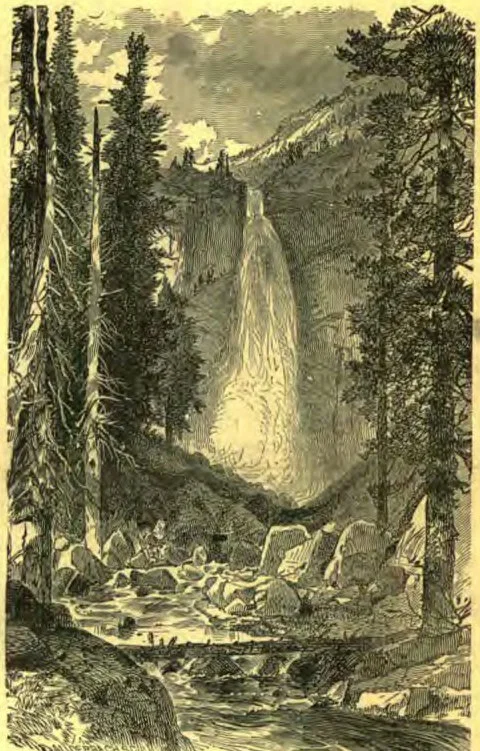
The highest waterfall in the world is the Yosemite Fall. The entire descent of this fall is two thousand five hundred and fifty feet. It is divided into three distinct divisions,—the upper, the middle, and the lower. The upper fall is a straight shoot of one thousand five hundred feet. The middle fall is a series of cascades descending about six hundred and twenty-six feet. The lower fall is a straight plunge of four hundred feet. At the beginning of the upper fall the river is about thirty-four feet wide. The water in its downward course catches the air in its fall, and then strikes a ledge of rock projecting from the mountain side. This produces an explosion, which sounds like peals of thunder, or heavy cannonading in the distance. Late in the season the river gets so low that tourists may go behind the upper fall with safety. A trail runs up to the top of the fall. It is a grand sight to go up to the end of this trail, and look down into the valley. Horses in the valley appear to be the size of sheep.
VERNAL FALLS.
VERNAL FALLS.
Bridal Vail is the first fall to greet the eyes of the tourist on entering the valley. The water here takes a plunge of six hundred feet, and is about forty feet wide at the top. There is a strong current of wind coming in from behind the fall, which strikes the foamy sheet of water, and makes overlapping folds in its downward course, thus causing it to resemble at a distance the soft, filmy folds of a vail. A beautiful rainbow may be seen in the spray of the fall about four o’clock in the afternoon.
The Sentinel Fall is on the same side of the valley as the Bridal Vail Fall—the south side. It takes its name from the Sentinel Rocks close by. Toward summer the stream that feeds this fall generally disappears.
The Ribbon Fall is on the north side of the valley, above Bridal Vail Fall. It has an almost vertical descent of two thousand feet, and then makes a further bouncing descent of over a thousand feet. Late in the season this fall nearly disappears.
The Royal Arch Fall is on the north side of the valley. The fall is fed by melting snows around the North Dome. It is a small stream flowing smoothly over an immense projecting rounded ledge of rock, and makes a fall of two thousand five hundred feet. This fall disappears early in summer.
The Nevada Fall has a descent of six hundred feet, and is at the head of the valley. There are water rockets that shoot out from the main body of water, and break near the bottom. Professor Whitney says that is the grandest waterfall in the world. Half way between the Vernal and the Nevada Fall is a bridge that crosses the river. Between the bridge and the Nevada Fall is the Diamond Cascade, so called because the water in its descent strikes huge rocks, and is thrown into the air, and breaks into crystal drops of various sizes.
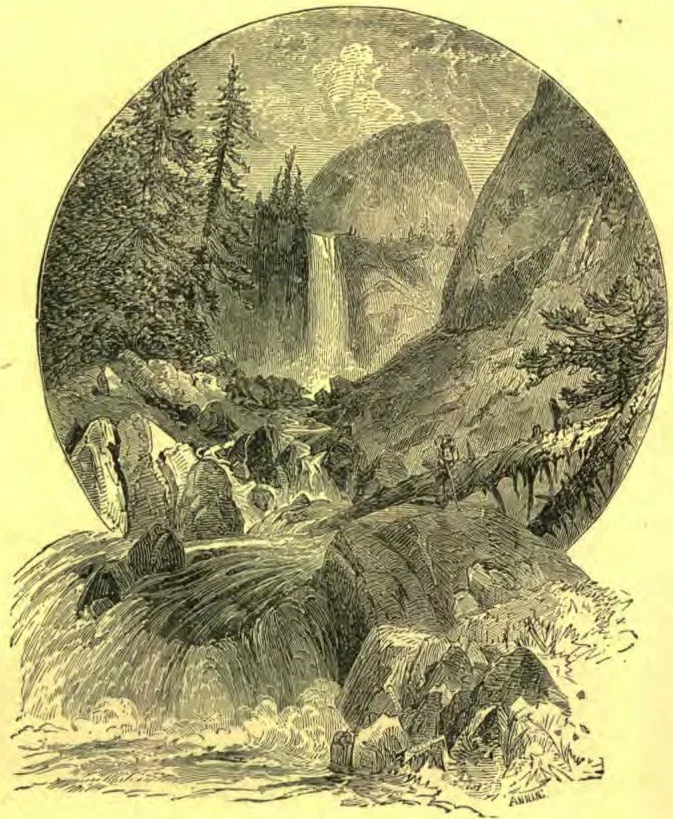
Vernal Fall is about two miles below Nevada Fall, and is about eighty feet wide at the top. The Merced at this point falls about three hundred and fifty feet. Just before the water falls, the river expands, and bears the appropriate name of Emerald Pool. A little farther up the stream the river-bed is so smooth that the water presents a smooth surface for a short distance, and is given the name of Silver Apron.
Cascade Fall is at the extreme lower end of the valley, and is about five hundred feet high.
DOULY GRAY.

THE GREAT CLOCK AT ROUEN.

NEVADA FALLS.
NEVADA FALLS.
Before we come to speak of this marvel of skill and durability, we will cast a glance at the city and environments where this great curiosity is kept. Rouen, formerly Ratumakos (the Rotomagus of the Latins) is poetically located on the right bank of the Seine, eighty-four miles north-west of Paris, and fifty-six miles east-southeast of Havre. With its feet as it were in the waters of the river Seine, the main part stretches out upon the slope facing in the south, in full view of this beautiful stream, which describes right here most graceful curves, meandering through vast and ever-verdant meadows, and flowing gently downward until it reaches the sea. Rouen is a place of great antiquity, and existed before the conquest of Gaul by the Romans, who gave it the name Rotomagus. Viewed from the adjoining heights, no provincial town in all France presents a more magnificent aspect.
In the ninth century it was pillaged by the Normans, who made it their capital. After the Norman Conquest, it long continued in the possession of the English, who finally lost it in 1449, just eighteen years after the inhuman sacrifice of Joan of Arc, or the Maid of Orleans. Its extensive manufacturing industries make Rouen the Manchester of France.
Its cathedral is a vast and imposing structure, with its front flanked by two lofty towers, and almost covered with images and sculptures. Its interior is four hundred and thirty-five feet long, one hundred and four feet broad, and eighty-nine and one-half feet high. The choir has on its pavement small lozenge-shaped tablets of marble, marking the spots where the heart of Richard Coeur-de-Lion (the lion-hearted) and the bodies of his brother Henry and his uncle Geoffroy Plantagenet were interred. There are other public buildings of vast dimensions, such as the archbishop’s palace, the court-house, etc., etc. In the Place de la Pucelle is a monument erected to the Maid of Orleans, on the spot where the heroine was committed to the flames at the age of twenty, May 31, 1431, amidst the clamors of assembled thousands before whom she was quickly consumed to ashes, dying with the name of Jesus upon her lips. Corneille, Fontenelle, and other eminent men were born in this city.
Rouen has several suburbs, of which St. Sever, on the left bank of the Seine, is the most extensive, being largely composed of manufacturing establishments and smelting works whose lofty chimneys seem to wish to rival the towers, pyramids, and steeples on the opposite bank, where, surmounting the altitude of the somber cathedral, we see the singular spectacle of a railroad toward the sky. A series of lovely hills in the immediate environments hang like a grand necklace as it were about the city and its annexes of suburbs and villages. Up the stream, on the left, as we face the east, are the picturesque yet pointed, high, and menacing rocks of St. Catherine, running out to the very border of the Seine; on these borders the valley of Darnetal, enriched by two little water-courses. In the west, and as it were a side-piece to this valley, lies the charming vale of Bapaume, aggrandizing the Seine with the waters of its brilliant and large river.
All these waters, be it as fertilizers, as sources of motive power, or as in the case of the Seine itself, as a maritime highway, compose in a large measure the hidden means whence grew the wealth and prosperity of Rouen for many generations. During the last century its growth has been no less marked. Its population—largely of ancient Norman stock—according to the census of 1891 was one hundred and twelve thousand three hundred and fifty-two; but no doubt the actual population now is considerably more. But to come to its clock.
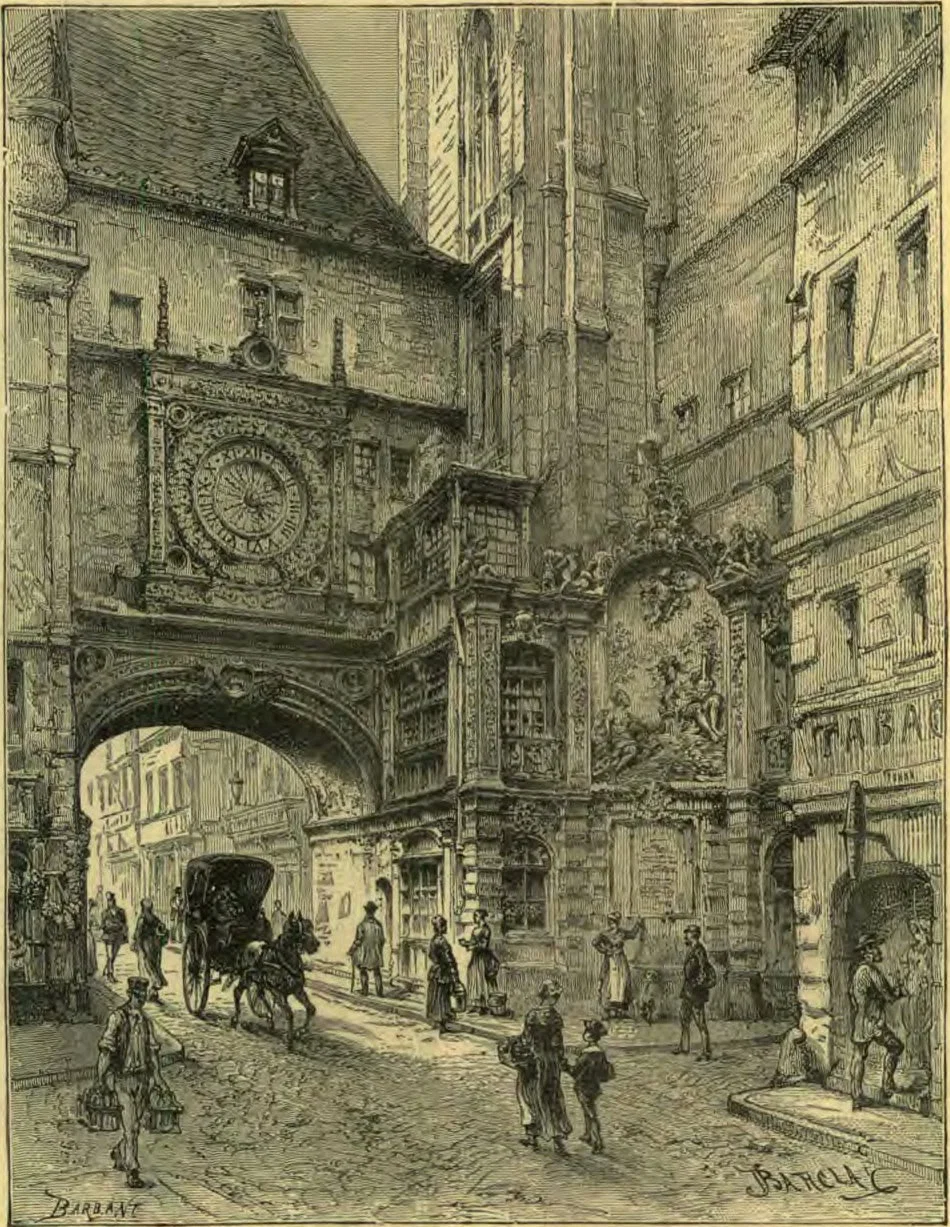
This masterly mechanism is said to be the most ancient if not also the most beautiful in the world. For the last five hundred years it has been in service, never once stopping or in any way getting out of order, some trifling repairs excepted. It is the work of a skilful native artist, Jehan de Felins, whose history has been preserved to us through the thoughtfulness of another, a skilled watchmaker, M. Hainaut, of the same city.
Although the latter may have been equally skilful, and was surely more learned and advanced in his art, the time-piece of Jehan de Felins is none the less a marvel of solid and delicate workmanship. During five centuries it has not undergone more than one single modification, which was a compensation pendulum, attached more than a century after Galileo discovered the isochronism of the same. This improvement was not introduced until the year 1712, but it did not involve any other change in the ancient mechanism. One single part only has suffered, and this is the rope chain connecting the hands with that portion of the wheelwork which causes the former to move on the dial. But this rope chain was not the work of Jehan de Felins; it belongs to a much later epoch.
“This clock,” says M. Hainaut, “does not seem to become worn out in any way. It runs uninterruptedly, when all the rest from the same period of time are no more.”
THE GREAT CLOCK IN ROUEN.
What sad and what glorious hours did this clock chronicle! Its imposing wheelworks had revolved about forty-two years when Joan of Arc was burned at the stake, for which shameful deed its hands, alas, may have given the signal.
Some few of its wheels are more than a meter (39.36 inches) in diameter. They are of brilliant steel, and highly polished in places. M. Hainaut thinks that in spite of its great age it is very likely yet to survive the greater part of modern clocks.
The authentic history of this time-piece is known to-day down to the most wearisome details, and a list is kept of those watchmakers who successively had the care of it, from the inventor, Jehan de Felins, down to the present actual keeper, covering about twenty names in all.
This Jehan or Jean (John) de Felins is undoubtedly not to be compared for either skill or scientific attainments with the manufacturers of chronometers and other instruments of precision, in our own time; but he shows us what one may achieve even though deprived of extensive knowledge or unusual advantages, by working thoughtfully, thoroughly, and perseveringly. For this clock, which is altogether in primitive style, has now been running over five hundred years with precision and without showing any wear of the machinery whatever. Its wheelwork still looks new, and might yet run a number of centuries more, and that, as Mr. Hainaut says, “in such a way that this, the most ancient tower clock in all France, will also be found to be the youngest and the most durable as to service, even after having existed so long already.”
In closing we may add that the watchmaker Lepaute (1709-1789), who has posed before the world as the first inventor of horizontal time-pieces, is simply deceived; for Jehan de Felins had practically carried out the same principle more than four hundred years previously.
A. R.

A GOLD-MINE IN PORTUGAL.

A short time ago an old deserted gold-mine was discovered in the central part of Portugal. It was thought at first the mine was exhausted, but the experts of a Berlin firm who had bought the property, found, after careful examination, that this was not the case. The mine was worked in the first and second centuries after Christ by the Romans then occupying Lusitania, the present Portugal, and was deserted by them for some unknown reason before being exhausted. The mine contains rich quartzes which compare in quality with those of the Transvaal, but can be mined at much less cost. The first assay by the German experts, supported by those of the royal mining academy in Berlin, showed a surprisingly favorable result. According to their report, a ton of quartz contains from twelve to forty-eight grams, with an average of twenty grams. Further experiments on a larger basis have proved the quartzes of this mine and the ancient ore rubbish can be mined easily and cheaply by means of amalgamation, netting an average gain of eighty-seven per cent of the above-mentioned analysis. It sounds almost incredible that in many parts of Portugal there are immense mounds of ore rubbish,—quartzes left from ancient antimony mines, and containing paying quantities of gold, which have been lying undisturbed for centuries.—Chicago Tribune.

Stimulants and the Illusion of Power

It is the feeling of fictitious power which is engendered by the use of stimulants which no doubt inclines so many to have recourse to them.—S. W. Sibley.

THE SEVEN WONDERS OF THE WORLD.

NO. 3.—THE PHAROS OF ALEXANDRIA.

OFF the wave-kissed shore of historic Egypt lies a rocky islet whose name and fame have survived the shifting scenes of buried centuries. Many of the works of man are doomed to perish in oblivion; but here and there something has been achieved which, although it might yield to the disintegrating forces of nature, was destined to be remembered by succeeding generations till the end of time.
During the brilliant career of Alexander the Great, his name was rendered still more conspicuous by the founding of a city which was called Alexandria, in honor of the great conqueror himself. In the autumn of 332 B. C. the original city was located on the lowlands, about fourteen miles west of the Canopic mouth of the Nile. The architect, Dinocrates, designed the plan of the city, which was at first about four miles long and fifteen miles in circumference. The two main streets were straight, and crossed each other at right angles in the center of the city. These streets were adorned with colonnades. In the most prosperous days of Alexandria, many grand edifices added to her splendor and magnificence. There were the palaces of the Ptolemies, the temple of Serapis, the museum, the library, the theater, the mausoleum of Alexander the Great, etc.
It was a common custom in Alexandria to construct subterranean cisterns under the houses. In fact, it is said that the water supply thus secured was sufficient to meet the demands of the entire population for a whole year. During the city’s greatest prosperity, the population, including free citizens, strangers, and slaves, was perhaps six hundred thousand or more. Next to Rome and Antioch, it was “the most magnificent city of antiquity, as well as the chief seat of Grecian learning and literature, which spread thence over the greater part of the ancient world.” After the death of Alexander the Great, the Ptolemies here founded their residence.
In front of this magnificent city, nestling amid the restless waves of the Mediterranean Sea, lay the little isle of Pharos, which was connected with the city by the Heptastadium, or seven-furlong mole. This mole formed the division between the two harbors of the city, and extending along its entire length a street was finally constructed; and thus the island became a suburb of the city. It remained for Ptolemy I, son of Lagus, to begin upon that picturesque spot in the sea a work which was destined to win the rare title of one of the seven wonders of the world. He encouraged science, literature, and art, and was the founder of Alexandria’s great museum and famous library. He also sought to increase the commerce of the city, and through his efforts Alexandria became the great mart of the Mediterranean. On the northeast point of the island of Pharos, in full view of the flourishing city, Ptolemy located his famous lighthouse, the wonder of the world. It was probably about four hundred feet high, and was built of white marble. From its imposing summit a light was kept constantly burning, which was visible for about forty miles. This marvel of architecture was not completed till about three years after Ptolemy’s death, in 280 B. C. It withstood the ravages of time for many centuries, lasting through a period of about sixteen hundred years.
How many of the boys and girls of the INSTRUCTOR family can draw a valuable lesson from the ever-luminous Pharos of Alexandria? Is it not possible for us to shed rays of light to guide the wandering ones into the harbor of safety? Read what Jesus says in Matt. 5: 14-16. MRS. M. A. LOPER.

A POOR BOY WHO ROSE.

Not merely rose early in the morning—though doubtless he did that;—but he rose in life, in power, in the hearts of his countrymen.
William Cobbett, the popular English leader of the first thirty-five years of our century, was able to declare that he could not remember the time when he did not earn his own living. Yet he never for a moment lost sight of his purpose to learn. The beginning of that ambition was somewhat unusual.
When he was eleven years old, he was working in the gardens of the Bishop of Winchester, and one of the workmen, fresh from Kew Gardens, so delighted the lad with descriptions of their splendor, that he determined to see them.
Next morning he started for Kew, with a sixpence half-penny in his pocket. When he arrived at Richmond, he had threepence left for supper and lodging. He suddenly came upon a little volume in a bookseller’s window, the “Tale of a Tub,” price threepence, and he went in and bought it. He read it sitting on a haystack, and as he says of the occurrence: “It produced what I have always considered a birth of intellect.”
In the morning he went on to Kew, and found work. The “Tale of a Tub” became his most cherished possession; and when it was lost with a box which fell overboard in the Bay of Fundy, he wrote: “The loss gave me greater pain than I have ever felt at losing thousands of pounds.”
Another experience, when he was a private soldier, seems very hard. Then he was actually hungry, as only fourpence a day for food could be saved out of the allowance of sixpence, which had to serve also for washing, clothes, pipe-clay, and hair powder.
“The whole week’s food,” he said, “was not a bit too much for one day.”
For pocket money there remained twopence a week, but one day he had managed to save a halfpenny, and he determined to buy a red herring the very next morning. That night, however, he discovered that his halfpenny was lost.
“I buried my head under the sheet,” he wrote nearly fifty years after, “and cried like a child.”
Yet during this entire year he was reading all the books he could procure from a neighboring library, and studying and writing amid the brawling and laughter of a dozen idle soldiers.—Selected.

OLDEST OF BANK NOTES.

Among the curiosities obtained by the British Museum there is none so interesting as a Chinese bank note of the Ming dynasty, about 1368. No earlier example is known to be extant. It is, however, a comparatively modern specimen for China, although it was not till three hundred years after its issue that bank notes were used in Europe.

Doing Good Brings the Highest Good to Ourselves

The means with which we do good to others bring the best and highest good to ourselves.

THE CULMINATION OF GREEK ART.

It begins with the clearer and more glorious sunlight—the illustrious period of Phidias, Myron, and Polycletus. The application of the art had begun to have a wider scope, for we find demi-gods, divine men, representations of the Graces, Hours, and Fates; horses, lions, and other beasts.
Calamis, thought to have lived about the fifth century B. C., was noted for his incomparable horses. His masterpiece in human figures was the statue of Sosandra, on the Acropolis of Athens.
Pythagoras’s limping “Philoktes,” says Cheney, “made the beholder feel the pain of the wound.”
Myron, considered third of his day, executed works of no mean order. Of his works ancient writers have said that “the breath seems to rest upon the lips.” His cow was so natural that it would have been an excusable mistake for the maid to attempt milking her.
Polycletus was also a great master of the Argos school. His was the discovery of the principle “that the weight of the body should rest more on one foot than on the other, in order that the different actions of the muscles should give variety to the statue.”
Venus of Milo, the finest female statue in the world, demonstrates the masterly skill of Scopas, of whose statues it is said, “They were full of enthusiasm, motion, and action. They were of the Parian stone, but it seemed to become yielding in his hands; the hair played in the wind in fine locks, the hands seemed to move, and a goat which was brought to sacrifice was ready to shout for joy.”
Venus of Cnidos was the masterpiece of Praxiteles, and yet we might mention the eulogy on his statue of Niobe: “From a living being the gods made me a stone; from a stone Praxiteles made me again a living being.” He stood supreme for beauty, as Phidias did for grandeur.
Great as these masterpieces were, there were still greater.
Phidias, son of Archimides, as if not satisfied at the giddy and defiant height to which Greek art had ascended, proposed to cap the cap-stone. To him is accorded the enviable position of first place in the file of Greek artists; his Athena and Zeus hold aloft their own in majestic dignity, being the most superb creations of unsurpassable craftsmanship.
On a statue of Jupiter, in Olympia, it is said: “Either the god came from heaven to earth to show his form, or thou, Phidias, didst go to heaven to see the god.”
His Minerva Medica, his Parthenon, and others, all express a skill defiant and severe.
Nor was art confined only to a favored few, or to a small section of the country; for there were schools of art in Attica, in Peloponnesus, in Messene, in Thebes, in Argos, in Rhodes, and elsewhere. “Lanzi counts one hundred and seventy thousand statues and antiquities at Rome. Rhodes alone furnished three thousand, and three or four hundred repetitions of a single subject were not uncommon.”
Taking into account the ruthless despoiling by barbarians, Romans, Turks, and pirates, and bearing in mind how every excavation brings some additional relic, it would not be easy to overestimate the number of contributions to the altar of Grecian art.
The ancients counted seven wonders, the greatest of which was Greek art. We may add another,—the wonder that this seventh wonder has never been equaled! P. Giddings.

Only the Good-Willing Are Good

He only is good who wills the good.—Kant.

THE CHRISTIAN'S HOPE.

“Blessed are ye, when men shall revile you, and persecute you, and shall say all manner of evil against you falsely, for my sake. Rejoice, and be exceeding glad: for great is your reward in heaven.”
The people of God shall live with Christ in heaven a thousand years (Rev. 20:4) until the holy city comes down upon the earth. Rev. 20:9; 21:2. Immortality and eternal glory will be given them when Jesus comes. Then shall they sing with the angels of God in the Father's house. “God shall wipe away all tears from their eyes.” In this blessed hope we rejoice now, not only when everything goes well, but also when we have to suffer for Jesus's sake.
“Fear not, little flock; for it is your Father's good pleasure to give you the kingdom. Sell that ye have, and give alms; provide yourselves bags which wax not old, a treasure in the heavens that faileth not, where no thief approacheth, neither moth corrupteth. For where your treasure is, there will your heart be also.” Luke 12:32–34.
What a glorious promise to those who fear God, and who give themselves and all that they have into his hands! If you do that, you do not need to fear when others ridicule you and speak evil of you. You need not fear when they hate you and persecute you. They cannot touch a hair on your head without the will of your heavenly Father. Holy angels guard you, and protect you in every danger. Only hold on to our dear Saviour, and he will give you a place in the kingdom of glory in spite of all the opposition of Satan and the world.
Jesus has said, “I will never leave thee, nor forsake thee.” Heb. 13:5. How often he has kept you in danger, and kept your lamp burning in hours of darkness. He reaches out to you his strong arm. Take it, and never let go your hold of him. Then he will be your rod and your staff, even when you walk through the valley of the shadow of death. Ps. 23:4.
But if you want a treasure in heaven, you must not cleave to earthly treasures. Do not put your trust in worldly riches. Do not live in luxury and idleness, while you forget the poor and fatherless. “Give, and it shall be given unto you; good measure, pressed down, and shaken together, and running over, shall men give into your bosom. For with the same measure that ye mete withal it shall be measured to you again.” Luke 6:38. Jesus says, Sell, and give alms; and he promises a reward in heaven. By every self-denial for others, you lay up a treasure in heaven. There we behold the crown of glory shining brighter than the sun; the white raiment, whiter than the snow, brighter than the light of the day. There you may shine in glory with the heavenly hosts, and walk with Jesus.
“For our conversation [Greek, citizenship] is in heaven; from whence also we look for the Saviour, the Lord Jesus Christ: who shall change our vile body, that it may be fashioned like unto his glorious body.” Phil. 3:20, 21.
We are citizens of the heavenly city when we are born from above by the truth and Spirit of God. What a high and glorious calling to be citizens of heaven, sons and daughters of the heavenly Jerusalem! Gal. 4:26. God will be their God, and they shall be his people. 2 Cor. 6:16.
“We give thanks to God and the Father of our Lord Jesus Christ, praying always for you, . . . for the hope which is laid up for you in heaven.” Col. 1:3, 5.
We are really thankful to God that he even in these last days has a little flock who, having received the word of God, have their hope in heaven. God has in tender mercy looked to us as a people, and Jesus himself will lead us until there shall be one flock, one shepherd. The hidden manna is laid up in heaven, and he that overcomes shall eat of it. There is also a white stone which Jesus will give him that overcomes, and a new name. Rev. 2:17.
To the early Christians the apostle wrote, “For ye had compassion of me in my bonds, and took joyfully the spoiling of your goods, knowing in yourselves that ye have in heaven a better and an enduring substance.” Heb. 10:34.
Behold how the Christians in the days of the apostles with joy suffered persecution for the truth's sake. Not a few of our brethren have lately also suffered persecution. How good it is to be their companions and fellow-believers. Shall not we gladly receive the truth of God, and count it more precious than much fine gold? What are the riches and honor of this world?—Nothing but glittering bubbles, that glide away and are not easily caught, and in the hands of him who does catch them, they break sooner or later. How much better is the heavenly substance? It is enduring as eternity.
“To him that overcometh will I give to eat of the tree of life, which is in the midst of the paradise of God.” Rev. 2:7. The tree of life is in the city of God, by the river of water of life, which, clear as crystal, proceeds out of the throne of God and the Lamb. Rev. 22:1, 2. And the throne of God is in heaven. Rev. 4:2.

THE LOVE OF GOD.

Like a cradle rocking, rocking. Silent, peaceful, to and fro. Like a mother's sweet looks dropping On the little face below,— Hangs the green earth, swinging, turning, Jarless, noiseless, safe, and slow; Falls the light of God's face bending Down, and watching us below.
And as feeble babes that suffer, Toss and cry, and will not rest, Are the ones the tender mother Holds the closest, loves the best,— So when we are weak and wretched, By our sins weighed down, distressed, Then it is that God's great patience Holds us closest, loves us best.
O great Heart of God! whose loving Cannot hindered be, nor crossed; Will not weary, will not even In our death itself be lost,— Love divine! of such great loving Only mothers know the cost,— Cost of love, which, all love passing, Gave a Son to save the lost.
— Saxe Holm.

1 JOHN 4:4.

Greater than all, our beautiful Jesus Dwelleth within us, both willing and strong; Nothing can harm us, for he overcometh; Keepeth us safe from temptation and wrong. MRS. F. A. REYNOLDS.

THE HEAVENLY INHERITANCE.

“Blessed be the God and Father of our Lord Jesus Christ, which according to his abundant mercy has begotten us again unto a lively hope by the resurrection of Jesus Christ from the dead, to an inheritance incorruptible, and undefiled, and that fadeth not away, reserved in heaven for you, who are kept by the power of God through faith unto salvation ready to be revealed in the last time.” 1 Peter 1:3-5.
A living hope is an active hope,—a hope which gives comfort and strength, joy and peace. Through faith in Jesus, in his death and resurrection, we obtain this hope—a firm assurance and a heart-felt longing for the eternal inheritance.
The inheritance is incorruptible. The crown of immortality shall shine forever on the brow of the saved. The cold embrace of death shall never chill the heart any more. The dim eyes and lifeless form shall no more cause the tears to flow from the eyes of bereaved mothers, nor tear asunder the tender cords of friendship and love. Immortal inheritance! Glorious crown of life! Thy heavenly glory charms my soul!
The inheritance is undefiled. Sin can never pollute the pure white garments. Troubled heart, yonder is eternal rest and peace for you. Here Satan opposes, the world troubles, temptations assail us, but there is eternal, undisturbed peace in the kingdom of heaven. There the Prince of Peace leads his people unto living fountains of water, and God shall wipe away all tears from their eyes. Rev. 7:17.
The heavenly inheritance can never fade. Here the cold winter comes with ice and snow. The green forests fade, the flowers of the field wither. The beauty of the whole earth shall pass away like an old, worn garment. The dark night of tribulation is near, the last time of trouble is at hand. And that will be a trouble greater than this poor earth has ever seen before. Like a bitter cold winter it will close the year of probation. Night cometh, but also the morning. The eternal morning is beyond the night. That brings an inheritance that fadeth not away. The eternal flowers in God's paradise can never fade.
O world, how dark thou art! Depart from my soul with thy fading glory. Come near, O Jesus! Fill my soul with thy heavenly treasures. Keep me by faith unto that glorious salvation, which is to be revealed in the last time. J. G. MATTESON.

THE CRIMSON TIDE.

A poor fisherman’s wife came to the minister with her hands full of sand, saying: “Do you see? O, my sins, my sins!—as the sands of the seashore for multitude, as the sands of the seashore!”
“Where did you get it?” asked he.
“Down by the beacon.”
“Go down by the beacon, and dig up a pile of sand as high as ever you can,” said the minister, “and wait for the tide to come in.”
She went down by the beacon, and heaped up the sand.
She watched the waves as they crept higher and higher and swept over her pile of sand, and it was gone; then she clapped her hands for joy. It was a pantomime of the glorious gospel. The tide, the crimson tide, rolls in, which taketh away the sins of the world. “It cleanseth me, it cleanseth me! O, praise the Lord, it cleanseth me!”—The Sailors’ Magazine.

Willingly Following Christ at Our Own Expense

The true lover of Christ is always willing to follow him at his own expense, but he never has to do it.
Continue reading: LESSON 9.—THE TIME OF THE JUDGMENT