The Youth’s Instructor, Vol. 37, No. 10.

I WAIT

The Youth’s Instructor

Mar 6, 1889

S. D. A. Publishing Association · Battle Creek, Mich. · Mar 6, 1889

I WAIT.

If only the rain would cease to beat, If only the wind would cease to blow, If only the clouds would beat retreat, And the summer sunshine glance and glow, I should be perfectly happy, I know.
All day, and every day, I wait For something or other to come and go, To make my pleasure a perfect state, To make my heart a summer glow Of sure delight that will never go.
But all day, and every day, I wait, And the days run by, and the days run low, And everything seems too soon or too late, And I never find what I seek, you know, Never get just what I want, you know.
There's always something or other amiss, The tide is at ebb when I want it at flow, A fleck and a flaw to mar the bliss That might be easily perfect, I know, If I could but make things come and go.
I've waited now so long and so late, That the hope I had, like the tide, runs low, And I begin to think that I shall wait Forever and ever like this, you know, For the things to come, that always go.
And I begin to think that perhaps—perhaps, When time is so swift, and joy so slow, I'd better make most of the hours that elapse, And the best of the days that come and go, Or the years will be gone or ever I know.
And I shall sit weary and old and sad, Like a little weary old woman I know, And think of the days I might have been glad, Of the pleasures I dropped, the things I let go, For the things I never could find, you know.
—Nora Perry, in the Youth's Companion.

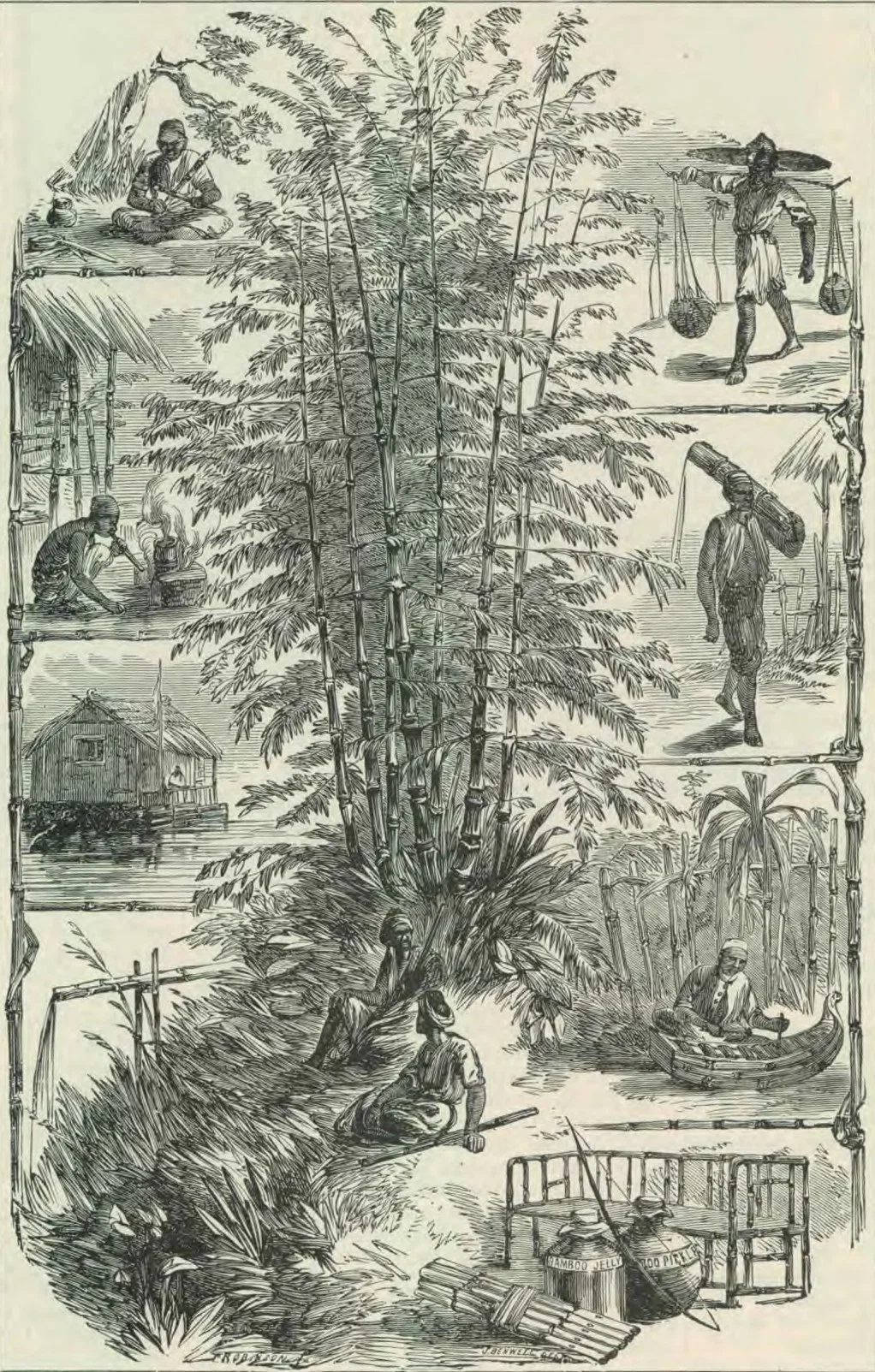
THE BAMBOO.

In tropical countries where periodical rain-falls saturate the earth, the variation and profusion of vegetable life seems almost limitless.
The trees are put to a variety of uses to which it would be difficult to adapt any one species of the temperate zone. Perhaps the most useful of these is the palm. “Palms in unending variety of form and fruit,” says one writer, “present the most striking feature of a tropical scene. The masses of the people in our own latitude get their daily bread, literally, from the grass family. Here palms furnish the people with food, clothing, and building material.”
But no less useful than the palm is the bamboo, found in nearly every part of the tropical world. It belongs to the grass family,—one of those arborescent grasses,—half grass, half tree. Its jointed stems are formed not unlike those of the wheat and other grains; but they shoot up to a hight of forty, sixty, or even eighty feet, taking on the woody nature and appearance of a tree.
The bamboo is remarkable for its rapid growth. Says a well-known writer, “In the Royal Botanical Garden of Edinburgh, a bamboo was observed to increase six inches a day in a temperature of from 65° to 70°. The Bambusa gigantea (gigantic bamboo) of Burmah has been known to grow eighteen inches in twenty-four hours; and as the Bambusa Tulda in Bengal attains its full height of seventy feet in a single month, its average increase cannot be less than an inch per hour.” “The culms (or single stems) attain a thickness of six inches, the single joints are twenty inches long, and the leaves are of indescribable beauty. . . . Sometimes a hundred culms spring from a single root, not seldom as thick as a man, and towering to a hight of eighty or a hundred feet. Fancy the grace of our meadow grasses, united with the lordly growth of our Italian poplar, and you have a faint idea of the beauty of a clump of bamboos.”
In India, China, and the East Indian Archipelago, the bamboo is cultivated with great care. Shoots are placed in a pit two feet deep, in the autumn or early winter, and the pit filled with rich soil and sulphur. All growth for the first three years is cut back, but the shoots of the fourth year are allowed to grow.
All this care is well bestowed upon the bamboo, which is put to an almost endless number of uses. The tender shoots in spring are served up like asparagus. They are salted and eaten with rice, preserved in sugar as a sort of jelly, or made into pickles. The seeds of this plant are also used as food.
But it is the stem of the bamboo which is made most use of. Bows are made of it, the light, slender stalks serving as arrows. The larger joints form water buckets, and the smaller ones bottles; the Dyaks of Borneo using them as cooking vessels. Lengths of bamboo are made hollow, joined together end to end, and serve as pipes to carry water.
Bamboo is also useful as timber, and many houses are made entirely of this material. For posts and columns, undivided stalks are used. The split stalks form floors, rafters, and roof, and are woven into lattice-work for the walls.
And for the inside furnishings of the house, its uses are many; it goes to form all the furniture, baskets, cages, chairs, beds; writing paper is made from the inside pulp, and pens, or reeds, from the slender stems; and one Oriental species is so hard that it can be used for a knife, and is also employed as a whetstone. Indeed, the bamboo is “one of the most wonderful and most beautiful productions of the tropics, and one of Nature’s most valuable gifts to uncivilized man.”
But we do not need to go across the seas, nor out of our own home to study the economy of Nature. Within a stone’s throw of our own doors the returning spring will soon work miracles wonderful beyond all telling, but unnoticed and unappreciated many times, because they are so silently performed. Who will have eyes to see what is done? W. E. L.

A PRESCRIPTION FOR WEAK FINGERS.

Mrs. H. E. BROWN in her book, “Beautiful Hands,” has some sensible words for school-girls. A group of girls were talking about and comparing their hands, when one of them came to say:—
“Housework is a lady’s finest accomplishment, and it’s the very best exercise in the world for school-girls. Mix it up with study, my mother says, and the one helps the other. When we are tired of brain work, muscle work comes in as a change and rest; and while we are getting knowledge of books, we get a knowledge of useful household arts; and what is a woman worth without both?”
“Housework isn’t genteel,” sneered Belle.
“Genteel! And supposing it isn’t; who is going to sacrifice a real good to gentility? Not I, for one. Isn’t Miss Montgomery genteel enough for you? And isn’t she intellectual and accomplished? You know what a magnificent pianist she is, well enough. And she is just as magnificent a housekeeper.”
“Housekeeper!” retorted Belle. “She lives with her father and mother, and they’re rich as Croesus; guess you’re mistaken in the person.”
“Don’t be so fast, my dear,” calmly replied Nellie. “I am well acquainted with the family, and know whereof I affirm. She has had the whole care of the housekeeping for five years; makes all the bread that is eaten in the house, to say nothing of cakes and pies and knick-knacks, and does nearly all the chamber work and sweeping. And I can tell you, too, why she does it, why she began to do it. She had a great talent for music, and Rossini told her she never could succeed until she had more strength in her fingers. She asked him how she could make them stronger. ‘Make beds,’ said he, ‘sweep rooms, knead bread.’ And she began to do it; and she told me it was a perfect marvel to herself and every one how much her hands improved in the first six months. The prescription worked to a charm, and she has kept it up ever since; and the fact that she is such a splendid player to-day, yes, and singer, too, is owing to her housework. She irons, too, and sometimes washes. She says it is splendid exercise for the hands and arms to do either of these.”

FRED'S MISTAKE.

Fred Graham sat staring into the fire, but it was evident from the pucker on his forehead that he was not engaged in his favorite pastime of watching the pictures formed by the glowing coals. For fully ten minutes he sat motionless on the rug; and any one who knew him could have told you that that was a long time for Fred Graham to sit still.
For nearly a year he had been eagerly looking forward to a visit from his cousin, Ralph Ray. Ralph was a lad of thirteen, who lived in a distant city, and was supposed by Fred to know everything,—in short, was his beau ideal of a boy. And now he was really coming,—would arrive on the morrow. All day there had been a pleasant bustle of preparation.
But what was it that troubled Fred? So thought his mother as she stood in the doorway, unobserved by him. “What is it, Fred?” said she at last.
“Well, mother,” he replied, in a burst of boyish confidence, “I’ll just tell you all about it. You know some of the boys laugh at me, and call me ‘mamma’s girl,’ when they see me washing dishes or helping you in any way about the housework? Well—you know—I thought—now, mamma, I just couldn’t bear to have Cousin Ralph ridicule me; and don’t you think you could get along without my help while he is here?” He threw his arm coaxingly around her neck.
She looked gravely into the fire for a moment, and then said, “Yes, Fred, it shall be as you wish.”
But as he gave her a good-night kiss, he fancied her face wore a pained expression, and he was not altogether happy as he went off to bed.
With the exception of baby Lucy, he was his mother’s only child. He was extremely fond of her, and had always helped about the housework as handily as if he had been a girl. But of late some of his associates had foolishly ridiculed him; and he supposed that surely city-bred Ralph would look with contempt upon “girl’s work.”
Ralph came the next day. In appearance he was all that Fred had imagined him to be,—tall and manly, with bright, dark eyes, and an easy, graceful manner. He was jovial and fun-loving, and the boys were soon fast friends. The first day or two was spent in roaming over the farm, which to Ralph was a world of wonders.
On the morning of the third day, Fred burst into the kitchen, where his mother was busy at work, saying, “O mother! can’t we go down to Taylor’s pond to skate this morning? The boys say there is splendid skating there.”
His mother gave her consent, and he went to the wood-shed to put on his skates, calling to Ralph to “hurry up and come on.” To be sure his conscience smote him a little, as he passed the sitting-room door, and heard the doleful cries of baby Lucy, as she sat in her crib with no one to amuse her. That had always been his task, but now he would not allow himself to think of it.
He put on his skates, and waited so long for his cousin to come that he went into the house to see what was the matter. Imagine his surprise to find Ralph seated in the rocking-chair with the baby on his knee. Mrs. Graham was just saying, “I believe you must exert some magic influence upon her; she is so quiet.”
Fred could only stare in shame-faced astonishment at his cousin, who was doing what he himself had been ashamed to do.
“You see,” said Ralph, in answer to Fred’s surprised look, “I am used to taking care of baby at home.”
But Mrs. Graham was soon at leisure, and having relieved him of his burden, the boys started for the pond.
This was not the only time Ralph showed himself helpful. He was often seen, dish-towel in hand, wiping dishes when his aunt was particularly busy. Fred felt himself in a rather curious position; and when, a few days later, a letter came from Ralph’s mother to Mrs. Graham, in which she told how much she missed her helpful son, Fred’s discomfiture was complete.
He felt as if he must make a clean breast of the whole matter to Ralph. So when they were alone, he suddenly asked, “Don’t the boys where you live ever make fun of you for doing girl’s work?”
Ralph laughed a little, and said, “Well, yes; some of the fellows do.”
Then Fred told him the whole story of how he generally helped his mother, and how he was afraid Ralph would ridicule him if he did so while he was there.
Ralph laughed heartily, and then said: “Well, I used to feel just as you do about being ridiculed; but I long ago came to the conclusion that it is cowardly to be afraid to do anything that is right; besides it seems to me very unmanly for a big, strong fellow to allow his mother to tire herself out working for him, and then be ashamed to help her.”
“Cowardly! Unmanly!” Just the words Fred would have shrunk most from having applied to him. Was it possible he had been both? The next morning Fred stole down stairs early, and went into the kitchen. His mother was getting breakfast, and putting his arms round her neck, he begged her to forgive him for being so cowardly and weak. From that time forward he was her own helpful boy again.
VIOLA E. SMITH.

OBSERVATION AND THOUGHT.

EXCLUSIVE of animal decay, we can hardly arrive at a more absolute type of impurity than the mud or slime of a damp, overtrodden path in the outskirts of a manufacturing town. I do not say mud of the road, because that is mixed with animal refuse; but take merely an ounce or two of the blackest slime of a beaten foot-path, on a rainy day, near a manufacturing town. That slime we shall find in most cases composed of clay (or brick dust, which is burnt clay), mixed with soot, a little sand, and water. All these elements are at helpless war with one another, and destroy reciprocally one another’s nature and power, competing and fighting for place at every tread of your foot, sand squeezing out clay, and clay squeezing out water, and soot meddling everywhere and defiling the whole. Let us suppose that this ounce of mud is left in perfect rest, and that its elements gather together, like to like, so that their atoms may get into the closest relations possible.
Let the clay begin. Ridding itself of all foreign substance, it gradually becomes a white earth, already very beautiful, and fit, with the help of congealing fire, to be made into the finest porcelain, and painted on, and be kept in kings’ palaces. But such artificial consistence is not its best. Leave it still quiet, to follow its own instinct of unity, and it becomes not only white but clear; not only clear but hard; not only clear and hard, but so set that it can deal with light in a wonderful way, and gather out of it the loveliest blue rays only, refusing the rest. We call it then a sapphire.
Such being the commission of the clay, we give similar permission of quiet to the sand. It also becomes, first, a white earth; then proceeds to grow clear and hard, and at last arranges itself in mysterious, infinitely fine parallel lines, which have the power of reflecting, not merely the blue rays, but the blue, green, purple, and red rays, in the greatest beauty in which they can be seen through any hard material whatsoever. We call it then an opal.
In the next order the soot sets to work. It cannot make itself white at first; but, instead of being discouraged, tries harder and harder, and comes out clear at last, and the hardest thing in the world; and for the blackness that it had, obtains in exchange the power of reflecting all the rays of the sun at once, in the vividest blaze that any solid thing can shoot. We call it then a diamond.
Last of all, the water purifies, or unites itself; contented enough if it only reach the form of a dew drop; but, if we insist on its proceeding to a more perfect consistence, it crystallizes into the shape of a star, and for the ounce of soot which we had, by political economy of co-operation, a sapphire, an opal, and a diamond, set in the midst of a star of snow.—Ruskin.

A DANGEROUS PROVERB.

"It is better late than never," May incline to error great; Since delay, how slight soever, Often means forever late.

THE TURNING-POINT.

It was the beginning of the holidays when Mr. Davis, a friend of my father's, came to see us, and he asked my parents to let me go home with him. They consented, and I was much pleased at the thought of going out of town. The journey was delightful; and when we reached Mr. Davis's house, everything looked as if I was going to have a nice time. Fred Davis, a boy about my own age, took me cordially by the hand, and all the family seemed like old friends.
“This is going to be a holiday worth having,” I said to myself several times during the evening. We all played games, asked riddles, and laughed and chatted as merrily as could be.
At last Mrs. Davis said it was bedtime; then I expected family worship, but we were soon directed to our rooms. It seemed strange to me; for I had never before been in a household without the family altar.
“Come,” said Fred; “mother says that you and I are to be bedfellows.” I followed him upstairs to a nice little chamber which he called his room. He undressed first, and jumped into bed.
I was much longer about it, for new thoughts began to rise in my mind. When my mother put my portmanteau into my hand just before the coach started, she said, “Remember, Robert, that you are a Christian boy.” I knew very well what that meant, and I had now just come to a time when her words were to be remembered. From a little boy I had been in the habit of kneeling in evening prayer.
“Why don't you come into bed, Robert?” said Fred. “What are you sitting there for? Can't you undress?”
Yes, yes, I could undress, but ah! I was afraid to pray and afraid not to pray. It seemed to me that I could not kneel down to pray before Fred. What would he say? Would he not laugh? The fear of Fred made me a coward. Yet I could not lie down on a prayerless bed. If I needed the protection of my heavenly Father at home, how much more abroad. I wished a thousand things—that I had slept alone, that Fred would go to sleep. Perhaps struggles like these take place in the bosom of every one when he leaves home and begins to act for himself, and on his decision may depend his character for time and eternity. With me the struggle was severe.
At last, to Fred's cry, “Come, boy, come to bed,” I mustered courage to say, “I will kneel down and pray first; that is always my habit.”
“Pray!” said Fred, turning himself over on his pillow, and saying no more.
His propriety of conduct made me ashamed. Here I had so long been afraid of him, and yet when he knew my wishes, he was quiet and left me to myself. How thankful I was that duty and conscience triumphed! That settled my future course. I believe that the decision of the Christian boy, by God's blessing, made the Christian man; for in after years I was thrown amid trials and temptations which must have drawn me away from God and from virtue, had it not been for my settled habit of secret prayer.—Selected.

Erratum: Language Correction in Glimpses of Switzerland

ERRATUM. In No. 10 of “Glimpses of Switzerland” the language mentioned as Roumanian should have been le romanche.

SOMETHING SURE.

“WHAT a pity nothing ever Has a beauty that will stay!” Said our thoughtful little Nellie, Stopping briefly in her play. “All these velvet pansies withered,— And I picked them just to-day.”
“And there's nothing very certain,” Answered Bess, with face demure; “When it rains, we can't go driving,— I wish promises were truer! I could rest if I were certain Of a single thing that's sure!”
Grandma smiled from out her corner, Smoothing back a soft gray tress, “Sixty seconds make a minute; Did you know it, little Bess?— Sixty minutes make an hour, Never more, and never less.
“For the seconds in a minute, Whether full of work or fun, Or the minutes in an hour, Never numbered sixty-one! That is one thing that is certain Ever since the world begun.
“Though the rose may lose its crimson, And the buttercup its gold, There is something, through all changes, You may always surely hold: Truth can never lose its beauty, Nor its strength, by growing old.”
—Mrs. Julia P. Ballard.

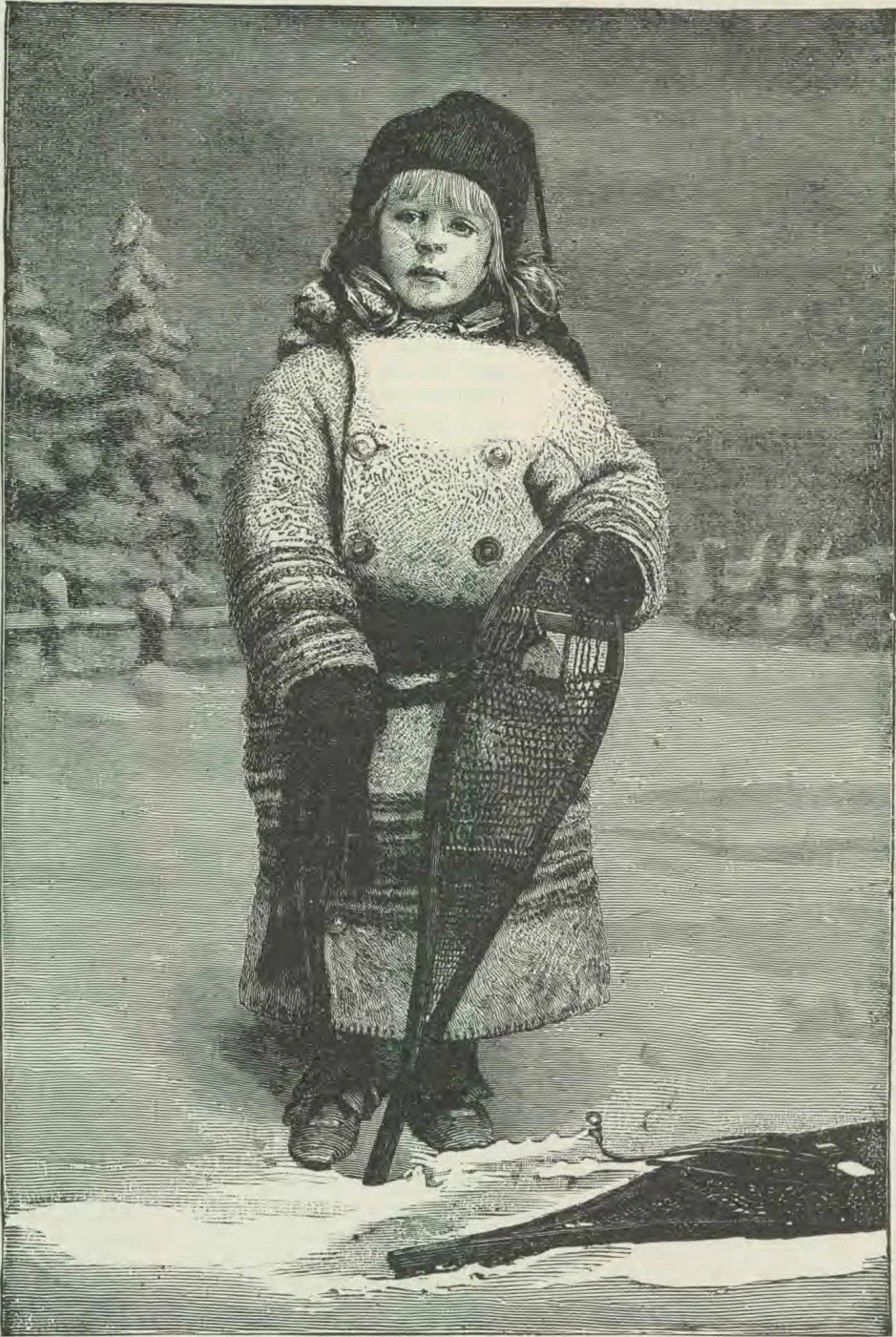
LYNN'S SNOW-SHOES.

LAST summer Lynn moved from Florida to Canada. He had never seen any snow in all the six years he had lived. He could not think what it was like. He was impatient for winter to come.
It was summer time when he came to Canada. As the weeks flew by, the days grew shorter and the nights longer. The weather became colder and colder; and one morning he waked up to find snow on the ground. It was fluffy and white, like the soft down on his baby sister's cloak. He hurried to dress, and ran outdoors. But he found the snow was cold, and melted when he took it in his warm hands, or brought it into the house.
He could hardly wait to eat his breakfast. He was continually jumping down from his chair to run to the window. At last his mamma dressed him in his gay toboggan coat and cap, and sent him outdoors.
Lynn did not know much about snow. He thought he could walk off on top of it the same as he could on the ground. His mamma did not tell him anything about it; she thought he would like better to find out for himself.
Lynn ran off the clean-swept porch into a drift. He went into the drift up to his knees. The snow flew up on to his cap and into his eyes. “Oh! Oh!” he said. He did not know whether to laugh or to cry. You never saw such a surprised little boy. He looked up at the window where his mamma stood laughing. Then he laughed too, and his mamma came and helped him out. He wanted to wade in the snow all day, but she would not let him.
When Lynn's papa came home to dinner the next day, he brought him a queer present. At least, Lynn thought it was a strange one. His papa told him they were snow-shoes, and that after dinner he might put them on.
The shoes were made by bending a stout strip of hickory in an oval form. The ends of the hickory strips were fastened together in a point behind. The frame was made firm by stout strips of hickory, and the whole was filled in with strong thongs, or strips, of leather, netted together. There were straps to fasten the shoes on the feet.
Lynn said he did not want to wear such shoes. They were not pretty; nobody else would have such strange things on their feet. And he pouted, like a naughty boy, all through dinner time.
Papa laughed. “All right,” he said; “we will wait till some other day.”
It was more than two weeks before Lynn thought of his shoes again.
It kept on snowing for several days. The snow got quite deep. It was hard work for Lynn's papa to wade through it. It thawed a little, and froze a good deal. This made a crust on the snow that almost bore Lynn up.
Then Lynn's papa brought out the queer shoes. “Now,” said papa, “I will put on these new shoes, and show you what they are for.”
He strapped them on, and started off on the crust. Lynn was delighted. “Come back, papa! come back!” he shouted; “I want to put them on.”
Papa came back and put the shoes on Lynn. “Now go slowly,” he said, “and be careful not to trip up.”
“I can do that easy enough,” Lynn replied. He was not careful; he wanted to walk as fast as his papa did. The very first step he hit one snow-shoe on his ankle. It hurt, but he would not cry. At the next step he set the edge of one shoe on the other. Then he could not lift his foot; he lost his balance, and went over into the snow.
Papa helped him up. “It is not so easy as I thought it was,” Lynn said.
“Do you want to give it up?” his papa asked.
“No, sir,” said Lynn, “I mean to try it every day, until I can walk as well as you do.”
He has kept at it, and now he can walk on them very well.
Where Lynn lives, the winters are long and cold. The snow gets very deep, and the crust thick. The Indians and the trappers, and many other people, wear snow-shoes. If it were not for these useful articles, it would be very difficult for them to go anywhere.
W. E. L.

THE CHAMOIS.

The chamois is found in all the mountains of Europe which bound the valley of the Danube; but it makes Switzerland its chief home.
In general appearance, its head and body are not unlike those of the goat. But it has a more slender neck, and no beard; and its horns are black, and stand erect, being curved into hooks only at the tips.
The chamois is not only very swift of foot, but very surefooted. Its cup-shaped and sharp-edged hoofs have been specially made for the mountains, on which it loves to dwell. It makes its way up and down the face of very steep rocks. It bounds swiftly from crag to crag, springing fearlessly to the top of the sharpest rocks, if only it can find room to place its four feet close together.
The flesh of the chamois is considered a great dainty by the Swiss; and its skin, when tanned, is the fine, soft leather, which is called chamois-leather.
Chamois-hunting is a favorite pursuit in Switzerland. The sport is attended with very great peril. The hunter has often to spend days and nights alone upon the mountains. He has to pass over dangerous rocks and precipices, and often his rashness costs him his life.
The chamois has the greatest love for her young; and, when they are in danger, she shows wonderful sagacity in planning means for their escape.
A Swiss hunter, while pursuing his dangerous sport, saw a mother chamois and her two kids on a rock above him. They were sporting by her side, leaping here and there around her.
The hunter, climbing the rock, drew near, intending, if possible, to take one of the kids alive. No sooner did the mother-chamois see him, than dashing at him furiously with her horns, she tried to hurl him down the cliff. The hunter drove her off, fearing to fire, lest the young ones should take to flight.
He knew that there was a deep chasm beyond, by which he believed the escape of the animals to be cut off. What was his surprise, therefore, when he saw the old chamois form with her body a bridge across the chasm, which she could just span by stretching out her fore and hind legs! As soon as she had done this, she called on her young ones, and they sprang, one at a time, on to her back, and reached the other side in safety. She sprang across after them, and was soon beyond the reach of the hunter's bullets.—The Nursery.

BENNIE

Bennie was a fat, rosy boy nearly three years old, full of life and play. He had two brothers and three sisters older than he. They liked to play with him at home; but when they went away for fun, they did not want to take him, though, strange to say, that was just the time he wanted to be with them.
Their house stood back from the road, and behind it the ground sloped away into pleasant fields. On the other side of one these fields, lived their little cousin, who was always glad to have these playmates come for an hour's romp in the barn, on warm summer days. They would open the big doors, so the breeze could come through, and would play hide and seek, or climb up on the haymow and take the breathless jump into the “hay” below, or play tag all around the barn floor or the farm-yard.
They thought they could not take care of little Bennie in such play as this; but in truth they were too selfish to want to, so this is the way they managed.
Going out of the door together, with Bennie as usual bringing up the rear, they would run around the house three times, as hard as they could go, poor Bennie puffing after, and calling,— “Wait for me! Wa-a-it!”
But the third time around, he was always so far behind that when he came in sight of them, they would be running cross-lots, with their sun-bonnets and hats in their hands, and almost to the farther fence.
Then the tired baby feet would carry him to the one place where his welcome was never worn out—his mamma's arms.
One day when they ran away from him, he did not go into the house, and the busy mother did not miss him till the boys and girls came home; then she asked,—
“Where's Bennie?”
“We left him home,” said Mary, the oldest.
“You did? I have not seen him. Where did you leave him?” she said, severely.
“He was running around the house after us, crying,” replied Mary, hanging her head.
“Oh, shame on you! to treat your little brother that way! Go right off and look for him.”
They hunted all over the house and yard. They looked in the cistern, and in the well, and under the bushes; but no Bennie could they find. Then they began to cry, and to lay the blame upon one another for not taking him with them.
As they were walking slowly along through the tall grass, afraid to go home and meet their mamma's sad face, down by the rail-fence they saw some red stockings and a pair of little legs sticking through near the lowest rail. With a glad cry they ran to the spot, and found Bennie half way through the fence—fast asleep.
He had tried to follow them across the field; but dusty, hot, and tired out, he had fallen asleep trying to squeeze through the fence.
May be you can imagine how glad they were to find the little wanderer. They talked the matter over on the way to the house, and made up their minds to treat Bennie more kindly. L. E. ORTON.
Continue reading: OLD TESTAMENT HISTORY