The Youth’s Instructor, Vol. 32, No. 18.

WHAT TWO CHIMNEY-SWALLOWS SAID

The Youth’s Instructor

Apr 30, 1884

S. D. A. Publishing Association · Battle Creek, Mich. · Apr 30, 1884

WHAT TWO CHIMNEY-SWALLOWS SAID.
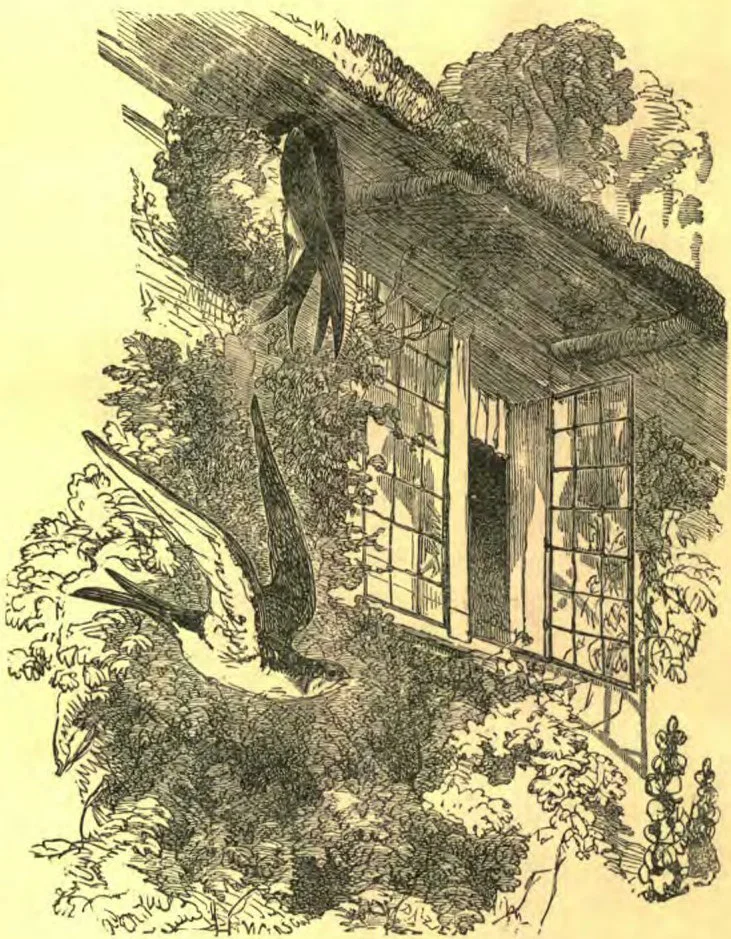
AROUND a quaint old chimney-top I watch the swallows rise and drop— Their queer gyrations through the air How cleanly cut, how deft and fair! Gossips are they, but full of glee— A populous, world-wise colony. They dip, they dart, they swim, they sail, This way and that their wings prevail; They chirp, and talk, chatter, and sing, And keep forever on the wing; Yet we, so full of household cares, No busier are than they with theirs.
To-day one of them chanced to meet An alien swallow down the street, Whose house a palace is in size— I saw him from its chimney rise. Then he who had the lowly nest The courtlier swallow thus addressed: “How happy you, whose home is placed So high above the earth’s dull waste; Your walls are broad, and bright, and new, You catch the heaven’s serener hue, While I, immured so far below, But little of your comfort know.” The bird addressed turned round his head, And to his cottage cousin said: “Alas! how hard it is to tell What happens where your neighbors dwell; I should enjoy my safe, high nest But for some things you have not guessed. The site is good, the air is free, And with my brethren I agree; But in the parlors down below They storm, and scold, and quarrel so,— That other race, the human folk,— Rise up their unforgiving words In bitterness unknown to birds. The soot and smoke are sweet and clear; But rather than that atmosphere Of querulous talk, which does not cease, I’d choose a squalid hut—and peace!”
The swallow of the chimney old Heard all; and when the tale was told, Said: “Well, my home is plain, I know, But peace and order reign below— No discord comes its joy to mar, There is no human tilt or jar, And every word, I must confess, Is touched with grace and tenderness. I could not be a denizen With scolding wives or brutal men; My little birds would hear the din, And they to quarrel might begin: Better the outside cold and rain Than such a purgatorial pain. If you must dwell in this sad way, Long live my chimney, old and gray!”
If what the swallows say is so, How little of their lot we know Who live in brick or wooden walls— Or whether grief or joy befalls. So, where the chimney-swallows sing, I only think of this one thing— Does joy or discord yonder dwell? But ah! you cannot always tell.
—Joel Benton.

MERRIE ENGLAND

Written for the Instructor.

FOREIGN TRAVELS.—NO. 4.

MERRIE ENGLAND.

It seems almost absurd in such an article as this to pretend to speak of England, the greatest commercial nation on the globe and the mistress of the ocean, and of her great metropolis, the center of influence, commerce, and money in the world. The reader must remember that our trip was wholly on business, and not in any sense that of sight-seeing or pleasure. Hence comparatively few points of interest were seen, only such as happened to come in our way. This will perhaps explain why our account is so meager. Traveling rapidly by rail, and stopping at only a few places, not many points of interest are seen, and we can only briefly notice these.
In riding through England, one is struck with the thorough system of farming, the neatness of the houses and yards, the many populous cities, and the beautiful green grass and the plentiful flowers. If such was the appearance the first of March, what must it be in June? Instead of fences and stone walls, well-trimmed hedges are seen along the roadside. They were just putting forth their leaves. Most Americans would not enjoy the climate, however. There is much cloudy, foggy weather and drizzling rain, leaving a sense of chilliness and depression. Probably this is not so much so in the summer. There are not such great extremes of heat and cold as in America, but one longs for the clear sky.
The surface of the country is usually quite level. The land is nearly all owned by rich lords and the gentry, who have fine houses and horses, and rent their land to farmers. As the property descends to the eldest son or heir, it is all kept together in large estates. They have fine parks, and much land is kept for game, so they can have hunting parties and fine times. Thus the common people generally do not own their farms and homes, but rent of the rich and great. Americans would not like this feature. But perhaps it makes the country look all the more beautiful, as these fine estates are kept up in good shape, the parks are pleasant to the eye, and the castles and fine mansions add to their attractions. England is a beautiful country to look at.
Passing through the country so rapidly, we saw but little of the cities. We spent a few days at Great Grimsby, which is north from London, on the east coast of England. It contains some forty thousand inhabitants, and is a very pretty place. It is principally noted for its fisheries, which are said to be the most extensive of any in Great Britain or in the world. Most any morning, hundreds of small vessels can be seen unloading their slippery cargoes in all directions. The fish are caught with hooks and seines, in various parts of the sea, especially near Iceland, around which are many banks where they draw their nets in water from one hundred to eight hundred feet deep, and scoop the fishes up. Some of them are strange looking fish.
In and near Great Grimsby are about twenty-five persons who are keeping the Sabbath of the Lord. Our new English paper, The Present Truth, is to be printed there. We spent a short time at Southampton, on the south coast of England. It is one of the oldest English cities, having existed away back in Roman times. Some of the great stone city gates are still standing, though most of the ancient walls are gone. The statue of Isaac Watts, who wrote so many excellent Christian hymns, stands in the public grounds. Southampton is a fine looking old town of some seventy thousand people. Here also we met with about thirty believers who are keeping the Sabbath.
After our visit here, we went to the great city of London, a description of which we will give in our next article.
UNCLE IDE.

FAMILY SECRETS.

“I’ve been waiting for you ever so long, Aunt Lois,” said Fanny, standing by the gate, with a basket in her hand.
Aunt Lois was going to the woods with Fanny. They were going for mosses and scarlet twinberries and ferns, and Aunt Lois was to make a fernery for Fanny.
“You were coming at two o’clock,” said Fanny, “and that’s past half an hour ago. And you always do come when you say.”
“That means,” said Aunt Lois, “that you want me to ‘give an account,’ as you call it. Well, I don’t always do that for little girls; but the truth is, I got so interested in prying into some family secrets, that I actually forgot my promise and everything else.”
“Now, Aunt Lois, that’s just what I’ve heard you say it was very mean to do. I just believe you’re ‘funning.’ I thought you never did such things.”
“Well, I did to-day. And I found out ever so many queer things about a certain family. I don’t think any the less of them, to be sure; but then, the queer things were so odd that I couldn’t help wanting to find out all about them.”
“Is it a large family?” asked Fanny.
“Very,” said Aunt Lois.
“And who told you about them?”
“One of the family told me several things, because I was so eager to know. I kept a pretty close watch, and saw several things myself. I used a spy-glass, and as they didn’t know it, I don’t feel at all ashamed of it.”
“Aunt Lois!”
“Yes, I did. Some of the family have the oddest faces—their lips, especially. They don’t exactly pout, but they have a queer way of letting their lip hang down. Some of them look like monkeys, and they have been called so.”
“I should think they would get very much vexed.”
“Not at all. Some of them are very slow walkers. You would hardly believe me if I should tell you that some of the family I was finding out about, take only one step a year. A poet who watched one of them actually saw that they took just one step every year, and so he wrote about it. You might think they were going to battle, so many of them wear helmets and spurs. Some carry spikes, and some have the meekest dress, and do not walk at all. Some dress very showily, and some are so ragged and jagged you might take them for beggars. Some supply a great many people with food, even at the cost of their own lives. Some are so little they are called dwarfs. The one I saw to-day was so small I could hardly see it.”
“Well, I wouldn’t want to know any such family. I don’t like beggars, nor fighters, nor queer people, any how. But I know you, Aunt Lois, and it isn’t people you mean. I know you never watched anybody with a spy-glass. Now, what are their names, and who are they?”
“Well, this very small one that I was so interested in has so long a name that you couldn’t say it after I told you once,” said Aunt Lois, laughing.
“Try me.”
“Well, it was Corallorhiza Odontorhiza. And now I will introduce you to this member of the queer family.” Aunt Lois opened her basket, and handed Fanny a long stem with curious green, oblong balls hanging from little stemlets on it—eight or ten of them, and each one was tipped with brown and a hint of purple. The stem itself was a pinkish brown, and the root was knobbed and branching like coral.
“I knew it was a flower! And I should think these were small. Is this little brown, ruffly edge the blossom?”
“Yes. And with my glass I was finding out all about it. It is an Orchid. The name of this family is Orchideæ, and I have already told you the special name of this one. The ‘coral’ comes from the root. That is more curious than the blossom, and prettier, I think. The orchids have six parts to the flower, so much alike, often, you might call them all petals, but three are really the calyx. One of the three petals always has a lip, and I was delighted to find the lip of even this little Corallorhiza ruffled, and veined, and fringed. And without my glass, I shouldn’t have known it had any lip at all.”
“Where did you get it?” asked Fanny, peering down into the little “ruffly brown.”
“A friend brought them in to me from a walk on the high hill you see over yonder. Blossoming away in October! Generally they are asleep in August. But the yarrow, and wild-carrot, and toad-flax, and everlasting are in bloom, and the Orchis was not to be outdone.”
“What do you mean about some of them walking a step in a year?”
“Many kinds of the Orchis have two bulbs for the root. One of them dies each year, and from the second one a new shoot comes up, which moves the plant along a little, so that in a few years it has moved quite a little distance. So some one says of it,—”
‘The Orchis takes Its annual step across the earth.’
“Some of the flowers look like bees, and some like spiders, and, as I said, some are like monkeys. From one or two kinds a sort of jelly or broth is made from the dried root, called salep, which is very good for food, and has long been used by the people in Persia and other countries.”
“But here we are among the ferns, and we will leave this ‘queer family’ now, and go on with our fernery. You may keep this Corallorhiza, and I will just say that I would like you to remember that its prettiest part, the root, is the one it keeps out of sight, and that although its blossom is small, it bears close inspection, and the more carefully you watch it, the more you see in it to admire.”
—Mrs. Julia P. Ballard.

WHAT ONE BOY DID.

He was only fourteen years old, and an apprentice boy at that; but he changed a poor little peasant village into a great manufacturing town, and, more than this, left to his country a profitable industry which has grown into her principal resource for wealth. This is the way he did it:—
Two hundred years ago a horse-trader came to the peasant village of Chaux-des-Fonds, in the Jura Mountains of Switzerland, bringing with him a silver watch. The villagers had never seen anything of the kind, and it was a great curiosity. People came from far and near to see the wonderful little machine work. But one day it stopped. Nobody knew what to do, and not only the owner but the whole town felt the loss. Everybody was talking about the misfortune, and with good reason. Imagine living in a town where there was never a time-piece of any description! At last, Jean Richard, a smith's apprentice, made his appearance. He was a clear-headed, clever boy; and looking carefully among the wheels and cogs of the watch, he fancied that he might put it in order. He asked if he might try, and permission was readily given. He put the watch in order very quickly, and at once became the hero of the village. But he was not satisfied. If he could mend a watch, he could make one, he believed; and so he set about the work without tools, machinery, patterns, experience , or anything, in fact, save his own will and purpose and ingenuity. He worked bravely on, toiling late at night and early in the morning, and in a little less than two years saw his first watch measuring time.
It was a triumph, and the brave boy deserved all his satisfaction. A few years more and Jean himself was at the head of a large and successful watch-making business, and before many years had passed, Switzerland was noted as a watch-producing country.
You see, boys, what the qualities were which led to this success,—perseverance, courage, and hope. Jean Richard had no more of these, perhaps, than many a boy who does little or nothing, but he was willing to try the seemingly impossible thing. Are you?—S. S. Classmate.

EDITOR'S CORNER.

RUDE, unmannerly boys and girls come to our notice every day, as well as do children and youth of good behavior. We enjoy the presence of the latter class, while the uncultivated manners of the first excite our pity that they, too, have not pleasant, winning ways. We pity them; for possibly they alone are not to blame for their lack of courtesy. Their early associations and training may have been such that ill manners are the natural consequence.
Good manners cannot be cultivated in a moment. They are the result of careful training for days and even years, in our every-day life, the work having been begun by parents and guardians in the earliest years of childhood. All do not alike have opportunities for learning true politeness, but as the faults in one's manners are pointed out, they can, by proper efforts, be improved. Simply studying books on etiquette, written by popular authors, is not the best way to improve, for there is danger of attending more to the wording of the rules than to their real spirit.
The Bible, which teaches us to love our neighbor as ourself; to do good, not expecting any return; to lend, hoping for nothing, has proved itself the best text-book on manners; for true politeness is that kind regard for the rights and feelings of others, even in little things, which will make one forgetful of self. If this principle of love does not shape your manners, dear reader, they need correcting. Examine them by the good Book, and cultivate those graces of kindness which will make you truly courteous.
Home is the place where the effects of true politeness should first be felt; but a person ought always to take his good manners with him, as a recommend; for they will have an influence more powerful than wealth to open one's way into good society.
When you have learned the Bible rule, to seek others' good instead of your own, you will be ready to bear burdens, and to grant favors, regardless of a little inconvenience to self. You will find pleasure in learning what will please and benefit your fellows, and then in distributing such helps as are needed. You will have kindly words, even for the unfortunate ones of society, the class whom Christ most delighted to bless. You will have ready the graceful bow, the pleasant smile, the cheery good morning, as you pass in and out among your fellows; indeed, your presence will almost give inspiration to those with whom you come in contact. But not until Christ's graces shine richly out of the heart, can we, in a correct sense, be called truly polite. M. J. C.

NEW-TESTAMENT HISTORY.

LESSON 185.—PAUL BEFORE FELIX.

1. Who sent Paul to Felix the governor? Acts 23.
2. How did he explain the matter? Verse 25.
3. How did he address the governor? Verse 26.
4. Why did he rescue him from the Jews? Verse 27.
5. What opportunity had he given the Jews? Verse 28.
6. How did Lysias regard their accusations against Paul? Verse 29.
7. Why did Lysias find it necessary to send Paul to Felix? Verse 30.
8. Tell the circumstances of Paul's journey to Cæsarea. Verses 31, 32.
9. How was Paul received by the governor? Verses 34, 35.
10. Where was he put for safe keeping?
11. How long did he have to wait for his accusers? Acts 24:1.
12. Who came against him?
13. With what flattering words did Tertullus begin his speech? Verses 2, 3.
14. What favor did he ask? Verse 4.
15. What charge did he then bring against Paul? Verses 5, 6.
16. Why had not the Jews inflicted punishment upon him? Verse 7.
17. Who substantiated what the orator had said? Verse 9.
18. How did the governor give Paul permission to speak? Verse 10.
19. Why did Paul the more cheerfully answer for himself?
20. How long had it been since Paul went up to Jerusalem? Verse 11.
21. What did Paul say about his conduct while at Jerusalem? Verse 12.
22. What did he say about the accusations which had been brought against him? Verse 13.
23. What confession was he willing to make? Verses 14, 15.
24. How did Paul exercise himself? Verse 16.
25. For what purpose had Paul now come up to the Holy Land? Verse 17.
26. How had the Jews found him? Verse 18.
27. What did Paul say ought to be done? Verses 19, 20.
28. What was the only thing that they could truthfully bring against him? Verse 21.
29. On what pretext did Felix defer making a decision? Verse 22.
30. What orders did he give concerning Paul? Verse 23.
31. What interview did Felix hold with Paul? Verse 24.
32. How did Paul improve this opportunity? Verse 25.
33. What effect had Paul's words upon the governor?
34. How did Felix quiet his own conscience?
35. What motive had the crafty governor for holding frequent interviews with Paul? Verse 26.
36. On retiring from office, why did he leave Paul a prisoner? Verse 27.

NOTES.

Acts 23:25. After this manner.—The Roman law required that a subordinate officer, in sending a prisoner to the proper magistrate for trial, should draw up a written statement of the case.—Hackett.
Ver. 26. The most excellent was an official title usually given to a governor or procurator holding the office of Felix.—Rev. Com.
Ver. 27. Having understood that he was a Roman.—This is stated as a reason why Lysias was so prompt to rescue him. It was not until he had taken Paul into his custody that he ascertained his rank; but, as was not unnatural, he wished to gain as much credit as possible in the eyes of his superior.—Hackett.
Ver. 31. Antipatris.—This was about thirty-eight miles from Jerusalem, on the route to Cæsarea. It was built by Herod the Great, on the site of a place called Caphar Saba, and was named by him Antipatris, in honor of his father Antipater.—Hackett.
Ver. 35. Herod's judgment hall.—This was not the common jail, but part of a palace built by Herod the Great, who had rebuilt Cæsarea, . . . and had given it a new name in honor of the Roman emperor, by whose favor he had obtained the kingdom. Paul was lodged in this place as more favored than prisoners in general were.—Scott.
Chap. 24:1. After five days.—On the fifth since Paul's departure from Jerusalem. . . . According to Roman usage, a case referred like this should be tried on the third day, or as soon after that as might be possible.—Hackett. A certain orator.—This was probably a Roman proselyte to Judaism; yet he speaks everywhere as a Jew.—Clarke. As the people in the provinces were not acquainted with the forms of Roman law, they employed advocates to plead for them before public tribunals.—Hackett.
Ver. 2. We enjoy great quietness.—The language of Tertullus is that of gross flattery. History ascribes to Felix a very different character. Both Josephus and Tacitus represent him as one of the most corrupt and oppressive rulers ever sent by the Romans into Judea. He deserved some praise for the vigor with which he suppressed the bands of robbers by which the country had been infested. The compliment had that basis, but no more.—Ibid.
Ver. 5. Nazarenes.—This was the name usually given to the Christians by way of contempt. They were so called because Jesus was of Nazareth.—Barnes.
Ver. 10. Many years.—As Felix became procurator probably in A. D. 52, he had been in office six or seven years, which was comparatively a long time at this period, when the provincial magistrates were changed so rapidly.—Hackett.
Ver. 22. Having more perfect knowledge.—Since Felix had been already procurator more than six years, and Christianity had spread itself, not only in all parts of Judea, but in Cæsarea itself, it is natural that he should have a more correct knowledge of this religion than the Sanhedrists on this occasion had sought to give him; hence he did not condemn the accused, but left the matter in suspense.—Meyer.
Ver. 24. Drusilla, his wife.—This Drusilla was a younger daughter of Agrippa I., who was mentioned in chap. 12:1, and a sister of Agrippa II., who is mentioned in chap. 25:13. . . . Josephus says: “Agrippa gave his sister Drusilla in marriage to Azizus, king of Emesenes. . . . But this marriage was dissolved in a short time in the following manner: When Felix was procurator for Judea, he saw her, and being captivated by her beauty, persuaded her to desert her husband, transgress the laws of her country, and marry himself.”—Hackett.
Ver. 27. Willing to show the Jews a pleasure.—He hoped to prevent the complaints of the Jews against his government, by leaving Paul, in some measure, in their hands. For it was customary for governors, when they left, or were removed from a particular district or province, to do some public or beneficent act, in order to make themselves popular. But Felix gained nothing by this. The Jews pursued him with their complaints against his administration, even to the throne of the emperor.—Clarke.

TO THE SECRETARIES.

AGAIN we are obliged to send out to our S. S. workers a summary report of the schools only, instead of the complete reports, as we had intended. There have been serious difficulties to contend with that have made it impossible to print a double number. We are sorry to disappoint those who have been anxiously waiting for such a paper. We hope they will keep up good courage, and work harder than ever to have a good report to bring in next quarter.
Some of the secretaries, though not a majority of them, we are happy to state, complain that it is almost impossible to get reports from their schools unless they write to them individually each quarter. This involves a large amount of work for these secretaries, who undoubtedly have all they can well attend to without it. Have not these delinquent schools interest enough in their State association to try to have it as fully represented as possible? We trust that next quarter we shall hear of a better condition of things.
Other secretaries say that they cannot send in their reports on time because the schools, although they fill out the blanks sent, are tardy in sending them back again. Will not these tardy ones put forth extra efforts to remedy this evil? The blanks will be sent you by your secretary just as soon as the quarter closes. Fill these blanks out immediately, and send them back to the State secretary. This you can easily do, as it will take but a few minutes, if you keep a complete record of your school. There will then be much time saved that could be better spent in other directions of the S. S. work.
One word to the State secretaries themselves. This quarter several reports came in without their footings. To be sure it is not much work to add one such report, but when eight or ten, as was the case this time, send in such blanks, it necessitates using time that can ill be spared for such work. Let each secretary see that his report is added, and that it is correctly done.
May none become discouraged, or think lightly of the Sabbath-school work. May all take hold together, heart and hand, to do better work each year than they have done before. W. E. L.

GENERAL SUMMARY OF S. S. REPORTS

For Quarter Ending December 31, 1883.
Names of States Names of State Secretaries No. Schools Reported Membership Average Attendance Non-Members Enrolled Dropped from Record Number Under 14 Number Over 20 Church Members Number of Classes Number of Members in Primary Division Intermediate Division Senior Division Keep Complete Records Number of Instructors Taken Contributions Received Amount Sent State Association Amount Sent General Association
California Mrs. G. D. Ballou 28 1180 887 262 124 441 559 610 156 343 189 620 23 775 $225 83 $23 70
Colorado O. H. Pierce 2 78 57 19 2 31 34 32 10 27 7 44 2 45 $16 10
Canada Miss Libby 4 40 25 2 8 20 23 4 9 23 14 $1 22 $1 02
Dakota Vesta J. Olsen 11 338 162 84 26 134 146 145 40 103 81 164 9 96 $15 04 $1 12
Indiana Leanna Murrell 33 856 699 57 75 311 383 461 107 242 156 410 30 456 $61 45 $2 52
Illinois Lizzie S. Campbell 50 704 474 68 42 235 309 528 89 125 78 296 20 245 $24 29 $2 14
Iowa Mrs. P. A. Holly 36 1179 699 82 102 427 400 529 139 329 145 434 20 453 $43 95 $7 50
Kansas Emma Enoch 38 1040 630 85 96 456 420 483 117 326 103 346 25 303 $36 48 $4 41
Kentucky Sallie B. Branstetter 3 46 20 2 1 17 17 15 7 8 9 28 3 10 $20 25
Michigan Eva Bell Giles 71 2392 1700 125 106 900 1110 1184 329 554 320 1384 76 1794 $210 42 $14 02
Missouri Vita Morrow 20 450 314 34 40 124 171 140 62 123 18 201 12 215 $48 48 $2 70
Maine Mrs. A. K. Henson 17 250 179 8 7 76 105 90 34 38 32 602 39 331 $60 53 $9 23 $95
Minnesota E. S. Babcock 11 1005 698 91 80 830 404 511 131 202 602 39 331 $10 67 $1 37 $14
New York Mrs. N. J. Wadsworth 15 295 115 20 8 85 120 124 40 56 38 178 12 117 $10 67 $1 37
North Pacific R. D. Benham 6 180 129 10 12 69 65 68 22 58 24 94 5 95 $9 13 $75
Nevada
New England Mrs. E. D. Robinson 24 417 312 25 39 95 243 229 62 84 19 296 20 387 $57 11 $6 20 $1 00
Nebraska
Ohio Verna Nill 24 510 354 30 31 148 252 287 69 148 35 301 22 307 $47 13 $4 45 $43
Pennsylvania Mrs. F. C. Oviatt 31 607 304 31 25 164 276 461 70 159 59 200 27 227 $28 39 $2 13 $22
Tennessee J. F. White 3 71 49 2 1 22 37 45 10 22 0 38 2 35 $1 75 $20
Texas
Vermont Ann E. Smith 13 285 164 15 38 75 101 178 35 67 8 207 9 121 $12 01 $1 05 $10
Virginia Lillie D. Woods 4 93 62 9 4 45 40 27 12 35 9 56 3 28 $1 64
Wisconsin Mrs. Nellie Taylor 46 1080 909 125 69 351 498 484 152 808 141 512 432 $50 55 $6 05
Upper Columbia Francis E. Jones 6 132 80 29 8 36 53 71 14 44 23 64 4 50 $7 30 $30
Totals 506 13152 8791 1161 934 4240 5831 6777 1694 3410 1494 6575 277 6634 $979 26 $93 83 $6 90
WINNIE LOUGHBOROUGH, Secretary General Association.

Sabbath School Notes Referenced in Review

For additional notes, see the S. S. department in the Review for April 29.

DREAMING AND DOING.

Amy was a dear little girl in many things, but she had one bad habit,—she was too apt to waste time in dreaming of doing, instead of doing.
In the village where she lived, Mr. Thornton kept a small shop, where he sold fruit of all kinds, including berries in their season.
One day he said to Amy, “Would you like to make some money?”
“Of course I should!” said Amy; “for my mother has often to go without things she needs so that she may buy shoes or clothes for me.”
“Well, Amy, I noticed some fine, ripe blackberries in the hedges around Mr. Green’s field; and he said that I or anybody else was welcome to them. Now, if you will pick the ripest and best, I will pay you eightpence a quart for them.”
Amy was delighted at the thought, and ran home and got her basket, and called her little dog Quip, meaning to go at once to pick the berries.
Then she thought she would like to find out, with the aid of her slate and pencil, how much money she would make if she were to pick five quarts. She found she would make three shillings and fourpence—almost enough to buy a new calico dress.
“But supposing I should pick a dozen quarts, how much should I earn then?” So she stopped and figured that out. “Dear me! It would come to eight shillings!”
Amy then wanted to know how much fifty, a hundred, two hundred, three hundred quarts would give her; and then how much she could get if she were to put it in the savings-bank, and receive five per cent interest on it.
Quip grew impatient, but Amy did not heed his barking; and when she was at last ready to start, she found it was so near dinner-time that she must put off her gathering till the afternoon. As soon as dinner was over, she took her basket, and hurried to the field; but a whole troop of boys from the school were there before her.
Amy soon found that all the large, ripe berries had been gathered. Not enough to make up a single quart could she find. The boys had swept the bushes clean. All Amy’s grand dreams of making a fortune by picking blackberries were at an end. Slowly and sadly she went to her home, recalling on the way the words of her teacher, who said to her, “One doer is better than a hundred dreamers.”—Selected.

COD

OFF the coast of Norway is the greatest place for cod in the world. During the months of January and February the cod come about the Loffoden Islands from the south and west in immense numbers. It seems as if all the families in all countries could dine on those fish, and none be missed.
They arrive in what the fishermen call “cod mountains.” These codfish are piled one upon another, often to a depth of more than a hundred feet. The mountains they form are wide as well as high,—great moving mountains of cod.
If you have seen a fish-net, you know it has weights along the lower edge, for sinking it. When the fishermen off Norway cast their nets among the mountains of cod, they feel the sinkers hitting the fish, that seem to have barely room to swim.
Have you ever thought that creatures living in the sea have more space than we who live on the land? If it were not so, in time the fish might all be caught and eaten. Some lakes and streams, where too many men and boys go fishing, after a while have hardly any fish left in the water.
It is said that this can never happen to the sea. There the fish have plenty of places where no hooks or nets can take them. People may expect to eat broiled cod and chowder as long as the world stands. The saying will always be a true one, that “there are as good fish in the sea as ever were caught.”—Our Little Ones.

Better Budget.

EVA BROWN of Lafayette Co., Mo., says: “I am twelve years old. I have two sisters and one brother. My grandma, who lives in Dakota, sends me the INSTRUCTOR. I like it very much.”
BERTIE STEVENS writes from Morrow Co., Ohio. He says: “I am eight years old. I was afraid you could not read my writing, so I got my sister to write for me. Mamma takes the INSTRUCTOR, and she reads the stories to me. I like to hear them. I go to Sabbath-school nearly every Sabbath. We had preaching last week; Elds. Gates and Underwood preached for us. I am trying to be a good boy.”
HERE is a letter from CORA and ROY JOHNSON of Smith Co., Kansas. It reads: “We are two children, brother and sister, one ten and the other eight years old. We have been trying to be Christians more than a year. We signed the teetotal pledge, and we wish all the INSTRUCTOR family would do so too. Our papa is going to canvass for ‘Thoughts on Daniel and the Revelation.’ We have taken the INSTRUCTOR a long time, and we like to read it. We can go to meeting and Sabbath-school every Sabbath, for the church is on our place. It is a sod building, but it is very pleasant, and we like to go there. We study Lesson Book No. 2. We want to be good children. Pray for us, that we may be permitted to meet the INSTRUCTOR family in heaven.”
HARRY RUPERT writes from Huron Co., Ohio. He says: “I thought I would write a few lines for the Budget. I am twelve years old. I like the INSTRUCTOR very much. I am trying to work in the cause of God. I have been out canvassing for the Sabbath Sentinel. I have been out two days, and have got sixteen subscribers; a part of them at twenty-five cents, and some of them for fifteen cents. What I get over I use to pay for the papers for others. As soon as school is out, I am going at it in earnest. I intend to take the INSTRUCTOR with me. Brn. Underwood and Gates were here, and we had some excellent missionary meetings, which roused us up to the missionary work. I believe we have the truth, and all who think so will work for it. I want to do my part, so that when Christ appears in the clouds of heaven, I may hear the words spoken unto me, ‘Well done, good and faithful servant.’ I want to have stars in my crown. My father is in Kentucky this winter. I want all the INSTRUCTOR family to pray for me, that I may have a home in God’s kingdom. I send my best wishes to all.”

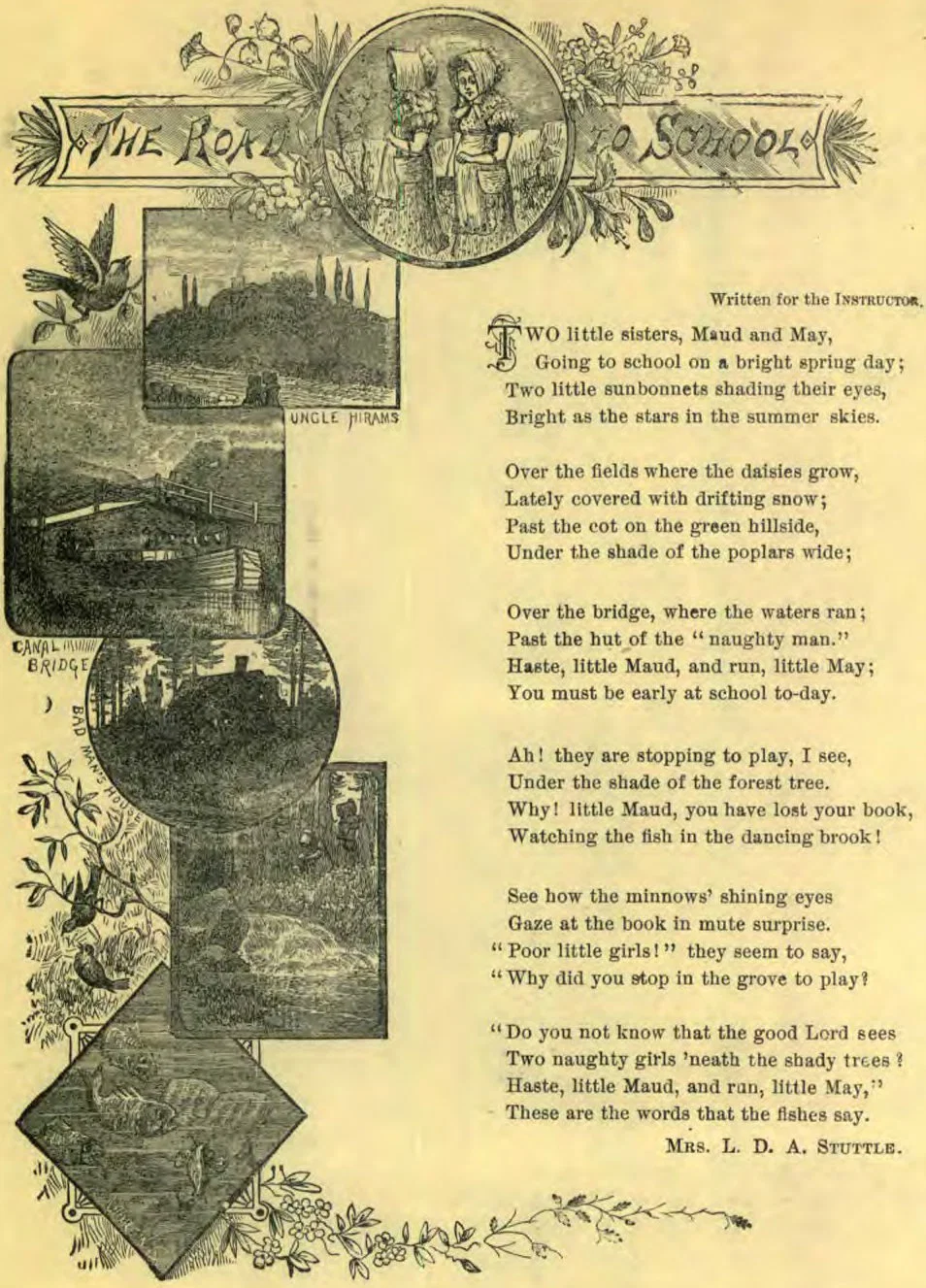
Two Little Sisters Going to School

Written for the INSTRUCTOR.
Two little sisters, Maud and May, Going to school on a bright spring day; Two little sunbonnets shading their eyes, Bright as the stars in the summer skies.
Over the fields where the daisies grow, Lately covered with drifting snow; Past the cot on the green hillside, Under the shade of the poplars wide;
Over the bridge, where the waters ran; Past the hut of the “naughty man.” Haste, little Maud, and run, little May; You must be early at school to-day.
Ah! they are stopping to play, I see, Under the shade of the forest tree. Why! little Maud, you have lost your book, Watching the fish in the dancing brook!
See how the minnows’ shining eyes Gaze at the book in mute surprise. “Poor little girls!” they seem to say, “Why did you stop in the grove to play?
“Do you not know that the good Lord sees Two naughty girls ’neath the shady trees? Haste, little Maud, and run, little May,” These are the words that the fishes say.
Mrs. L. D. A. Stuttle.

You have reached the end of this edition.

The Youth’s Instructor · Apr 30, 1884