The Youth’s Instructor, Vol. 30, No. 25.

THE MINISTRY OF POLITENESS

The Youth’s Instructor

Jun 21, 1882

S. D. A. Publishing Association · Battle Creek, Mich. · Jun 21, 1882

THE MINISTRY OF POLITENESS.
Kitty going to join the ministry! Well, if that isn’t a good joke. She must think she is a woman’s righter,” and Harry Franklin threw his hat up in the air, and gave a laugh.
“That isn’t the kind of ministry I mean,” answered Kitty, shyly, while tears began to come in her gray eyes. “I mean the ministry of politeness.”
“And pray, what is that, Miss Woman’s Rights?” demanded Harry, with another laugh, louder and more disagreeable than the first, while he threw a handful of grass he had pulled to give the pony, standing at the door, over Kitty’s hat and curls.
“No wonder you ask, Harry,” said his mother, who had come out on the porch in time to hear the last few remarks, “for it is very evident that you don’t know. Even Rob, waiting patiently for us to get into the phaeton, knows more of it than you do. He never would have thrown that grass over Kitty’s hair when she was just going to ride. If you really wish to know what it is, I’ll tell you. Part of it is Kitty’s patiently taking the grass out of her hat, and shaking it from her hair without calling you ‘a horrid old thing’ and asking me to make you behave.” “That’s right, Kitty,” she said turning to her daughter; “silence is the next best thing to the ‘soft answer.’ If we learn not to say disagreeable things, it is easier to say agreeable ones. And now who is going with me down to the cars to meet papa?”
“I am,” answered Harry immediately.
Kitty was only human, and for a moment the new profession was forgotten, as she said hastily:— “You went yesterday, and mamma said I might go to-day. I think it is real”—then she remembered, and suddenly stopped.
Her mother noticed it, and always quick to help her children in any triumph over self, said at once:—
“I’ll take you too, Kitty, this evening, for I promised. Harry can go because he was so patient in not speaking first.”
Harry drew his brows together, for as he often confided to Kitty, he “would much rather take a whipping than have mamma chaff him.” The “chaffing” did some good, however, for he helped his mother into the phaeton, then absolutely waited till Kitty got in before he took his seat in the rumble. He met his reward in a bright smile of approbation from his mother,—a smile he valued in proportion to its scarcity, for “harem scarem” Harry was always in some mischief.
After they had been driven for a few moments down the pretty avenue of trees that led to the gate, Mrs. Franklin looked down at her little daughter sitting on the seat by her, and said:— “What made you think of the ministry of politeness, Kitty dear?” “I was reading something about it the other day in that little book you gave me, and I thought I would try to be polite.” “The Bible doesn’t say anything about being polite,” broke in Harry in his usual abrupt style. “And if it isn’t in the Bible, we needn’t do it.” “But it is in the Bible, Harry,” his mother answered him. “What else does this mean? ‘Be kindly affectioned one to another with brotherly love, in honor preferring one another.’ What else does the Golden Rule mean? Why, I could go on for half an hour repeating verses that mean we must be polite to each other.”
“But people need not be polite in their own family,” Harry said.
“Ah, my boy! you never made a greater mistake than that. There is no place where politeness is more needed than in one’s own family. We are much more apt to be courteous to strangers, whom we do not feel intimate with, than we are to our own home people; and it is a mistake, for we are less thrown with them, and so less likely to be made uncomfortable.”
“How does it make you uncomfortable, mamma?”
“Suppose you were to ask me, ‘Can’t I drive Rob now, mamma?’ and I was to answer you, ‘No, you shan’t,’ wouldn’t that make you feel very badly?”
“Yes’m, it would. I would think I was speaking to Kitty.” Harry answered with a sudden burst of thoughtfulness that made Mrs. Franklin and Kitty both laugh.
“But if I said, ‘I am afraid to have you drive now, Harry, for Rob is very tricky, and we are going down hill, you would not feel bad, though you would not be allowed to drive any more than if I had answered you roughly. Do you see?”
“Why, yes! So it does make a difference!” Harry said. “I never thought of that before.”
“One reason that families don’t get on smoothly and happily together is, that they are not particular enough about these little acts of courtesy and kindness that make life go so much more smoothly. You and Kitty would be much happier together if you spoke to each other as you speak to papa and me.”
“How do you mean, mamma,” Kitty asked.
“Why, if you said, ‘Please, Harry, don’t touch that, it will break,’ instead of, ‘You mustn’t touch my things! Mamma, please make Harry behave!’”
—Kitty looked conscious, for she remembered having used these very words early in the morning, and in a very cross tone, too.
“You wouldn’t speak that way to me,” her mother continued. “You would have spoken pleasantly and amiably, and I would have been a great deal readier to listen, and do as you asked.”
“And you too, Harry,” Mrs. Franklin said. “Who was it I heard yesterday saying, ‘Go ’way and leave me alone; I don’t want to be bothered by a girl; what can a girl know about making a kite?’ and five minutes after, when I passed, the same person said to me in a pleasant manner, ‘Please, mamma, help me hold this paper till I paste it.’ Kitty could have held it better than I could, for her fingers are smaller, and would go in places where mine would not go, and she would have been interested and stayed to help you, while I had to go away in a few moments.”
“But it is different, somehow, mamma.”
“Not very different, Harry; the principle is the same. What would you think if I were to say this evening when your papa asks me for another cup of coffee, ‘I can’t give you any more; I’m tired of pouring coffee for you, you are such a bother.’”
The children both laughed at the idea of their gentle mamma saying such a thing, and said they would think it very queer.
“It would not be a bit worse than for you and Kitty to speak so to each other. There is just as much necessity for the little people in our homes to be courteous to each other, as for the grown people to be. If you only take care of the tone of your voice, it is so much easier to be polite, for you would not be likely to make a very disagreeable remark in a bright, cheerful voice, would you?”
“No, indeed,” the children answered.
“That is so much the case,” Mrs. Franklin continued, “that when you only hear people talking, you can usually tell whether they are saying pleasant or disagreeable things. An angry voice is like a railroad whistle, warning you to get off the track, and if any one is wise he will heed the warning. If you get into the habit of speaking to each other in a cross voice, you will find that presently, even though you feel kindly, you cannot speak so; and then, children, you will be sorry for it, and it will be too late to alter the tone of your voice. I have gone into people’s houses sometimes and heard them speaking to each other in cross or sulky tones, and then they would come into the room where I was, and speak to me as sweetly and pleasantly as a May morning; but I could not enjoy it, because I felt that it was their company voices that I heard, not the real honest tones of their hearts. So above all, be polite to your own family, for there is not much temptation to be rude to people you meet formally. But there is your papa coming to meet us, and we must hurry. We will talk some more about the ministry of politeness another time.”—New York Observer.

THE ROSE.

As the rose, unfolding in beauty rare, Its fragrance breathed on the summer air, From the cold, dark earth, from sun and shower, Has silently gathered its precious dower,
So may we each, in our lowly place, While the light of love and the dew of grace Soft fall on the flowers of heavenly birth, Unfold to gladden and bless the earth.
And when at eve the King we greet, As he comes to gather spices sweet From his garden fair, be ours to bring Some fragrant, precious offering.—Selected.

CANTERBURY, ENGLAND.

CANTERBURY, although not the largest, is the most important town in Kent, and is also the Cathedral City of the see of the Archbishop, Primate of all England. It is supposed to have been founded before the Christian era, some say in 900, B. C. When the Romans landed in Britain, it was in the possession of the Belgae. Among the Romans it was known as Durovernum. It was walled in by Ethelbert about the year 600. In the reign of Richard II. the walls were repaired, at which time the deep ditches surrounding the city were 150 feet wide. The walls were two miles in length, and on them were twenty-one small towers. There were seven gates, only one of which now remains. It is called the Westgate, and is the entrance from the London Road. Canterbury was twice ransacked by the Danes. In 851 they nearly destroyed it, killing 7,000 of its 8,000 inhabitants. The Archbishop was carried away in fetters and afterward murdered. At that period the city was very rich, having two years before paid the Danes $150,000 ready money to make peace.
At the time of the Norman conquest it was larger than London, and from that time until the Reformation it enjoyed a peaceful prosperity, profiting much by the continual coming in of pilgrims from all parts of England and the continent, to visit its religious establishments and shrines; more particularly that of Thomas à Becket.
Some little distance from the city, on the road to Dover, is the ruins of St. Sepulchre's Priory. In the time of Henry VIII., Elizabeth Barton, called the Holy Maid of Kent, carried on her impostures here. She pretended to have the gift of prophecy, and proclaimed against those who favored the Reformation,—including the king, his divorce and second marriage, in her denunciations. She was arrested and executed at Tyburn, with six others, for treason.
The Cathedral of Canterbury is one of the most venerable relics in England. Upon its site stood the magnificent palace of the Saxon kings of Kent. The site was made over to Augustine by his royal convert, Ethelbert, who established a church and monastery there, called Christ's Church. St. Augustine was declared first Archbishop about the year 600. In 1011 it was plundered by the Danes, but in 1023 Canute, the Dane, ordered its reconstruction. Twenty years later it was nearly destroyed by fire, and Bishop Lanfranc rebuilt it on a grand scale. In 1174 two-thirds of the building was again destroyed, and it was rebuilt fire-proof. Quite a portion of that work still remains in the Cathedral. From that time it was called the “Church of St. Thomas, the Martyr,” in memory of the murder of that troublesome priest, Thomas à Becket, who was murdered there in 1170. A new shrine was erected for the saint in 1220, and so numerous were the offerings made by the pilgrims, who flocked there, of all grades of society from kings to peasants, that we are informed by Erasmus, that the chapel glittered with jewels, gold, and silver. Henry VIII. made short work of the whole affair. The remains of Becket were disinterred, burnt, and scattered, and every article of value appropriated to the king's private use. There is now shown in the castle museum at Taunton a relic of Becket, said to have escaped the wrath of Henry. It is a wooden vase containing some of the blood of Becket, which was gathered up by his admirers after his martyrdom. It was hid behind some plaster of Paris images. I looked at this vase two years since, while visiting the castle museum. It evidently contains dried blood of some kind, but who knows that it is Becket's blood? If so, what profit is there in his blood now?
J. N. LOUGHBOROUGH.

Beginning with Modesty, Ending with Honor

BEGIN with modesty, if you would end with honor.

LITTLE TANGLES.

As weavers a good king employed Half of his subjects day by day; And when the tangled threads annoyed, He bade them send for him straightway. The patterns and the silk he gave, And lovely goods the bright looms made; All loved the king, yet strove to save Each broken warp without his aid.
Shrewd men and women, children, too, Were busy at the flying looms; It was a pleasant sight to view Those lustrous silks in sunny rooms! Among the workers was a child, A wee, pale girl, oft left alone, Yet she was ever patient, mild, With happy light the blue eyes shone.
All wondered at her cheerful mien; And loved to hear her softly sing, While through the meshes bright and fine, Swift as a little wild bird’s wing Her fingers darted to and fro!
... One day the men were sadly tried, Their threads got broke and tangled so; Nor could they pattern true, beside.
And round this cheerful little girl They gathered all with quest’ning gaze; Why did her spindles constant whirl, Nor silk e’er twist in blinding maze?
“Now tell us, happy little maid,” A strong man said, with tearful eyes: “In trouble, sir, I’m not afraid To seek the King so good and wise!”
“Each morn and night his help we seek!” With one voice cried the swelling throng. “But I,” she said, with blushing cheek, “His guiding hand feel all along; For when a tiny knot I find, That instant I invoke His aid, And so the tangles all unwind; On Him my ev’ry care is laid!”
—George Bancroft Griffith.

“THAT BOOK.”

“Toss me that book,” said a boy to his little sister.
“It isn’t a book,” said Miss Three-year-old. “It is the Bible, and it isn’t to be tossed.”
That was a lesson of reverence for her elder brother to learn. Charlie’s Latin grammar, the stories and histories on the center-table, even that illustrated edition of Longfellow’s poems,—all these were books according to the little maiden’s idea. But the big volume out of which papa read in the morning, the morocco one, with gilt clasps, that mamma carried to Sabbath-school, were not books, they were Bibles. Sometimes, perhaps, when mamma was not looking, she might venture to toss a book that did not have pretty covers, but the Bible never.
We like the way this little girl reverenced the Bible. It is not a common book. It is the Book of books. When we receive little presents from our friends, we value them very much in proportion as we love the givers. So should we value the word of God, his present to us, so highly that, no matter how simple the covers that contain it, we shall always desire to take the best care of it, and allow it to serve no ignoble purpose.—Little Star.

Seeking God's Blessing for a Life of Good Works

As the plowing and sowing will not make a harvest unless the rain from heaven fall on the seed, so must you have God's blessing with you, if you would live a life full of good works. Try to think of this every morning when you rise, and ask God to help you to be one of his children, doing good to all around you.

Perseverance, Experience, Caution, and Hope for Success

If you wish success in life, make perseverance your bosom friend, experience your wise counselor, caution your elder brother, and hope your guardian genius.

NEW-TESTAMENT HISTORY.

LESSON 87.—THE GREAT COMMANDMENT.

“But when the Pharisees had heard that he had put the Sadducees to silence, they were gathered together. Then one of them, which was a lawyer, asked him a question, tempting him, and saying, Master, which is the great commandment in the law? Jesus said unto him, Thou shalt love the Lord thy God with all thy heart, and with all thy soul, and with all thy mind. This is the first and great commandment. And the second is like unto it, Thou shalt love thy neighbor as thyself. On these two commandments hang all the law and the prophets.”
“And the scribe said unto him, Well, Master, thou hast said the truth; for there is one God; and there is none other but he: and to love him with all the heart, and with all the understanding, and with all the soul, and with all the strength, and to love his neighbor as himself, is more than all whole burnt offerings and sacrifices. And when Jesus saw that he answered discreetly, he said unto him, Thou art not far from the kingdom of God.”
“While the Pharisees were gathered together, Jesus asked them, saying, What think ye of Christ? whose son is he? They say unto him, The son of David. He saith unto them, How then doth David in spirit call him Lord, saying, The LORD said unto my Lord, Sit thou on my right hand, till I make thine enemies thy footstool? If David then call him Lord, how is he his son? And no man was able to answer him a word, neither durst any man from that day forth ask him any more questions.”
“Then spake Jesus to the multitude, and to his disciples, saying, The scribes and the Pharisees sit in Moses’ seat: all therefore whatsoever they bid you observe, that observe and do; but do not ye after their works; for they say, and do not.” He also warned his disciples against the vainglorious spirit of the Pharisees, and others, saying, “Beware of the scribes, who desire to walk in long robes, and love greetings in the markets, and the highest seats in the synagogues, and the chief rooms at feasts; who devour widows’ houses, and for a show make long prayers: the same shall receive greater damnation.”
“And Jesus sat over against the treasury, and beheld how the people cast money into the treasury: and many that were rich cast in much. And there came a certain poor widow, and she threw in two mites, which make a farthing. And he called unto him his disciples, and saith unto them, Verily I say unto you, That this poor widow hath cast more in, than all they which have cast into the treasury; for all they did cast in of their abundance, but she of her want did cast in all that she had, even all her living.”
The instruction brought out in this and the two preceding lessons are supposed to have been given by our Lord on Tuesday, the third day of his last week,—sometimes called the “holy week.” On the preceding Friday, just before the Sabbath began, he had come to Bethany. It will be remembered that he was on his way from Jericho up to Jerusalem. At Bethany, in the house of one Simon, he remained over the Sabbath. It was on this occasion that Lazarus sat at meat with him, Martha served, or waited on the table, and Mary anointed his feet with the precious ointment. On Sunday he made his triumphal entry into Jerusalem, and returned at night to Bethany. On Monday, he cursed the fig-tree, as he was on his way to Jerusalem; and on arriving there he drove from the temple the sordid traders and haughty rulers, who had polluted it. Tuesday morning, while going from Bethany up to the holy city, the disciples noticed that the fig-tree which Jesus had cursed was withered. During the day, he gave parables, answered questions, rebuked the wicked scribes and Pharisees, and taught the waiting people, as already noticed.

QUESTIONS.

  1. When it was known that Jesus had put the Sadducees to silence, what other powerful sect tried to confound him? Matt. 22:34.
  2. Who was appointed to be their spokesman?
  3. What question did he ask?
  4. Repeat the scripture that Jesus gave in answer to this question. Mark 12:29, 30.
  5. Where is this commandment first recorded?
  6. Which of the ten commandments are included in this great commandment?
  7. How can you show that it includes them?
  8. What command did he say was second in importance?
  9. Which of the ten commandments are included in this precept?
  10. How may this be shown?
  11. What did the lawyer say about the correctness of this answer? Mark 12:32.
  12. What remark did he make concerning the importance of these great commandments?
  13. How did Jesus regard this lawyer’s remarks?
  14. What encouraging words did Jesus speak to him?
  15. What do you think Jesus meant by this remark?
  16. While the Pharisees were thus gathered together, what question did Jesus ask them? Matt. 22:41, 42.
  17. How did they answer him?
  18. What did he then ask them to explain?
  19. What is the true answer to these questions?
  20. What effect did these interviews have upon the Pharisees and Sadducees?
  21. Why were the disciples of Jesus to have respect to the teachings of the scribes and Pharisees? Matt. 23:1, 2.
  22. Why were they not to pattern after their works?
  23. What else did Jesus caution them against?
  24. What did he say the scribes and Pharisees desired? Mark 12:38.
  25. What did they love?
  26. How does he further describe their character?
  27. What will be the consequence of such hypocrisy?
  28. What did Jesus behold, as he sat over against the treasury? Mark 12:41.
  29. How did he contrast the giving of the rich men with the giving of the poor widow?
  30. In what sense did the widow give more than the rich men?
  31. When did our Lord give the instruction brought out in this and the two preceding lessons?
  32. What journey had he made during the preceding week?
  33. When did he arrive at Bethany?
  34. What happened as he tarried there over the Sabbath?
  35. What took place on Sunday? On Monday?

SCENES IN THE LIFE OF CHRIST.

LESSON 74.—REVIEW.

  1. Of what did some of the people tell Jesus? Luke 13 : 1.
  2. What did he say about these Galileans?
  3. What other example did Jesus bring up?
  4. What did he say about the men who had suffered these things?
  5. What did he say should happen to all who do not repent?
  6. Relate the parable of the fig-tree.
  7. What do you think this parable is meant to teach?
  8. Whom did Jesus heal one Sabbath day as he was teaching in the synagogue?
  9. Tell how the miracle was performed.
  10. What ado was made by the ruler of the Synagogue?
  11. How did the Lord answer him?
  12. What effect had this answer upon the people?
  13. At what time of year did the Jews hold the feast of the Dedication? John 10 : 22.
  14. What important question was asked Jesus at this feast?
  15. How did he answer?
  16. How did the Jews receive this answer?
  17. What did Jesus say to the Jews, when they took up stones to stone him? John 10 : 32.
  18. What reply did they make?
  19. When Jesus had escaped from them, where did he go?
  20. How was he received there
  21. What did he do for the country on the east side of the Jordan? Matt. 19 : 1, 2; Mark 10 : 1; Luke 13 : 22.
  22. What did Jesus say when he was asked if there are but few that will be saved?
  23. What will be said to some who shall knock at the door of mercy after it is closed?
  24. What plea will they make?
  25. How will their plea be answered?
  26. When will there be weeping and gnashing of teeth? Luke 13 : 28.
  27. What did Jesus say about the gathering of the saints in the kingdom of God?
  28. What warning was given Jesus about this time?
  29. How did he receive it?
  30. On what occasion was he watched to see if he would heal on the Sabbath day? Luke 14 : 1.
  31. What occasion was there for exercising the gift of healing?
  32. What question did he ask them before performing the miracle?
  33. How did they meet this inquiry?
  34. When he had healed the man, what other question did he ask, that they were unable to answer?
  35. What instruction did he give to those who were disposed to seek the highest rooms and the most honorable places?
  36. What did he say to the Pharisee who had invited them to the feast?
  37. What remark was made by one who was sitting at the feast?
  38. By what parable did Jesus reply to him?
  39. How may this parable apply to us?

GENERAL SUMMARY OF S. S. REPORTS

For Quarter Ending March 25, 1882.
Names of States Names of State Secretaries No. Schools reported Membership Average Attendance New Members Enrolled Dropped from Record Number Under 14 Number Over 20 Church Members Number of Classes Number of Members in Primary Division Intermediate Division Senior Division Keep Complete Records Number of Instructors Taken Contributions Received Amount Sent State Association Amount State Sent General Association
Alabama C. O. Taylor 2 49 43 2 21 23 24 7 19 5 23 16 50
California E. A. Chapman 25 985 692 181 106 390 420 425 129 360 158 469 10 465 $117 40 $3 43
Colorado
Dakota M. M. Olsen 8 232 174 22 22 95 111 118 29 71 56 104 8 72 7 87 10
Indiana Leanna Morrell 22 490 325 27 17 171 206 224 62 138 119 207 14 265 30 66 3 01 62
Illinois Lizzie S. Campbell 31 665 468 48 48 243 330 363 86 99 151 334 21 63 26 98 2 19 22
Iowa J. H. Durland 32 1014 668 58 71 321 427 425 118 284 275 224 22 408 46 14 3 42 35
Kansas Mrs. Clara A. Gibbs 30 805 551 109 42 307 381 373 101 175 307 227 23 240 14 22 1 92 20
Kentucky
Michigan Eva Bell 67 2147 1631 335 191 729 1107 1283 325 517 513 1027 60 1373 222 93 16 64 1 66
Missouri D. T. Jones 14 342 226 40 20 115 138 156 35 93 60 158 18 168 30 23 1 99 87
Maine Hattie Gifford 10 251 176 12 9 87 105 164 32 36 43 76 4 105 1 15
Minnesota E. S. Babcock 51 1184 839 141 105 329 488 552 156 183 129 572 34 463 55 75 3 76 55
New York Mrs. N. J. Walsworth 20 370 201 15 25 73 210 247 53 51 58 231 16 197 11 44 1 08 12
North Pacific R. D. Benham 5 129 98 13 5 51 50 61 17 30 24 48 3 69 4 35 50 10
Nevada C. M. Kinney 1 8 12
New England Mrs. E. D. Robinson 22 448 310 30 23 121 256 297 55 84 54 272 17 329 47 30 4 89 1 00
Nebraska Mrs. Mary Clausen 16 495 331 65 35 179 183 216 55 121 83 60 12 181 17 09 2 23 25
Ohio Verna Null 32 636 437 33 36 208 340 345 94 158 112 317 27 380 54 55 5 91 60
Pennsylvania Mrs. F. C. Oviatt 18 295 228 17 24 116 167 170 52 79 67 165 18 169 21 05 2 61 25
Tennessee & Va. Mrs. Mary Remley
Texas Sue Dickerson 8 255 141 30 11 105 110 100 30 67 42 79 8 132 10 25 1 70 17
Vermont Ann E. Smith 11 289 189 14 13 93 165 156 34 70 39 180 9 102 13 50 1 30 13
Wisconsin Mrs. Nellie Taylor 59 849 691 91 106 338 357 336 115 243 184 359 18 354 35 32 4 38 51
Upper Columbia Mrs. M. O. Beck 4 108 71 9 7 41 50 65 12 21 18 52 4 81 3 75 35
Totals 488 12046 8880 1292 916 4134 5631 5985 1598 2906 2497 5184 355 5594 $779 78 $63 13 $7 70
EVA BELL, Secretary General Association.

THE RAIN-MAN.

RAIN-MAN, Rain-man, come to-day, Shower the meadows fresh and gay; Give sweet grass to cow and calf, Wake the rose and make it laugh.
Dance and fall from out the sky, Fill our cistern long since dry; Foam the brook up to the brim, Swell the pool where ducklings swim.
Wash the strawberries in their bed, Make them ripe and round and red; Wash the cherries 'neath the eaves, Blushing under thick green leaves.
Lay the dust upon the street, Send up odors clean and sweet From the earth and new-mown grass, When the little breezes pass.
Send the doves, that love not rain, Trooping to their cote again; But the sparrows chatter more When you beat upon their door.
Steal into the robin's nest, Make the nestlings seek her breast; Make the chickens run and hide 'Neath the mother-wings so wide.
Rain-man, 'neath your cloudy hat, Come and clatter, pat, pat, pat; O'er the roofs, and chimneys, too, Let us hear your tramping shoe.
Put your cloak on, Goodman Gray, Come and visit us to-day; Pour your buckets down the sky; When you're through, we'll shout: “Good-by!” —Augusta Larned, in St. Nicholas.

WATCHING THE BIRDS.

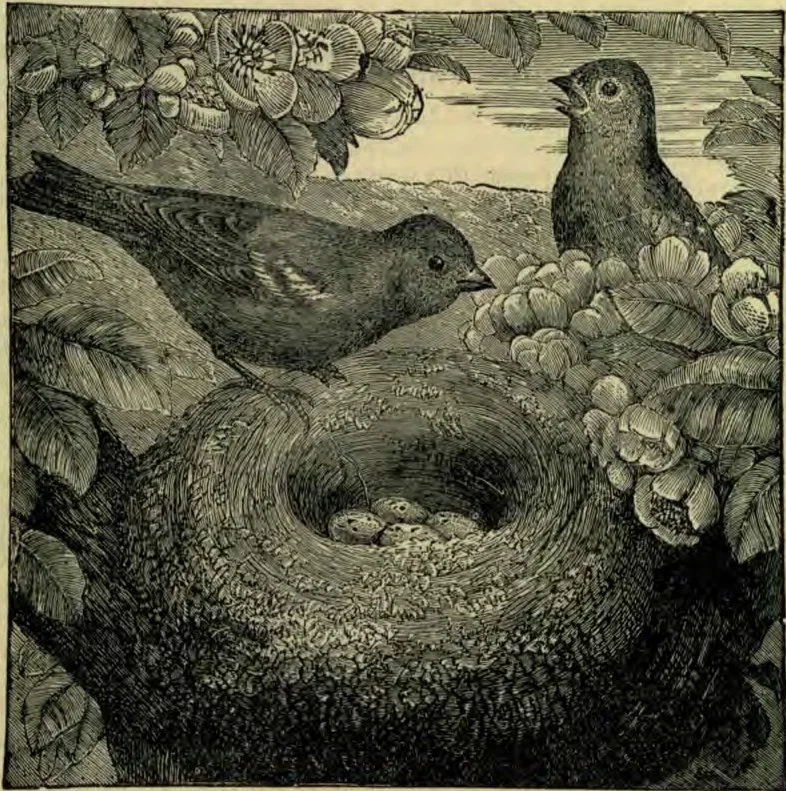
No doubt many of the boys and girls who read the INSTRUCTOR have spent many happy hours during the spring that has just gone from us, in lying under the trees and watching the birds over head. How joyfully we welcomed them that first morning that we were wakened by their sweet songs! Then what a commotion there was among the newly opening leaves as the little inhabitants of the trees were choosing their mates and the places where they should build their nests. Then we watched them gathering the dry last year's grass, and tiny twigs, and the horse hair from the barnyard, and perhaps bits of string that we hung for them on the limbs of the trees. How shyly they eyed us as we did so, and then while we watched them from around the corner of the house, how they twittered, and fluttered, and hopped nearer and nearer until with a dive they seized it, and darted away to weave it in with the grass and twigs and hair to make their summer home.
Then they grew more still and we knew that if we should climb the trees and take a peep at their homes, we could count one, two, three, and maybe four and five little blue, or brown, or white, or spotted eggs, according to whether they were robins, or sparrows, or some other kind of bird. And, perhaps, knowing that they could not count their eggs, and so would not miss “just one,” we took one from the nest of each kind of bird we could, and so had an egg museum. And how we felt toward those cruel boys who robbed our pets of all their eggs, and perhaps of their nest too. Then, on going out one morning, we saw a mother-bird standing on the edge of one of the nests, with a worm in her mouth, and we saw three or four little open mouths stretching up for it, and when we threw out some crumbs, the old birds, instead of eating them on the spot, carried the largest pieces up to their little family. Perhaps, too, some of you were so kind and gentle with the birds that they were no longer afraid of you, but would come to your hand for food, and after flying away south for the winter, would come back the next spring and build in the same old tree or porch again. You then thought how much nicer it was to watch the birds living so free and happy, than to have them shut up in a cage, only you wished they could stay all through the winter. Well, can we not learn a useful lesson from them even if they are only with us during the summer? God, who made us, and the fruits for us to eat, and the animals and plants to feed and clothe us, made the birds and flowers for our pleasure and enjoyment, and not for that alone, but also to teach us how to live at peace with each other, and how kind and obliging we should be to our playmates.
Again, as we look at Mr. Sparrow in the picture, singing so joyously to his mate, who is feeling very proud of her four speckled eggs, we are reminded of what Jesus said so many hundred years ago:—
“Are not five sparrows sold for two farthings, and not one of them is forgotten before God? . . . Fear not therefore; ye are of more value than many sparrows.” S. E. S.

JESUS' LOVE.

SOME of you have been told that Jesus does not love naughty children; that you must be good if you want the Lord to love you. And you have tried, oh, so hard, to be good, that you might win his love and be saved. Every birthday and New Year's Day, the first day of school and the first day of vacation, whenever you have gone visiting and the day you came home, and many other times, you have said to yourself: “Now I am going to commence anew, and try as hard as I can to be good.” But in a short time you said or did something wrong, and after several failures you became discouraged, and then said to yourself, “I can't be good, and I will not try any longer. I never can make Jesus love me.”
Now Jesus loves you, just as you are. Jesus loves even naughty children. He wants you to come to him with all your faults and sins. Do not wait to make yourself better, but come to him now. He will receive you as his own dear child. Then try anew to do right. You cannot make yourself wholly good, but you can do the best you can, and Jesus will help you through the rest. If you are truly sorry for your sins, and try to turn away from them, Jesus is ever ready to forgive and help you. He is never impatient with our frequent failures, and never weary of our cries. Loving and patient, strong and gentle, ever ready with sympathy and help, Jesus is the children's best friend, the children's loving Saviour.—Selected.

THE FATE OF THE APOSTLES.

St. MATTHEW was martyred in a city in Ethiopia.
St. Mark was dragged through the streets of Alexandria, in Egypt, till he expired.
St. John, after having been put into a caldron of boiling oil at Rome, and receiving no hurt, died a natural death at Ephesus, in Asia.
St. Peter was crucified at Rome, and, according to his request, with his head downward, thinking himself unworthy to die in the posture in which his Lord had died.
St. James the Great, was beheaded at Jerusalem.
St. James the Less was thrown from a pinnacle of the temple and beaten to death with clubs.
St. Philip was hanged against a pillar at Hierapolis, a city in Phrygia, till he expired.
St. Thomas was pierced through the body with a lance, at Corarandel, in the East Indies.
St. Jude was shot to death with arrows.
St. Simon, the zealot, was crucified in Persia.
St. Matthias was first stoned and afterward beheaded.
St. Barnabas was stoned to death by the Jews at Salamais.
St. Paul, the great teacher of the Gentiles, was beheaded at Rome by the tyrant Nero.
Such was the fate of the first preachers of the gospel of peace, according to the best accounts we have of their end, and truly they were “sent forth as sheep among wolves.”

A LOVING DAY.

“Mother, I suppose one reason why they call the Sabbath a holy day is because it’s such a loving day,” said a little boy, looking up into his mother’s face.
“Why, is not every day a loving day?” asked his mother. “I love father, and father loves me, and we both love you and baby every day as well as on the Sabbath.”
“Well, but you’ve no time to tell us so on week-days,” said the little boy. “You have to work, and father has to go off early to his work, and he is so tired when he comes home. But Sabbath he takes me on his knee and tells me Bible stories, and we go to church together. And, oh, ’tis such a loving day.”

Watch Your Heart Against Sin

WATCH your heart! Don’t let the love of sin dwell in it. Don’t give it to Satan, but ask Jesus to make it his throne.

You have reached the end of this edition.

The Youth’s Instructor · Jun 21, 1882