The Youth’s Instructor, Vol. 38, No. 42.

ROUND THE WORLD.—31

The Youth’s Instructor

Oct 15, 1890

S. D. A. Publishing Association · BATTLE CREEK, MICH. · Oct 15, 1890

ROUND THE WORLD.—31.

JEYPORE.
After a two days' rest at Delhi, we once more boarded the train, and started on our journey southward. The road is narrow gauge, and passes over some steep gradients. But as the shades of night were drawing over the landscape, we did not see much en route. The crops looked flourishing on either side of the track, and flocks of peacocks feeding quietly among them were apparently in undisputed right, their beautiful plumage glittering in the last red rays of the sun, as it disappeared behind the western horizon. The night was comparatively cool, but we were painfully aware that, as we drew farther to the southward, the heat would increase, and that sleeping would be an utter impossibility.
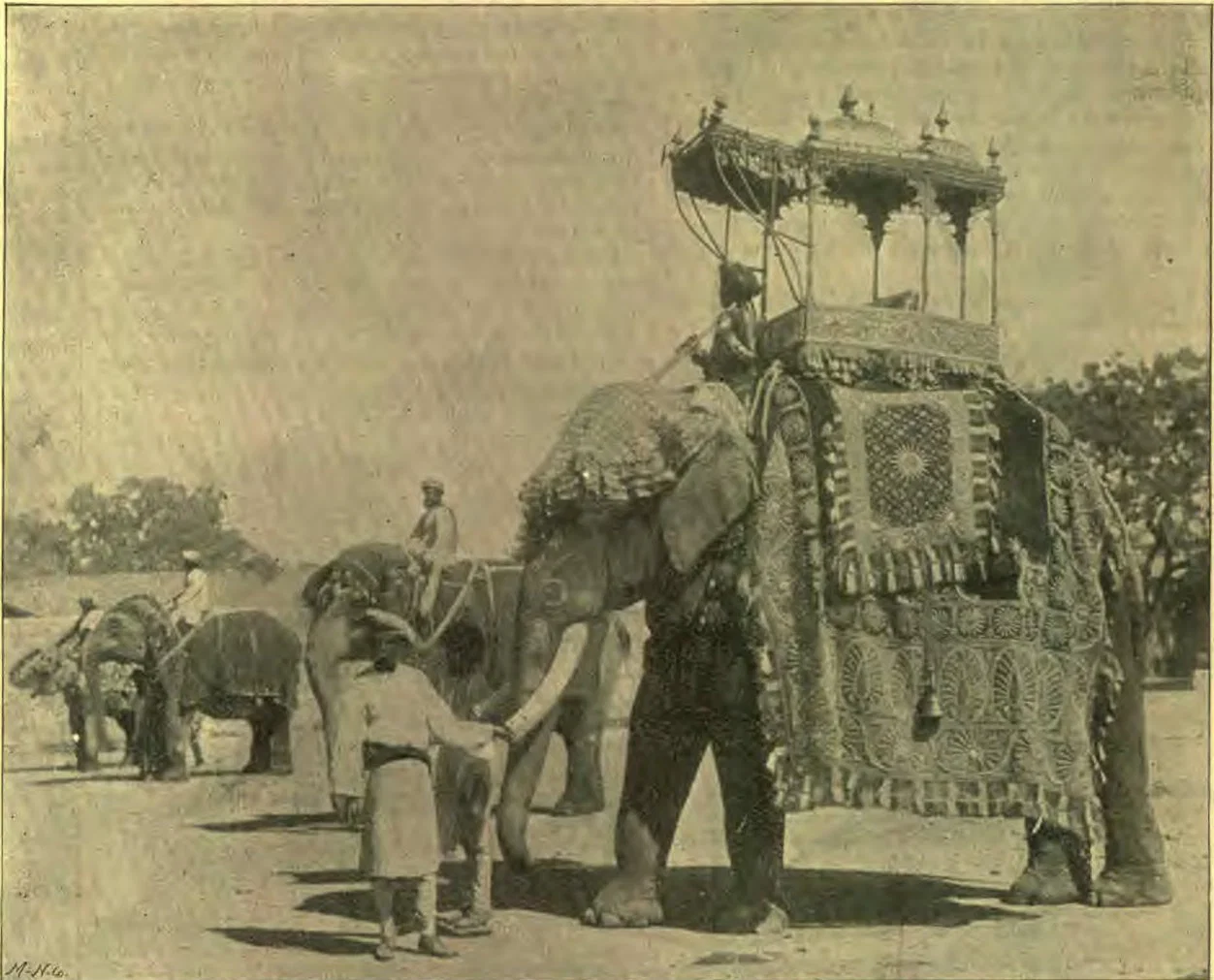
ELEPHANT RIDING IN INDIA.
In the morning we arrived at Jeypore, the capital city of the native State of Rajputana. It is by far the finest town under native control in India. It is well managed, and the people are greatly advanced in civilization. Its streets are very wide, the houses lofty and well-built, and all the principal highways lighted with gas. It possesses high schools, a school of art, a college, and almost every institution found in the most advanced cities in the civilized world.
All these improvements are owing to the late Maharaja, Jey Singh, a wise, enlightened, and liberal-minded prince. The present town was founded in 1728. It is surrounded on all sides, except the south, by rugged hills, the chief summits of which are crowned with forts.
One of the most interesting sights in the city is the stables of the Maharaja. They contain, I should think, many hundreds of horses, most of them of magnificent stock. The collection has been gathered from almost every imaginable part of the surface of the globe. There are shining Arabs, with a beauty sufficient to satisfy the eye of the most critical Bedouin; little Shetland ponies, with their flowing manes and tails, and Clydesdale draught horses, that look capable of pulling almost any load. They lead an easy life, for there is little for them to do. The method in which they are tied up in their stables is a peculiar one. There are no partitions between the stalls, and to prevent them from kicking or injuring one another, a rope about a foot and a half or two feet in length is attached to each fore foot, and pegged into the ground. Then one some eighteen or twenty feet long is fastened to each hind foot, and also pegged down. From the halter another lariat is fastened to the manger, so that tranquillity is verily insured.
The public gardens are beautifully laid out; no European gardener could manifest better taste. The fernery is charming, and surpasses anything that I have ever seen before. In cages at one side of the main square are specimens of almost every kind of bird that can exist in that climate. In size and variety they range from the tiny warblers of the jungle to the silver peasant and the largest specimen of aqueous bird. A museum known as the Albert Hall stands in the center of the gardens. It is a very imposing structure, containing some well-executed frescoes of early days in India, when the gods of the Hindoos carried on wars against each other.
In the afternoon we drove to Amber, or Old Jeypore, four miles from the present city. Arriving at the confines of the place, we were met by an elephant sent out by the Maharaja to take us up the mountain. This is customary, and a courtesy shown to all visitors desiring to view the halls of his ancestors.
We had often heard about riding on elephants, and had seen pictures of the performance, but this was our first attempt. The driver sat behind the animal's ear, which was almost large enough to cover him, and certainly to form a good sunshade, could it only be brought into the right position. At a word from the driver and a prod from a grappling-iron by means of which he steered the beast, the giant knelt down. Then a seven-foot step-ladder was unslung from his side, and placed on end, and up we clambered. It was now Jumbo's turn to arise, which he did at considerable "passenger's risk" we thought; for the effort seemed greater than that of a ship crossing the breakers of a billowy bar. With another prod, and some inexpressible lingo from the jarvy, our steed commenced to waddle. I shall never forget the sensation; the motion is indescribable. He seemed to plow along worse than a brig in a gale of wind. We have sat astride the naked back of an Irish donkey, and poked him with a pin to call forth kicks and energy, we have ridden wild horses on the prairies at break-neck speed, we have come into the goal posts of a half-mile race poised on the dorsal vertebra of a Missouri mule, but we would infinitely prefer to brave all such dangers again rather than be doomed to another hour on the back of an elephant. It nearly made me seasick, and every little while he would sneeze, or something of the kind, wetting his deck-like back fore and aft, and completely submerging us. But to his praise be it said, he did steer well, and would tack his huge, clumsy feet round the sharpest corners among the rocks, as we ascended the mountain-side, without once grazing our toes.
The old palace is on the side of a mountain, frowning down over a dam of water which doubtless served as a moat in ancient days. It is an immense building, and the style resembles much that of other buildings of the same nature hitherto described. As a whole, it is not very handsomely ornamented, the decoration of but two small rooms being worthy of note. Their walls are embellished with a host of little mirrors of peculiar shape, which reproduce at least a thousand times the one gazing into them. The deserted zenana, or quarters of the queen, looks as if it wanted some one to come and live there, and the wind sweeps cruelly through the marble screens, as if telling that the days when these rooms resounded with merry laughter are over, and that the breezes have now undisputed sway. A melancholy gloom hangs over the majority of buildings of this class, and I imagine that I would often look behind me if I were passing through on a dark night.
After surveying the ruins, we once more mounted and started down grade, and the motion was, if anything, worse than when ascending. If you want any bones dislocated and set again, try a ride on an elephant; or if you wish your teeth loosened prior to visiting a dentist, take a jog on Jumbo down a canon, and it will insure “painless dentistry.” Safely landed once more at the foot of the gulch, we vowed we would never go elephant riding again.
We slept again that night on wheels, the iron horse whirling us down to India's great seaport. A reverend gentleman disturbed our peaceful slumbers during the night with a “Hurry up and get out, I want that carriage for my daughter.” But we had been elephant riding and were weary, and didn't propose to get up, dress, and shift about thirteen pieces of baggage, so we bade him depart to find a resting-place for his daughter elsewhere. Unwillingly, and with no too kind au revoirs, he did, and finally found another compartment for her, and then a roost for himself with some betel-nut chewing, poojah-performing Babus (native gentlemen), where, without doubt, he enjoyed the aroma and the local society.
Next morning we were laid over at a wayside station till the special train containing Prince Albert Victor, the future king of England, should pass. It was a pretty train, handsomely equipped, with Pullman cars and silvered railings, while from the hinder coaches appeared a perfect bevy of peons, and bearers and conductors innumerable. We queried why we were not dignified with such state, and thought we were just as ornamental and every bit as useful in this world as His Royal Highness.
We sincerely hope that the night which followed will be our last on an Indian railroad in the hot season. The heat was something fearful. H. took the upper berth, and tried to sleep, but how well he succeeded he alone can tell. A British army officer and myself disrobed, and sat in our sleeping suits gasping for air. Many of the depots we passed through were brilliantly lighted and decorated in honor of the prince, but if he was as stifled as we were, he could not have paid much attention to this burst of loyalty. It had lost all charms for us; the only thing we could summon up energy enough to do was to use our lungs lustily to the wallahs on the platforms for “pani” (water). One such experience is enough. As the morning approached, the atmosphere suddenly changed, and was quite chilly, which did not add to our physical comfort. At last the brakes grated on the rails in the Bombay depot. We hurried to the post-office to see if there was not food for folks who have undergone letter-starvation for nearly three months. Nor were we disappointed. We were glad we had a carriage, for we could not have carried it all home in our arms. P. T. M.

THE PASSING OF SUMMER.

WHEN summer kindles purple fires, That run along the foxglove spires, And set the meadows all aglow With blazing torches in a row, Those July days beneath her feet, June grass that once was fair and sweet Grows crisp and sere, then quick she flees The humming of her belted bees, And sets within her meadows glad A host of fellows emerald clad. These wee musicians of the field, When nesting birds no song-burst yield, Take up the strain, and from their bows In tiny tide the music flows, A mimic music, shrill and thin, Breathed out from elfin violin. Then “Katy” comes with her old ways, And argues through the August days; And last in damask, ebon drest, The summer’s very latest guest. He winds his clock, and counts the time That sunny fields and skies may rhyme, For well he knows, the old-time friend, That summer’s reign is at an end, And numbers with his tick, tick, tock, Each day of grace. The little clock Beats out the long September hours, Beats out the death of all the flowers, Numbers each falling leaf and brown, Until it, too, at last runs down. And then, with vanished birds and bees, The summer flits across the seas.
—Harper’s Weekly.

SOME GIRL'S WAYS.

It was a busy morning in a big farm-house kitchen. Nell was bending over the sink, picking a chicken, with a decided scowl on her face; Hattie was kneading bread, with an expression of grim determination, suitable for a soldier scaling his enemies' breastworks; and Susan was shelling peas, her pretty face spoiled by the settled discontent about the mouth. The girls were not talking—they never talked while they worked—but they often spoke sharply and unkindly. Work was to them a separate state of existence, in which the Christian graces played no part.
“Did I leave my whip in here?” asked a hesitating voice at the open door, and a boy in a big straw hat appeared behind the voice.
“No,” snapped Nell, “but it’s a wonder you didn’t, for you are always leaving something around for us to tread on.”
“It has fallen down under your chair, Susan,” he said, coming in to pick it up.
“Ned, you are always bothering somebody,” fretted Susan, while she arose with ungraciousness in every movement.
“Father called me to come quick and catch the chicken, and I stood it in the corner,” replied Ned, roughly, and gladly made his escape.
That same morning, in a neighboring farm-house kitchen, Lucy was kneading the bread as deftly as Hattie, but at the same time planning with Helen and Grace how to earn money for their mission-boxes; Grace had a funny story to tell while she washed the dishes, and Helen told them of a meadow-lark she saw while picking the strawberries that she was now hulling for the strawberry short-cake for dessert.
Sam came in with an armful of wood, threw it noisily into the wood-box, twitched Grace’s curls, made believe to dive his hands into Lucy’s pan of flour, snatched the largest strawberry from Helen’s dish, and pranced out, whistling a Sabbath-school hymn.
The girls smoothed out the little smile that Sam’s antics always brought to their faces, and began to sing his hymn, being echoed by Fanny, who was sweeping the front stairs.
Which family do you belong to, girls?—Advocate and Guardian.

THE OUTWARD APPEARANCE.

Ella Raymond one day went into a variety store near the school-house to buy a slate-pencil. While she was waiting for it, she noticed an oddly-attired, strong-bodied, elderly woman, with her awkward hands bare, who leaned over the counter, giving an order.
“Do see Nancy Rhodes,” said Ella, nudging her companion. “She’s the queerest looking thing! I’d stay in before I’d walk out in that rig. I should think she’d be ashamed of herself.”
“Hush!” said Carrie Fay, in a softer whisper, “she might hear you.”
“What if she does?” said Ella, in a yet louder tone. “She ought to hear somebody, and learn what people think of the way she looks.”
“Do stop,” entreated Carrie, anxiously. “I’m just sure she can hear.”
Ella laughed, yet looked a little confused herself as Nancy came toward them in passing out, and looked keenly at her. She thought perhaps she might be taken to task for her rudeness. But Nancy merely passed on.
Ella, emboldened, ran after her a little way behind, and, imitating the walk of the old lady, laughed with the foolish giggle so common to many young girls. And by not taking heed to her steps, her foot turned in a hole, and down she went, books, slate, high head, and all.
“O, dear!” she cried, “what a tumble! I’ve hurt my foot dreadfully.” She tried to get up as she spoke, but stopped, with an expression of pain on her face.
“Let me help,” said Carrie; “it’s just too bad.”
“O, don’t try to lift me!” said Ella. “You can’t, any way, and it only makes my foot hurt all the worse.”
“I guess I can lift you,” said a voice, and the startled girls looked up at Nancy, whom they had forgotten in the excitement of the accident. The queer-looking creature, in spite of the protestations of the hurt child, took her easily in a pair of muscular arms, and said, with a smile,—
“Now, where would you like to ride to?”
“You can never carry me,” said Ella; “it’s two whole squares away.”
But Nancy did carry her, following the quick feet of Carrie Fay, and laid her triumphantly on the couch in her mother’s sitting-room.
“There,” said she, “I guess you’re all right now. I know’d I could do it. I hope you ain’t hurt much.” And Nancy departed, making light of her services, as Mrs. Raymond followed her with many thanks.
Ella’s ankle was badly sprained, and there were many days of pain before it was strong again. And in those days she learned the story of Nancy, and had time to become disgusted with her silly and wicked contempt for unattractive clothes and faces and figures.
Nancy Rhodes had been left an orphan with younger children to care for, and had stooped her strong young shoulders over many a washing and ironing that the children might be kept from the poor-house or orphan asylum, and educated. They had now grown, and gone into the world. The girls were married to thrifty men, and one of the brightest boys was a thriving young grocer in a village near by. But Nancy chose to live by herself in her own old cottage, where she was kept in decent comfort by her grateful family.
She was happier so, and felt that she was not like the younger children of her family.
“They’ve got ways I can’t seem to enjoy,” she said. “I mean I enjoy seeing them have ’em, but style got all washed and ironed out of me, I guess. I go visitin’ either one or another of ’em every little while, and then I come home and enjoy myself, thinkin’ how nice it was. But it’s more like home to me to be common and to have common things.”
“I do not know,” said Ella’s mother, “why I never thought to tell you the reason of Nancy’s lack of refined manners and of her big, bony hands. She had no time in her young and middle-aged life of cares and hard work to improve any part of herself except her heart. But she kept that tender and willing.”
“To think,” said Ella, “that she could carry such a big girl so far! I shall go to see her as soon as ever I get well.”
She lay and thought about it for a long time. Then she spoke again.
“Mamma, do you think Nancy would like one of those pretty crocheted shoulder-capes that I can make? It would be warm for her, and becoming if it was black, with black ribbons in it.”
And many otherwise weary hours were passed away after that by the weaving of the soft wool into the proposed cape.
When Ella was well enough, she took it herself to Nancy, and went alone. For she meant to ask if the kind, fantastic-looking woman had heard her foolish words, and then she meant to ask her forgiveness. But Nancy would listen to no confessions and no pleas for pardon.
“Young girls will be young girls,” she said. “I never lay up nothin’ against ’em. But I shall keep this cape as long as I live.”
Ella and Nancy were famous friends after that, and the lesson Ella had learned she never forgot. Whenever some physical peculiarity or oddity of manner or dress was brought to her notice, she always thought of Nancy, and wondered if the life of the strange-looking person held a beauty unseen by careless eyes.
Perhaps there is no need more apparent among the young than a respect for humanity in whatever form it may appear. Often the most forbidding exterior covers such virtues as the world most needs. And even if this is not true, we should still treat with consideration those who suffer from characteristics they are not responsible for. Man, that looketh on the outward appearance, would often be ashamed could he look upon the heart, which God alone can see.—The Classmate.

ASK AND RECEIVE.

Wouldn't you think a child was foolish who came asking his mother for something, and never put out his hand to take it when she offered it to him? I can see him now, the silly little thing, with his eyes tight shut and his palms tight closed, begging, begging, while his mother holds what he wants in her lap, and longs to give it to him; only he just won't take it.
Why, you say, the child must be a simpleton! Yet aren't we doing something very like it perhaps, you and I who are trying to lead lives that will please the Lord Jesus, and who ask for the help he has promised to give on that very condition of asking, and yet make so often a sad failure?
You see, in the first place, it cannot be his fault. He has promised, and it is impossible for God to lie. So it must be something wrong with us; and I believe the trouble is often simply that we do not take the help held out to us. We pray and pray for help, and never trust him. What did you do when you took Jesus for your Saviour? Asked him to forgive your sins, and believed that he did so, did you not? Then why not do the same way about the every-day help you need from him? He loves you, he is present with you, he wants you to lean on him. O, open your closed eyes and your clenched hands wide, and see the loving Lord Jesus, standing near you all the time with help that he longs to give you when you will take it, when you will trust him!—Selected.

A STORY OF A MATCH BOY.

“The only good use I ever knew old postage-stamps to be put to,” said a gentleman in Boston the other day, “was before the present craze. About 1850 there was a boy who went about law offices selling matches. He was a bright, intelligent lad, and professed himself anxious for an education. An old gentleman who stood high at the bar, wishing to test the boy’s honesty on this point, told him that if he would paper a good-sized closet adjoining his office with old postage-stamps, he would pay for his education. The boy at once set to work, and interested every lawyer in Court street, who saved all their stamps for him; and in due time the undertaking was accomplished, and the agreement carried out.”
In that way the match-boy was enabled to rise in the world; and no doubt by this time, if he still lives, he is a man of consequence.—Golden Days.

WILLY AND THE ROBIN.

WILLY had a garden of which he was very proud. In it there grew one crocus, one pansy plant, two beans, and a little strawberry plant with two white blossoms. The strawberry plant was Willy’s especial favorite; he felt more pride over his two strawberry blossoms than his father felt over his whole garden. Every day Willy watered his plant, and watched the blossoms to see if they were nearly ready to turn into strawberries. He thought they would taste better than anything he had ever eaten, and he had already bargained with cook for cream to pour over them.
One day when Willy was in the garden, he heard a chirping overhead, and presently a robin flew out of the pear-tree.
“I wonder if there’s a nest up there,” said Willy to the gardener.
“I think likely,” said the gardener; “a pair of robins have been flying about there for a week.”
“I mean to climb up and see,” said Willy. He seized hold of the rough trunk of the pear-tree, and worked himself up among the branches, where he peered everywhere among the fragrant blossoms for the nest. At last he found it—a beautiful little home, made of straws, and lined with soft hair. In it were two pale blue eggs. Willy was delighted.
“You just ought to see here!” he shouted. “I have found two of the dearest little eggs I ever saw.”
“Well, now you have seen them, you would better come down,” said the gardener; “the mother-bird will be coming back, and you will frighten her.”
“I don’t want to stop looking at them, they are so pretty.”
There was a pause, and the gardener looked up suspiciously.
“I would not handle them,” said he.
“O, I shall not hurt them; but they are so warm and smooth. How I should like to have one!”
“You would not rob the poor birds, would you?”
“I don’t call it robbing, exactly; I haven’t got a single nice little egg like this, and there are two in the nest, and the robin can lay some more. Robins always lay more than two, any way.”
“I wouldn’t do it, Master Willy.”
“I guess I will, if I choose. It is not any of your business, any way; you keep on weeding the radishes. Some boys take all the eggs they can find. Of course that isn’t right; but I don’t think it is wrong to take one, when I can’t get one any other way.”
Willy slipped down the tree trunk, the egg in his pocket.
“I will blow it clean, and hang it on the side of my looking-glass,” he said, examining it. He turned it over thoughtfully, and then looked at the tree again.
“I really ought to have two,” he said, “to hang one each side of the glass; one isn’t good for much alone. James, don’t you suppose the robin means to lay more?”
“I don’t know,” said the gardener.
“Well, any way, I believe I will take the other; one egg more or less isn’t much matter to her.”
So Willy climbed up, and brought down the second egg.
“You needn’t look at me like that,” he said to the gardener; “I only took two of the robin’s eggs, just two.”
The gardener made no reply to what Willie said.
The next day Willy found that his strawberries had “set.” Two little green balls took the place of the blossoms. Every day they grew larger and larger, and soon the shade of red began to show itself. At last Willy determined that on the next morning they would be perfectly ripe, and he went to bed full of delicious anticipation.
It was a little after eight the next day when he ran out to his garden. The gardener was already at work near by. Willie bent over his precious plant, and parted the green leaves, but, alas, no fruit greeted his eyes.
“James, James!” he called wildly, “who has eaten my strawberries?”
“I have not,” said James.
“But who has, do you think?”
“I saw a robin hopping about there half an hour ago,” replied the gardener. “I think it was the one that lived in the pear-tree.”
“The wicked, thieving bird! I would like to wring her neck!”
“Why do you call it thieving?” said James. “She couldn’t get strawberries any other way. You can have other strawberries to eat.”
“But they won’t be these; and I think, James, that you were just as bad as she was. Why didn’t you drive her away?”
“I?” said the gardener in a tone of surprise; “why, it was none of my business; I kept right on weeding the radishes.”
Willy fruitlessly lifted the leaves of his plant, tears starting in his eyes.
“Both gone! both of them! I wish one were left, at least. The greedy creature!”
“I don’t know,” said James; “one berry hardly gave Mrs. Robin a taste. I presume she thought one was not of much use alone.”
Willy burst into tears. “I don’t know what you mean by talking so,” he sobbed; “you do not care at all that the horrid robin has taken all the strawberries I had, every one I had!”
“Do you think that was very horrid of her? Why, she only took two. Do you suppose she minded any when a boy took two eggs out of her nest the other day? To be sure, they were all she had, but there were only two.”
Do you think Willy forgot this lesson? I am sure he could not forget it.—Ellen V. Talbot.

OLD BIDDY AND HER NINE.

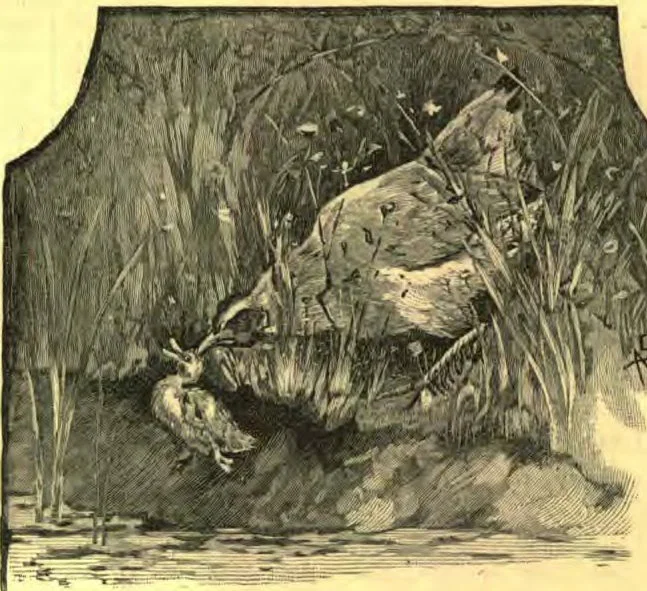
OLD Biddy walked forth from her nest in the grass, And saw something too ugly for her to let pass. “What is it?” she thought, with her head in the air. “O, now I remember! It’s a duck, I declare!” So, forthwith, she caught it by the back of its head, And tossed it about till it was near dead. Little Geoffrey, who saw it, rushed into the fray, Picked up little duckling, and drove Biddy away. “And now, Mrs. Biddy, just see what I’ll do, To punish and give a good lesson to you!” He took all the eggs she had laid in her nest, And put in some duck’s eggs, the freshest and best; “And now, Mrs. Biddy, when you’ve had the ill luck Instead of a chicken to hatch out a duck, We’ll see if it looks as ugly to you, As other hen’s ducklings now seem to do.”
So in Biddy’s warm nest, four weeks to a day, Right through the white walls the broad bills pecked away. And Biddy, good soul, lent all the aid that she could, As any good mother-hen in such a time would. And when they came out, of ducks there were nine, She gazed in delight! “Now these are all mine.” And she swelled in her pride, as if never before A young creature had knocked, or a hen opened the door.
Their feet were like paddles, their bills broad and wide; They waddled in walking, the nine by her side. They greedily shovelled the food in their pen, And yet she adored them, this ridiculous hen. When they took to the brook, and swam far away, She clucked, and she grieved, through the whole of the day. “They may be peculiar, these dear babies nine, But then, I adore them, because they are mine.”
—Mrs. C. C. Parsons.

A TALK ABOUT THE MOON AND STARS.

“See it wink!” So said tiny Cecile, who sat on the porch watching the evening star that had just appeared in the sky.
“No, it doesn’t wink,” replied her eight-year-old cousin, Enid; “it was you that winked.”
“No, it wasn’t I, either; the star winked. Now see how wide I hold my eyes open, and it winks just the same yet. You watch it, and see.”
But Enid was sure a star could not wink, any more than a lamp; and then it occurred to her that perhaps the light of the star flickered, as the blaze of a lamp does when the wind blows it. To make sure, she went to the open door, and asked her aunt, Cecile’s mamma, if the wind didn’t almost blow the stars out sometimes.
Aunt Altha told her the stars have too strong a light to be put out in such a way, but that something in the air gets between us and the stars, and makes them seem to flicker, just as though we should swing something rapidly before the lamp.
Enid went and sat down on the porch again, and tried to tell Cecile what she had learned. Then she watched the moon and star for a time, and after awhile she said, “Cecile, the moon looks like Aunt Altha’s big brass tray, doesn’t it?”
But Cecile exclaimed, “My! Mamma couldn’t carry many dishes on the old moon tray, could she?”
“Why not?”
“’Cause it’s so little. That would be just about big enough for us to play dinner with, wouldn’t it?”
“Why, Cecile! that’s a ’stremely big tray. It would cover your little table all over!”
Now Enid had appeared to her small cousin to know almost everything—nearly as much as mamma; but Cecile thought it very strange for her to say the moon was as large as her table, when she herself could see that it looked only a little larger than one of her plates. It was her turn now to refer to mamma; so she went to the door, where, with her face pressed against the screen, she inquired, “Mamma, is the moon as big as my table?”
Instead of answering, her mamma laid down the paper she had been reading, and went out onto the porch where the children were, asking, meanwhile, “What size do you think it is, my dear?”
“’Bout so big,” making a circle of her thumbs and first fingers.
“Why, Cecile! what a queer little girl you are!” That is what Enid said, she was so astonished that Cecile should think the moon so small.
Then mamma sat down with them, and said: “You remember that Cecile could scarcely see the kite that went so high in the air to-day, while Enid could see it easily. That is because of a slight difference in the shape of your eyes, which makes things far away seem smaller to Cecile than to Enid. But the moon is so very far away that it seems to all of us to be much smaller than it really is. You can scarcely think how very large it is.”
“Big as your brass tray?” queried Cecile, hesitatingly; for that seemed to her almost impossible.
“If it were only that large, we could not see it at all. You know that the boys’ kite was larger than that, but when it had gone the length of their string, you could scarcely see it. And the moon is much farther away than the kite was; it is farther away than Enid’s home—many, many times farther.”
The children had never been farther than where Enid’s papa and mamma lived, and that seemed a great distance to them. They were amazed that the moon should be still farther. Then Aunt Altha asked them how large they supposed it to be, in order for them to see it so far away.
Enid made a circle as large as her arms would make; but that was not large enough.
“Only think,” her auntie said; “if we were in a high place, so that the trees would not be in the way, could we see your house?”
Cecile thought they could, but Enid knew it was too far away; and auntie said, “Then the moon must be many times larger than your house, to be seen so much farther.”
“How big is it, Aunt Altha?”
“About one quarter as large round as this earth.”
“Why, Aunt Altha! that can’t be, ’cause then it would cover us all up, and we couldn’t see anything else!”
“If it were near us, it would; but I can hold my hand in front of you, and it doesn’t hinder your seeing other things, although it is larger than your eyes.”
“But, Aunt Altha, how big are the stars?”
“Many of them are much larger than the moon; but they are still farther away, so they look smaller. Some are larger than the earth.”
“Why, Aunt Altha!” exclaimed Enid, almost impatiently, “don’t you know there wouldn’t be room in the sky for but one, if they were bigger’n this world?”
“Well, let us see. We will take one of these stones for the world, and another for the moon, and others for the stars. Enid may place the earth stone in the middle of the porch, and Cecile may put the moon stone some distance away, and we will have the stars scattered all around the edge. Then you will see how there is room for all.”
Enid saw how it might be; still it was a great deal for her to believe; but after she went home, she asked her mamma about it, and she told her that all Aunt Altha had said was true.
MRS. ADA D. WELLMAN.

A DEER YARD.

When the cold comes on, and the snow begins to get deep, the deer commence to make their yard to live in during winter.
They make great paths through the snow for a large circuit, and by traveling over it in all directions, it gets trodden down hard, and makes a very good yard for them.
They browse on the bark of the moose-wood, red maple, and beech-trees. They first commence gnawing the bark at the bottom of the tree, and work upward as winter comes on, as far as they can reach.
They do not gnaw the bark off entirely around the tree. If they did, the tree would die; and it is said they seem to understand this, and leave enough of the bark to save the life of the tree. They also eat grass, shrubs, buds, and moss in the season when they can get them.
There are three species of the deer-kind of animals; the moose, deer, and caribou. The largest is the moose. Sometimes they are as large as the largest horses.
They have heavy, lofty horns, or antlers; these spread out in shape like the open fingers of the hand. They shed these horns once a year, usually in February. They add one new prong every year, beginning when two years old, so by counting the horns, you can tell how old a moose is. The horns are not shed all at one time, but come off one by one, as the moose rubs against the trees.
The moose is called the most noble animal of the forests. In the State of Maine, the white pine is called the finest and most noble of forest trees. So the moose and the pine-tree is on the shield in the coat of arms, as the great seal of the State of Maine.—Our Little Men and Women.
Continue reading: A LESSON IN PUNCTUATION