[We are very glad to be able to present the following article from the pen of one well known in astronomical circles. The author has been for many years the director of Chabot Observatory, Oakland, has conducted solar eclipse expeditions to Japan, India, and Georgia, and is in solar photography an expert. He is a careful observer, and his article is dependable.—Ed. S. of T.]
SO much of unworth is being published about Halley's comet, that many people do not know what to believe. I would not blame them if they said just what the psalmist says that he said in Ps. 116:11. It is a little unfortunate that some are getting quite nervous about it. I read an editorial that had so many misstatements in it that I was struck with admiration. There were twenty-three statements, supposed to be facts, of which nineteen were untrue, uncertain, or sheer nonsense.
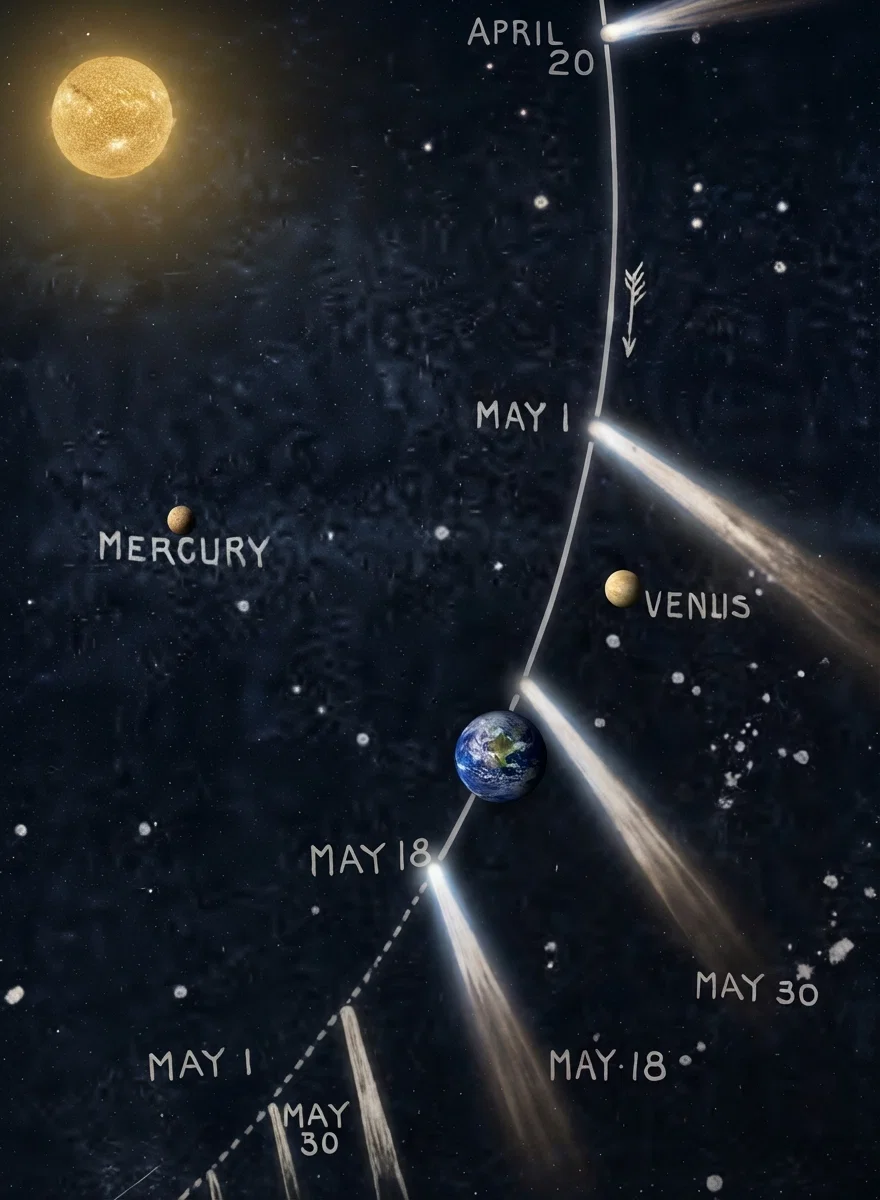
It is not absolutely certain, nor anywhere near certain, that the earth will pass through the tail of the comet. Personally I want to have it happen, but am fully prepared for a big disappointment. IF the comet's tail is pointed directly AWAY from the sun, AS THE TAILS OF COMETS SELDOM ARE, and IF the tail is long enough to reach beyond the earth, then the earth will certainly pass through the tail of the comet on the afternoon and evening of May 18. But if the tail is curved, as the tails of comets USUALLY ARE, it is easily possible that the earth will pass UNDER it, several hours, or even a day or two, AFTER the 18th. I have not seen this possibility (perhaps I should say probability) pointed out before.
If the tail is too short to span the gulf of 15,000,000 miles between the earth and the comet at that time, why, of course nothing can happen. The tail may easily be much longer than is necessary, and may just as easily be too short. Which will it be? Astronomers can not tell how long any comet's tail will be at any time. Comets have been seen to break up under the very eyes of astronomers. The critical time in the history of a comet, seemingly, is when it is near the sun; and there are not a few astronomers who fear that Halley's comet has seen its best days; and they are not very enthusiastic about its present appearance, altho the conditions are considered unusually favorable, and in some respects extremely so, for a big display.
It should be understood that Halley's comet is not a GREAT, but only a BIG comet. It is true that it appeared as a terrifying object in 1066 and 1456, but at other times it has been only a big or fair-sized comet, while at yet other times not even that. Its appearance, size, and shape depend greatly on the relative positions and distances of the comet, earth, and sun. At this apparition, as remarked before, the conditions are exceptionally good for a fine display of tail, so that, if the comet does its full part, we may expect to see something worth remembering.
The great fame of this comet does not rest upon its bigness, like the comet of 1858, and others, but upon the fact that it was the first comet known to be "periodic." That is, it was the first comet known to travel around the sun again and again, in nearly regular periods of time; and Halley's name is associated with it because it was through his great labors that this fact was discovered. Until his time, comets were considered, even by astronomers, to be only chance visitors, passing near us for the first and the only time. Halley predicted this comet's return, at a certain time long after his death. His prediction came true, and this comet has ever since been known by his name.
The English astronomers Hind, Cowell, and Crommelin have added greatly to the comet's fame and their own by tracing its history backward mathematically and otherwise to the year 250 B. C.! The latter two gentlemen have received the praise and admiration of astronomers for predicting its present perihelion passage (its nearest point to the sun) within three days. This can be appreciated all the more when we remember that it has been invisible since 1835 and that it is about two years ahead of its average time. This is its twenty-ninth appearance, but it seems to be a hopeless task to trace it farther back. It may very well be that it came into our system at that time.
HALLEY'S COMET, THE SUN, AND THE EARTH The sun is the large sphere; the earth the small sphere not named.
A recent writer, with airy flippancy, says he "can pack a comet's tail in a trunk;" another, that he "can carry it in his hat!" Neither gave the size of the comet's tail, the trunk, or the hat. No one KNOWS much about the tail of a comet, but the speculations and guesswork about them would fill many trunks. It is safe to say, however, that the tail contains very little solid matter; for stars that would completely disappear when near the horizon, on account of our earth's atmosphere, have been seen DISTINCTLY shining through a comet's tail where it was a million miles or more in thickness. The tail, taken generally, is perhaps more nearly a vacuum than can be produced by the best air-pumps.
A great geologist, the greatest of his time, instead of naming a certain definite period of time as the age of the earth, as many smaller men have done, contented himself with simply saying, "The time was long," and let it go at that. Why not say the same of the matter in a comet's tail?—the amount is small. When we go beyond that, in our present state of knowledge, it is guesswork, not science.
I was once authorized to ask my friend the great astronomer Barnard, to lecture before a certain body. He readily consented, asking what he should take for his subject. As he had, at that time, discovered more comets than any other living astronomer, and had studied and written much about them, and, I must confess, with the hope of learning myself about these perplexing bodies, I suggested comets. "But I don't know anything about comets," said Barnard; and he—wisely, I think—chose another subject.
The present apparition of Halley's comet is a practical demonstration of the fact that the mathematical astronomer can, when he has the reliable observations that can be furnished by the skilful observer, pursue a comet to the uttermost confines of our system; and altho it may be invisible for a thousand or thousands of years, and travel with inconceivable speed, it is never for even a single hour beyond his ken. Yet no astronomer can answer this simple question: "What is a comet?" They are among the greatest, if they are not THE GREATEST puzzles with which astronomers have to deal. Changes take place within a day that make the comet almost unrecognizable. Some have completely disappeared, and there is an actual list of "lost comets!" A whole issue of the SIGNS could be filled with the remarkable doings of comets.
The spectroscope, an instrument as wonderful as the telescope, has given us valuable information about the elements, or at least some of them, of which comets are composed. Cyanogen, which is one of them, was discovered in Halley's comet by Frost. Now, while the spectroscope tells us that there is such and such a gas or metal in a comet, it does NOT tell us in what proportion, or how much. Mix a quart of sea water with a barrel of pure water; dip a piece of paper in it, and let it dry; then burn the paper before the spectroscope, and you will detect the presence of salt as certainly as if you were burning salt by the pound.
I know nothing of chemistry, but am told that cyanogen gas is deadly; but, as one may see from the above illustration, the fact that cyanogen is present, does not prove that it is in such quantity as to be dangerous. Our fifty or one hundred miles of atmosphere will give us perfect protection in any event.
The following quoted from Chambers' "The Story of the Comets," page 190, gives still another view of this interesting point: "The important part played by cyanogen in the spectra of comets, considered in conjunction with solar and laboratory observations of the cyanogen spectrum, led Newhall to propound the following interesting questions concerning the nature and origin of cometary radiations: 'Is it not possible that the hydrocarbons, nitrocarbons, etc., which11seem to be evidenced by the spectra of all comets, are always present in circumsolar space, and rendered incandescent by some process connected either with the motion of the solid parts (including dust) of the head of the comet through vapors, or with the emission of some influence from the comet's head?' Are we to say that all comets, wherever they may come from in the universe, and whatever their main material may be, always bring with them the cyanogen and hydrocarbons which give them luminosity? Or is it not more rational to say that the spectra of all comets are approximately similar, because they always find the same vapors spread in their path as they approach the sun, and can only elicit the spectra of the vapors?'"
In other words, the author of this interesting theory believes there is cyanogen all around us, and that the comet merely makes it visible. If this is true, then the earth has been passing through this much dreaded cyanogen since the morning stars sang together! Moreover, if it is only the comet's head that renders the vapors incandescent, then the danger, if any, would be some fifteen million miles from the earth, for that is about the distance the head will be from the earth May 18, when the earth, sun, and comet are in a straight line.
There is some reason for believing the earth passed through part of the tail of the great comet in 1861, on Sunday, June 30, near sundown. A certain vicar thought it unusually dark, and ordered the pulpit candles lighted; and Sir Robert Ball, the eminent and witty Irish astronomer, says that the burning of those candles "was the only loss to the earth!"
It seems, then, that there is nothing to fear, altho, if the comet makes a fine display in the middle of May, as every astronomer fervently hopes it will, I feel safe in predicting the biggest prayer-meeting, at that time, in the history of the world.
The distance of the comet from the earth for the following dates is calculated from the Ephemeris of Mr. Crommelin:
April 20
111,900,000 miles
" 28
84,900,000 "
May 6
55,700,000 "
" 10
40,900,000 "
" 12
33,800,000 "
" 14
26,900,000 "
" 16
20,800,000 "
" 18
16,100,000 "
" 20
14,300,000 "
" 24
20,700,000 "
" 30
40,600,000 "
It will be observed that the earth and comet are nearer together after they have been in a straight line, than at that particular time. The comet actually passes only about 6,000,000 miles from where the earth will be in the first week in May. Its nearest approach to the sun (or perihelion) will be on April 19—about 58,000,000 of miles. Its greatest distance, 3,300,000,000 miles, will be reached in about thirty-eight years.
From April 19 to May 16 the comet and the earth will approach each other at the rate of 3,500,000 miles a day; while near the end of May they will recede from each other at about the same rate. After the 19th of April, until it reaches the other end of its path—far beyond Neptune—it will constantly diminish its speed.
If one of the planets were traveling in the place of the comet, astronomers could tell with certainty just about how bright it would appear to us, but a comet is so uncertain, in nearly everything except its position and motion, that the following theoretically calculated brightness must not be taken as trustworthy, but only roughly approximate:
Calling the brightness on April 20 25, on May 1 it should be (theoretically) 50, on May 6 76, on May 10 125, on the 15th 324, on the 16th 410, on the 19th 696, on the 20th about the same, and by the 25th it will diminish to 185. It is possible that the above may prove to be reasonably correct.
I expect, in a clear sky, we will be able to see the comet without a telescope by May 1, or before. From May 1 to the 15th it will rise about two hours before the sun. The observer's latitude has something to do with it; and the SIGNS being a great traveler, I will not particularize, except to say that in certain parts of the country it will rise nearly two and one half hours before the sun. About one hour must be taken off this for the strong light of the dawn.
It will rise, during all this time, near where the sun rises, the end of the tail rising earlier—how much earlier depends upon the angle, which is known, and is variable; and the length of the tail, which can not be predicted.
Between the 15th and the 18th, whether it can be seen or not depends upon its brightness, and the same may be said from the 18th to the 20th. On the 18th it will change to an evening object, setting AFTER the sun, going down tail pointing east and up, something like the big comet we saw last January; but I hope to see Halley's as a more conspicuous object than comet 1910a. On the 20th it will set about an hour after the sun, and nearly four hours later toward the end of the month; but it will be rapidly receding, becoming fainter every day.
April 13.
American Bible Society Endowment
By Editor
The American Bible Society has been able to raise $500,000 to meet the offer of Mrs. Russel Sage of a similar amount, the whole to be used as an endowment for the society. It ought to be a cause of rejoicing on the part of all Bible lovers that this has been raised. Surely if there are any organizations on earth which have done good work for God and the Gospel of our Lord Jesus Christ, the Bible societies have been among them. They have opened great gates, have broken down mighty bars, and have carried the Word of God through trouble and persecution to those who were in darkness. May God's blessing rest upon them.
One of the worst things in connection with the New York Stock Exchange gambling, is what are called "wash sales." It is said that 60 to 80 per cent of the transactions on the Stock Exchange are wash sales, in which there is no real sale at all; in which there are bogus sales for the purpose of creating a false idea of prices. In a word, the purpose is to swindle somebody else. The New York Stock Exchange has as one of the articles in its constitution, "To maintain high standards of commercial honor and integrity among its members, and to promote and inculcate just and equitable principles of trade and business." Surely that is high-sounding, and looks well; but it certainly does not tally with the questionable dealings constantly manifest. (One Eastern paper remarks: "Confidence men who operate elsewhere than in Wall Street are pursued by law; usury elsewhere is prohibited; gambling contracts elsewhere are not enforceable in the courts. Why should they be in Wall Street?")
Leslie M. Shaw, former Secretary of the Treasury, says that Japan can — he does not say that she will, but can — put 200,000 soldiers in Hawaii in thirty days without firing a shot; that Japan can land a fleet at Seattle in a foggy day without so much as causing the barking of a dog; that she can march her troops down the Coast and take every excuse for fortifications which we have on the Coast without opposition, for not one of the forts is protected from the rear; and further, that if every powder-mill in the United States was to make powder twenty-four hours per day for thirty days, the product would last our present navy but two hours. He further declares that these are not state secrets; everybody knows them except ourselves, and still we go on building battle-ships; but battle-ships without colliers and transports are absolutely worthless. He declares that he did not predict war, as he was wrongly reported, but he did predict what we would wake up to in case of war.
Sunday Seventh Day.—A Springfield (Ore.) paper gives a sample account of what comes before many town councils. It reads: "Moved by Rivett, and seconded by Kestley, that the town attorney be instructed to draft an ordinance entitled 'Sunday Closing,' wherein card games, pool and billiard-rooms, baseball, and bowling-alleys, shooting-galleries, near beer joints, and electric theaters be prohibited running on the seventh day of the week, commonly known as Sunday." The Springfield Council of Oregon better read up from the calendars.
A Portland (Oregon) man is said to have discovered the lost Egyptian art of preserving vegetable and animal matter indefinitely. He has taken roses withered for months, and brought them back to their original freshness and color. Vegetables were similarly demonstrated. Corn on the cob a year old was restored by being placed in water over night, so that it not only looked but tasted fresh; and he contends that the process is so simple that a child may apply it to the product which is to be preserved, when the secret is learned.
A news item in the New York "Evening Telegram" of March 23 declares that to win a prize of $25.00 in a Marathon dance, four girls between the ages of 17 and 18 collapsed after an hour and a half. One of them had to be taken home in an automobile. Sixteen participated; and others kept on in their giddy whirl while their companions were lying helpless on the floor. What a senseless thing it was! If such exertion as this had been put forth in any useful way it would have been called insanity.
The Full Loaf.—A San Francisco supervisor is making a strong struggle for pure and full weight bread. A one-pound loaf is the standard, but the bill permits larger and smaller. We hope the measure will carry.
Polonium is said to have about 5,000 times greater radio-activity than radium. It takes several tons of pitchblende to obtain only one tenth of a milligram, equal to .0154 of a grain.
The pope has bestowed his blessing upon Mr. John D. Rockefeller on account of his princely gifts.
The Next Decade.
By Editor
Mr. John Temple Graves, the editorial correspondent of the Examiner in Washington, declares that there lies in the next decade either universal peace or universal war. He says: "There are thoughtful men at the capital, as well as at the metropolis, who believe that the issues of the next decade hold for the world either universal peace or universal war. Forces of tremendous moment are moving powerfully toward each possibility, side by side. The white banner of peace and the red flag of carnage are struggling to the front of human interest as the arbiters of issues and of life to the nations."
What it will be is clearly foretold in the Word of God. That declares that the cry of peace will issue in disappointment, and that the preparation for war will issue in world-wide strife; and Mr. Temple's article would seem to be in harmony with this, for he says: "The pity of it is, and the danger is, that it is always possible to arouse the world by rumors or threats of war. There is in the universe no theme so noble and inspiring as universal peace, and yet its evangel scarcely quickens a pulse of the public or awakens a response from those who hold the theme in tender reverence."
Tuberculosis Sunday
By Editor
Tuberculosis Sunday.—April 24 is set apart by the National Association for the Study and Prevention of Tuberculosis, as "Tuberculosis Sunday," which means of course anti-tuberculosis Sunday, in which ministers all over the land are asked to do all in their power to enlighten people regarding the great scourge. We wish them Godspeed in their mission. But we hope also that there will be remembered the greater scourge even than tuberculosis. The latter is to a large extent preventable and curable; but the other plague is absolutely incurable by men, and can be remedied only by faith in Jesus Christ—that plague is the plague of sin.
Missions and the New Time in Non-Christian Lands
ALL this stirring of the depths in the great non-Christian lands, of which the news despatches are ever telling us, is full of meaning in the missionary advance.
Everywhere through heathen lands there is presented to our vision the view of open doors, for the moment thrown more widely open than ever before, but threatening to fly shut at any time. Never was there a situation more urgently appealing for earnest and instant action on the part of those who know the Gospel message. The awakening of Asia has passed into hackneyed phrase within the last few years, but it is a tremendous fact always with us in facing the missionary problem. Not long since the London Spectator, in a serious article on the situation, said:
"The fact is often disputed, but there undoubtedly is a comity of Asia which is at least as operative as the comity of Europe, or it is possible that there is an emotion akin to the one which produced the crusades, and that, tho not so directly connected with any religious impulse, still is fatal to quiescence, and is sweeping through Asia from Nagasaki to the Bosphorus, stirring up races which for ages have slept the sleep of content, but are now determined to advance upon some path, mental or physical, which they think open."
Who can fail to see in this sudden rousing of the great continent of ancient heathenism the fulfilment of one of the signs given by Joel the prophet, by which men were to know when the day of the Lord was near at hand?
"Proclaim ye this among the Gentiles; Prepare war, wake up the mighty men: . . . let the weak say, I am strong. . . . Let the heathen be wakened. . . . Multitudes, multitudes in the valley of decision [or cutting off]: for the day of the Lord is near in the valley of decision."
Swatow (China) Rowboats
And history and prophecy alike forbid the popular idea that somehow out of this stirring of new life among the ancient peoples the world is to glide grandly into millennial peace. The new time does not mean this. But in it all we may see the world hastening on to the final crisis, and gather inspiration for more earnest efforts than ever before to evangelize these peoples.
In the London Contemporary Review of last September, Mr. Newton Marshall summed up the Asiatic question in the forceful words:
"The whole of Asia is in the throes of re-birth. At last we may see these three—the yellow race, the Indian race, and the Arab-Persian Mohammedan race. And all that is, working for the Armageddon."
Now in this little time of peace is the auspicious hour to reach the ears of all these races with the message of salvation. The century of missions has prepared the way for a sharp, short work in our time. We hardly appreciate what the last few years have wrought, and I, for one, like to have it told me again and again. For instance, Dr. Selmon, editor of our Chinese paper, Shi Chao Yuch Pao (The Signs of the Times), speaking of one province of China, Honan, recently told us:
Farm Ox-Cart in Shang Tsai, China
"Previous to 1900, Honan possessed not a single foot of railroad; and only a few of the larger cities had post-offices. But now there is a trunk line from north to south and another from east to west; and not a city or town of importance in the province is without a post-office. God is surely preparing the way for us; for how could we send forth the truth-bearing page without post-offices and post-roads? While a few years ago in one city of two hundred thousand not more than three newspapers were subscribed for, to-day in this same city, newspapers are read by every merchant and educated man."
Then speaking of the educational decree of 1901, he adds:
"By this one decree an educational system was abolished that had been in vogue for millennia, and several millions of China's brightest young men, who were in the schools of the old order, with their faces toward the dead past, executed a 'Right about, face!' and are now looking toward a living future."
And he tells of seeing workmen tumbling idols out of the temples, and putting in tables and chairs and the equipment for a modern school. Thousands of temples, the latest news informs us, have been turned into schools.
Never a decade of modern history brought such appeals for missionary activity as this first decade of the twentieth century; and so far as China is concerned, an ominous note comes to us in the words just spoken by the retiring Chinese minister to Germany. Announcing a change in China's policy regarding militarism, he shows how quickly the newly awakened life is to be turned into channels that will add ever-increasing difficulties to the country's evangelization. He said:
"If we make all the available men join the military, we have such an enormous population—some 400,000,000—that we shall overshadow all other armed nations. The details of the plan have not been worked out, but we propose to make our young men soldiers, not only through drill, but by education. They must learn what a shame it is for the most ancient, and in population the greatest, nation on earth to be so weak."
It is almost an echo of the prophet's words, "Let the weak say, I am strong."
Again, the great Indian race is passing through similar evolution. It was of India's age-long indifference to great world movements that the poet wrote:
"The East bowed low in earnest thought,
In silent, deep disdain;
She heard their legions thunder past,
Then bowed in thought again."
But this is not the India of 1910 and onward. And while the new time and the breaking away from the bondage of old customs presents the golden opportunity for missionary work, we know well what lies but a little way beyond. Our missionaries in India, north, south, east, and west, appeal to our Mission Board as never before for the reinforcements of men and means to take advantage of the golden opportunity. So it is with every society.
At the recent Student Volunteer Convention in Rochester, Mr. George Sherwood Eddy, fresh from India, gave a view of the situation so informing and up-to-date that I must quote three paragraphs:
"The most encouraging thing I have seen in India is the present unrest. While this has been partially caused by the partition of Bengal and Japan's conquest of Asia, its real cause lies deeper. That cause is found in the conflict of the new civilization with the old, the work of the leaven of a new principle, the upheaving of a new life. Five causes have led up to this; namely, Western education, the natural antipathy for foreign rulers, the poverty of the masses leading to natural dissatisfaction, the agitation of the educated Indians for self-government, and the dissatisfaction of the people with the old order, both political and religious.13"England is hated in India to-day as the United States is hated in the Philippines, and Japan is in Korea. But common honesty demands that recognition be given the work which she has done for the country. England has given to India 30,000 miles of railways, 50,000 more miles of telegraph lines, 25,000 miles of irrigating canals reclaiming twenty million acres of waste lands, more than 50,000 miles of macadamized roads, a splendid educational system, with five universities, 145 colleges, and 5,700,000 pupils to-day, a splendid medical work with 2,500 hospitals and dispensaries treating 22,000,000 of patients last year. Further, in spite of the poverty of India, under British rule the trade of the empire has increased tenfold in sixty years.
"But the marvelous thing in India is the awakening of that empire; an awakening, first within the church, and second, without the church in the leavening of the life of the people. It is an awakening involving the reaction of Christianity upon the non-Christian religions and upon the whole nation. . . . While during the last decade the population has increased 2½ per cent, the Parsees have gained 4 per cent, the Jews 6 per cent, the Mohammedans 8 per cent, while the Protestant native Christians increased 63 per cent, more than twenty times as fast as the population."
Truly the signs of the times in India are full of significance from the point of view of missions.
A few words must sum up Africa and the new time. A recent writer in the World's Work, Mr. C. M. Keyes, says of Central Africa:
"Where Stanley blazed the way, the cohorts of civilization have followed closely. The very cannibals who hurled against the canoes of the intrepid explorer clouds of arrows, are to-day themselves the pilots, the firemen, the engineers of the river steamboats."
Now the railways, south and east and west, land our missionaries at points which formerly represented weeks or months of weary travel.
And the inroad that Mohammedanism is making in the Dark Continent, throwing a blighting influence over tribe after tribe, challenges everywhere the vanguard of the missionary advance. Without a doubt the recent events in Africa and Persia will consolidate and strengthen the Moslem races, for whose evangelization scarcely anything has as yet been done. At the same time the progress toward constitutional government swings open a door hitherto but slightly ajar.
From every part of the great non-Christian lands, with over half the population of the world, the voice of current events sounds like a trumpet in our ears, "Now, just now, is the time."
Notes and News
By Editor
BROTHER JAMES COCHRAN sends us this item: "Mrs. Lulu Wightman closed a very interesting series of meetings in the Kansas City church, Sunday evening, March 20, beginning early in the winter. The attendance was large from the beginning. The last night of the meeting, from seventy-five to one hundred were turned away, not able to get even standing room. As a result of the meeting thirteen, all adults, accepted the truth. Other cases are hopeful."
ELDER P. G. STANLEY, president of the Cumberland Conference, organized a church at Athens, Tenn., Sabbath, February 19. On Sunday, $40 was raised by the organized company to purchase chairs for their place of meeting.
BROTHER MATT. J. ALLEN writes from Simcoe, Ontario, Canada, that seventeen have accepted the truth, and that others are interested.
BROTHER W. H. WILD, of Hinsdale, Ill., writes that if any one will send him 25 cents only, he will send them his picture "Beautiful Zion," and a beautiful lithograph, "The Lord's Prayer and Ten Commandments," in ten colors.
The Prospectus of the "Colegio Adventista del Plata," at Entre Rios, Argentina, has come to our table. It is a neat college calendar, and the school it represents will be a great factor in that field. The principal of the school is Prof. Walton C. John.
—★—
Making Home Happy
These three books by Mrs. L. D. Avery-Stuttle furnish to the parent a much-needed help in the instruction and entertainment of their children
Making Home Happy
Pictures before the reader in interesting story form the relations that should exist and the lines of influence that should be guarded and cultivated in every home. (200 pp.)
Making Home Peaceful
Is the sequel to the above, and every one reading the first book will want to learn more about "Deacon Beardsley's" family, and how an unhappy home was made peaceful. (227 pp.)
Those Bible Readings
While especially suited to the needs of the young, there is an attractiveness in the arrangement and presentation of these readings that will hold the interest of all, old and young. (206 pp.)
These books are beautifully bound and may be obtained singly at 75 cents each, or the entire set of three for $2.00.
Pacific Press Publishing Assn.
Mountain View, California
Portland, Ore. Regina, Sask., Can. Kansas City, Mo.
Wanted
A CONTINUOUS supply of SIGNS OF THE TIMES, Watchman, Life and Health, etc., also foreign publications, for missionary work. Address Mr. John Schick, Barberton, Ohio.
CLEAN copies of the Youth's Instructor, SIGNS OF THE TIMES, Our Little Friend, or other doctrinal or health literature, for the use of school missionary society. Address W. E. Whitmore, Atwater, Cal.
Two New Tracts
By Editor
The Bible or Tradition? A review of Dr. Torrey on the Sabbath. Revised and enlarged edition. 32 pages, B. S. L., 193. Price 2 cents.
Simple Treatments for Common Ailments: Illustrated edition of the popular tract by Dr. Edwards on this topic. 24 pages, B. S. L., 201. Price 1½ cents.
Address the publishers of this paper.
For Sale
Nice home near Lodi, Cal., 11 acres Tokay vineyard, family orchard, new five-room house, bath, tank, windmill, barn, sheds, chicken houses, acetylene gas, water piped all over the place; church and school privileges at the Western Normal Institute. Easy terms. Also 16 acres orchard, mostly peaches. Work all done on place. Good buildings. Address Owner, Box 119, Acampo, Cal.
IN THREE DAYS
SAN FRANCISCO
Overland Limited
TAKES YOU
To Chicago
ACROSS GREAT SALT LAKE
—AND—
HIGH SIERRA BY DAYLIGHT
Luxurious High-class Equipment
Electric Lighted Throughout
Pullman Drawing-room
Stateroom
Vestibuled Sleeping Cars
Careful and Attentive Dining Service
Parlor Observation Car with Library and Cafe
Ladies' Reading Room
Gentlemen's Smoking Room
Daily News Bulletins
Latest Papers and Magazines