The Youth’s Instructor, Vol. LIII, No. 16

Feeding upon the Light

The Youth’s Instructor

April 18, 1905

Review and Herald Publishing Assn. · Washington, D. C. · April 18, 1905

Feeding upon the Light
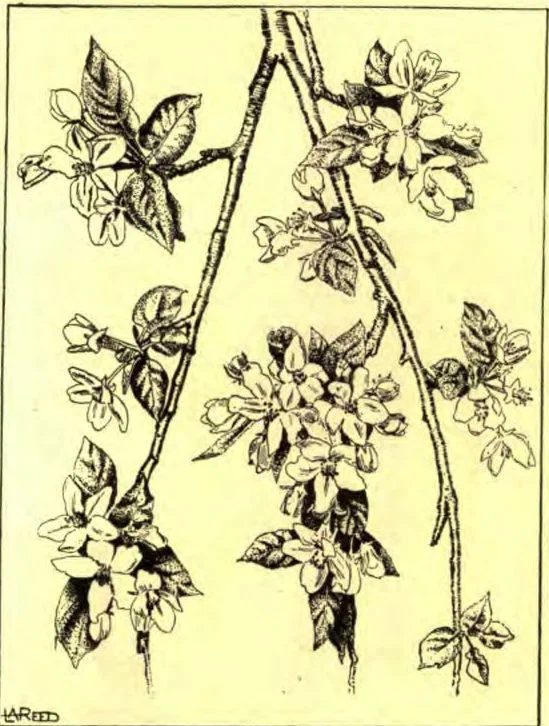
THROUGH the long days of winter the trees look dead. Their naked branches stand out dark and bare against the winter sky. But in the early days of spring all the trees and shrubs, the plants and vines, suddenly awake from sleep. The leaves burst from their buds. Green growth springs up on all sides. The flowers blossom. What has wrought the change?
Ah, the sunlight has been pouring forth its increased energy upon the earth, and all living things respond to its kindly impulse. Life responds to the light.
The leaves will wake from sleep only when light calls. The flowers will burst their bonds only when light energizes them.
Life responds to light. At the call of light, life answers.
Hugh MacMillan has said something beautiful upon this subject:—
“A beautiful little daisy grows by the side of a path in the outskirts of a large city. It follows with its golden eye all day the march of the sun through the heavens. Like a miniature sun, it expands its white, luminous petals, and revolves in its little orbit on earth as its great prototype revolves in its magnificent orbit on high. When the sun sets, the daisy closes its little eye, and sinks into sleep.
“I have seen the lamplighter come and light the gas lamp beside it, and its broad yellow gleam has fallen across the folded head of the little flower buried among its leaves; but it awoke no response. I have seen, later in the evening, the moon rising over it, and sending down a flood of brilliant silvery rays upon the spot where it grew; but it still remained shut up in its emerald hood. Later in the night, the whole face of the sky sparkled with stars; but to the music of the spheres and the witching spell of the starbeams the little daisy remained insensible. The lights of the earth and the glories of heaven—lamplight, moonlight, starlight—allured it to open its bosom and bask in their smiles, but all in vain.
“And so it remained all night, until the sun rose above the horizon in the early morning; and when the first warm sunbeams fell upon its head, it unfolded at once its pearly rays, and opened its golden heart; and as long as the sun shone, without a cloud to obscure its rays, it confessed the sweetness and potency of the solar presence, and continued open until the sun set.
“And why was this?—Because it found the sunshine alone the stimulus of its vital action,—the food which it assimilated, and by means of which it was able to grow the bright colors which enliven it, and all that made it what it was. The light of the sun was its life. Neither lamplight, nor moonlight, nor starlight contained the principles essential to its existence; and therefore it acknowledged them not.
“That daisy read me a lesson which it would be my highest happiness to learn and practise. What it does will-lessly and unconsciously, I should do willingly and consciously. ‘Whom have I in heaven but Thee? and there is none upon earth that I desire beside thee.’ God alone is conatural with my spirit; all influences that own him not are foreign and uncongenial; they have no true relation to my higher being. The True Light, that lighteth every man that cometh into the world, is alone the element of life.
“Let looking to Jesus, then, be the business of my life, while I run with patience the race set before me, that my face may be always lightened. Let me with open eyes and open heart, behold his glory, that I may be changed into the same image, and be, like the daisy, a miniature of the Sun of Righteousness.”
And “we all, with open face beholding as in a glass the glory of the Lord, are changed into the same image from glory to glory, even as by the Spirit of the Lord.”
But the great characteristic of life is growth; and growth is the building, or storing-up, process. The plant, living in the sunlight, grows; that is, stores up light and heat. And the longer it continues to grow, the more it stores. The mushroom grows in a single night; it has but paltry store of light and heat, and is almost worthless as fuel. The oak grows for a hundred years; through a hundred years it stores within itself light and heat: it is excellent fuel. And coal, the vegetable growth of ages past, is still better fuel; for it is concentrated, crystallized sunlight.
It is therefore plain that the more light appropriated, the more complete and full is the life. A little light drunk in means but a little of life; but much light appropriated means much life. And fulness of light everlastingly and fully appropriated is a full life and everlasting life. The mushroom appropriates but little light; it grows in a single night: it appropriates some light, not much. Its life is measured by the amount of light which it has appropriated, and that light was the few rays that reached it through a single night. The tree, however, which for years appropriates light, has a life that is measured by scores of years.
Suppose your life to be measured by a few rays of light that have sifted down through the shadows of night; would your life thus be a full life? Would it be an unending life? Thus living, would you know anything of the wondrous glory of God’s undimmed light, or the overflowing fulness of his life?
O the little of his fulness that satisfies the souls of men! Only a few rays sifting down through the blackness of the night! Only a few trembling beams of star or moon or lingerings of the day! True, the soul must take a few rays, for no light at all means no life at all; but as to appropriating the fulness of the light fully and forever, that some think unnecessary. Therefore, like the mushroom, this starved soul grows through one night, and, like the mushroom, it shrivels up in the glory of the day, and is no more. The place that knew it once, knows it no more forever! Fit ending for a mushroom, but what sort of ending for a human soul?
Give us rather to live in God’s unending light, and thus to know the fulness of his unending life; to grow like a cedar in Lebanon, to be of God’s own planting, “trees of righteousness,” trees “planted by the rivers of waters,” whose fruit never fails, and whose leaf never fades; to bathe in the effulgent shining of his glory, where there is no darkness, no chill, no death!
There, kissed by the balmy breezes from the land of the blessed; there amid the radiant beauty of the flowers, and the enrapturing melody of the birds, drinking in his everlasting goodness and his soul-enriching glory—this, O brother, is our everlasting portion.
Shall we be satisfied with less?
L. A. REED.

Power of a New Sun Motor

A PORTUGUESE inventor and scientist has constructed a sun motor, by which he has found that there is no substance, not even asbestos, that will not fuse in his wonderful furnace, into which the concentrated rays are thrown by the aid of over six thousand mirrors. Manganese, also, which is the hardest known substance to melt, runs almost like water, when this heat is applied to it. Iron, instead of melting and running in a liquid state, as it does in a blast furnace, shrivels and becomes like pasteboard burned in the fire.
The inventor believes he has established that the rays from the sun are electrical, and that the new motor has opened a window in nature’s workhouse which has been closed up to this time. In chemistry especially the machine has possibilities calculated to lead to important results, while in the field of astronomy much will be attained. By means of special appliances the power from the sun may be applied to the soil in such a way as to increase the fertility.
The inventor is confident that he will be able to displace steam with his motor in countries like those of South America, the Sahara Desert, California, and certain parts of Texas, where the sun shines nearly all the time.
The rays are caught in a great, shield-shaped contrivance of mirrors. This is so regulated by a delicate clock-work mechanism that it always faces the sun. Directly in front of the reflector is the sun furnace, or retort, lined with fire-brick, which gathers the concentrated rays with intense heat. Even the fire-bricks are unable to withstand the terrific power for any great length of time. The temperature of the furnace is higher than any ever recorded by man.—Young People’s Weekly.

Bloom

Blossoms, in the joyous spring, Breathe their fragrance to their King. His are all the forest bowers, But the joy of them is ours.
B. F. M. Sours.

How Gold-leaf Is Made

THE art of the gold-beater is one of the oldest handicrafts in the world, and among those which have changed least. Much of the decoration of Solomon’s temple is believed to have been covered with gold-leaf, hammered to the requisite thinness by hand, as it is to-day.
The gold-beater receives his material not in the form of the sixty-pennyweight ingot in which it is cast, but in the form of a ribbon about an inch wide and twenty-four feet long.
This ribbon is first cut into two hundred squares, and placed in the “cutch,” which is a pile of square pieces of a peculiar paper, part animal and part vegetable in composition, the preparation of which is a secret. The best cutches are made in London. A square of gold is placed between each two leaves, and the whole mass is ready for the first beating.
This is done with an iron hammer, weighing from twelve to seventeen pounds, while the cutch rests upon a granite block, which is supported by a heavy wooden post.
Under the heavy, measured blows of the hammer the sheets of gold begin to stretch or expand until in half or three quarters of an hour, they have reached the edges of the cutch. They are then removed, and with a thin strip of bamboo are cut into quarters, so that the two hundred pieces become eight hundred. Next comes the “shoder,” a collection of eight hundred pieces of skin, four inches square, made from the intestines of cattle. As in the cutch, each piece of gold is placed between two leaves of skin, and bands of parchment or vellum are slipped over the whole pile, to keep it together.
Another beating, this time with a hammer weighing from eight to ten pounds, now follows. This takes about an hour, during which the sheets of gold are all the time perceptibly growing thinner.
The last stage is the “mold,” which, like the cutch and the shoder, is composed of alternate leaves of gold and skin; but the mold is about five inches square and made up of gold-beater’s skin. The preparation of this is a jealously guarded trade secret.
The skin, like that in the shoder, is made from the intestines of the ox. It is translucent, and not unlike rawhide in color. Although it will stand continuous beating without breaking, it will tear like a sheet of thin paper. The making of a single mold requires the intestines of five hundred bullocks. Between each two beatings the skin is rubbed with baked and pulverized gypsum.
A mold contains one thousand sheets. After the second beating the workman takes from the shoder a single leaf of gold at a time, handling it with bamboo pinchers, and, when necessary, smoothing it with a rabbit’s foot. With the strip of bamboo he cuts each sheet into quarters again, so that the original two hundred have now become three thousand two hundred. One shoder, therefore, contains more than enough gold to fill three molds.
The final beating, in the mold, is done with a seven-pound hammer, and requires from three to four hours. By this time the gold-leaf should have expanded again to the edge of the skins, and should be of the requisite thinness, which is determined by holding it up to the light. If it transmits green rays, it is done, and will measure about one two-hundred-and-eighty-thousandth of an inch in thickness.
The hammers used in beating gold are slightly convex on the face. The art of the workman consists in so striking that the gold will always be thinnest in the center. He must pound with evenness all over the square, in order that the sheets of gold may expand without losing their form; but at the same time he must keep the thickest part near the edges, so that when the sheets are finally trimmed to size, the thicker portions may fall in the waste, to be recast. No machinery has ever been devised which will do this successfully.
The tools of the craft are interesting and peculiar. The rabbit’s foot is exceedingly soft, and just oily enough to prevent the gold from sticking, and the bamboo pliers and cutting-slips are the only things with which it is possible to do this delicate work. The gold does not adhere to the fibers of the reed as it does to steel.
The gold-beater performs all his work standing. The use of the heavy hammers in such continuous pounding would, one would think, impose an almost intolerable strain upon the hands and arms. The men say, however, that their arms never ache. The only place where “it catches them” is in the bend of the knee.
The lack of strain upon the arms is accounted for by the fact that the hammer rebounds. It is astonishing, but by no means a rare thing to see a gold-beater change hands while the hammer is in the air, and without losing a stroke.—Edward W. Frentz, in Youth’s Companion.

The Song-Sparrow

DEAR little song-sparrow! Who does not love him?—modest, unassuming, ever happy and musical, even in the cold, blustering days of March; and trustful and thankful when the early snows of winter have driven southward most of the feathered songsters, and covered the little brown seeds with a white mantle.
A few of this species remain in the North during the coldest months, but most of them seek a warmer and more friendly climate. In early March, however, some sunny morning, we are awakened to the fact that Winter’s icy grasp is being broken, and Spring, with her attendant train of birds, sunshine, and flowers, comes on apace. From orchard and roadside we hear the melodious notes of the song-sparrows, who have arrived with the bluebirds, and who confirm, by a sweet, continuous chorus, the solo performances of their brilliant blue neighbors, who assure us, over and over again, that “tru-a-ly, tru-a-ly,” spring is coming.
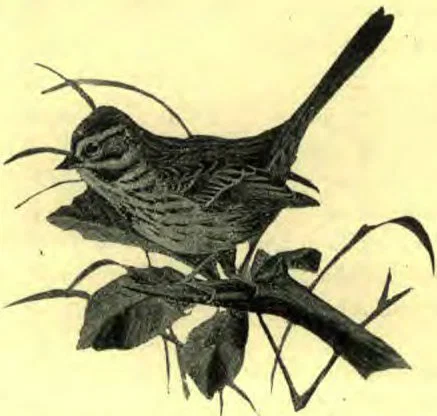
The song-sparrow is a plain bird, with a grayish-brown back, marked with reddish streaks, and plain brown wings and tail. His head is brown, streaked with gray; and he has a brown stripe on each side of his throat. Underneath, he is grayish white, spotted with brown. These spots come together, and form a dark patch, or breast-pin on the center of his breast. By this breast mark he may always be recognized from other sparrows. What this bird lacks in brilliancy of plumage, it abundantly makes up by the sweet persistency of his song. It has been suggested that his song resembles the words, “Maids, maids, maids, hang on the teakettle, teakettle, ettle, ettle.” This is the common song of these birds, which we hear coming from every meadow, brook, and roadside bush. Individuals vary this song. The song-sparrow also has a more complicated and brilliant performance, which he gives on the wing.
Some of the best gifts of nature are the most abundant. So it is with our little song-sparrow. During the warm months, one can not go far in the country without meeting this friendly bird, and being greeted by his cheery song.
The nest is rather thick, largely built of fine dry grass, and mostly lined with horse-hair. The parent birds hide it carefully near the base of an old stump, surrounded with grasses, or among protecting bushes. Sometimes, when snakes or mice abound, it is elevated a little way above the ground, in the crutch of a low-spreading shrub.
Three broods are usually raised in a season; and as the birds are scrupulously neat, they occasionally raise two broods in the same nest.
The birds take turns in occupying the nest; and after the young are hatched, each parent takes part in providing food for the growing family.
Late in November most of them leave our northern climate.
Many useful lessons may be learned as we study the life of our unassuming friend, but one of the most important is a lesson of faith. Whether flying among the glad spring flowers or gleaning a scanty pittance among the frosts and falling leaves of autumn, his song is full of trust and good-will. EVA JENKS.

The Versatility of the Banana

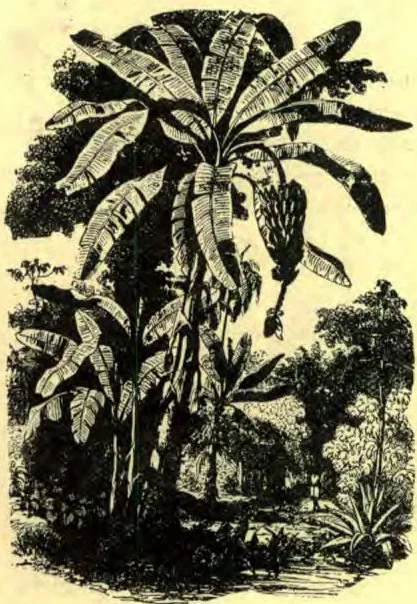
MUCH has been told about the versatility of the bamboo, that grass of the tropics which rivals the oak in height and surpasses the pine in utility. As much may be told in the future about the banana, that great tropical lily which circles the world in the torrid zone, and feeds lazy millions of mankind who have nothing to do but pluck and eat. The potato is not bad as a producer, but the banana outvies it in the ratio of forty-four to one, and wheat in that of one hundred thirty-three to one, one acre of ground yielding banana food enough for fifty men. A piece of land of one hundred twenty square yards will produce four thousand pounds of fruit, while the same area rarely produces more than thirty pounds of wheat or eighty of potatoes.
No books are written in the tropics on “Five Acres Enough,” for two acres there will feed a company of soldiers, and with only a fraction of the labor, and the value of the banana is not alone in bulk; for its nutritive value is very high, being twenty-five times greater than our ordinary white bread and forty-four times greater than the potato. There are various other uses to which the banana plant is put,—the invaluable Manila hemp comes from one species of it,—but we shall confine ourselves here to its food uses. From every part of the neighboring tropics the great green bundles, weighing at times more than a hundred pounds, pour into the United States, till we receive annually about ten million dollars’ worth. But these are eaten merely as dessert.
Only recently have steps been taken to adapt the banana to more varied uses. The dried banana is one of the latest innovations. By getting rid of its abundant water, a great saving in transportation is affected, and vast quantities of overripe fruit can be utilized, in addition to the small bunches not deemed worth shipping. Mr. A. F. Spawn, a distinguished adapter of vegetable food to human uses, tells us that fifteen different dishes can be made from the banana, first dried and ground into flour. These include breakfast food, crackers, biscuits, cup cake, fruit cake with banana raisins in it, etc. Indeed, a ten-course dinner, from soup to coffee, has been served, made wholly of variations of the banana.
Banana bread has been voted excellent. Then we have “banana figs” and “banana raisins,” not unlike the real article, and “banana coffee,” which tastes a great deal like real coffee, and has none of the nerve-wracking effects claimed for coffee by those who are opposed to it.
Banana coffee is one of the many discoveries of Mr. Spawn, who is an enthusiast on the utilization of the banana, and is turning out a ton a day of this product from his plant at Woodbury, N. J. He has evaporating machines in Mexico, in which the fruit is thoroughly dried and prepared for roasting into artificial coffee. These new uses of the banana point to a greatly widened employment of this prolific and nutritious fruit.—Search-Light.

Preserving Foods

(Concluded)
BECAUSE germs are everywhere, ready to spoil anything within their reach, it becomes necessary to take various measures to preserve foods. Many methods are adopted for preventing the action of germs on food. Some of these have already been mentioned. The germs may be destroyed by heat as in the ordinary processes of cooking. By heating over from time to time, food can be kept fresh for a long time, which, if not heated, would spoil in a few hours. Instead of heating the food over every little while to kill any more germs that may have fallen in, one may heat the food, and then exclude the germs by keeping it in an air-tight package. This is called canning. Such food is said to be sterile; that is, without any living germs.
Foods may be preserved by drying, as dried fruits, dried vegetables, and grains, or they may be preserved by the use of antiseptics, as is done in salting meat or butter or in smoking meat, or in the preparation of preserves and jellies by the use of large quantities of sugar; or foods may be put in an ice-chest, and thus kept from spoiling. This does not stop the action of the germs, but retards it. The germs continue to multiply, though slowly; and food, if left long enough, would be found to be spoiled, even in an ice-chest.
Foods are often kept in cold storage for weeks, in large cities. Meat, butter, eggs, and other foods are stored when they are cheap, and kept there until prices rise. Refrigerator cars or refrigerator steamers are used to transport perishable goods long distances. While ordinary decay does not take place in cold storage, there seems to be a deterioration, and the food is not so good as when fresh.

Natural Preservatives

Nearly all the processes of preserving food were employed by nature long before man ever used them. A grape is a little can of fruit. The skin, as long as it is whole, prevents the germs from getting inside. Decay does not usually begin until the skin is broken or punctured by some little animal.
Winter apples resist decay for a long time because of a tough skin. Cocoanuts, bananas, oranges, and, in fact, nearly all fruits are examples of nature’s method of keeping out the germs. Such fruits spoil much more rapidly when the outer covering is injured.
But while disease germs can not grow through the skins of fruits, there are molds that find lodgment on the skin, grow through, and thus cause decay. By wiping or polishing apples occasionally, and keeping them perfectly dry, the molds do not get a foothold, and the apples last much longer.
Another of nature’s methods of preserving against germ action is the use of antiseptics.
Plants and animals protect themselves to some extent against the inroads of germs by producing substances that are germicidal, or at least antiseptic. In the air and on the skin, there are always germs, known as “pus germs,” which are capable of producing boils. They are on the hands, under the nails, and all over the body, even after a most thorough bath, and you may wonder why they do not cause more trouble than they do. They can not, ordinarily, get through the skin, which serves as a protection, the same as the skin of a grape or the peel of a banana; but when the skin is bruised or broken, they may get an entrance. Sometimes a child falls down and gets a bad bruise. Perhaps the “skin is barked” or torn off the hand. The little fellow says nothing about it, though it hurts pretty badly. Thousands of germs may have gotten into the wound, yet in nine cases out of ten the wound will heal without any difficulty. Why?—Because the serum, or fluid, poured out has the power to destroy the germs or prevent their growth.
There is an acid in the stomach of healthy people and healthy animals which is capable of destroying nearly all the germs that are eaten with the food.
You may have wondered why growing grass and other plants do not decay; for when it is cut down or broken off, decay soon sets in. During life the fluids of the plant are resistant to germ life. So, then, nature has the power to exclude germs from her products, and to make antiseptics. Many of the fruit acids are more or less antiseptic, and this is a reason why lemon-juice and other fruit juices are often so excellent for certain disturbances of the system.
Another method nature uses (and when we say “nature” we do not mean a blind force, because we see in all this the well-laid plan of an all-wise and loving Creator) to preserve against germ action is drying. As they mature, wheat, corn, beans, peas, and other vegetables and cereals dry, and are then unassailable by the germs. In countries where figs grow, these often fall off the tree, and dry on the ground. They are such soft, juicy things that if this did not occur, they would soon sour through germ action.
Out in the desert where animals die, they often, instead of decaying, dry up. The air is so dry that it absorbs the moisture from the body of the dead animal so rapidly that it does not have time to decay. So, over the great Western deserts may be seen the dried-up mummies of many animals. It was the dryness of the Egyptian air that enabled the ancient Egyptians to embalm their dead so successfully that now, after thousands of years, some of these bodies are still in a fair state of preservation.
Sunlight is another of nature’s means of destroying germs. Where the sun strikes directly, the germs do not live long, that is, on the surface. When sunlight is allowed to enter a parlor, it may fade carpets a little, but it plays havoc with the germs. You know the difference in the odor of a room which is always dark and one which has an abundance of sunlight. One smells musty, and you are glad to get away from it. Your sense of smell warns you that it is not a healthful place to live in.

Spores

Germs, as a rule, succumb readily to the action of heat, chemicals, drying, and sunlight, but they produce spores, or what resembles seed, which can survive much more severe treatment. Germs do not all form spores. The varieties that do not are much more easily destroyed. Ordinarily, exposure to water at a temperature much below boiling—one hundred forty degrees Fahrenheit for ten to fifteen minutes is sufficient to destroy all germs, if there are no spores present. Exposure to direct sunlight for about an hour, will have the same effect. But spores may still live after having been boiled for several hours. One kind is said to require fifteen hours of steady boiling in order to kill it. Fortunately, the ordinary disease germs do not form spores.
You may have heard the words “disinfect” and “sterilize” used, and may have wondered if they mean the same. They do not, exactly. To disinfect anything is to destroy all infectious material, all disease germs in or on it. To sterilize it is to destroy all the germ life. It is much more difficult to sterilize anything than it is to disinfect it, because there are usually some spores present (of harmless germs as a rule) which are extremely difficult to destroy. Very rarely is milk actually sterilized. It is usually put through a process to kill the disease germs. But if such milk were sealed in air-tight, sterilized bottles, it would sour in a few days, showing that some germs were still present in the milk.
Sterilizing milk renders it much more difficult to digest. Pasteurizing it, that is, cooking it at a temperature of one hundred forty degrees, kills most of the dangerous germs.
Milk could be sterilized by heat in three different ways: first, by heating it to a point above the temperature of boiling water. This is accomplished by having the milk in a close vessel, boiling it in brine, which, you know, can be heated much hotter before it boils than plain water.
Another method of killing the spores is to keep the milk boiling for eight or ten hours, or even fifteen hours. Both of these methods are objectionable, as they cause undesirable changes in the milk. Sterilized milk is especially bad for babies; and yet it would not be so bad as some of the milk which is fed to them swarming with germs.
Another method of sterilizing milk is known as fractional sterilization. By this method the milk, which is sealed, or so closed as to keep the germs out, is heated to near the boiling-point for a few minutes for three successive days. Such milk will keep indefinitely, the same as canned fruit, and is not open to the objection that it has been overcooked. But even this amount of heating probably makes the milk inferior to raw clean milk.
You will wonder how three successive heatings at less than boiling temperature is more effective than one continuous boiling of several hours; and before I explain this it will be better to say a little more about the formation of spores.
Under certain circumstances not yet well understood, little granules from all parts of a germ will collect at one point. In some species of germs this is at one end, in others, it is at or near the center. Sometimes this is accompanied by swelling of the germ at the point of collection.
Around this collection of granules forms a very tough resistant shell, and finally nothing remains but the spore.
Under favorable circumstances a new germ hatches out from this spore, much as a chick develops from an egg.
When milk is heated to one hundred forty degrees, for a time all the germs are killed. The heating favors the development of some of the spores, and within twenty-four hours a crop will have hatched out. Heating this will kill the newly hatched crop. The second day the rest of the spores will all hatch out; so that, with rare exceptions, three successive heatings will sterilize the substance, not by destroying spores, but by destroying the newly formed germs.
MIKE ROSE.
Continue reading: Paul Again Visits Corinth