The Youth’s Instructor, Vol. 37, No. 25.

SELF-CONTROL

The Youth’s Instructor

Jun 19, 1889

S. D. A. Publishing Association · Battle Creek, Mich. · Jun 19, 1889

SELF-CONTROL

FROM childhood up there has been something inspiring to me in the sight of a team of four horses, and to be whirled on by them was a curious mixture of terror and exaltation. Who does not like to watch the driver, whether he sits on the high seat of a country picnic wagon, or mounts the elegant four-in-hand coach? What a watchful eye, what a grasp he has on the reins! Not a prance of the sixteen feet, not a pricking of the eight ears, not a turn of the four heads, escapes him. He knows which one will shy on the slightest provocation, which one will be ready to start off if a team comes up behind. The reins are slender, but strong; he keeps them well in hand; and because he keeps them well in hand, the coach whirls on in safety. I dare say you have all envied him.
You will not be at a loss to understand me if I say that you are each driving a four-in-hand. If I should go still farther, I would name your steeds Thought, Affection, Appetite, and Passion ; and when you have learned to manage them in all their different exercises, you have learned self-control.
Or I might illustrate it in another way, and say that each of you is a king in his own right, having a kingdom full of subjects wide awake, and often turbulent, who must be constantly restrained, if order and right-doing shall prevail in the realm. This kingdom we call “Self,” and to rule it well is to have self-control.
We are all fond of power; but I can tell you the power over one's self is the mightiest human power in the world. It is much more interesting to see a boy or a man subdue himself than to watch any control of mere animals.
I remember a boy whom I used to study. He had a quick, fiery spirit, which started up in anger on very slight incitement; indeed, it was almost vicious. But he had been taught that wouldn't do, and his efforts at self-control were, to say the least, unique. I have seen him as a little fellow dash out of the house in a rage, run round it two or three times, and come in with a smiling face. It was his own remedy, administered in his own way; but as time has gone on, he has had himself more and more in hand, until now only a little trembling of the lips, and then a firm compression, show that he is moved. That boy is destined to be a strong man.
This is the phase of self-control which presents itself most vividly to you now; the quick, hot spirit of youth, the fight which is in most boys, is what you recognize now as needing restraint. The longer you live, the more you will see that it must lay its hand on every part of your lives. Self-control in eating and drinking keeps you from becoming gluttons and drunkards; that you can understand. But you do not know, and God forbid you should ever realize, the possibilities of evil which lie in every life. There are risks in thinking, risks in every affection, in every passion, in every appetite, which can only be avoided by this stern self-control.
You can turn to the Book to find the estimate there put upon it. Over and over again in the Proverbs it is expressed in various ways. “He that is slow to anger is better than the mighty, and he that ruleth his spirit than he that taketh a city.” And James says, “Let every man be . . . slow to speak, slow to wrath.” Paul says, “I keep under my body, and bring it into subjection.” I wish you would try to find out all there is in the Bible which touches on this subject; I am sure the number of texts will surprise you.
There is one text, however, which brings great help and comfort. If you look in the margin of the Revised New Testament at Galatians 5:23, you will see that self-control is a fruit of the Spirit. At the end of the list—last, but by no means least—stands the word temperance, and in the margin it is self-control, which, I suppose, is what the word really meant at the time it was used there, although temperance has so long expressed one idea that it now means to you, not itself even, but total abstinence.
To one who knows how difficult is this mastery over self in all the multiplied forms in which it must be accomplished, it is good to be told that there is an all-powerful ally in the Spirit of God, and to be assured, the Spirit is promised to those who ask it.
It will be of little use to talk of this if we do not practice it. Let us begin to-day this self-control, knowing that it is to be a life-long work, but knowing also that it will grow easier as we go along, and as we become “strong in the Lord, and in the strength of his might.”
Who is free?—He who masters his own self. Who is powerful?—He who can control his passions.—H. A. H., in New York Observer.

ONLY ONE WEAK SPOT.

It was Daisy's birthday, and in the afternoon she was going to have a party in honor of the event. Her Cousin Charlie had come over to help with the preparations, and he was busy on the lawn, putting up tables, arranging chairs in the shade, and helping with the long tent.
All was ready now but the swing, and as Charlie looked at the new, strong rope, he thought that there would not be any danger of its breaking down, with such knots as he meant to tie. As he ran it through his hands, his glance fell upon one place where the rope seemed to be weak; there was a flaw in it, and it was rough and frayed-looking, instead of being even, like the rest.
“Only one little weak place, but all the rest is so good that I don't think it will matter much,” Charlie said; and climbing the tree, he soon had the ends firmly fastened to one of the massive, wide-spreading limbs of the old oak.
It was a pretty sight, when the little guests came that afternoon, to see the childish figures flitting over the velvet lawn. Each one was eager to have a turn in the swing, and Daisy had hard work to remember her duties as hostess, and wait till the last.
Charlie's strong arms pushed the little ones to and fro, and Daisy was wild with delight as she went higher and higher with each push, until she felt as if she were a bird, trying her wings for the first time.
Suddenly there was a snap, and the rope parted, letting Daisy fall, with a frightened scream, upon the ground in a limp heap.
A badly-sprained ankle proved to be the only result of the accident; but the little party quietly left, all their happiness clouded over by the remembrance of Daisy's white face and closed eyes.
An hour later, Charlie stood under the oak tree, looking at the broken rope. It was as he had feared when Daisy fell,—the one weak spot had parted, and so the whole rope had been insecure.
“What was the trouble, Charlie?” asked Uncle Henry. “I cannot understand how a new rope parted so readily.”
Charlie showed him the frayed edges of the place that had given way, and explained how all the rest of the rope had been so good that he had thought it could be trusted.
“That was a dangerous thing to do,” said Uncle Henry, gravely, “as you would have known yourself, if you had stopped to think. The weakest place determines the strength of the whole, whether it be in a rope, in a bridge, or in character. There may be only one weak place in a bridge, but if the engine comes crashing through at that weak place, then the bridge is no stronger than that one place. So the rope had only one weak place, but that made the strength of all the rest insecure. It is just so with your character, too, my boy. It may be strong and upright in most particulars, but if there is one weak place, if there is an appetite that you cannot control, or a sin you cannot conquer, then all the rest of your character is to be tested by that weak spot. If little Daisy's accident should teach you the lesson of carefully guarding the weak places in your character, and not relying on the strength of the rest, then I could not be sorry that it happened, notwithstanding the disappointment and suffering it has caused her.—Youth's Evangelist.

To a Bird.

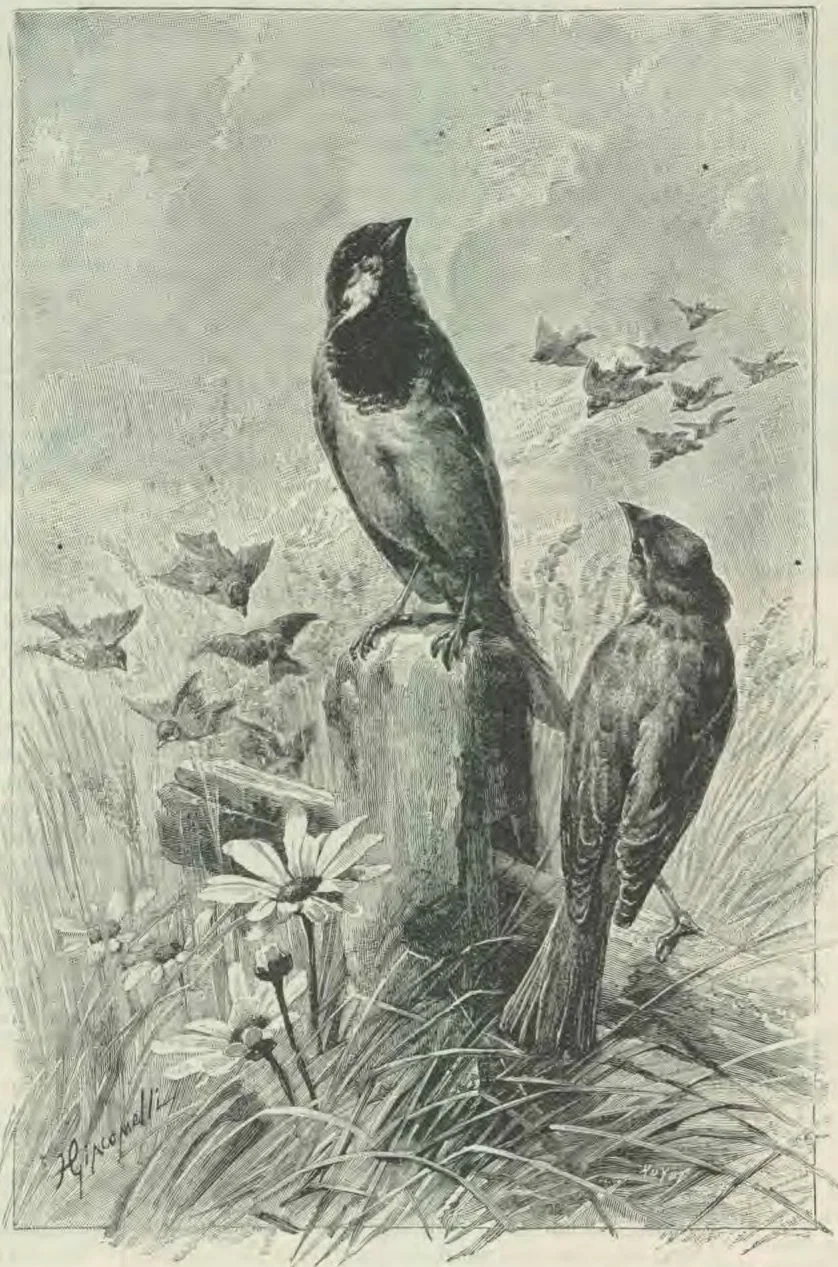
Little bird, could I but know What you say while singing so, I should have some words for praise, Even in the darkest days.
When the day is dying slow, And your trills are soft and low, I have almost thought I heard Human speech from singing bird.
When I hear your voice at morn, From the snowy-blossoming thorn, Much I wonder how the night Taught you such a wild delight.
Did the lilies, in their sleep, Whisper secrets strange and deep— Words too sweet for mortal ear, Minstrel of the blossoming year?
Did the warbling woodland stream Drop its music in your dream, Or the fragrant zephyr, born Of the newly wakened morn?
Have the violets in the grass, Breathing sweetness as you pass, Told you, trembling 'neath the dew, Stories of the heaven's bright blue?
Sing on, bird, forever sing; May good spirits speed your wing! Sing to all, dear bird, but see That you sometimes sing for me.
—Selected

ONE DAY’S WORK FOR JESUS.

“Mamma, I do not see what I can do to help any one,” said May Miller one morning, as she came into the sitting-room, with a perplexed look on her usually sunny face.
“What is on your mind, daughter, that you should say that?”
“We sang a song in Sabbath-school about ‘Something for Children to do,’ and the superintendent asked us what we thought it meant, and if we would not find something to do to make some one happier. I have been thinking about it all the week, and I cannot see what a little girl without any money of her own can do for anybody,” answered May.
“If I were rich, I could buy clothes and things for the poor,” she added.
“As you are not rich, the Saviour does not ask you to do a rich girl’s work; but I think you can find your own work, if you will look for it right in your every day life,” said Mrs. Miller.
“I want to do something for Jesus, if I only knew what he wants me to do,” said May.
“Well just watch your chances of doing good to-day, in small things, and perhaps by night you will find that a little girl may find a place in the Master’s work. Solomon says, ‘Even a child is known by his doings, whether his work be pure, and whether it be right.’ And if the angels who watch over little children carry a report to heaven of their actions, don’t you think that report shows whether they are doing the will of Jesus or the will of Satan?”
“I never thought of it before,” replied May soberly.
Later in the morning Mrs. Miller said, “May, I want to send you to the washer-woman, to see if she can come to-morrow. You may stop for an hour with Helen Goodman. You have not been there for several days.”
“No, mamma, only once since she broke her ankle. May I take her that bunch of pansies and mignonette Aunt Jane gave me this morning?”
“Yes, and I will send her some rolls and honey too. Anything coming from out the house tastes so much better to a sick person than home cooking; and here are two oranges—one for you and one for Helen,” said Mrs. Miller.
Soon May was ready, with her pretty willow basket covered with a snowy napkin in one hand, and a large bouquet of flowers, that were still dewy with the sprinkling she had given them, in the other. With many cautions to look out for trains at the street-crossings, her mamma kissed her good-by, and watched her trudge away in the sunshine.
She had not gone far before she met two ragged boys, with a rope around the neck of a little dog, pulling him along. His shaggy black coat was full of dust, where they had dragged him when he would not walk.
May went fearlessly up to them, and said, “O boys, please don’t abuse the dog. Is he yours?”
“No,” said one, “we got him up the street, and we are going to throw him off the dock, to see him try to swim out.”
“I can tell you something to do better than that,” replied May quickly. “Let him go, and I have a big juicy orange I will give you to eat.”
These street idlers, who seldom had an orange, were glad to make the exchange, and soon the dog was scampering for home, and May went on her way with a lighter heart.
Just before she reached Mrs. Goodman’s, she saw a puny girl, wheeling a baby in a cart; she was trying to cross the walk, and the wheel was against the curb. She had attempted to lift it, but could not, and she stood there crying. May came along, and said, “You lift one wheel, and I will the other,” and their united strength put it up on the sidewalk. Taking two or three sprigs of mignonette and some pansies from her bouquet, she put one into the baby’s hand, and the rest she gave to the little nurse, who took a long breath of delight as she examined the “faces,” of the big velvet pansies. “I will carry them straight home to my sick brother,” said she.
May found Helen lying in a room opening off the kitchen, where Mrs. Goodman was cooking the mid-day meal over the hot stove. She was holding the baby on her hip, and his red face looked as if he were being cooked too.
Putting the flowers into a glass of fresh water, May went out into the kitchen, and said to Mrs. Goodman, “Jamie seems so warm and fretful that if you will let me, I will take him out in the shade in the back yard, and amuse him till you are done cooking.”
“If you only will, dearie, I shall be so glad. I must have the dinner at the station in time; for my husband has so little time to eat it. I do miss Helen so when his dinner has to be taken.”
“I would offer to go with it for you,” said May, “but mamma will not allow me to go near the elevated road alone.”
“You can oblige me just as much by staying with Helen and caring for Jamie while I am gone. I will call you when I go,” said Mrs. Goodman.
While Mrs. Goodman was gone, May drew up the stand to the side of Helen’s bed, and began to empty her basket. She put everything in order, and set the flowers near, to give beauty and fragrance to the repast; and lastly she took from the bottom of the basket a book of child’s stories, and said, “You will not want to talk while you are eating, and I will read to you.” After she had finished the story, she said, “You may keep the book till I come again.”
Helen’s eyes were full of tears as she replied, “You are just as good as you can be to every one, May.”
“Me?” answered May in surprise. “I am not good at all, but I mean to be when I find ‘my work.’ Your mamma has come now, and my hour is up; I must run along and do my errand.”
Mrs. Goodman thanked her heartily for the rest she had given her with Jamie, and for her kindness to Helen.
After May had helped her mamma wash the supper dishes, and had put the dining room in order for the next morning, they sat down together in the twilight, as was their custom, and Mrs. Miller said, “May, tell me how you have spent the day. Did you find anything to do for the Saviour?”
She told her mamma how the time had been occupied, and finished by modestly saying, “I did not do much, mamma, but I felt pleasant towards every one, and I tried to remember that a little girl’s work might be a smile and kind words, if she had nothing else to give.”
“So it is, my child,” Mrs. Miller replied, with a gratified look. “He measures our work by the love we put into it more than by the amount. If we are faithful with ‘one talent,’ he will soon intrust us with more.” MRS. L. E. ORTON.

JUNE

Green, sloping fields, o'er which cloud-shadows pass; A quivering splendor tangled in the grass; Sunrise-hued roses, throbbing in the air; The starry blackberry blossoms here and there; And on divinest skies white clouds, that lay As air of heaven in drifts that dropped away; Rapture of birds at dawn, a hush at noon.— Ah! by my heart's wild beating, it is June! —Mrs. L. C. Whiton.

Little Duties Are Golden Pins

LITTLE duties are golden pins, by which we secure the mantle of God's love more firmly about us.

HOE YOUR OWN ROW.

“HERE you are—Evening Herald!”
“Don’t want any paper. G’way, boy!”
“Only one left, sir.”
“I tell you I don’t want it. There!”
The old gentleman tossed a nickle to the newsboy, and mounted the stairs to his office with agility hardly to be expected in one of his age. But when he arrived on the landing, and was fumbling at the lock, he was surprised to find the newsboy at his elbow.
“What do you want?” he asked, somewhat testily.
“Here’s your paper, sir, and your change,” said the boy respectfully.
“Well, I never saw such a boy!” exclaimed the old gentleman, in surprise. “I told you I didn’t want the paper.”
“But you gave me a nickle.”
“I gave it to you out of charity.”
“Then take it back,” said the boy firmly, although with trembling lip; “I am not begging; I am selling papers. I will take two cents for a paper, but I won’t take a cent out of charity.”
“Well, I declare,” said the old gentleman, “you are a most astonishing boy! But you are a sensible chap, and I will buy a paper from you to-day—and every day. You will get along in the world, my lad.”
There are not many boys, perhaps, who are like our newsboy, although all boys would be better and happier if they would reject all gifts, and take nothing but what they have earned. Independence is a cardinal virtue that makes a man great.
A few years ago a poor cartman in Boston, while plying his vocation on the docks had the misfortune to have his cart and horse precipitated into the water, the horse being drowned and the cart damaged.
Some charitable persons set on foot a subscription to repair the loss, but he firmly rejected it.
“I’m not denying that I’m poor enough,” said he, “but I have always had foresight to lay by something for a rainy day, and I’ll take care that no one shall look at my new cart and horse, and say, ‘I gave him a dollar to get it.’”
These two instances might be imitated to advantage by boys and girls alike of every station in life.—Golden Days.

HOW TO BE HAPPY.

THERE is a little secret about it! We wonder how many girls and boys know what it is? There's Joe Ellis. “He's a lucky boy,” his friends say. You see he is an only son, and there are few things that money can buy that he cannot have. But he isn't happy; oh, no! You have only to look into his fretful face, and hear his whining voice when something doesn't just suit him, to make sure of that.
But there is Flora Day. Her mother is a seamstress. Her papa died when Flora was two years old, and since then, Mrs. Day has had to work early and late to keep the wolf from the door.
How few pretty things Flora has had, and how dearly she loves such things! How few pleasures that children enjoy have fallen to her! And yet how glad and happy a girl is Flora! She has learned the secret, you see. Do you guess what it is? Shall we whisper it to you?—Flora loves everybody, and Joe loves just himself. Flora has little time to think of herself, for she is planning how to please and help somebody else. Joe has none of this to do, and so his mind dwells upon himself, his wants, his pleasures, and his pains.
Of course he is unhappy, and of course Flora is happy.—Sel.

DARE TO DO RIGHT.

DID you ever know of a person who did right whom sensible people despised? If no one says, “You have done right,” in words so we can hear it, the little voice we all carry within our minds will always say, “You have done as you ought to.”
When Athens was governed by thirty men, called “tyrants,” they wanted a very rich man named Leon killed, so that they could have his riches. They wanted the great philosopher Socrates to help them; but he said, No; he would not engage in so great an “ill as to act unjustly.” You see he did right with thirty rulers over him, and all cruel men, too.
Christ was a greater philosopher than Socrates, and he taught us to “do as we would be done by.” If we follow that little rule, we shall always dare to do right. How much more of joy and less of sorrow there would be if everybody loved these words of the Saviour’s.—Sel.

A Good Life Shines Like a Candle

WE cannot hide a good life. It shines. It may make no more noise than a candle, but it may be seen. Thus even a boy or a girl may be a light-bearer.

A HOME IN THE COUNTRY.

A FEW weeks ago, you were told about little Ched’s visit to the country. His papa afterwards bought a home just outside the big city where they had lived. Now I will tell you about the times Ched had in his new home.
Early every morning his papa got on to the cars, and went into the city to work; so Ched and his mamma were left alone most of the time.
Ched didn’t mind that, though, because he found so many things to look at and learn about. I wonder if the little folks in the country ever think how many things they have which children in the city never see? The first time this little boy went to the country, when he saw a wild bird, he thought it was somebody’s canary that had gotten out of its cage and flown away.
He didn’t dare to pick the wild flowers, nor even the dandelions, at first, but wanted his mamma to buy some of them; because in the city they had sometimes bought a few flowers at a greenhouse, or in the market where people brought things to sell which grew in the country.
When Ched learned that he could pick the wild flowers without paying for them, and that he could have apples from the orchard for nothing, then he thought everything in the country belonged to any one who wanted it.
Soon after they moved into their new home, he wandered one day into the yard belonging to one of their neighbors, and seeing some bright flowers growing in front of the house, he began picking them.
A woman came out of the house, and told him he mustn’t do that; and she took what he had away from him, and told him to run home. He was very much grieved, and told his mamma that the woman “scolded” him when he “wa’n't doin’ nothin’ but pickin’ flowers.”
The houses were closer together here than they were farther from the city; and one time when Ched was playing with a little boy named Carl, who lived in the next house, they decided to go over to Carl’s house and hunt the hens’ eggs.
They found enough to fill both of their caps; and then little Ched started home with his share, the same as he used to at his uncle’s, when he went with his cousins to gather the eggs.
Carl called to him to bring them back; and because he wouldn’t do so, Carl ran after him, jerked the cap away, and broke some of the eggs in it.
It was quite a time before Ched could understand what belonged to him, and what belonged to other people.
Nearly every time he went away from home, he had trouble in some way. Once he got lost; sometimes he would get with naughty boys, who either were mean to him, or else taught him to do something he ought not to do.
His mamma tried to have him like to stay at home. She had him hunt for pretty stones; helped him to make baskets of burrs; showed him where were birds’ nests; taught him to make caps of leaves; helped him learn to tell what grew on the different trees just from looking at the leaves; and let him have a little play garden, where he planted seeds, and then dug them up in a little while, to see if they had begun to grow.
This garden was a very nice thing for Ched, even if he did let nothing grow long there; for he learned very much from it about plants.
But all these things didn’t keep this little boy from wanting to go away from home sometimes.
One day he noticed some big white daisies, with yellow hearts, growing just beyond their fence; so he crawled through a little hole between the boards, and began to pick the flowers.
But soon he spied a good many more, a little further off, on what people call “the common.” That is a field which no one works, and which has no fence around it, where any one may go.
Ched threw down what flowers he had picked, and started on; but about the time he reached the place where the daisies were thickest, he caught sight of something else.
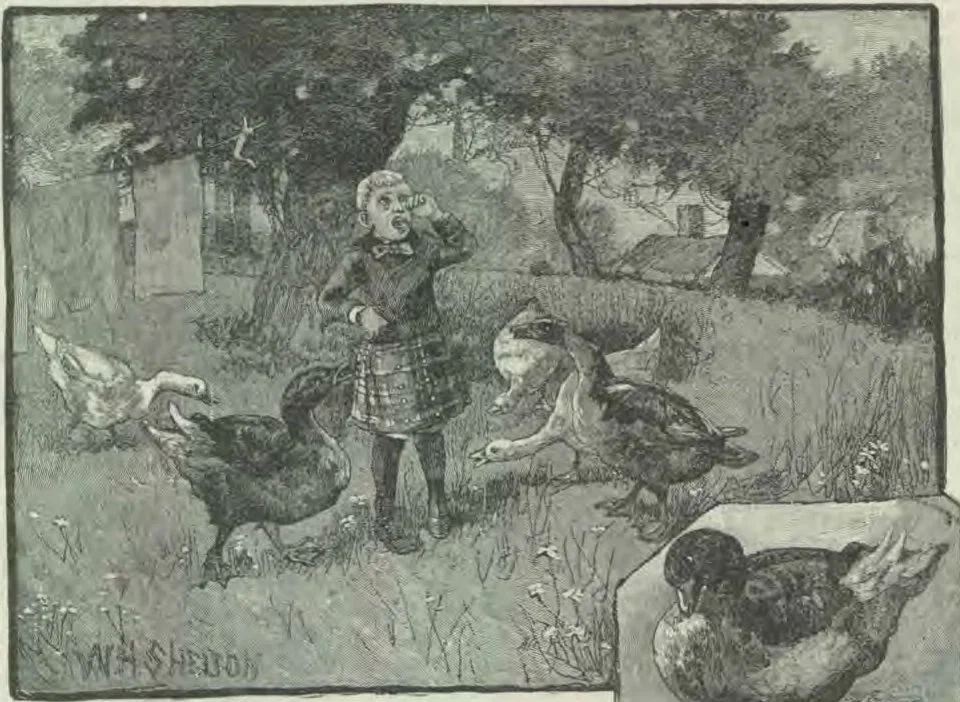
What do you think it was?—a goose, to be sure. But although Ched now knew what chickens and turkeys were, he had never before seen a goose.
When they lived in the city, he had sometimes gone to the park with his papa and mamma; and there they saw large, beautiful white birds, called swans, swimming on the water; and he thought this goose must be a swan.
He started to go where it was; but it stretched out its long neck, and started toward him, making a very queer noise. Ched didn’t know what to think of that; but in a moment several other geese were running toward him, making a terrible noise.
Louder and angrier their screeches grew, till they were worse than anything this little boy had ever heard. A dozen wild Indians would not have scared him more. They struck at him with their wings, and pecked at his little plaid dress and red stockings; and poor Ched thought they were surely going to kill him and eat him up.
If you were ever chased by ugly geese, you will not wonder that he was very much frightened, and screamed dismally. He was too frightened to run; and, besides, the geese were all around him.
He looked toward home, and would a great deal rather have been there than have all the daisies in the world, or anything else. He thought he never should see his papa and mamma again.
I don’t know which made the worst noise, Ched or the geese. But they didn’t hurt him any; for a woman who came out of a house near by, to get some clothes which she had hung to dry on the common, found the little boy, and led him away.
If he had not been so scared, he might not have wanted to go with her, she was so homely, and her clothes looked so queer; but now he was very, very glad to have her take his hand, and he kept close to her, so that the geese, which followed after them, would not get him.
The woman took him clear to the fence back of his own home; then he crawled through the same hole where he had gotten out, and ran to his mamma in the house, a very happy little boy, though the tears were still lodged on his tanned cheeks.
After getting into so much trouble by running away, Ched was willing to stay at home with his mamma; but she told him that if he would help to do her work, she could go with him nearly every day out into the fields, to gather flowers; or to the brook, where the tiny fishes were; or to the woods, where they could see the wonderful squirrels, of which his papa had told him, but which this little boy from the city had never yet seen.
And now Ched is trying to find how many things he can do to help his mamma.
MRS. ADA. D. WELLMAN.

OUR FREDDY.

Freddy lives on a farm. He has a grown-up sister called Bessy. Her pupils call her Miss Walton. She teaches school in Boston. She comes home to the farm every summer. Then Freddy has fine times. He takes her to drive. They go fishing. He shows her the calves and lambs and young colts.
Freddy owns a wagon. Watch is his horse. One morning Freddy invited Bessy to ride in his wagon. “Do, Bessy! it is such fun,” he said. “My horse Watch is very gentle.”
But Bessy said she would see him ride first.
So Freddy harnessed Watch to the wagon. He drove down the lane to the house very fast. But Watch would not stop at the door. He was very thirsty, and so he trotted right down into a little pond to drink.
Freddy jumped out. He was afraid Watch would upset him into the water.
Bessy said she was afraid to ride after such a frisky horse.
Now I want to tell you a story about Freddy. It will show you what a good boy he is.
Last summer, Bessy and Jack and Freddy were all going on a journey with their mother. They were going to ride twenty miles in the cars. Then they were going to sail forty miles in a steamboat, over a lovely lake.
Freddy had never been on a steamboat. He talked about it every day. He used to wake up in the night and think about that steamboat. He told all the boys at school about it. Each one of the boys wished he was going too.
Freddy thought the day to go would never come. At last it came.
Now Freddy likes to go to school barefoot. But when boys go barefoot, they are apt to hurt their feet. The day before the journey, Freddy had bruised one of his feet against a stone.
That morning he put on his shoes. His foot was very sore. He could not wear them.
Just think of it! Of course he could not go on that steamer barefoot.
What do you think he did? Do you think he cried? I know some boys who would have cried. Perhaps I should have cried myself!
But Freddy went to his mother. He said, “I cannot go.”
Then he helped the rest to get ready. He brought the water from the well for Jack. He wiped the dishes for his mother. He helped Bessy pack the lunch-basket.
When school-time came, he trudged off to school.
When his mother and Bessy and Jack came home, he met them with a very happy face.
Bessy calls Freddy her “hero.”
I, too, think he was brave. Don’t you?—Selected.
Continue reading: THE STONE THAT REBOUNDED