The Youth’s Instructor, Vol. 37, No. 6.

A LETTER

The Youth’s Instructor

Feb 6, 1889

S. D. A. Publishing Association · Battle Creek, Mich. · Feb 6, 1889

A LETTER.

AND so, my child, your heart is almost weary, And life has nothing that is fair to you? Because you say, with explanation dreary, “There is so little that a girl can do!”
And yet, I think, that somewhere in your city Many there are who need a helping hand; Or, at the least, some word of love and pity, That they will prize, and subtly understand.
Be not cast down, because of earthly treasure Little you have, in silver and in gold; These, too, are good; but God hath greater pleasure, In the heart’s riches, which are manifold.
Do what you can, and let the Lord’s increasing Make of it more until the harvest come; And meanwhile, strive and labor without ceasing, Hearing Christ’s voice above the city’s hum.
Never a day within the crowded city, Never an hour from morning until eve, But that his voice is heard to plead for pity, But that his heart is known to pain and grieve.
Go then. But if your heart is sad and broken, And to be helpless is your heaven-sent fate, Take comfort, and remember ’tis well spoken, That they, too, serve, who only stand and wait! —Chamber’s Journal.

Glimpses of Switzerland.—No. 10.

THOSE who began at Via Mala, and have in imagination taken the trips through Switzerland as indicated in the preceding articles, have, as will be seen by looking over a large map of the country, touched at nearly all the points most interesting to tourists. They have called at various wild and romantic gorges, fresh and green valleys, been rested by the loveliness of calm and picturesque lakes, felt the exhilarating effects of the clear, bracing air of mountains and rushing torrents, all the way around from Basle to the Rigi in the northern central part, Wallenstadt and Ragatz in the east, Bern, the Alps, Geneva, Lake Léman, Neuchâtel, Bienne, and the Juras in the south and west. From many elevations all along we have had entrancing views of the majestic and sublime Alps,—from between fog-clouds straining eager eyes to catch every peak visible, in a morning light, in afternoon brilliancy, in sunset gorgeousness of coloring and artistic shadings,—and at varying distances, sometimes near their very feet, again from thirty to one hundred miles away.
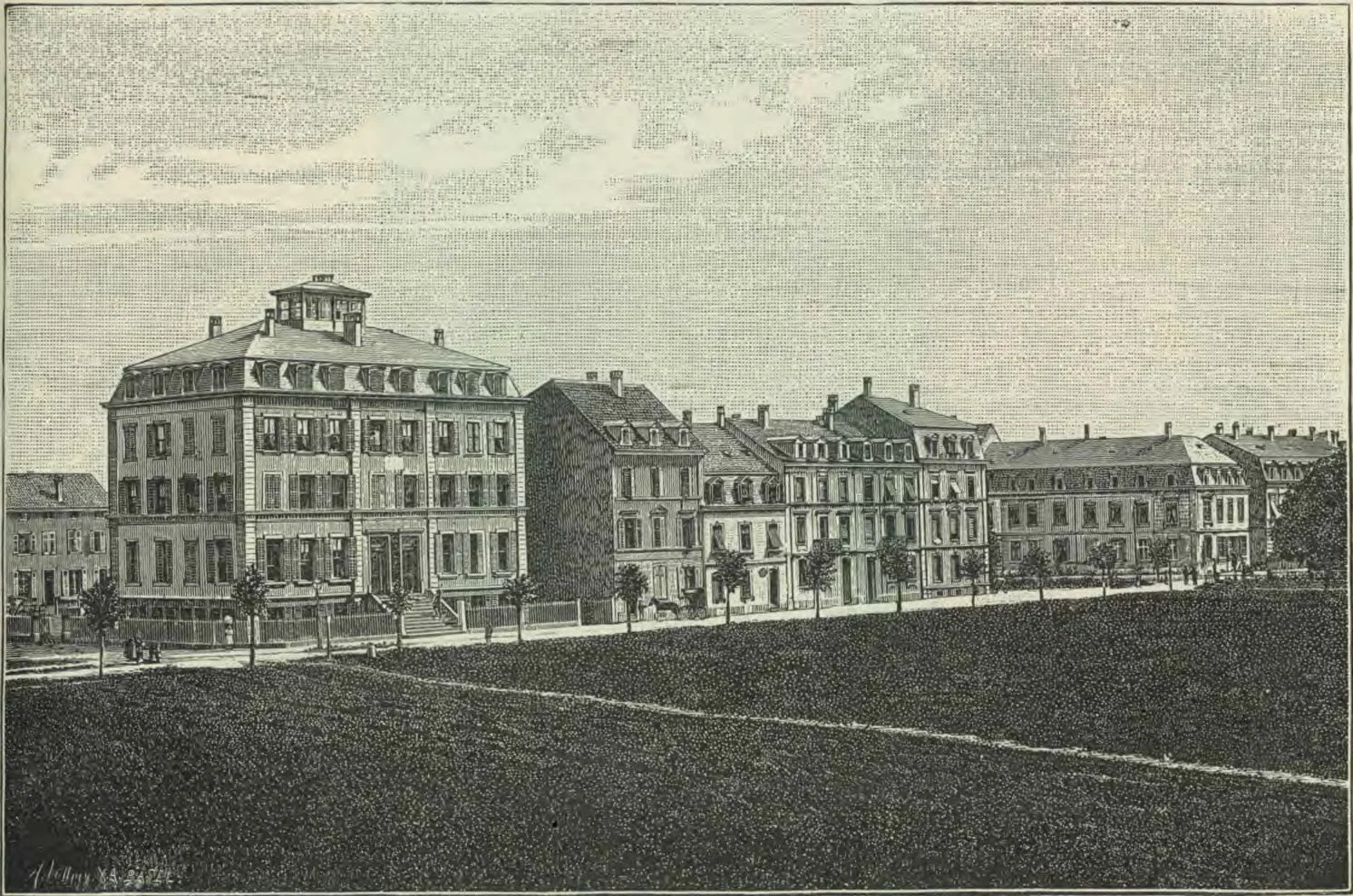
Now let us return once more to Basle and to Weiherweg, on which, as before mentioned, and as is shown in the cut, our publishing house of Central Europe is located. Just east of it, at the right in the picture, the railroad leading out into Germany crosses the street, and farther east and north lies the main city, which is also the oldest part, and presents a decidedly “foreign” appearance. At the west, on Weiherweg, is another large new building owned and occupied by our people and for the Conference school opened there last spring.
A little way to the north are the rooms first occupied by the Central European Mission family and the publishing work in its infancy some ten years since, 68 Müllerweg. To accommodate the increasing work, they moved from here to more commodious quarters at the corner of Belchenstrasse and Wieherweg, where the type-setting, proof-reading, etc., also that part of the printing which could be done by a large hand-press, were done. Here Eld. Andrews laid down his earth-work, and others carried it on as best they could.
Soon the work required more room, and in 1885 the large building you see at the left in the illustration was completed and occupied. This house is about 75 by 45 feet, and built of stone. The corners, two columns in front, also the door and window frames, are of cut stone, but the main wall is of common masonry of quarried stone laid from the basement up to the mansard roof. This wall is about four feet thick at the base, being gradually drawn in to about one half that thickness at the top of the third story. Both sides of the walls are plastered. Outside, the last coat is a mixture of drab-tinted paint and plaster, spattered on with a brush in a way to give a nice finish, resembling a kind of cut stone, a coating quite impervious to the weather.
Some of the workers have rooms here, and half of the first floor is a meeting hall for the Basle church; but the publishing work is increasing, and it is to be hoped that it will soon require the whole building. When the photograph was taken from which the illustration was made, it was desired to have some things characteristic of the country represented; so for one thing we arranged a basket which one of the office girls, formerly accustomed to carrying weights thus, put on her head, and stationed herself at the corner as you see her. The contents of the basket consisted mainly of a duvé,—a large sack of light cloth filled with down, for a bed-cover. These, when well kept, are comforts which many in cold climates would esteem luxuries, for they are light, fluffy, and warm, and not, as some have represented them, soggy, foul feather beds.
In building blocks they have an odd fashion of leaving one end rough and unfinished ready for the proprietor who next adds a house, to join his to it; thus the former outside wall becomes only a thick partition between the two houses. A distinction between houses of the same long block is made by varying the shade of paint, or other arrangement of the outside finish, and frequently there is quite a variation in hight or style of roof. A partial idea of how the rough end of an incomplete block looks, can be formed from the appearance of the house next to the office, though it is not really plain in the picture, for instead of carrying out the Swiss plan in extending this block out to the corner, an alley was left, so their rough wall and roof without cornice remain exposed to view. Light colors or white are used throughout the country for outside finish, and the plaster is painted or white-washed down to the ground, no foundation stones left uncovered. This gives the towns especially, a much pleasanter appearance than where everything is built of red brick, and left with the natural color, which with age becomes dingy and dismal-looking, as in England.
The training ground, of which the lower extremity appears in front of the Basle office, is daily used by citizens who have, while younger, passed the required time yearly for several years in training for soldiers, and are now compelled by law to keep up their practice as marksmen. At six every morning, and again after business hours, men come up from the city, and as they fire volley after volley at the stationary targets, the result of which is carefully recorded, and as drills of more or less moment occur weekly, occupants of the office have no opportunity to forget that wars have not yet ceased. All of their warlike preparations, however, are simply defensive, for although Suisse supports a large standing army, and her able-bodied citizens everywhere are kept in practice, and subject to a call to arms at almost any time, it is only to maintain her neutral position among the great European powers.
The opinion that the Swiss have a peculiar and fantastic national costume probably has its foundation in the fact that artists have generally chosen to represent them in their holiday dress. It is true that each canton has its distinctive costume, one for each sex, and on fete days and other special occasions these curious garments are brought forth. Some have a white waist with long and very full sleeves, and over this a velvet bodice or high girdle decorated with bright trimmings. The skirt is of other material, and is also more or less elaborately trimmed. A showy head-dress and fanciful slippers or shoes complete the outfit; other cantons have other combinations. But these costumes are rarely worn. I have seen the crowds on various public fete-days, and at the “inaugural” of a new railroad, etc., and except at carnival time have seen but very few of these strikingly peculiar costumes.
Peasants, or country people, and the working classes generally, are recognized by a uniformly plain dress,—the men appear in a straight, loose blouse, usually of blue cotton, which reaches below the hips, generous-sized pantaloons, a common straw or felt hat, and heavy boots; the women in a plain skirt and loose basque, also with heavy shoes and almost universally bareheaded. These so generally have a load of some sort to carry on their heads, they could hardly attempt to wear bonnets or hats. In Basle I have frequently seen women on the street in winter bare-headed, but with their hands in a muff, and sturdy matrons sitting in the market-places with only the protection of a shawl and an extra pair of large wooden or heavy leather shoes, lined with wool, waiting for customers to buy the vegetables, eggs, etc., they have brought from home on their heads or wheeled in a cart. To be sure, a Basle winter is mild, yet with fine weather a farm-wife of America would deem it beyond endurance to help herself and family as do many of these Swiss mothers.
In cities all the fashions are seen as in America, and in features, complexion, and general appearance, the majority of the people are fully equal to Americans in the same classes of society, while in intelligence and ability they are not inferior. In stature the average is below the average in America and some other countries.
As to language, there is no distinct Swiss language, as some suppose. There are three distinct languages, and each is more or less prolific in dialects. The German especially abounds with them, and not infrequently it occurs that peasants of one canton cannot understand that of the one next to it. These dialects are so far from correct language that an educated German who has not learned the dialects can scarcely understand or make himself understood among those who use them. The French also has its patois, or dialect. Nearly three-fourths of the people are German; the greater share of the remainder are French, and about 200,000 are Italian and Roumanian. In religion, some 20,000 are Jews and Dissenters, while two-fifths of the whole population are Catholic, and nearly three-fifths are nominally Protestant; but Protestantism here bears a marked likeness to Catholicism in ceremonies and forms of worship.
The Swiss, although generally poor, are large-hearted and generous; they make it a practice to give something, though it be but little, to every one in greater need than themselves. They are impulsive and warm-hearted, have great love for kindred and home, and are extremely jealous for the honor and well-being of family relations. They are fond of music, and greatly appreciate the beautiful in art and nature. One finds lovely plants and flowers in almost every yard. In profusion, variety, and beauty, I never saw anything in roses to equal those of Suisse.
It would seem that with the fine tastes, industrious and frugal habits of the people, the country might be filled with the finest homes everywhere, and indeed there are a great many. But it must be remembered that in a majority of cases, indulgence of the appetite for strong drink and tobacco absorbs quite a proportion of their small earnings; again, the land is government property, and although not exceedingly high-priced, the great majority of the people can only rent of the capitalists who own a great share of the tillable land, and rent is rather high; then if we deduct the moderate proportion of one-third of the whole area as that part of mountainous regions which is untilable, we have an average of 270 persons to be supported by each square mile, provided farming were the only means of support, and we know this is the only safe basis in estimating the real capacity of almost any country to sustain its inhabitants for a long period.
In this series, I have given many details in order to give the reader as clear and correct ideas as I could, perhaps at the risk of being tedious. In closing, I can but wish, however, that some pleasure and profit may have been afforded as we have caught these glimpses of Switzerland.
ADDIE S. BOWEN.

The Bible: The Gospels and the Book of John

THE BIBLE.—NO. 4.

In the last talk I told you how the Jews divided the Old Testament into twenty-two parts, or books; that these parts formed three general divisions—the Law, the Prophets, and the Scriptures; that the words scripture and scriptures, when used in the New Testament, refer to the Old Testament as a whole; and that the New Testament is composed of the Gospels, the Acts, the Epistles, and the Revelation.
The Gospels—Matthew, Mark, Luke, and John—are not four accounts, or histories, different in the sense that they contradict one another, or that one denies what the others say. But they are different in that one book often mentions what the others omitted. In this way we get more from the four than we do from one book alone.
The book of John is supposed to have been written long after the other three Gospels, and speaks of many things the other three do not mention. This book is thought to have been among the last written of all the books of the New Testament. It was written about a hundred years after the birth of Jesus, and after the apostles were all dead. Peter and Paul and others had finished their work, and had gone to their graves. And after a life spent in serving the Lord, a life full of trials and dangers, John, now an old man, looked back over the work he and his fellow apostles had wrought for Jesus, and wrote an account of the acts and words of the Master he loved so well.
I have told you how God, by his Spirit, moved the minds of good men to write what he had revealed to them, and that they wrote in a language quite different from ours, so what God spoke and showed to them had to be translated from their language into ours; that is, the meaning was transferred, or brought over, from their language, and put into ours, so now we can read in our Bible what God said to them, and what he caused them to see.
Learned men have spent many years studying the languages in which the prophets and apostles wrote, and now there are thousands of persons who can read them as well as they can the English; and we ought to be thankful that it is so, because we can know what God would have us do. The Bible has also been translated into the German, French, Swedish, and many other languages—nearly three hundred—so that all people can have the Bible, and can know what God's will is, and how he has provided a Saviour for all mankind.
The Bible in many respects is a wonderful book. Several different persons wrote it. These persons lived in different countries, and wrote at different times. About fifteen hundred years passed before all the Bible was written. God had a design in this, and I think it was to show that when all these different parts of the Bible, written by different persons, all having minds different; written in different places, some of them hundreds of miles apart; and written at different times, hundreds of years apart,—it was to show when all these fragments were put together, how all God says at one time agrees with what he says at another time, and how all these parts make a beautiful harmony in all their variety. They contain law, prophecy, history, poetry—beautiful thoughts in beautiful language—sound wisdom, glorious promises, and dreadful warnings.
The Bible, best of all, tells us about Jesus our Saviour, and how God so loved the world as to give him up to die for man. It tells us how this Jesus came a little babe to Bethlehem, and lay in a manger because there was no better place for him; how he grew up into young manhood, and went about doing good; how gentle he was to the weak and the wronged; how terribly he rebuked the wicked and pointed out their sins, and how at last he died on the cross for our sins, and rose to finish in heaven the work which he began for us on earth.
N. J. BOWERS.

ON GUARD.

“Self-preservation is the first law of nature,” and this instinct that prompts us to be on the watch and to protect ourselves from our foes is not only conspicuous among human beings, but prominent also throughout the lower orders of creation.
In Egypt a traveler noticed a flock of birds similar to the ibis. All were feeding but one, which kept watch and was on the alert to warn of the approach of danger. When the rest had had their fill, the sentinel took his turn, another bird occupying his place and doing guard duty. When these strange birds went off to warmer or to cooler regions, there was always one of the flock left to keep watch until their return.
In California, the same instinct was observed among a herd of ostriches. Wherever there was a group feeding, there was always one or more on guard, and no bribe of any sort could induce them to leave their post.
David says, “I watch, and am as a sparrow alone upon the house-top;” and even so small a bird teaches us to be vigilant and self-sacrificing.
The Rev. J. G. Wood, in his Homes Without Hands—a most interesting volume—gives the following account of the red-billed weaver bird: “Wherever the buffalo exists, there the weaver bird may be seen, flitting about the animal as unconcernedly as if it were carved out of wood, perching on its head and pecking among the hair, settling on the massive horns and leaping at passing flies, while ever and anon it makes a dash along the back, digs away at the thick hide, and presently sits quietly on the buffalo, eating something which it has just secured.”
“The buffalo has very good reason to encourage the presence of its feathered allies, for not only do they free it from the troublesome insects, but they are always vigilant, and serve to detect danger. As soon as the bird perceives, or fancies it perceives, any thing that is suspicious, it ceases from feeding and looks anxiously about. Should its suspicions prove correct, the bird flies in the air with that peculiar whirring sound that is indicative of danger, and which is known to the buffalo as well as to itself. As soon as the signal is thus given, the buffalo dashes away into the thickest underwood, accompanied by its faithful friends.”
“Eternal vigilance is the price of safety,” and those who form a habit of watchfulness, and are often on guard, can detect the danger afar off, and save themselves and their friends from impending destruction.—S. S. Classmate.

“BLESSED ARE THE PURE IN HEART.”

Many years ago, there lived in the city of Providence, R. I., a boy, who, by the purity of his character, his kindness and unselfishness, won the confidence and love of all his school-mates. One day the teacher asked his pupils if they knew any boy who always tried to do right.
One manly fellow answered,—
“I think I do.”
“Who is it?”
“Fletcher!”
“Those who think Fletcher always tries to do right, will hold up their right hands.”
In a moment every hand but Fletcher’s was up. It was a noble testimony to the boy’s integrity.
When he grew up, Fletcher did not grow proud and haughty, as many who in their boyhood have a reputation for being good, do. He graduated with honors at an American college, and then completed his studies in Europe, after which he entered the medical profession, in which he soon had the confidence of his community.
After some years’ practice, he was taken with a fatal disease. His sufferings were such that his mind became delirious, and friends had to watch him day and night. On the night before his death, reason resumed her throne, only for a moment. Fixing his eyes steadfastly upon his attendant, he said, very solemnly,—
“Without holiness no man shall see the Lord.”
Now we understand how his boyhood had been kept free from the stains that marred the character of other boys. Now we see how he went through countless temptations and trials unscathed. The guiding thought of his whole life had been, “Without holiness no man shall see the Lord.”—Sci.

BLOW, WIND, BLOW!

Now the snow is on the ground, And the frost is on the glass: Now the brook in ice is bound, And the great storms rise and pass. Bring the thick, gray cloud, Toss the flakes of snow; Let your voice be hoarse and loud, And blow, wind, blow!
When our day in school is done, Out we come with you to play. You are rough but full of fun, And we boys have learned your way. All your cuffs and slaps Mean no harm, we know; Try to snatch our coats and caps, And blow, wind, blow!
You have sent the flowers to bed, Cut the leaves from off the trees; From your blast the birds have fled; Now you do what you may please. Yes; but by and by, Spring will come, we know. Spread your clouds, then, wide and high, And blow, wind, blow!
—St. Nicholas.

WHAT MAKES SNOW.

Four little noses were flattened against the window panes. Four dismal faces looked out at the fast falling snow, and four little hearts were as heavy as the leaden clouds. Two whole days indoors was too dreadful for anything, so the children thought. There was one warm motherly heart that thought so too.
But by and by the snow storm seemed tired out, and only a few great feathery flakes came slowly down. Then mamma brought out caps and coats, arctics and mittens, bundled up four eager little people, and turned them out-of-doors.
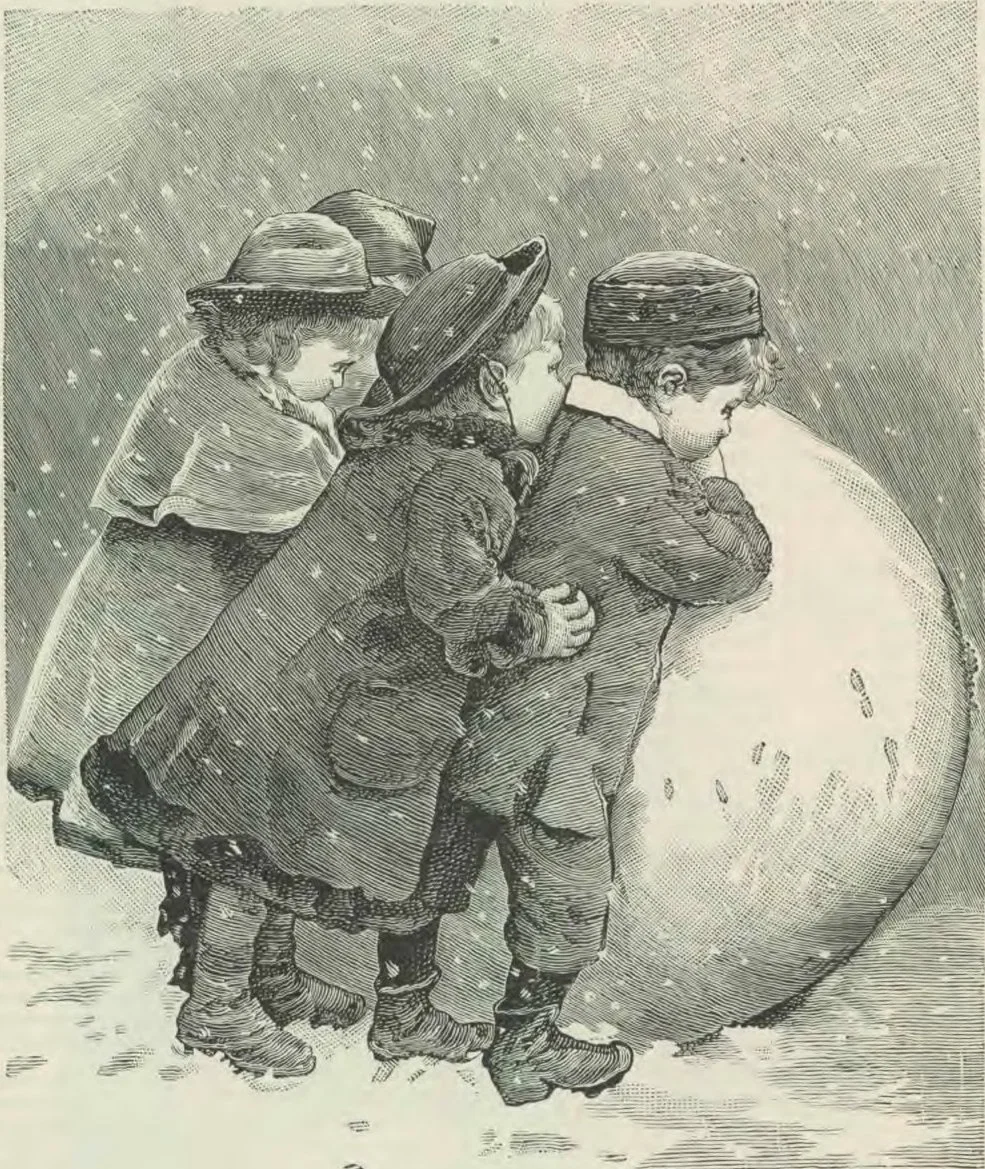
Such a frolic as there was, as the four tramped up and down, made wheels and zigzags on the smooth surface, and shouted themselves hoarse! They began a snow man, but by the time the tea-bell rang, they had only got one great big snow-ball rolled up for a foundation.
“Oh, see me smoke!” exclaimed Johnny, puffing out his breath, which curled in a frosty wreath above his head.
“Just like old Jacob’s pipe,” said Mabel. And at once four small faces were puffed and red in the effort to see who could make the largest cloud wreaths.
“Come, come! children,” called mamma from the door; “the bell rang ten minutes ago.”
Four reluctant pairs of feet turned towards the house.
“I say, papa,” said Fred, throwing his cap into the corner, and kicking off his overshoes, “what makes a fellow’s breath come out all white, like smoke, outdoors?”
“Well,” returned his papa. “I should like to have you put your cap and overshoes in the proper place before I answer your question.”
“I beg your pardon,” answered Fred, whose mamma had taught him to be as polite to his own folks as he would be to strangers, and he hurried to put the misplaced articles into the closet.
“What makes the smoke?” said papa, when Fred returned. “Your breath is warm and moist, and when you breathe into the cold air, the cold condenses the moisture in the warm air you breathed, and it makes a tiny cloud.”
“Oh,” said Johnny, breathing on his chubby red fist, “the breath is warm, but I don’t see any moisture in it;” and he looked as if he thought papa was joking.
“Just try it on the window that is farthest from the fire,” returned papa, noticing his doubting look.
Johnny went to the corner of the room, and breathed on the window-pane. His breath made a little blur on the glass, and presently a tiny stream of water trickled down.
“It’s so,” cried Johnny, pointing to the water drops, while all the children ran to try what they had tried a hundred times before but never thought about.
Then they sat down to supper, and papa supposed the matter was forgotten.
But he was mistaken. For Fred, who was more thoughtful than the others, had, in the evening, been quietly amusing himself by breathing on the corner window. As the cold had steadily and rapidly increased since sunset, the breath from Fred’s mouth, and the steam from the tea-kettle on the stove, had covered the window with beautiful frost pictures.
“It is very warm here,” said mamma. “Fred, please let down the window.”
Fred climbed up on a chair, and gave the window a push. As he did so, tiny particles of snow sifted down into his face.
“I say, papa,” said Fred again, “what makes it snow?”
“I thought you had forgotten all about such things,” his papa replied. “The same thing that made your breath turn into cloud-wreaths makes snow.”
Fred looked puzzled.
Papa explained. “Cold air cannot hold as much moisture as warm air. The wind that comes from the sea is warm. When it blows over the land, it strikes cold air from above the land, and that makes the moisture in the warm air gather into clouds. When the land air from the mountain-tops and other high places is cold enough, it freezes the vapor into little particles, and we have snow; when the land air is not so cold, the moisture comes down in rain.”},{
“You can see that it is so by remembering how your breath acted on the glass. Before supper, when it was warmer outdoors your breath stood on the glass in tiny drops; now the air outside is much colder, and your warm breath turns to frost on the windows.”
“It is very warm here yet. I think,” said papa, “that we can make it snow in the house.”
At this all the children started up, and mamma laid down her sewing.
“Snow in the house!” said Johnny, running to the window. “It is just as still outside, and the sky is all bright, and the moon shines.”
“So much the better,” said papa; “for now we can be sure that this snow does not come down from the sky.”
The air indoors was steamy from the boiling tea-kettle. Papa went to the window Fred had let down and pushed it up. “We must wait till it is a little warmer in this corner,” he said, and in a few minutes he called out, “Now, children, look;” and he opened and shut the window very quickly. Fine snow particles fell down into the upturned faces.
“It came off the window itself,” said Johnny, who was never ready to believe anything that was told him.
“No, it didn’t,” said Fred; “for the wind and snow came from the other way to-day, and this window is as dry outside as it is inside.”
“Fred is right,” said papa, who saw Johnny was going to dispute him. “The cold air rushing in through the open window met the warm, moist air that tried to rush out, and condensed the moisture, so as to make the tiny particles of snow. If the air were more moist inside, we could make snow that you could see plainer.”
“To-morrow is wash-day,” said Fred; “and I mean to go down to the kitchen when Ann boils the clothes, and see if I can make snow myself.”
“That is right,” papa replied; “when we can do so, it is very useful to try the experiments we learn about. Then we will know for ourselves that the things are so, and we will remember them longer.” W. E. L.

A PLEASANT SURPRISE.

SYBIL is a sick little American girl who lives at Berlin. She is not so ill as to have to stay in bed. She lies on a couch by the window much of the time, and on sunny days drives out with her mother in a warm, cosy carriage, drawn by two ponies.
It was on her drives that she learned to know Maggie and Willie. They are little peddlers. They are poor, and their parents are dead. So Maggie is the house-mother, and Willie is the man of the house. Their house consists of one small room.
At Christmas time Sybil and her mother planned a surprise for them. This surprise was a nice new stove. Their old one was dreadfully cracked. They could hardly keep a fire in it, and though it consumed lots of fuel, it did not keep them warm.
On Christmas Eve they were out as usual selling things, and Sybil and her mother drove round to their house, and Sybil was lifted out and carried up to see the new stove put in place. The little room was very bare, but exquisitely clean. The old cracked stove shone so you could almost see your face in it. It did not take many minutes for the two stove-men to take it down and put up the new one. A fire was made in the new one, and the coal box filled.
Then Sybil’s mother spread the supper-table with the contents of a basket she had brought, and Sybil put in the center a pretty vase filled with great red and white roses. Then two candles were lighted. They hurried a little while doing this for fear the little peddlers might come in and catch them at it; for they did not want them to know where the bright new stove and the supper and the roses came from.
As they went out, Sybil said to the servant who was carrying her, “Stay a moment and let me look.” So he paused in the doorway, and Sybil’s soft dark eyes grew full of a pleasant light, as she looked around the cosy little room; for cosy it was, and warm and bright, and the roses filled it with a sweet fragrance.
As they drove away, they saw the little peddlers coming. What they said when they opened the door, we shall never know. But we can easily imagine how it must have seemed to them, and how they grew warm in the warm glow, and with what appetites they ate the supper, and how they smelled and smelled the great red and white roses.—Our Little Men and Women.

Much Wisdom in Few Words

Much wisdom often goes with fewest words.—Sophocles.

LESSON 8.—CROSSING THE RED SEA.

INTRODUCTION.—This lesson continues the Bible narrative from the departure of the Israelites from Egypt to their arrival at the Red Sea, including their miraculous crossing of the latter and their wonderful deliverance from the pursuing army of Pharaoh.

QUESTIONS WITH NOTES AND COMMENTS.

1. WHEN the king of Egypt found that the Israelites had actually gone, how did he feel? Ex. 14: 5.
“And it was told the king of Egypt that the people fled.” Pharaoh could not have been ignorant of their departure, since he had himself given them permission and even urged them to depart; but he seems not to have thought that their purpose included more than the three days’ journey into the wilderness which constituted the first demand of Moses and Aaron. The expression of the text evidently conveyed to his mind the idea that they did not intend to return, which would naturally have aroused an intense feeling of reluctance in the minds not only of Pharaoh but of all the Egyptians, whose treasures the Israelites had “borrowed” from them. The readiness of Pharaoh to pursue the Israelites, notwithstanding the recent terrible judgments against him, must have been due largely to the peculiar condition in which he saw them placed. The natural route of their journey would have led them north of the Red Sea, and the strange proceeding of their marching southward along the sea into a place where all egress seemed to be cut off, may have led him to suppose that their God had forsaken them, and that they were entirely at his mercy.
2. What did he do? Verses 6, 7.
Josephus states that the army of Pharaoh on this occasion consisted of 300,000 men, 50,000 of whom were borne in chariots. The chariots were drawn by either two or four horses, and held usually three persons.
3. Had the Lord foretold this action on the part of Pharaoh? Verses 1-4.
4. Where did Pharaoh and his army overtake the Israelites? Verse 9.
The weight of evidence favors locating the camp of the Israelites at this time on a strip of land running parallel to the Red Sea, and bounded on the opposite side by the mountain chain of Attaka, about twelve miles below the present site of Suez. This strip of land opens southward into the Valley of Bedea, a broad, alluvial plain which is on its southern side shut in by the termination of another chain of mountains, thus cutting off any further progress in that direction to such a multitude as the Israelitish host. There remained to them only the alternative of plunging into the sea or going up the valley of Bedea, which would have taken them back to Egypt. By approaching them as he did from the rear, Pharaoh seems to have had the design of driving them back before him, or of destroying them if they refused to go.
5. When the Israelites saw the Egyptians, how did they feel? Verse 10.
6. How did they show their lack of faith in God? Verses 11, 12.
7. What words of courage did Moses speak? Verses 13, 14.
8. What did the Lord say to him? Verses 15, 16.
9. What did he say that the Egyptians would do? Verse 17.
10. How did the Lord protect the Israelites through the night? Verses 19, 20.
11. What way of escape did he prepare for them? Verses 21, 22, 29; Ex. 15: 8.
The act of Moses in stretching out his rod toward the sea in the sight of the host of Israel seems to have been designed mainly to convince the people that Moses was the chosen servant of God, through whom he would work for them, notwithstanding they had murmured as they had against him. The “strong east wind” here mentioned is a slightly figurative expression, used in the Scriptures to denote any uncommonly strong or violent wind, from whatever direction it blows. The purpose of this wind, which was doubtless hot and dry from the desert, seems to have been the drying up of the sea bed after the waters had been divided, rather than the sundering of the water itself, which at that place is said to be about eighty feet in depth.
12. When the Egyptians followed them into the sea, what did the Lord do? Ex. 14: 23-28; 15: 9, 10.
It is not probable that the Egyptians, confused as they must have been by the intense darkness which overshadowed them, more from the cloudy pillar in their front than from the night itself, knew that in following after the retreating Israelites they were entering the bed of the Red Sea between two walls of water. It is more likely that they imagined the Hebrews were retreating back towards Egypt. Mr. Bush says, in regard to the act of Omnipotence in troubling the Egyptian host: “We suppose the fact to have been that the side of the pillar of cloud toward the Egyptians was suddenly and for a few moments illuminated with a blaze of light, which coming as it were in a refulgent flash upon the dense darkness which had preceded, so frightened the horses of the pursuers that they rushed confusedly together, dashing the wheels of one chariot confusedly against another, upsetting, breaking, and tearing them from their axles, while the horses themselves, floundering in pools or sinking in quicksands, were thrown into inextricable confusion, and thus became an easy prey to the returning waves.” From the words of the psalmist (Ps. 77: 17, 18) there seems also to have been a commotion of the elements, with lightnings and tempests of rain or hail which beat in the faces of the Egyptians and made their progress extremely difficult.
13. What was it that enabled the Israelites to cross the sea? Heb. 11: 29.
When we take into consideration the circumstances in which the Israelites were placed in entering at night into the bed of the Red Sea between two threatening walls of water, not knowing with any certainty their destination or what was to be the outcome, it becomes evident to us that their action must have been accompanied by a sufficient exercise of faith to make true the statement of the above text.
14. What effect did this deliverance have upon the people of Israel? Ex. 14: 30, 31.
15. After such exhibitions of God’s power and his care for them, ought they ever to have feared again?
16. Why were all these things written? Rom. 15: 4.
17. What song did Moses and the children of Israel sing after their deliverance? Read Ex. 15: 1-21.
18. After the seven last plagues are poured upon the wicked, what song will the redeemed sing? Rev. 15: 2, 3.
19. Repeat the substance of this song. Rev. 15: 3, 4.

A DROLL MILK WAGON.

Domingo Andrada and his sister Marikena live in a very sunny land.
It is the land of Brazil, where there are fruits and flowers the year round, summer always; and every day at noon Domingo and Marikena cannot find their shadows; for the sun is right overhead, and their shadows are under their feet.
They love the sunshine, and instead of wearing broad hats and sunbonnets, they go bareheaded. They have black eyes and hair.
In their school room they sing all their lessons. Now, is not that a merry way? But it would sound funny to you; for it is in Portuguese, and so is all their talk and chatter.
Every morning they are up early, and out on the balcony watching for something. Soon they call out, “Leite, leite,” which means “milk, milk.” Do they see the milk wagon?—No; they see large, patient-looking cows, which are driven from door to door and milked. When their favorite cow comes along, they go down and see her milked, and she lets them pat her glossy sides.
At evening they watch the sunset over the mountains; but when the candles are lit, they follow the Brazilian custom.
Each child goes to father and mother, and, bowing the head, holds out the right hand and says, “A blessing, my father,” and, “A blessing, my mother.” Then the father and mother take the little hand and say, “God bless and keep you, my child.”—Anna R. Henderson.
Continue reading: QUEER NAMES FOR THINGS