The Youth’s Instructor, Vol. 30, No. 20.

HOW ENGLAND WAS REFORMED

The Youth’s Instructor

May 17, 1882

S. D. A. Publishing Association · Battle Creek, Mich. · May 17, 1882

HOW ENGLAND WAS REFORMED.

THE readers of the INSTRUCTOR have been shown in two previous talks how in the fourteenth century the people of England were enabled by the labors of John Wycliffe to know more nearly than they had before how God would have his people live. You were told about King Henry VIII. and his defiance of the pope of Rome in the early part of the sixteenth century, and also how Mr. Tyndale and Mr. Coverdale were the means of giving to the people the blessed word of God, from which they might learn for themselves the true way to serve him. You were also promised a talk about “Bloody Queen Mary,” and some of the men she was the means of killing, in trying to restore the Catholic religion.
The first whom she caused to be put to death because of his opposition to the pope and the Catholic religion was John Rogers. This man was born about the year 1500. After receiving a thorough education at the University of Cambridge, and after entering the priesthood there, he went to the city of Antwerp, in Belgium, to serve as chaplain to some Englishmen living there. Here he met Mr. Tyndale and Mr. Coverdale, who were then engaged in making the translation of the Bible which you were told about several weeks ago. He became convinced by talking with these men, that he was not living out God’s will himself nor teaching it correctly to others; and by assisting them in their work of translating, he learned the true teaching of the Scriptures. He then renounced the idolatrous worship of the church of Rome, and went to Wittenberg, Germany. This place was the home of the great reformers, Luther and Melanchthon, whose graves may still be seen there, together with Luther’s cell in the convent, and Melanchthon’s house. Here Mr. Rogers was given the charge of a congregation of Reformers, which he kept for many years, greatly increasing his learning all the time by diligent study.
In the reign of Edward VI., Mr. Rogers was invited to return to England, and was given an office in St. Paul’s cathedral, the second largest church edifice in Europe, the largest being that of St. Peter’s, at Rome. He held this office at the time of the accession of Queen Mary, and on the next Sunday after she made her triumphal entry into London, he preached a sermon in which he exhorted the people to adhere to the doctrine taught by himself and others in King Edward’s days, and to resist the ceremonies and belief of the Catholic church. But Mary and her ministers were determined to put down the Reformation in England, and so they summoned Mr. Rogers before them to answer for his sermon. But he defended himself so ably that they could find no excuse for punishing him, and he was dismissed. Soon after this, however, the queen issued a proclamation forbidding any one to preach any new doctrine or to read the Scriptures in the churches without her special permission. This action soon gave them an opportunity of again accusing Mr. Rogers, and after an examination he was ordered to remain in his own house.
At this time he could easily have fled to Germany, where he would have found peace, and obtained support for himself and his large family. Yet for the sake of defending the truth before the English people, he would not depart after being once called to answer in the cause of God, but was willing to hazard his life and the comfort of his family. At the end of six months he was taken to Newgate prison, where he was confined for two years. While here, he passed through three examinations of his belief, in which he defended himself alone against all the bishops who were assembled against him. Yet these men, prompted by hatred and envy, condemned him without any just cause to be burned alive as a heretic. This horrible and wicked sentence was carried out on the fourth of February, 1555. Just before leaving the prison for his execution, he requested the privilege of speaking a few words with his wife before his burning. His inhuman persecutors denied him even this last earthly boon! His wife with her eleven children met him on his way to the stake; but even the sight of his own flesh could not move him to accept the pardon brought to him at the stake if he would renounce his belief; for he answered, “That which I have preached I will seal with my blood.” And when taunted with being a heretic, he answered, “That shall be known at the day of Judgment.” All the way from the prison to the place of burning he repeated the fifty-first psalm, and at Smithfield, a spot in London since rendered famous by the many martyrs who have there laid down their lives for the truth of God, this man, the first of the Marian martyrs, was burned to ashes. C. H. G.

TRUST IN GOD.

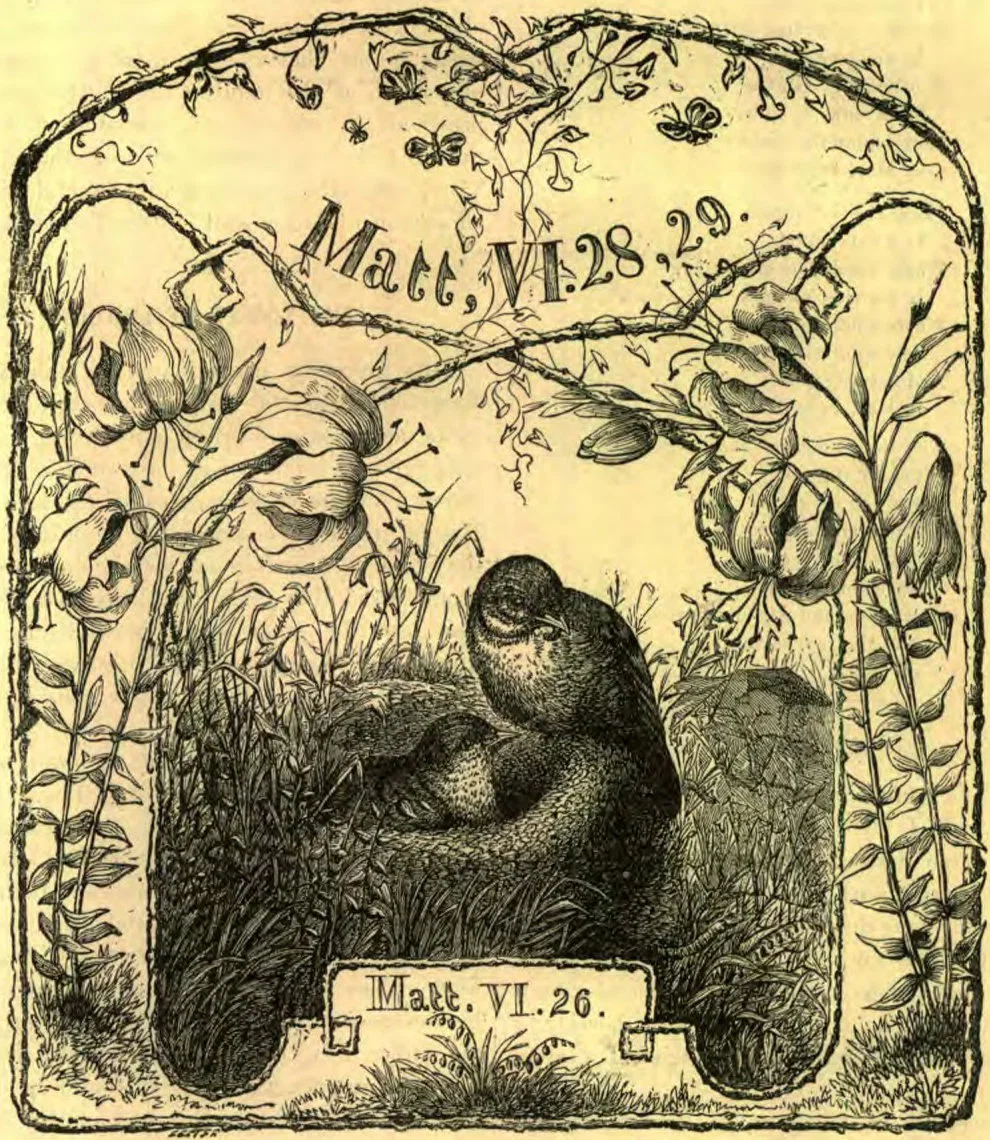
“Behold the fowls of the air; for they sow not, neither do they reap, nor gather into barns; yet your heavenly Father feedeth them. Are ye not much better than they?” Matt. 6 : 26.
The child leans on its parent's breast, Leaves there its cares, and is at rest: The bird sits singing by its nest, And tells aloud His trust in God, and so is blest ’Neath every cloud.
He hath no store, he sows no seed, Yet sings aloud, and doth not need; By flowing streams or grassy mead; He sings to shame Men, who forget, in fear of need, A Father's name.
The heart that trusts, forever sings, And feels as light as it had wings; A well of peace within it springs; Come good or ill, Whate’er to-day—to-morrow brings, It is His will! —Isaac Williams.

POLITE SLANG.

“Oh, it’s awful pretty, just too sweet for anything! May I try it on?” And Marion Hobart turned to her “dearest friend,” Frances Shaw, her fair face glowing with enthusiastic admiration.
“Certainly, my dear,” was the reply. “Oh, you look perfectly lovely! I almost wish it was yours, only I might die of envy. Your complexion is simply perfect, and mine is just horrid. I couldn’t look as pretty as you, tried I ever so hard.”
“O sweetest of flatterers!” Marion replied. “What signifies a complexion, with your superb hair and eyes? And think how splendid it is to have all the money you want to buy pretty things. Oh dear! I think I’m the one to die of envy.”
“Why, Marion!” said a gentle voice, in sad, reproachful tones.
“For pity’s sake, Sue, where did you come from? And what have I said that you should speak in such lugubrious tones? I didn’t suppose that you were within a mile of us.”
“Well, I’m willing to confess that I’m ashamed of myself,” said Frances. “Don’t you remember what Dr. Mann said four years ago, when we graduated from the grammar school? There were three words he begged us not to use till we were twenty-five. The words were ‘horrid, splendid, awful.’” And here we are, graduates of the High School, indulging in all sorts of extravagant expressions. Of course, I except you, Susie: you never say anything that isn’t just right.”
“O France, dear,” said Susie, “you are greatly mistaken there.”
“No, she isn’t,” said Marion. “You’re a sweet and patient saint. But illness has been an armor to shield you from the fiery darts of temptation to which poor France and I have fallen victims.”
“You incorrigible girl!” said Frances. “You know Sue never talked in the reckless way we do. Although she doesn’t say much about it, I know she refrains, from pure principle. And we’re church-members, as well as she.”
“Yes, ‘in good and regular standing’; and our communication should be ‘yea, yea, and nay, nay.’ And seriously, girls, I really wish to get rid of this very foolish way of talking. But the force of habit is sadly strong. Silly thoughts pop into my mind, and out they come. How can I help it, Sue?”
“Some one has said we cannot prevent the bird’s flying over our heads, but we may prevent their building their nests in our hair,—a pleasant way of saying that we must not harbor evil. We are not to blame if a wrong thought enters our minds: we are to blame if we cherish it. So with regard to these reckless forms of speech. They take the place of better and more earnest thought; and it seems to me that a person must grow shallow in proportion as she indulges in such thoughtless expressions. I should say, crowd out frivolous thoughts by meditating on something higher. Then, with the Saviour’s all-powerful aid, your efforts must be successful.”—Our Young People.

THE TOWER OF LONDON.

THIS Tower is denominated in the National Encyclopedia as, “a cluster of houses, towers, barracks, armories, and prison-like edifices.” On the tower-ground, comprised in thirteen acres, there are thirteen towers in what is called the inner ward. Besides these there are a few buildings outside the ward. The tower nearest the entrance to the ground, and that under which we pass by a gateway into the inner ward, is called the Bloody Tower. It is supposed that it was in this tower that the two royal children, the sons of Edward IV., were strangled, in 1483.
The White Tower, the first one built, was constructed under the direction of William, the Norman conqueror, in 1079-80. It measures one hundred sixteen feet from north to south, and ninety-six feet from east to west, and its height is ninety-two feet. It has an embattled roof with watch-towers at each corner, extending many feet higher than the roof. It consists of three stories, besides spacious vaults beneath. The external walls are fifteen feet thick. There is a wall seven feet thick running lengthwise of the building, dividing it from basement to summit, and another wall running crosswise, thus giving four rooms, two large and two small, on each floor. The ascent to the rooms of each story is by means of a winding stairway in the northeast corner.
This tower is now an armory. Some of its rooms are filled with curious weapons of the past, such as bows, arrows, lances, spears, shields, helmets, coats of mail, etc. In the department called the Horse Armory there are, in all, twenty-two equestrian figures, clothed in the armor of the various reigns from the thirteenth to the seventeenth century.
Most of the smaller towers were erected in the reigns of John, 1199, and Henry III., 1216, and these have been used as prisons. Various and curious are the devices and inscriptions cut by the prisoners, in the stones of these prison walls. One of the most interesting of these prisons is the Beauchamp Tower. In this have been confined dukes, earls, bishops, etc., some of whom were doomed to execution on Tower Hill, which is just outside the tower grounds. One royal prisoner has left this inscription, in Latin, “The more suffering with Christ in this world, the more glory with Christ in the next world.” Another wrote, “That which is sown by God in tears is reaped in joy.” It was immediately in front of this tower that the scaffold was erected on which some of the queens and noble ladies were executed, among them Annie Boleyn, and Lady Jane Grey.
Fox, in his Book of Martyrs, says that Lady Jane traced with a pin, on the walls of her prison room, in Latin, these words,—
“To mortals common fate thy mind resign, My lot to-day to-morrow may be thine.”
There is a chapel of St. Peters in the tower-grounds, and beneath this the remains of Lady Jane are deposited.
Among the many who were imprisoned in London Tower and then executed on Tower Hill, we may mention Cromwell, Archbishop Laud, and the Duke of Monmouth, who was proclaimed as a rival king to James II., at Taunton, Somerset, in 1685.
J. N. LOUGHBOROUGH.

MAY! SWEET MAY!

The spring in its beauty The spring-time, has come; The gay blossoms flutter About my home; The robin is warbling His blithe roundelay, And singing the praises Of May, sweet May.
The bees are beginning The honey to sip, And the butterflies, flitting, In sunshine dip; Whirling and dancing From spray to spray, They join in the praises Of May, sweet May.
I hear the soft music In all the wood, Where streamlets are leaping In merriest mood— Where wild birds are coming, And squirrels play, And nature rejoices In May, sweet May.
And shall I not hail thee, Beautiful Spring! For joy to my spirit Thy bright days bring. To God, the Creator, My homage I pay, And thank him who gives us The May, sweet May.
—Helen E. Brown.

THE PROMPT CLERK.

A young man was commencing life as a clerk. One day his employer said to him:—“Now, to-morrow, that cargo of cotton must be got out and weighed, and we must have a regular account of it.”
He was a young man of energy. That was the first time he had been intrusted to superintend the execution of this work. He made his arrangements over night, spoke to the men about their carts and horses, and, resolving to begin very early in the morning, he instructed the laborers to be there at half past four o’clock. So they set to work, and the thing was done; and about ten or eleven o’clock his master came in, and seeing him sitting in the counting-house, looked very black, supposing that his commands had not yet been executed.
“I thought,” said the master, “you were requested to get out that cargo this morning.”
“It is all done,” said the young man, “and here is the account of it.”
He never looked behind him from that moment—never! His character was fixed; confidence was established. He was found to be the man to do the thing with promptness. He very soon came to be one that could not be spared; he was as necessary to the firm as any one of the partners.

THE SPIDER'S HOME.

A CERTAIN spider, found in the southern part of Europe, makes a curious cradle to preserve her babies through the cold winter, so that the spider family shall not be exterminated. She makes a silk case somewhat the shape of a balloon upside down, not quite half an inch long, and fitted with a door, or cover, which may be opened, though she leaves it carefully closed. In this are placed the eggs, from which little spiders will come out in the spring. To protect them from enemies and the cold, the anxious mamma makes an outer case of exactly the same shape, only about an inch long, and of course larger all around, also fitted with a closed door. Between the two cases the space is stuffed with a golden-brown colored silk, which she spins herself, and makes it warm and comfortable inside. The whole thing is hung to a bush, and left throughout the winter.

SCENES IN THE LIFE OF CHRIST.

LESSON 69.—GOD'S CARE FOR HIS CHILDREN; THEIR DUTY OF WATCHFULNESS.

And Jesus continued speaking to his disciples and the people who were gathered to hear him, as follows:—
“Therefore I say unto you, Take no thought for your life, what ye shall eat; neither for the body, what ye shall put on. The life is more than meat, and the body is more than raiment. Consider the ravens; for they neither sow nor reap; which neither have storehouse nor barn; and God feedeth them; how much more are ye better than the fowls? and which of you with taking thought can add to his stature one cubit? If ye then be not able to do that thing which is least, why take ye thought for the rest? Consider the lilies, how they grow: they toil not, they spin not; and yet I say unto you, that Solomon in all his glory was not arrayed like one of these. If then God so clothe the grass, which is to-day in the field, and to-morrow is cast into the oven; how much more will he clothe you, O ye of little faith? And seek not ye what ye shall eat, or what ye shall drink, neither be ye of doubtful mind. For all these things do the nations of the world seek after; and your Father knoweth that ye have need of these things. But rather seek ye the kingdom of God; and all these things shall be added unto you.”
Jesus did not mean by this talk to forbid people from taking care to provide for their own temporal wants, but simply to warn them against being too anxious about them, and thus making the things of this life of more importance than their eternal welfare.
Then the Saviour spoke to his followers these words of comfort, “Fear not, little flock; for it is your Father's good pleasure to give you the kingdom.” He bade them to be willing to sell of their goods to give to the poor, and urged them to provide themselves bags, or purses, which would not grow old,—“a treasure in the heavens, that faileth not, where no thief approacheth, neither moth corrupteth.” “For,” said he, “where your treasure is, there will your heart be also.”
Jesus then began to talk to his disciples as if he were speaking to all who should believe on him down to the end of time. He taught them that they should always live in readiness to meet him, whenever he might appear, and warned them against being so taken up with their own business and pleasure that they should not be ready to receive him. He compared the waiting of his followers to the waiting of servants for their master when he was to return from his wedding, according to Eastern custom. He said: “Let your loins be girded about, and your lights burning; and ye yourselves like unto men that wait for their lord when he will return from the wedding, that when he cometh and knocketh, they may open unto him immediately. Blessed are those servants whom the lord when he cometh shall find watching . . . Be ye also ready; for the Son of man cometh at an hour when ye think not.”
But if one of those servants should say in his heart, My lord delayeth his coming, and so begin to beat the men-servants and maidens, and to eat and drink and be drunken, “the lord of that servant will come in a day when he looketh not for him, and at an hour when he is not aware. . . . And that servant which knew his lord's will, and prepared not himself, neither did according to his will, shall be beaten with many stripes; but he that knew not, and did commit things worthy of stripes, shall be beaten with few stripes: for unto whomsoever much is given, of him shall be much required; and to whom men have committed much, of him they will ask the more.”

QUESTIONS.

1. How did Jesus caution the disciples against being too anxious about the things of this life? Luke 12:22
2. What did he teach them was of more importance than food and raiment?
3. What did he say about God's care for the ravens?
4. By what words did Jesus teach that our anxious thought and care cannot change things, unless God shall use his power to help us? Verses 25, 26.
5. What did he say about his Father's care in clothing the lilies of the field?
6. What lesson are we to learn from this? Verse 28.
7. Why is it unnecessary for the followers of Jesus to be over-anxious about their temporal wants? Verse 30.
8. What is promised to those who will make their eternal good of first importance? Verse 31.
9. What words of comfort did Jesus speak to his followers in all ages?
10. What did he bid them be willing to do?
11. With what did he urge them to provide themselves?
12. How may this be done?—Real purses may become old, and lose out the money put into them; but those who give of their means to help God's poor, lay up their treasure in heaven,—a treasury that never fails.
13. Where will one's heart be likely to be?
14. How did Jesus now begin to talk to his disciples?
15. What did he teach them?
16. Against what did he warn them?
17. To what did he compare the watching of his followers?
18. How were they to be prepared? Verse 35.
19. Why was it necessary for servants waiting for their lord to be always in such a state of readiness? Last part verse 36.
20. What blessing was pronounced upon servants who should be found so waiting?
21. What admonition is given to those who profess to be looking for the coming of their Lord and Master in the clouds of heaven? Verse 40.
22. By what figure did he set forth the danger of those who should in their hearts put off the coming of the Lord? Verses 45, 46.
23. How was that servant to be punished who knew his lord's will, and yet did it not?
24. What difference was to be made in the case of one who, knowing not his lord's will, did commit things worthy of stripes?
25. What lesson did Jesus then draw from this figure? Verse 48.
26. Of whom will men ask most?
27. How, then, will it be likely to be in God's dealings with us?

NOTES.

Can add to his stature a cubit.—Stature means height. A cubit was originally the length from a man's elbow to the end of the middle finger. The cubit of the Bible is about twenty-two inches.
Is cast into the oven.—The ovens in the East are made of stone, clay, or brick, out of doors, as brick ovens sometimes are in this country. They are usually heated by burning in them dry grass, straw, or stubble, which the women gather for fuel. When the oven is hot, the ashes are removed, and bread placed within. So the grass is cast into the oven.
Let your loins be girded.—This refers to the ancient manner of dress. The men as well as the women of the East wore a long flowing robe as their outer garment. When they labored, or walked, or ran, it was necessary to gird, or tie, this up about the body, by a sash or girdle, so that it might be out of the way. So, to gird up the loins means to be ready, to be active, diligent.
Your lights burning.—Servants in the East were expected to be ready for the coming of their absent master at any hour of the day or night. At night they were to keep their lights trimmed and burning, and themselves continually ready to receive him, “that when he cometh and knocketh, they may open unto him immediately.”

NEW-TESTAMENT HISTORY.

LESSON 82.—REVIEW.

  1. What family of Bethany was especially beloved of our Lord? John 11.
  2. How was this family afflicted?
  3. How did they seek relief and comfort?
  4. What seeming indifference was manifested toward them in this time of great distress?
  5. What heavy blow in the meantime fell upon them?
  6. How did the Jews show respect for the family?
  7. Relate the conversation between Jesus and his disciples as he was about to start for Bethany.
  8. Give a description of Bethany.
  9. Relate the circumstances attending our Lord’s arrival at Bethany.
  10. Give an account of the miracle by which Lazarus was raised from the dead.
  11. Describe the effect of this miracle upon the Jews who witnessed it.
  12. What was said at a council called by the chief priests and Pharisees?
  13. What was the result of this council?
  14. How did these actions affect the course of our Saviour?
  15. How did Jesus rebuke the pride of his disciples before crossing the Jordan to come to Bethany? Luke 17: 5, 6.
  16. How did he give them a lesson on humility?
  17. To what did Jesus refer when he said to the Pharisees, “Behold, the kingdom of God is within you”?
  18. How did Jesus intimate that these proud Pharisees were so blind as not to appreciate the privilege of listening to the teaching of the Son of God?
  19. How did he describe his second coming?
  20. How did he describe the state of society that will exist at that time? Luke 17: 26–29.
  21. How does he set forth the folly of trying to shield ourselves in the day of trouble?
  22. Relate the parable of the wicked judge and the importunate woman. Luke 18.
  23. What was this parable meant to teach?
  24. What other lesson did he give on the subject of prayer? Verses 9–14.
  25. To whom was this parable especially addressed?
  26. After relating the parable, how did Jesus impress its meaning?
  27. What lesson did he teach concerning divorce? Mark 10.
  28. Tell how he received little children.
  29. How did he make use of this circumstance in teaching an important lesson?
  30. In what respects must Christians become like little children?
  31. Relate the conversation that Jesus had with the rich young man. Mark 10: 17–23.
  32. By what remarks did Jesus show that it is impossible for any one to live a holy life without help from God?
  33. What precious promises did he make to those who will forsake all for his service?
  34. How was the quality of mercy illustrated in the parable of the laborers? Matt. 20: 1–16.
  35. What did Jesus say to his disciples about the trials and sufferings that he was about to endure? Mark 10: 32–34; Luke 18: 31–34.
  36. How did the sons of Zebedee show their desire for preferment? Matt. 20: 20–28; Mark 10: 35–45.
  37. What did Jesus say to them?
  38. What course did he recommend for all who are troubled with such desires?
  39. Tell how the two blind men were healed near Jericho? Luke 18: 35–43; Matt. 20: 29–34.
  40. What may we learn from our Lord’s visit to Zacchaeus?
  41. By what parable did our Lord show that every one is required to do all he can in the service of God?
  42. Tell how Mary anointed Jesus. Matt. 26: 6–13; Mark 14: 3–9; John 12: 1–11.
  43. What did he say to those who complained of her extravagance?

The Bible as the Foundation of Education

If we are wise, we shall make the Bible the corner-stone and top-stone in our education. All education has grown out of religion. History has moved along by the power of religion. This day came to us as it is, because it has been preceded by a wide and deep study of the word of God.

Government Sunday-School Census of the United States

THE first official Sunday-School census of the United States is now being taken by the Government. This is a recognition of the importance of the Sabbath-school, which it is gratifying to secure. The gathering of the statistics has been placed in the charge of Mr. John D. Wattles, of the Sunday School Times.

THE BOOK OF REMEMBRANCE.

Sometimes teachers keep a book containing the names of their pupils, and after each name the teacher, every night, places a number telling the department and scholarship of the day. In that book is set down every failure in lessons, and every instance of disobedience that comes to the teacher’s knowledge. But there are many things that book does not tell. The teacher cannot know all that goes on in the school-room; and there are sins no one can see. The wicked thoughts, the mischievous plans, the acts which children would do if they dared, the feelings of anger, and hatred, and rebellion, and envy, and other evil passions, no human eye can see, no earthly pen can record. But there is an eye that sees it all, and a book of remembrance in which all is written. “The eyes of the Lord are in every place, beholding the evil and the good;” and in the day of Judgment the books will be opened, and all shall be “judged out of those things which are written in the books, according to their works.” Rev. 20:12.
If I should say, “All that never disobeyed their parents, or told a lie, or said a bad word; all who were never angry or saucy; all who never did wrong or thought evil in any way, may say, ‘I,’” how many would speak? Not one in the world can say, “I have never sinned.” And if every boy and girl who reads this should from this time never do anything naughty, or think anything sinful, still in God’s book of remembrance those old sins would stand black and dreadful.
What can be done with the past? Cannot the fearful record be removed? O blessed, joyful hope! God will forgive the past. He will wash away your sins, when you earnestly ask it in Jesus’ name.
Sometimes you have removed pencil marks with a rubber, leaving the page white and clean. The Lord says: “I, even I, am he that blotteth out thy transgressions for mine own sake, and will not remember thy sins.” With perfectness unequaled by human cleansing, “the blood of Jesus Christ, His son, cleanseth us from all sin.” And when the books are opened, those whose page is fair and clean, will enter into the golden city, and be happy for evermore.—Little Christian.

THE PALMYRA PALM.

Among the great family of palms none perhaps is more useful than the palmyra palm. In the province of Tinnivelly, in South India, very little rain falls, and in consequence of the excessive drought, much of the land is uncultivated. Standing on a mountain about twenty miles from Cape Comorin, the beholder may look down upon both Tinnivelly and Travancore at once. Travancore is beautiful, with its mantle of green over hill and dale, and its bright lakes and rivers, while Tinnivelly, with its low, red sand-hills, shows few signs of cultivation. But here, in this parched and sandy district, the palmyra palm flourishes. The cultivation of this palm involves little trouble or expense. If the nut be cast into the ground and loosely covered over with sand, it requires no more thought or care. Perhaps two or three years may pass before the young palmyra appears above ground, but during this interval it has been busy working its way into the heart of the earth in search of water. A missionary once told us that when a well was being dug somewhere on his grounds, he found the long, stringy roots of the palmyra forty feet beneath the surface, and still working their way downward. This furnishes a reason why the palmyra flourishes best in a loose, sandy soil, and why in the hottest season of the year its crown yields a constant supply of cool, sweet sap.
The Hindoos say that there are eight hundred and one uses of the palm. Certain it is that every part of the tree can be made useful to man. But the most valuable product of the palmyra palm is the sap.
The palmyra palm grows to a height of from sixty to ninety feet, and its tall stem is usually perfectly straight, but its bark is rough from the scars of former leaves. It is destitute of branches, like other palms, but is surmounted by an erect plume of fan-shaped leaves.
The sap flows for seven or eight months of the year, and is obtained, not from the trunk, as in the maple, but from the flower-stalk or spadix at the top of the tree. A palmyra-climber is furnished with a crutch, which, when about to climb, he rests against the stem of the tree to assist him in his ascent. He thrusts his feet through a loop of rope, to keep them close together, and clasps his arms around the trunk of the tree, and draws himself up a little way; then again extending his hands and drawing up his feet, he continues his difficult and dangerous ascent, and if accustomed to the work, soon reaches the top of the tree.
With his rude tools he cuts away the old leaves, and bruises or slices the extremities of the flowering branches, which furnish the sap, and hangs a little earthen vessel to each flower-branch to receive the sap as it flows drop by drop. It is the business of a climber to ascend the tree morning and evening to trim the spadix, and to empty into a basket made of palmyra-leaf, which he carries with him fastened to one side of his waistcloth, all the sap that he finds collected since his last ascent.
The female members of the climber’s family convert the sap into sugar by boiling. The wife gathers the firewood from the jungles and carries it home on her head. The sap is put into large earthen pots and boiled down over a slow fire. When sufficiently cooked, it is poured into molds, each formed of half a cocoanut-shell, and when cooled and hardened, is a coarse, dark sugar. If clarified and refined, it makes an excellent sugar-candy. Palm-sugar is largely used as food. The surplus sugar is sold to purchase rice or the coarse and scanty clothing usually worn by the natives. Fifty palm trees will support a family.
Thus does God, our loving Father, supply the wants of his creatures in every part of the habitable globe.—Helen H. Holcomb.

PRAY AND HANG ON.

WHEN little Tom was six years old, he went into the forest one afternoon to meet the hired man, who was coming home with a load of wood. The man placed master Tom on the top of the load, and drove homeward. Just before reaching the farm, the team went briskly down a steep hill. When Tommy entered the house, his mother said:—
“Tommy, my dear, were you not frightened when the horses went trotting so swiftly down Crow Hill?”
“Yes, mother, a little,” replied Tom, honestly; “but I asked the Lord to help me, and hung on like a beaver.”
Sensible Tom! he joined working with praying. In all troubles ask God to help you, and help yourself with all your might.
He who hath led will lead, He who hath blessed will bless, He who hath fed will feed; Can he do less? He fainteth not, He faileth never, So trust in Him, To-day, forever. —Home Guardian.

LETTER BUDGET.

Lena Walker, of Dallas, Texas, says: “I want to write you a few lines to express to you our thanks for the valuable papers which we receive every week. I am eleven years old, and not an Adventist, but I attend Sabbath-school regularly, and read the INSTRUCTOR with a great deal of interest. We have a nice Sabbath-school, and I like all the members very much. I wish the INSTRUCTOR a long and prosperous life.”
Nevmo M. Jennings writes from Cherokee, Kansas. She says: “I am eight years old. I like to go to Sabbath-school, and enjoy learning my lessons. My two oldest brothers, Byron and Malcom, take the INSTRUCTOR. When we are done with them, I take them to school and give them to my school-mates. Last winter I got my teacher to sign the teetotal pledge. I am trying to work for Jesus, and I love to do it.”
Clara Beaman writes from Beaman, Iowa. She says: “I am living with my grandma. I went to school this winter. We have to go ten miles to meeting. It is now two weeks to Quarterly Meeting, and if grandma is able, we shall go. I have one brother and no sister. My grandma takes the Signs and Review. I love to read the INSTRUCTOR. I have never written for a paper before.”

THE BREATH OF SPRING.

The breath of spring is in the air, And in the damp morasses; The earth already groweth fair With hints of coming grasses. The blue-bird warbles in the tree, With now and then a robin; And with the coming life to be, All nature’s heart is throbbing.
The brooklets tinkle in the glade, And silver-thread the meadow, Or steal along, as half afraid, They glide beneath the shadow. The timid crocus lifts its head, Above the dark leaves peering; The tiny violet from its bed Looks up, as nothing fearing.
The ice has melted from the streams, The snow from off the hedges; In silver flecks the sunlight gleams Along the forest edges; And with a sigh of spring-like breeze, A sweet, delicious sobbing, The voice of bird and air and trees, All nature’s heart is throbbing.
—Good Words.

You have reached the end of this edition.

The Youth’s Instructor · May 17, 1882