The Youth’s Instructor, Vol. 33, No. 16.

THE SKYLAK

The Youth’s Instructor

May 6, 1885

S. D. A. Publishing Association · Battle Creek, Mich. · May 6, 1885

THE SKYLAK.

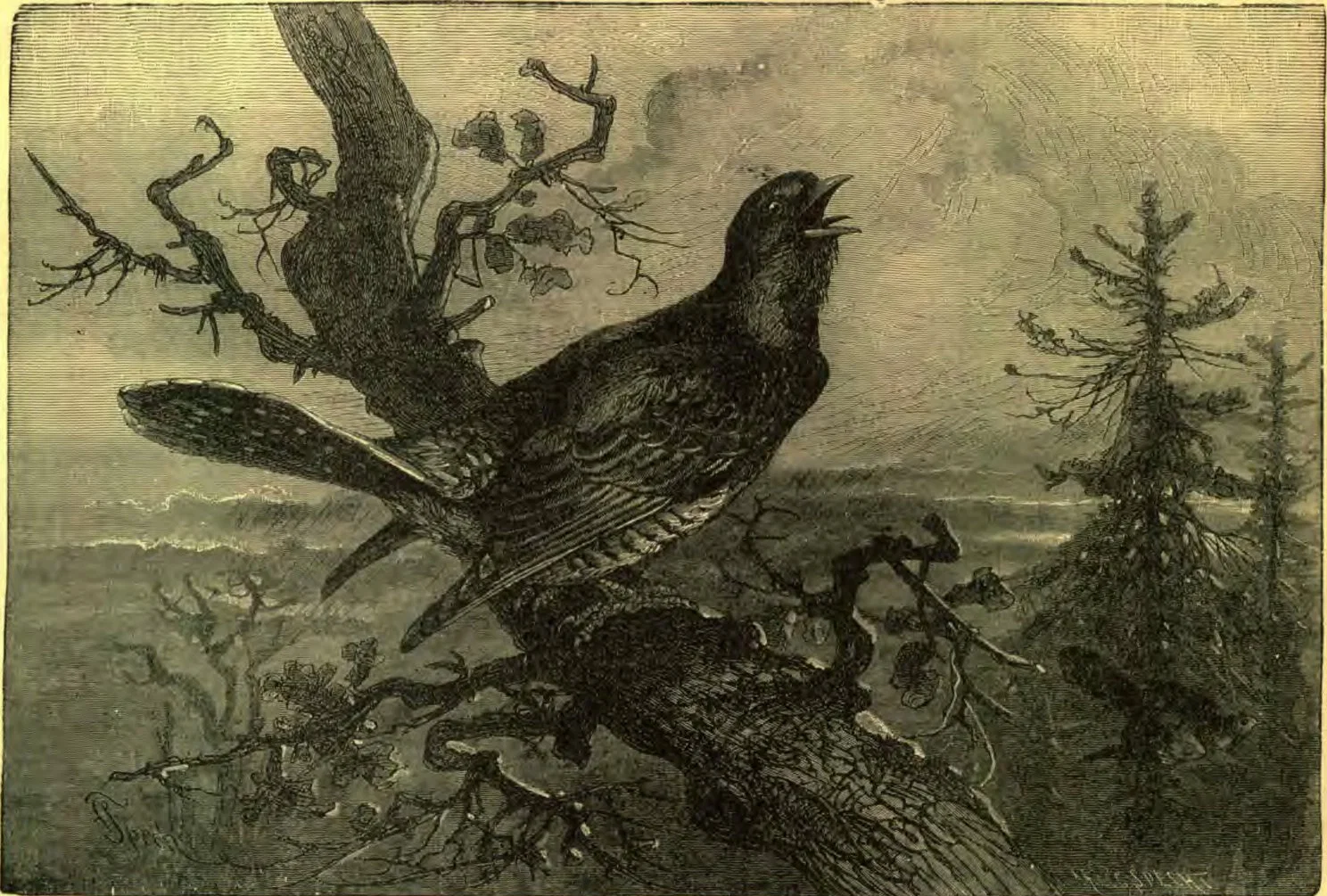
Bird of the wilderness, Blithesome and cumberless, Sweet be thy matin o'er moorland and lea! Emblem of happiness, Blest is thy dwelling-place— Oh to abide in the desert with thee!
Wild is thy lay, and loud, Far in the downy cloud; Love gave it energy, love gave it birth. Where on thy dewy wing— Where art thou journeying? Thy lay is in heaven, thy love is on earth.
O'er fell and fountain sheen, O'er moor and mountain green, O'er the red streamers that herald the day, Over the cloudlet dim, Over the rainbow's rim, Musical cherub, soar, singing away!
Then, when the gloaming comes, Love in the heather blooms, Sweet will thy welcome and bed of love be! Emblem of happiness, Blest is thy dwelling-place— Oh to abide in the desert with thee!
—James Hogg.

MURILLO'S MULATTO.

NEARLY three hundred years ago, in the city of Seville, lived one of the greatest of Spanish painters—Bartolomé Estéban Murillo.
Many beautiful pictures painted by this master adorn the palaces of the Old World, while a few may be found in the possession of wealthy art-lovers on this side of the water.
In the church of Seville, one may see four beautiful paintings, one, a picture of Christ bound to a column, St. Peter in a kneeling posture at his feet, as if imploring pardon; another, a superb painting of St. Joseph; one of St. Ann; and a fourth, an exquisite picture of the Virgin Mother holding the infant Jesus in her arms. These paintings are largely sought, and long gazed upon, by all art-lovers who visit Spain, and are particularly admired by artists for their truthful beauty, delicate tints, and natural coloring.
But they are not Murillo's.
These noble paintings, the pride and glory of Seville to-day, were conceived and executed by a mulatto, Sebastian Gomèz, who was once the slave, then the pupil, and in time the peer of his illustrious and high-minded master.
The childhood of Sebastian Gomèz was one of servitude.
His duties were many and constant. He was required to grind and mix the colors used by the young senors, who came at the early hour of six in the morning to take their lessons in drawing and painting in the studio of the great Murillo; to prepare and stretch canvas, run errands, and be ready at all times to answer the capricious demands of these high-born and imperious youths.
The poor mulatto boy had, however, in addition to a generous heart and amiable temper, a quick wit, bright intellect, and willing hands. His memory also was excellent; he was not without judgment, and, what was better than all, he was gifted with the power of application.
Intellect, wit, memory, judgment, are all good endowments, but none of these will lead to excellence if one has not a habit of industry and steady application.
Sebastian Gomèz, at the age of fifteen, found himself capable not only of admiring, but also of appreciating, the work of the pupils who wrought in his master's studio. At times he even fancied that he could detect errors and blemishes which they failed to note in their studies.
It chanced, sometimes, that he would drop a hint of his thoughts, when handling a maul-stick, or moving an easel for some artist student. “How droll it is that the sly young rogue should be so nearly correct in his criticisms!” one of the pupils would perhaps remark, after overhearing some quiet suggestion of the mulatto lad.
“Aye. One might think the slave a connoisseur,” would laugh another.
“Truly, it is owing to a cunning hint of his that my St. Andrew's arm was improved in the foreshortening.”
“It was Gomèz who detected first the harshness in my coloring of this St. Catherine's hands, and noted the false curve of the lower lip. The mulatto has the true eye for color, and in truth he seems to guess at form as readily as some of his betters.”
Such were the remarks that often followed the lad's exit as the young senors lightly commented upon his criticisms. There came a time, however, when the poor mulatto received from their lordly lips far other than light comment.
One day, a student who had been for a long time at work upon a “Descent from the Cross,” and who, but the previous day, had effaced an unsatisfactory head of the Mater Dolorosa, was struck dumb with surprise at finding in its place a lovely sketch of the head and face he had so labored to perfect. The miracle—for miracle it seemed—was inquired into; and examination proved that this exquisite head, which Murillo himself owned that he would have been proud to paint, was the secret work of the little slave Sebastian. So closely had he listened to his great master's instructions to the pupils, so retentively stored them in his mind, and so industriously worked upon them while others slept,—his custom being to rise at three in the morning and paint until five,—that he, the servant of the young artists, had become, unconsciously to himself as to them, an artist also. Murillo, upon discovering the genius of Gomèz, was enraptured, and declared that the young mulatto should be in his sight no longer a slave, but a man, his pupil, and an artist.
“Other masters leave to posterity only pictures,” exclaimed the glad master. “I shall bequeath to the world a painter! Your name, Sebastian, shall go down to posterity only in company with mine; your fame shall complete mine; coming ages, when they name you, shall call you ‘Murillo's mulatto’!”
He spoke truly. Throughout Spain to-day, that artist who, of all the great master's pupils, most nearly equals him in all his varied excellences, is best known, not as Sebastian Gomèz alone, but as “Sebastian Gomèz the mulatto of Murillo.”
Murillo had Gomèz made a free citizen of Spain, treated him as a son, and, when dying, left him part of his estate. But Gomèz survived his illustrious master and friend only a few years, dying, it is said, about the year 1590.—St. Nicholas.

DIVING-BELLS

Deep down in the sea are hidden rich treasures of pearls, corals, and sponges. Men have always coveted this wealth, but it was once very much harder to get than at the present time. The most expert divers could remain under water hardly two or three minutes at a time. If you try to hold your breath for just one minute, you will readily see what hard work it is to stay under water. Two minutes would not give time enough to explore the richly laden ships that had been wrecked at sea, and bring away the cargo.
Sometimes it was necessary to build bridges across wide, deep streams, and to clear away dangerous rocks from narrow channels, so as to make a safe passage for ships. It was very difficult to do this work, because men could not go under water to fix the foundations. “Necessity,” says the old proverb, “is the mother of invention;” and this necessity led to the invention of the diving-bell and the diving dress.
A very simple experiment will show the principle upon which the diving-bell is constructed. On plunging an inverted tumbler downward in the water, it will be found that at first the water does not rise up inside the tumbler,—that it remains empty and dry. As you plunge it down deeper, the water begins to rise a little. This is because the pressure of the water on the air that filled the glass, is so great that it condenses the air, and the water rushes in to fill the vacancy.
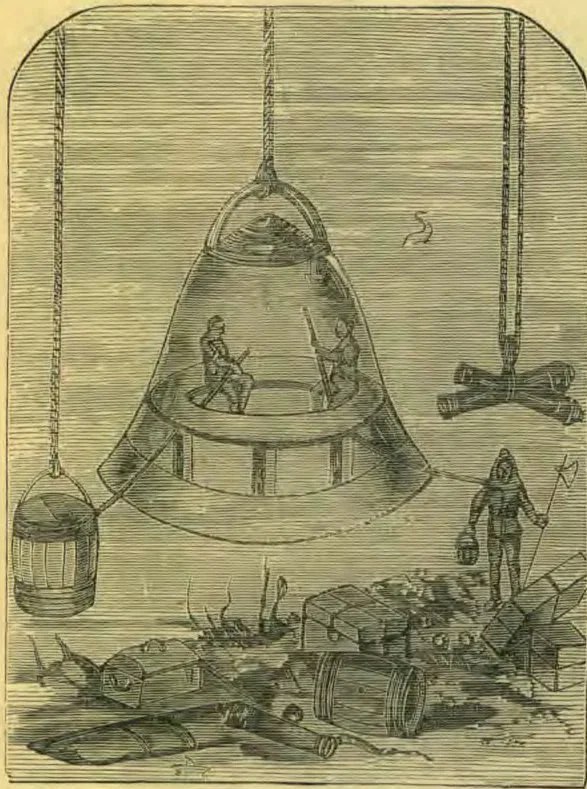
The first diving-bells were very simple,—nothing more than a large, air-tight, bell-shaped, wooden structure, bound with iron hoops like a barrel, and containing seats for the divers. But they could not remain long under water; for as soon as the fresh air in the bell was exhausted, they had to return to the surface, or perish.
Dr. Halley, a member of the Royal Society, who took great interest in diving and divers, set his wits to work to remedy the difficulty. In the above picture, you can readily see how this diving-bell looked, and the method employed to keep up the supply of air. The bell, you remember, was made of wood; but the artist has very accommodatingly drawn it so that we can see inside. It was lighted by heavy glass windows.
Dr. Halley incased two barrels with lead so as to make them air-tight. Over a hole in the top of the barrel he screwed a leathern hose; and he made a bung-hole in the bottom, so that the water could rush in, as the barrel was lowered, and the air condensed. There were two of these barrels, so arranged that they could be lowered alternately, like buckets in a well. The hose could be brought around under the bell, and through it the fresh air rushed. From a stop-cock in the top of the bell the foul air escaped with such force as to make the surface of the water boil. So long as the bubbles rose to the surface, those above knew that all was right down below.
Sometimes a diver, having on his head a copper helmet that has glass windows in front, went down with the bell. To his helmet was attached a leathern hose, extending up into the bell, so that he could be supplied with air.
Many improvements have been made in the diving-bell since Dr. Halley’s time; yet the general plan is the same. The air is now supplied by a force-pump, and a long rubber hose conducts the air from the pump to the top of the bell.
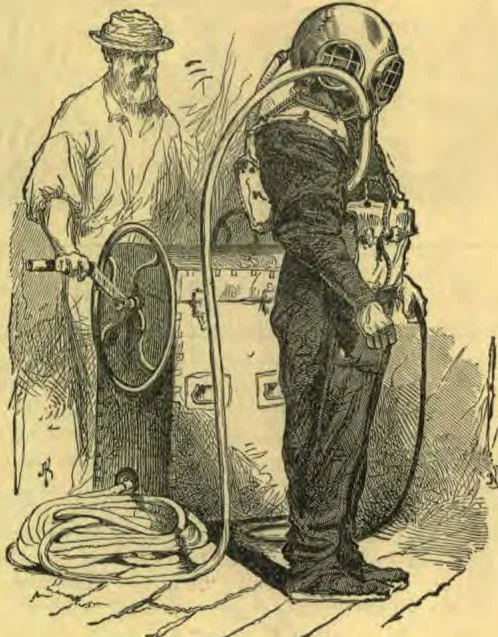
A less expensive apparatus is the diving dress, shown in the accompanying picture. The suit is made of India rubber, covered inside and out with tanned twill, to protect the rubber from injury. It is air-tight and water-tight. The helmet is made of tinned copper; the sleeves fit tight around the wrist, leaving the hands free; and to the soles of the shoes are attached heavy lead weights. Air is supplied by a force-pump, through a tube connected with the back of the helmet. There is an escape valve in the top of the helmet, the same as in the diving-bell.
Arrayed in this garb, the diver seizes the life line, and is swung off into the sea. The heavy leaden soles on his shoes carry him straight down, and help him to keep his footing while at work below. This dress does not add to the beauty of the wearer, and will probably never become fashionable, but it enables him to be eminently useful.
Diving is said to be a very profitable business, but it is attended with great danger. If the valves in the helmet should become clogged, or some careless person on shipboard should tread across the air pipe, thus cutting off the supply of air, life in the diving dress would very soon cease. It is not unfrequent to find the diver dead when he is hauled to the surface. It takes great resolution and presence of mind to become a good diver. If it were not for these brave men, who are willing to incur these risks, we would have scant knowledge of the strange life under the sea. “They that go down to the sea in ships, that do business in great waters; these see the works of the Lord, and his wonders in the deep.” W. E. L.

HOW TO SAVE TIME.

When people say they are doing this or that “to pass away the time,” they forget that “time is the stuff life is made of.”
Wasting time is the same thing as wasting life; and those who know how to economize time, have also learned the only possible way of lengthening their lives.
When you read the lives of famous persons, you will always find that they have been great workers. The celebrated Madame Roland was not only a politician and a scholar, but a housekeeper. In her “Appeal to Posterity,” she says: “Those who know how to employ themselves always find leisure moments, while those who do nothing are in want of time for everything.”
Mrs. Somerville, the famous astronomer, knew how to crowd a great deal into life. Young people are apt to suppose that one who was as learned as she was, must have spent all her life in hard study, and have had a very stupid time. But Mrs. Somerville learned to use her moments so carefully that she had time for many things besides her mathematics. She went into very brilliant society, read and wrote much, and—let me whisper to the girls—found time to make her own dresses and attend to many domestic duties, which some people would consider unworthy the attention of a great and learned mind. What helped her most, in all these varied employments, was that she had the power of so concentrating her attention upon what she was doing, that nothing going on around her could distract her thoughts.
It is true that all cannot do this, if they try ever so hard; but many who have not formed the habit of concentrating attention, cannot read to themselves or write an ordinary letter where others are talking.
Another good way of saving time is to learn to move quickly, not forgetting, however, that there is a kind of “haste” which “makes waste.” Try to acquire a dexterity in doing those common things which must be done very frequently. For instance, the operation of dressing has to be performed by all, many times in the course of a year; yet some people are always dressed at the appointed time, while others, who have been busy as long as they, are sure to be behindhand, because they have a habit of dawdling.
Whatever you have to do, learn first to do it in the best way, and then to be as short a time about it as is consistent with doing it properly. Those who take care of the moments find that the hours take care of themselves.
We waste more time in waiting for ourselves than we do in waiting for others; and after we have done one thing, we are often so long in deciding what to take up next, that when we have decided, the time is gone which we ought to have given to it. But those who are always ready to pass quickly from one occupation to another, will have accomplished all they had intended, while we have been thinking what to be at. If you have some definite idea in the morning of what you mean to do during the day, whether in work or play, you will do more than you will if you simply pass from one thing to another with no plan; and you will be more likely to do things at the proper time.
Another help to save time, is the habit of keeping things where they belong, so that you will not waste precious moments in looking for them. Have at least two books always in reading—one which does not require very close attention, for leisure moments, when you do not feel like doing much, and one solid one, which requires more continuous thought. I suppose this was the plan of the old lady who always sent to the library for “a sermon book and another book.”
It is surprising how much can be acquired by giving a little time each day to systematic reading. The story is often told of the young man who read through Macaulay’s History of England, and was surprised at its ending so soon, by a habit of reading a few pages each day, while he was waiting for his dinner. Of course, the same rule applies to other things, as well as to reading.
Do not imagine, after all this, that simply because you are always doing something, you are industrious. You may be worse than idle, if you are wasting not only time, but eyesight and material. Work must be to some purpose to be worthy of the name. It may be better to be idle all day, than to be reading trash, or straining your eyes and nerves over some intricate and useless piece of needlework. Many of these things are made only “to give away,” because people are too indolent to think of any gift more useful or appropriate.
Perhaps you will say that all this advice is of no use to you, because you have all the time you want now; but you must not forget that there are a great many people in the world who find it hard work to crowd into a day all that it is necessary for them to do, and they would be very glad to have you give some of your leisure to them. Unemployed time is a sure indication of neglected duty. Even the ant, in the old nursery rhyme, says:—
“I always find something or other to do, If not for myself, for my neighbor.”
When you have not enough to occupy you, look among your circle of acquaintances, and see who of them needs to have you “lend a hand.”—St. Nicholas.

THE OLD DOCTOR'S STORY.

“I HAVE a little story to tell you, boys,” the old doctor said to the young people the other evening. “One day—a long, hot day it had been, too—I met my father on the road into town.
“‘I wish you would take this package to the village for me, Jim,’ he said, hesitating.
“Now I was a boy of twelve, not fond of work, and was just out of the hay field, where I had been at work since day-break. I was tired, dusty, and hungry. It was two miles into town. I wanted to get my supper, and to wash, and dress for singing-school.
“My first impulse was to refuse, and to do it harshly, for I was vexed that he should ask me after my long day’s work. If I did refuse, he would go himself. He was a gentle, patient old man. But something stopped me; one of God’s good angels, I think.
“‘Of course, father, I’ll take it,’ I said heartily, giving my scythe to one of the men. He gave me the package.
“‘Thank you, Jim,’ he said. ‘I was going myself, but somehow I don’t feel very strong to-day.’
“He walked with me to the road that turned off to the town, and as he left, put his hand on my arm, saying again, ‘Thank you, my son. You’ve always been a good boy to me, Jim.’
“I hurried into town and back again. When I came near the house, I saw a crowd of the farm hands at the door. One of them came to me, the tears rolling down his face.
“‘Your father!’ he said. ‘He fell dead just as he reached the house. The last words he spoke were to you.’
“‘I am an old man now, but I have thanked God over and over again, in all the years that have passed since that hour, that those last words were, ‘You’ve always been a good boy to me.’”
No human being ever yet was sorry for love or kindness shown to others. But there is no pang of remorse so keen as the bitterness with which we remember neglect or coldness which we have shown to loved ones who are dead.
Do not begrudge loving deeds and kind words, especially to those who gather with you about the same hearth. In many families a habit of nagging, crossness, or ill-natured gibing, gradually covers the real feeling of love that lies deep beneath.
And after all, it is such a little way that we can go together!—Youth’s Companion.

IMPORTANT BIBLE SUBJECTS.

LESSON 48.—INHERITANCE OF THE SAINTS.

[NOTE TO THE STUDENT.—Do not consider the lesson learned until you can give at least the substance of every text, with the correct reference for each. The references in black letters indicate those texts that should be committed to memory. A little diligent application each day will enable you to do this.
1. AFTER Abraham had obeyed the command to offer up Isaac, what did the Lord swear to do? Gen. 22:16–18.
2. How numerous did he say Abraham’s seed should be? Ib.
3. Where have we found similar expressions? Gen. 13:16; 15:5.
4. What did the Lord say that Abraham’s seed should possess? Gen. 22:17.
5. What is indicated by the statement that his seed should “possess the gate of his enemies”?
6. Then with what other scriptures already learned is this parallel? Gen. 12:3; 13:15; Rom. 4:13.
7. What further shows that the promise in Gen. 22:16–18 is the same as those previously learned? Gen. 22:18, compared with Gen. 12:3; 18:18.
8. Why did the Lord say that he would do this thing? Gen. 22:18, last clause.
9. And what have we before found was the condition on which the promise was based? Gen. 18:19.
10. What did Stephen say as to the fulfillment of the promise recorded in Gen. 15:5 and 17:8? Acts 7:5.
11. What do we concerning all of God’s promises? 2 Cor. 1:20; 2 Pet. 3:9.
12. Then what must we conclude concerning these promises to Abraham?

NOTE

“AND thy seed shall possess the gate of his enemies.” The gate of a city is the place where the people go in and out. Whoever, therefore, controls the gate, controls the movements of the people of the city. Then to say that one possesses the gate of any place, is to say that he possesses the place. So the text just quoted must indicate that Abraham’s seed should conquer all their enemies, or, in other words, should have universal dominion in the earth. And this is just what the scripture affirms. Rom. 4:13. Abraham died without seeing the fulfillment of this promise. As Stephen says, he did not inherit enough land to set his foot on. But the promises of God are sure, and therefore we must conclude that this promise will yet in some way be fulfilled, and that not only Abraham’s seed, but Abraham himself, will possess the land.

CONDITIONS OF SUCCESS.

Looking at the teachings of Scripture, the example of the great Teacher and his apostles, and the ordinary experiences of Christian effort, we may venture to assert that as a rule, we have no right to expect conversion without previous conviction; nor conviction without impression; nor impression without attention; nor attention without interest. Conversely, therefore, the ability to secure the interest of a class of children is usually the first step toward becoming the means of their conversion to the love and service of the Redeemer.
Solomon has declared, in language which comes home to one's every-day life and business, “If the iron be blunt, and he do not whet the edge, then must he put to more strength; but wisdom is profitable to direct.”
The figure is as striking as it is plain and familiar. It calls up the image of the ancient carpenter, endeavoring to impart the first rough outline to a shapeless block of wood. Blow after blow is struck with force and precision, yet apparently with little result. The workman “puts to more force,” and wields his implement, until the strong arm is weary, and the sweat trickles off the furrowed brow. Yet how slowly the work goes on! The axe is blunt—wretchedly blunt—and the means of whetting its edge are not at hand.
Or we see another man similarly engaged. His strokes fall fast, and no little exertion seems to be employed. But the blows fall at random; now here, now there. The wood is chipped and scored in all directions, but we look in vain for definite form—the material is spoiled; and as for the axe, its edge is taken off by sheer misuse in unskillful hands. The axe has become blunted through ill-usage, and the result is as unsatisfactory as in the former instance.
The proverb is many-sided; but we are concerned with only one of its applications. Is not the blunted axe an object seen but too often in the hands of the Sabbath-school laborer? A teacher who fails to secure the interest and attention of his pupils, and whose apparently fruitless exertions we have compared to the strokes of a blunted axe, will be found in most cases to be at fault in one or both of these two respects,—his material is unsuitable, or he does not know how to use it. To put the statement in another form, his lesson preparation is faulty, either in respect to matter or to method—unfit in itself, or badly arranged.
A primary requisite for efficient preparation is restfulness. This is a jewel worn by few in these days of hurry and impatience; yet the effort to obtain it, if only for a while, will not be without its reward. Lessons thrown into shape under pressure generally bear marks of haste and crudity, and awaken only vexation, disappointment, and inattention, when delivered. Early commencement of preparation, solitude, meditation on the objects and responsibilities of the work, and prayer, will do much to promote calm, faithful, and earnest application to the solemn yet delightful task of searching the Scriptures, not only for personal profit, but for the enlightenment and sanctification of others.—Teacher’s Cabinet.

THE TARIFF.

It may be that the most our little readers know about taxes is the hard times they experience when the taxes come due; for it is then that father says, “Johnnie, you must wait awhile for your books, for I have the taxes to pay soon.” Mother says, “I would be glad to get what my daughter desires so much; but unless the taxes are paid promptly, we may lose our home.” Possibly it may sometimes cost an effort to meet these demands, yet all wish to submit gracefully to the regulations of our good Government, which has made its laws according to its best light.
Some of our young readers may have heard their parents talking about the tariff, but did not understand very well the meaning of the word. The St. Nicholas says:—
“There are two kinds of taxes—direct and indirect. One species of indirect taxation is what is styled the ‘Internal Revenue,’ which taxes domestic evils, like the liquor trade, and yields the Government an immense sum.
“But its favorite and most profitable indirect device is the ‘Tariff.’ Upon certain products and manufactures brought to our shores from other lands, it lays a ‘duty,’ or tax, and that duty must be paid to the proper Government officials (called ‘customs officers,’ or ‘custom-house officers’) before the things can be sold in this country. On every pound of figs brought to this country, the Government, through its ‘customs officers,’ collects two cents. Slates and slate-pencils from abroad must pay thirty cents for every dollar they are worth. When you buy these things, remember you are paying much more than actual values. A part of the excess goes into the treasury of the United States as ‘duty,’ or ‘indirect tax,’ for, of course, the dealer who imports these articles includes this extra cost in the price charged the purchaser.”
“You little folks have perhaps no idea how much you contribute every year to defray the expenses of our grand republic! Dolls and toys not made in this country must pay thirty-five cents on every dollar of their value! Bonnets, hats, and hoods, for men, women, and children; canes and walking-sticks; brooms, combs, jewelry, precious stones, musical instruments of all kinds, playing cards, paintings, and statuary,—these are also roughly jostled by this uncouth law.
“I should state, however, that all articles from abroad are not taxed. There is what is known as the ‘Free List,’ on which are placed certain imports exempt from duty, such as nux vomica, asafoetida, charcoal, divi-divi, dragon’s blood, Bologna sausages, eggs, fossils, and other articles! But the great bulk of important staples used in every-day life does not come within this favored class. Chemical products; earthenware and glassware; metals; wood and woodenwares; sugar; tobacco; provisions; cotton and cotton goods; hemp, jute, and flax goods; wool and woolens; silk and silk goods; books, papers, etc.; and sundries—thus reads the Tariff List.
“This is what is called ‘Protection.’ That is, putting heavy duties on foreign articles and commodities raises the prices of those foreign articles, and compels people to buy, instead, those made and produced by American industry.”

NOTHING IS LOST.

NOTHING is lost; the tiniest seed By wild birds borne or breezes blown Finds something suited to its need, Wherein ’t is sown and grown.
So with our words, or harsh or kind; Uttered, they are not all forgot; They have their influence on the mind, Pass on, but perish not.
So with our deeds, for good or ill, They have their power scarce understood; Then let us use our better will To make them rife with good!
—Religious Telescope.

PROTOPLASM

Protoplasm is a word not commonly understood by the young, but the growth of plants and animals is so dependent upon it, that it is an interesting subject for study. Here is what a writer in the Treasure-Trove says about it:—
“When one looks at a house, he sees it is built of bricks and mortar, or pieces of wood or stone; and no matter how many rooms, or how many stories high, or how beautiful the furniture, it is quite clear that the materials of this structure are either brick, wood, or stone. Now when a student looks at an animal, he wants to find out the component materials of which it is made. He studies over the matter a great deal, and cuts off sections, and puts them under a microscope, and by this means he finds that animals are made of cells. Now, I must stop and tell you that plants are made of cells also, and thus you will see there is a likeness between animals and plants.
“Cells in plants and animals somewhat resemble the cells in honey-combs, but most are round, though some are six-sided. Animals and plants are made up of cells; these cells are very small, indeed, and they are filled with a liquid. The cells of plants grow together, just as honey cells do; the side of one forms the side of another. The cells in animals are round like oranges; between them is a substance that connects them; in the center of each of the animal cells is a little spot called a nucleus.
“Scientists use the word protoplasm a great deal when talking about cells; it is a sort of a fluid which fills the cell, and has much to do with its growth. Now you must notice that as in a great city there are many workshops where curious things are made, so in the body of an animal there are thousands of cells where the work of the body is carried on. You eat beef, and flour, and potato; the cells take these substances, and make blood, bone, hair, flesh, nails, eyes, teeth, etc., from them. You see they must be very capable, indeed, and diligent—these cells. Beside this, the cells are constantly making new cells; the nucleus is the beginning of the new cell, and that new cell will have a nucleus in it. It is the protoplasm that seems to have the power to cause the cells to do their work. If you put a frog’s foot under the microscope, you can see the blood, running like little rivers, and the cells, the nucleus, and the protoplasm.”

AN INTELLIGENT DOG.

THE theory once so prevalent, that animals do not reason, and are governed in their habits only by instinct, is becoming less and less popular every year. It often seems as if some animals lacked only the gift of speech to make them as intelligent as men. Particularly is this true of the canine species. In the last number of the INSTRUCTOR a scrap was published, illustrating the strong attachment the dog has for his master; and here is something equally interesting, from the Child’s Companion, displaying a remarkable degree of intelligence in this animal:—
“Once upon a time, not very long ago, a gentleman lost his dog in Piccadilly. There was such a hubbub of carriages and carts and horses and people, that his whistle could not be heard, and so at last he turned sadly away, and went home alone.
“As he lived a little way out of London, he thought there was no chance of Scotty’s finding his way home, especially as he always went to town by train, and traveled many miles every week in hansom cabs.
“In about two hours a cab drove up to the door, and out jumped the dear old collie dog. The cabman rang the bell, and the gentleman went out and inquired where he had found his pet.
“‘O sir,’ said the cabman, ‘I didn’t find him, he found me! I was waiting in Piccadilly, looking out for a fare, when in jumps the dog. I thought it was very impudent of him, so I shouted to him to get out. Then I got down and shook my whip at him, and tried to pull him out, but never a bit did he care. He just sat still and barked, as much as to say, “Drive on, please.” I took hold of him by the collar to lift him out, and then I saw your name and address, so I thought I’d just drive him home. He seemed quite happy then, and I shut the doors, and he stood up on the seat, looking out as gravely as a judge, till we came to your house, and then he jumped out sharp.’
“You may suppose the gentleman gave the kind cabman a good reward, and loved his clever dog more than ever.”

BOOKS IN OLDEN TIMES.

How literally the prophecy is now being fulfilled, that “many shall run to and fro, and knowledge shall be increased.” If responsibilities have increased in the same ratio that books have multiplied during the last few centuries, this is a generation of whom much will be required. The editor of the Ladies’ Repository has made some statements regarding the scarcity of books from the thirteenth to the fifteenth centuries, inclusive, which may be of interest to our young friends:—
“Before the art of printing, books were so scarce that ambassadors were sent from France to Rome to buy one copy of Cicero’s works, and another of Quintilian’s, because a complete copy of these works was not to be found in all France. Albert Abot, of Gemblours, with incredible labor and expense, collected a library of one hundred and fifty volumes; and this was considered a wonder indeed. In 1494 the library of the Bishop of Winchester contained parts of seventeen books on various subjects; and, on borrowing a Bible from the Convent of Smithin, he had to give a heavy bond, drawn up with great solemnity, to return it uninjured. When a book was purchased, it was an affair of such importance that persons of distinction were called together as witnesses.
“Previous to the year 1300, the library of the University of Oxford consisted only of a few tracts, which were carefully locked up in a small chest, or else chained, lest they should escape; and at the beginning of the 18th century, the Royal Library of France contained only four classics, with a few doctrinal works.”

The Ice Palace.

In Greenland, the people sometimes live in houses made of ice. Does it not seem strange? But it is true. They have no timber, out of which to build, and tents made of animals' skins would be too cold. They pile up great blocks of ice, and cement them by pouring water over them.
These houses are round; and from a hole in the top the smoke ascends, and they put a sheet of clear ice in the wall for a window. In summer, of course, these houses all melt. Then they live in tents made of sealskins. In 1739, the Empress of Russia had built a grand palace of ice. It lasted till March, 1740. It was one story high, and had three rooms and a great hall. The outside was ornamented with statues carved in ice. The yard was inclosed with an ice balustrade. At the corners were ice pyramids, and between these were cannon carved out of ice, and ice dolphins mounted on pedestals. There was also an ice elephant, with a man upon his back. He had his trunk raised in the air, and spouted water out of it in the daytime and burning naphtha at night. The cannon could be loaded with real powder and fired. Lighted up with thousands of torches at night, the palace looked grand indeed, and it was surely a wonderful work.—Selected.

Sixteen American Inventions of World-Wide Adoption

The following are sixteen American inventions of world-wide adoption,—the cotton gin, the planing machine, the grass mower and reaper, the rotary printing press, steam navigation, the hot air machine, the India rubber industry, the machine manufacture of horse-shoes, the sand blast for grading, the gauge lathe, the grain elevator, artificial ice making on a large scale, the electro-magnet in its practical application, and the telephone.—The American.
Continue reading: FOR HIM