Your ShelfYour Projects

Signs of the Times, Vol. 26, No. 44.

THE VOYAGE OF LIFE

Signs of the Times

Oct 31, 1900

Pacific Press Publishing Company · Oakland, California · Oct 31, 1900

THE VOYAGE OF LIFE.
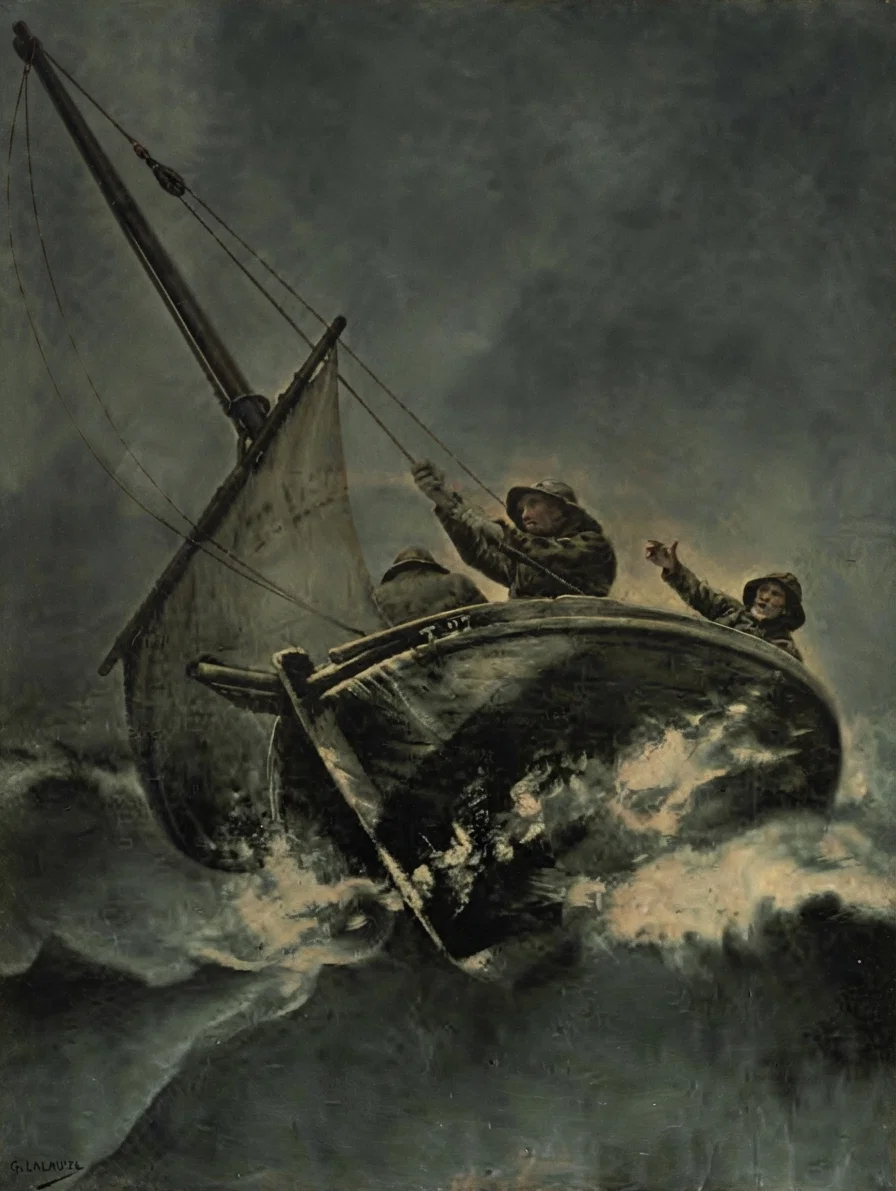
"THEY that go down to the sea in ships, that do business in great waters; these see the works of the Lord, and His wonders in the deep. . . . He maketh the storm a calm, so that the waves thereof are still. Then are they glad because they be quiet; so He bringeth them unto their desired haven."
MANY a sturdy ship has successfully battled against wind and storm for weary days and nights, and has at last been hopelessly wrecked at the very entrance of the port for which it has so bravely striven. On the open sea there is comparative safety. There the wisdom and strength of the captain and hardy seamen are usually sufficient to safely guide the vessel through storms into the calm waters. But dangers increase when the great ship nears the port. There hidden shoals and reefs abound; treacherous currents and winds change the vessel's course; and in the darkness fearful destruction may result by seeking an entrance to port between mistaken headlands.
So WHEN the land is neared, the experienced pilot is taken on board. He finds a path of safety even in the darkest night. Knowing the danger signals, and understanding the lights along the shore, he safely guides the vessel into its desired haven.
LIFE'S voyage is almost over. Evidences that the port is near are rapidly increasing. Within are quiet waters and peaceful rest, the glad home welcomes, the green fields and the fountains of the dear homeland. Without are perplexity, the roar and darkness of the tempest, hidden danger, and treacherous signals.
CHRIST, the divine Pilot, is seeking admission into human lives. He longs to lead past all earthly dangers to the heavenly port. In pleading accents He says, "Behold, I stand at the door, and knock;" and the promise is given, "If any man hear My voice, and open the door, I will come in to him, and will sup with him, and he with Me." Again He says, "When thou passest through the waters, I will be with thee." And again, "I will guide thee with Mine eye."
WHEN the disciples were storm-tossed in the darkness on Galilee, Christ approached and bade them "be of good cheer." "It is I; be not afraid," He said. "Then they willingly received Him into the ship; and immediately the ship was at the land whither they went."
MANY voyagers to the port of life are depending solely upon their wisdom and righteousness. The Lord pities such, and longs to aid them. He well knows how futile the effort will be, how bitter the disappointment, how fearful the shipwreck. The Lord will plead, but will not compel. We must willingly invite Him if we would have His leadership. There must be entire surrender of the vessel to the faithful Pilot, entire dependence upon His master mind, His infinite wisdom, almighty power, and unchanging love.
To THOSE who will thus trust His guidance, the Saviour speaks to-day: "Be not afraid!" "Be of good cheer!" And in the midst of earth's commotions and strife, the fearful tempest of oppressions and sin, when brave men's hearts are failing them for fear, the Master's "Peace, be still," is heard above the tumult, and the Christian mariner can say, "I will both lay me down in peace, and sleep; for Thou, Lord, only makest me dwell in safety."
HAVE you, dear fellow-voyager, surrendered all to the divine Pilot? "Behold, now is the day of salvation." Tarry not until the tempest thickens and the waves overwhelm. God's call is for to-day; it is the enemy who suggests to-morrow. If He who stilled the tempest on Galilee is for us, who can be against us? If we willingly receive Him, He will give us our heart's desire; He will surely bring us unto our desired haven. W. H. B. MILLER.

THE PARABLE OF THE VINEYARD.

IN the parable of the vineyard Christ opened before the Jews the past history of their nation, showing the deeds of unrighteousness they had done, notwithstanding the great light given them. In the immense congregation surrounding Christ there were many priests and rulers. The divine Teacher's gaze took in past, present, and future, as He presented before the Jewish rulers their own course of action. Messenger after messenger had been sent by God to the husbandmen in charge of the vineyard, to receive the fruits thereof. These messengers bore to the husbandmen a most solemn message. But they were shamefully treated by them. One was beaten, another stoned, and another killed.
Last of all, the owner of the vineyard sent His Son, saying, "They will reverence My Son." But when the husbandmen saw Him, they said, "This is the heir; come, let us kill Him, and let us seize on His inheritance."
As Christ described His vineyard, fenced about by the commandments of God, and as He spoke of the treatment His messengers had received, the Jewish rulers stood as if riveted to the spot; and when Christ asked, "When the Lord therefore of the vineyard cometh, what will He do to those husbandmen?" they joined with the people in answering, "He will miserably destroy those wicked men, and will let out His vineyard unto other husbandmen, which shall render Him the fruits in their season." With their own lips they pronounced their sentence.
Jesus looked upon them, and seeing His look, they knew that He read the secrets of their hearts. His divinity flashed before them with unmistakable power, and, seeing in the husbandmen a representation of themselves, they involuntarily exclaimed, "God forbid."
With heavenly light shining from His countenance, Christ said, "Did ye never read in the Scriptures, The Stone which the builders rejected, the same is become the head of the corner?" What an impression these words made upon those who heard them! If they had received Christ as the Sent of God, saying, "Blessed be He that cometh in the name of the Lord. . . . Thou art my God, and I will praise Thee; Thou art my God, I will exalt Thee," how different would have been their future! But they rejected Christ, and He declared, "Therefore I say unto you, The kingdom of God shall be taken from you, and given to a nation bringing forth the fruits thereof. And whosoever shall fall on this Stone shall be broken; but on whomsoever It shall fall, It will grind him to powder." The husbandmen had yielded to God no returns, and in these words is portrayed their final doom. The Stone lies passive under the treatment It receives. It is discarded, stumbled over, mocked at; but at last a living power takes possession of It. It seems to rise from the earth, and falls on those who have treated It with such contempt. On those who do not fall upon It and become broken, whose hearts are not cleansed by the mercy and forgiveness of God from hereditary and cultivated tendencies to wrong, that Stone will fall and grind them to powder.
"And when the chief priests and Pharisees had heard His parables, they perceived that He spake of them." Their hearts were filled with hatred toward Him, "but when they sought to lay hands on Him, they feared the multitude, because they took Him for a prophet."
Those who are true learners in the school of Christ will study with intense interest the parable of the vineyard. In this parable Christ presented the true condition of the once chosen people of God. He revealed to them their sinful breach of trust. He designed this parable to be a lesson to all, warning them that unless they walk in the ways of the Lord, keeping all His commandments, He can not bless and sustain them. The church on earth is greatly beloved by God. It is the fold provided for the sheep of His pasture. But the Lord will not serve with the sins of His people. Many times He has suffered calamity and defeat to come upon them because they have glorified themselves, weaving false principles into their practise. He willingly forgives those who repent, but He will remove His favor from those who go on sinning, exalting self, and mingling the sacred with the common. Terrible judgments will destroy those who have misrepresented Him, saying, "The temple of the Lord, The temple of the Lord, The temple of the Lord, are these," when their example is misleading.
In His daily life Christ gave men an example of the work they were to do. In the temple, in the highways and byways, by His parables, His miracles, His divine compassion and sympathy, He constantly declared, I came not to do My own will, but the will of Him that sent Me. He went about doing good, healing the souls and bodies of those who were sick; and when Pilate gave Him up to the rage of the people for whom He had done so much, it was with the words, "I find no fault in Him." His was a perfect humanity. In His life, activity and devotion were harmoniously blended. The day found Him teaching in the temple or healing the sick; and the night, praying in Olives for strength to complete His work. The Son of man, He must brace Himself for duty and temptation. He must have vigor of soul and body. He must leave His followers a perfect example of how to combat the enemy. And He prayed earnestly to His Father for strength to do this. For all who desire to follow Him, His example is left on record. Prayer sanctified His ministry. Strength and vigor for daily duty are derived from worshiping God in the beauty of holiness. The lamp must be filled with holy oil before its light can shine amid the moral darkness.
The Lord has a warning for His people. When men in positions of trust grow careless, when they disregard the requirements of God, when they abuse the influence and misappropriate the talents God has given them, they are abusing His goods, and punishment will surely come upon them. Those who are called by Christ's name are to wear His credentials, showing that they have learned His meekness, His lowliness, His compassion, His love for others. When Christians do this, there will be a different condition of things in the church; for Christ will be revealed. Humanity will be under the influence of divinity.
For the good of His church God has intrusted to men of His appointment the work of representing Him by their well-chosen words and their firm resistance of evil. The hearts of these men are to be tender and their characters symmetrical, that they may rightly represent the Saviour. But many in God's service are harsh and discourteous. Their spirits are loveless; for they are filled with selfishness and covetousness. They think they have a right to make their own terms regarding the value of their labor, and they become oppressive. If, after testing them, God sees that they will not repent, He removes them, and gives their place to men who will better represent Him. If those who are thus raised up by the Lord remain true and loyal, the Lord will work through them in a remarkable manner.
The confusion which weakens the church of God is a result of the work of unconsecrated men, whose narrowness of vision prevents them from seeing the loving-kindness shown them by God. They fail to see that God gives to them in order that they may impart to others. All the counsels of God are faithful and true. He disciplines His people that He may lead them in the right way. If they refuse to be instructed, if they will not heed the command to impart what they receive, God can not use them. When God's people become so blind that they lose sight of principle, when they partake of the same spirit that is stirring the hearts of the ungodly, they can not bear God's sign or seal. The severity of their punishment will be proportionate to the light which they had but to which they did not give heed.
Satan is constantly using mighty principalities and powers to destroy the chosen people of God. Unconsecrated Christians are aiding him in his work. All who fail to keep Christ in view are working away from the right. They are not gathering with Christ, but are scattering abroad. The life-giving power of Jehovah is more needed now than at any former period in the history of the church. God's people are to stand firm in the acknowledged strength of Jesus Christ. He is their refuge and defense.
True faith and sanctified work are greatly needed at this time. God says to His people, "Press together, press together; that you may not be destroyed as were the inhabitants of Jerusalem." "Come, My people, enter thou into thy chambers, and shut thy doors about thee; hide thyself as it were for a little moment, until the indignation be overpast. For, behold, the Lord cometh out of His place to punish the inhabitants of the earth for their iniquity; the earth also shall disclose her blood, and shall no more cover her slain." Persecution is coming, and God calls upon all to stand firm in Christian love, their hearts knit together, of one mind and one judgment. His people are to cleave to Him, and they are to love one another as He has loved them. Christ's life is to be their example. In love, in meekness, in humility, they are to follow Him.
MRS. E. G. WHITE.

The Friend Who Never Forsakes

"Truer still, and more loyal, and more potent to keep, is the Friend who never forsakes us, not even when we forsake ourselves. If you will let Him, He will come in when all other friends have failed you, and will give you help. His friendship abides in sunshine and storm. He forgives much because He loves much. When the whole world has gone, this loving Friend will love you still."

LESSONS FROM MATTHEW 24

THE SIGNS OF THE LORD'S COMING AND OF THE END OF THE WORLD.

(Concluded.)
THE sign "in the stars" is that "the stars shall fall from heaven" (Matt. 24:29; Mark 13:25), and that they shall fall "as a fig tree casteth her untimely figs when she is shaken of a mighty wind" (Rev. 6:13). And so, in 1833, it came to pass.
Extensive and magnificent showers of shooting stars have been known to occur at various places in modern times, but the most universal and wonderful which has ever been recorded is that of the thirteenth of November, 1833, the whole firmament, over all the United States, being then, for hours, in fiery commotion! No celestial phenomenon has ever occurred in this country since its first settlement, which was viewed with such intense admiration by one class in the community, or with so much dread and alarm by another. It was the all-engrossing theme of conversation and of scientific disquisition for weeks and months. Indeed, it could not be otherwise than that such a rare phenomenon,—next in grandeur and sublimity to that of a total solar eclipse, or a great comet stretched athwart the starry heavens in full view of a wonder-struck universe—should awaken the deepest interest among all beholding it. Nor is the memory of this marvelous scene yet extinct; its sublimity and awful beauty still linger in many minds, who also remember well the terror with which the demonstration was regarded, and the mortal fear excited among the ignorant that the end of the world had come. During the three hours of its continuance, the day of judgment was believed to be only waiting for sunrise, and, long after the shower had ceased, the morbid and superstitious were still impressed with the idea that the final day was at least only a week ahead. Impromptu meetings for prayer were held in many places, and many other scenes of religious devotion, or terror, or abandonment of worldly affairs, transpired, under the influence of fear, occasioned by so sudden and awful a display.
But, tho in many districts the mass of the population were thus panic-stricken, through fear as well as want of familiarity with the history of such appearances, the more enlightened were profoundly awed at contemplating so vivid a picture of the apocalyptic image—that of "the stars of heaven falling to the earth, even as a fig-tree casting her untimely figs, when she is shaken of a mighty wind." In describing the effect of this phenomenon upon the black population, a southern planter says:—
"I was suddenly awakened by the most distressing cries that ever fell on my ears. Shrieks of horror and cries for mercy could be heard from most of the negroes of three plantations, amounting in all to some six or eight hundred. While earnestly and breathlessly listening for the cause, I heard a faint voice near the door calling my name. I arose, and, taking my sword, stood at the door. At this moment I heard the same voice still beseeching me to rise, and saying, 'O my God, the world is on fire!' I then opened the door, and it is difficult to say which excited me most—the awfulness of the scene, or the distressed cries of the negroes. Upwards of one hundred lay prostrate on the ground, some speechless, and others uttering the bitterest moans, but with their hands raised, imploring God to save the world and them. The scene was truly awful, for never did rain fall much thicker than the meteors fell towards the earth; east, west, north, and south it was the same." In a word, the whole heavens seemed in motion.
The display, as described in Professor Silliman's journal, was seen all over North America. The chief scene of the exhibition was within the limits of the longitude of 61° in the Atlantic Ocean, and that of 100° in Central Mexico, and from the North American lakes to the southern side of the island of Jamaica.
Over this vast area, an appearance presented itself far surpassing in grandeur and magnificence the loftiest reach of the human imagination. From two o'clock until broad daylight, the sky being perfectly serene and cloudless, an incessant play of dazzlingly brilliant luminosities was kept up in the whole heavens. Some of these were of great magnitude and most peculiar form. One of large size remained for some time almost stationary in the zenith, over the falls of Niagara, emitting streams of light which radiated in all directions. The wild dash of the waters, as contrasted with the fiery commotion above them, formed a scene of unequalled and amazing sublimity. Arago computes that not less than two hundred and forty thousand meteors were at the same time visible above the horizon of Boston! To form some idea of such a spectacle, one must imagine a constant succession of fire-balls, resembling sky-rockets, radiating in all directions, from a point in the heavens near the zenith, and following the arch of the sky towards the horizon. They proceeded to various distances from the radiating point, leaving after them a vivid streak of light, and usually exploding before they disappeared. The balls were of various sizes and degrees of splendor; some were mere points, but others were larger and brighter than Jupiter or Venus; and one, in particular, appeared to be nearly of the moon's size. But at Niagara no spectacle so terribly grand and sublime was ever before beheld by man as that of the firmament descending in fiery torrents over the dark and roaring cataract. . . .
The point from which the meteors seemed to issue was observed, by those who fixed the position of the display among the stars, to be in the constellation Leo. At New Haven it appeared in the bend of the "sickle"—a collection of stars in the breast of Leo—a little to the westward of the star Gamma Leonis. By observers at other places remote from each other, it was seen in the same constellation, altho in different parts of it. An interesting and important fact in this connection is, that this radiating point was stationary among the fixed stars, that is, that it did not move along with the earth in its diurnal revolution eastward, but accompanied the stars in their apparent progress westward.—"Our First Century," pp. 329, 330, 332.
In all of these extracts the italics are those of the book itself.
"And upon the earth distress of nations with perplexity." This is so to-day in all the nations; for years it has been so, and it only grows worse. Note that it is not simply distress of nations; this might be, and it might be borne with comparative equanimity, because they might see a way of escape. But it is not so in this word, nor in the time of the fulfilment of that Word; for this is "distress of nations with perplexity." They do not know which way to turn to find assured relief from the distress, and ways that they do take deepen rather than relieve the distress and perplexity.
And everywhere to-day men's hearts are failing them for fear, and for looking after those things that are coming on the earth. Among all classes of people there is this fear because of what is already before them, and wondering what can be the worse which they certainly fear is coming.
Then said Jesus, "When these things begin to come to pass, then look up and lift up your heads; for your redemption draweth nigh." Luke 21:28. They began to come to pass in 1780, and then this redemption was drawing nigh.
And next He says, "When ye shall see all these things, then know that it [His coming] is near, even at the doors." Matt. 24:33. All people can now see all these things. All the signs mentioned as coming "upon the earth," and among the nations and among men, can be seen in the events of the times in which we live to-day; and the signs that were to be in the heavens, and which were the beginning ones, all can see in the authentic records of the events. And to-day being the time when all can "see all these things," it is settled by the Word of the Lord that now is the time when He would have all to "know that He is near, even at the doors."
"But of that day and hour knoweth no man, no, not the angels of heaven, but My Father only." Matt. 24:36. The definite time, the day and the hour, the times and the seasons, of His coming "the Father hath put in His own power" (Acts 1:7); and no one, neither man nor angel, can ever make it known. And every one who ever attempts to know it is deceived; and every one who ever attempts to make it known, is both deceived and a deceiver.
But, tho no one can ever make known the day and hour of the Lord's coming, this in no-wise affects the truth that all may know when His coming "is near, even at the doors;" for He said, "When ye shall see all these things, know that it is near, even at the doors."
And now is the time. ALONZO T. JONES.

HOW MUCH REDEMPTION INCLUDES.

THERE is much more included in the redemption brought to man through Jesus Christ than is generally supposed. The argument is sometimes adduced by the advocates of Sunday sacredness that the first day of the week is observed to commemorate the finished work of redemption. Before accepting as correct an assertion thus designed to set aside one of the precepts of Jehovah, spoken with His own voice, and written in stone with His own finger, it might be well to ascertain if redemption has been fully completed; for it would be out of place to observe a memorial in honor of an event not yet fully consummated.
Redemption means a redeeming, purchasing, or bringing back of something which was lost. In the plan of salvation it includes the restoration of all that was lost through the transgression of Adam. In Luke 19: 10 we read, “The Son of man is come to seek and to save that which was lost.” When man sinned, he lost not only his innocence—the moral image of God—and his life, but his beautiful home as well. The Scriptures speak of the “times of restitution of all things.” Acts 3: 21. When this time comes, as it surely will, we shall see the original plan of the Creator carried out,—man clothed with eternal life and purity, and restored to his Eden home. Not until this is accomplished can redemption be said to be complete. Mighty events in this tremendous drama are yet to be enacted.
Said the Saviour, after giving the signs which were to appear as immediate precursors of His second coming, “And when these things begin to come to pass, then look up, and lift up your heads; for your redemption draweth nigh.” Luke 21: 28. Tho drawing “nigh,” it was still future. Again, in Rom. 8: 23, we read, “And not only they, but ourselves also, which have the first-fruits of the Spirit, even we ourselves groan within ourselves, waiting for the adoption, to wit, the redemption of our body.”
Thus we see that redemption includes transformation of the body. Now we can sing, “Redeemed, how I love to proclaim it,” andcan rejoice in redemption from forgiven sins through Jesus Christ (Eph. 1: 7); but at the resurrection another step in the stupendous and mysterious problem will be taken, in the redemption from the power of death of this “vile body,” and it will be “fashioned like unto His glorious body” (Phil. 3: 21). The Lord says, “I will ransom them from the power of the grave; I will redeem them from death.” Hosea 13: 14. Not until the last sinner to be saved has been redeemed from the power of his sins, and the voice of the Archangel has penetrated the long galleries of hades, can we speak of redemption being finished. But this step in the “mystery of godliness” draws on apace. He will soon announce the mystery “finished,” and come to gather His elect.
Then, as before noted, man will be placed in his Eden home, and the purpose of God in forming the earth will be carried out. When man was created, he was placed in a home adorned with everything pleasant to the sight. When he sinned, he was driven out, lost his home, and ever since has been an exile. On every hand can be seen the marks of the curse. The Lord purposed that man should inhabit the earth forever; “for thus saith the Lord that created the heavens; God Himself that formed the earth and made it; He hath established it, He created it not in vain, He formed it to be inhabited.” Isa. 45: 18.
Man stood at the head of all created things,—the king of the earth. But when he sinned, the dominion given him by his Creator passed into the hands of the devil, who, by usurpation, became “the prince of this world.” John 14: 30. But this inheritance and dominion, wrested from man by fraud, have been purchased back. “In whom [Christ] ye also trusted, after that ye heard the word of truth, the Gospel of your salvation; in whom also after that ye believed, ye were sealed with that Holy Spirit of promise, which is the earnest [pledge] of our inheritance until the redemption of the purchased possession, unto the praise of His glory.” Eph. 1: 13, 14. “And Thou, O Tower of the flock [Christ], the stronghold of the daughter of Zion, unto Thee shall it come, even the first dominion, the kingdom shall come to the daughter of Jerusalem.” Micah 4: 8. The “first dominion” is that given by the Creator to Adam. He lost it; but Jesus, through His death, has purchased it back, and through Him it will be restored to His elect.
At a tremendous cost the Son of God has purchased back for man all that he lost by the fall; and He offers it to him without money and without price. The time will come when there will be “no more curse,” and the restoration of all things will have been accomplished. The blot of sin will have been wiped out, the universe cleansed, and man, redeemed from death, will be made immortal, and be placed in his Eden home.
This is a regeneration, a re-creation. It will take the same power to effect this that it required to make the earth and all that is therein in the beginning. It will be a new heaven and a new earth. It will be the work of that same creative power through Jesus Christ that was exercised in the formation of the earth. And as we behold the eternal beauties of the new creation, we shall be reminded of the power of our Redeemer. The memorial of creative power—the Sabbath—will remain, and it will be observed to all eternity. “For as the new heavens and the new earth, which I will make, shall remain before Me, saith the Lord, so shall your seed and your name remain. And it shall come to pass, that from one new moon to another, and from one Sabbath to another, shall all flesh come to worship before Me, saith the Lord.” Isa. 66: 22, 23.
Reader, is redeeming power working in your heart? Are you looking with joy to the time of the fulness of redemption, and the fruition of the Christian’s hope?
G. B. THOMPSON.

SIN AND THE SABBATH.

THE second chapter of Genesis records the institution of the Sabbath, and the third chapter describes the manner in which the human race was brought into the condition of sin. Thus the Sabbath was instituted before sin entered the human heart. After sin had entered, there was revealed to man the remedial system of the Gospel; and those who accepted that system expressed their faith by offering sacrifices which pointed forward to the sacrifice of “the Lamb of God, which taketh away the sin of the world.” Thus we see that the whole sacrificial system grew out of the condition of sin, and pointed forward to the One who was to take away that condition.
During the Levitical age many annual sabbaths were observed in connection with the typical service. See Leviticus 23. In the third verse of this chapter the weekly Sabbath is spoken of as the Sabbath of the Lord. Then follows an enumeration of the annual sabbaths. These were to be observed “beside the Sabbaths of the Lord.” Verse 38. Thus we see that the observance of the weekly Sabbath was separate and distinct from those annual, typical sabbaths which were a part of the sacrificial system growing out of the condition of sin, and pointing to the Saviour.
Now it is self-evident that the whole system of shadows must pass away when the great Sacrifice which is foreshadowed was made on Calvary. This passing out of shadow into sunshine was signalized by the rending of the vail of the temple when Jesus hung on the cross. The crimson tide which takes away the condition of sin, is now flowing. The vail of sin separating between man and God was rent asunder on Calvary, and by faith we may now “enter into the holiest by the blood of Jesus, . . . through the vail, that is to say, His flesh.” Heb. 10:19, 20.
“Let no man therefore judge you in meat, or in drink, or in respect of an holy day, or of the new moon, or of the sabbath days; which are a shadow of things to come; but the body is of Christ.” Col. 2:16, 17.
The above scripture clearly shows that all those meats and drinks, holy days and sabbaths which were observed in the shadow of the cross, vanished away, with the system of which they were a part, when the Sun rose on Calvary. Every soul who fully accepts the great Offering there manifested, is emancipated from that condition of sin out of which the typical service grew, and is therefore no longer subject to any of its requirements.
The observance of the weekly Sabbath rests upon a basis entirely different from that of the annual sabbaths. Instead of growing out of the condition of sin, the weekly Sabbath was ordained as a memorial of God’s creative power before man sinned. And when sin is banished from the heart, and the soul is born again, or re-created, the Sabbath remains as the memorial of the creation of a new heart. The reason assigned in the fourth commandment for Sabbath observance is that all things were made by creative power; and the more we see and know of that power in our own hearts, the greater reason we have for Sabbath observance. Those who have no experimental knowledge of the operation of divine power in the creating of a new heart, can not truly keep the Sabbath, or obey any other precept of God’s law; for says the apostle, “The carnal mind is enmity against God; for it is not subject to the law of God, neither indeed can be.” Rom. 8:7.
From the above scripture it is evident that sin and true Sabbath observance can not dwell together in the same heart. It is also evident that any effort to compel sinners to observe the Sabbath is an attempt to force them to do that which God has declared to be impossible. Those who are seeking to enforce the observance of the first day of the week by civil law, show that they have a mistaken idea of the nature of true Sabbath observance. It is impossible to enforce real Sabbath observance even on the real Sabbath; but to enforce Sabbath observance on Sunday is absurdly impossible.
We have seen, then, that the sacrificial system, with all its annual sabbaths and holy days, grew out of sin, and foreshadowed the great Sacrifice which takes away that sin, and that when Christ died on Calvary, all those shadowy ordinances necessarily passed away, because there was no longer any reason for their existence. We have also seen that the weekly Sabbath was ordained as a memorial of God’s creative power before the advent of sin into the human heart; and that after sin has been eradicated from the heart by that same power, through faith in the blood of Jesus, there is a re-creation, and the reason for Sabbath observance is stronger than ever.
The Sabbath rests on the eternal rock of truth, whose summit is kissed by the sunlight of Calvary, and we shall see that it will outlive all the time-serving structures built on the sands of error, and tower above the wrecks of time after the foul miasma of sin has been fully eradicated from the universe.
GEO. A. SNYDER.

HE KNOWETH BEST.

HE knoweth best; I can not tell Why He doth lead me so, Why mist, and cloud, and darkness hide The steps where I must go; But, "This way, child, lies Canaan's rest," He whispers oft, who knoweth best.
He knoweth best; I can not see Ofttimes His guiding hand; What hidden purposes are His I may not understand; But of His goodness I'll attest, And trust Him, for He knoweth best.
He knoweth best; my heart's desire Perhaps would only prove An idol I would fondly shrine Between Him and my love. Tho He denies my heart's request, 'Twill be because He knoweth best.
He knoweth best; perhaps for me Are weary hours of pain; Life's bitterest cup of grief may be Held for my lips to drain; Tho He permits this fiery test, I'll trust Him still, He knoweth best.
He knoweth best; thus all along I'll let Him choose for me; With Him to lead I will not fear, Tho dark the way may be. So peace shall come into my breast The while I sing, "He knoweth best." —E. E. Miles.

The Repentant Sinner

God sees the repentant sinner when he is still a great way off, meets him with forgiveness, and puts upon him the robe of Christ’s righteousness.

"IN SECRET HAVE I SAID NOTHING."

SECRET societies are multiplying. On every hand are secret chambers where men and women band themselves together, under oaths and penalties not to divulge the secrets of the order, whatever they may be. Many inducements are held out for people to join these secret organizations. By paying certain sums in dues, large sums are promised the families of deceased members. These things seem all right in viewing them from a worldly standpoint, but there is no example of Christ to follow in entering these secret chambers. He said plainly, "I spake openly to the world; I ever taught in the synagog, and in the temple, whither the Jews always resort; and in secret have I said nothing."
Positively Jesus gave Himself to the world. He put no seclusion on any portion of that precious life. None ever found Him engaged so busily that the needy one could not come close to Him for the healing of any trouble, either of body or soul.
It may be said, "But did not Christ take the twelve into a chamber alone the last night He was with them, and there commune with them?"—Yes, He thus met with His disciples. There was nothing said, however, that could be called secret. Even this precious instruction, falling from His lips on this occasion, was for the world. For Jesus had before instructed them, saying, "What I tell you in darkness, that speak ye in light; and what ye hear in the ear, that preach ye upon the housetops." Matt. 10:27. It is plain, then, that whatever Jesus told His disciples on the night of His betrayal, or at any other season of communing with them, was for the purpose that they should present it later to the world.
This seclusion is selfish; therefore it is not of Christ. Why keep it secret? O, it is too good to be told! If it is of real good to one, why should it not be equally valuable to another? The principle is wrong. God's blessed Gospel, the best news ever published in this world, is freely offered to every soul, free or bond, rich or poor, learned or unlearned. All are equally rich with it, all are equally poor without it. Freely it is given, freely it is to be passed on to others in need of its blessed saving qualities. "Freely ye have received, freely give."
There is no secret revealed unto the Son by the Father (since that Son gave Himself for us) that is not revealed by that Son unto His children on earth. "Henceforth I call you not servants; for the servant knoweth not what his lord doeth; but I have called you friends; for all things that I have heard of My Father I have made known unto you." John 15:15. "And the glory which Thou gavest Me I have given them." Chapter 17:22. "For I have given unto them the words which Thou gavest Me." Verse 8. "That the world may know that Thou hast sent Me, and hast loved them, as Thou hast loved Me." Verse 23.
This is perfect love, and therefore is Christian love. Anything short of this reveals not to the world in its fulness the love of Jesus Christ.
Secret things belong unto God, but whatever He reveals is for us and our children. Let not the follower of Christ seek to retain the light and blessing God may have put into the heart for the enlightenment and help of some other soul equally precious, toiling along life's way in darkness. Go not into the secret chambers in search of Christ. He is not there. "Wherefore if they shall say unto you, Behold, He is in the desert; go not forth: behold, He is in the secret chambers; believe it not." Matt. 24:26. But, dear soul, He may be found. Read this: "I will be found of you, saith the Lord." "Then shall ye call upon Me, and ye shall go and pray unto Me [alone in the closet], and I will harken unto you. And ye shall seek Me, and find Me, when ye shall search for Me with all your heart." Jer. 29:12-14.
T. E. BOWEN. Rome, N. Y.
Continue reading: BLESSINGS IN DISGUISE