The Youth’s Instructor, Vol. 48, No. 22.

BEAUTIES OF SOUTHERN CALIFORNIA

The Youth’s Instructor

May 31, 1900

Review and Herald Publishing Company · Battle Creek, Mich. · May 31, 1900
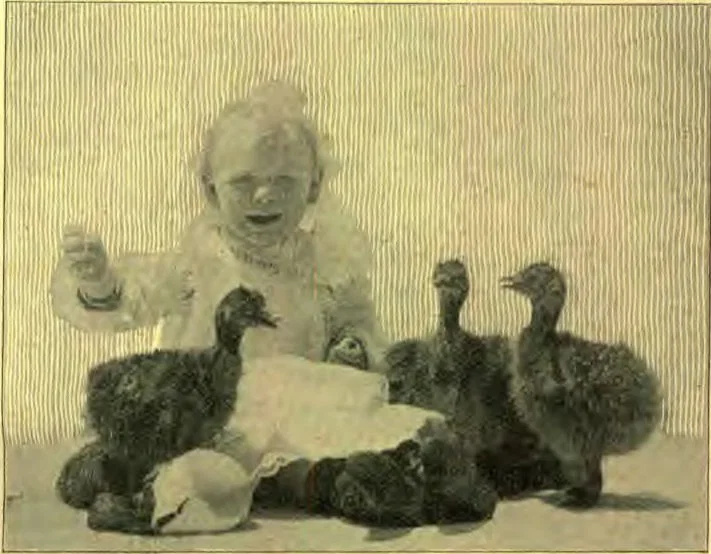
PRIZE BABIES
PRIZE BABIES

BEAUTIES OF SOUTHERN CALIFORNIA

VII
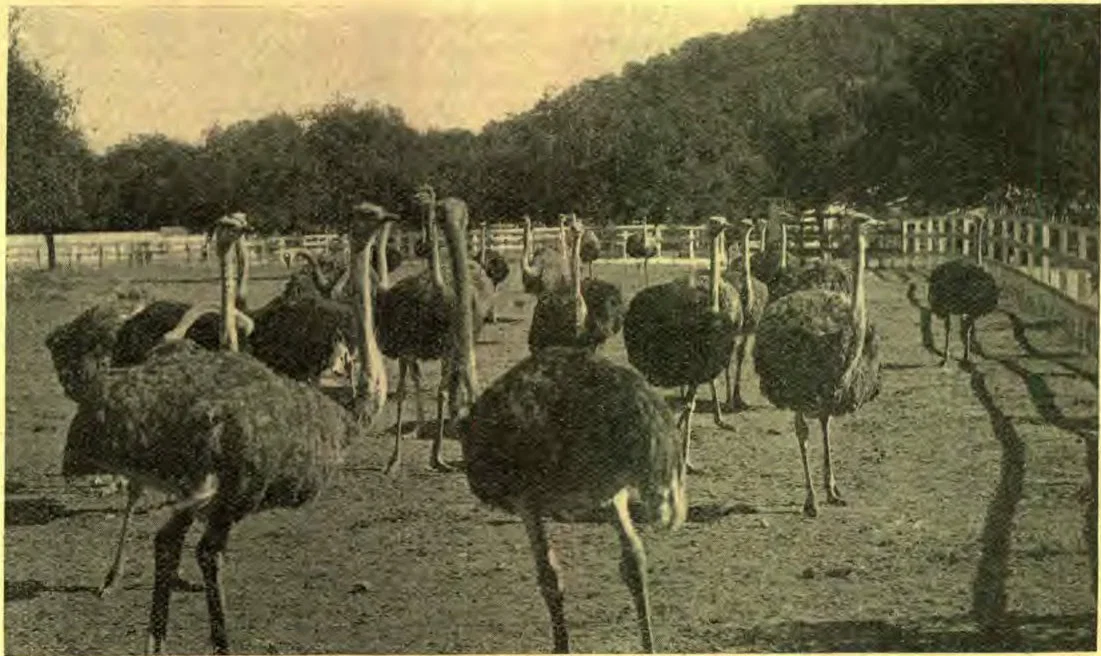
Among the beauties of this country I am going to name one of the ugliest creatures that can be found in the wilds of Africa, or that wanders over the deserts of Arabia, and that is the ostrich. Yet the tourists who come here to see and enjoy the beauties of this region seldom miss visiting an ostrich farm; and could you see them apparently admiring these ungainly creatures, you would certainly conclude that to those who are looking for the beautiful, all things appear beautiful. However, I would not say that these huge birds are admired because of their physical charms,—for surely ostriches are as unlovely here as in their native homes,—but rather because they are a relic of an earlier epoch.
There are several ostrich farms in Southern California,—one at Los Angeles, one at Pasadena, and another at Coronada, and two at Norwalk. We will notice the one at Pasadena, where we shall see stalking proudly about, in their respective pens, Mr. and Mrs. Mc Kinley, Mr. and Mrs. Bryan, Mr. and Mrs. Dewey, and many others bearing names with which we are familiar.
When full-grown, the ostrich is nearly eight feet high. Its massive body is supported by two long, stout legs. The great, stiff neck, which is more than a third the full height of this ungainly bird, ends in an abrupt turn, and is finished off with dark eyes and a flat, clumsy beak. This is its apology for a head. When the beak opens, there seems to be nothing there but a great cavity leading to the canal that is always ready to take in almost anything, from a rock half the size of an orange to an old newspaper, with the same relish.
The ostrich is not so polite as he might be. For instance, if Mr. Mc Kinley should luckily receive his allotted portion of alfalfa, grain, chopped beets, and pieces of rock first, you would be likely to hear Mr. Dewey send forth from the adjoining yard a succession of hissing, sputtering notes that would be anything but euphonious; or he might roar out as vociferously as a wild beast. These birds do not chew their food, but swallow it just as it is given to them. It is amusing to see them eat oranges, and to watch a dozen of the juicy balls working their way down the bird’s long neck at one time. After the ostriches have swallowed their supply of food, they turn to the pile of broken rock, and with the same apparent zest gulp down great pieces of stone.
IN THE OSTRICH PARK AT PASADENA
A full-grown ostrich weighs between two and three hundred pounds, and the birds are valued at five hundred dollars a pair. There are about two hundred birds on the Pasadena farm, in an inclosure of five acres. At this season may be seen in the breeding department barrels of eggs, many incubators in operation, and dozens of young birds in almost every stage of development, from those just out of the shell to those varying in age from a few months to a year. When just out of the shell, one of these birds is almost as large as a common-sized chicken. It reaches its full height and weight when two years old.
The habits of ostriches differ somewhat from those of other members of the great bird family. Mrs. Ostrich will lay between fifty and sixty eggs during the season, which lasts from March to September. During this time she and her mate will sit whenever a sufficient number of eggs are left in the pen. When there are a dozen or more eggs, they are not put in a nest, but partly buried in the sand in the sunniest place that can be found; then while the sun’s rays beat upon them, the birds enjoy themselves promenading in apparent indifference about the yard. When the eggs are in the shade, the two birds take turns keeping them warm.
Ostrich eggs vary from six to eight inches in diameter, and weigh about four pounds each. An omelet made of one egg will make a meal for eleven persons.
The ostrich is noted for its strength, and the rapidity with which it gets over the ground. When teased, it will stamp and kick with as much force as a mule; and if frightened, it will easily outdistance a horse.
The only beauty about these birds is their lovely plumes, which they carry about with as much pride and far more grace than do the daughters of fashion, who rob them of their only charm.
MRS. KATHLEEN WAGNER-GILMORE.

THE SOUTH SEA ISLANDS

As we enter the island world, the first thing to attract the attention is the islands themselves. When one is first sighted in the distance, it looks like a cloud on the horizon; but as we draw near, we find a little patch of land in the midst of the great ocean. A later acquaintance shows us that the island is a little world by itself.
Some islands are wholly of coral formation, and are low and flat, but little above the level of the sea. Such are most of the Tuamotus. Upon these islands the soil is very thin, and though the cocoanut flourishes there, little else will grow. The diet of the natives is therefore principally composed of cocoanuts and fish. As there are no hills nor mountains, there are no streams nor bubbling springs, only little, stagnant pools. Rainwater and cocoanut milk are generally used for drinking purposes.
The Society Islands are apparently of volcanic origin, and differ from the Tuamotus in that they are all mountainous, and tower high above the level of the sea. The little coral polyps must have had some part in their formation, for each island is surrounded by a coral reef, and coral rock abounds in their lagoons. Even the highest mountains are covered with vegetation, and through each verdant little valley a sparkling stream wends its way to the ocean. In the larger islands, water is abundant, but in some of the smaller ones it is not plentiful. Wherever we may be, water is one of our greatest blessings, but it is especially so in the tropics. At least I believe that we can appreciate its value more here.
Viewed from the sea, the islands present an attractive appearance, as they are covered with rich verdure in every shade of green. After a hard shower, the little cascades falling among the hills resemble white ribbons floating over the green.
No one attempts to say how long these islands have been in existence, but it seems that it must have been for centuries; for it has been so long since there have been any volcanic disturbances that the only earthquake here that the people now living have ever heard of is one at Tahiti. It happened one hundred and two years ago, just before the first missionaries arrived from England. Coming just at that time, the natives thought it must have something to do with the missionaries; and fearing such power as could shake the island, they allowed the strangers to remain.
So far, these islands have been quite sheltered from the various natural disturbances that have taken place in other parts of the world. I have never heard of there being a hurricane, tidal wave, or real famine in this group of islands. Still the effects of the curse are manifest in various ways here as well as elsewhere. Some time ago there came a blight on the cocoanut trees, so injuring them that they did not bear for a year or so, and many died; but they have now recovered from its effects. At that time the bananas, breadfruit, and nearly or quite all of the vegetables were also affected by the blight, so that food was scarce, and the people called it a famine, though it was quite unlike the famines that are reported from other parts of the world. No one really suffered for want of food.
A sort of plague visited the people here fifty years ago, at the time when the Sabbath was changed in this group of islands. It seems that the early missionaries did not change the day as they crossed the day-line on their journey hither, but kept on counting the days as they had on the other side of the line; so for several years they kept Saturday as the Sabbath, supposing it was Sunday. No attempt was made to change until after the French took possession of the islands; then the missionaries united their influence with that of the government in changing the rest-day to Sunday. It was just at that time that some contagious disease carried off the people by hundreds. Being extremely superstitious, many of the people think that this was a judgment on them for changing the Sabbath. It is seldom that a contagious disease reaches these islands; but when it does, it works havoc among the natives, who are very ignorant of the laws of health, as well as careless in the extreme.
Though we are apparently quite secure here, we know that in these days all is uncertainty, and we must be prepared for the unexpected. When the people shall have rejected the Lord, and given themselves wholly to serving the devil, God will remove his protecting hand, and we shall be likely to experience the unbounded wrath of the dragon.
But “God is our refuge and strength, a very present help in trouble. Therefore will not we fear, though the earth be removed, and though the mountains be carried into the midst of the sea; though the waters thereof roar and be troubled, though the mountains shake with the swelling thereof.” B. J. CADY.

THE PRICE OF OUR REDEMPTION

I
“And the chief priests and all the council sought for witness against Jesus to put him to death, and found none. For many bare false witness against him, but their witness agreed not together. And there arose certain, and bare false witness against him, saying, We heard him say, I will destroy this temple that is made with hands, and within three days I will build another made without hands. But neither so did their witness agree together. And the high priest stood up in the midst, and asked Jesus, saying, Answerest thou nothing? what is it which these witness against thee? But he held his peace, and answered nothing. Again the high priest asked him, and said unto him, Art thou the Christ, the Son of the Blessed?” “I adjure thee by the living God, that thou tell us whether thou be the Christ, the Son of God.”
This appeal was made by the first magistrate of the nation—a man occupying the highest position in earthly courts. But Caiaphas was not accepted by God as the high priest. His fitness for this position ended with the garments that he wore. He was incapable and unworthy. His religion was a cloak that hid the deformities of a hard, cruel heart.
Christ knew that Caiaphas was unworthy to occupy the position he did. But knowing this, he responded to the high priest’s appeal. He knew that he himself was appointed to his office by God, and there and then he might have glorified himself. He might have exercised a power that would have made his judges quail. But a body of flesh had been prepared for him. Being found in fashion as a man, he humbled himself. The true High Priest stood before the false high priest to be criticised and condemned.
To the charge of the high priest, Jesus said, “Thou hast said: nevertheless, I say unto you, Hereafter shall ye see the Son of man sitting on the right hand of power, and coming in the clouds of heaven.” With dignity and assurance were these words spoken; for they fell from the lips of One whose spirit went with them. The only begotten Son of God was the speaker, and into the hearts of his hearers flashed the conviction, “Never man spake like this man.”
Weighted with such great results, this was to Christ one of the most wonderful moments of his life. He realized that now all disguise must be swept away. The declaration that he was one with God had been made. He had openly proclaimed himself the Son of God, the One for whom the Jews had so long looked.
“Hereafter shall ye see the Son of man sitting on the right hand of power, and coming in the clouds of heaven.” At that day Christ will be the Judge. Every secret thing will be set in the light of God’s countenance. What a contrast there will then be between those who have refused Christ and those who have received him as a personal Saviour. Sinners will then see their sins without a shadow to veil or soften their hideousness. So woeful will be the sight, that they will desire to be hidden under the mountains or in the depths of the ocean, if only they may escape the wrath of the Lamb. But those whose life is hid with Christ in God can say: “I believe in him who was condemned at Pilate’s bar, and given up to the priests and rulers to be crucified. Look not upon me, a sinner, but look upon my Advocate. There is nothing in me worthy of the love he manifested for me: but he gave his life for me. Behold me in Jesus. He became sin for me, that I might be made the righteousness of God in him.”
The idea that there was to be a resurrection of the dead, when all would stand at the bar of God, to be rewarded according to their works, was not a pleasant thought to Caiaphas. He did not wish to think that in the future he would receive sentence according to his works. If there was to be no resurrection, he would flatter himself with the thought that he could securely keep his counsel. But if there was, what a revelation would be made of his dark deeds! There rose before his mind, as on a panorama, the scenes of the final Judgment. For a moment he saw the fearful spectacle of the graves giving up their dead, with secrets he had hoped were hidden forever. For a moment he felt as if he were standing before the eternal Judge, whose all-seeing eye was reading his soul, bringing to light mysteries supposed to be hidden with the dead.
But the scene passed from his vision. Christ’s words cut him, a Sadducee, to the quick. He was maddened by satanic fury. Was this man, a prisoner before him, to be allowed to assail his most cherished theories? Rending his robe, that the people might see his horror, he demanded that without further preliminaries the prisoner be condemned for blasphemy. “He hath spoken blasphemy,” he said: “what further need have we of witnesses? behold, now ye have heard his blasphemy. What think ye?” “And they all condemned him.”
MRS. E. G. WHITE.

THE DAY'S WORK

Do thy day's work, my dear, Though fast and dark the clouds are drifting near, Though time has little left for hope and very much for fear. Do thy day's work, though now The hand must falter and the head must bow, And far above the falling foot shows the bold mountain brow.
Yet there is left for us, Who on the valley's verge stand trembling thus, A light that lies far in the west—soft, faint, but luminous. We can give kindly speech And ready, helping hand to all and each, And patience to the young around by smiling silence teach.
We can give gentle thought And charity, by life's long lesson taught, And wisdom, from old faults lived down, by toil and failure wrought. We can give love, unmarred By selfish snatch of happiness, unjarred By the keen aims of power or joy that make youth cold and hard.
And if gay hearts reject The gifts we hold, would fain fare on unchecked On the bright roads that scarcely yield all that young eyes expect, Why, do thy day's work still. The calm, deep founts of love are slow to chill; And Heaven may yet the harvest yield, the work-worn hands to fill.
— Selected.

PAN-AMERICAN HORTICULTURE

HORTICULTURISTS have abundant reason to feel a lively interest in the great Pan-American Exposition to be held in Buffalo in 1901. In the embellishment of the grounds the architects have planned to use trees and shrubs, foliage and flowering plants, in quantity to dazzle the lovers of fine horticultural displays. The extensive area of the Exposition grounds affords abundant room for the elaborate display of color that is contemplated. There are nearly three hundred and fifty acres in the Exposition site, of which about one third are the improved lands of Buffalo’s beautiful Delaware Park. Upon the park lands many thousands of dollars have been expended from year to year in maintaining and improving the variety of rare shrubs and trees.
Lying directly north of the park lands and upon a higher elevation, is the remainder of the Exposition plot. Included in the plan for the arrangement of the buildings is a magnificent court three thousand feet long, with a transverse court one thousand seven hundred feet from east to west, besides subordinate courts. All these open spaces are to be beautified with palms and other tropical plants in tubs and vases placed near the surrounding buildings and beside the fountains and pools. To these will be added formal flower beds, and sunken gardens of elaborate arrangement, wherever their presence will enhance the beauty of the courts.
The water features of the Exposition include a Grand Canal more than one mile in length, which completely encircles the main group of buildings. Lagoons with sodded banks and shaded with a variety of trees, shoot off from the main canal at various points, and add their beauty to the landscape effect. The entire outer wall of the Exposition grounds is to be a bank of solid foliage. Many thousands of trees, shrubs, and cuttings have already been planted, in preparation for the elaborate horticultural features. Large trees, which fortunately were already upon the Exposition site, have been preserved by transference to places where their stately shafts of green would heighten the color effect in contrast with the brighter hues of the buildings.
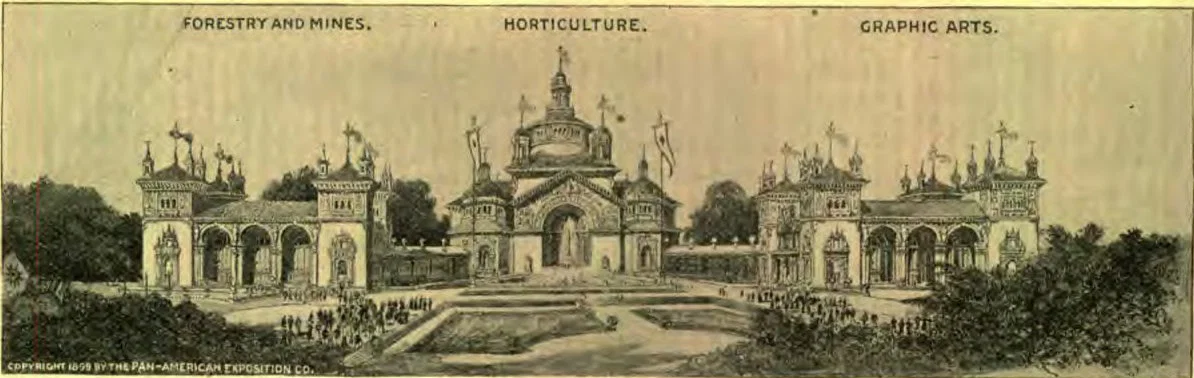
The building to be devoted to the Department of Horticulture, of which Mr. F. W. Taylor is chief, is two hundred and twenty feet square. It has two arcaded wings sweeping from the north and south façades to the eastward and connecting with other buildings to form a semicircular court. West of these arcades are the conservatories, in which will be displayed the palms and other plants of tropical origin. The arcades leading from the main building will be kept gay the entire season with flowering and ornamental plants. The large building will be used for the display of fruits and various other exhibits pertaining to horticulture.
The exhibits to be made by the leading florists of the United States will be situated south of the Horticultural Building. To these displays some six or seven acres of land will be devoted. William Scott of Buffalo, a prominent florist and well-known contributor to literature upon flowers, will have charge of the floral exhibits. Several prominent horticulturists have already entered for the competition of 1901. In these displays there will be over five hundred beds in which will be shown every popular flower known, from the low-growing verbena to the stately dahlia and hollyhock. There will be numerous specimens of the summer climbers, conspicuous among which will be the new varieties of the gorgeous clematis.
The water gardens, of which there will be a number in various parts of the grounds, will be important and attractive features, and will include in their displays, besides the mammoth Victoria Regia of the Amazon and the Nilumbiums of the Nile, many Nymphæas never before exhibited. When at their best, there will be special exhibitions of roses, dahlias, gladioli, sweet peas, chrysanthemums, and other popular flowers. Exhibits from all the large growers of the country are assured.
FORESTRY AND MINES. HORTICULTURE. GRAPHIC ARTS.
Horticulture has made wonderful strides within a very few years, and many of the floral specimens that will be seen at the Pan-American Exposition were not in existence at the time of the World’s Fair at Chicago. The displays of the now popular canna will surpass anything yet seen either in America or Europe. One may therefore confidently expect this Exposition to be, from the view-point of the horticulturist, the most brilliant ever held.
MARK BENNITT.

RESPECT THE AGED

SEVERAL boys were standing on the steps of a country store—one afternoon, when an old woman came out. She had scarcely passed the group when one called out, “See the old ragbag moving off!” Another asked her what she would take for her “gait,” which was not very graceful, as she was rheumatic, and walked with difficulty. So the “fun” went on for a few moments, until one manly boy could stand it no longer. With flashing eye, and voice choking with indignation, he said, “Boys, aren’t you ashamed of yourselves to make fun of that old woman? Somebody loves her, no matter if she is old, ragged, and dirty.”
“Oh, hear him preach!” said one of the idle group.
“Here, get on this box, and give us a sermon, parson,” said another, in laughing derision. Nothing daunted, the noble lad stood his ground in defense of the old woman; for he had been taught to respect the aged and the poor.
Boys are often thoughtless and cruel in the way they treat those whom they consider beneath themselves in social position. Some lack moral courage to do what they know to be right; but how cowardly it is to stand by, and hear a poor old man or woman made the target for low sport, and offer no word in their defense. How lacking in true manliness is the boy or young man who will make unkind remarks about the aged and infirm. O boys! be above such fun; remember that Jesus died for all,—old as well as young,—and that it is not the mark of a gentleman to be rude or unkind to any one, much less the poor and aged.
M. C. Du Bois.

HER IDEAL

“ALLIE is the queerest girl!”
Harriet broke out explosively with this exclamation after a long interval of silence over the dainty materials that were expected to grow into something both ornamental and useful.
“Why?” I asked, invitingly.
“She’s always saying the oddest, most out-of-the-way things, that make you laugh, but sometimes they make you think—afterward.”
“For instance?”
“To-day she was writing away at her little red desk when I went in. Of course she stopped; but I asked her what she was doing, and acted as if I cared, and what do you suppose? She held up a sheet of paper all closely written over, and said it was a ‘Portrait of a Lady.’”
“‘A pen-portrait?’ I asked.
“‘Yes; an old, old lady—the kind I’d like to grow to be when I get real old.’”
“You couldn’t help laughing, she was so in earnest about it. But at last it made me half in earnest, too, and I made her read to me.”
“What was it like?”
“Well, first of all, her old lady was pretty. ‘She couldn’t help it, you know,’ she said—‘my kind of old lady. The loveliness in her would just show through, like a lamp set in an alabaster vase. She would be gentle, with the sweetest manners, and a soft, not very loud voice. She would be bright, too, and cheery; for my old lady would never be the least bit sad or lonely or discouraged, or look so. That would be half the charm of her. She couldn’t; for she would have got so used to living with Jesus, and resting on his strength, and enjoying life in his companionship, that nothing could take away her cheer and happiness.”
“‘My dear old lady would be very dainty—that’s another thing. Some girls are, you know, and some aren’t. She would be—not neat, that isn’t the word—but exquisite, like a rose or a violet, always fresh and sweet. All her things would be in order, of course,—the kind a flower has, the order that grows itself, or seems to. It would not be a kind that would make little children afraid to come near. You couldn’t rumple it or crumple it; for the very next minute it would grow again.
“‘I think she would be bright and wide-awake and interested in everything. She would read the papers, and talk with everybody who would talk to her, and she would read new books, and have nice things to say about them. Girls would ask her advice in selecting or making gifts for their friends; for she would be sure to know what would be pretty and appropriate. That would be another thing about her—she would care about such a lot of people. As she grew old, she would blossom out, and open out, and stretch out friendly hands to ever so many people. She would know people by name, and what they were doing or wanting or needing; and that would very often be the same thing as their getting it. It is so easy to give people what they want, either by your own hand or another’s.’”
“I believe the last thing she had written was that her old lady would know how to do things. She would be wise in the loveliest ways. She would not only know all the things about housekeeping that it is such a help to have somebody to go to for, but she would know games, and how to tell birds by their songs, and how to know the first wild flowers, and—and things like that.”
I laughed as Harriet stopped for breath. “Well, dear, your old lady—or Allie’s—would be a paragon. You say that is her ideal?”
“Yes; she says it’s what she means to grow to! She says she believes that old people are just the same as young people, only ‘more so.’ Those who are fretful and ‘putchiky’ and disagreeable do not become so all at once. It’s the way they started, that’s all, and it just keeps on. She says she’s going to start right off to grow the other way. Do you believe there’s anything in it, auntie?”
“Yes, I do, dear! And if I were you, I would start with her, and this very day, for there isn’t a minute to lose, if you mean to be that kind of old lady.”—Well-Spring.

WHERE PRAISE IS DUE

O RARE exotic! sheltered so That no rough winds upon thee blow, Thy wants supplied with tender care, What wonder thou art sweet and fair?
But thou, O lowly, wayside flower! A bare subsistence all thy dower, Praises to thee because thy face Smiles bravely from thy barren place!
—Margaret Manning.

THE DEAF AND DUMB

MANY popular errors prevail in reference to persons born both deaf and dumb. Among these is the idea that deaf mutes are dumb because of some vocal defect. The fact is that with hardly an exception, the vocal organs are in a normal condition, the dumbness arising from disease or some mental derangement.
Many children classed as deaf are not entirely so; yet while they are able to hear sounds, they can not distinguish them sufficiently to aid in learning to speak. Neither should children who lose their hearing after acquiring speech be classed as deaf mutes, as the knowledge of language places them on a higher plane than that of those born deaf.
While the deaf mute is isolated from his companions in many ways, and can not appreciate the value of many external objects, the loss of these senses is somewhat compensated by increased keenness of vision, the eye of a deaf mute usually being quick to detect every variation in the face or actions of his companions.
It is commonly supposed that deaf mutes are morose and hot-tempered; but since the institution of homes for them, statistics disprove the assertion that their forced isolation changes their disposition.
It is difficult to obtain accurate statistics from which to ascertain the causes of congenital deafness, because of the unwillingness of parents to admit that their children were born deaf; yet fully sixty per cent of all cases are congenital. By far the greater number of congenital deaf mutes come from parents of lineal consanguinity, or near relationship, or from inherited tendencies through deaf-mute ancestors.
Anciently it was thought impossible to give instruction to a deaf mute, as it was supposed that language could be acquired only through the ear. Lucretius wrote,—
“To instruct the deaf no art could ever reach, No care improves them, and no wisdom teach;”
and in some countries it was the practice to destroy children who, at three years of age, were found to be incapable of hearing or speaking. Nor had such unfortunates, in the estimation of the clergy, any future hope, St. Augustine declaring that “deafness from birth makes faith impossible, since he who is born deaf can neither hear the word, nor learn to read it.”
Bede in 685 mentions the first instance of a deaf mute receiving instruction. No other case is noted until 1442–85, when Rudolph Agricola mentions another. Pedro de Ponce, a Spanish Benedictine monk born in 1520, is the first person to go on record as instructing the deaf and dumb, and teaching them to speak. W. S. CHAPMAN.

VELOX AND OTHER DEVELOPING PAPERS

When Velox paper was first introduced, it created quite a sensation in the photographic world. It bounded to universal favor at once, but was soon rejected by the majority of professional photographers as unsuited to their needs. With amateurs, however, it still retains a well-deserved popularity.
Many different brands of similar paper are now on the market. I have used none of them myself, but have been assured by those who have that there is no more difference between them than between different brands of gelatin paper. I will therefore describe the method of working Velox, and you can apply the instruction to any other similar brand.
Velox is a bromide-developing paper, but it is not nearly so sensitive as “standard” bromide. A dark-room is not needed, but of course the paper will not bear exposure to too strong a light. If handled expeditiously, prints may be changed and developed by the light of an ordinary lamp, provided it is placed on the opposite side of the room in which one is working. By drawing down the curtains, the paper may usually be handled with safety during the day.
The exposure may be either by daylight or by artificial light; but the intensity of daylight varies so greatly that one is likely to waste two or three prints in testing its strength every time he begins to print. For that reason it is better to print by artificial light. Both printing and developing may be done in the sitting-room during the evening, without disturbing other members of the family in their use of the light. Held one foot from a number two kerosene burner, a negative of ordinary density will print in two or three minutes.
Though Velox prints very slowly, compared with the ordinary bromide paper, it more than makes up the time by the rapidity with which it can be developed. The image will flash up almost as soon as the paper touches the developer, which must be strong. Our standard developer, used full strength (without the addition of water), is a developer par excellence for Velox paper, but it will require a restrainer to keep the light portions of the picture clean. One drop of a ten-per-cent solution of bromide of potassium, or of a fifteen-per-cent solution of chloride of sodium (common salt), to each ounce of developer, will be about what is required under ordinary circumstances.
As development is so rapid, it will be necessary to exercise great care in immersing the print. If one part of the paper remains out of the developer half a second after another part touches it, the picture will be irreparably ruined. The best way is to take one corner of the print between the thumb and forefinger, lay it face downward in the developer, and move it quickly back and forth two or three times. Turn the print over, and push the corner that you still hold under the developer; then lift it quickly, so that some of the developer will flow over the face of the entire print. This will wash away any air-bells that may have formed. The print may then be turned face downward again, and moved quickly back and forth for two or three seconds. If the exposure has been sufficient, the image will be so nearly developed by that time that the print may be lifted entirely out of the developer. Enough developer will remain on the film to complete the development. The moment the print reaches the desired density, it must be immersed in the fixing-bath. A plain hypo-bath will do, but the addition of a little alum will harden the film, and lessen its liability to injury while washing.

FORMULA

Hypo, 2 ounces Powdered alum, ½ ounce Water, 8 ounces
This bath keeps well; and if desired, it may be used over and over again. Fix fifteen minutes, and then wash one hour in running water.
Stained whites may be caused by over-exposure, by forced development of an under-exposure, by fogged paper, or by an insufficient amount of restrainer in the developer.
Too much restrainer or too weak a developer will give shadows of a greenish or brownish tint. Over-exposure is another cause of this trouble.
Gray shadows and weak high-lights are caused by under-exposure.
Prints that have been over-developed may be reduced, as with other bromide paper, with a hypo.-ferricyanide bath.
Sometimes a print will be covered with hairlines, that look just like pencil-marks. Various causes have been assigned for this; but the true cause has probably not yet been discovered. The marks may be removed from the print after it is dry, by rubbing them with a tuft of cotton, moistened with alcohol. A few seconds in a weak reducing-bath will also remove them.
The Vinco paper, similar to Velox in other respects, develops much more slowly. The manufacturer of this paper is not a member of the paper trust, so Vinco is sold much cheaper than most papers of this class.
J. EDGAR ROSS.

Hymn of Children Seeking to Keep God's Word

“We are thy children, Lord. Teach us to keep thy word Precious and pure! Lead us in paths of right, And make us clear of sight, Noble and true and bright, Steady and sure!”

Reading With a Purpose

EVERY book that we take up without a purpose is an opportunity lost of taking up a book with a purpose.—Frederic Harrison.

LILACS

I've seen the pussy-willows With dainty, furry faces; I've found the pretty violets Abloom in shady places; The jonquil and the crocus Have told me of the spring, And in the orchard up and down Has glanced the bluebird's wing.
But here's the purple lilac, That lifts its fragrant plumes, And sends a waft of sweetness Through homely cottage rooms; Its hardy branches tapping Against the farm-house eaves, The flowers it gives us growing In generous, waving sheaves.
I'm sure the mother robin Is very glad to see The lilacs' screen about her Wee nest and fledglings three, And father wren is singing In pure delight to-day, That spring is here already, And summer on the way.
And I am glad our Father, Whose love is over all,— Who counts the stars by number, And sees a sparrow fall,— Has sent again the lilacs To make the garden fair, And waft their honeyed sweetness Upon the wandering air.
— Margaret E. Sangster.
Continue reading: ROBIN REDBREAST