The Youth’s Instructor, Vol. 38, No. 50.

A PLEASANT FACE

The Youth’s Instructor

Dec 10, 1890

S. D. A. Publishing Association · Battle Creek, Mich. · Dec 10, 1890

A PLEASANT FACE.

As you've been traveling to and fro, Or lingering in a place, Now tell me has it given you woe To see a pleasant face? When all the skies were filled with gloom, And rain poured down the while, O hasn't it seemed like summer's bloom To catch a cheerful smile?
O, if it does blow in your life A hurricane of ill, Why should you let the outside strife Your inner sunshine kill? O look around, and look above, And pray a little space, And sunshine of unselfish love Will glorify your face.
O, if you smile when all is bright, What credit will it bring? 'T would be a foul disgrace and blight To do another thing. But when the stormy wind's about, And gloom is o'er each grace, The brave will let love's sunshine out, And show a pleasant face.
FANNIE BOLTON.

ROB'S SERMON

He had no idea that he was preaching me a sermon. I don't suppose I could have surprised him more than by telling him that he had been doing me as much good as any sermon I had ever heard, and yet I have been trying to do differently ever since that rainy morning when I walked down the street behind Rob.
It was one of those dismally rainy days, when it takes a stout heart not to be affected by the dreariness of the weather, and when every one is apt to have a cloud on his face, to add to the general depression. There are some rainy days that are positively cheerful, when the rain comes down with a dash, as if it was bent on having a grand frolic, and sweeps along the streets as if it was enjoying the havoc it could make with umbrellas, and the drenching it could give people who thought they were well protected with gossamers and waterproofs.
This was not one of those days, however. It was a cheerless drizzle, that seemed as if it might last for days, and never get quite rained out. It had been lasting already for two days, and every one's spirit seemed to be down to zero. I know I was looking as if I had not a friend in the world, indeed for the matter of that, I suspect I looked as if I did not want a friend. Every one that I met reflected the same gloomy expression, and the first cheery thing that I heard came from under an old, ragged umbrella in front of me.
It was a clear, boyish whistle, as blithe as any blackbird singing among the blossoms on a sunny summer day. It was one of the popular tunes that the boy was whistling, and he went over and over the refrain, as if he enjoyed his own music so much that he could not leave off when he had finished.
I knew it was a boy, for I could see a bit of a shabby coat, and a pair of very well-worn trousers below the old umbrella, which was almost too big for a bit of a boy like that to be carrying. Such worn old shoes, too, you could hear the water gurgling in them as he trudged along, but he seemed rather to like it. I felt as if he was so determinedly cheerful that even having his shoes full of water would please him rather than otherwise.
Pretty soon he met another boy, a friend, evidently; for he sang out a cheery “Halloo!” that brought a cheery answer from the other boy in a twinkling.
A little later a mischievous gust of wind swept unexpectedly around the corner, and caught an old gentleman's hat.
Before it had had time to trundle more than a few paces up the street, Rob was after it, and with a bright smile that positively seemed to illuminate things like a sunbeam, he handed it back to the owner, who in his turn had to smile as he thanked the gentlemanly little owner of the huge umbrella.
Just a little further along, Rob, trudging along under his umbrella, and I, walking along behind him, saw a little girl come to grief. She was carrying a package of sugar, and though she had been protected by an umbrella, still the paper had got wet, and suddenly there was a little stream of sugar coming down on the wet sidewalk.
I should have thought matters beyond repair; not so my little friend.
“Halloo!” he cried, putting down his umbrella, and rushing to the rescue.
“Here, sis, I'll hold this place together, and you give me your handkerchief, if you have got one.”
The tears which had begun to flow, stopped, and the little girl surrendered her package to the strong, boyish hands, and looked on with an interested smile. She produced a neatly folded handkerchief from the depths of her pocket, and with deft hands the boy wrapped it around the package, and tied it up by the corners, so that no more sugar could make its escape.
“Guess we'll have to leave the rest there to make sugar candy when the sun comes out,” said Rob, as he put the package in the child's hands, and handed her the umbrella. “Now you're all right.”
On went the shabby umbrella again, with the happy little heart beneath it, and the next one to catch a reflected ray was a small boy who came around a corner, and turned in the same way we were going, without any protection from the rain.
“Here Tom, come under my tent,” was the shout from beneath the umbrella. “I always takes the family ark when I go out, just so's I'll have room for other fellers.”
I had to stop here, as I had reached my journey's end, but I felt like calling “Good-by” to the brave little fellow who had not only kept his own heart and face bright, but reflected radiance into every heart that he came in contact with.
And this was the sermon that he preached to me that dismal morning; and ever since, when I have felt like being gloomy and unhappy, I remember how much brighter and happier one can make the world by being helpful and sunshiny, and I try to imitate the example that was set me by the small boy beneath the ragged umbrella.—Youth's Evangelist.

ROUND THE WORLD.—39.

THINGS JAPANESE.

An inseparable accompaniment of every Japanese home, from the most exalted to the very humblest, is the hibachi. This object consists of a vessel partially filled with fine ashes, containing, when in use, a few bits of charcoal. This vessel may be of bronze, iron, porcelain, earthenware, or even of wood lined with copper. A pair of iron rods, generally held together at one end by a large ring, answer for tongs, being used after the manner of chopsticks.
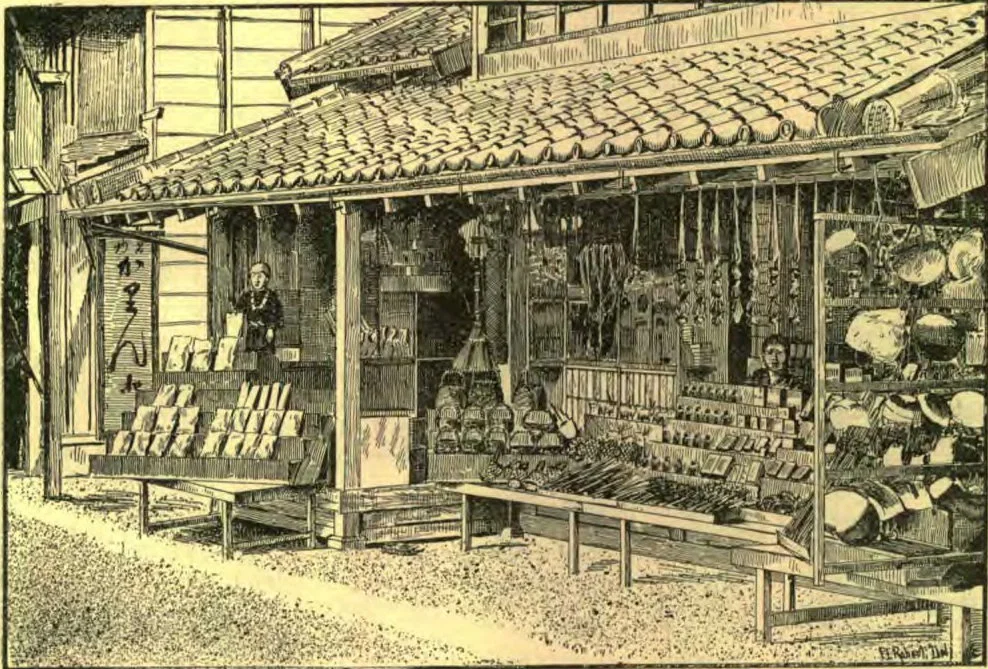
JAPANESE SHOP.
JAPANESE SHOP.
The hibachi may be quite a large affair, and subserve the duties of a stove as well. An iron ring, having three legs, or a grid spanning the box, is provided, on which the tea-kettle is supported, or even fishes broiled. The hibachi is a sort of portable fireplace, around which the family gather to gossip, drink tea, or warm their hands. A sentiment prompts many families to keep the hibachi burning continuously; and it is stated that there is one family in the city of Tokio, the capital of the empire, who have kept the fire alive for over two hundred years.
Before kerosene oil was introduced into Japan, illumination was of a very meager description. One can hardly realize the difficulty a student must have experienced in studying his classics by the feeble light emitted from tiny wicks, or the dim and unsteady flame of a vegetable wax-candle. It is related that in former times, devout students were accustomed to read one character at a time by the dim illumination of a glowing coal at the end of an incense-stick held close to the page! Candles are depended upon to illuminate the rooms as well as the hand lanterns carried about the streets.
The majority of the Japanese are either Shintos or Buddhists, and no matter to which of these heathen creeds they adhere, they have a little shrine in the home; it seems to be a necessary article. The shrine of the Buddhist is the only one of the two of which I feel able to give an intelligible description. It looks something like a small cupboard, open toward the top, and containing several shelves. On these are placed various vessels filled with boiled rice, loaves of mochi made of a special kind of rice, and a number of unripe peaches. On the lower shelf, in the right-hand corner, are seen a sweet potato and a radish, propped up on four legs, looking like toy deer or beasts of some kind. Whether this indicated the work of children, or represented the horses on which the gods could ride, I know not. In front of these shrines, one may often see the inmates of a whole house bow their heads, clap their hands, and then rubbing the palms together, in an imploring gesture, pray with much earnestness. Among the intelligent classes the shrine seems to be provided for the women only, the men having outgrown these superstitions; and it is interesting to observe that in Japan, as elsewhere, even in civilized or heathen countries, they make up the majority of those attending public worship.
Inside the entrance to almost every house is the shoe closet. The Japanese never wear their clogs in the house, but shake them off upon entering, and take a pair of sandals made of straw to wear inside.
Japanese gardens, like everything else connected with this remarkable nation, are small, and very unique in appearance to the Westerner. The Japanese have brought their garden art to such perfection that a plot of ground ten feet square is capable of being rendered exquisitely beautiful by their methods. Plots of ground that in the home land are too often cumbered with coal ashes, tea-grounds, tin cans, and the garbage barrel, in Japan are rendered charming to the eye by the simplest means. With cleanliness, simplicity, a few little evergreen shrubs, one or two little clusters of flowers, a rustic fence projecting from the side of the house, a quaintly-shaped flower-pot or two, containing a few choice plants, the simplest form of garden is obtained.
So much do the Japanese admire gardens and garden effects, that their smallest strips of ground are used for this purpose. In the crowded city, among the poorest houses one often sees in the corner of a little earth area that comes between the sill and the raised floor, a miniature garden made in some shallow box, or even on the ground itself. In gardens of any pretensions a little pond or sheet of water of irregular outline is indispensable. If a brook can be turned to run through the garden, one of the greatest charms is attained; and a diminutive waterfall gives all that can be desired. With the aid of fragments of rocks and rounded boulders, the picturesque features of a brook can be brought out. Little rustic bridges of stone and wood span it, and even the smallest pond will have a bridge of some kind thrown across it. A few small hummocks and a little mountain six or eight feet high, over which the path runs, are nearly always present. The Japanese are very fond of growing dwarf trees and shrubs, which are really greatly in harmony with all the other surroundings of the house and garden. It is a common custom in winter time to wrap all these dwarf trees and shrubs in garments of straw. These are thatched on, if we may use the term, in very pretty designs, completely enshrouding the whole of the trunk of the tree.
The Japanese are famed for their embroidery on silk, and the banners and kakemonies which they have made adorn many of our Western homes. Curious to say that although many of them have beautiful collections of pottery and paintings and other bric-a-brac, they never keep it on exhibition in their parlors, but on the contrary, it is stowed away in brocade boxes, and only taken out on special occasions.
The national exhibition was in vogue at Tokio, the capital, during our visit to Japan, and one day we went up to see it. Alighting from the cars, we were ushered into a typical Japanese city, and found that there were street-cars running as at home. They were about the same in build, but much shorter. The car was comparatively empty when we entered, but it gradually became fuller, till there was no more sitting room, and the passengers were obliged to stand. They lined all down the middle, and although the way was long and the road rough, they seemed to smile and laugh as usual, and not mind the discomfort in the least. Every time the vehicle would come to a stop, down would go those who had been standing, one on top of the other, but they only laughed as they picked themselves up again, surveyed each other in blank bewilderment, as if wondering whether they had all of themselves, and whether they had not become mixed up in their fall. We have seen sardines in a box, and wondered how the poor little things felt, but we believe that to any one desiring the information, these Japs could vouchsafe it; for it appeared to us that they underwent a very similar experience.
To endeavor to describe the exhibition would be futile, as it is an undertaking that would require far longer than one day’s visit to do justice to, or anything that might be designated by that term. But we did have a Japanese dinner. We sat upon a mat, and called for chow. A little tea-pot about half the size of an ordinary cup was brought, and cups holding about two or three thimblefuls. The Japs drink a great deal of this beverage, always without milk or sugar. Next we were handed a square box, about four inches deep and nine each way. This was divided into three compartments. In one of them, the largest, was rice, which is the staple article of food in the country. In the others were sundry delicacies (?)—perhaps I may call them abominations. One was raw fish pounded fine, made hard, and then cut in thin slices, sea-weeds galore, and the roots of the lily plant. We tried it, but oh! our stomachs rebelled, and we were perforce obliged to turn attention to the rice. We have eaten with forks, we have eaten with spoons, or even as our first parents, with fingers and thumbs, but never before had we tried to fill the inner vacuum by means of a chopstick. Navigate we couldn’t. We endeavored to convey rice to our mouths by squeezing it between the sticks, but it was too soft. Then we dug down deep into the dish, and thought to bring up a mouthful balanced on top of them, but it fell over the side. We were very hungry, and eyed covetously the dexterous manner in which a little Jap woman handled hers near by. But finally we relinquished the task as a bad job, vowing we would go at it like a cow or a sheep before we would try chopsticks again. P. T. M.

POSITIVE JOHNNIE.

His name was Johnnie Raymond, but his friends called him “Positive Johnnie.” He never “guessed” or “supposed” or “believed.” Oh, no! He was always sure; he knew, and he was very persistent in his knowledge. He was very frequently wrong in his assertions, and each one was a falsehood, although not purposely made.
We should be positive when we are right, and especially about matters connected with our personal and spiritual welfare; but to be too positive, when we are in the wrong, is not so commendable.
“Where is the chisel?” asked papa.
“In the tool-box,” replied Johnnie; “I saw the handle sticking out this morning.”
“I guess not, Johnnie. I just looked in the tool-box.”
“I tell you, I know it is there,” affirmed Johnnie; “I saw the handle of it sticking out.”
“Then go get it,” ordered papa.
Johnnie came back a little crest-fallen.
“It wasn’t the handle of the chisel I saw, but of the screw-driver,” he said.
“May be it would be best not always to be so sure,” suggested papa, with a grim smile.
The next morning his mother took him to task for a piece of negligence. The garden gate had been left open the night before, and the cow had entered the garden, and eaten several of the finest heads of cabbage.
“I wasn’t in the garden once yesterday,” declared Johnnie.
“But who else left the gate open?” asked mamma.
“I don’t know,” was Johnnie’s reply. “I wasn’t in the garden yesterday. I am just as sure of that as that I am standing here.”
Then his Aunt Mary spoke up,—
“Johnnie you were in the garden yesterday afternoon,” she quietly said; “I saw you.”
“Why, I wasn’t, and you didn’t,” he sharply insisted. “Don’t I know? It was some other day.”
“You went in to see if there wasn’t a rabbit in the old pump-stock lying among the currant bushes,” said Aunt Mary.
“That’s so!” admitted Johnnie, a little tardily.
The next afternoon he came home considerably out of humor. He flung his hat aside, and wiped his hot face. He had just walked over to the railroad station and back, a distance of five miles.
“I’ll not put my faith again in anything that Cousin Chester says,” he announced, in an irritated outburst.
“Why, what has Chester done?” asked his sister Jennie, as she stopped in the middle of the room, brush and dust-pan in hand.
“He promised to come this afternoon to go chest-nutting,” Johnnie said. “You know the trees are on the bluff, on the other side of the station. Well, I went over with bags and clubs to meet him, but when the train steamed up, he wasn’t on it.”
“Are you sure Chester said Wednesday?” Jennie shyly asked.
“Oh, fudge!” cried Johnnie, “of course I am sure. You shall not say that I’m over-positive this time.”
“Johnnie,” slowly remarked Jennie, “you dropped the letter on the porch when you started for the station. I picked it up, and glanced at it to know whose it was. There it is on the clock-shelf. Chester says in it that he would come on Thursday, and that is to-morrow.”
Johnnie read the letter, and found that Jennie was right.
“How stupid I’ve been!” he muttered.
“And how positive!” reminded Jennie.
“Yes,” gravely confessed Johnnie, though his face grew very red. “I said I wasn’t over-positive, but it seems I was. I’ll just quit being so sure about things. I’ll say ‘likely’ or ‘may be’ or ‘perhaps.’ I’ll not say, ‘I know,’ but ‘I think’ or ‘believe’ or ‘presume.’ Then I shall not make a fool of myself so often, just to be mercilessly twitted about it.”
Johnnie tried to reform, and succeeded at last, though he found it no easy task.—Christian Observer.

JESUS KNOWS.

ALL our little heart-aches, All our joys and woes. All our hopes and wishes, Jesus says he knows.
And our every action Is to Jesus known, From the time we're little, Till we're fully grown.
When we play or study, When we wake or sleep, He delights to bless us, And his children keep.
He will always guide us, Listen to our prayers; For the loving Saviour For his children cares.
—Selected.

MAKING PENCILS.

The so-called lead of our pencils is a mixture of what is known as German clay and graphite. Graphite is often called black-lead, although it is in no way related to lead. It is a form of carbon, and of the same family as coal. It is, however, an older member of the family, being found in granite rocks. The name lead was given to it because lead had formerly been used for marking on paper. The way in which these materials are made into pencils is described in the New York Sun:—
Do you see this fine black powder? It is graphite. It costs twenty-five cents a pound. This white substance is German clay. It is brought as ballast in sailing vessels. We mix the clay with the powder, and grind them in a mill, adding moisture, till the mixture becomes a paste like putty.
This paste is pressed into dies of the size of a pencil lead, but four times as long. Cut into proper lengths, the leads are baked at a high temperature. The degree of hardness is determined by the proportion of clay—the more clay the harder the lead.
The wood of the pencil is cedar. This is brought mostly from Florida, and is obtained from fallen trees. It is delivered in blocks sawed to pencil lengths. Half of these are thick to receive the lead, and half are thin to be glued upon the others when the lead has been inserted.
The blocks are wide enough for four pencils each. They are grooved for the leads by a saw. The leads are taken from hot glue, and laid in the grooves. Then the thin piece is glued to the thick one. After the blocks are dry, the four pencils of each block are cut apart. Another machine shapes them, making them eight-sided, three-sided, round, or flat, as may be desired. They are burnished by machinery, and are then ready to be tied up in bunches.
The higher grades of pencils are made by finer manipulation of the graphite and the use of better material. The average pencil costs about one quarter of a cent to make. Of this grade of pencil an operator will turn out twenty-five hundred in a day.

THE FIRST TWENTY YEARS.

“LIVE as long as we may, the first twenty years seem to form the greater part of our lives. They appear so while they are passing; they seem to have been so when we look back to them; and they take up more room in our memory than all the years which succeed them.”
Take good care of the first twenty years of your life, and you may hope that the last twenty will take good care of you.—Young Reaper.

THE LAPP'S GOOD FRIEND.

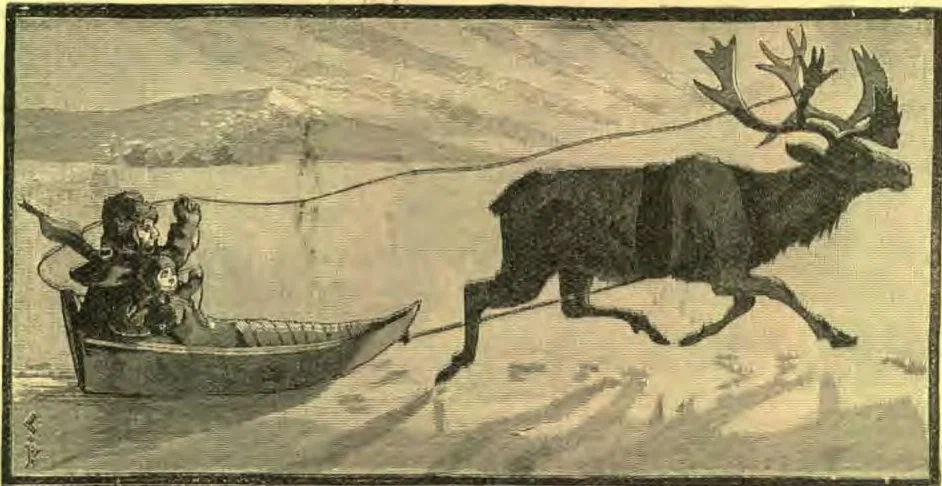
Do you know what a reindeer is like, and what sort of man a Laplander, or Lapp, is?
They both live far away, in a very cold land where the sun does not rise for months, and all that time it is dark and cold with deep snow and ice! And when the sun comes again, it will not set for months, and then it is day all the time. You can imagine in the dark days what a nice thing the moonlight is! How the Lapp must enjoy riding over the snow at a very rapid rate! No man can keep up with the reindeer, and he can go miles and miles without getting tired.
The reindeer is put to a great many uses. It is good to eat, gives milk, and draws a load very fast. The skin makes a warm covering for the “Lapp,” a roof for the huts, or a tent for him to live in. When cut into thin strips, it makes a nice kind of rope; the fat yields oil to burn or to eat, and the hair is used to fill beds. But the Laplander likes the skin for a bed better. The hoof, horn, and bone are also useful.
The Lapp is very fond of reindeer, and though he is ever so poor, is pretty sure to own four or five.—Mrs. G. Hall.

JULIE'S LESSON.

Julie sat down on the top step, waiting for mamma to come home. She made one think of a young squirrel in her gray coat and hat, the especial point of resemblance being the way in which she rolled a big peach stone from one cheek to the other as she sat there gravely meditating.
“Mamma told me to be a very good girl while she was gone. Well, I guess I have been pretty good for me. I don’t think there is anything bad enough to tell about, anyway.”
“Well, my pet,” said a voice just below her, and there was mamma, with a bright smile of welcome and ever so many bundles, and Julie flew down the steps to meet her.
“What have you in your mouth, dear?”
“A peach stone,” said Julie.
“Why, we have no peaches in the house to-day. Where did you get it?”
Julie hopped around on one foot for a minute, then took the stone from her mouth, and began rolling it between her hands in an embarrassed way.
“You see,” said she, “Molly and I were playing down by Dobson’s grocery, and there was a basket of peaches on the sidewalk, and Molly said, ‘I dare you to grab a peach,’ and so of course I had to grab it, mamma!”
Mamma’s sorrowful face made Julie’s own lose a little of its brightness. She sat quietly watching her mamma take off her bonnet and gloves, only once saying cheerfully, “Now, mamma dear, it’s all right; don’t worry about it any more. You see, I have asked God to forgive me, and the man didn’t see me, so it’s all right!”
Presently mamma sat down, and took her little daughter on her lap.
“Julie,” she said, “do you remember the other day we saw a young boy in the street, in charge of a policeman, and you asked me what he was being taken away for?”
“Yes, mamma.”
“What did I tell you the boy was?”
“A thief,” said Julie.
“And what did I say a thief was?”
“Somebody who took what did not belong to him,” said Julie, with a shocked look on her face. There was a moment’s silence, and then Julie burst into tears. “O mamma, I didn’t mean to! Can’t I ever not be a thief again?”
“My darling, you can begin all over again. First, you must go to Mr. Dobson, and tell him what you did, and pay him for the peach. Then come home and ask God to forgive you, and he surely will if his little child is truly sorry, as I think she is. And one thing more you must learn, Julie—to be really brave; brave enough to do always what is right. It is never brave or smart to do a thing just because you are dared to do it.”
About five minutes later a little gray figure stood in Mr. Dobson’s store, watching him weigh out a pound of animal crackers for a little girl.
“Have one, Julie?” he said kindly, holding out toward her a very mild-looking lion.
Julie shook her head. “No, thank you, sir,” she said.
Mr. Dobson looked surprised. “Well, that’s the first time I ever knew you to refuse anything good to eat. A’n't sick, are you?”
Then, as they were left alone in the store, Julie suddenly burst forth, looking straight ahead without winking, and speaking as fast as she could:—
“O Mr. Dobson, I came to tell you that Molly dared me to grab a peach, and I was a coward and took it, and you didn’t see me; but I don’t want to be a thief. Here’s the money, and will you please forgive me, so I can ask God to, and begin all over again?”
By this time Julie’s breath gave out, and Mr. Dobson was so astonished that he seemed to have lost his breath, too, for a minute.
Then he said: “Julie, you are a good, brave girl. Of course I forgive you, and the next time you see anything in front of the store that you want, come right in and ask for it, will you? Now we’ll have some animal crackers, just to show we are all right again.”
So he held open a little paper bag, and began to pour them into it, singing, with a merry twinkle in his eye:—
“The animals went in, two by two, One wide river to cross— The elephant and the kangaroo—”
I guess you’ll find them all there, Julie, when you get home—a regular Noah’s ark!”
And Julie went off with a very happy look upon her face; for she knew the loving smile and kiss that were awaiting her at home, and the dear mother’s voice that would surely say, “God bless my little daughter.”—Congregationalist.

JOHNNY'S OWN WAY.

Johnny wanted very much to “help” his mother bake pies one morning. So she gave him a piece of dough, the cover of a starch box for a pastry board, and a clothes-peg for a rolling-pin. When he had rolled so hard that his face was very red, he put his little pie on the stove-hearth to bake; and then he saw the pretty, soft steam puffing out of the kettle. He tried to catch it in his hand, but it flew away. Then he put his finger near the nose of the kettle. His mother saw him, and cried:—
“O Johnny, take care, or you’ll burn your fingers, my dear!”
“Steam can’t burn!” cried wise Johnny; “only fire burns.”
“You must not try it. Believe me, it will burn you. Do stop, Johnny.”
“O dear,” cried Johnny, “why can’t I have my own way sometimes! I do like to have my own way! When I’m a big man, I mean to stand and poke my forefinger in the tea-kettle all day, sometime, and have my own way, and—”
Poor Johnny did not wait till he was a big man to do this; a scream of pain told that he had had his own way already.
The dear little white fingers were sadly burned, and for hours Johnny screamed and jumped about so that his mother could hardly hold him on her lap.
“Oh! oh! oh! what shall I do! Oh, dear, mamma, I’ll never have my own way again as long as I live! When I’m a great man, I’ll never put my fingers in the tea-kettle. Oh, dear, dear!”
Take care, little folks, how you take your own way; there are worse foes in the world than Johnny’s steam. Your parents are wiser than you, and they love you too well to deny you any harmless pleasure.
—Words of Life.
Continue reading: JOHNNY CLIMBS INTO GEOGRAPHY