Pacific Press Publishing Company · New York · Jun 10, 1897
The People Shall Dwell Alone
Forty years the Lord led and fed his people in the wilderness.
All this time he was teaching them the way of allegiance to himself—the way of faith.
This he did in order that his purpose might be fulfilled through them in the land whither they were going to possess it.
At the end of the forty years they were encamped in the plain of Moab, opposite to Jericho, preparatory to entering the land of their possession.
While there encamped the will of God concerning them was declared by an irresistible inspiration upon the prophet Baalam, and in words of instruction to his people for all time.
And the words are these: “Lo, THE PEOPLE SHALL DWELL ALONE, AND SHALL NOT BE RECKONED AMONG THE NATIONS.”
At that time the Lord’s people composed “the church in the wilderness” (Acts 7:38); and in thus declaring that they should dwell alone and not be reckoned among the nations, he plainly declared his will that his church should be forever separated from every State and nation on the earth.
God never intended that his people should be formed into a kingdom, or State, or government, like the people of this world; nor that they should in any way be connected with any kingdom, or State, or government, of this world.
They were not to be like the nations or the people around them. They were to be separated unto God “from all the people that were upon the face of the earth.” The people were to dwell alone, and were not to be reckoned among the nations.
Their government was to be a Theocracy pure and simple—God their only king, their only Ruler, their only Lawgiver. It was indeed to be a church organization, beginning with the organization of the church in the wilderness; and was to be separated from every idea of a State. The system formed in the wilderness through Moses, was to continue in Canaan; and was intended to be perpetual.
“The government of Israel was administered in the name and by the authority of Jehovah. The work of Moses, of the seventy elders, of the rulers and judges, was simply to enforce the laws that God had given. They had no authority to legislate for the nation.” For God had declared plainly: “Ye shall not add unto the word which I commanded you, neither shall ye diminish ought from it.”
Thus the principles of their government were solely those of a pure Theocracy. And such “was and continued to be the condition of Israel’s existence as a nation.” In any government it is only loyalty to the principles of the government, on the part of its citizens, that can make it a success. Consequently, on the part of Israel, it was only loyalty to the principles of a pure Theocracy,—God their only King, their only Ruler, their only Lawgiver—that could possibly make that government a success.
But loyalty to these principles demanded that each one of the people should constantly recognize and court the abiding presence of God with him as the sole King, Ruler, and Lawgiver, in all the conduct of his daily life. Yet it is “by faith” that God dwells in the heart and rules in the life. And “without faith it is impossible to please him.” Therefore the existence of the original government of Israel, and the existence of Israel as a nation, depended upon a living, abiding faith in God, on the part of the people of Israel.
And just here, the only point where Israel could fail, Israel failed. The people did not abide in faith. They did not remain loyal to God as their King. “And Joshua the son of Nun, the servant of the Lord, died, being an hundred and ten years old. . . . And also all that generation were gathered unto their fathers: and354there arose another generation after them, which knew not the Lord, nor yet the works which he had done for Israel.”
“And the children of Israel did evil in the sight of the Lord, and served Baalim: and they forsook the Lord God of their fathers, which brought them out of the land of Egypt, and followed other gods, of the gods of the people, that were round about them, and bowed themselves unto them, and provoked the Lord to anger. And they forsook the Lord, and served Baal and Ashtaroth.”
Then all the evils that came upon them only as the result of their apostasy and idolatry, they charged back upon the government of God. In their unbelief and apostasy, they could see in the continued raids of the heathen, by which their country was sacked, and themselves were oppressed, only evidence that for all practical purposes the government of God had failed.
They therefore reached the conclusion “that in order to maintain their standing among the nations, the tribes must be united under a strong central government. As they departed from obedience to God’s law, they desired to be freed from the rule of their divine Sovereign; and thus the demand for a monarchy became widespread throughout Israel.” Accordingly, they said to Samuel, “Make us a king to judge us, like all the nations.”
As their hearts were fully set on having a king like all the nations; and as practically they were much like all the nations anyhow; the best thing the Lord could do for them was to let them have their king. Nevertheless he said to Samuel, “Protest solemnly unto them.”
Samuel did so, but still they insisted “Nay; but we will have a king over us; that we also may be like all the nations; and that our king may judge us, and go out before us, and fight our battles for us.”
And of it all the Lord said to Samuel, “They have not rejected thee; but THEY HAVE REJECTED ME, that I should not reign over them.” And Samuel said to them, “YE HAVE THIS DAY REJECTED YOUR GOD . . . and have said unto him, Nay; but set a king over us.”
It was the same story of Babylon, Assyria, and Egypt, over again. When they knew God they glorified him not as God. And as they did not like to retain God in their knowledge, the arch-deceiver seduced them into idolatry, and from idolatry into monarchy, in order that he might gain supremacy over them, and by worldly influence entice them, or by force prohibit them, from the service of God.
It was to save them from all this that the Lord had said of them, “The people shall dwell alone, and shall not be reckoned among the nations.”
If they had remained faithful to this principle, there never would have been amongst Israel a State or a kingdom.
Therefore, in announcing this principle, God intended forever that they should be completely separated from any such thing as a State or kingdom on the earth.
And as when that word was spoken they were “the church,” it is absolutely certain that in announcing that principle, God intended to teach them and all people forever that his plainly declared will is that there shall be a complete separation between his church and every State or kingdom on the earth: that there shall never be any connection between his religion and any State or kingdom in the world.
And further: As that people were then the church; and as the Lord said they rejected him when they formed that State and kingdom; it is perfectly plain by the word of the Lord that whenever the church forms any connection with any State or kingdom on the earth, in the very doing of it she rejects God.
And from ancient time all this was written for the admonition of those upon whom the ends of the world are come. Will the people to-day be admonished by it?
The Mission of the American Sentinel.
By Editor
THE AMERICAN SENTINEL stands in defense of a principle, and that is why the paper exists. From the day it was established it has been an uncompromising advocate of the absolute separation of religion from the State, not in name only, but in fact. This is a question that concerns every intelligent person in every land under the sun.
Government and religion are both essential, but the spheres of action of each are sharply circumscribed. One presides over the realm of conscience, taking cognizance of the thoughts and intents of the heart; the other deals with overt acts, beyond which it cannot go. One leads the individual to do right because it is right, the other restrains him from evil through fear of punishment or hope of reward.
Every individual is endowed by the Creator with certain inalienable rights. Government is simply a compact entered into whereby the united strength of the majority is exercised in the maintenance of these rights against the encroachments of selfishness and greed. One of these rights is the freedom to worship or not to worship God, according to the dictates of conscience. Jesus Christ, the author of Christianity, gave this liberty of thought and action to all his followers; but this privilege many who have claimed to be his disciples, have refused to their fellows. They have read from his teachings, and from their interpretation of them have formulated a creed. Everything that disagrees with this is wrong, as they view it. Failing by argument to convince those who differ from them, they have sought to invoke the arm of the law to compel an outward acknowledgment under penalty of physical punishment. At best this can only make hypocrites355and a hypocrite is two-fold more the child of the evil one than the open opposer.
Now the point: The trend of passing events indicates that among many so-called Christians there is creeping in the idea that the civil law can be made an adjunct in the propagation of the gospel; and not in our own country alone is this true, but it is pervading Christian lands everywhere. Pride, worldliness and Pharisaism are fast coming into the churches, and just to the extent that the churches have lost the primitive power of the gospel in their work, just to that extent is there a clamoring for civil power to forward their ends, and the logical result of this is but one thing—persecution pure and simple to dissenters.
Against all this the SENTINEL raises a warning voice. There is no power under heaven to make men good at heart but the transforming power of Jesus Christ, and his kingdom is not of this world. His weapons are not carnal, but spiritual; love, not force. In the light of the past and of the sure word of prophecy, the SENTINEL beseeches the people everywhere to open their eyes and discern the signs of the times.
Great Britain's Naval Spending and International Arbitration
GREAT BRITAIN'S interest in the cause of international arbitration is indicated, it is said, by an appropriation for the present year of $109,190,000 for the construction of marine engines of war.
Falling Back Upon Rome.
SPEAKING of a change of views recently experienced by a W. C. T. U. evangelist relative to the question of which day is the Sabbath, the N. Y. Christian Advocate, of May 6, says:—
“The question between those who observe Sunday as the Lord’s day and those who maintain that the only day to be observed as a sacred day is the seventh day, is a complex one, that the study of many years would not fully exhaust. There are some questions upon which practical wisdom for busy Christians is to follow the teachings of the Church in all matters that are not flatly and unmistakably contradictory to the Word of God.”
In other words, this question of which day is the Sabbath being so complex and difficult of solution, it is impracticable for the individual Christian to undertake it, and his proper course is to follow the teachings of the Church. This is the principle of popery, as straightly put as it would be by an acknowledged spokesman of Rome.
It sounds odd to hear this leading Methodist organ falling back upon this purely papal principle in defense of Protestant practice in the observance of the Sabbath. Yet, after all, it is not strange, but perfectly natural; for Protestant practice in this important matter, as generally observed, is not Protestant at all, but papal; that is, the observance of Sunday as a sacred day rests not upon the Word of God, but upon tradition and the precepts of “the Church”; and when the champions of Sunday observance find themselves under the necessity of defending it, they at once fall back upon the papal principle of directing conscience by the word of man, instead of the Word of God. Papal practice must be defended by papal principles.
An Unchristian Petition.
AT a special meeting of the Charleston (S. C.) Ministerial Union, May 14, as reported in the Charleston News and Courier, the following petition to the Postmaster-General was presented and unanimously indorsed:—
“To the Hon. James A. Gary, Postmaster-General—
“Honored Sir: The Sunday railway train, by its ready and wide-extended inducement to travel, both for pleasure and business, is undoubtedly the most influential agency now undermining public reverence for the divinely-appointed sabbath.
“The transportation of the mail, except in the vicinity of large cities, is the chief cause and support of the Sunday train.
“The great facilities for daily intercommunication by rail, telegraph and telephone leave no excuse for the Sunday mail as a necessity, a fact sustained by the diminished mail service and almost universal closing of post-offices in England and Canada.
“State legislation cannot stop United States mail trains, therefore the responsibility for Sunday mail service and largely for all Sunday travel rests solely upon the post-office department.
“If the United States Government, through you and your department, by the approval and direction of the President, would set the example of reverence for the Lord’s day by stopping the transmission of mails and closing all post offices on Sunday, it would evoke a divine blessing upon itself and the whole country; would teach a sublime lesson to the world; would confer a great boon upon thousands of its own and other officials and employés, and would put such a stamp of condemnation upon all acts of public desecration of the sabbath as would deter good citizens from their commission, and render all proper Sunday laws, State and municipal, easy of enforcement.
“We, therefore, do most earnestly but respectfully petition you, and through you his Excellency the President, to forbid the transmission of any mails on Sunday, and order the closing of all post-offices throughout the United States on that day.”
Let it be observed that this petition is avowedly in behalf of “the divinely-appointed sabbath.” It does not356claim to speak for any “civil” institution. Also, that it asks the Government to “set the example of reverence for the Lord’s day,” and thus—as it says—“evoke a divine blessing upon itself and the whole country,” and “put such a stamp of condemnation upon all acts of public desecration of the sabbath” as would give life to “all proper Sunday laws, State and municipal.”
As the matter now stands, these State and municipal Sunday statutes are for the most part shorn of their intended force by their manifest hostility to the spirit of the Constitution, which declares that “Congress shall make no law respecting an establishment of religion, nor prohibiting the free exercise thereof.” The Postmaster-General is asked by this petition to take a step which will commit the Government to the recognition and enforcement of religion, and thus get over the objection offered by the Constitution.
All this is plain enough to the view of any person who will look at the facts; and that such undisguised Church-and-State demands are being made upon the Government is a fact which should cause American citizens who love liberty and believe in the separation of Church and State, to do some serious thinking.
Education of the Conscience
THE most practical education any person can receive is education of the conscience. He will have more use for this than for any other, and more momentous issues will hang on its decisions. The teacher in this education is the Holy Spirit, and the text-book is the Word of God.
Spending on Luxuries Amid Hard Times
Apropos to the cry of “hard times” so much sounded by this “Christian nation,” are the following figures given by the Union Signal:—
“The people of this country expended last year $22,000,000 for chewing gum; $400,000,000 for amusements; $600,000,000 for jewelry; $800,000,000 for tobacco; and $1,400,000,000 for strong drink.”
A Menace to Liberty.
“OPEN the Convents,” says the Michigan Christian Advocate, of May 22, in commenting upon the death of an unfortunate inmate of one of those institutions, while attempting to escape. The victim was a young woman twenty-two years of age, and her death resulted from injuries caused by leaping from a second-story window of the “Convent of the Good Shepherd,” in Indianapolis, Ind. The Advocate says it is scandalous that such things can happen in “the land of the free.”
It is very true that such happenings are altogether incompatible with the theory upon which this Government assumes to stand, and such involuntary servitude should be at once abolished by the strong arm of the law. To quote the Advocate’s word, “Ecclesiastical prisons are not compatible with civil liberty. Barred doors, rusty keys, dark recesses, unscalable walls, mysterious secrecy, are forbidding enough under State auspices. . . . What was the American Government established for, anyway? If Spanish institutions are to be fostered and perpetuated here, Columbus might as well have refrained from his big discovery.”
But what the liberty-loving people of this country need to realize is that more formidable than all the ecclesiastical prisons which Rome maintains, as a menace to American liberty, is the presence of Romish principles in the beliefs and practices of the American people. While these principles remain to enslave the understanding, there can be no safety for that personal liberty which is lost behind barred doors and unscalable walls.
Mr. Worldlyman's Advice to Preachers.
In the Herald and Presbyter, of May 26, “Mr. Worldlyman” writes a “Letter to Preachers,” which may explain why the Church is getting into such close touch with the world, and is striving so earnestly to get possession of worldly power. The letter runs as follows:—
“Don’t preach first principles all the time. It may be a good sermon, old-fashioned, not up to the times. It is what the people do not care to hear. This humdrum of ‘faith, repentance and baptism, and add to your faith virtue, and to virtue knowledge, and to knowledge temperance, and to temperance patience, and to patience godliness, and to godliness brotherly kindness, and to brotherly kindness charity,’ is old, and sounds like fault-finding. We are none of us perfect, but we do not want to be told of it all the time. We are doing as well as we can, living about as well as most folks, and our church is as good as anybody’s for all that I can see, and I don’t know that it is any better. We can read about those things in the Bible if we want to. Give us something new and startling that will please and draw the crowd.”
“Our preachers must not be, nor teach their congregations that they are to be, a peculiar people; but they must be like other folks. Just to think, the idea of being a peculiar people, a holy nation, a chosen generation, called out of darkness into light; a people of God, having obtained mercy, and abstaining from worldly lusts which war against the soul; speaking and living honestly, endeavoring to glorify God in our bodies and spirits, which are his. How absurd! How far behind the spirit of the age and the aspirations of the present time. How old-fogyish it looks and sounds. Why, the preacher of to-day must have some theatrical get-up about him. He must strike attitudes in his pulpit, instead of sin and spiritual wickedness in high places; use a few high-sounding words and phrases, such as ‘We must be in touch all along the line;’ ‘The Fatherhood of God and the brotherhood of man.’”
“Tell people something that interests them. If they hear a passage repeated that seems to justify them in something they want to do, it pleases them. ‘Does it not say in the Bible there is a time to dance?’ Get very much interested in anything that seems to favor them in the way they desire to go. Tell some witty story to cause357a laugh, and you will take. Touch very lightly on Bible teachings and Bible principles, especially the teachings of Christ through his apostles. Talk about higher criticism and an educated ministry, and when you were in college; preach about this great universe, sun, moon and stars; come down to earth once in a while and talk about the wonderful inventions of men—what great things they are doing in these days of steam, telegraph, telephone and electricity.”
“This is a great world and we are a great people. The Bible is a great book, wonderful, considering the age in which it was gotten up, but is hardly up to the times. Criticise it as the teachings of men, and when you find anything that does not just correspond with your views, just say: ‘Paul was an old bachelor, and did not like the women any way, or had dyspepsia, and did not know what was the matter with him. Peter got the blues, and James had the gout.’ Make it sound funny.”
“What were Peter, Paul, James or John compared with the men who occupy the pulpits at the present day? Can not the people go to Christ to-day without their instruction—Christ and the Spirit, not the gospel? Smite your breast and cry, ‘Christ within!’ These men are good, no matter whether they have obeyed the gospel or not; they are honest and sincere, and it does not seem right to tell them they have not obeyed the Master. Preach a goody-goody kind of salvation that will please the people; leave the gospel of Christ and his salvation therein taught out of the question, and you may take the world, or at least the world will take you, in this craze of interdenominationalism, singing: ‘The world for Christ, and Christ for the world, with the Christ left out.’”
Is the Sabbath in Danger?
On the question of the danger of losing the Sabbath an exchange makes this pertinent comment: “‘Our Sabbath in danger’ is the note of alarm sounded by the clergy. The Sabbath will not be in danger so long as nobody is prohibited from keeping it. As for Sunday, the indications are that it will continue to recur once a week for some time to come.”
Surplus of Protestant Ministers Versus Real Need
THERE is reported to be a great surplus in the ministry of the Protestant church, no less than four hundred applications having been received for one pulpit in New York City. Nevertheless there is no surplus in the number who are preaching the glad tidings of salvation to sinners, or who are ministering to their unfortunate fellow-beings in the name of Jesus Christ.
Baptist Principles vs. Sunday Laws.
From “Baptist Principles of Religious Liberty,” by Geo. B. Wheeler.
1. SUNDAY laws had their origin in a union of Church and State.
2. They were enacted to enforce the observance of a church dogma.
3. They have been perpetuated by church influence, and are therefore religious in origin, nature, and object.
4. They are used to persecute conscientious dissenters.
5. They attempt to enforce a religious observance which pertains to the first table, contrary to Baptist principles.
6. They meddle with religion and matters of conscience contrary to the spirit of Christianity.
7. They were opposed by Roger Williams.
8. They discriminate in favor of the doctrine of one church and against the faith of another.
9. They have, between Sept. 29, 1885, and Dec. 31, 1896, imprisoned 41 conscientious Christians for a total of 1722 days.
10. They have driven 12 Christian men in the chain-gang of Tennessee for a total of 445 days.
11. They have been used by persons calling themselves Baptists, to imprison their dissenting Sabbatarian neighbors, and to drive them into the chain-gang.
12. These cruel persecutions have been defended and encouraged by papers bearing the Baptist name.
13. Sunday laws are not based by their advocates on the idea that one day in seven is needed for recreation from continuous toil, since Sunday-law advocates attempt to prohibit all innocent recreation on that day.
14. Sunday laws would be sumptuary laws, even if it could be proved that they were civil instead of religious, since they would attempt to dictate to the citizen when and how he should employ his time for his physical good.
15. Sunday laws and liquor laws are not alike, since the first seeks to protect the “holy day” from “desecration,” while liquor laws seek to protect the man against his liquor-maddened fellowman.
16. Sunday laws attempt to compel men to act outwardly as though they believed the day holy, whether they do or not.
17. Sunday laws attempt to compel Seventh-day observers to treat Sunday with the same outward regard that they pay to the Sabbath of the Lord, thus compelling them to break down the distinction which the Lord commands men to make between the Sabbath and other days of the week.
18. Sunday laws therefore conflict with the conscientious convictions of seventh-day observers, just as laws requiring Baptists to sprinkle their children conflicted with the conscientious convictions of Baptists in the early days of New England.
18. Sunday-law advocates to-day declare that seventh-day358observers are not persecuted when imprisoned for failure to observe Sunday, just as the persecutors of Baptists once declared that it was not persecution to imprison a Baptist for refusing to have his child sprinkled.
20. Sunday laws prohibit both work and recreation, thus compelling idleness which is productive of crime.
21. God commands cessation from work on the Sabbath, but this command contemplates a “holy” use of a “holy” day, which can only be secured by making the man holy—something which God can do, but which human law cannot accomplish.
22. Sunday laws are papal in principle in that they are a part of that policy which declares that the State should enforce conformity to church doctrines.
23. Baptists have always taught that Christianity was possessed of enough inherent power to stand without the support of human law; yea, even against it.
24. Agitation for Sunday legislation is increasing in the same proportion that the spiritual power of the church is decreasing,—a parallel to the condition of the popular church in the days of Constantine.
The Outlook for General Disarmament.
“New York Observer,” April 29.
WE fear that those of us who have been looking for the speedy disarmament of the nations, and the settlement of international difficulties by arbitration, are far in advance of the times. For if the present conduct of Greece, Turkey and Spain teaches any lesson at all, it is that the desire to fight is that which nations will sacrifice most to gratify, and the power to fight the last element of national life which they lose. Here are three nations practically bankrupt, and with every inducement to maintain peace and devote their energies to productive labor. Yet on a provocation to war, which with each could have been avoided by small compromises which would not have greatly affected national pride, they place on their frontiers within a few weeks, or send over sea, armies varying in number from 100,000 to 200,000 men. It is not true to say that this is the work of the governments alone, which regard themselves as trustees, and so must be keenly self-regarding as respects national honor. For the peoples are quite as ready to fight, and at the first summons forsake their avocations and join the colors, though they know that they will have nothing save gratification of the fighting instinct for their pay.
The Salvation Army Decision.
COMMANDER BOOTH TUCKER, of the Salvation Army, has been convicted in a New York City court of maintaining a public nuisance and of keeping a disorderly house. The “disorderly house” in question is the Salvation Army headquarters in West Fourteenth St., New York City; and the “nuisance” consists of the protracted evening meetings regularly conducted there in the peculiar manner with which the “Army” have made the public familiar.
The “Commander” has issued a statement in which he denounces his conviction as being an invasion of liberty of conscience and an instance of flagrant persecution, without any warrant of law.
That the prosecutors in this case were actuated to some degree at least by malicious motives, seems evident from the nature of the charge which they have succeeded in substantiating in the lower court. The term “disorderly house” has acquired a definite meaning in the public mind which would be most untrue and slanderous as applied to the meeting hall of the Salvation Army. Doubtless there is less disorder, even in the strictest sense of the term, in a meeting like those complained of than characterizes the all-night revels which are frequently to be noted as a feature of life in “high society.”
Catholic Soldiers Refuse Compulsory Religious Service
THE Catholic Standard and Times, of May 15, makes mention of the recent rebellion of the Catholic members of the Ninth New York regiment against an order to attend religious service in Bloomingdale Reformed Church, New York City; in justification of which it says:—
“We believe there is no rule of the service compelling Catholics to attend a form of service offensive to their feelings and which, as individuals, they are prohibited by their own church under pain of sin from attending.”
The Catholics were right in refusing to attend religious service at the dictation of the Government; and they would be equally right in refusing to do a religious act at the dictation of the church. In each case the dictation is that of man, and therefore essentially the same in character. The Government has as good right to359compel the performance of a religious act as the church has to prohibit it.
The individual is responsible to God for the character of his actions. And when he submits to any human dictation in religion, whether from State or Church, he denies God’s right to govern his actions by the divine principle of love, and to guide him by His Word and His Spirit.
Individualism as the Basis of Reform
CONCERNING the necessity of individualism as the basis of true reformatory work, Mr. Charles Booth, of London, who has made a special study of the social and moral condition of the people in that city, testifies that “almost every social and economic question . . . derives its ultimate practical importance from a more widely spread and more human care for the individual,” and that the hope of uplifting the fallen lies not in State enterprise or Collectivism, but in “the reform of the individual by the individual.”
A Religious Revolt in Canada.
CLERICAL despotism, combined with certain liberalizing influences which that despotism cannot shut out, is driving the people of Lower Canada into open religious revolt. What the poor people of that district have to submit to under the ecclesiastical regime which the Catholic Church has established, may be seen from the following quotation from the London (Ont.) Guardian:—
“It may not be known that according to Quebec law tithes are levied and collected in the same manner as the municipal tax. It often happens that in a given district the bishop decides that a new parish ought to be formed and a church built. He selects the plans and decides what the cost shall be. A rate is then struck, and men have been forced to mortgage their farms, in order to meet their payments. The only way to escape is to abjure the church—a course which to the devout Romanist is mortal sin. He exposes his family to the persecution of his former co-religionists, and, of course, is deprived of the means of grace.”
Such is the natural fruit of Rome’s substitute for “the liberty wherewith Christ has made us free.” Gal. 5:1.
Christian Advocate Praises New York Sabbath Committee
THE N. Y. Christian Advocate, in making mention of the late report of the New York Sabbath Committee, says: “The efforts to maintain the civil Sunday cannot be understood apart from the labors of this committee. It is no exaggeration to state that whatever is preserved to us of order and Sabbath decorum in this city of New York is mainly due, under God, to the wisdom and energy of the New York Sabbath Committee.”
It would have been much to the point if the Advocate had pointed out what logical connection there can be between God and a “Sabbath” committee, and the preservation of a “civil” Sunday.
A Prior “Christian Nation” Decision.
IN a recent issue of the New York Journal, Mr. A. H. Lewis points out that the Supreme Court decision of February, 1892, that the United States is a Christian nation, is not the first decision made in a court of law on this subject, but that as far back as 1813 a decision was rendered, which affirmed just the opposite of that of 1892. The circumstances are given as follows:—
“The time was 1813; the scene a town on the Barbary coast. An American privateer put in with three hapless British ships as prizes. The privateer turned over the three captured Britons to Mordecai Noah, afterward high sheriff of New York, and incidentally a newspaper partner of James Watson Webb—then American agent or consul-general to the Barbaries. The privateer wanted the prizes hawked off at public outcry; the Yankee captain hungered for the money he had fought for.
“But the British minister there stationed objected. He pulled a treaty on the Bey of Tunis, who was about to authorize the sale—the Bey, by the way, was to get 20 per cent. This treaty which had been made between the Bey and Great Britain distinctly recited that in event of a war between England and ‘any other Christian nation’ neither side should be permitted the Barbary ports as a theatre of sale for prizes.
“Noah admitted the treaty, but contended that the United States was not a ‘Christian nation,’ and didn’t fall within the terms of the treaty. Noah showed the Bey our Constitution—our bill of rights. He invoked his olive-colored admiration to the fact that we had no national church, and that Christian, Jew (Noah was a Jew), and Mohammedan, were alike equally free in the enjoyment of every American privilege.
“Therefore, claimed Noah, the United States could not be called a ‘Christian nation,’ . . . It took the Bey ten minutes to decide with Noah. The United States was not a ‘Christian nation.’ The British minister was turned down, the prizes were sold, the wise Bey got his rake-off of 20 per cent. of that auction’s proceeds, and the decision itself was never attacked. It stands to this day.”
IN 1813 the Constitution was better known and appreciated than it is to-day.
Blue Laws in New Jersey.
“Catholic Standard and Times,” May 22.
LAWS that are deeply, darkly, but not beautifully blue still guard the coasts of New Jersey. It is not lawful there to try to avert danger to life and limb on the sabbath day, as the Erie Railroad people found out this week when they set a gang of men to work at a level crossing where the ground was found to be unsafe. The Mayor, the Aldermen, the Street Superintendent, and Mr. Dogberry were hurriedly got together, and the watch was directed to arrest all the “vagrom men” who had so outraged the feelings of New Jersey. This was done, and the laborers, having been brought before a justice, were let out on bail. It is entirely lawful to employ men in blue to enforce Blue Laws, but not to endeavor to prevent the town being painted red by some appalling catastrophe on a railway line. These good Jersey people read the Bible, but only, it appears, with one eye open.
He Rode on Sunday.
New York “World,” June 5.
At last the royal dictum of imperial New Jersey has gone forth. It is vicious and immoral to ride a bicycle on Sunday, unless to church.
Justice Collins, of Westfield, has said it.
A Westfield man was riding his wheel Sunday. He was run down and injured by another wheelman and brought suit before Justice Collins. The Justice, looking over his spectacles, shook his head.
“You were violating the State law in riding on Sunday for pleasure,” said the Solomon. “You have no right to sue for damages.” And the Westfield man went away and wept.
The Beauties of State Prayer.
PRESS dispatches from Springfield, Ill., under date of June 3, mentioned the following:—
“The chaplain of the House, the Rev. David G. Bradford, opened proceedings to-day in the State legislature with the following prayer:—
“‘Almighty God, we seek thy presence and blessing at the beginning of another day's diligent labor. Help us, we pray thee, in the discharge of this day's duties. Help these men to remember the poor, tax-burdened people of this great State.
“‘Contract, we pray thee, the capacious maw of the penal reformatory, charitable and educational institutions of Illinois. May they learn to be content with less money, and may we, who refuse to worship a golden calf, refuse also to worship gold in any other form.
“‘Forbid that any foreigner visiting our shores shall ever again have occasion to write:—
“‘Money, money, is all their cry;
Money's the total sum.
Give us money or else we die,
Oh, let the money come.’
“‘And we will ever give thee endless praise. Amen.’
“This prayer was greeted with enthusiastic applause.”
Numerical Growth and Spirituality of the Methodist Church.
By E. G. Andrews
By Bishop E. G. Andrews.
So far as numbers may give evidence there has been an almost steady progress. In 1872 there were 76 annual conferences; in 1897, 124; in 1872, in round numbers, and including those on trial, 9,000 effective ministers; now more than 14,000. In 1872 there were 1,400,000 church members and probationers; now there are 2,800,000; in 1872 less than 1,300,000 Sunday school pupils, now more than 2,600,000; in 1872, 13,000 churches, valued at $57,000,000; now 26,000, valued at $109,000,000, with a parallel increase in parsonages and their value.
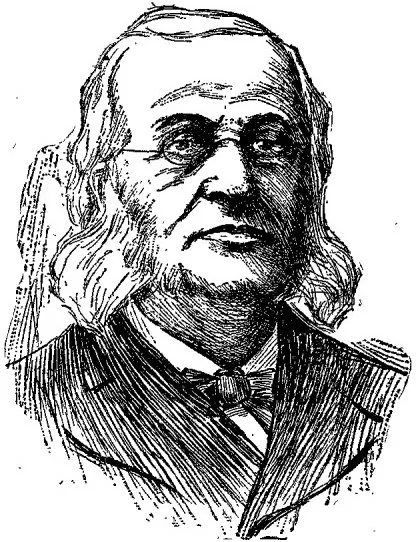
BISHOP E. G. ANDREWS.
Has the spiritual life of the Church kept pace with this increase of its numbers, property and gifts, with this extension of its area, with this multiplication of its agencies?
An easy optimism would fain answer, “Yes,” but an easy optimism is not admissible in a time of transition like this, when a strenuous, perhaps a narrow, interpretation of the moral law is giving place in many quarters to a perilous laxity, as, for instance, touching Sabbath observances, amusements and selfish extravagances; when the Bible is undergoing a critical and in many cases an indifferent or hostile questioning.—From address delivered at the 25th anniversary of his ordination. New York Herald, May 24.