“And hope maketh not ashamed; because the love of God is shed abroad in our hearts by the Holy Ghost which is given unto us.” Rom. 5:5. This scripture does not say that love for God is shed abroad in our hearts, but the love of God is shed abroad in our hearts. The love of God must be the same kind of love that God himself is in possession of. And what will this love of God received into our hearts do for us? — It will make us like God in character; as there is no hatred in God, so there will be none in us if we have his love in our hearts. As God has no desire to harm any of his creatures, so we shall have no desire to harm any of them. As God is earnestly desiring to save all men from sin, so we shall desire to do all in our power to save sinful men. As God cannot indulge in speaking evil of even his enemies, so we shall have no desire to speak evil of those who may evil entreat us. As God is ever ready to lift up the fallen, and to comfort the afflicted, so we shall take pleasure in doing the same thing. As God rules not the universe with an iron hand, but in love and tenderness, so those who are called to responsible positions among his people, if they have the love of God in their hearts, will rule in the spirit of love and tenderness.
If this true “love of God” was truly “shed abroad” in the hearts of all God’s people, we should have no more church difficulties of any kind. There would be no more evil speaking one of another, because each one would love every other one. We would not see so many faults in others, for love shall cover the multitude of sins. We would have no empty treasuries in our conferences, because the love of God would prompt us to do just what God would have us do on this point, and every one would render to the Lord his own; for no man can have the true love of God in his heart, and withhold his means from the cause of God. It seems to the writer that what this people need more than anything else is the love of God in their hearts. In “Mount of Blessing,” page 31, we read as follows: “Righteousness is holiness, likeness to God; and ‘God is love.’ It is conformity to the law of God; for ‘all thy commandments are righteousness;’ and ‘love is the fulfilling of the law.’ Righteousness is love, and love is the light and the life of God.”
The love of God in our hearts will enable us to walk in the light of God, and to live day by day the life of God, which is a life of love, with no hatred at all in it. It will help us to live a life of activity and earnest work; for there is no indolence in the life of God.
How wonderful is the plan of salvation, and the power of God’s grace, that we poor mortals who have sinned may have the privilege of representing the very character of Heaven itself in this dark world of sin. No wonder that Satan stands aghast, and wonders at the manifestation of redeeming grace in the children of God.
SCIENCE AND FOOD.
Science is, to speak metaphorically, “poking its nose into everything.” Its X-rays of investigation are being turned on to every fact and feature of life. A few years ago a man’s appetite was regarded a sufficient guide in deciding what he should eat. He ate this and rejected that because he did or did not like it. If he liked a certain article, he ate it till he didn’t like it, and then tried something else. Now it is made clear that appetite is akin to conscience,—a very necessary and useful faculty, but of necessity almost wholly a creature of education and habit. It needs careful training and cultivation according to right principles, or it is likely to become a snare, an agent of destruction. Science shows to us what are the requirements of our systems. They are composed of certain elements which the food must supply, and it is an evident necessity that the food be of such a character as to fill the requirements. The elements of food are of vegetable growth. Nature elaborates the food required by men and beasts, and produces it in plants and trees. Vegetarians contend that from the vegetable world mankind may and should derive its food, without slaying and eating animals that have assimilated from plants the food that men require. That is, they claim that it is more humane and more conducive to health to take these food elements at first hand, fresh from nature’s laboratory, than to take them in the partly worn-out and often diseased tissues of animals. The argument is strong and the conclusion apparent in the light of reason and philosophy. But some have found the vegetarian regimen insufficient for their support. There is for some cases such a lack of the fatty qualities as to produce a lean, lank appearance that has not always spoken well for the diet reform. Now if animals can obtain from the vegetable world all the elements of nutrition, why cannot we, except it be that our digestive or assimilative powers are not adapted to that class of food exclusively?
While it is true that beasts eat and appropriate food without cooking or preparation, to man is given the ability to aid his digestion by artificial preparation. It is here that science comes to our aid. Cooking and preparing food has long been left to taste and ignorance. It is the legitimate work of wisdom and skill. Cookery should no longer be left to the smirch and drudgery of pots and kettles, and consigned to some girl who will work the cheapest.
Then, too, science is going farther, and chemical laboratories are busily engaged in solving the food question. From nuts are being produced those features of nutrition in which we have been wont to regard the vegetarian dietary deficient. It is no longer necessary to depend upon the butcher nor even the dairy to supply their necessary part of the bill of fare. Butter, cheese, milk, and meat are now made ready for our use, directly from the vegetable creation. These articles possess the necessary qualities of nutrition and flavor to entitle them to the places they are made to fill. We use constantly upon our table most of these articles, and can say that they fill the bill.
Disease of various types is becoming so prevalent among animals that it is nothing short of dangerous to depend upon animal food. It is therefore providential that provisions are being made by which it is wholly unnecessary to do so.
SYSTEM IN HOUSEWORK.
By M. L. Hale
BY MRS. M. L. HALE.
(Brownville, Neb.)
It is generally acknowledged by good housekeepers that she who does her work with some system, accomplishes more with less effort, and is always more “presentable” than she who does it in a haphazard way. But system should not be carried to such an extreme as to make ourselves or our families uncomfortable. It should always be our servant, never our master.
Good housekeeping requires much planning and real executive ability. There are so many wheels to be set going, and to be kept running each day; and she who understands her business will see that they do not jar or interfere with one another. A carefully planned program will aid her greatly in this. Try it, you who never have, and make one out that will best suit your circumstances, as all have not exactly the same kind or amount of work to do; then follow it as closely as possible, until it becomes second nature.
Have a regular time for rising in the morning, and let it be early enough so that you need not feel hurried. Make your toilet neatly before leaving your room, for what sight is more displeasing than an uncombed, untidily dressed woman! and do not forget to have a few words of secret prayer that you may be kept through all the trials of the day. So much depends on beginning the day with the blessing of God upon it!
I will submit a program for each day in the week, with a few suggestions that, I trust, may be helpful to some:—
Sunday.—Brush and straighten up the rooms generally, gather up the clothes ready for washing, and, while getting dinner, do a little extra baking for next day, also cook the grains for next day’s breakfast. In the afternoon, look over the week’s papers, and mark, wrap, and direct such as you wish sent to others, also write letters. If possible, become better acquainted with your friends and neighbors in a religious way.
Monday.—Arise a trifle earlier than usual, if you wish, but do not get up in the middle of the night, in order to get your washing on the line ahead of your neighbors,—there is neither sense nor comfort in that. Make your toilet as neatly as on other days, washing need not be very dirty work, and there is no reason why a woman should rig up like a scarecrow on that particular day. Put over the wash water with a little soap, and while it is heating, sort, and put to soak in cold water any clothes that may need it, after which all the white clothes may be put into a tub (unless you use a machine), the least soiled on top. Pour the boiling hot suds over them, and cover tightly till your breakfast work is done, when you will find they require but little rubbing. Scald or boil, and finish in the usual manner. Get an easy dinner. I prefer a baked dinner on wash day, and a boiled or steamed, when baking and ironing. After dinner, rest and read. At night fold and sprinkle the clothes, being careful not to get them too damp, as that makes ironing much slower. Common sheets, kitchen towels, and plain underclothes need no sprinkling, and but little ironing if nicely folded.
Tuesday.—Do as much of the ironing as you can, and at the same time bake bread, so as to economize fuel. After the dinner’s work is finished, rest, or do any necessary mending in the clothes already ironed. Spend the evening in some pleasant way with your family.
Wednesday.—Finish the ironing and mending, and put away all the clothes. If possible, attend the weekly prayer-meeting at night; if not, have one alone or with your family.
Thursday.—Do the general sweeping and dusting, airing and changing bedclothes, etc. After dinner make friendly or missionary calls, sew, or plan a pleasant afternoon with the children. Thursday evening is a convenient time for the family to take each a general bath, before retiring, unless you prefer taking it during the day.
Friday.—All necessary baking and cooking for the Sabbath should be done, also all needed cleaning. Chores, so far as possible, should all be done before sundown, so the entire family can be gathered in the cozy sitting-room, all ready for the Sabbath.
Sabbath.—Begin the day with worship, in which all may take part, either by singing or prayer, or repeating verses of Scripture. Go over the Sabbath-school lesson for the last time, and retire early, so as to be up in good season the next morning, that all may be ready for Sabbath-school without any unnecessary hurry or bustle. Parents should spend as much time as possible with their children, upon the Sabbath, making it the most pleasant, as well as the most profitable day of the week.
In a small family, or when there is much extra work to be done, such as house-cleaning, canning, or sewing, time can be saved by washing only once in two weeks.
In conclusion, I will say that I enjoy the Home department very much, but am sorry that so few of the sisters take an interest in writing for it. I am sure that most of them have had some experiences that would be a benefit to others did they but feel free to relate them. I would suggest that the editor allow us to write under a nom de plume and thus, perhaps, do away with a little of the reserve that is felt when we sign our names to what we say.
[The editor grants that privilege when it is requested.]
A FLOWER MISSION.
By Editor
An esteemed friend sends us the following letter, which we publish instead of writing an article as the letter suggests. The letter has said what she wants to have said, and has said it as well as we could possibly do. We prefer always to let our correspondents tell their own story. We think the suggestion an admirable one, and second the proposition made by Sister Reed. Here is the letter:—
DEAR EDITOR: For a long time I have had in mind a subject which I wished to place before our people, but as I am not accustomed to writing for publication; I will write you a personal letter, and if you think the suggestion a good one, I should like to see an article in the REVIEW from you on the subject.
We who have ever been ill know how much beautiful flowers help to cheer and interest us when too weak to read or even to think much. We also know that there are thousands who are so situated that it is impossible for them to obtain the flowers. There are many of our people and children who would be glad to help lighten the burdens of such, if they only saw a way to do so. My idea is for all who have flower gardens this year to save seeds, and send all they can spare to some person who would put them up in packages to be sent to those who will cultivate flowers and give bouquets to all the sick, lonely, and careworn ones they can find. By so doing I think much good would be done, and many hearts would be cheered. Those so engaged would also become more interested in missionary work. From my flower garden this year I think I can spare two or three quarts of choice seeds for the “Flower Mission.” If you deem this worthy of notice, please write early enough so that this year’s crop of seed may be saved, and many sick ones cheered as a result. Yours in the blessed hope, MRS. MAY R. REED. Seymour, Wis.602
In order to facilitate the work which is here proposed, we will voluntarily constitute the Home department of the REVIEW AND HERALD a receiving and distributing bureau. We will be glad to receive from our subscribers packages of flower seeds for the purpose specified. Our lady assistants will cheerfully and carefully assort and preserve the seeds until they shall be called for; and in the spring we will invite those who will raise flowers for the benefit of the sick and poor, to send to us for the seeds which have been donated. Who will engage in this work?
The contributions of flower seeds should be sent to the REVIEW AND HERALD, Home department, Battle Creek, Mich. Let the seeds be choice, and carefully labeled. Packages must be left tied so as to be open for inspection; otherwise, letter postage will be charged. In small quantities they can be enclosed in an ordinary envelope with letter. In sending large packages they should be securely tied in strong paper or cloth sacks. T.
A MISUNDERSTANDING.
A misunderstanding, you say,
And neither will deign to explain;
For each one must hold his own way,
And never be friendly again.
O brothers, for whom Christ hath died,
Supposing his wrath should declare
Your wrong from his grace shall divide,
His mercy no more you may share;
With the hurt of the loss in your heart,
With the sore of its woe in your life,
Could you bear from life's realm to depart?
Could you dwell in a kingdom of strife?
A misunderstanding! How slight
Is the error unpardoned, unshriven,
Compared with the infinite height
Of sins which your Lord hath forgiven.
— Selected.
THE FAMILY BATH.
By T.
As enlightenment advances, the bath becomes more and more a necessity. Filth and ignorance are closely related. A clean skin and a clean heart are mutually beneficial. Every Christian mother desires that each of her flock shall have the benefits of frequent ablutions. But how to secure these benefits is not always an easy problem. Very few of our ordinary houses are constructed with a bath room or any facilities for bathing. It is only now that people are beginning to understand that a house is not complete without special provisions for bathing. Then there are other difficulties that face the mother who would be glad to suggest a bath to the members of her flock. There is only the kitchen stove on which to heat water, and it takes a large quantity to warm sufficient water to fill the bath tub half a dozen times.
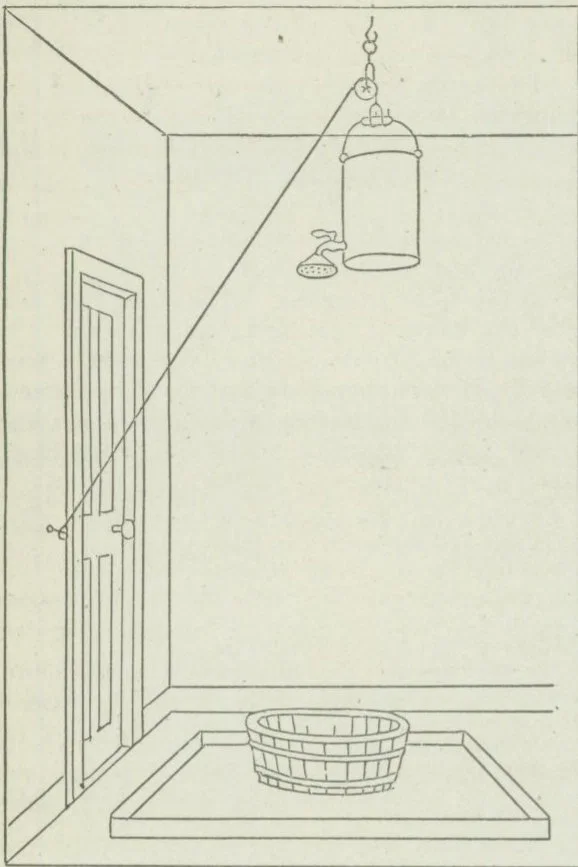
We have a simple contrivance in our house, which is one of the old-fashioned ones, built when people didn't bathe. The accompanying diagram will illustrate the arrangement, which consists of a shallow zinc pan three or four feet square and two inches deep, with a stiff wire in the edge of the rim. This is placed on the floor, and may contain a small tub to catch most of the falling water. In the ceiling of the room a hook is screwed, to which is attached a small pulley carrying a small rope. To one end of the rope is fastened a double wire hook to hold the bucket, and to the other end is fastened a loop or single hook giving just rope enough to raise the bucket to the ceiling and reach to an eye or nail in some convenient casing. Have a good tin bucket that will hold two or three gallons, with a faucet and a small spray fixed at the bottom. It is not necessary to use a flood of water in order to procure a good bath; and if a spray sufficiently small cannot be obtained, the matter may be remedied by using a larger one, and stopping some of the holes with solder. (In fact, our artist has got the one in the picture too large by half.) The advantages of such an apparatus are very apparent. It may be used in any room, and is very easily removed when the bath is over. It requires but a teakettle full of hot water to warm half a dozen baths. It is more cleanly and wholesome than a tub bath, as clean water is continually coming over the person. It costs but a very small sum, and may be obtained anywhere.
T.
MOSLEM WOMEN.
WOMAN occupies a subordinate position among the Mohammedans. She is her husband's slave, and must not even pray at the same time and place as the men. It is allowed that women have souls, but their salvation depends largely on strict obedience to their husbands. In one of Mohammed's visions, he saw heaven and hell; the former was peopled chiefly by men, the latter by women.
Polygamy is the curse of the Oriental nations, and is allowed by the Koran, which, however, restricts the number of legal wives to four. This allowance may be supplemented by an unlimited number of female slaves, who always are actually, though not lawfully, their master's wives.
Among the better classes, the harem system is in vogue, and an absolute seclusion imprisons the women, morally and physically; when abroad, they must wear the veil. There is no home life as we know it; in the harems, the women have separate apartments; but this is usually impossible among the poor, and the miserable state of things can be readily imagined. The daily life of the women is infinitely degrading; the worst passions of human nature are developed and stimulated to a fearful degree,—jealousy, intrigue, and murderous hate. No male missionary or even physician can ever reach the jealously guarded women of the harem; this is a field for lady missionaries only.
The Moslem idea of women is vile and degrading. The divine law of love is violated by his wicked and brutal treatment of defenseless women. Among their proverbs are these: “The heart of woman is given to folly;” “Trust neither a horse, a king, nor a woman;” “Women are the whips of Satan.”
The great mass of women are utterly ignorant; they marry when between twelve and fourteen years of age, and the men are bitterly opposed to their being educated; so dwarfed is the intellect, that a woman of twenty-five is intellectually just like a child of eight, in a Christian land.
In a conversation between a European traveler, Sir Samuel Baker, and a party of Arabs in the Eastern Soudan, the sheik made the forcible expression that “a woman is of no use after she ceases to be young, unless she is a good strong person who can carry water from the river, grind corn, and make bread.” In this assertion he was seconded and unanimously supported by the crowd of Arabs present.— Young People's Foreign Missionary Journal.
A WINSOME HOME.
THE interior, much more than the exterior of a dwelling, mirrors more or less clearly the minds of its inmates. The judgment that, upon crossing a threshold, we are tempted to form from a few hasty glances, often proves to be correct. Taste, refinement, love of order, peaceableness, cheerfulness, and other traits may be at once suggested, and you may feel that you do not need to be told what sort of people inhabit the place. “Appearances,” runs the proverb, “are deceitful;” but the story told by the interior of a home is likely, in general outline at least, to be true. And if the home you have entered be winsome, the thought will be quite sure to come that its quiet ministry cannot be overestimated. It reacts upon those whose inner life it expresses, so that what they have given forth, they receive again with generous interest.
And the friends and neighbors who visit such a home? They, too, even though they may not realize it, are potently affected. The place has a charm for them. They go out for a walk, and almost before they know it, they find themselves at the familiar door. Then, of course, they must ring and go in, though it be only to exchange greetings.
And the guests? Happy are they who are privileged to pass a night or two beneath that hospitable roof! Luxury may be a stranger there, plain living may be compulsory, but if there be plain living, there is also high thinking; and not only that, but warm hearts and loyal souls. The faces of the inmates, the few well-selected pictures, the books on the tables, the arrangement of the furniture, and the food that is served,—everything in that home helps in some way to make it more attractive; and when the guest retires for the night, though the room that he occupies be as simple as it well can be, he feels more at peace than he would were he domiciled in a palace, with half a dozen lackeys at command. A home like this cannot be made to order; all the wealth and art in the world cannot create it. Before it can exist, you must have well-balanced natures,—minds that think, hearts that love, and service without price.
—Mid-Continent.
EATING IN FAITH.
By S. Addie Bowen
BY S. ADDIE BOWEN.
(Randolph, N. Y.)
The French translation of Rom. 14:23 seems a little clearer than the English. It reads: “But he who doubts whether he is permitted to eat of a food, is condemned if he eat of it, for he eats not of it with faith; now all that is not done with faith is sin.” This brings the matter of eating right to the law of God for a test, the same as every other act of our lives.
Those who do not love God see nothing of a moral or religious nature about eating, and perhaps many of us who do love him, are yet committing sins of ignorance in this; if so, the Lord commands us to repent when made aware of our fault, and repentance always includes reform. Very much is embraced in this reformation. One feature of it has been especially impressed upon my mind, and putting it in practise has brought such a blessing that it seems clear to me that the thought is from the Lord. It may be a help to some other soul.
Looking at the food ready to be eaten, I wish to see the life and power and love of God in it, and think that the word of life which caused that grain or fruit to grow is still in it; also that this life and power are to be life and power to me. This brings a consideration of the kind and condition of foods, not with a prohibition against this or that in the form of a “must not eat it,” but on the side of free choice not to hinder the Lord in giving life through the food he has created.
Do we not then earnestly desire to learn the best ways of preparing foods, to retain, if possible, all the life the Lord has put into them, and so to partake of them as to receive the life he designs thus to impart? When this faith is fully completed, our taste will desire only the purest and most life-giving foods, and we shall truly eat and drink only to the glory of God. 1 Cor. 10:31.
WHAT IS COMING?
By Allen Moon
THESE are revolutionary times. All is uncertainty in the political arena. The people suffer from the financial stringency, and being in ignorance of the real cause, seek relief in various directions. At one time they attribute to high tariff the crime of causing all their woes; at another, some specific piece of legislation, as the Sherman Silver-purchasing Act; and when these in turn have been modified or repealed, according to the demand, without producing any improvement in their condition, the people suddenly discover that silver does not occupy the place as money that it should, and that its restoration will immediately remedy all difficulties, and prosperity will come to every household in the land. The world does not know that all this trouble is the result of heaping “treasure together for the last days.”
In the religious world there is a corresponding misconception of the source of the poverty in the church, and of the corruption that prevails everywhere. As in political circles, so in religious, the remedy is sought everywhere but in the right place. They seek to amend the national Constitution so that the name of God and of Christ will appear in that dead document instead of in the lives of believers. Sunday must be enthroned in law, that the wrath of an offended God may be appeased, in the place of rendering the service of loving obedience. The reign of Christ is sought by filling offices of trust with priests and preachers, that through their authority men may be brought to submit to Christ, instead of by the preaching of the gospel of Christ, which is the power of God unto salvation to every one that believeth. Politicians have entered upon what they call a campaign of education.
What is needed most just now is a real work of education along the line of pointing out the true remedy for every earthly woe, and that only disaster can result from the application of false remedies. The Religious Liberty Association was organized to assist in accomplishing this work. Already some advancement has been made. At the Christian Endeavor Convention, held in Washington in July, thirty thousand tracts were distributed among the delegates, to be carried to every State and Territory. During the recent imprisonment of Brethren Howe and Simpson, in Ontario, a little paper was printed and sent to nearly thirty thousand families in Canada. This is only a fraction of what should be done. Everywhere the field is ripe. The work should be continued in Canada. In Tennessee the arrest and imprisonment of our brethren continues, and in addition to caring for the families of the imprisoned, as in several cases the present year, a large quantity of literature is needed for distribution among the people. So long as the oppressive laws are on the statute books, the prosecution will continue; but it seldom continues long in one place, for the people read and become ashamed that they have engaged in such work; but as our people spread over the States, they meet new trials, and new opportunities for enlightening the people are presented. Shall we with renewed effort engage in this work, knowing that the time is short in which to labor?
ALLEN MOON.
PASSING EVENTS AND COMMENTS.
By Editor
The Scolding Tone.— We don't allude to scolding, but to the tone of scolding. People may talk in a whining tone who have no thought of whining. People may say light and foolish things in a grave tone. So also good-natured people, loving people, may become addicted to the tone of peevishness and scolding. Parents sometimes fall into the error of giving what would be good Christian advice and counsel to their children, were it not conveyed in a tone that indicates more than simple earnestness,—it has all the temper and modulation of genuine scolding, and carries that impression.
But we are pained at times to hear this tone employed in preaching. Good, well-meaning men address their congregations in tones, which, if the speaker and his words were concealed and unknown, would certainly give the impression that he was vexed and was freeing his mind in his own way. In fact, we are compelled to conclude that some speakers have in their mind some evil or reprobate object which they consider it to be their duty to castigate, and they speak to the evil genius in the tone of their voices, while their words are framed for actual ears.
A cutting rebuke may be safely administered if the tone be pleasant, in places where even milder words would shock and offend if the tone were severe and harsh. Ministers often give the impression that they are scolding, when it is very remote from their purpose to do so. If any one is in doubt as to whether he uses a scolding tone when he preaches, let him ask his wife at home.
Phoenix Park.— It was fourteen years ago that the world was startled by the brutal murder of Lord Frederick Cavendish and under-secretary Burke in Phoenix Park, Dublin, by Irish agitators. There followed a long line of prosecutions, executions, assassinations, and intrigue. Last week another feature was added to the bloody story, by the arrest in France, of Patrick J. P. Tynan, who has been known as “No. 1” of the conspirators. In connection with his arrest the detectives announce the discovery of a very extensive plot involving dynamite destruction and murder. The ramifications of this plot extended to America, and contemplated the assassination of the czar of Russia and queen of England at the time of their meeting on the occasion of the czar’s present visit.
Whether we may credit all the reports we hear or not, it is evident that the anarchistic forces are neither dead nor slumbering. The drastic measures adopted by the European governments for their suppression, have only had the effect of checking their demonstrations, but the smoldering fires await an opportunity to break out with irresistible and dreadful force. The breaking out of a European war will bring to anarchists the opportunity for which they are waiting. There is hardly one of the great nations that has not as much cause to fear the foes it harbors in its own borders as those that may arise outside. The prospects for prolonged peace are not as flattering as many would fain believe them to be.
MORTGAGE INDEBTEDNESS.
By Uriah Smith
We are happy to correct wrong impressions wherever there is good evidence that such exist. The idea largely prevails that it is the farmers of the West who are laboring under a heavier burden of mortgage indebtedness on their farms than the farmers in the more eastern portions of the country. But it appears that the percentage is heaviest in New Jersey. On this point, the Country Gentleman says:—
It is generally supposed that mortgage indebtedness on farms is larger in the West than in the East, accounting for the interest taken by western farmers in free-silver coinage as a means of relief from their heavier burdens. But the last census report tells a different story. The percentage of debt in Illinois is 34; Indiana 30; Kansas 35; Michigan 32; Minnesota 31; Iowa 33; Nebraska 32. In the Eastern States we find: New York 43; New Jersey 49.64; Pennsylvania 40.65; Delaware 44; Connecticut 40.64; Rhode Island 42.59. The number of families owning farms free from incumbrance is considerably larger in the South and West than in the East.
U. S.
FORLORN AND DEBASED.
By Uriah Smith
THESE are the terms in which the Century describes the present condition of the American theater, to which it pays its respects in the following forcible language. Happy they who have never wasted any time in its unhallowed enclosures, nor drawn any poison from its filthy fountains:—
Nobody with any knowledge of the facts will deny that the American theater, considered merely as a rational means of entertainment without reference to its relations to literature and art, is in a most forlorn and debased condition. Tragedy, high comedy, the historical and romantic drama, have been virtually banished from the stage or find few worthy interpreters, and have been replaced to a large extent by worthless melodramas, the extravagant buffooneries of so-called farce comedies, or the feverish and unwholesome society play, in which the most vicious topics are discussed openly under the pretense of solving social problems.
U. S.
Curfew Bells and Children's Evening Safety
By T.
Curfew.— We notice that in a great many cities and towns the custom of ringing a bell at nine o’clock in the evening as a signal for children to be indoors, off the street, is being adopted, nominally at least; although there may be a question as to the effectiveness of the arrangement. It is a matter in which policemen naturally dislike to interfere, and yet the demand for such an arrangement is painfully evident everywhere. But to us the strangest of all things is that there should be any necessity for the civil authorities to take upon themselves this feature of home training, in a country that is called Christian, and in an age of enlightenment, such as we flatter ourselves that we live in. How any parent who has the least regard for the temporal and eternal welfare of his child, can permit that child to be upon the streets after dark, is to us a profound mystery. Experience has invariably demonstrated the terrible evil of street associations, especially those influences that lurk in our streets after nightfall. It is then that Satan goes abroad, and finds an easy victim in every youth and child that is out from the restraint of home. It is a burning shame, a deep disgrace and reproach upon this age of enlightenment, that there should be any cause for legislation in this matter,—that professed Christian parents should have to be rebuked by the intervention of peace officers to protect the welfare of their children. In many places there are no such regulations, but the same principle applies, and it is undoubtedly high time for every father and mother fully to awaken to the importance of keeping their children off the streets at all times except when business calls them there, and especially to throw about those children the protection of the home after nightfall. The father or mother who allows son or daughter to range the streets after dark, deserves to be classed with fabled Hindu mothers who throw their offspring to the crocodiles. T.