The Story of the Rebellion Against the Government of King Jehovah
By Carlyle B. Haynes
The Great War — No. 4
The Story of the Rebellion Against the Government of King Jehovah
The Dominions of King Jehovah
(Concluded)
CARLYLE B. HAYNES
We are now to take our journey out into the stellar system to view at least some small part of the immense territory presided over by the great king, Jehovah. To travel out to these magnificent bodies we must find some mode of covering space faster than anything known on this earth, for the fastest cannon ball ever shot from the mouth of a gun could not traverse this space in ten hundred thousand years.
The very nearest star to this earth is 25,000,000,000,000,000,000 miles away. Its name is Alpha Centauri. And should we desire to visit the North Star, or Polaris, we must travel over 276,000,000,000,000,000,000 miles. So we must travel with the light, the fastest thing that moves. Light travels at the rate of 186,000 miles a second, or more than seven times around the earth in the space of a second.
A Step Into Illimitable Space
But traveling at even this terrific pace, it will take considerable time to reach even the very nearest stars. At the rate light travels we should not reach Alpha Centauri before four and one-third years had passed, and it would take forty-seven years to get to the North Star. So after we have traveled the 2,693,000,000 miles from our earth to the outermost planet, or Neptune, we have taken only a faltering step into illimitable space, comparable to the first step of the child beginning to walk.
And when we are this much nearer the stars, there appears to be no change in them, but they seem as far away as before. There are still immeasurable reaches of space between us and the stars, so great, in fact, that thought fails in the effort to bridge it, and even our imagination is useless here.
The stars, like the sun, are self-luminous. In fact, the sun is a star itself; and seen from other stars, its appearance would be that of a small star.
All the Universe in Motion
All the stars, together with the sun and our entire solar system, are rushing through space at an inconceivable rate of speed. The speed of a cannon ball is no more than 2,000 miles an hour, which bears no comparison to the rate with which the heavenly bodies are moving. When it is considered that if the mean density of the earth were but two and one-half times that of water, it would weigh 2,200,000,000,000,000,000,000 tons, and that just one of the planets is 89,000 miles in diameter, and would take into its vast circumference more than a thousand globes the size of the earth, it is wonderful that such vast masses of matter should move at all. But Jupiter, with all its immensity, is moving in its orbit about the sun at the rate of 29,000 miles an hour; Venus, 76,000 miles an hour; and Mercury, 105,000 miles an hour, or 1,750 miles a minute, hundreds of times swifter than a cannon ball.
Surely we must exclaim with John on the Isle of Patmos, “Great and marvelous are thy works, Lord God Almighty” (Rev. 15:3); and ask with the psalmist, “O Lord God of hosts, who is a strong Lord like unto thee?” (Ps. 89:8); and say with Moses, “Thy right hand, O Lord, is become glorious in power” (Ex. 15:6).
The speed of the sun with its retinue of worlds is 150,000,000 miles a year, and so vast is its orbit around the throne of the Creator that for the six thousand years of the earth’s existence no deviation from a straight line has ever been noticed in its circuit. And the stars are at such distances from us in our rapid flight through space that no change can be noticed in their positions, though they are moving much more swiftly than are any of the planets.
Arcturus and His Sons
Centuries ago in the land of Uz, God asked Job the question, “Canst thou guide Arcturus with his sons?” Job 38:32. Arcturus is a star nine hundred and fifty millions of millions of miles distant from the earth. It is one of the brightest of the stars. So distant is it that it takes light traveling at the rate of 186,000 miles a second, 181 years to reach this earth from it. The sun is nearly a million miles in diameter, but Arcturus is a million times larger than the sun. So much brighter is Arcturus than the sun that if the sun were at an equal distance from the earth, it would be necessary to use a powerful telescope to find it. If the sun were placed one hundred and forty thousand times farther away than it is, it would appear to us about as bright as Arcturus now does; but if Arcturus were placed this same increased distance away, its brightness would scarcely diminish, for Arcturus is now eleven and a half million times farther away from the earth than 140,000 times 93,000,000 miles, which is the distance of the sun from the earth.
Inasmuch as Arcturus is a million times larger than the sun, it is reasonable to suppose that it has a much larger number of worlds circling it in their orbits than has the sun. And with all these rushing worlds, it sweeps grandly through space at the rate of four hundred miles a second, never a second out of time, and guided by that great Master Mind whose throne, undoubtedly, its orbit encircles.
“Behold, I Am Vile”
Well might Job say, “Behold, I am vile; what shall I answer thee? I will lay mine hand upon my mouth” (Job 40:4), in answer to the question of the Lord when he asked, “Canst thou guide Arcturus with his sons?”
While we have but begun the journey into space, for these are but the outlying borders of his works, yet here we must stop for a brief space, for we cannot go farther with our finite wisdom. Over all these rushing, whirling orbs, Jehovah presides. This is his kingdom, and we have seen but a small part of it. Throughout all these objects and among all these intelligences, he is ever present. All its complicated movements are guided by his unerring wisdom. By his word in the beginning it emerged from nothing. “He spake, and it was done; he commanded, and it stood fast.” Ps. 33:9. “By the word of the Lord were the heavens made; and all the host of them by the breath of his mouth.” Ps. 33:6.
Surely we can say with David, “The heavens declare the glory of God; and the firmament showeth his handiwork.” Ps. 19:1. It is here in these vast realms of the8universe, the chambers of the Eternal, that we behold the might of the Mighty, the strength of the Strong, the wisdom of the Wise, the lore of the Learned, the made of the Maker, the order of the Orderer, the glory of the Glorious; and we see, though our eyes are dim, and our minds untaught, the majesty of the Designer who so reflects himself in all his works. It is thus we should look upon the universe in all its awful grandeur—the earth, sun, stars, moon, planets,—all,—and we shall confess that these—without life or power or purpose or thought or will, unable to build up or destroy, to end or begin, hold or advance, to be or not to be—declare there is a God.
Over Architraves of Eternities
It is said that “an angel once took a man . . . and lifted him up into space to show him the glory of the universe. . . . The man ceased to be cowardly, and was ready to fly with the angel past galaxy after galaxy, and infinity after infinity, and so man and angel passed on, viewing the universe, until the sun was out of sight—until our solar system appeared as a speck of light against the black empyrean, and there was only darkness. And they looked onward, and in the infinities of light before, a speck of light appeared, and suddenly they were in the midst of rushing worlds. But they passed beyond that system, and beyond system after system, and infinity after infinity; until the human heart sank, and the man cried out, ‘End is there none of the universe of God?’ And the angel strengthened the man by words of counsel and courage, and they flew on again until worlds left behind them were out of sight, and specks of light before them were transformed as they approached them, into rushing systems.
“They moved over architraves of eternities, over pillars of immensities, over architecture of galaxies, unspeakable in dimensions and duration, and the human heart sank again and cried out, ‘End is there none of the universe of God?’ And all the stars echoed the question with amazement, ‘End is there none of the universe of God?’ And this echo found no answer.
“They moved on again past immensities of immensities, and eternities of eternities, until in the dizziness of uncounted galaxies the human heart sank for the last time, and called out, ‘End is there none of the universe of God?’ And all the stars repeated the question, and the angel answered, ‘End there is none of the universe of God. Lo, also, there is no beginning.’”
The Lesson of the Universe
The universe speaks a language of its own, which we may learn to read and interpret to our doubting soul’s full satisfaction. More sweet than the music of the spheres is its varied wisdom if it tells us of might which we cannot hold; of power which we cannot reach; of lore which we may behold but not all contain; of wisdom we can scarcely know the measure; of majesty and grace and grandeur which shall wrap our souls in speechless amazement, and fill our minds with vast consternation of thought, for we shall be as one void of mind or wisdom. Yet amid all our confusion and deep amazement we should discern to know a wisdom we cannot otherwise perceive, and should discover a knowledge which shall banish all our thoughts of doubt and unbelief.
This, my dear young friends, is our Father’s house. As I write of it for you to read, I find in my heart a vast longing to go home. I want to continue that journey with you through the ever-expanding regions of space, and press on to the uttermost borders of the Father’s dominion. May you make sure, and may I, that in the time soon to come, our journey may be continued under the guidance of him who created all these things, and who upholds them all.
At the court of the King of this heavenly empire, Lucifer, the angel of light and glory, ministered,—the respected, loved leader of a great number of the angels. Like flashes of light, they winged their way to the farthest stars and planets on errands for the great King. Love reigned supreme in the heavenly kingdom, and joy and happiness filled every heart. The cloud of the coming revolt against the Majesty of heaven had not yet fallen over any mind.
The Study of Our Missions in India
By M. E. Kern
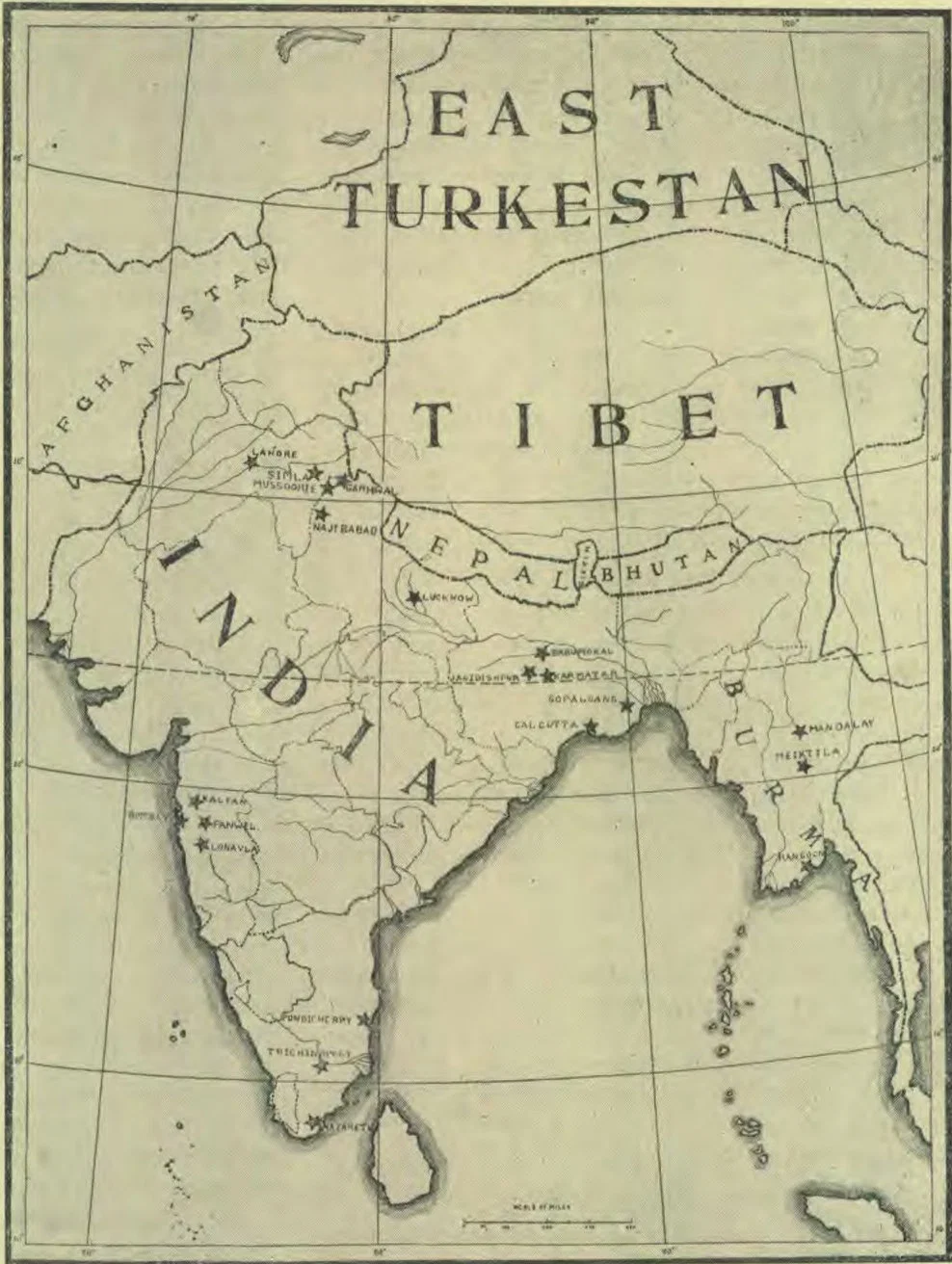
Do you like to look at pictures? Here is one which I hope is interesting to every Missionary Volunteer. It is a picture of a map of India,—India with its 300,000,000 souls for whom Jesus died, millions of whom yet know little or nothing of the gospel. Do those stars look good to you? This depends, I think, on your acquaintance with the great needs of India, on how much you know of the devotion and sacrifice of God’s people it has taken to put those stars on the map, and on your genuine love for Jesus and the things that he loves.
Our Missionary Volunteer Societies are now having the privilege of studying this map and the story of these stars. Most of our societies, I believe, have purchased the set of outline wall maps to be used in the mission studies. At the Missionary Volunteer Department office we have filled out our outline map of India, and here is the picture of it as it now looks. From this your society can prepare its India map for the mission studies now appearing in the Gazette.
Then to help all our young people to better understand our work in India, we give below a list of the stations, with the kinds of work being carried on at each, the workers, and the visible results.
The last-named station in Burma — Kaw-kay-et — is not on the map, because the news of its establishment came after our cut was made. It is located on the map about one fourth of an inch southeast of Meiktila, close to the border between Burma and Siam.
Do you know some of these workers? Whether you do or not, I am sure you will have greater interest9in them and can pray for them more intelligently after you have studied the story of the work as it is given in “An Outline of Mission Fields” and the Church Officers’ Gazette. Let every Missionary Volunteer do his part to make these studies interesting, and to learn all he can about the great mission field of India.
M. E. Kern.
NORTHWEST INDIA
NAME OF STATION | YEAR ENTERED | WORK CONDUCTED | WORKERS IN CHARGE | OTHER WORKERS | RESULTS
NORTHWEST INDIA
Simla | 1913 | Evangelical | Dr. H. C. Menkel | Mr. and Mrs. Ray Kimball | Strong English church
Lahore | 1914 | Evangelical; Mission schools; Hospital | F. H. Loasby; F. H. Loasby; Dr. V. L. Mann | | Native church
NORTH INDIA
Mussoorie | 1907 | English school; Treatment rooms; Evangelical | G. F. Furnival; Wm. Lake; Visiting pastors | Mrs. E. E. Bruce; P. C. Poley | English church
Lucknow | 1908 | Headquarters; Ind. Training school; Dispensary; Printing plant | H. R. Salisbury; I. F. Blue; Miss L. M. Scholtz; Mr. Parkinson | S. A. Wellman; A. H. Williams; M. M. Mattison; R. D. Brisbin | English church
Garhwal | 1910 | School for Hindu boys | C. C. Belgrave
Najibabad | 1910 | Evangelical; Dispensary | R. P. Morris; Miss B. A. Kurtz; Miss Shoto Mitter | | Native church
BENGAL
Calcutta | 1896 | Evangelical | J. M. Comer | W. S. Mead; L. J. Burgess | English church
Karmatar | 1899 | Evangelical & school; Dispensary | L. G. Mookerjee; Mrs. L. G. Mookerjee | Native workers9
NAME OF STATION | YEAR ENTERED | WORK CONDUCTED | WORKERS IN CHARGE | OTHER WORKERS | RESULTS
Gopalgunj | 1904 | Dispensary & evangelical | Mr. and Mrs. C. C. Kellar | Native workers
Jagidishpur | 1913 | Girls’ school & dispensary | Mr. and Mrs. R. H. Leech | Native workers
Babumohal | 1913 | Santali station & school | W. A. Barlow
BOMBAY PRESIDENCY
Panvel | 1911 | School & dispensary | Mr. and Mrs. A. G. Kelsey | | English church
Lonavla | 1912
Kalyan | 1913 | Evangelical; Mission schools | M. D. Wood; Mrs. M. D. Wood; M. D. Wood | Miss Elinora Reid; Miss Mary Moss
Bombay | 1913 | Evangelical | G. W. Pettit; W. R. French | Miss R. E. Boose; W. R. Nelson | English church
SOUTH INDIA
Nazareth | 1907 | Evangelical & school; Girls’ school | E. D. Thomas; Mrs. Joseph
Trichinopoli | 1913 | Evangelical | J. S. James | G. G. Lowry
Pondicherry | 1914 | Evangelical | V. E. Peugh
BURMA
Rangoon | 1904 | Evangelical; Treatment rooms | R. B. Thurber; Mr. and Mrs. F. A. Wyman
Mandalay | 1915 | Evangelical | R. A. Beckner
Meiktila | 1910 | Trades school | D. C. Ludington
Kaw-kay-et | 1915 | Evangelical; Dispensary | G. A. Hamilton | Miss Mary Gibbs; Eric B. Hare
A Message of Hope
By Cora Ferris
A BURST of song, a melodious lay,
Trilled in the apple tree over the way,
And my heart is cheered on its loneliest day.
O singer so sweet, in thy garb of brown,
Pouring a flood of happiness down
As if to erase the heaviest frown,
Tell me, does trouble e’er come thy way?
Does food get scarce and the skies grow gray,
Or is life one long, grand holiday?
As the song trilled forth afresh, it seemed
To carry a message that glowed and gleamed
With the sun’s rich rays which through it streamed;
“Happiness, happiness, all the day;
Happiness, happiness, come what may;
Let memories of blessings cheer all thy way!”
CORA FERRIS.
Electricity in Queen Elizabeth’s Time
An English collection of Elizabethan letters and anecdotes of court life quotes the opinion of a provincial young lady of quality, but recently come up to London to accept a position in the queen’s household, who had witnessed some simple electrical experiments. She wrote home to her mother:—
“The Queen is now well recovered of her sicknesse, which was but litle tho it lookt at first as it wold be greate. She puts much truste in her Doctor, one Gilbert, and soe doe her ladis for the moste parte, and I am laught at by alle but onely Lady Margaret for that I doe fear the man and his cures that they bee not such as are permitted to Xtian [Christian] folke to undergoe. I have seen him playe strange tricks, takeing, for the diversion of the queen’s ladis, a silke glove from one and her bedes of ambre from another and a scrappe of the writeing of her Love from another, if she have it about her and can be purswaded to give it uppe, and makeing the one to russle and give forthe speckles of fyre, and the others one to pick the other uppe by touching of it,—and a blacke catte comeing in he rubed her that she brissled and gave forthe little fyres that daunced alonge her furre in the dark as if the wyches that love blacke cattes were strokeing her back. Soche matters are of the divel and sholde not be medled with for sporte, they are not meet for good Xtians.”
Poor, timid little lady! If she deemed Dr. Gilbert’s tricks and cures of three hundred years ago so perilous to the soul, what would she have thought of the electric shocks, baths, massage, and all the varied tingling, prickling, crackling, and spark-spitting electrical devices of our modern physicians? At the least, that the medical profession was a most un-Xtian trade!— Selected.
Waste in Raisin Industry
THE Department of Agriculture calls attention to the waste in the raisin industry when no use is made of the seeds, and describes the different products that can be obtained from that neglected source. The waste from the seeding machine has been found to average ten per cent of the yearly crop.
As they come from the machines, the seeds are covered with a sticky mass of pulp that cold water easily dissolves. When it is concentrated, the pulp yields a sirup something like strained honey. The sirup has a reddish color, and is slightly tart, owing to the grape acids.
The sirup is a useful addition to the housekeeper's supplies. It can be used in making mincemeat with less expense and less labor than when the raisins themselves are used, and it has all the delicious flavor of the raisins. It is suitable for table use, and a manufacturer of sirups for soda fountains finds it excellent in carbonated drinks.
The sirup, however, is not all, for the seeds still remain. When they have been screened, dried, and ground, it is possible to extract from them about one seventh of their total weight in a pale, golden-yellow oil that has a delicious, nut-like taste. This oil dries rapidly, and can be used in paints and varnishes. The oil also makes a compact soap, with a pleasant aromatic odor.
From the residue, tannin can be extracted, and there will still remain a substance known commercially as “meal,” that makes good stock feed.—Selected.
Modes of Travel
THE eight-passenger touring car is a long way removed from ancient modes of travel, but even the simplest of these have done good service; so we do not decry past favors, but are grateful for present facilities.
On land, the elephant, camel, buffalo, dromedary, dog, yak, llama, donkey, horse, goat, and reindeer have all helped to solve man's problem of transportation by either carrying him on their backs or hauling the vehicle in which he rode. Even man himself has taken the place of a beast of burden, and carried his fellow man in a chair strapped to his back, or pulled or pushed the jinrikisha or wheelbarrow in which he sat.
On the water the great ocean liner and the merchant ship have supplanted the primitive water craft of past centuries as completely as the express train and trolley car and automobile have supplanted all simple land conveyances.
When man had reached the acme of land and water transportation facilities, he looked toward the sky, and lured the winged bird to teach him the secret of aerial transportation; and now the biplane, monoplane, and dirigible have joined the chief conveyances to do man's bidding in peace and war.
How to Retain Health
By J. W. Lowe
If we would retain the possession of health and live to a ripe old age, we must obey physical law in every respect, which is our reasonable duty.
The transgression of physical law is almost always the cause of disease, pain, and early death.
It is futile and foolish to suppose that we can live in a careless and unhygienic way and not sometime have to pay the penalty for our transgression.
Everything in nature has been arranged by the Creator according to cause and effect. Obedience to physical law secures health and life, as a natural consequence. But the transgression of physical law tends to disease and death. We are sure to reap as we have sown. J. W. Lowe.
Worth Trying
By Helen I. Castella
I DON'T believe you'll get it looking the way you do." Mrs. Lang's tone held a note of despair. "If it had only been a month later, and Mrs. Hays had paid me for the sewing I'm doing—but there would be no use asking her to advance the money; she would be likely not to."
"O, no! Don't ask her to advance it, mother," pleaded Elmer piteously. "'Cause more'n likely she'll tell Van Lennep, and he'll let it out to the other fellows. I'd rather risk not getting the job than for the boys to know how poor we are."
"That isn't the right spirit, son. Life is certainly having its ups and downs. Maybe after a while it will be better; we'll hope so. But Uncle Morton is so peculiar. 'Most likely he'll study you from the crown of your head to the tip of your shoes, and then write me a note saying your appearance was not satisfactory. I really ought to have made you keep the blue suit until you got another."
"If I hadn't started to wear the blue suit, I'd been going around in my skin," said Elmer rather indignantly. "How would it do if I wore Jack's winter coat with my old brown trousers? They don't show the patches as bad as the blue."
"Worse and more of it." His mother tried to keep from tears by laughing. "You would look like a patched-up boy. A bank position is very hard to get, and it is only because I wrote to Uncle Morton over a year ago, asking if he would not keep you in mind and suggest something when the opportunity came, that he has done this—sent word that there is a vacancy for a beginner and suggested that you go up for an interview. If you could only earn the money by running errands or some odd jobs—but there isn't time. I am actually ashamed to let you go as you are. Jack's shoes are positively the only thing between either of you fit to be seen."
Jack colored painfully, his feet being a sore spot with him. An infantile illness had left him noticeably lame. There was a difference of two inches between his right and his left side, and his left shoe had a specially constructed heel which made walking easier for him. It was rather an understood thing that Jack was to be always more or less dependent. When her only sister died, Mrs. Lang accepted the orphan boy much as she had accepted everything in life, often endeavoring to assume a cheerfulness which she did not feel. As Jack grew older, she told him frankly that if at times they were hungry for other things there was always plenty of love to go round. As soon as Elmer was fortunate enough to get a position, life would be easier, of course, and then he might see a way toward helping Jack to earn some money. People who wanted clerks in grocery stores, etc., at present seemed chary of a boy who walked even a trifle lame.
When it was quite settled that Elmer could not go, that by no way possible could he be made to appear presentable before the uncle, Jack seemed so absorbed in thought that there was no getting a word out of him. He was not able to join in many of the sports common to the other boys, and for this reason Elmer never thought it queer when his cousin didn't wait for him or join the crowd after school. Jack often loitered, taking the river way, watching the boats as they glided over the broad expanse of water. But instead of standing still to gaze, as he usually did, on this particular day he slipped down, and, hidden from view by a row of freight cars, drew from his pocket a dull gold locket, quaintly carved, with a cameo in the center. He touched a spring, and his mother's eyes from the portrait seemed to smile at him. "Elmer's got to go Friday, and there's only a day left. I wouldn't part with your picture,—I'll keep that forever,—but the locket'll give Elmer a start. I've kept it till the last minute, hoping the money'd come some other way, but it hasn't."
After this conversation, carried on between Jack and the picture of his pretty mother, which was all that he had to remember her by, Elmer went home from school the day following and announced that Jack had not been there at all. "Professor Hay looked at me awfully queer when I said I didn't know why he was absent. He was all ready to start when I left, all but combing his hair."
"Jack couldn't have felt bad because you didn't wait for him?" was Mrs. Lang's suggestion, but her son laughed.
"Why, you know that wouldn't make him mad. Don't I run ahead 'most every time? I was sure I'd find him home with you. Where'd I better look?"
"Look everywhere, promptly. Of course nothing has happened to him, but I never knew him to absent himself from school before. I can't understand it."
But, truth to tell, Jack had no intention of following his cousin to school that sunshiny morning, and he swung himself upon the steps of the trolley at the very moment Elmer was entering the schoolhouse for the morning session. Naturally in his inexperience he made for the largest, most pretentious jewelry store in the shopping district of the city he chose for his destination. The clerk was inclined to laugh at first when he took the bit of jewelry from the boy's trembling fingers, but he dropped his banter when he looked into the earnest eyes which always won friends in spite of Jack's shyness. "This wouldn't be any good to us.12We don't deal in antiques at all. But you take it over to Broussais. He's on Third Avenue. Here, I'll write the address on a card. He deals in precious stones and things like this. He'll tell you what it's worth."
Jack had hardly any hope in his heart after this first refusal. He extended the locket timidly to the swarthy, bushy-eyebrowed Easterner, hardly daring to say a word. "You want to sell this? Humph! It is not of any particular value, except as an antique. The cameo is pretty, but there are many pretty cameos."
"I've just got to sell the locket," blurted Jack impetuously. Another time he might have found it hard to tell the story of how his aunt had brought him up and shared with him everything she had for Elmer; but now he was desperate, and in a few minutes the man with the dark, shining eyes knew it all. He knew how their whole life had been a struggle against poverty, and how, because of Jack's affliction, Elmer was looked upon as the hope of the family. Jack leaned forward as he finished, and his words had an earnestness that rang of sincerity: "And if I can help Elmer to get this job, I've just got to do it. Don't you think so?"
"Yes, it is just what you must do," said Broussais in that deliberate fashion which belongs to the race. "Ten dollars, I think, will fit your cousin out," and he produced from the drawer a bill. "You write your name and where you live on this piece of paper."
Jack said afterwards he guessed it wouldn't have mattered if his clothes had been rags, for Broussais didn't seem to see anything but his face.
"You are a good boy, an honest boy, and clean."
Jack flushed beautifully. "I guess so," he stammered. "I've always tried to be."
"You like to work for me? My nephew, he went back to my own country last week. I need a boy. I teach you the business. Then you have work always. You like it? Ah! I expect you tomorrow."
When Jack reached home, he laughed because he found his aunt and cousin so excited that they were going to get the police department out after him. "Why, for ten dollars you can get rigged out as fancy as a prince," he shouted, waving the money. "And I've got a job myself, Aunt Kate, same as Elmer hopes to get. I wonder if every time you make an effort to set another fellow on his feet, it comes back to you so rich? It's worth trying, isn't it?" — Helen I. Castella, in the Visitor.