The Youth’s Instructor, Vol. 32, No. 13.

AMERICAN INDIANS

The Youth’s Instructor

Mar 26, 1884

S. D. A. Publishing Association · Battle Creek, Mich. · Mar 26, 1884

AMERICAN INDIANS.
When Columbus and his companions first landed upon the wilderness shores of this continent, they found its vast forests inhabited by a strange, wild class of beings, differing widely in almost every phase of life and habit from the people of their native land. Columbus and his companions were regarded by them with evident feelings of great superstition, as they supposed the strangers were gods come to their shores, but whether for good or evil they could not tell; and it was with difficulty that Columbus induced the natives to make any acquaintance with his company, or have any intercourse with them; but after a while their fears were so far overcome that they were induced to enter into trading, and thus Columbus procured food for himself and companions.
The origin of the American Indian has been for centuries a matter of debate among the various writers upon the subject. Some have endeavored to prove that they descended from the ten tribes; others, with as little foundation in facts for their theories, have tried to prove that they sprung from the Welsh, the Mongols, or the Malays.
But whatever may have been their origin matters little. The whole continent was occupied by scattered tribes, from the lowest stage of barbarism to a semi-civilized state. Agriculture among them was confined to the cultivation of a few plants,—maize, squashes, beans, tobacco, plantain, etc., and was conducted almost entirely by the women. Their few manufactures consisted of canoes made from bark, or from hollowed trees; lodges, or wigwams, of bark skins; simple garments of furs and skins; and in some parts, of basket-work and rude weaving; weapons; and images, carved, and occasionally hammered and molded.
In general appearance, their skin was brown or cinnamon-hued, their eyes dark, hair long, black, and straight, beard scanty, eyes deep-seated, nose broad but prominent, lips full and rounded, and face broad across the cheeks.
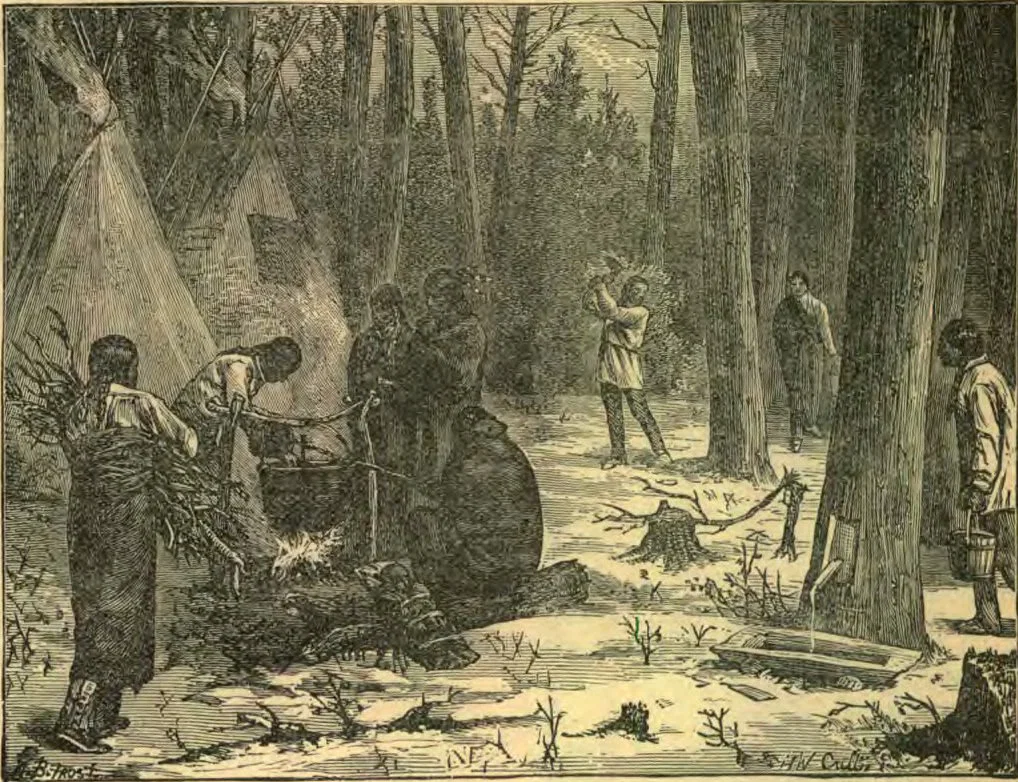
Our illustration shows a family of Indians around their camp-fire in their native forest. They seem to be engaged in making maple sugar, and we are told by those who have seen and eaten it, that they understand the art to perfection.
At first these strange men were friendly to the white men, and did them no harm; but after a time, from one cause and another, they began to show hostility, and all through the history of the early days of the settlement of this country, we find them at times on terms of friendship, and then committing the most horrible acts of cruelty and murder. Naturally the Indian is hospitable, and remembers with gratitude a favor or kindness; and so also does he harbor revenge for an insult or injury received. No doubt the treatment they received at the hands of the whites, often gave occasion for feelings of hostility.
Gradually and steadily other adventurers followed Columbus across the waters to the Western wilderness, to make for themselves homes, and to enjoy the rights and privileges denied them in their native land; and the red man found himself steadily driven from his home and hunting-grounds. He has fought and battled for his rights, but he has not been able to maintain them against his pale-faced foe. As civilization has advanced, he has retreated, fighting for every inch of ground.
The names by which Indian tribes are known to us are a strange medley. Many of them are nicknames given them by the whites; as the Diggers, Blackfeet, Flatheads, etc.; others are derived from some locality near which they reside; as the Delawares, Hurons, and Mohawks. In almost every State in the Union to-day may be found a few remaining descendants of the tribes which once roamed through its forests, and held undisputed title; but the great majority of them are found in the far western States and Territories, where reservations for them have been located by the government. Some of these tribes still remain in their savage state, living by plunder and robbery. Others, through the efforts of the government, and of missionaries who have labored among them, are becoming civilized, and are adapting themselves to the customs of the white man.
According to the estimate of the Indian Department in 1871, the Indian population of the United States was about 350,000. That the race is decreasing cannot be doubted. J. W. R.

A WORD ABOUT WORDS.

Ah me! these terrible tongues of ours! Are we half aware of their mighty powers? Do we ever trouble our heads at all Where the jest may strike or the hint may fall? The latest chirp of that “little bird,” That spicy story “you must have heard”— We jerk them away in our gossip rash, And somebody’s glass, of course, goes smash. What flames have been blasted and broken, What pestilent sinks been stirred, By a word in lightness spoken, By only an idle word!
A sneer—a shrug—a whisper low— They are poisoned shafts from an ambushed bow! Shot by the coward, the fool, the knave, They pierce the mail of the great and brave; Vain is the buckler of wisdom or pride To turn the pitiless point aside; The lip may curl with a careless smile, But the heart drips blood—drips blood the while. Ah me! what hearts have been broken, What rivers of blood been stirred, By a word in malice spoken, By only a bitter word.
A kindly word and a tender tone— To only God is their virtue known! They can lift from the dust the abject head, They can turn a foe to a friend instead; The heart close-barred with passion and pride Will fling at their knock its portal wide, And the hate that blights and the scorn that sears Will melt in the fountain of childlike tears. What ice-bound griefs have been broken, What rivers of love been stirred, By a word in kindness spoken, By only a gentle word!
—Sunday Magazine.

Doing and Being.

“THERE!” exclaimed Marion, fretfully, as she turned from the window, “the day is all gone, and I haven’t done anything. I haven’t done anything,” she repeated discontentedly; “and I meant to do so much.”
“What have you done?” asked Beth, closing her work-basket. “Sit down and tell me.”
“Well,” said Marion, seating herself, “you know my day as well as I do. This morning I read three chapters in the Bible, as usual. I do want to get through it this year. Then I was gone an hour on that errand for father; then I wrote three letters, mended Tom’s mittens, and corrected Nellie’s composition; then mother called me to set the dinner-table. After dinner I directed a magazine and two papers to your missionary; then—oh! Nellie’s Arithmetic—that took me an hour, she was so stupid; then father asked me to copy a deed for him; and then that tiresome Mrs. Green called, and I entertained her for an hour; and then—how little it all seems—I went out to get sewing silk for mother, and buy that ball I’ve been promising Georgie for a month; and now the man is lighting the gas over the way, and my day is gone! I can’t help feeling dissatisfied; I have not done anything good to-day.”
Beth was rocking lazily to and fro in her chair. “You think a great deal about doing, don’t you?”
“Yes, and so do you; you are always at work doing something.”
“It’s a good thing to be so. God gives us many things to do; but don’t you think he gives us something to be, just as well?”
“Oh, yes; of course!” Marion replied very quickly.
“May I speak plainly, Marion? May I tell you all about your unsatisfying day?”
“Faithful are the wounds of a friend,” said Marion, as she dropped down on the carpet at her friend’s feet, and laid her head in her lap.
“I’ve been thinking,” said Beth, as she stroked Marion’s hair, “I’ve been thinking all day, as I watched you, that I would like to say this to you. In trying to do what he commands, I’m afraid you forget to be what he commands. First, about reading the three chapters; how did you read them?”
“Hurried through the last,” confessed Marion; “and I did look to see if it was short. I always feel condemned if I don’t read it through when I set myself to do it.”
“Poor child! we will talk about that some other time. Then came the errand for your father; you fretted about that because you said you were wasting your time. You answered your mother saucily when she inquired whom your letters were written to; you scolded Tom for burning his mittens; you made fun of Nellie’s spelling, and set her lips to quivering. You spoke impatiently to your mother about setting the table.”
“And Betsey ought to do it; I repeat it,” interrupted Marion, wilfully.
“And you struck Georgie for hiding the paper you were looking for. And you made fun of Mrs. Green before she reached the corner.”
“O dear! tell me about being,” cried Marion. “I will think about being if you will help me.”
“The Good Book says: ‘Be ye also patient; be thankful; be not conformed to this world; become little children; be ye therefore perfect; be courteous; be not wise in your own conceits; be not overcome of evil,’” softly repeated Beth.
Marion listened, making no reply. Twilight grew into darkness. The tea-bell sounded, bringing Marion to her feet. In the firelight, Beth could see that her cheeks were wet.
“I’ll have a better day to-morrow, God helping me. I see that doing grows out of being,” said Marion, quietly.
“‘True worth is in being, not seeming— In doing, each day that goes by, Some little good, not in dreaming Of great things to do by and by; For whatever men say in their blindness, And spite of the fancies of youth, There’s nothing so kingly as kindness, There’s nothing so royal as truth,’” replied Beth, quoting from their favorite writer, as they passed out into the dining-room to supper.—Christian Weekly.

Written for the Instructor

MUST SECURE A CONNECTION.

On the rocky coast of Scotland, a noble ship was wrecked at some distance from the land. The people of the country gathered in crowds upon the shore, but so fearful were the breakers between the shore and the ship, that no boat could live to reach the helpless crew, whose shrieks and cries could be distinctly heard by those on the shore. At length a cannon was brought, and its booming was heard by those on the ship, above the roar of the surf. Must they not have felt that it was cruel to be firing cannon shot at them, when they were already in such fearful danger? But presently, as a shot whizzes over the ship and sinks in the waves beyond, a line falls across the deck. With eager hands they seize it, and begin to haul it in. After a time they reach the end of it, and find a rope attached. They pull on this until it brings them the end of a strong cable, that, upon trial, they find to be attached to the shore. They make the cable fast to the ship. The life-boat is lowered, and attached to the cable by loops of strong rope. The boat is filled with men, and safely they row to the shore. Load after load, they pass from the ship, till all are saved.
The first thing to be done for that endangered crew was to establish a connection between them and the shore. This was done by means of the line’s falling across the deck of the ship. But this would not have availed anything had not those on board the ship pulled in the line, and then the rope, thus securing the cable, the other end of which was fastened to the shore. So they were brought into connection with the shore, and enabled, by the use of the boat, to reach the land.
Iniquity has separated between us and God, and sin has hid his face from us. Isa. 59:2. In consequence of this, we are hopelessly lost, unless a connection can be established between us and God. In mercy and in love to us, he throws across our pathway a line, the Sabbath-school lesson, of which if we take hold, it will lead us to the Sabbath-school, a rope; and if we faithfully follow this up, it will bring us to Christ, the strong cable, firmly anchored to the eternal rock. If we will attach ourselves to him by a living faith and obedience to the law of God, we may pass safely over the rough sea of life, and land in the haven of eternal rest, in the kingdom of God. May none of us fail to make use of the most simple methods which our heavenly Father would employ to bring us into such a living connection with him as shall result in our final salvation, and secure us a home in the earth made new. D. P. CURTIS.

SPRING-LIFE

A LIFE-TIDE is flowing Through woodland and plain; The sun-king is touching The earth-heart again; And thrilled by his fervor, The blossoms arise, Half-shyly, scarce daring To look in his eyes.
The oak of the forest Is filled with new wine; A wind-harp is breathing Its notes through the pine. The buds have been dreaming On stemlet and bough; Earth’s music and laughter Are waking them now.
The spring-time is teaching A lesson of life— Of growth and of glory Unmingled with strife; It tells us that labor Is sweeter than calm, That springing and blooming Are blessing and balm.
—Selected.

Idle Hands and the State Prison Register

Here is a hint for our boys. A visitor at a State prison was looking over the list of names in the prison register, and noticed that, under the head of “Occupation,” the words “No trade” were written against nine-tenths of the names contained in the register. Dr. Watts knew what he was writing, when he said,—
“Satan finds some mischief still For idle hands to do.”

EDITOR'S CORNER.
How is it with the small boys and girls of the INSTRUCTOR family, do you claim most of your time for play, or do you give father and mother a share of it? How many of you love to work for your parents? We know of some who do, and we think of many more who could make themselves very useful in this way. Perhaps you are all willing to be little helps in the family; but some little boys and girls are more thoughtful than others, and we ask the question to set you all thinking what you can do to be helpful. We know from your letters that many of the INSTRUCTOR children claim to be little Christians, and it doesn't seem possible that one can be a Christian who is not trying in all the ways he can to do good, does it?
True, your parents have many things to do that you cannot help about, but there are many little things you can learn to do a little better than almost any one else, which if done by you, will relieve your parents very much. Then aside from its making their labors lighter, it gives them so much pleasure to know you are learning to be useful.
It is really wonderful how much you can be taught to do, when you have a mind to learn. What if you do get tired sometimes; it will do you good, for the resting will be so sweet afterward. What about tired fathers and mothers? Do you think they would sometimes enjoy a rest? Have you ever noticed how many steps they take in one day? Many parents need to keep up almost a ceaseless round of stepping, often to make the children more comfortable; do you ever watch to see how many times your little feet could fit right in to do the stepping in their stead?
We have seen little girls so eager to help mother that they would climb upon a stool to wash dishes, iron, and sometimes even cook. One little girl stood upon a stool helping her mamma iron, when a lady caller asked her if it did not tire her to iron so long. This was her beautiful answer, “Not when I do it for mamma.” Ah! here is the secret: “Love lightens labor.” If you all should cultivate the same spirit of love there would n't be so many tired mammas, would there? We shall sometime hear what you are doing for your parents, shall we not? M. J. C.

That Boy.

After the snow and the rain and the cold, our sidewalks are so slippery that it is a difficult thing to walk down the street, especially if the wind blows so hard that your feet can scarcely keep up with your body. So when I turned the corner on my way home yesterday, and saw on the next block a group of noisy boys, some on skates and some on sleds, I wondered how I should steer safely through them. But I soon forgot myself in watching an old lady who crept cautiously along a little way ahead of me. Surely, I thought, she cannot keep her footing among those shooting sleds and jumping boys; so I quickened my pace to come to the rescue.
Just as she neared the group, one of the wide-awake boys noticed her, and stepped forward, saying courteously, “Sha'n't I help you along? It's awful slippery here.”
I could not hear the old lady's answer, but she took the boy's arm; and with a manner as gentle as it was manly, he led her down the length of the block to the house on the other corner, and then rushed back into the thick of the frolic, as if nothing had happened.
This morning I rode with the doctor as he made the round of morning calls among his patients; and while I was sitting in the sleigh on B—— street, this same boy went running up the steps into the next house, carrying a bundle of neatly strapped books, his whole appearance wearing that unmistakable just-out-of-school air, which a boy unconsciously puts on when his lessons are recited. In a minute he rushed out with his skates in his hand; but before he was across the street, a sweet-faced lady came to the door, calling to him,—
“Charlie, my dear, do you know grandma has not come?”
“Well, mamma?” he said interrogatively, and yet as if he was in a great hurry to be off.
“What do you suppose is the reason, Charlie?”
“It's a fact, it is too slippery for her to step out; but I'm just going skating.”
“Wouldn't my boy enjoy his skating better if he made somebody happy before he starts?”
The boy came back, and laying his skates on the door-step, was going off “in a jiffy,” when his mother detained him a moment.
“If grandma is not quite ready, don't make her feel that you have anything else to do, but wait her convenience. She will not keep you more than five minutes, and when we do a little service for others, we must make it a pleasure for them to receive it.”
Charlie scampered off, and in a short time appeared again, carefully guiding the steps of a bright-looking old lady, who leaned proudly on his arm, while he chatted gayly, and his boyish laugh told of the sweet confidence underlying his respect for her. Just then the doctor came out, and we drove off.
I had wondered not only at the thoughtful kindness so often lacking in heedless boyhood, but at the easy grace with which the thing was done. But that glimpse of mother and grandmother revealed the secret. Boys who would not be intentionally rude, are often thoughtlessly so, or if they have an observant eye and kind heart, feel awkward in offering courtesies or rendering little services. The habitual exercise of a kind disposition, the every-day practice of politeness, is the only way in which a boy can acquire that unaffected ease and grace which make little attentions a pleasure to himself and others.—Christian Weekly.

TIME

How often we are reminded that time is fast passing; yet how seldom do we fully realize it! When we see the sun sinking in the west, we say, “Another day has gone;” and when we see the earth in her robe of white, we are reminded that another year has passed. So at the end of every hour, day, and month, we see that time is fast speeding on.
How important it is that we strive to improve well every moment as it comes to us; yet we are often led to discouragement when we look over our past life, and see the many failures we have made. We sometimes make mistakes in neglecting to do the little things, thinking that they are too small to be of much importance. Yet many of our failures are caused by the neglect of these little matters.
The present is all the time we shall ever have. The opportunities that come to us in the ordinary affairs of every-day life may be all that God will ever see fit to give us. Let us improve them while we may. E. R.

NOTES

Acts 19:21. I must also see Rome.—It is the conjecture of the great scholar, Dr. Lightfoot, that the Roman Emperor Claudius was now dead. He had recently banished all Jews from Rome. See Acts 18:2.
Ver. 22. Asia.—In the New Testament, this word is always limited to Asia Minor, the three provinces of Lydia, Caria, and Mysia, with the western part of Phrygia.—Vincent.
Ver. 23. Concerning that way (Rev. Ver., the way).—That is, concerning the religion of Jesus Christ which Paul inculcated, that method of worshiping God and securing eternal life, which he taught.—Gloag.
Ver. 24. Silver shrines.—These silver shrines were small models of the temple of Diana, containing an image of the goddess. They were purchased by the pilgrims to the temple, and on their return home, were set up as objects of domestic worship.—Ibid. Diana.—The heathen goddess to whose worship the celebrated temple at Ephesus was dedicated. According to some, her image was made of black ebony; others say, gold, and still others, wood. It is maintained by some that the image was at first simply an aerolite, or meteoric stone, and was afterward reproduced in metal.
Ver. 27. Temple of the great goddess Diana.—This temple was anciently regarded as one of the Seven Wonders of the world. It was two hundred and twenty years in building before it was brought to perfection. It was built at the expense of all Asia Minor, and would hold twenty thousand people. According to Pliny, it was four hundred and twenty-five feet in length, two hundred and twenty in breadth, and was supported by one hundred and twenty-seven pillars of Parian marble, each of which was sixty feet high. These pillars were furnished by as many princes, and thirty-six of them were curiously carved, and the rest were finely polished. Each pillar, it is supposed, with its base, contained one hundred and fifty tons of marble. The doors and paneling were made of cypress wood, the roof of cedar, and the interior was rendered splendid by decorations of gold, and by the finest productions of ancient artists. This celebrated edifice, after suffering various partial demolitions, was finally burnt by the Goths, in their third naval engagement, in A. D. 260.—Barnes.
Whom Asia and all the world worshipeth.—The temple had been built at the common expense of all the Greek cities in Asia, and pilgrims repaired thither from all nations and countries.—Abbott.
Ver. 29. Theatres.—The theatres of the Greeks were not merely places for public exhibitions, but also for holding assemblies, and often for courts, elections, etc.—Barnes.
Ver. 33. Alexander.—Thought by most commentators to be the same as “Alexander the coppersmith,” or brazier, spoken of by Paul in 2 Tim. 4:14. See “Life of Paul,” by Mrs. E. G. White.
Ver. 35. Is a worshiper.—In Greek, neokoron, literally, “a temple-sweeper,” a title which was assumed as a mark of high distinction. The margin of verse 35 says, “the temple-keeper.”
Ver. 36. Do nothing rashly.—We here see how the prudence and wise foresight of this town clerk calmed the turbulent spirit of an excited mob. It was through this man that God worked for his cause. It was the saying of the great Cotton Mather, that when we are inclined to be rash or hasty we “should remember the advice of the town clerk of Ephesus.”
Ver. 40. We are in danger.—The Roman government watched every appearance of insubordination or sedition in the provinces with a jealous eye. It was a capital offense to take part in a riotous proceeding.—Hackett.
Chap. 20:1. Macedonia.—An ancient Roman province now known as Salonica, north of Greece. It may be found on the map of Turkey.
Ver. 2. Came into Greece.—Greece here denotes the Roman province of Achaia, comprehending Greece proper and the Peloponnesus, the capital of which was Corinth.—Gloag.
Ver. 6. Days of unleavened bread.—The seven days of the Passover, in which they ate unleavened bread.—Clarke.

Life as a Leaf of White Paper

LIFE is a leaf of paper white Whereon each one of us may write His word or two—and then comes night; Though thou have time But for a line, be that sublime; Not failure, but low aim, is crime. —Lowell.

Notes on the Sabbath School Department

For additional Notes, see S. S. Department in Review for March 25.

NEW-TESTAMENT HISTORY.

LESSON 180.—PAUL IN DANGER AT EPHESUS.
1. What was Paul’s purpose with reference to his future journeyings and labors? Acts 19:21.
2. What laborers were sent into Macedonia? Verse 22.
3. Where did Paul remain?
4. What stirred up Demetrius, the silversmith?
5. What steps did he take? Verse 25.
6. What speech did he make to them? Verses 25–27.
7. What effect had his words? Verse 28.
8. How far did the uproar extend? Verse 29.
9. On whom did they lay hands?
10. Where did they take them?
11. How was Paul prevented from joining them?
12. What kind counsel did he receive from some of the chief men of Asia?
13. Describe the confusion of the scene? Verse 32.
14. Who tried to make a speech to the people? Verse 33.
15. How was he prevented? Verse 34.
16. Who finally gained a hearing? Verse 35.
17. How did he gain the attention of the multitude? Verse 35.
18. How did he quiet their fears? Verse 36.
19. How did he show the injustice of their course? Verse 37.
20. What course did he recommend? Verses 38, 39.
21. How did he impress them with wholesome fear? Verse 40.
22. What was he then enabled to do? Verse 41.
23. What action did Paul now take? Acts 20:1.
24. What letter did he write while in Macedonia?—The one known as the Second Epistle to the Corinthians.
25. What other work did he accomplish in Macedonia? Verse 2.
26. Where did he then go?
27. How long did he remain in Greece? Verse 3.
28. Why did he not, on leaving this place, go directly to Syria? Verse 3.
29. Who went before, and waited for him? Verse 4.
30. Where was Paul while they awaited him at Troas?
31. Whence did Paul set sail on leaving Philippi? Verse 6.
32. How long was he in reaching that place? Verse 6.
33. How long did he remain there?

THE GNAT.

The gnat does not always have pretty gauze wings, so that it can fly through the air. Indeed, when it is young, you would not know that it was a gnat at all. It does not then live in the air, but in the water. The mother gnat lays her eggs on top of the water. These eggs all stand endwise in a little cluster, so as to form a boat.
Young gnats always live in water. If you were to stand a bucket of water outdoors in the summer time, you would in a few days find it full of young gnats. They look just like long worms. The gnat-worm always hangs with its head down, so that it can breathe through a little tube that it pushes out of the water. In the course of three weeks it has changed its skin three times. By and by it changes its skin for the fourth time, and also changes its form. Before, it was of an oblong shape; but now it is shorter and more rounded.
It cannot eat when in this form, for it has no organs to use in digesting its food. Instead of having one tube to breathe through, it has two shorter tubes, that look like long ears. When the gnat wants to move, it bends its tail up under its head, and then straightens out, thus pushing itself through the water.
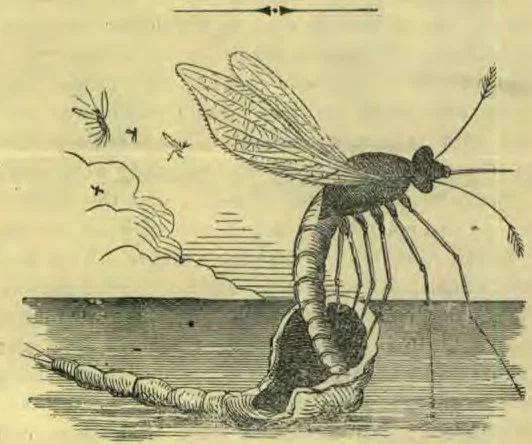
By and by the insect makes one more change. It straightens itself out, raising the larger end of its body a little above the water. Then the skin splits very rapidly between the two breathing trumpets, lengthening and broadening until you can see the insect inside. Pretty soon the gnat pulls itself nearly out of its covering. It is now in great danger; for its wings are not dry, so that it can fly away, and if it were to tip over, it would drown. When the wind drives these little insects around on the water from one place to another, they look like little boats with very tall masts.
But the gnat does not long stay in such an unsafe position. It has three pairs of legs; and it now draws the first two pairs out of its case, and leaning over, places its four feet upon the water, just as you see it doing in the picture on this page. Now it can unfold its wings, and let the air dry them. Then away it flies, if you try to catch it. By this time the gnat looks like any of the insects flying through the air.
We are not glad at all to have full-grown gnats around, for their stings are very unpleasant. The trunk, with which the gnat pierces the skin, is very curiously made. It is really a bundle of little swords inclosed in a case. This case is split from end to end, so that the gnat can easily thrust his sword into the skin. When he is hungry, he pierces the skin with his sword, and sucks up a drop of blood.
It does not seem as if the prick of a little instrument a great deal smaller than the finest cambric needle could make such a smart, does it? Indeed, it could not, if the gnat did not leave a drop of liquid poison in the wound. If you were to put a drop of water on the sting, instead of scratching it, it would not be so painful.
Mosquitoes are one kind of gnat. Did you know, when you were trying to kill them, how wonderfully they were made? W. E. L.

IF I WERE YOU.

“There, Carrie,” said grandma, “if I were you, I wouldn’t go whining about, fussing for something to do; but I’d do some of the many, many things that are all ready and waiting to be done by just such a little girl as you. When I see a bright, active little girl like you, I can hardly help wishing I could be little again; for when I look back, I see so many things I didn’t do, that I might have done just as well as not.”
“What things, grandma?” said Carrie.
“All sorts of things I might have done to help and cheer other people. Carrie, why do not you begin now, and try it? Then, when you get to be an old grandma like me, you won’t have to look back and be sorry.
“How I wish that when I was a child and went to school, I had been on the lookout for kind things to do! There was Dinah Jones, a little black girl whom we used to tease. I wish I had been kind to her! I did not even say, ‘Come, girls, don’t let’s tease Dinah.’ Why didn’t I give her an apple or a cooky once in a while? How her black eyes would have shone!
“Why didn’t I think to let poor Johnny Green take my sled once in a while? I can see him now, standing at the top of the hill, with his little cap drawn down over his white hair, shivering, as he watched us slide down, full of fun and frolic. No doubt his heart was aching all the time, because somebody did not give him a slide.
“Why didn’t I give a smile or kind word, if nothing more, to forlorn Katie Snow and her sister, who got nothing but kicks and cuffs at home, and were coolly left out of all the good times everywhere!
“O child, it makes my heart ache now to think how many times I might have made a sad heart happy, and I let it go. Just think, if I had begun, when a little girl like you, to show a kindness every time I had a chance, and had kept on every day of my life since, what good I might have done?
“Begin now, and see if it doesn’t pay. Help mother, help Jennie, amuse the baby; keep your eyes open on the street, at school, everywhere, and my word for it, you’ll find enough to do; and by and by you’ll be glad enough you’ve done it.”
“There are smiles to be given, kind deeds to be done, Gentle words to be dropped by the way; For the child that is seeking to follow the Lord, There is something to do every day.”
—The Well-Spring.

MARION'S THOUGHTS.

Little maid Marion, walking slow Down the long wood-path, thick with snow, Watching the snowflakes large and white, Like stars and crescents and flowers of light, Wondered much in her wise young brain If the dreary old winter were coming again.
Up in the elm, that very day, A little bird whistled his roundelay; A fly, just waked from his winter's sleep, Was scaling the window's slippery steep; And the swelling buds on the poplar-tree In their varnished wrappings were plain to see.
Peering and groping with fingers small, In the sheltered beds by the garden wall, She was sure she had heard, down deep below, The Jonquils donning their hoods of snow, And my Lady Crocus, under the mold, Weaving her mantle of purple and gold.
Little maid Marion, walking slow, Felt on her forehead the west wind blow, Saw the clouds from the brightening sky, Like routed armies go scurrying by, And heard from the boughs of the thorn-tree near, The brave little songster piping clear.
“Ha, ha!” laughed the jolly old sun again, “The blossoms quicken in snow and rain.” The sun slid down from the poplars high, The buds showed clear against the sky, And little maid Marion, smiling, thought, “The spring is coming just when it ought.”
—Christian Weekly.
Continue reading: Doing Good by Scattering to Others