The Youth’s Instructor, Vol. 35, No. 11.

BENEATH THE SURFACE

The Youth’s Instructor

Mar 16, 1887

S. D. A. Publishing Association · Battle Creek, Mich. · Mar 16, 1887

BENEATH THE SURFACE.
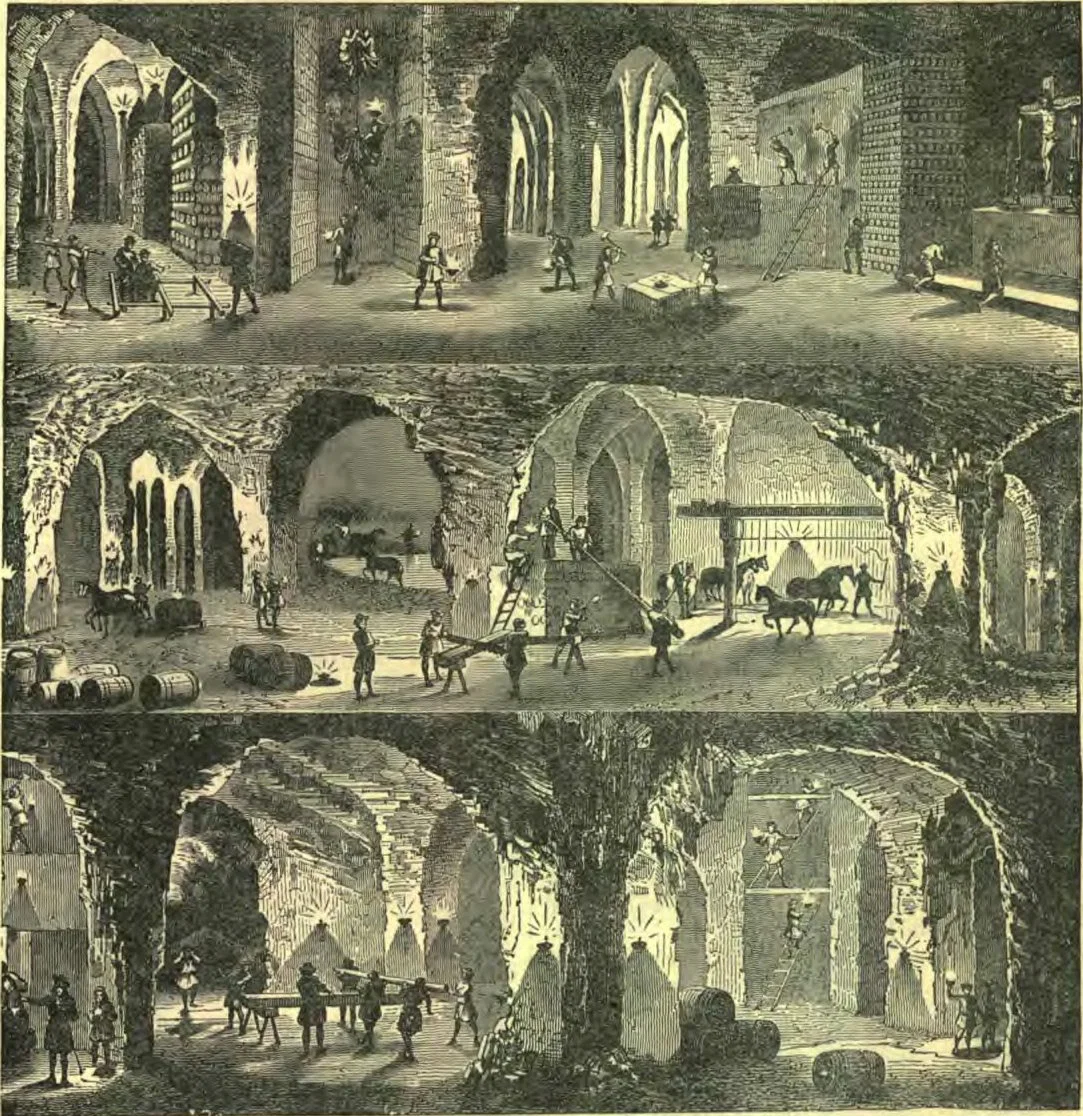
HOW seldom do we who enjoy the sunshine and the pure air think of those whom necessity compels to work for a life-time below the surface, cut off from the common comforts of mankind! While enjoying the ruddy glow of the coal grate on a chilly winter evening, who ever gives second thought to the toil and deprivation that are bestowed by the hardy miners to make the rest of the world comfortable?
Old Mother Earth contains stores of wealth which bravery and industry have made a source of blessing to millions; and it is about one of these avenues of resource that I shall now tell you.
In Austrian Poland, about seven miles south-east of Cracow, a city which you can find readily on your maps, lie what are probably the largest and most productive salt mines in the world. They extend two miles in length, one in breadth, and are from six hundred to eleven hundred feet deep. As many as fifteen hundred men and six or seven hundred horses are employed in working these mines, and in 1875 they brought in a revenue to the empire of some six million dollars. In our picture the artist has given us a view of that part of the mine that has been worked the longest.
But let us in imagination make a tour of this underground region. We bargain with two brawny Polish miners to conduct us through the intricate windings. Remembering the old saw, “When you are in Rome, do as the Romans do,” we make the descent in the shaft used by the miners, instead of employing one with the modern improvements for the comfort of timid folks. Each guide is provided with a torch, and one is given us also. We take our seats in a rude iron basket, with our legs hanging down, and grasping the chain above, begin the descent. The flare of the torches serves only to make the midnight blackness of the gloomy passage visible.
When four or five hundred feet down, we stop and get out. This is the part of the mine that has been worked the longest. The mine is full of difficult ascents and intricacies that are crossed by bridges and ascended by staircases; and as we thread passages, now to the right, now to the left, over bridges and staircases, we soon become so bewildered that we lose all trace of our whereabouts, and would never be able to find our way to the air and the sunshine if it were not for the trusty fellows who are going, one before us and the other behind us, to prevent any such accident.
But you will see that we are constantly going down, down, into the heart of the earth, following the vein of salt. What a surprise! Our narrow passage has opened into a large chamber, full seven hundred feet below the surface! All the salt has been taken from this part of the mine, and the room is now fitted up as a chapel. There are altars, and crosses, and images of saints, all made out of the pure rock salt. The light of the torches, reflecting on the salt crystals, makes the whole glitter like diamonds.
Crossing more bridges, and down more steps, we come to a little river, over which the guides row us in a rude boat. And now we go down more staircases, some of them of the most rickety kind, and across more little rivers, to which the first was but an introduction. And here we stand in a space nearly a hundred feet high, and two hundred in length and breadth,—the chamber of Letow. There is a larger one half a mile away, called the chamber of Michelawic. There are chairs, thrones, columns, altars, statues, and chandeliers in these, in all the splendors of rock salt. What good fortune! You have thought to bring along a few of our common fire-works. Let us put out the lights, and set them off. Such radiance! The pitchy blackness is suddenly illumined by a most gorgeous display. The rock salt reveals all the colors of the rainbow, and each crystal flashes like a diamond. It is as if the sun, moon, and stars were flashing before our eyes.
The chamber of Michelawic is consecrated to St. Anthony, and on the 3d of July grand mass is celebrated here, followed by a banquet. The principal officers of the mine are present, the workmen are given a holiday, and are presented with small sums of money, not very much, to be sure, but enough to make the poor fellows wish that the 3d of July came more than once a year.
But there is another place that we must visit; and that is the Infernal Lake, made up of the little streams we have crossed, and that all flow into it. It is seven or eight hundred feet long, four hundred broad, and about fifty deep. One might well suppose it the most dismal place on the earth; and if ever there was a spot where the evil ones congregated to lay their plans for the destruction of mankind, we might suppose they would choose some such place as this.
Setting off our fire-works, we produce a most wonderful transformation. The bright light makes more visible the surrounding gloom, and it would require no great stretch of the imagination to believe that we could hear a chorus of imps, and see their forms capering about in the gloom. Our own voices wake the dreariest echoes.
Here is a small boat, and we will embark on the inky waters. Ah! what sound is that? Groans, shrieks, and horrid laughter break upon the ear. Straining our eyes, we can discover no forms in the deep gloom. At the end of a wild refrain, we distinguish the words, “Gluck Auf! Gluck Auf!” (Welcome! Welcome!), as if the demons were bidding us to the hospitalities of the Infernal Pit. And suddenly, about a hundred feet before us, appear in flaming letters the words “Gluck Auf!” while the weird chorus is taken up again.
But now the mystery is solved, and our demons appear in the shape of muscular, ill-looking miners, who ask for a few kreuzers in return for the efficient aid they have lent in making the scene impressive. These we freely give, and it is astonishing to see how four or five cents will brighten up the stolid faces of these poor fellows.
At the lower depths there are no lack of miners who work steadily with pickaxes and crow-bars in getting salt. They here spend twelve hours out of the twenty-four, and receive only thirty or forty cents a day for their wages; and on this pittance they manage to support large families. Most of them are Poles, who are unable to read or write. They are compelled by the necessity of toil and their narrow circumstances to spend their lives below the surface.
Returning, by the way we had come, to sunlight and warmth once more, we can but feel deeply thankful that the lines have fallen to us in pleasant places.
W. E. L.

THE SNOW-BIRD.

IN the rosy light trills the gay swallow, The thrush, in the roses below; The meadow-lark sings in the meadow, But the snow-bird sings in the snow. Ah me! Chicadee! The snow-bird sings in the snow!
The blue martin trills in the gable, The wren, in the gourd below; In the elm, flutes the golden robin, But the snow-bird sings in the snow. Ah me! Chicadee! The snow-bird sings in the snow!
High wheels the gray wing of the osprey, The wing of the sparrow drops low; In the mist dips the wing of the robin, And the snow-bird's wing in the snow. Ah me! Chicadee! The snow-bird sings in the snow!
I love the high heart of the osprey, The meek heart of the thrush, below, The heart of the lark in the meadow, And the snow-bird's heart in the snow. But dearest to me, Chicadee! Chicadee! Is that true little heart in the snow.
—Hezekiah Butterworth, in Wide Awake.

HABITS OF THE NEW ZEALAND NATIVES.

NOMINALLY the aborigines of New Zealand are Christians. When once the word of God began to take effect, its power was felt from tribe to tribe, and within a few years they nominally consented to the God of the Bible. But, owing to a multiplicity of circumstances which we have not space to mention, as well as to the fact that the character of some who professed to be men of God and who were sent there as missionaries, was not as it should be, the work of grace was not as thorough as is to be desired. At the present time there are traces of many of their former customs and habits. It was deemed essential to manhood and womanhood to be tattooed. Men tattooed their faces and hips, and women their chins and lips. The operation was a tedious and painful one, and performed by those skilled in the business. The practice was observed at quite an early age. The person lays his head in the lap of the operator, and the lines are marked with a piece of charcoal. The skin was then punctured with a sharp bone instrument, and a vegetable pigment mingled with the blood. Only a little could be done at a time, and when the inflammation had subsided, another portion was operated upon. In this way it took several months to complete the process on one face. Once done, the lines were indelible. We have seen men and women fifty or sixty years old, upon whom the marks are as visible as when first made.
Cooking, weaving the flax leaf for garments, and weeding the gardens, was the employment of the women. Building, fishing, hunting, felling of the forests, the manufacture of tools, and the making of canoes, was the business of the men. In the ordinary field employment, all engaged. The superior class of garments for men and women, had a silky, glossy appearance, with wide borders variously dyed. Axes, chisels, and hatchets, were made of green-stone, or bone, and tied to a stick as a handle. It required many months to cut down a large kauri pine tree, and years to make one large canoe. They dug the ground with a spade of hard wood. When not employed otherwise, they fished, snared birds, and hunted pigs.
The culinary art was of the simplest kind. Fire was produced by friction. Stoves were of course unknown, and the cooking hut was called the kauta. A hole eight inches deep and three feet in diameter was made in the earth, where stones were heated to redness. Then a layer of flax and fern was placed upon the hot stones; the food, washed in a running brook, was laid upon this covering, and over it a flax mat; water was then poured over the oven, and the steam arose; the earth and ashes then shut in the steam. While the process of cooking was going on, dishes were made of the flax leaf; at the right time the oven was carefully uncovered, and the food was served up in these dishes, exquisitely cooked. Fishing excursions were of great importance, and attended with religious ceremony. They used nets and sieves as well as hooks. The nets and sieves were made of flax, and the hooks from bones—very often human bones. Some of their nets were exceedingly large.
Formerly the New Zealanders were a very warlike people. Before going to battle, they observed many ceremonies, and it was customary for them to work themselves into a frenzy by the war dance. No words can picture the revolting character of these scenes, when they acted more like demons than men.
In their social life, they had their code of honor, their forms of etiquette, and their rules of conduct. To meet friends after a long absence, was attended by a rubbing of noses, falling upon each other's necks, and weeping and wailing, to indicate how badly they felt while separated.
They found time for feasting, visiting, and amusements. Kite-flying, spear-throwing, foot-racing, swimming, etc., were common on these occasions.
There was, we think, a real nobility of soul among these heathen, but they needed a knowledge of God and the divine revelation, to direct their minds into the right channel, and for this cause God sent missionaries among them. S. N. HASKELL.

EYE-SERVICE

Carrie was dusting the parlor, looking quite like a little housekeeper in the big gingham apron which covered her from her dimpled chin to the bottom of her dress.
She was dusting after a fashion of her own,—not in the careful, methodical way in which she had been taught, but in a careless manner that she well knew would not please her mother. She flirted her duster over the top of the table and the cover of the piano, stirring the dust, but not removing it; and out-of-the-way places that she thought would not be noticed, she did not even pretend to dust.
Carrie would not have dusted in this careless way if she had known anybody was watching her, but she thought no one would know whether she did her task carefully or not, and so she determined to slight it as much as possible. Aunt Nellie, who was sitting by the window in the adjoining room, watched her little niece in silence through the open door for some minutes, then she spoke:—
“Carrie, is that the way you always do your work?”
The little girl started, and blushed a rosy red, as she looked up to see her aunt’s eyes resting upon her.
“I didn’t know you were there, auntie,” she exclaimed. “I wouldn’t have dusted this way if I had known any one could see me. I don’t see any use in being so careful always, auntie. It takes so much time!”
“There are several reasons, Carrie,” answered her aunt. “For one thing, you are a little girl now and forming your habits for life. If you acquire the habit of doing things carelessly, you will find that habit will cling to you when you grow older, even though you may wish to give it up then; but if, while you are little and are forming your character, you do everything carefully, to the best of your ability, you will grow up to be a careful, orderly woman, and your habits of neatness and thoroughness will be so strong that it will never be any temptation to you to slight your work. Don’t let your work be ‘eye-service,’ then, for your own sake.”
“What is ‘eye-service’?” asked Carrie.
“Eye-service is doing your work carefully and thoroughly for no better and higher reason than because you are being watched. Here in my work-basket is my little Testament. Read the sixth verse of the sixth chapter of Ephesians, and see what is said there about eye-service.”
Carrie turned to the passage and read it aloud:—
“Not with eye-service, as men-pleasers, but as the servants of God, doing the will of God from the heart.”
“You see a higher motive is given to us there than to work faithfully because we are being watched,” said Aunt Nellie. “We are to work for God, doing his will with all our hearts.”
“But dusting a room is such a little thing,” said Carrie. “That isn’t working for God.”
“What is working for him?” asked Aunt Nellie.
“Why, going to church and Sabbath-school, and saving up pennies for the missionary box, or earning them, and, I suppose, reading to old blind Kate,” answered Carrie.
“Yes, this is work for God, but it is only a part of what he has given you to do for him,” replied Aunt Nellie. “These little every-day tasks are part of your work for him, and you can please him by doing them faithfully. You may deceive your mother by eye-service, and she may think you have done your work thoroughly when you have really been slighting it; but remember God’s eye is always upon us, and he knows whether we are giving him heart-service,—that is, doing his will from our hearts.”
“I never thought of that before,” answered Carrie. “I won’t do eye-service any more, Aunt Nellie, and I will dust this room over again, and do it right this time.”
“And this time the duster did do its work thoroughly and well as the little girl moved about the room.
I wonder how many of the little boys and girls who read this remember whose eye is resting upon them as they do the little duties that are allotted to them.
Is your work eye-service, or, as a servant of Christ, do you do the will of God from your heart?—Minnie E. Kenney.

LIFE

THIS one thing will I do: most gratefully I will accept the life God gives to me, And wear it proudly, wear it patiently. Molded and fashioned by his mighty hand, He gives to me the life that he has planned, And bids me take, and see, and understand. Among the millions of eternity, Plain as thou art, there is no one like thee. O life! I bow before thee reverently! High privilege—a gift so rare to take! So I accept it, and for Thy great sake, Of this the life Thou giv'st The best will make. —Selected.

SOMETHING ABOUT TREES.

Some time ago I read an article in the INSTRUCTOR, in which I supposed was an error of the types, but learn that it was not so. The statement was made that in California the alder is a tree, and only a shrub in the East. I felt confident that I had seen alder trees elsewhere. Referring to Chambers' Cyclopedia, I found the alder set down as a tree thirty to sixty feet in height. Webster also calls the alder a tree. So the alder must be a tree in many parts of the world. I have seen large alder trees in California; the camp-meeting in Eureka, Humboldt county, was held in an alder grove, and the shade was abundant. On inquiry, I find many besides the writer of that article who knew the alder only as a shrub.
I supposed the writer meant the elder, as I have found no evidence that the elder is a tree outside of the Pacific slope. Nothing sooner attracts the eye of a stranger in California than an elder tree. A man told me that he picked five bushels of berries one year from an elder tree standing near his gate. It was in bloom when I saw it, and I thought five bushels not too high an estimate of its crop.
A leading newspaper in San Francisco once referred to the elder trees in California, in contrast with the elder bushes in the east, as evidence of the greater productiveness of their soil, and the influence of their climate. But that evidence is not conclusive. The buckeye grows to be a stately tree in some of the Eastern States; but in California it scarcely deserves the name of a tree. It does not grow much higher than the sumac, but it has much the same habit.
These differences can hardly be accounted for on the score of soil and climate. A tree which is abundant in one State is not found in one adjoining. The chestnut is a splendid tree in New York, Pennsylvania, this, and other States. But I never saw a native chestnut in Michigan, nor in California. On the other hand, the sassafras is a mere shrub in New York and Pennsylvania; I was much surprised on seeing sassafras logs cut for fence rails in Michigan. In the New Orleans Exposition I saw a section of a sassafras tree from Arkansas which was over four feet in diameter. Australia is noted for its large timber; and California for its “big trees.” I saw a stump of a tree which was ten paces across; and some trees are larger than that. No one who never saw them can realize their great size.
There was a certain man who “spoke of trees, from the cedar that is in Lebanon even unto the hyssop that springeth out of the wall.” It would be very interesting to read the account. Can the children of the “INSTRUCTOR family” tell who this man was, and where we learn that he wrote about the trees, and other things? J. H. WAGGONER.

AGASSIZ'S MOTHER.

Distinguished men met in honor of his fiftieth birthday. His friends—Lowell, Holmes, and Longfellow—read notable poems. In Longfellow’s there is an allusion to Agassiz’s mother, who mourns his absorption in his pursuits:—
“And the mother at home says, ‘Hark! For his voice I listen and yearn; It is growing late and dark, And my boy does not return.’”
When the great naturalist heard that, his face reddened with repressed feeling; tears gathered in the bright eyes and slowly rolled down his cheeks, and in the moment of intense silence that followed, his friends heard that quick gasp of suppressed emotion which is almost terrible to witness in a strong man.
At fifty he loved his mother.

THE MINISTRATION OF ANGELS.

LESSON 9.—THEY MINISTER TO THE SAINTS.

1. What service do the angels perform for the righteous? Heb. 1:14.
2. Who ministered to Jesus in his great temptation? Matt. 4:11.
3. How did Jesus say that the angels would be connected with his work? John 1:51.
4. On what special occasion did the angels minister to Jesus again? Luke 22:43.
5. What wicked woman once threatened the life of Elijah? 1 Kings 19:2.
6. What did the prophet do? Verse 3.
7. Where did he go, and how did he feel? Verse 4.
8. Who came to his assistance? Verse 5.
9. What had the angel provided for him? Verse 6.
10. How many times did the angel visit him? V. 7.
11. What effect had the food upon Elijah? Verse 8.
12. Who once made war with Israel? 2 Kings 6:8.
13. How was the king of Israel saved from the Syrians? Verses 9, 10.
14. How did this affect the king of Syria? Verse 11.
15. What did his servants tell him? Verse 12.
16. What did he then do? Verses 13, 14.
17. What did Elisha’s servant say when he saw their situation? Verse 15.
18. But what did Elisha say? Verse 16.
19. What does this show as to Elisha’s trust in God in time of peril?
20. What does James say we should learn from these prophets? Jas. 5:10.
21. What did Elisha then ask God to do? Verse 17, first part.
22. When his eyes were opened, what did the young man see? Verse 17, last part.
23. Was not this heavenly host there all the time, though unseen?
24. Then may they not also be near us though we do not see them?

NOTE.

Service of the angels.—“Angels are ever engaged in working for the happiness of others. This is their joy. That which selfish hearts would consider humiliating service, ministering to those who are wretched and in every way inferior in character and rank, is the work of the pure, sinless angels. The spirit of Christ’s self-sacrificing love is the spirit which pervades heaven, and is the very essence of its bliss.”
“But this spirit will not attend those who do not cherish a spirit of kindness, and seek earnestly to have control over their nature, and to bring their passions and every power into submission to God. They must cultivate a spirit of love, and control their words and actions. God requires his people to be far more considerate of the unfortunate than they are. ‘Pure religion and undefiled before God and the Father is this, To visit the fatherless and the widows in their affliction, and to keep himself unspotted from the world.’
‘Ample provisions have been made for all who sincerely, earnestly, and thoughtfully set about the work of perfecting holiness in the fear of God. Strength, grace, and glory have been provided through Christ, to be brought by ministering angels to the heirs of salvation. None are so low, so corrupt, and vile, that they cannot find in Jesus, who died for them, strength, purity, and righteousness, if they will put away their sins, cease their course of iniquity, and turn with full purpose of heart to the living God.”—Mrs. E. G. White.

TO S. S. SECRETARIES.

The attention of the Sabbath-school secretaries everywhere is called to the fact that it is absolutely necessary for them to fill out and return promptly to the State secretary the blank which she sends them at the close of the quarter. The reports are now printed in the Worker department of the INSTRUCTOR; and as the paper goes to press nearly a month before it reaches you, it becomes necessary to have the reports in early in order that you may get the printed report of one quarter before the next quarter closes.
Please bear in mind that when the time comes for the reports to be printed, we shall print them, whether returns have been received from all the States or not. We have instructed the State secretaries to send what reports they have at the time; and we shall look to the schools to make the report complete.
I know that it is often difficult for you to get your mail promptly when you live at a distance from the post-office; but would not care and promptness on your part greatly remedy the evil? We will allow a reasonable time for the report blank to reach you, and returns to be made. If one does not reach you within a week after the quarter closes, write to your State secretary about it. The blank should be sent to you at least a week before the quarter ends, thus enabling you to return it promptly at its close.
No doubt it is on account of not understanding the urgency of the case that you have sometimes failed in promptness in the past, and not on account of any desire to be slack. We hope all will willingly attend to the matter. W. E. L.

COLONIAL TIMES.

PRIOR to the American Revolution every colonial farmhouse and every blacksmith’s shop was a manufactory. For everything was literally manufactured, that is, made by hand. The blacksmith hammered out axes, hoes, forks, spades, ploughshares, scythes, and nails. A tailoress went from house to house to make up the winter clothing, and was followed by the shoemaker.
The farmer prepared the leather from skins which had lain in the vat for a year, and his wife made ready the cloth.
Spinning-wheels buzzed from morning till night. Skeins of woollen and linen yarn hung on the walls of every house. Seated on the loom-seat, the best woman of the family plied shuttle and treadles—weaving blankets, sheets, table-cloths, towels, bed-curtains, window-curtains, flannels, and cloth for garments.
Every woman in the household manufactured something. The aged grandmother spun flax with the little wheel; the youngest daughter carded wool, and the oldest, if the men were busy, hatcheled flax. It was hand-work that did it, and every hand did what it could best do.
The women, whose “work was never done,” not only carded, spun and wove, but they milked the cows, made butter, bread, and cheese, soap and candles, cooked the food, did the washing, and in harvest, raked hay, pulled flax, and dug potatoes.
The neighbor, who happened in for an afternoon’s gossip, brought her work. The mother patched or knitted, as she rested by the fireside, or quartered apples for the children to “string” and hang in the morning in festoons on the sunny outside walls. All were busy—always busy.—Companion.

THE LADDER OF ST. AUGUSTINE.

We have not wings, we cannot soar; But we have feet to scale and climb, By slow degrees, by more and more, The cloudy summits of our time.
The mighty pyramids of stone That, wedge-like, cleave the desert airs, When nearer seen and better known, Are but gigantic flights of stairs.
The heights by great men reached and kept Were not attained by sudden flight; But they, while their companions slept, Were toiling upward in the night.
—Longfellow.

INGENIOUS NEST BUILDERS.

THERE is a strong resemblance of fishes to birds noticed by persons who study the habits of these animals. The naturalist, C. F. Holder, in Wide Awake, calling attention to points of similarity in certain fishes and birds, mentions an Eastern bird called the Megapodius, which makes its nest by piling different materials together. He says the penguin and some other water birds deposit their eggs among pebbles and stones which they roll together. Mr. Holder says further that a few years ago he made the acquaintance of a fish in the St. Lawrence River which had this same habit of nest building. He discovered its nests in this way. He says:—
“In rowing along in the little bay in the southern portion of Westminster Island, I noticed on the right hand side of the rift a pile of pebbles and stone, that must have been nearly a cartful. They looked as if a tip cart had backed and dumped them on the edge of the little channel for some definite purpose. So artificial was it in appearance, that we concluded it was a lot of clinkers which had been thrown from a steamer, or that some small boat had here cast over a load of ballast. Several days later, in rowing along shore just at the entrance of the Lake of the Isles, opposite Westminster Park, I came upon three or four similar heaps, in shoal water. One of them was about ten feet in circumference and three or four feet high, approaching to within a foot of the surface, so that I readily reached some of the top pebbles. There were thousands of stones, and I estimated that the largest heap must have weighed nearly a ton, some of the stones that I secured weighing two ounces, while others at the bottom were nearly twice as large.
“These curious heaps were the nests of fishes; and along the sandy and gravelly shores of the Thousand Islands I found many more, telling of the industry and perseverance of the builders.
“These nests are known to the St. Lawrence oarsmen as ‘chub heaps,’ and the chub, or scientifically Semotilus bullaris is the builder. I was fortunate in finding the nests in all stages of construction, from a mere outline to the complete nest that undoubtedly took several seasons to build. The newly begun nests seemed to show a plan of construction; thus, the stones were dropped in a rude circle at first, as if the finny architects outlined the work before carrying out the design. The nest is made by one or more chubs, each stone being brought in the mouth and dropped in the selected place until it assumes large proportions, the pile being high enough sometimes to stop a boat. How such a heap of stones can be used as a nest would seem an enigma, but the rocky castle contains innumerable nooks, corners, and crevices in which the eggs and young find refuge from the cat fish, perch, and other forms which prey upon them; the eggs being deposited on the nest, the current washes them into the various snug harbors.”

THE LICK TELESCOPE.

AMONG other large and noble benefactions, James Lick, the California millionaire, a few years ago, devoted a generous sum of money to the erection of a gigantic telescope. This telescope, which will soon be placed in the observatory on the summit of Mount Hamilton, near San Francisco, is the largest instrument of its kind which has ever been constructed on the earth, and, if successfully completed, will undoubtedly reveal to the human eye for the first time many a secret of the sky. Some idea of the size and power of the Lick telescope may be gathered from the fact that it has a focus fifty-five feet long—nearly fifteen feet longer than the longest focus hitherto made. Like all modern telescopes, moreover, it is a refractor—that is, it will form the image directly to the eye.
The most important and interesting of all the parts of telescopes are their lenses. The lens is formed of two discs of glass, one convex and the other concave. The discs of the Lick lens are no less than three feet in diameter. Something of the exceeding difficulty which exists, both in procuring a perfect rough lens of this size, and in bringing it afterward to absolute perfection, may be judged by the fact that it took five years for the Paris glass-house, from which the rough lens was ordered, to produce it, and that it takes several years more to cut this lens to the exact proportions needed for the telescope.
The great lens, having been received from Paris, is worked over and over by workmen of the highest skill in a shop at Cambridge, Mass. It is placed upon a stool, consisting of a cast-iron plate, resting on an iron post, and made concave so as to hold the huge, convex glass. The men stand around it, at equal distances, with their hands resting on its edge. They constantly move it back and forth, using a friction powder called crocus, which is sprinkled upon the stone for polishing it. Thus the lens is very gradually, very slowly, brought up from a spherical to a perfect parabolic curve. It is almost impossible to think what dexterity of manipulation has to be employed in this process. It is a more subtle and delicate labor than the finest work a lapidary or a goldsmith ever performs. If the slightest difference in thickness exists on one side of the glass, the work has to be begun all anew, and the whole of the rest has to be ground down to match it. The least variation of thickness is fatal; the glass, in short, must be faultlessly accurate and uniform.
It is no wonder that, requiring so much patient and long-continued and minutely careful labor, the lens for the Lick telescope should cost fifty thousand dollars. The weight of the two discs is at least seven hundred pounds avoirdupois.
When at last the Lick telescope is set up on Mount Hamilton, and is turned toward the heavens, it will be a new and striking era in the history of astronomy. What will be seen through the huge lens may, perhaps, be best judged by the revelation it will give of the moon. The moon is two hundred and forty thousand miles from the earth. The Lick telescope will bring it, in vision, to within one hundred miles. That is, whatever we can now discover with the naked eye, in a very dry and clear atmosphere, a hundred miles away, will be descried on the moon through the mammoth telescope. It will not be possible, to be sure, to perceive living things moving on the surface of the moon, if such living things exist there. But, if the moon is actually inhabited, and if the people there by any chance traverse the peaks and craters in large bodies,—by such means, for instance, as great ships or conveyances,—such movements may possibly be discerned through the Lick lens.
Many questions otherwise concerning the planetary system will undoubtedly be solved by the far greater nearness which the Lick telescope will bring to us the heavenly orbs. Certainly no benefaction could be more useful to the cause of “star-eyed science” than the provision of the fund out of which this telescope has been constructed, and we may well feel proud that so splendid an instrument is to stand on American soil.—Youth’s Companion.

LIGHT FOR DIVERS.

A GLASGOW yacht, destined for pearl-fishing in South Australian waters, has been fitted with electrical apparatus expected to light up the water to the great depth of seventeen fathoms.

MY DOG.

This dog of mine, his name is Guy: Two friends we are, my dog and I: He finds no fault with aught I do: Where'er I go, he goeth too: Whate'er my wish, whate'er my whim, 'Tis law and gospel all to him; Our tastes are similar, you see, So I love him, and he loves me.
We both are fond of half-day jaunts In quail resorts and partridge haunts; We know the woods in every nook, We know the course of every brook; Going or coming, still we say We both prefer the longer way; Our tastes are similar, you see, So I love him, and he loves me.
We are not lazy, he or I, Yet well enjoy full length to lie Where mosses kind a couch have spread, And leaves are lisping overhead; Not lazy; no, but like the rest, We like to do what suits us best; Our tastes are similar, you see, So I love him, and he loves me.
Good company is Guy; it seems He knows the worth of thoughts and dreams; Though all so dumb and absent I, He ne'er complains or asks me why, Nor counts it in the least absurd To walk a mile without a word; Our tastes are similar, you see, So I love him, and he loves me.
“The happy are the wise;” so said Some great philosopher, I've read; We like that creed, and as we can We practise on it, dog and man: Both Guy and I believe it best To take the good and leave the rest; Our tastes are similar, you see, So I love him, and he loves me.
—Congregationalist.
Continue reading: AN ANGEL APPEARS TO A BAD MAN