Your ShelfYour Projects

Review and Herald, Vol. 66, No. 41.

THE COMING OF THE JUST ONE
Earlier text: MICHIGAN,

LETTER TO THE HEBREWS.

LESSON 4.—HEBREWS 2:9-16.

(Sabbath, Oct. 26.)

Questions, with Scripture Texts and Notes.

1. For whom did Christ die?
“But we see Jesus, who was made a little lower than the angels for the suffering of death, crowned with glory and honor; that he by the grace of God should taste death for every man.” Heb. 2:9.
2. Will all be saved for whom he died?
“But there were false prophets also among the people, even as there shall be false teachers among you, who privily shall bring in damnable heresies, even denying the Lord that bought them, and bring upon themselves swift destruction.” 2 Pet. 2:1.
“For God so loved the world, that he gave his only begotten Son, that whosoever believeth in him should not perish, but have everlasting life.” John 3:16.
“And ye will not come to me, that ye might have life.” Chap. 5:40.
3. Were the sufferings of Christ necessary to our redemption?
“For it became him, for whom are all things, and by whom are all things, in bringing many sons unto glory, to make the captain of their salvation perfect through sufferings.” “Wherefore in all things it behoved him to be made like unto his brethren, that he might be a merciful and faithful high-priest in things pertaining to God, to make reconciliation for the sins of the people.” Heb. 2:10, 17.
4. Wherein did it “become” God to have Christ suffer? (See note.)
5. Did the Son of God need to be made perfect in character?
“For we have not a high-priest which cannot be touched with the feeling of our infirmities; but was in all points tempted like as we are, yet without sin.” Heb. 4:15.
“For such a high-priest became us, who is holy, harmless, undefiled, separate from sinners, and made higher than the heavens.” Chap. 7:26.
6. Was he lacking in either power or glory?
“Hath in these last days spoken unto us by his Son, whom he hath appointed heir of all things, by whom also he made the worlds; who being the brightness of his glory, and the express image of his person, and upholding all things by the word of his power, when he had by himself purged our sins, sat down on the right hand of the Majesty on high.” Heb. 1:2, 3.
“And now, O Father, glorify thou me with thine own self with the glory which I had with thee before the world was.” John 17:5.
7. In what sense could Jesus be made perfect through sufferings? (See note.)
8. How is he the Captain of our salvation? Ans.—He is our Commander, Leader, going before us through all our obedience, trials, temptations, and sufferings.
9. How is it that the sanctifier and sanctified are all of one? Ans.—God is the Father of all, and they are united in one.
“That they all may be one; as thou, Father, art in me, and I in thee, that they also may be one in us: that the world may believe that thou hast sent me.” John 17:21.
10. Who are the brethren of Christ?
“For whosoever shall do the will of my Father which is in heaven, the same is my brother, and sister, and mother.” Matt. 12:50.
11. Notwithstanding his greatness and glory, what condescension does Christ show?
“For both he that sanctifieth and they who are sanctified are all of one: for which cause he is not ashamed to call them brethren.” Heb. 2:11.
12. Of whom will he be ashamed?
“Whosoever therefore shall be ashamed of me and of my words in this adulterous and sinful generation; of him also shall the Son of man be ashamed, when he cometh in the glory of his Father with the holy angels.” Mark 8:38.
13. What nature did he assume?
“For verily he took not on him the nature of angels; but he took on him the seed of Abraham. Wherefore in all things it behoved him to be made like unto his brethren, that he might be a merciful and faithful high-priest in things pertaining to God, to make reconciliation for the sins of the people.” Heb. 2:16, 17.
14. Why did he assume our nature?
“Forasmuch then as the children are partakers of flesh and blood, he also himself likewise took part of the same.” Verse 14.
15. Whom will he destroy through his death?
“That through death he might destroy him that had the power of death, that is, the Devil.” Ib.
“And the God of peace shall bruise Satan under your feet shortly. The grace of our Lord Jesus Christ be with you. Amen.” Rom. 16:20.
16. How and by whom was death introduced into the world?
“Wherefore as by one man sin entered into the world, and death by sin; and so death passed upon all men, for that all have sinned.” Rom. 5:12.
“He that committeth sin is of the Devil; for the Devil sinneth from the beginning. For this purpose the Son of God was manifested, that he might destroy the works of the Devil.” 1 John 3:8.
17. What did Christ come to bring? John 3:17; 10:10; 1 John 5:11.
18. Can death, then, be the friend of man? 1 Cor. 15:26; Jer. 31:15-17.
19. What effect does the fear of death have on man?
“And deliver them, who through fear of death were all their life-time subject to bondage.” Heb. 2:15.
20. By whom alone can this fear and bondage be removed?
“For as many as are led by the Spirit of God, they are the sons of God.” Rom. 8:14.

NOTES.

It became the Father to make his Son perfect through suffering. The attributes of God, both love and justice, required that a worthy sacrifice should be offered for man's redemption. Rom. 3:25, 26, shows that the sacrifice of Christ was necessary that God might be just, maintain the integrity of his government and law, and yet justify penitent sinners. In this view it was indeed fitting, or becoming, in the Father to provide such a sacrifice as the sufferings and death of his Son. In no other way could God's justice be honored; in no other way could sin be removed. Heb. 9:22.
In what sense was he made perfect through suffering? To some the idea may seem to be a great mystery, but it contains the richness of the gospel; not only purchasing us by his blood, but in partaking of our trials, temptations, and afflictions, he is brought near to our consciousness. Thus there is a unity insured which could not be without his suffering.
Were a man of immense wealth, who had never known suffering and care, to approach the poor and wretched, and endeavor to offer them consolation, words would be but sounds of mockery in their ears. But suppose one who had been immensely wealthy, and had resigned all, had become poor for the sake of the poor, had taken their severest sufferings upon himself, and even died that they might have life, then the poor hungry souls would hang upon his words with comfort and delight. Every tear that he shed would fall like a balm. There would be a union of hearts, for they would know his heart; they would understand and appreciate the strength of his sympathy, the depth of his love. Such a Saviour has the Father given to us, and the Scriptures assure us that he can be touched with the feeling of our infirmities, because of the temptations and agony through which he has passed. Had he never suffered, he could never be all that the weary heart longs for; but by his sufferings he can satisfy every longing heart, because by his own experience he is able to enter the secret chambers of human woe. Thus it is easy to see that his perfect adaptation to our every want is through his sufferings. Thanks be to God for such a Saviour!
Will the object of the death of Christ be accomplished? Will he destroy Satan? Most expositors pass this idea by, as though this were a work too great to be accomplished, or which the Saviour had no desire or thought of accomplishing. It seems to be taken for granted that Satan has, by some means, gained a right to eternal life. We cannot imagine that the existence of Satan, or of any moral evil, can be a desirable thing in the universe of God. The Lord did not originate sin; he never created an evil being. Evil angels and men were all created upright, but they fell, and have become desperately wicked. Now it appears reasonable and just, yes, necessary, that God should place intelligent creatures on probation, and permit them to form their characters as they should choose, for there could be no character at all without choice; and he reserves all to the decisions of the judgment. But we could not vindicate the government of God if he had originated sin, and planted moral evil in the hearts of his creatures. And it would likewise disparage his character and government, if, after sin had intruded itself into his fair creation, and marred it with its hateful work, he would perpetuate it, and give it an eternal abiding-place in his dominions. Said the Saviour, “Every plant which my Heavenly Father hath not planted, shall be rooted up.” Matt. 15:13. It is a cheering thought that the universe of God will be restored to its sinless, happy state, in which it was created. (See Rev. 5:13.)
The idea that Christ laid not hold of angels, or partook not of their nature, brings up the question of representation in the fall and recovery of man. Adam's sin involved his whole posterity in ruin. He stood as their representative, and the gifts of God to him were intended for all his race. (See Gen. 1:28; Ps. 115:16.) But as none of Adam's posterity represented a race, none of them could involve his posterity by his action. And therefore none of them has sinned after the similitude of Adam's transgression. (See the argument on representation in the fall and recovery, in Rom. 5:11-21.)

TEXAS S. S. ASSOCIATION PROCEEDINGS.

The eleventh annual session of the Texas Sabbath-school Association convened on the camp-ground at Garland, Texas, in connection with the camp-meeting.
FIRST MEETING, AUG. 28, AT 9 A. M.—President in the chair. Prayer was offered by Eld. E. W. Farnsworth. The minutes of the last annual session were read and approved. The President then made remarks in regard to the work of the Association the past year. The Secretary’s report showed sixteen schools, with 370 members at the beginning of the year, and twenty-two schools, with a membership of 558 at the close of the year. Remarks were made by Elds. Owen and Hyatt. Bro. Owen dwelt upon the importance of the Sabbath-school and its work. His work for the Sabbath-school was greatly appreciated.
The Chair was empowered to appoint the usual committees, which were named as follows: On Nominations, W. T. Johnston, J. M. Huguley, Elisha Taylor; on Resolutions, W. A. McCutchen, R. S. Owen, Elijah Taylor.
Adjourned to call of Chair.
SECOND MEETING, AUG. 30, AT 4:30 P. M.—The Committee on Nominations submitted the following: For President, W. S. Cruzan; Secretary and Treasurer, Mrs. M. Cruzan; Executive Committee: W. S. Cruzan, Mrs. M. Cruzan, W. S. Hyatt, W. T. Drummond, W. A. McCutchen. The report was adopted, and the persons named were elected.
Adjourned to call of Chair.
THIRD MEETING, SEPT. 1, AT 9 A. M.—The Committee on Resolutions reported as follows:—
Resolved, That we use every means at hand to influence all Sabbath-keepers in the State to become connected with a Sabbath-school, if located near one; and if not so situated, we urge the organization of one in their locality.
Resolved, That we hereby request all our laborers and canvassers to report at once to our State Secretary all Sabbath-keepers they may find who are not connected with a Sabbath-school.
After interesting remarks by Bro. Owen and others, the resolutions were adopted. Bro. Elijah Taylor presented the following resolutions:—
Resolved, That we hereby express our gratitude to God for sending Bro. R. S. Owen to labor with our children in behalf of their spiritual welfare, and that we will endeavor to carry out the instructions received from him.
Resolved, That we request that Bro. Owen be sent, if possible, to attend specially to the interest of our children at our next annual gathering, that he may devote his entire time to this work.
After animated and interesting remarks by several of the brethren, the resolutions were adopted without a dissenting voice.

TREASURER’S REPORT.

RECEIPTS.

Cash on hand Sept. 30, 1888, $15 54
“ received on tithes, 4 50
“ “ donations, 1 17
“ “ missions, 25 45
Total, $46 66

EXPENDITURES.

Paid on tithes to General Association, $ 60
“ on missions, 25 45
“ for supplies, 6 90
Due General Association, 5 83
Total, $38 78
Balance in favor of Association, $7 88
Adjourned sine die.
W. S. Cruzan, Pres.
Mrs. M. Cruzan, Sec.

NEBRASKA, TAKE NOTICE!

ALL communications respecting the canvassing work in this State, should be addressed to Eld. T. H. Gibbs, who has been appointed State Agent, 1505 E St., Lincoln, Neb. W. C. BOYNTON.

THAT IMPOSTOR AGAIN.

In the Review of Sept. 24, I had a notice of warning against a man named Crandall who was imposing on Seventh-day Adventists. He left the home of Bro. Wm. Fenner, of 164 East Genesee St., Auburn, N. Y., taking some money with him, but did not succeed in getting his trunk and valise. If any of our brethren have been robbed by him, or know of others who have, it might be well for them to send to Bro. Fenner, at the above-mentioned address, a description of the things taken, as the trunk will probably be opened by search-warrant soon. It is evident that the notice of warning appeared none too soon.
L. C. CHADWICK.

BIBLE SCHOOL FOR MINISTERS.

I wish to call the attention of our young ministers, licentiates, and other workers in the Michigan Conference, to the Bible School to be held in Battle Creek, beginning Nov. 6, 1889, and continuing twenty weeks. An important privilege and opportunity to be fitted up and qualified for greater and better work for God and his cause, is now open before you. Being located in our own State, we have it brought, as it were, to our doors, and no one who contemplates entering the ministry should allow the opportunity to pass unimproved. You may plead hard times and a lack of ready means. But you must remember that sacrifices must be made to attain any object. What you would gain by diligent effort in this school, can never be taken from you. Michigan should have at least fifty students in this school. It will require no greater effort to give instruction to many than to a few. We hope, therefore, that there will be an earnest effort made by many to attend.
It has been estimated that about seventy-five dollars will take a person through the twenty weeks’ term. Full particulars can be obtained by the catalogue which has been issued, and which will be sent free to all who apply. It can be obtained at the REVIEW Office.
Do not fail, by any means, to avail yourselves of this golden opportunity to become educated in ancient history, Bible doctrines, civil government, civil government and religion, etc. May the Lord give you wisdom to make a wise decision, and to decide at once. L. D. VAN HORN.

NOTICE!

Those having clean copies of Signs, Sentinels, or Instructors, please send the same, post-paid, to me, to be used in our reading racks. My address is 220 Wichita Ave., West Wichita, Kan.
Alfred Ogden.

News of the Week.

FOR WEEK ENDING OCTOBER 12.

DOMESTIC.

—Frost and snow in the Water Valley (Miss.) district have injured small crops.
—Five more bodies were found Tuesday at Johnstown, Pa., and it is expected that many more will yet be recovered.
—Reports from Mason City, Iowa, say that a prairie fire nearly destroyed the town of Estherville Sunday. A number of farm residences were destroyed, but citizens turned out, and by their support the town was saved.
—It is estimated at the Treasury Department that there has been a decrease of $13,300,000 in the National debt since Sept. 1.
—The seventeenth annual congress for the advancement of women convened at Denver, Colo., Tuesday. Mrs. Julia Ward Howe presided.
—Five cotton warehouses, two cotton-presses, and 4,500 bales of cotton were burned at Savannah, Ga., Wednesday. The loss is estimated at $400,000.
—An engineer of Pittsburg is preparing a model of a suspension bridge to span the Hudson between New York and Jersey City, the estimated cost of which is $40,000,000.
—The mansion of Mr. Clement Studebaker, at South Bend, Ind., was destroyed by fire early Wednesday morning, entailing a loss of $300,000, with but $25,000 insurance.
—At the Baltimore city jail, Wednesday evening, John Eisenberger, a wife-beater, received the lash at the whipping-post. He is the fifth person whipped under Maryland’s law of 1882.
—At Auburn, N. Y., Wednesday, Judge Davy decided that the electrical execution law was constitutional, and remanded Kemmler to the custody of Warden Durston, of Auburn prison, for execution.
—An appeal for aid—fuel, food, and clothing—is made in behalf of the people of Stevens County, Kansas, where four successive failures of crops have left the farming population without means of support.
—The “City of New York” ran aground, Wednesday night, in Gedney’s Channel, and at last reports was still immovably fixed in the mud. The passengers, most of whom passed the night in fear and trembling, were taken up to the city in steamers and lighters. It is said that some of them made an attempt to lynch the pilot, who caused the trouble.
—In half a dozen Southern States, within the last few weeks, there have been numerous cases of the shooting or whipping of negroes. The most murderous work has been done in Mississippi, in which State, according to a dispatch, the number of negroes killed was nearly or quite 100. There has been no interference in this wholesale massacre, by the regularly constituted authorities.
—The Pan-American Congress was assembled and organized in the State Department at Washington, Oct. 3. Secretary Blaine was elected President of the Congress, and made the formal address of welcome to the delegates. On the following day the latter started on a long tour which is to include nearly all the principal States of the Union, and continue till Nov. 18, when the conference will re-assemble in Washington.

FOREIGN.

—The Rothschilds of Paris have loaned the Russian Government 500,000,000 roubles.
—The Russian Government is enforcing quarantine regulations on the Persian frontier, owing to the prevalence of cholera at Reshd.
—The National Assembly of Guatemala has approved the contract for building a railroad from Port Barrios, on the Atlantic side, to the capital of the republic.
—According to the latest estimate, the new French Chamber of Deputies will have 365 republicans and 211 opposition members. This estimate includes the colonial members.
—It is reported that at a private meeting of members of the old French colony at Montreal, Wednesday night, it was decided to invite General Boulanger to take up his residence in Canada for the present.
—Drs. Kukenthal and Walter have just returned to Germany from an exploring expedition in the Spitzbergen Archipelago. They report the discovery of an important ocean current flowing from north to south, the whole length of Olga Strait.
—There are, according to an account just published, 1,000 hotels in Switzerland, making up 58,000 beds, and employing 16,000 servants. The annual receipts of these hotels amount to $10,000,000, and they give a net profit of thirty-three per cent on the capital invested.
—Terrible storms in Southern Europe are reported. On the island of Sardinia, 100 persons were buried in the debris of buildings shattered by the hurricane, and thirty persons were killed. In the province of Cagliari, Italy, a terrific storm has destroyed 240 houses. Hundreds of persons were injured, and sixteen were killed.
—Dispatches from Halifax, N. S., report a serious ocean steamship collision off the coast of Newfoundland. The transatlantic steamer “Geographic,” of the Bossiere line, and the sailing vessel “Minnie Swift” came together at two o’clock in the morning, Oct. 2. The “Minnie Swift” sank in two minutes, and the “Geographic” sank several hours after. It is said that fifteen lives were lost. Two boats, with thirty-five persons, are missing.
—News of fresh disasters comes from Japan, involving the loss of many thousand lives. Besides the terrible floods and land-slides, a great typhoon swept over Yokohama Sept. 11, destroying hundreds of houses, and involving a loss of hundreds of thousands of dollars. The following figures, which are official reports of the damage in the town of Wakayama and nine neighboring communities, only the minor portion of the devastated district, will give a clearer idea of the magnitude of the disaster: Lives lost, 1,288; wounded, 516; houses totally washed away or destroyed, 5,557; houses partially destroyed and flooded, 32,441; bridges washed away, 690; bridges damaged, 229; persons temporarily relieved, 62,714; persons dependent on charity for five days or more, 82,777. The complete schedule will increase these figures many fold.

RELIGIOUS.

—Idaho has inserted in its proposed constitution a clause forbidding the use of the Bible in public schools.
—A recent census of the attendance at fifteen of the largest churches in Chicago, gave a total of 11,066 persons, of whom 4,920 were men.
—The National Council of the Congregational churches of the United States began its triennial session in Worcester, Mass., on Wednesday, Oct. 9. The race question will enter into the deliberations of the council.
—In the preamble adopted by the convention of North Dakota, is the following: “We, the people of North Dakota, grateful to Almighty God for religious and civil liberty, do establish and ordain this Constitution.”
—A sensation was created in Chambers Co., Ala., recently, by the arrest of Rev. J. M. H. Duran, a Methodist minister, charged with passing counterfeit money. He admitted passing the spurious coin (seven silver dollars), but proved that he got it out of the contribution box.
—The Sunday movement is taking definite shape in Wisconsin. A movement is on foot for a State convention of pastors and people in the interests of Sunday closing, to be held in Milwaukee sometime during the fall or winter. The Catholic Citizen announces that the Catholic clergy will join in the movement.
—The New York World, canvassing about 300 New York churches last Sunday, found a total of 164,526 worshipers—men, 67,249; women, 97,277. The attendance at the Roman Catholic churches was noted at the high mass at eleven o’clock. Had the canvass been made in the early morning, the total would have been greater.
—At the recent session of the Central Illinois M. E. Conference, in Galesburg, the following resolutions, among others, were unanimously adopted:—
“Whereas, The time has come in the history of our country where our institutions are in danger from an element that is opposed by its origin and teachings to our civilization; and,—
“Whereas, We deem it necessary to use all proper means to educate our people to reverence our flag, and bring them, by proper teaching, into harmony with our institutions; therefore,—
“Resolved, That we as a conference do recommend that the American flag be placed in our churches and Sunday-schools as an emblem of our Christian civilization.”

Travelers’ Guide.

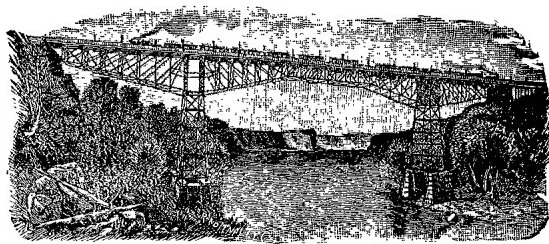
MICHIGAN CENTRAL NEW CANTILEVER BRIDGE, NIAGARA FALLS.

MICHIGAN CENTRAL

“The Niagara Falls Route.”

EAST.

STATIONS. †Mail. †Day Express. *N. Y. Express. ‡Atl’ntic Express. †Night Express. †Kal. Accom’n. †Local Pass’gr.
Chicago am 7.55 am 10.35 pm 3.10 pm 10.10 pm 9.10 pm 4.50
Michigan City pm 10.08 12.25 4.54 am 12.28 11.27 6.58
Niles 11.40 pm 1.30 5.49 1.50 am 12.55 8.17 4.15
Kalamazoo 1.12 2.45 6.08 3.35 2.27 am 7.10 6.00
Battle Creek 1.55 3.20 7.33 4.26 3.15 7.55 6.55
Jackson 3.35 4.39 8.49 6.13 4.45 9.25 8.30
Ann Arbor 5.04 5.43 9.41 7.50 6.00 10.48
Detroit 6.30 6.50 10.45 9.29 7.30 11.50
Buffalo am 8.30 am 4.25 pm 7.15 5.55 9.05 pm 8.05
Rochester 6.50 9.15 8.00 11.45
Syracuse 8.10 11.35 10.15 am 2.15
New York pm 4.30 pm 8.50 7.20 11.15
Boston 10.00 10.00 9.30 pm 2.50

WEST.

STATIONS. †Mail. †Day Express. †Chicago Express. *Pacific Express. †Evening Express. †Kal. Accom’n. †Local Pass’gr.
Boston am 8.30 pm 3.00 pm 7.00
New York 10.30 6.00 10.00
Syracuse pm 7.40 am 2.10 am 8.00
Rochester 9.55 4.20 10.45
Buffalo 3.30 am 12.15 6.35 pm 1.20
Detroit am 9.00 8.00 pm 1.20 am 10.15 pm 8.00 pm 4.00
Ann Arbor 10.27 9.02 2.24 11.35 9.15 6.22
Jackson pm 12.05 10.03 3.27 am 12.54 10.55 7.10 am 6.25
Battle Creek 1.55 11.36 4.30 2.15 am 12.27 8.52 7.55
Kalamazoo 2.45 pm 12.13 5.07 3.07 1.20 pm 9.45 8.40
Niles 4.20 1.30 6.22 4.32 3.06 am 7.30 10.15
Michigan City 5.42 2.35 7.20 5.43 4.32 9.00
Chicago 7.55 4.35 9.00 7.45 7.00 11.20
  • Daily. † Daily except Sunday. ‡ Daily except Saturday.
O. W. RUGGLES, General Pass. & Ticket Agent, Chicago. GEO. J. SADLER, Ticket Agent, Battle Creek.

Obituary Notices.

“Blessed are the dead which die in the Lord from henceforth.”— Rev. 14:13.
WILKINSON.—Died at Polk City, Iowa, of remittent fever, Aug. 20, 1889, George Wilkinson, aged 23 years, 2 months, and 17 days. He manifested great patience during his sufferings of fourteen days. Bro. Wilkinson was born in the north of Ireland, and came to this country with his parents and youngest sister, in the spring of 1881, other members of the family having preceded them. They settled at Blenco, Iowa, where the family has since resided.
George was always a good boy, much beloved by all who knew him, and was an especial favorite in the family. He was converted when about eighteen years old, and joined the M. E. Church on probation; but his attention being called to the subject of present truth, he carefully investigated it by reading; and as he decided to obey God in the keeping of all his commandments, he was never taken into full connection. He was baptized by Eld. G. F. Watson, and joined the Smithland S. D. A. church. Since then he has been a faithful worker in the church, Sabbath-school, and T. and M. society. The last year of his life was spent in the canvassing work, in which he was an earnest laborer, not leaving the field to visit his home for the last nine months. He fell at his post with his armor on, He loved his dear Master's appearing, and often expressed a desire to live to see him coming in the clouds of heaven. Though he has not been permitted to realize this hope, nor to engage in the work of the ministry as he had expected, we know he has escaped some of the perils of the last days; and we hope, if faithful, to meet him at the first resurrection. Funeral services conducted by the writer. Text: Rev. 14: 13.
A. P. HEACOCK.
JORGENSEN.—Sister Maud Jorgensen, wife of Bro. George Jorgensen, died at her home in Labette County, Kan., July 16, 1889, in the thirty-third year of her age. Sister Jorgensen embraced the truths of the third angel's message about seven years ago, under the labors of Eld. L. D. Santee, and has lived a devoted Christian life ever since, being a member of the Valedo church. Her illness was short and severe, but she bore it with Christian fortitude. She died with a full assurance of a part in the first resurrection. She leaves a husband and two small children, besides many friends, to mourn. We trust she sleeps in Jesus. Blessed sleep!
R. H. MILLEN.
COLE.—Died of cancer of the stomach, Sept. 19, 1889, at her home near Shelby, Ohio, sister Catharine Cole, aged 69 years, 7 months, and 13 days. Sister Cole, whose maiden name was Rice, moved from Pennsylvania to Richland County, Ohio, with her husband, John Gilmore, during the great Advent movement of 1844. Here she received present truth under the labors of Eld. D. E. Lindsey, in 1885. Though a great sufferer, and confined to her bed most of the time for eight years, she showed true fortitude and patience in her afflictions, lived a consistent life, and died rejoicing in hope of soon meeting her Redeemer at the resurrection of the just. The words of Job (19: 25-27) were often upon her lips, and seemed to afford her great comfort and joy as she passed “through the valley of the shadow of death” to her last, long sleep. She leaves a husband, three sons, and three daughters, all married, who mourn her loss. Two of these, W. H. Gilmore, of the Mt. Vernon Sanitarium, and Mrs. W. S. Champion, of Plymouth, Ohio, hold the same religious views as the mother, whose earnest desire was that the rest might search and find these truths that would prepare them to meet her when Jesus comes. The Christian's hope, and preparation for the judgment, constituted the theme of the discourse by the writer, to the large assemblage of relatives and friends. Text: Rev. 14: 13.
J. D. RICE.
Continue reading: DEDICATION OF THE WARD, KAN., CHURCH