Review and Herald Publishing Assn. · Takoma Park Station, Washington, D. C. · Apr 15, 1919
News Items on Cost of War, Divorce, and Science
Canada places the cost of the war to her at $1,500,000,000.
The twelve-year-old son of the Secretary of War recently celebrated his birthday by an airplane flight.
To equip graduate nurses soon to be released from military service to enter public health nursing, the American Red Cross has appropriated $100,000 to be used for public health scholarship funds.
A curious “sleeping-sickness” has made its appearance in the United States, and in some cities seems to be taking an epidemic form. One form of the sleeping-sickness is pronounced by physicians to be an after-result of the influenza.
According to the census bureau, approximately one out of every nine marriages in this country is terminated by divorce. This unfortunate condition would not be possible if young people gave more thought and prayer to the marriage relation before taking definite steps toward matrimony. No question in its solution could need more consideration and counsel, more divine wisdom, than this one.
Major H. G. Gibson, who died in Abbeville, France, was another martyr to science. He gave his life for the welfare of men as truly as if he had died on the field of battle. He was working to discover the germ that causes influenza. He succeeded, though the germ is exceedingly minute and difficult to trace. Weakened by his protracted labors, he contracted the disease from a particularly virulent strain of the germ. Pneumonia set in, and he died.
Cardinal Bourne’s recent visit to Constantinople was the first occasion of a member of the Sacred College setting foot on the shores of the Bosporus since the fall of the Byzantine Empire, nearly 500 years ago. In fact, the last previous appearance of a cardinal in Constantinople was in the year 1453, immediately prior to the overthrow of the Byzantine Empire and the capture of the city by the Turks. He fled in disguise as they were storming its walls.
The manufacture of 30,000 chairs and 10,000 tables for the war refugees of northern France has been started by 100,000 schoolboys working in manual training shops throughout the United States. As fast as the chairs and tables are finished they will be sent to France by the Red Cross, and distributed to refugees who have either no money to buy furnishings or are unable to obtain furniture because of the lack of materials and the destruction of furniture factories.
The “Sierra,” an army transport, had on board a number of skilled doctors and surgeons. Suddenly came a wireless call from the British steamer “Pollac,” many miles away, stating that one of the crew was sick. Symptoms were reported by wireless, a diagnosis was made, and treatment was prescribed. At last reports the invalid was improving. Then came a wireless message from the “Powhatan,” another army transport, distant fifteen miles. The doctors on the “Powhatan” wanted a consultation with the doctors on the “Sierra” over some difficult cases. Six doctors went to the telephones and “attended” the wireless consultation. These incidents surpass any of the fanciful marvels of the “Arabian Nights.”
Rumania is in a most awkward financial situation. When German forces advanced on Bucharest in 1916, the Rumanian government took its state archives to Jassy, which became the temporary capital; and in the fall of 1917 it transferred the national treasury, containing 900,000,000 francs in gold, a large amount in notes, and a great number of valuable securities owned by private citizens, to Moscow. The Russian revolution sprang up so suddenly that the Rumanian government could not withdraw the money, and after the fall of Kerensky, Trotzky seized it.
Eight out of eleven Massachusetts towns that recently voted on the liquor question voted wet. Two of these have been dry for a quarter of a century, and others for a shorter period. Somebody stayed at home, and expected the other people to vote the town dry as usual. Though we are on the eve of national prohibition, we cannot go to sleep. The liquor people are wide-awake; and if the temperance people do not remain awake and at work, the liquor people may find a way to make the nation wet. They are trying hard to do this very thing.
"World Peace"
THE little book, "World Peace in the Light of Bible Prophecy," has been off the press less than one month; yet at this writing the third edition of 50,000 is now being prepared, and orders for more than 110,000 have already been filled. "The World Outlook," "The Bolshevik Germ," "A League of Nations," "The Nations Fulfilling Prophecy," "The Eastern Question and Armageddon," "The Blessed Hope," "Signs of Christ’s Soon Coming," "The Next Universal Kingdom," are the chapter headings.
The book contains much of interest to the general reader and to the Bible student. Price, twenty-five cents. Order of your tract society, or of the Review and Herald Publishing Association, Takoma Park, Washington, D. C.
A Prayer
By J. H. Jowett
GIVE us pity for the infirm. May sorrow and deformity never become a commonplace! May I ever move toward them in sympathetic response! May I have eyes for the blind, and feet for the lame, and healing for all the sons and daughters of pain! — J. H. Jowett, D. D.
Interesting Verse
A WELL-KNOWN British writer composed the following poems from baby sayings:
Baby’s Theology
“A little four-year-old, with curly head,
Spoke, as she nestled in her tiny bed.
‘God, there is room for you!’ she softly said.”
“I wonder — when the years are multiplied —
Will there be room for God still at her side?
If so, our Father will be satisfied.”
Baby’s Astronomy
“‘Silvery, silvery moon in the sky!
I love you so dearly, and I’ll tell you why.
I love you still more than the beautiful sun,
For he goes away when the daylight is done,
He only will shine when the world is all bright —
But you, silver moon, give me light in the night!’”
“Ah, little baby,—but we are grown old,—
The sun gives the light to the moon, we are told;
But often, like you, ’tis the gift that we love,
And we praise not the Giver who lives up above.”
Baby’s Economy
“‘It isn’t right to waste the light,’
Said Nurse — and puffed it out!
‘Now go to sleep, the stars will peep,
No doubt!’”
“‘Geof’s curly head went down in bed,
‘How kind of God!’ said he,
‘To waste his light all through the night
For me!’”
“Ah! little lad, we too are glad
God is so wondrous kind,
His gifts are free, for you and me
To find!”
On the Way to China
By H. O. Swartout
H. O. SWARTOUT
MISSIONARIES often say that a person who wishes to write about China should do so soon after his arrival, before everything in the country becomes too familiar to seem worth writing about. The writer has been in China only a short time, but he begins to realize the truth of what the older missionaries say. These sketches are an effort to catch the early observations and impressions before they fade into the humdrumness of long experience.
The Chinese say of China, “It is a new country every ten miles,” so any description which covers the whole country would be lengthy indeed; and any description of one part would be far from a perfect description of some other part. The writer having seen but a very small part of China, makes no attempt to give a description of all China or of all Chinese.
Before beginning to tell about this country, perhaps it would be well to say something of how one gets to it; for among those who read these sketches there may be some who will later come here. The preparations for such a trip, and making it, are real events in a young person’s life. Missionaries, both old and young, frequently tell of the details of the voyage, the sort of ship they crossed in, how they felt while out on the ocean, what they thought when they landed, — an evidence that the “first time over” remains long in the memory.
The Foreign Mission Board has reliable lists of articles needed by the new recruit. By correspondence with the board one may avoid taking useless articles and forgetting necessary ones. Articles sent to China are usually first sent to Montgomery Ward & Co. for repacking and export shipment, as this company makes a specialty of such work.
The few weeks before sailing are spent visiting relatives and attending to the many items of business that must be settled before leaving the homeland. A passport must be secured. One must be vaccinated for typhoid and smallpox. All necessary dental work should be done. These and many other details make the weeks a kaleidoscopic time of pain and pleasure.
Those whose homes are in the Eastern or Central States find the trip to the Pacific Coast a real pleasure. One gains a conception of the bigness of the United States. There are several routes to the coast, each having its peculiar charm, but probably the Southern route is the poorest. Most of our missionaries are sent out in the summer or early autumn, and there is nothing but hot weather and parched landscape along the Southern route at this time, unless the traveler has time to stop off and take some side trips. But whatever route is chosen, one should have a small camera with a good lens as part of his equipment. The pictures he gets are a reminder of kinder climes and freer days all during the years of toil which follow when he reaches the mission field.
The writer was one of the party of forty-two workers who went out in the summer of 1916, the largest party ever sent out at one time by our people — perhaps by any mission board. By July 31 we had gathered from all parts of the country, ready to board the “China,” which was starting from San Francisco the next day. At two in the afternoon the ship pulled away from the pier. Hundreds of friends had come to see us start, and we could see their handkerchiefs fluttering farewell even after we were too far away to distinguish one person from another in the crowd on shore. Finally a point of land hid both pier and friends from sight, and we realized that at last our voyage had really begun.
So intent were we in watching the hills slowly sink from sight — that last glimpse of the homeland which some of us were leaving forever, perhaps — that we did not at first notice that the weather on the Pacific was any different than that on San Francisco Bay. But the “China” was heading west southwest into a brisk west northwest gale, and the resulting pitch and roll of the ship soon drove all but three of the party to the place where they could best lie flat and keep still. You have all read too many descriptions of seasickness to care to hear another. Suffice it to say that the members of our party experienced all the varieties4that have ever been described, and some that were indescribable. But many had recovered by the next day, and were ready to enjoy whatever pleasures the long voyage might afford.
We went on deck the morning of the eighth day to see the peaks of the Hawaiian Islands rising out of the sea. The vast, heaving, deserted ocean soon narrowed into a coral-bottomed bay, festooned with feathery seaweed and teeming with multicolored fish. The “China” did not leave Honolulu till late afternoon, so we spent the whole day with our Hawaiian brethren, viewing the Waikiki swimming beach with its world-famed surf riders, the wonderful aquarium, and the plantations and parks where flowers and fruits grow in such profusion as to make one think the Hawaiian Islands to be the garden of the world.
Before the sixteen days between Hawaii and Japan were past, the voyage began to grow tiresome. Deck sports had lost their novelty, and the appetite for ship food began to pall. The only things that broke the monotony were a deck sport tournament and a small typhoon. The members of our party took most of the prizes in the former, and had their second attack of seasickness in the latter.
All ships equipped for passenger service have libraries, pianos, decks where one may take walks, apparatus for various kinds of sports suited to the limited space of a ship’s deck, and many times other things for the convenience, enjoyment, and comfort of their passengers. One who wishes to read has full opportunity to do so. One who is musically gifted is always sure of an appreciative audience. One is not limited in his walking, except by time and strength. Ring-a-peg, deck golf, and shuffle board are going from morning till night. A person may write all the letters he wishes, or he may lean over the rail watching for flying fish. Where there is a party of friends on the same boat, the loungeroom is always available for meetings of social or business nature. Many passengers drink, smoke, and gamble to excess also, but of course such things only excite the disapproval and disgust of missionaries.
Those on the “China” passed their time in various ways till we reached Yokohama, where the ship lay at anchor three days waiting for engine repairs. It rained most of the time, but there was enough good weather to allow a trip by rail to Tokio. Japan seemed like a pigmy country, a land of short people, little houses, tiny farms, narrow-gauge railroads, and small businesses,—everything on a diminutive scale. Not till one has been in the East for some time does one see that in spite of appearances, the industry and the enterprise of the Japanese make them a force by no means small.
The trip from Yokohama to Shanghai was short. At dawn the third day the “China” was plowing through the sea of yellow mud at the mouth of the Yangtze, though land was not yet in sight. About nine o’clock we caught our first glimpse of China, a low, muddy shore, less than ten feet above sea level, unrelieved by grove or hill,—the seaward edge of a delta plain which extends on all sides for many miles.
Soon after landing, our large party broke up, a few remaining in Shanghai, some going on to south China or the Philippines or Malaysia, and some preparing for trips to various stations in the interior of China. The writer was one of the party which went to Nanking for language study. Shanghai had provided a few of the “seventy-two distinct and awful smells,” a sight of the naked children, the bound feet, and the long queues, which are still common in China, in spite of its being called a modern republican nation; but the city had so much of a foreign air and so many modern improvements that not till we had settled in Nanking and begun to look around us, did we realize that at last we were in China.
Porto Rico
PORTO RICO, often called “the enchanted isle,” is one of the most beautiful portions of the United States. Its forest-clad mountains, its picturesque houses, its foreign-looking fortifications, its tropical palms, all add to its charm. The ocean to the north of it, 33,000 feet deep, is said to be the deepest of the Atlantic. Hurricanes often visit it, and twice it has been shaken by very severe earthquakes.
Since we obtained this island from Spain at the close of the Spanish-American War the missionary task there has assumed large proportions.
Porto Rico has a million and a quarter inhabitants — 350 to the square mile. The old Indian stock, now extinct, has left its traces everywhere. Slaves, once brought from Africa, have also laid their dusky impress upon the people. Once the island was the penal colony of Spain, it is said, and so convicts were added5to the strain. And with it all, there are the descendants of the Spanish, cultured and charming people from one of the finest stocks in Europe.
The four hundred years of Spanish dominion, however, and of undisputed Roman Catholic sway, left the people of the island illiterate, with few schools, and only 30,000 pupils in the schools of all kinds. It compelled attendance on gorgeous ceremonies and brilliant processions, but left the people superstitious, bound down by the terror of demons and worship of spirits. It made the Porto Ricans unskilled in government, and it failed to develop the resources of the island.
The United States, and American missionaries, have been at work in Porto Rico for twenty years, and much has been accomplished.
Roads have been multiplied, fine buildings have gone up with amazing rapidity, and commerce with all the world has prospered.
Everywhere schools have sprung up, and they now have nearly 200,000 pupils. Both Spanish and English are used in these schools. Many of the pupils have already become teachers or have entered important professional work.
The United States has brought to the Porto Ricans the genius of self-government. The first vote taken by Porto Ricans under the new organic law of 1917 was on the prohibition question, and they proved their farseeing wisdom by giving an overwhelming majority for the reform — and this though the Latin races are supposed to be inclined toward alcohol.
Best of all, the United States has established freedom of religion. Protestantism has already gained 15,000 members, representing a very large number of families, and exerting an influence disproportionately great. Medical missions, Christian education, and evangelism have gone hand in hand.—Christian Endeavor World.
Word from Chung-king, China
In a personal letter to friends in the homeland, Mrs. John Andrews gives an interesting picture of Chinese customs, also a sad picture of Chinese cruelty, which we have been permitted to give to INSTRUCTOR readers. Mrs. Andrews writes:
It is raining quite steadily and the moon, though partly hidden by clouds, makes a shining path across the river with dark shadows where the bank curves around to make a harbor for hundreds of junks from up the river.
Just a few lights can be seen in the city, and the rattles, gongs, and conch shells are not being used tonight.
The steady drip, drip of the rain is such a contrast to the noise of the past week. This week is a Chinese festival for homeless and friendless spirits, who are supposed to haunt the place.
After dark, little lamps on floats are set adrift on the river, from boats and rocks along the shore. The current carries them downstream in long chains, and they burn for quite a time and are a pretty sight indeed.
After a hundred or more of these little lamps have been floated, the worshipers place others along the path leading up the river bank, and over the hill. Sometimes these paths lead to a temple or wayside shrine, and sometimes only out among the graves which are everywhere on the hillsides.
Great numbers of people are doing this at the same time, so the lights look like swarms of ordinary fireflies, a very pretty sight.
Quite a story came to light the other day. We heard that a man who was dumb had miraculously recovered the power of speech. I thought it was a fake, but he came out here, and this is his story:
When he was but a baby his mother died. His father, a Manchu, married again. In course of time his stepmother became interested in another man and poisoned the boy's father. Fearing the child would tell, she took the little fellow, then eight years old, nailed him against the wall by his hands, made an incision under the lower jaw, and cut out his tongue at the roots.
He says that healed up without much trouble, but that his hands were infected by the nails and were very painful for a long time afterward. He grew to manhood without being able to talk, writing to make his wants known. As he was a Manchu he received a pension from the government until the republic was established.
While in a city above here, he happened into a China Inland Mission chapel. After hearing the gospel, he finally one night had a dream. He seemed to see a great light, and a voice told him to speak. He did not try to talk, he said, thinking it only a dream. This was repeated, and then, he did try, and has been talking ever since. He uses the muscles of his throat and face a good deal, but can be understood very well.
One hears so many stories of fiendish cruelty out here, that one is tempted to disbelieve them, but every now and then an instance comes to light which shows that they are all too true.
A Dinner Cooked in Bamboo Vessels
By J. E. Fulton
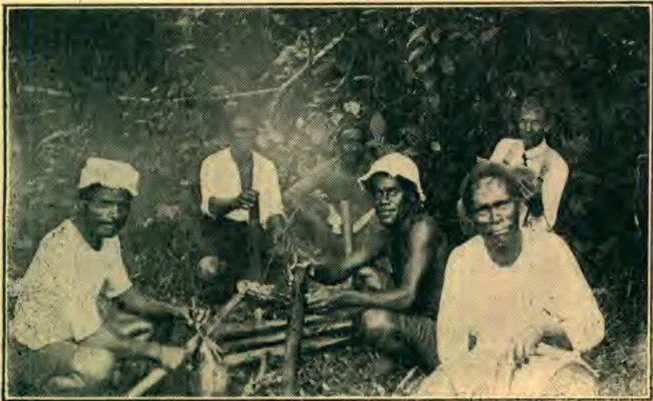
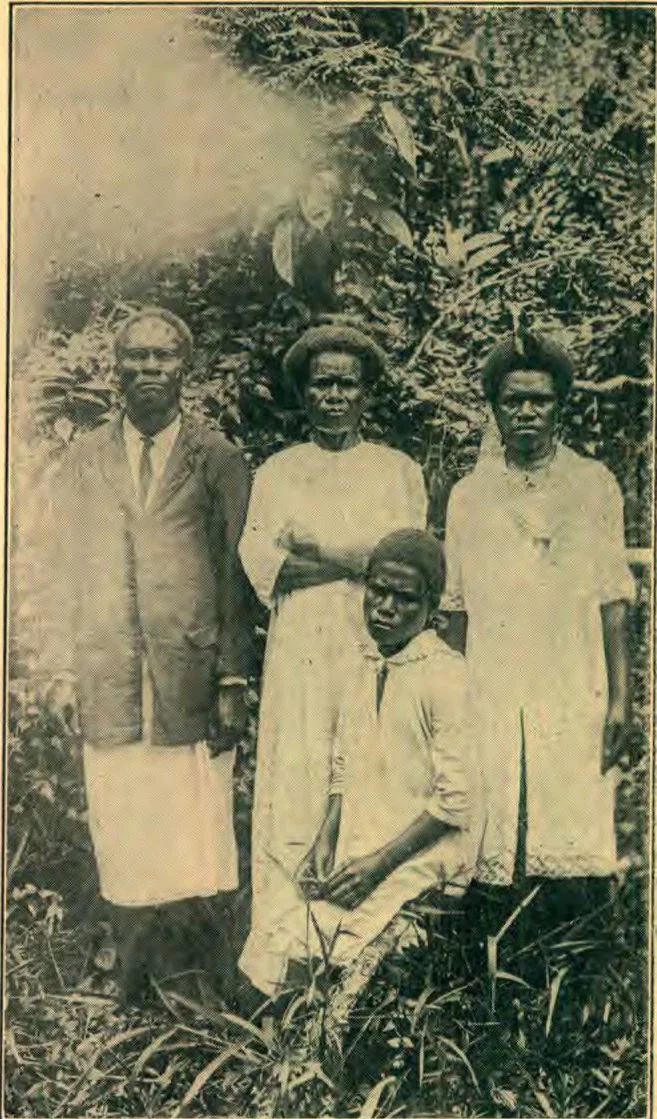
One day as Pastor Parker and I were journeying with some of our native brethren among the mountain tribes of Fiji, we found ourselves at mealtime some distance from any native town. We came to a beautiful stream of fresh water, but we had no cups with which to dip up the water. Our native brethren had some taro, a vegetable, but where was the vessel to cook it in? There were fresh, crisp leaves often used for greens, but how, I queried, could these be cooked? We had crackers with us, but we wanted in addition some hot water for coffee, but how could this be secured? Pastor Meciusela Naisogo, a native of the mountain district, noticing our fears, said, “We shall show you a new thing today.”
PREPARING THE MEAL
PASTOR MECIUSELA NAISOGO AND FAMILY
Halting to rest in the valley by the stream, one of our Fijian evangelists cut down some bamboo trees, then cut them up into sections, each about three feet long, so that a closed joint was at one end, the other being open, thus making a hollow tube, each holding about a half gallon of water. There were perhaps ten of these tubes prepared. Water was dipped up in some of them and from one of these we drank.
While some were gathering wood and making a fire, others were paring and cutting up vegetables in slices just large enough to slip into the bamboo tubes. The young, fresh leaves of the taro were gathered, rolled up in balls, and placed in other tubes. To the vegetables and greens a little water was added, and after a stopper of leaves was placed in the open end of each of the bamboo tubes, they were placed on the fire, the open ends being slightly elevated to keep the water from escaping. The native brethren kept the bamboos moving back and forth in the fire, rolling them over and over, the fire meanwhile charring the green bamboos to a sooty black. They were carefully watched, so as not to burn through. The bamboo wood is fine and hard, and being green does not burn readily, and so serves well as cooking vessels. It was quite a surprise to us, and also to a Fijian with us who was from the coast, to see how quickly and how perfectly everything was cooked.
After the Fijian brethren declared the dinner cooked, large green leaves were plucked and laid down as plates and tablecloth. Then in just the right way one of the brethren slit each bamboo tube with a knife—and out came the vegetables and greens steaming hot, onto the green leaves. The food was simple, but sweet and clean, and with our crackers made a refreshing meal. While partaking of the vegetables, the water was heating in a bamboo. I was doubtful about its actually boiling and laughingly expressed my fears. But soon the bamboo reached me, after having been carried fully twelve feet from the fire, with the water still boiling. Thus had the native sons found a means of cooking food away off in the mountains far from ordinary supplies. J. E. Fulton.
DELLA STEVENS
By Della Stevens
Amodini
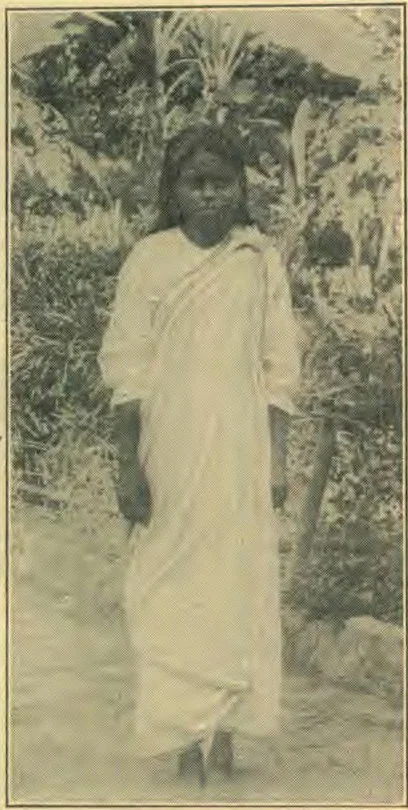
If you could see her today, you would never recognize her as the uncouth girl that came to our Bengali Girls’ School three years ago. She wore a dirty, torn garment, and before she could be admitted to the school her hair had to be cut short to protect the other girls from vermin. As the days went by we discovered this child had a violent temper. With the least provocation she would strike other girls, thus keeping the school in a continual turmoil, and winning for herself many enemies.
One day she became angry with her little sister, and threw a pair of scissors at her with such violence that they were broken to pieces as they struck the floor.
At another time, because I refused her something she wanted to do, she went into the garden and pulled up all my beautiful flowers, to which I had given much care. We punished her, reasoned with her, but to no avail. After this last offense I suggested to her that when these violent fits of temper came over her she drop on her knees where she was, regardless of the other girls, and pray audibly for help. She promised me that she would try to do this, and from the time of the promise, fully one year ago, to the present time, I have never known her to lose her temper. Just before her baptism two weeks ago she told me what a struggle she had had to overcome her temper. With each victory gained, came new strength.
AMUDINI
She is now a general favorite in the school, and truly one of God’s own little ones.
She has found that Jesus is a very present help in every time of need.
Friends, pray for our Bengali Girls’ School.
DELLA STEVENS
Say So
If you believe in yourself —
Say so.
If you have convictions worth while —
Say so.
If you are happy and are glad of life —
Say so.
If some one helps you and lifts you up —
Say so.
If you think this is a great world in which to live —
Say so.
If you don't like things as they are —
Say so.
If you make a blunder now and then, have the courage to —
Say so.
If you have love in your system, the world would like to know it —
Say so.
“What All the World’s A-seeking,” is a frank expression and open confession. It begs for it every hour. It wants it now. In fact, one of the great pieces of building material in your own personal success is the one that is able to suggest to you just now and when to — Say so.—“Take It.”
Benefits of Good Literature
THE young man who wrote the following letter is fortunate, in that he is finding what he wants. There are many like him enrolled in our literature classes in the Correspondence School,— people who are living richer, fuller lives for having touched the lives of the great and noble of all ages through the medium of literature.
Literature is one of the easiest subjects to study by correspondence, since much depends upon the reading a student must do. At the same time, it is serious enough to commend the respect of any one.
New students enroll every week. When will you begin?
“Before taking up this course I had studied quite a few of the different authors and had received much benefit; but I have gained much courage and many blessings from this course of study. My attention has been called to poems and essays that are of great value to me. By studying them I received a truer idea of what literature is. The first ten lessons on Biblical literature were especially helpful. Many of the psalms mean much more to me now than ever before, because I see so many more beauties in them.
“Before pursuing this study I had no just conception as to most of the authors. Now I find that they were doing what they thought was right and proper before God. Many of them had a deep inner longing in their souls for something better, something divine. I thought most of these men were not Christians, but now I know differently. I can now see how much some of these did to bring the Bible to the people, such men as Wycliffe, Luther, and others. Bacon’s essays are rich in wisdom. Milton’s poems were a great blessing to me. Bunyan’s works are interesting and helpful. I have received a real inspiration for higher ideals. By seeing what other men did, a desire is created in my own heart to become like them and also do great things. I believe if we read these great men, walk with them in purpose, become close companions with the noble-minded, we shall become like them, a glory to God and a benediction to men.”
AGNES LEWIS CAVINESS.
The Beauty of Truthfulness
(Concluded)
“WHAT did we learn at our story hour last evening?” asked Mrs. Laon, as she and the children gathered for another lesson on the importance and beauty of truthfulness.
“We learned,” answered Carroll, “that real roses, peaches, and diamonds are better than artificial ones, and that boys and girls to be genuine must be truthful. If they are not truthful, they are mere shams, or imitation boys and girls.”
“Good, Carroll! What great men, Lucile, have you found who loved truth and hated lying?”
“I could think of only Washington, Lincoln, and Mr. Wu you told us about in our last lesson.”
Portion of the Main Gallery of the Congressional Library,
Washington, D. C.
“How do you know Washington always told the truth?” asked Carroll. “My teacher says the story about the hatchet and the cherry tree is a myth.”
“That may be a myth; but here is a story known to be true, which shows that Washington in his youth loved truth. One day he and two neighbor boys had great fun with a colt. George mounted the colt, a new experience for the young creature, so he gave the fearless rider a lively scamper over the pasture. The three boys played various tricks upon the colt, and kept up the fun until the animal dropped dead from a broken blood vessel. The consternation of these bold riders was expressed in a period of absolute silence as they viewed the remains of their once lively entertainer. But of course when the full significance of the colt’s demise came over them, they began to think of the forthcoming explanation to be made to the owner of the colt.
“The two neighbor boys invented a plausible story for George to tell his mother; but when that youth presented himself before her he told the exact truth. Mrs. Washington, on learning the story the boys had proposed, said, ‘My son, I should rather lose a thousand colts than have you tell me an untruth.’”
“The names of the two boys who prepared the lie were forgotten long ago; but after nearly two hundred years, the name of George Washington still lives in the hearts of men throughout the world.”
“How do we know Lincoln was truthful, Carroll?”
“He wouldn’t have been called ‘Honest Abe’ if he hadn’t been truthful.”
“Yes, an honest person cannot be untruthful. When the young Mr. Lincoln was a clerk in a village store, he sold an assortment of goods to a woman. She paid the price, $2.06; but after she left the store he discovered that he had overcharged her six cents. It troubled him all the evening, so bright and early the next morning Mr. Lincoln called upon the lady, apologized, and returned the six cents.
“At another time he failed to give a customer the full amount of her purchase. He lost no time in adjusting the matter, after the error was discovered. You may be sure such a conscience would not suffer him to falsify.”
“Do persons who are truthful always become great persons, mother?” asked Lucile.
“Not always in the sense the world counts greatness; but in the Lord’s sight all truthful persons are great persons, and it is quite safe to say that all really great people are truthful.”
“Jackson was another president who abhorred lying; so did President Hayes.”
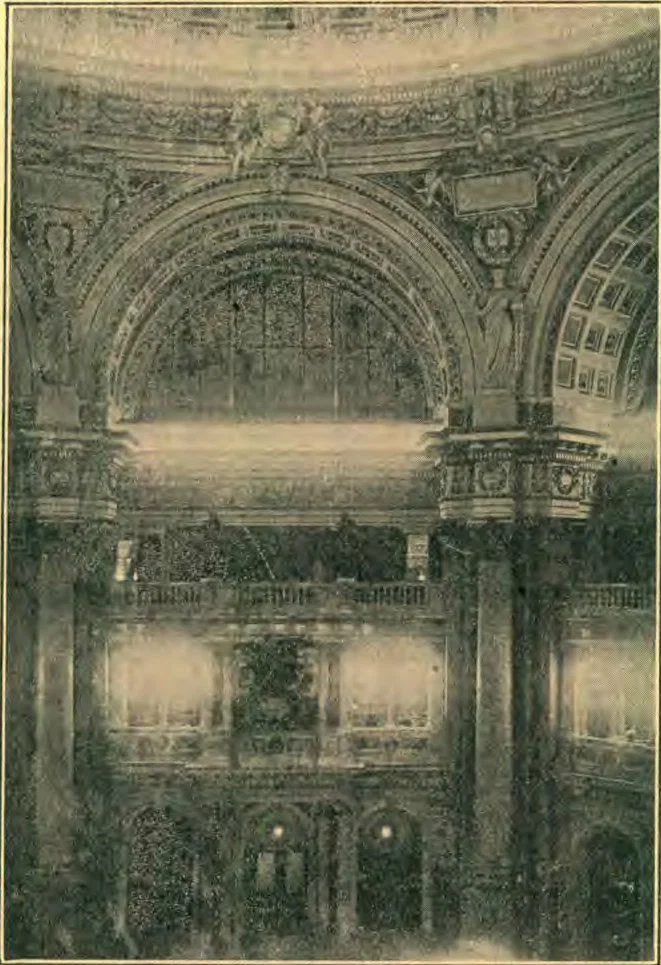
“This picture of the main gallery in the Congressional Library contains sixteen life-size statues of the world’s greatest men. One of these is the statue of Moses, and one is of the apostle Paul. Why are Moses and Paul so honored? It is because they loved and spoke the truth. If Moses had been a lying man, he could not have lived in the hearts of the people for more than three thousand years.”
“Raphael, who painted the beautiful Sistine Madonna, loved truth and hated evil. It is said that ‘every evil humor vanished when his comrades saw him, and every low thought fled from their minds.’ Evil thoughts flock to the liar.”
“Who composed that beautiful piece you have for your lesson this week, Lucile?”
“It is one of Bach’s pieces, mother. My teacher says he’s wonderful.”
“He is, and some one said that ‘wherever Bach’s music is heard it makes of that place a church.’ He was a true man, or he could not have composed music so pure and sweet that it would make a church or sacred place wherever played.”
“One of the rules that the great Marshal Foch gives to his soldiers and demands that they heed, is: ‘Tell the truth squarely, face the music, and take your punishment like a man, for a good soldier won’t lie.’”
“A good soldier will not act cowardly, and it is cowardly to lie to shield oneself from reproof or punishment.”},{
Competing with God
By C. S. Longacre
OUR characters should be a transcript of the character of God. Jesus said, “Be ye therefore perfect, even as your Father which is in heaven is perfect.” We can be perfect as God is, when we realize that the Creator of all things supplies us with all the qualities of his own perfection and offers them to us as a free gift. It is possible for us to be clothed with the perfect righteousness of Christ, and to permit Christ to live his perfect life in us again. The life of Christ must pulsate through our members, if our characters are to become models of his character.
Years ago, Bonnat, the French painter, was making a portrait of an American, and he became so unpleasantly close in his observations, and looked so hard and intently into his face, that the American drew back and asked what it meant. Bonnat replied, “I am competing with God, and I must see everything which he has put into your face!”
We Christians are also competing with God, and we must leave nothing undone to make our poor wretched lives a correct transcript of his great masterpiece—the character of Jesus Christ, which was true to the divine original.
C. S. LONGACRE.
Winning Your Way in Life
“WINNING your way in life depends very much on not losing heart.”
Time Is the Chance to Live
“TIME is the chance to live. Whoever wastes it wastes life.”