MEMORY VERSE: “Obey my voice, and I will be your God, and ye shall be my people.” Jer. 7: 23.
STUDY HELPS: “Patriarchs and Prophets,” pp. 616-626; “Bible Lessons,” McKibbin, Book Two, pp. 58-60.
“I wish that there were some wonderful place
Called the land of Beginning Again,
Where all our mistakes and all our heartaches
And all of our poor, selfish grief
Could be dropped, like a shabby old coat, at the door,
And never put on again.”
Questions
1. When Saul had reigned two years, what did the Philistines do? How large was Saul’s army? How large was the army of the Philistines? 1 Sam. 13: 1-5.
2. When the men of Israel saw the trouble they were in, what did they do? Verses 6, 7, first part. Note .
3. Where was Saul? Why did he tarry so long? Verses 7, last part, 8.
4. Instead of waiting until Samuel came, what did Saul do? Who only was permitted to present sacrifices before the Lord? Verse 9. Note .
5. When did Samuel arrive? What question did he ask Saul? What excuses did Saul make for what he had done? Verses 10-12.
6. What reproof did Samuel give Saul? What would have been established if Saul had obeyed the Lord? What was to be the penalty for Saul’s sin? Verses 13, 14.
7. Where did Samuel then go? How many men were now with Saul? How did the Philistines continue to spoil the land? Verses 15-18.
8. What made the Israelites still more helpless? Verses 19-23. Note .
9. What did Jonathan one day propose to his armor-bearer? What showed his faith in the Lord? 1 Sam. 14: 1, 6, 7.
10. In their planning how did they seek to know the Lord’s will? What sign was given them that they should go forward? Verses 8-12.
11. How did Jonathan and his armor-bearer reach the summit of the cliff where the Philistines were encamped? What was the first result of their attack? Verses 13, 14.
12. How were those two brave men aided in their fight? Verse 15. Note .
13. What did the watchmen in Saul’s army discover? How did they find out who was fighting the Philistines? How did the army then try to help in the battle? Verses 16, 17, 20.
14. How did the Israelites that had before been captured by the Philistines then help? Who else joined in the battle? What was the result? Verses 21-23. Note .
Additional Reading
The story of how near Jonathan came to death after the battle was won, is told in 1 Samuel 14: 24-45.
An interesting comment on this story is given in “Patriarchs and Prophets,” pages 624-626.
The Monkey-Eating Eagle
THE monkey-eating eagle of the Philippine Islands, says American Forestry, is one of the largest living birds of prey, if not the largest. Probably the vernacular name of monkey-eating eagle will be universally adopted, although the bird does not always confine itself to a monkey diet, but, when monkeys are scarce, will resort to the yards of the natives and make off with an occasional small pig or some of the poultry. That kind of robbery has indeed happened so often that the natives now regard the handsome and powerful bird as an enemy and greatly rejoice whenever one is captured or killed.
On account of the mountainous character of the country and the great density of the forests where the eagle lives, it is no easy task to collect specimens; only a few mounted skins occur in museums in any country—probably less than eight altogether.
A monkey-eating eagle may weigh as much as twenty pounds; and it has the largest raptorial foot of any living bird known in the world. The strength and grip of that powerful claw, with its great talons, exceed that of any other known bird, and even surpass the clutch of the strongest of men.—Selected.
Suffering Today, Success for Those Who Follow
“If we succeed without suffering, it is because some one has suffered before us; if we suffer without success, it is because some one will succeed after us.”
Mine or His: Giving the Heart to God
By L. E. C.
“Mine”—“His”
“MY son, give me thine heart.” The tender, pleading request is addressed to each of us individually,—to you, to me. But how easy it is to delay the answer, at least in part! We profess to have given our hearts to the Master; we say we have surrendered all to him, and yet there is often a mental reservation of some pet shortcoming. Perhaps it seems so small in comparison with other things which must be given up in harmony with an outward profession of Christianity that we hardly consider it at the time.
But as the days and weeks and months, yes, and even the years pass by, there comes a realization that our experience is not fully satisfying. Indeed, it is possible to engage in active work in connection with the cause of God, and still be unregenerate at heart. The leaven of that one cherished sin works subtly. We almost unconsciously let down the bars on first one point and then another until license is so utterly confused with liberty that we come to look upon “the old paths” as entirely too narrow and circumscribed for this modern age. But occasionally there come hours of heart-searching, when we question why our ministry to others is so ineffective. And we wait in vain for an experience which can never come until we realize that religion is a matter of faith and not of feeling.
Breaking through these clouds of discouragement comes the Father's promise of a new heart: “I will take the stony heart out of their flesh,” he declares of Israel, through the prophet Ezekiel, “and I will give them a heart of flesh: that they may walk in my statutes, and keep mine ordinances, and do them: and they shall be my people, and I will be their God.”
But on what condition will this promise be fulfilled?—Only by our compliance with the Father's request: “My son, give me thine heart.” He does not ask for a fragmentary gift, but for the whole, without reserve. What we have designated as “mine” must be fully and freely “his.”
“I owned a little boat awhile ago,
And sailed the morning sea without a fear,
And whither any breeze might fairly blow,
I steered my little craft afar or near.
Mine was the boat; and mine the air;
And mine the sea; nor mine a care.
“My boat became my place of mighty toil;
I sailed at sunset to the fishing ground.
At morn the boat was freighted with the spoil
That my all-conquering work and skill had found.
Mine was the boat; and mine the net;
And mine the skill and power to get.
“One day there passed along the silent shore,
While I my net was casting in the sea,
A Man who spake as never man before.
I followed him—new life began in me.
Mine was the boat, but his the voice;
And his the call, yet mine the choice.
“Oh, ’twas a fearful night out on the lake,
And all my skill availed not at the helm,
Till him asleep I wakened, crying, ‘Wake!
Take thou command, lest water overwhelm.’
His was the boat; and his the sea;
And his the peace o’er all and me.
“Once from ‘his’ boat he taught the curious throng,
Then bade me let down nets out in the sea.
I murmured, but obeyed, nor was it long
Before the catch amazed and humbled me.
His was the boat, and his the skill,
And his the catch, and his my will.”
It is profitable sometimes to step aside and let the busy world whirl on, while we spend a quiet hour in self-examination, to determine just how we stand in relation to eternity. The searchlight of the Spirit will reveal to the earnest seeker the real reason why his experience is unsatisfactory to himself and a stumblingblock to others. Too frequently the roots of failure find nourishment in the little things that we have held in reservation while outwardly heeding the admonition of the Father: “Give me thine heart.” Shall we not determine today to give him all? For “ye are not your own; ye are bought with a price,” even the precious blood of Jesus Christ. L. E. C.
Pray, Push, and Pull
By Eugene Rowell
Though of words long and solemn
Our language is full,
Three small ones are potent —
They're pray, push, and pull.
EUGENE ROWELL.
The Daily Word
IN the sunny Southland there is a large, genial man who is manager of a chain of stores, who writes his mother every day. He buys a package of postal cards, and addresses them all to her, then each day after his work is done and the evening meal is over, he sends the word of greeting. You may know also that a busy man who does this each day, quite frequently sends a fat letter filled with comforting news and sentiment.
Making It Accurate
IN the home of a pious farmer there hung the well-known motto: “But as for me and my house, we will serve the Lord.” The motto meant something in that house, for the farmer prayed daily that all might truly serve the Lord. The last clause fitted all the house save the oldest son, who persistently refused to accept Christ. One day the father and son were alone in the room where the motto hung. The father said, “My dear Henry, I cannot and will not be a liar any longer. You, who belong to my house, do not want to serve the Lord. Therefore I must add the words ‘except Henry;’ it hurts me to do it, but I must be true.” The thought so impressed the boy that he gave himself to Christ.—The Expositor.
An Explanation
A POEM, “The Lighthouse and Its Keeper,” is referred to in the April Gazette as appearing in this issue of the INSTRUCTOR. By mistake it was printed in the INSTRUCTOR of March 11, page seven.
Copyright by Kiser Photo Co., for Great Northern Railway
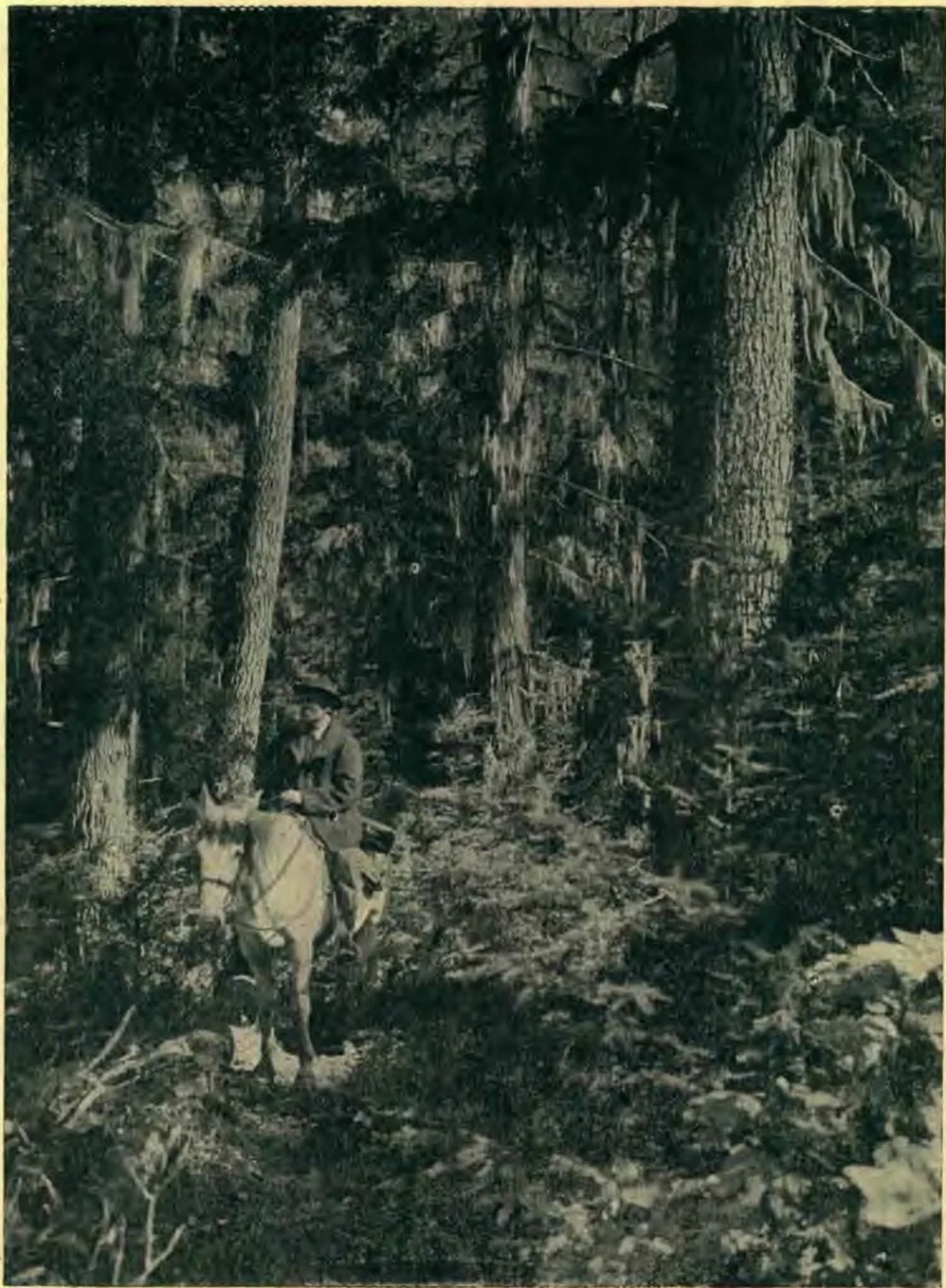
ON THE TRAIL TO AVALANCHE LAKE