The Youth’s Instructor, Vol. 38, No. 12.

THE BETTER WAY

The Youth’s Instructor

Mar 19, 1890

S. D. A. Publishing Association · Battle Creek, Mich. · Mar 19, 1890

THE BETTER WAY.

COME hither, little sad-eyed maid, And to my ear explain Why trembles on thy lash a tear, Why quivers thy round chin. Thou mournest all thy lack of grace, Of feature fine and fair? Thou longest for a daintier garb, And ornaments to wear?
My child, thy cravings are not strange; Thy mind is sensitive; But for these lacks a substitute Thou mayst in time receive, Continued culture of the mind, And training of the heart, Will give a finer, truer grace Than mere beauty can impart.
A love for all that's beautiful, And pure, and good, and true Will leave its trace upon thy face, And bring real charms to view. Then bravely chase the tears away, And make the best of life, And care not but to make thy part With useful labors rife.
My little, nickel-plated clock Ticks gaily on the shelf; It lingers not about its work, Nor sighs unto itself The great mistake its maker made In giving it no charm. No sparkling jewels on its breast, Nor beauty rare in form.
Its hands point out the hour as true As though 't were cased in gold, And full as oft we seek its face This virtue to behold. Oh, could we all as cheerfully Perform our humble task, And not complain of faces plain, Nor useless honors ask!
IDA IDEN HOLLY.

THE ARK AT BETH-SHEMESH.

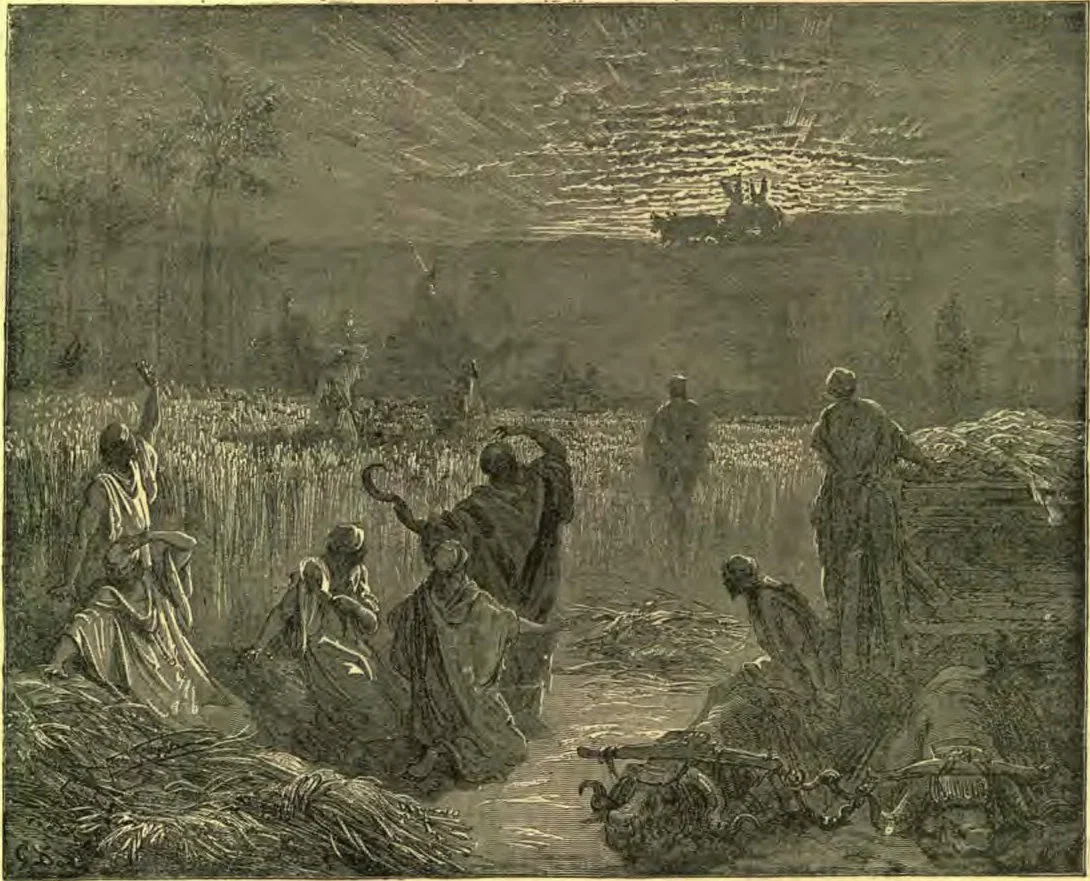
It was the time of the wheat harvest. The broad fields of bending grain invited the reaper’s hand. Every fruitful hill and valley seemed responsive to the goodness of the Creator. From man’s heart alone no thankfulness welled up. Grief, shame, and rebellion against the dealings of God, held sway; for this was in the time when judges ruled in Israel, and the people had departed from God. And so far had they turned away from the right, and so stubbornly had they persisted in their rebellion, that the Lord had allowed their enemies to prevail against them.
A little more than half a year had gone by since the fateful day when Israel, without inquiring of the Lord, went in their own strength to conquer the Philistines, and in the first battle were defeated and four thousand of them slain. Angry at the just rebuke of God, they hardened their hearts still more, and most presumptuously carried the ark from the tabernacle at Shiloh to the battle-field. Then the Lord allowed it to be taken by their enemies, and thus the visible evidence of his presence departed from Israel.
The Philistines rejoiced greatly when the ark came among them, thinking, no doubt, that the power of the Israelite’s God would go with it, and make them victorious over all their foes. But in this they judged wrongfully. The God of Israel was not as the gods of wood and stone. His name was to be feared. Wherever the ark went among the Philistines, sickness and death followed, until at the end of seven months they were anxious to send it home.
One day a Beth-shemite named Joshua went with his men into the fields to reap the grain. Undoubtedly it was with heavy hearts they thrust in their sickles, while they spoke to one another of the departed glory of Israel. While they were talking, they looked up, and saw a strange sight; for approaching the field where they were reaping, came two lowing kine, drawing a new cart, and in the cart was the ark of God. Unguided by human hands, the kine came “into the field of Joshua, a Beth-shemite, and stood there, where there was a great stone; and the men of Beth-shemesh offered burnt-offerings, and sacrificed sacrifices the same day unto the Lord.” And they rejoiced that God had not wholly turned away his face from Israel.
But it is safe to infer that their prayers were not of the right sort, and contained no heart-felt repentance for the sins that had divorced them from God’s favor; for while the ark was in the field, curiosity so far took possession of them that they forgot, or at least disregarded, the careful instructions they had had concerning the sacredness of the ark,—that ark so sacred that even the priests dared not remove its coverings, but only the high-priest beheld it when he went into the most holy place once a year; they forgot all this, blinded their eyes to the fearful judgments that had already been visited upon them for disobeying, and, removing the coverings, they looked in upon the tables of the law. And God “smote the men of Beth-shemesh, because they had looked into the ark of the Lord, even his servants of the people fifty thousand and three-score and ten men; and the people lamented, because the Lord had smitten the people with a great slaughter.” And they cried, “Who is able to stand before this holy Lord God?” Then they sent for the men of Kirjath-jearim, and they took the ark to the house of Abinadab, a Levite, where it remained for twenty years.
Now these things that happened were examples unto us, and were written out for our instruction. What a lesson this brief experience of the Israelites contains! How careful we should be to render prompt obedience from the heart to all God requires, and to treat with reverence the things he has made holy. God says he does not change; and if he was so careful then to teach people reverence for his law and place of worship, do you think he now lightly regards irreverence in his house, and unfaithfulness in his service?
W. E. L.

THE INFLUENCE OF A KIND ACT.

“What a dreadful day!”
“I’m fairly blown to pieces.”
“I’m glad we caught this car, if we did have to run for it,” and the three rosy, breathless girls sank into the seat as the car moved on.
After they had arranged their hair and ribbons and dresses, with which the boisterous wind had taken most daring liberties, they began to talk again. They talked very fast, and sometimes all at once, in voices that were not as subdued as is becoming in a street-car. At times it sounded as though a small flock of magpies had taken possession of that end of the car.
The car gradually filled up, and although their tongues were busy, their eyes were free to scan every new-comer. The handsomely dressed ladies were inspected with critical eyes; then the three heads were drawn close together, and the three voices were mingled in loudly whispered comments.
At the crossing of a fashionable street the car stopped, and a young girl, about the age of the three, entered. She was richly though plainly dressed, and, in spite of the wind, not a fold of her neat toilet appeared to be displaced. She was so sweet, so modest, so unassuming, and yet so evidently aristocratic, that many admiring eyes followed her as she took her seat.
“There’s Gertrude Eastman,” said Maud Haven. “How awfully proud and stuck-up she is,” said Clara Denton. “She’ll hardly speak to common folks.”
“I’d be proud, too, if my father was as rich as hers, and I lived in as fine a house,” replied May Travis, looking admiringly at the trim little figure.
“I don’t care if she is rich,” said Clara, who envied Gertrude her luxurious life; “she needn’t snub other folks just because they are poor. It isn’t money always that makes people worthy of notice.”
“What a lovely dress she has on,” said Maud. “Oh dear, I wish I could afford to have such nice clothes, and have them made so beautifully,” and Maud cast her eyes over her home-made dress, which, notwithstanding much fancy trimming, lacked the artistic elegance of Gertrude’s plainer made gown.
All this time the subject of their remarks sat quietly looking out of the window, unconscious of the interest she was creating in the minds of the three girls in the corner of the car.
How the wind did blow! It seemed to rise higher and blow more fiercely every moment.
Again the car stopped, and an old woman, bent and feeble, entered. The wind had handled her very roughly. Her shawl was twisted, her thin gray hair was scattered loosely over her forehead, and her bonnet was all awry. She trembled as she stood for a moment casting her eye down the length of the already filled seats; then a clear young voice at her side said, “Please take my seat,” and a steady hand was reached out to help her.
“Thank you, my dear,” replied the old lady, looking up into Gertrude’s fresh young face as she sank into the seat. “That wind most tuckered me clean to death.”
She drew a long breath as she leaned back in the seat, but in doing so she touched her head lightly against the window, which set her bonnet more crooked than ever. She reached up her thin, white hands to set it straight, but in her helplessness only made a bad matter worse; and as the three thoughtless girls in the corner watched her, a smile passed over their faces, and a suppressed titter was heard in that direction.
It was not audible to the old lady, who was a little deaf, but Gertrude heard it, and she looked coldly toward them for an instant, with the expression that Clara Denton thought “so proud and stuck up.” Then, turning to the old lady, who was still struggling with her bonnet, she said, with a smile that was neither cold nor proud,—
“Won’t you let me fix it for you?”
“Oh, thank you, dear,” replied the old lady, looking at her in grateful surprise, “I wish you would.”
Then, to the amazement of the girls, the aristocratic Gertrude Eastman stopped and untied the worn ribbons, straightened the bonnet, setting it firmly on her head, and tied them again with her own daintily gloved hands. Then she gently smoothed back the ruffled gray hair, and smiled on the wrinkled old face, as she reached up to take hold of the strap again.
“Thank you so much, dear,” said the old lady. “That does feel a powerful sight better. Do you know you put me in mind of my little granddaughter, who died only a few weeks ago? She was just such a dear, sweet girl as you are, and she was careful to have her old grandmother fixed up all right; but she’s gone now, and I have to do the best I can for myself.”
“I am very glad that I have been allowed to take her place even once,” said Gertrude gently, as she signaled the conductor to stop the car; and turning to leave, she smiled, and said, “Good-by, grandmother.” Then she tripped out of sight, and the car went on its way.
There was silence in the corner. The three tongues that had been running so fast a short time before were still, and the other passengers did not seem to be nearly so amusing as they had been. At last Maud Haven spoke, and this time in a quiet tone.
“Well, girls,” she said, looking from one to the other, “she is a thorough lady, anyhow.”
“I think she is perfectly lovely,” said May Travis, enthusiastically. “I’ll never call her proud again. I tell you what it is, girls, I don’t believe one of us would have dared to do what she did, for fear of being laughed at.”
“She just did it to show off,” said Clara Denton, spitefully, who could not forget the look in the flashing eyes as they rested a moment on her.
There was silence again for a moment; then Maud spoke in the same manner as before, and this time there was a slight quiver in her voice.
“Girls,” she said, “I’ll tell you what I think. I believe it wasn’t so much because Gertrude Eastman is a born lady that she did that, as because she is trying to be a Christian. Don’t you know she joined the church a little while ago?”
“Well,” said May, soberly and thoughtfully, “if it’s that that makes her so lovely, I wish I was one, too.”
“So do I,” answered Maud softly; and Clara said nothing as they rose and left the car.
Gertrude Eastman went on her way, little dreaming of the seed she had sown by the way-side that afternoon, nor how quickly it was to bear fruit; happy only in the thought that she had been permitted to do a little act of kindness to the lonely old lady.
But months afterward, when she greeted Maud Haven and May Travis as they became members of the same church with herself, they told her how this little act of hers had opened their eyes to see the beauty of a Christian life, and made them desire to live one too.—Nellie Helm.

THE SOD SCHOOL-HOUSE.

I THINK I see some of the dainty little children who go to school in the large brick school-houses in town, or even in the pretty little school-houses we see here and there in the country, look up in wonder, and I hear them say in surprise, “A sod school-house! Did any one ever go to school in it?” I will tell you of one in which a lady once taught about twenty-four boys and girls, ranging in age from four to fifteen years. They learned very fast in their sod school-house, although they did not have many of the fine maps, charts, and globes we see in nicer school-rooms. They learned about many things out of the great book of nature, that were not in their school-books.
But first I will tell you about the house. It was fourteen or fifteen feet square, and not more than six feet high at the sides or eaves. The walls were made of strips of sod cut about three feet long, one foot wide, and three inches thick, piled up so as to make a solid wall as thick as the length of the sods. A row of posts, perhaps nine or ten feet high, ran through the center of the room, and a large beam was laid across the posts at the top. Willow poles were laid close together from the sides up to this center beam, and then came a thick layer of willow branches, and outside of this an abundant covering of prairie grass, or wild hay. There were three half-windows, one on each of three sides, the door being in the fourth side. The floor was just rough boards laid down loosely, with wide cracks between.
What do you think of such a school-house? “Rather dark,” says one. “How gloomy, with only three little half-windows, set in that deep, black wall!” exclaims another. Well, sometimes it did seem a little gloomy on rainy or cloudy days, but at such times all tried the harder to help make sunshine inside the house.
But I must tell you of some of the little pets, and also of the pests, about the school-house. The pets the children liked best were the pretty little striped squirrels, or pocket-gophers. They were very numerous. At night teacher and scholars left behind them the crumbs from their dinner baskets. The squirrels soon learned to find the crumbs, and before long became so tame that they would venture about at recess and noon when teacher and pupils were near. The teacher told the children not to frighten them, and she very quietly tossed these tiny visitors bread and butter. It was amusing to watch them sit up on their hind feet, and taking the bread in their two front paws, turn it round and round, nibbling off the butter and then the bread. At first, if any one moved, they would drop the bread, and with a shrill little whistle, scud to the nearest hole, which was not far away; for sometimes they dug through the sod walls. But they always came back in a little while, and soon grew so tame that when the teacher sat down on the ground, they would come up and eat crumbs from her hand. How cunning they were! But one night some bad boys, who did not go to school, came and killed them all. Was not that cruel? The squirrels were not afraid; for the poor little things did not know these were not the same boys who had been taught to be kind to them. The teacher and scholars felt very bad when they came the next day and found their pets dead.
But I must tell you about the pests too. The worst one of these pests was—what do you think?—just little fleas! But how they bite! You know that after sod gets old and dry, as it does inside of such a house, these insects get all through the dust, and come out and hop about. The teacher used to see them hopping on her desk, or, rather, little old table; for she had only a rough, square table, and a kitchen chair, that one of her patrons had loaned her for the term. One day when the teacher had called school, and sat down by the table, she happened to glance up in the corner over the table, and what do you think she saw there? A snake about two feet long, coiled up. The teacher jumped right into the middle of the floor. That frightened the snake, and he uncoiled, dropped down behind the table, and went through a crack and under the floor. Well, the teacher sat down to go on with her work, and in about a minute the snake thrust his head through another crack in the floor, right under her dress at her feet. A few whisks from the broom soon sent his snakeship out-of-doors.
Now, I suppose you are thinking that school under such disadvantages as these could not be worth much to anybody. But though the work was done under difficulties, that teacher looks back to the term as a very bright spot in her memory, and she has reason to think many of her pupils view it in the same way, though she afterward taught that school for several terms in a nice new school-house.
“Where there is a will there is a way,” and a good education does not depend altogether upon advantages. Every opportunity lost is lost forever. Every moment of our time is so much of a God-given talent, which, if wasted, is talent hidden, for which we must one day give account. Let us see to it that we have a good account to render of our time. A. E. W.

WANTED

WANTED: Smiling, gentle little lasses, With loving words to say, With traps to catch the sunbeams bright And drive the clouds away, Whose willing hands and sunny hearts Will cheer and help each day.
Wanted: Laddies whose hearts are strong and brave, Though kind and tender quite, Who'll never be ashamed to stand Up nobly for the right, But will go forth in Jesus' name The false and wrong to fight.
Does some one say, “Too young to prove Mighty against the foe”? God put his grand and noble oaks In acorns small, you know: His heavy golden grain-crops all In tiny seed-bags grow.
And to each little child he says, “The Lord hath need of thee;” In each young heart begins a work That by and by may be An honor to his name on earth And through eternity.
—Susan Teall Perry.

YOU MUST BE BORN AGAIN.

THERE is a story of a colored man who came to a watch-maker, and gave him the two hands of a clock, saying,— “I want yer to fix up dese han’s. Dey jes doan keep no mo’ kerect time fur mo’ den six munfs.” “Where is the clock?” asked the watch-maker. “Out at de house on Injun Creek.” “But I must have the clock.” “Didn’t I tell yer dar’s nuffin de matter wid de clock, ’ceptin’ de hands, and I done brought ’em to you? You jess want de clock so you can tinker wid it, an’ charge me a big price. Gimme back dem han’s.” And so saying, he went off to find some reasonable watch-maker.
Foolish as he was, his action was very like that of those who try to regulate their conduct without being made right on the inside. They know no more of the need of a change in their spiritual condition than the poor negro did the works of his clock. They are unwilling to give themselves over into the hands of the great Artificer, who will set the works right, so they may keep time with the great clock of the universe, and no longer attempt to set themselves according to the incorrect time of the world. And their reason for not putting themselves into the hands of the Lord is very similar to the reason the colored man gave. They say: “We only wish to avoid this or that bad habit.” But the great Clock-maker says: “I cannot regulate the hands unless I have the clock. I must have the clock.”—Young People’s Magazine.

Birds Learn to Avoid Telegraph Wires

In Cincinnati, the other day, an English sparrow became entangled in a net-work of telegraph and electric light wires, and was instantly killed, though it did not fall at once to the ground. Shortly after, sparrows came flocking from all directions to the scene of disaster, until there seemed to be thousands of sympathetic mourners. They hovered about for nearly three hours, apparently discussing the cause of the accident, and then flew away. This recalls what an English writer says of the rapidity with which birds learn to avoid telegraph wires. The first winter after the lines were stretched along the coast, in a certain locality in Scotland, he frequently found numbers of starlings in the early morning, lying dead or wounded by the road-side. But, strange to say, throughout the following and succeeding winters hardly a death occurred among the starlings on their arrival. It would thus appear that the birds were deeply impressed, and understood the cause of the accidents among their fellow-travelers the previous year, and carefully avoided the telegraph wires. That young birds steer clear of the wires without having had any individual experience is easily explained by the fact that older ones always lead the way among birds which fly in flocks or convoys.—Congregationalist.

HOW DISHES ARE MADE.

One day Jennie went with her papa to see how dishes were made. She was very much delighted with the visit, and when she came home, she wrote out a story about what she had learned. This is what she wrote:—
Papa took me to a pottery, where they make all kinds of dishes. First the man took us through the dressing-room. There I saw piles of dishes, and men and women hammering at them. But we did not stop there; we went out into the yard. I looked into one part of the building where it was all dark, with three great chimneys, broad on the ground and narrow high up.
There wasn’t anything to see in the yard but horses and carts hauling clay, and great heaps of it on the ground. Papa said it was kaolin, not exactly dirt, but clay. He spelled it for me.
There was another of those chimneys in the yard. That is where they dry the clay. Then the man led us to a little door in the side of the house, and we went in. That brought us into a little room where they were getting the clay ready.
The clay was first sieved through a sand-screen. Then it was weighed and put into bins. It looked like fine, dark flour.
A little way from the bins was a big, deep box. They were mixing clay and water in it, and making a paste.
At the end of the box they had a pump working, and it was pumping the paste into what is called a press. I couldn’t half understand it. It looks something like a baby crib, only it has slats across the top, and they’re close together. They have a lot of bags in between the slats, and the clay gets into the bags and gets pressed flat, so that most of the water is squeezed out. When they take it out of the bags, it looks something like a sheet of short-cake before it’s cut or baked. A lot of them are rolled together, and that’s what dishes are made of. They call it biscuit.
After the little room comes one big room, where they don’t make much of anything. It is like a large shed, for it is dark and has no floor. We went through it, and over to one side, and up the stairs to the second floor.
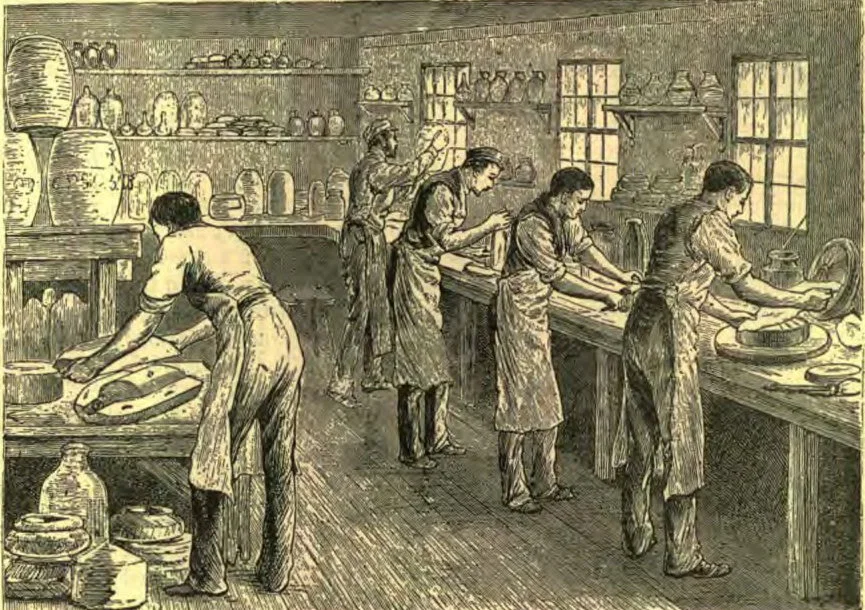
This is in one large room, with ever so many windows. All around the sides, and down the middle, and crossways, and out in the wings are shelves piled full of new dishes. All along the walls are tables on which they make them.
I saw two boys throwing up a great lump of clay and catching it, then cutting it with a string and putting the pieces together again, then throwing it up again, until it made me dizzy to look at them. I asked the man what they were doing, and he said, “Wedging the clay.” That means taking the air out. They keep on doing that until there are no air-bubbles in it.
We stopped and talked to a man who was making a sugar-bowl, and he told us how he did it. All the men have on the table in front of them a lump of clay, a wheel, some molds, a sharp knife, a bucket of water with a sponge in it, and something like a round slab of plaster of Paris to work on.
Do you know what the potter’s wheel is? It looks as if it was made of hard, smooth, baked white clay, and is something like a grindstone, only not half as thick. The grindstone stands up, but this lies flat, with its round side turned up, like the head of a barrel, and is set on a pivot.
The molds are of plaster of Paris. They are round on the outside, and have the shape of what the man wants to make on the inside, and are in two pieces. Little things like cups are made in one mold, but large things like pitchers are made in two or three pieces, in two or three molds, and then put together. Handles and spouts and such things are made separately in little molds, and put on afterward.
This is the way it is done. First the man cuts off a piece of the biscuit, and kneads it on the plaster of Paris slab. Then he takes one piece of the mold, fixes the clay in nicely, shaves off what he don’t want, then puts on the other piece of the mold, and sets it on the wheel. He gives it a shove and sets it spinning. It stops itself after awhile; then he opens the mold, and there is the dish. The clay keeps the same thickness all through, and fills both pieces of the mold.
Then the man takes it out and sponges it. If it isn’t just the right shape, all he has to do is to wet it, and it will come right. Then he puts on the handle, or puts the pieces together, fixing them just so with his fingers and knife. Then they’re ready to be burnt the first time.
We walked all around, and saw here one man making cups, another tureens, another bird-baths, and everything you could think of. Then we went downstairs, through the dark rooms, into where the tall chimneys are. Then I found out they call them kilns. They have at the bottom a large furnace, and over that a huge oven, where they put the dishes in to bake.
But they don’t put them in just as they are. On the high shelves all around are a lot of things called saggers. They look something like bandboxes made of fire-brick. The soft dishes are put into them, the lids are put on, and they are piled up in the oven. Then the men build a big fire in the furnace, and let it burn for several days. When it goes out, they let several more days go by for the kiln to cool, and then take out the saggers. When the dishes are taken out, they are hard and rough and of a yellowish white. The fire is built up after the dishes are put in, and the kiln is allowed to cool off before the dishes are taken out, because the men have to go in and out of the big ovens.
Wouldn’t you think a pile of soft plates and saucers would burn all together and stick fast to each other? But they don’t. There are little things made of hard clay with three bars and three feet, and they put them in between dishes, so that one plate has one in it, and the next sets on top of that, so that they can’t stick together. Did you ever see three little dark spots on the bottom of a saucer? This is what makes them.
We next went into the room back of the kilns. It had shelves all around, too, and there were piles of dishes after the first burning. A lot of women sat on stools on the floor, and they were brushing the fire-cracks with some stuff out of little bottles. This was to fill them up so that the glazing wouldn’t run in.
In another room at one side of the first, they did the glazing. They called it dipping. There was a large tank in the middle of the room, with a deep red liquid in it. The men dipped the dishes in, and they came out a beautiful pink. Then they stood them up on the shelves around the room, and by and by they turned white, just like the ones we have on the table every day.
There is nothing more done to them except dressing. We had now gone all around, and were at the dressing-room, where we started. Dressing is nothing but knocking off any rough lumps with a chisel. Every time I look at dishes, I think there are ever so many things we use every day that we don’t know anything about. —Adapted from Wonder Stories of Science.

POOR LITTLE BLUEBIRD.

“Where did you get that rubber gun, Harry?” said his mother.
“I traded my kite and some marbles to Tom Pratt for it,” said Harry.
“I don’t like to have you have it. I will give you five cents for it.”
He wanted the five cents, but he liked the gun very much.
“Why don’t you want me to have it, mamma? You think I might shoot birds with it, because some of the other boys do. But I wouldn’t. I wouldn’t shoot a little bird for anything.”
“I don’t believe you would, dear. But I always think that when a little boy has a gun in his hands, he is in danger of doing more than he intends, so I think it would be safer for you to give it to me at once.”
Harry grumbled a little, but gave up the gun, and took his five cents.
An hour later he came into the room again. The gun was still lying on the table. His mother had intended to burn it when she went down to the kitchen.
Harry took it up, and snapped it several times, thinking it a great pity that a boy could not have such a nice toy.
Then he stepped outside the door, and, picking up some pebbles from the gravel walk, tried to see how often he could hit the fence post.
He knew very well that he was doing wrong. His mother had bought the gun, and he had no right to use it.
“But I’m not doing a bit of harm,” he said to himself. “I’m just having a little fun, and it doesn’t hurt the post. Ah, there you are, you little bluebird. You may come near. I won’t hurt you.”
The pretty bird flew about, twittering as if it enjoyed the bright sunshine and the sweet summer air.
“I wonder how near I could come without hitting it,” said Harry. “I just want to scare him a little.”
He aimed at one side of the bird, and even then held the rubber back, not half meaning to shoot. Then the rubber seemed to snap almost of itself. There was a faint, pitiful little chirp, a flash of blue in the sunlight, and the pretty songster lay at the foot of the tree.
Harry ran and picked it up. It fluttered a moment, and then lay quiet in his hand.
Who can tell how Harry felt? He walked slowly in to his mother.
“O mamma, I’m so sorry. I didn’t mean to. You know I didn’t.”
“Yes, I know it. But you disobeyed, and this is what comes of it. The birds are God’s little creatures. He made them to give us pleasure by their sweet songs, and he will surely be angry with any one who hurts them. You have taken away a life which you can never give back. And I suppose it has some young birds.”
“Yes,” said Harry, “there is a nest in the tree.”
He climbed up and fed the young birds, hoping they would live. But the poor little things missed the warmth of their mother’s wing, and died one after another.
In all his life there will be a pain at Harry’s heart whenever he sees a bluebird.—Sidney Dayre.

A TOUCH OF NATURE.

A LITTLE maid upon my knee Sighs wearily, sighs wearily! “I’m tired of dressin’ dolls And having stories read,” says she.
“There is a book, if I could see, I should be happy, perfectly! My mamma keeps it on a shelf— “But that you cannot have,” says she!”
“But here’s your ‘Old Man of the Sea,’ And ‘Jack the Giant!’” (Lovingly I tried the little maid to soothe.) “The interestin’ one,” says she.
“Is that high-up one!—seems to me The things you want just has to be Something you hasn’t got; and that’s The interestin’ one!” says she.
—St. Nicholas.

Angels Do God's Pleasure Without Questions

A TEACHER was explaining to her class the words concerning God's angels, “ministers of his who do his pleasure,” and asked: “How do the angels carry out God's will?” Many answers followed. One said, “They do it directly;” another, “They do it with all their heart;” a third, “They do it well;” and after a pause a quiet little girl added: “They do it without asking any questions.”

Kindness in Thought, Speech, and Action

“To think kindly of each other is good; to speak kindly of each other is better; but to act kindly toward another is best of all.”
Continue reading: OUTDOOR GAMES AND SPORTS OF CHINESE BOYS