The Youth’s Instructor, Vol. 32, No. 28.

EPHESUS

The Youth’s Instructor

Jul 9, 1884

S. D. A. Publishing Association · Battle Creek, Mich. · Jul 9, 1884

EPHESUS

Written for the INSTRUCTOR.

EPHESUS

Ephesus, although a city but little noticed in the Scriptures, is to the Bible student a place of great interest, because in the days of the apostles it was one of the chief seats of missionary enterprise. A city with better natural advantages for spreading the light of the gospel it would be hard to find. It stood on a bank of the Cayster River and near a fine harbor on the coast of Asia Minor, thus having intercourse with all the maritime cities of that day; and through the long plains bordering the neighboring rivers, it had easy access to the principal inland cities. In the days of the apostles it was in the full height of its prosperity and power. It was a very ancient city, so old that its founders are unknown; but it did not have so remarkable a history as some of the neighboring cities.
It was early taken possession of by the Ionians under Androclus, and the city was extended over the heights of Mount Coressus and Mount Prion; but the older inhabitants clung to their homes in the plain.
In Roman times the city was, if anything, more magnificent than before. It was the center of trade for the region round about. The inhabitants were noted for their wealth, their luxurious and dissolute habits, and their belief in magic and witchcraft.
The chief attraction of the city, however, was the famous temple of Diana, which stood in the plain about a mile away from the main part of the town. The original image of this goddess, which the Ephesians claimed had fallen from heaven, was a very rude affair, consisting of a head and a shapeless trunk. Even the later images, notwithstanding the perfection to which all arts had at that age attained, still kept the rude mummy-like form of the original image.
The first great temple to Diana was built at an early date, Croesus himself furnishing most of the columns and several cows of gold. But on the same night that Alexander the Great was born, an incendiary set fire to this fine work of art. The Ephesians enthusiastically went about rebuilding it on a larger and grander scale than before. All the chief cities of Asia Minor helped defray the cost of the structure, and the ladies of Ephesus contributed their jewels to aid the work. In so high honor was Diana held, that Alexander the Great offered to bear the expense of the whole building if he might but inscribe his name on it. This request the public-spirited Ephesians refused to grant. Many fine works of art were continually brought as offerings to the temple, until it came to be in reality a rich museum.
Once a year, probably during all the month of May, a festival was held at Ephesus in honor of the goddess, and all the Ionians endeavored to be in the city at that time, bringing with them their wives and children. The people were not allowed to bear arms near the temple, and no bloody sacrifices were offered. At such times the “craftsmen” carried on a lively trade, selling to the superstitious Ionians “silver shrines,”—images of Diana and that part of the temple in which she stood. These the strangers carried to their distant homes, and set up as objects of private worship. Diana was at this period held in greater veneration than any other heathen god, and her worshipers were found in almost every land.
It has been thought that it was during the time of this festival that Paul and his companions in travel stopped at Ephesus. The craftsmen found their trade somewhat lessened, probably on account of what the heathen had already learned from Paul in regard to the true God. At such a time the city would be crowded with strangers from abroad, and it would require but a few remarks so inflammatory as those spoken by Demetrius to fill the whole city with confusion.
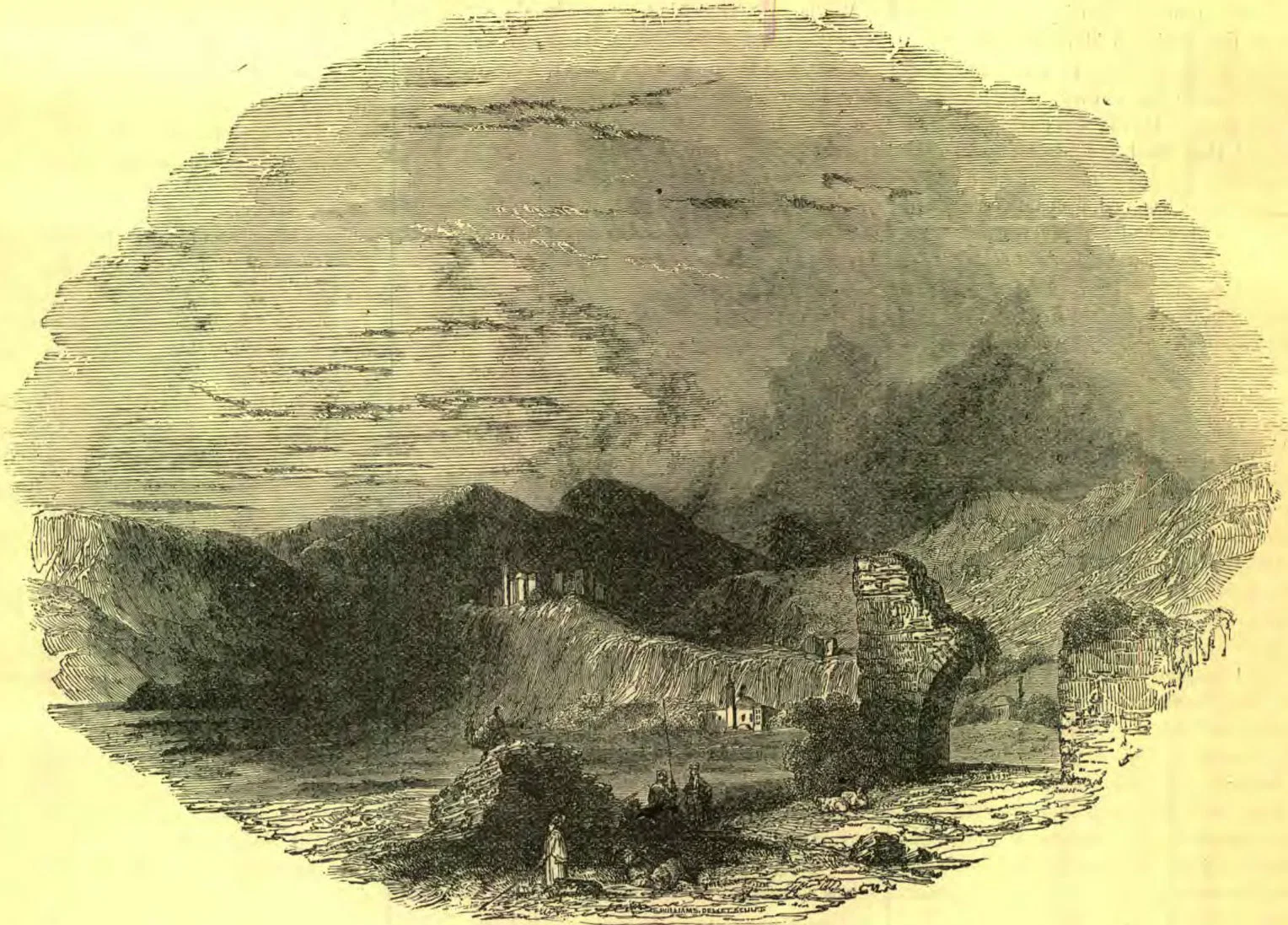
But the life and activity of the place has gradually given way to desolation and ruin. A wretched village named Ayasuluk stands on the site of what was once a proud heathen city; and mud from the River Cayster covers the spot where stood the temple of that goddess “whom all Asia and the world worshiped.” In wandering over the ruins, travelers see, to use the words of another, “piles of ruined edifices on the rocky sides and among the thickets of Mount Prion; they look out from its summit over the confused morass which was once the harbor where Aquila and Priscilla landed; and they visit in their deep recesses the dripping marble-quarries, where the marks of the tools are visible still.” Close to one of these hills stand the ruins of a vast theater, whither the infuriated mob, having caught Gaius and Aristarchus, Paul’s fellow-laborers, rushed, and for two long hours wearied themselves with shouting, “Great is Diana of the Ephesians!” The theater was a large building, open to the sky, as all the theaters were at that day, and was capable of seating thirty thousand persons. Across on the plain was visible the magnificent temple of Diana. Quite extensive ruins of the theater yet remain, although the marble seats have been removed. In the accompanying picture is given a good view of the present condition of Ephesus.
The glory of the Ephesians has been brought low; the worship of Diana has perished with her followers. But the light of the gospel of Christ, then so despised, shines brighter and brighter as the ages roll away, because it is from above, from the Lord of heaven and earth, who “dwelleth not in temples made with hands, neither is worshiped with men’s hands, as though he needed anything.”
“Art builds on sand; the works of pride And human passion change and fall; But that which shares the life of God, With him surviveth all.” W. E. L.

UPPER STREAMS.

I KNOW of a stream that rushes down The rocky bed of a mountain glen: Dashing and splashing through green and brown, In shadows now, in the sunshine then. All through the dreariest winter-time, All through the brightest of summer days, It sings and babbles its woodland rhyme, And fills the air with the sweetest praise.
The weariest traveler here may drink; The poorest peasant or simplest child May quench his thirst at the brooklet’s brink, Here in the forests, cool and wild.
And “whosoever will” may take These waters that flow from the highest hills And over the rocky barrenness break— Water which upper spring distills!
I know of a river, crystal clear, Free for all the children of men; The poor to bless and thirsty to cheer, With source far up beyond earth’s ken; Which flows with a boundless fullness down, Down from the hills of God on high, Through the sunny green and shadowy brown, Through sorrows that live, and joys that die.
O water of life with thy musical flow, In sorrows and night we press to thy brink! Earth’s deepest grief and bitterest woe Are here assuaged as we stoop and drink. No price to pay—no gift to bring; Only to come at the heavenly call; Only to Christ’s dear name to cling— Free to the poorest and neediest of all.
O water of life! O crystal stream! Brimful of blessings from paradise, Reflecting the light’s celestial gleam That shines on thy bosom in far-off skies, Flow through the lands that need thy waves; To thy full flood may the dying press! Sing to the lost of the love that saves— O river of God, cheer, save, and bless!
—St. Louis Evangelist.

JACK

“Greens! Dand’lion greens! g-r-e-e-n-s!” shouted a child’s voice, as the small, bare feet came pattering up the lane. Presently a face appeared at the open window of my kitchen, where I was busy superintending the baking.
“Please, ma’am, don’t you want a basket of fresh greens, all picked with the dew on ’em? They’ll make a good dinner, and only cost five cents.”
Poor little fellow! I thought, to work so long and to trudge so far, all for five cents! My dinner was provided, and dandelion greens were not included in the bill-of-fare, but how could I refuse him?
“Yes, Jack, come in here and eat a doughnut, while I empty your basket.”
He was not slow to accept the invitation, and chattered like a magpie every minute while he eagerly devoured several doughnuts, and looked longingly at the pan of cookies just taken from the oven.
“Thank you, ma’am! You see it makes a fellow awful hungry—this dand’lion business does. I like to get ’em when they’re fresh and cool, before the sun has been on ’em long, so I start at five o’clock, and sometimes earlier, and of course I don’t have any breakfast first; and when it happens that a feller hasn’t had any supper either the night before, it makes him feel kind of empty like.”
All this was said without a moment’s pause; and swinging his little bare heels together, as he sat perched up on the window-sill, he laughed the merriest laugh in the world, which brought to the surface a great dimple hidden away in each sun-burned cheek, and showed all his pretty white teeth.
“But you had your supper last night, didn’t you?”
“No, ma’am. You see there was only two potaters to go round, and the round they had to go was mother, Susie, and me; a big round for two small potaters, don’t you think so, ma’am?”
And again he laughed, as if it was the funniest thing he ever heard of, instead of a most pathetic story.
“How did you manage?” I asked.
“Well, you see, ma’am, I haven’t been to school long enough to know how to divide two potaters among three people so that each shall have a whole one, so I says to mother, ‘You take this one, and Susie and I’ll handy-spandy for the other.’ Then I held it behind me, and said to Susie, ‘Handy-spandy, Jack-a-dandy, upper hand or lower?’”
“‘Lower,’ says Susie.”},{
“And lower it was, to be sure, ’cause I held both hands even till she answered, and then dropped the one with the potater in it lower, which wasn’t cheatin’, ma’am, now, was it?”
“No, my brave little Jack; it surely was not cheating,” I answered, turning away, that he might not see the tears in my eyes.
“Well, Sue, you see, didn’t like to take it; for she’s awful generous; and she tried to get it back on me by saying she thought upper, and ’twas only her lips that said lower. She meant upper all the time. She isn’t well, Sue isn’t. She’s little and white, and one potater isn’t much of a supper for the like of her, anyway. And at last I made her eat the whole of it. I told her that we’d have a good dinner to-day, ’cause I know’d somebody would buy my greens; and I’m going to spend the whole five cents for one dinner. What do you think of that? I’m going to get three herrings at a cent apiece, and the rest in potaters.”
And he smacked his lips as he thought of the treat in store for them all.
“I think,” he continued, “that you’ve paid me pretty well for my greens in doughnuts without any five cents at all. Still, as I look at it,” he added, with a sly twinkle in his great blue eyes, “doughnuts is doughnuts, and cents is cents, and the doughnuts is a present, and the cents is pay.”
I laughed at his reasoning, which certainly was most sensible and true, and then said:—
“Now, Jack, I want you to keep your five cents till some night when you haven’t any supper, and let me fill your basket with something that I know will go round. I want you to have a glass of fresh milk; so you must carry this tin pail besides the basket. Do you think you can manage them both?”
“Well, ma’am, I guess you’ll see whether I can manage ’em or not. But do you think I can dig greens enough to pay for all them things you’re putting in?”
“No, Jack, I don’t; for they are not to be paid for. I want to send these to your mother, that is all; and as you said, yourself, doughnuts is doughnuts, and cents is cents.”
“To be sure,” he answered, merrily. “Well, ma’am, I just wish you could see ’em when I tell ’em how good you’ve been to me. Some folks ain’t good, you know,” he added with a sigh.
While I filled the basket, he told me their little history, never realizing how full it was of the deepest pathos—the struggles of the poor mother to keep her family together after the death of her husband, a good, kind man, who had left her one morning, full of life and strength, to go to the iron foundry, and was brought back a few hours later, having met his death while toiling for those he loved. He did not realize, either, how his own self-sacrificing spirit shone out through his words, proving to me the strength and sweetness of his character. What a hero he was, this little twelve-year-old Jack!
“Mother has worked so hard for Sue and me that she hasn’t much strength left. And don’t you think,” he added, straightening himself up proudly—“don’t you think I’m big enough to take care of us three? Leastways I’ve been lucky this morning, for I’ve sold my greens and found you.”
The gratitude in his heart was plainly visible in his little face, as he turned it up to me. I told him that henceforth we would be the very best of friends, and that happier days were in store for him and for those at home; that I could find work for him to do, which would certainly help toward the support of all three.
Such a happy Jack as he was when I sent him home that April morning, with the basket on one arm and a pail of milk on the other; and I wish I could tell you, for I am sure you would like to hear, what pleasant days followed for Jack and those so dear to him; but it would make such a long, long story we should never come to the end of it. Indeed there is no end to it. It is a story which is being lived through now, and it grows more interesting and more beautiful—more tender and true, with every chapter.
Jack is proving himself the hero I knew him to be. He works, early and late, on a small piece of ground which we allow him to cultivate on our farm; and he carries his produce to town in a basket, strapped on his back, and he is as happy as a king—happier than many kings, I am sure.
Little, pale Susie, is not half so pale as she was before she, too, had the chance given her to help. She has free range in my flower-garden, and makes up the daintiest “button-hole bouquets,” with which she fills her small basket every morning for Jack to take with him. He never finds the least difficulty in disposing of them all, and a proud little lass she is when he drops the pennies into her hands at night.
The mother, we think, is growing strong and well again—happy in her boy’s thoughtful care and cheery, light-hearted ways. He is not yet thirteen years old, but his mother calls him the “head of the house,” and he truly deserves the title. Brave little man! God bless him!—Marion Mitchell.

Reading, Thought, and Digestion of Books

You may as well expect to grow strong by always eating, as wise by always reading. Too much overcharges nature, and turns more into disease than nourishment. It is thought and digestion which make books serviceable, and give health and vigor to the mind.

EDITOR'S CORNER.

You may all have sung the spirited song for Sabbath-school workers, beginning, “Gather them in, gather them in; gather the children in.” It urges us to gather the children into the Sabbath-schools, the multitudes who do not already attend, that they may be told the good news of a Saviour, and may be taught to love and obey him. It is a great privilege to be connected with a good Sabbath-school; and such opportunities, rightly improved, result in the salvation of many precious souls. So, gather them in, dear readers. It would be well if all the children and youth in this beautiful land were members of real live Sabbath-schools, with teachers who felt that their own future good depended upon rescuing their pupils from eternal death.
While it is true that some who do not have Sabbath-school privileges gain a knowledge of the Saviour, and build upon this Rock, which will anchor them in the coming storm, it is also true and, oh! so sad, that many Sabbath-school scholars are so indifferent as not to make Christ their strong tower, into which they can run and be safe in times of danger. Oh! how such will lament their neglect when it is too late; for they had advantages which will leave them without excuse.
But there will come a day when the angels will do the gathering. Who will then “be gathered in”?—Those who gave themselves to the Saviour, to be smoothed and polished until he saw his own image reflected in them. These may once have been ever so wicked, but their roughness and blemishes were all removed. They submitted to the polishing process, and became new creatures,—jewels, the Lord was pleased to name them.
Have you ever seen a diamond or precious stone in its rough state? A gentleman in La Salle Co., Ill., was once walking in a ravine which opened into the Illinois River, when he picked up what appeared to us like an ordinary stone; but by wearing off the outside on a common grindstone, it proved to be a handsome agate, of fine quality. It was beautifully tinted and marked, and that part of the surface which had been ground, was polished smooth as glass, although he claimed that with finer instruments it could be made to exceed very much in brilliancy what it then was.
So much beauty hidden by such a rough exterior seems so very like the natural person. The Great Refiner applies just the right instruments to remove all the roughness and the defects, when he gives the finishing polish, and pronounces them his “special treasures.” And of these, not one of them will be lost, “in that day when I make up my jewels.” Who will submit to the smoothing process, and so be gathered to “shine as the stars forever and ever”? M. J. C.

IMPORTANT BIBLE SUBJECTS.

LESSON 2.—SECOND ADVENT.

[NOTE TO THE STUDENT.—Do not consider the lesson learned until you can give at least the substance of every text, with the correct reference for each. The references in black letters indicate those texts that should be committed to memory. A little diligent application each day will enable you to do this.]
“For we have not followed cunningly devised fables, when we made known unto you the power and coming of our Lord Jesus Christ, but were eye-witnesses of his majesty. For he received from God the Father honor and glory, when there came such a voice to him from the excellent glory. This is my beloved Son, in whom I am well pleased. And this voice which came from heaven we heard, when we were with him in the holy mount. We have also a more sure word of prophecy; whereunto ye do well that ye take heed, as unto a light that shineth in a dark place, until the day dawn, and the Day-star arise in your hearts.” 2 Pet. 1: 16-19.
“And Enoch also, the seventh from Adam, prophesied of these, saying, Behold, the Lord cometh with ten thousand of his saints.” Jude 14.
“Our God shall come, and shall not keep silence; a fire shall devour before him, and it shall be very tempestuous round about him. He shall call to the heavens from above, and to the earth, that he may judge his people. Gather my saints together unto me; those that have made a covenant with me by sacrifice.” Ps. 50: 3-5.
“He which testifieth these things saith, Surely I come quickly. Amen. Even so, come, Lord Jesus.” Rev. 22: 20.
“And it shall be said in that day, Lo, this is our God; we have waited for him, and he will save us; this is the Lord; we have waited for him, we will be glad and rejoice in his salvation.” Isa. 25: 9.
“For this we say unto you by the word of the Lord, that we which are alive and remain unto the coming of the Lord shall not prevent them which are asleep. For the Lord himself shall descend from heaven with a shout, with the voice of the archangel, and with the trump of God; and the dead in Christ shall rise first: then we which are alive and remain shall be caught up together with them in the clouds, to meet the Lord in the air; and so shall we ever be with the Lord.” 1 Thess. 4: 15-17.
“But of the times and seasons, brethren, ye have no need that I write unto you.” 1 Thess. 5: 1.
“And take heed to yourselves, lest at any time your hearts be overcharged with surfeiting, and drunkenness, and cares of this life, and so that day come upon you unawares. For as a snare shall it come on all them that dwell on the face of the whole earth.” Luke 21: 34, 35.

QUESTIONS.

1. What doctrine occupies a prominent place in the preaching of the apostles? 2 Pet. 1: 16.
2. When had they been eye-witnesses of the glory of Christ’s second coming? Verses 17, 18.
3. To what occasion does Peter refer? Matt. 17: 1-5.
4. Did they have any stronger evidence to present than their own senses? 2 Pet. 1: 19.
5. How early was Christ’s second coming a subject of prophecy? Jude 14.
6. How long after the creation did Enoch live?
7. How long before the birth of Christ?
8. Who are the “saints” referred to in Enoch’s prophecy? Jude 14 (Revised Version); Matt. 25: 31.
9. What other patriarch of ancient time prophesied of the Lord’s second coming? Job 19: 25-27.
10. What testimony did David bear on this subject? Ps. 50: 3-5; 96: 11-13.
11. For what purpose did he say the Lord would come? Ps. 50: 5.
12. With what words of Christ does he agree? John 14: 3.
13. What did the apostle John say at the thought of Christ’s soon coming? Rev. 22: 20.
14. Why did he say this?
15. In the day of the Lord’s coming, what will be said? Isa. 25: 9.
16. Why will the Lord save these persons?
17. In what condition must one be in order to wait for another?
18. Who are the ones that will be rewarded when the Lord comes? 2 Tim. 4: 8.
19. If we do not love to hear or think about the Lord’s coming, of what may we be assured?
20. Would we not naturally expect some revelation to be made concerning the time of so important an event? Amos 3: 7.
21. What does Paul say to the brethren? 1 Thess. 5: 1.
22. Of what “times and seasons” is he speaking? 1 Thess. 4: 15-17.
23. If there was no need for Paul to write concerning the time, what must we conclude?
24. Why are the brethren not ignorant of the time? 1 Thess. 5: 4, 5.
25. What makes them children of the light? Ps. 119: 105.
26. Upon whom will the day of the Lord come as a thief? 1 Thess. 5: 2, 3; Luke 21: 35.
27. What will cause men to be blind to the near coming of Christ? Luke 21: 34, 35.
28. Can the people of God be called “dwellers” upon this earth? Heb. 11: 13; 1 Pet. 2: 11.
29. Where is their home? Heb. 11: 16; Phil. 3: 20 (Revised Version).

NOTES.

When we made known unto you.—Probably Peter here refers particularly to statements respecting the coming of the Saviour in his first epistle (chap. 1: 5, 13; 4: 13); but this was a common topic in the preaching and in the epistles of the apostles. It may, therefore, have referred to statements made to them at some time in his preaching, as well as to what he had said in his former epistle. The apostle laid great stress on the second coming of the Saviour, and often dwelt upon it.—Barnes’s comment on 2 Peter 1: 16.
2 Peter 1: 19.—The recollection of the transfiguration of Christ gave great confidence personally to the apostle, which was indeed especially intended; and his testimony concerning it might be a great confirmation of the faith of other Christians; yet they had also a “more sure word of prophecy.” The appearance and voice on the mount were transient, and only three persons witnessed the interesting scene, one of whom had long before been martyred. Whatever assurance, therefore, it might bring to the individual concerned, it was not so well suited fully to satisfy the minds of men in general, as the prophecies of Scripture were.—Dr. Scott.
With ten thousand of his saints,—Or, of his holy ones. The word “saints” we now apply commonly to redeemed saints, or to Christians. The original word is, however, applicable to all who are holy, angels as well as men. The usual representation in the Scriptures is that he would come attended by the angels (Matt. 25: 31), and there is doubtless allusion here to such beings. It is a common representation in the Old Testament also that God, when he manifests himself, is accompanied by great numbers of heavenly beings. See Ps. 68: 17; Deut. 33: 2.—Barnes.
The “crown of righteousness” is to be given to all who love the appearing of the Lord. The state of mind of those who love his appearing is indicated by the beloved and loving disciple, who, in response to the Lord’s assurance that he will come quickly, says, “Even so, come, Lord Jesus.” Those who love the Lord will love to think of the time when they can be with him; those who have no acquaintance with the Lord will of course feel no interest in his coming; and will feel an unwillingness to hear or read of it. If the thought of his coming does not make us glad, we may be assured that we are losing our love for him, and that we are engaged in that which he would not approve.
The Lord, as the prophet Amos says, has never performed any great act which concerned the welfare of men, without giving them previous warning. The antediluvians learned, through the preaching of Noah, how long it would be before the flood came; the inhabitants of Sodom were faithfully warned of their impending fate; and that greatest of all events, the sacrifice of Christ for a lost world, was accurately located hundreds of years beforehand. If God was so careful to inform men when the great work for their salvation would commence, can we think that he would leave them in darkness concerning the time of its consummation?

A LITTLE NORMANDY BOY

Written for the INSTRUCTOR.

A LITTLE NORMANDY BOY.

In the village of Aurillac, Normandy, lived a widow named Vigier. When her husband died, he left her pretty well off, with five boys to support.
Four were put out to learn trades, but little Jean, the youngest, through the kindness of the parish priest, was sent to a college in one of the neighboring villages.
But after a time, through no fault of her own, the widow Vigier became dependent upon the people for support; and they decided to send her to the asylum for the poor. Little Jean knew nothing of this. He always had a tender love for his mother, and showed it in many ways quite unusual for a boy of his age.
Knowing the love Jean had for his mother, the kind curate went himself to the college to tell Jean what was to be done with his mother.
With a silent grief, touching to behold in one so young, the little boy listened, yet without shedding a tear.
“Monsieur le Cure,” said he, “I thank you for all your kindness; but my mother shall never enter the hospital, where she would die of grief. I shall leave this college. I will stay with my mother. I will support her,” he added proudly.
Although the curate told him of the difficulties in his way, he replied firmly, “I will support my mother.”
He left college and all his bright plans for the future, and returned to his own home. While little Jean showed his great love for his mother, his four brothers, although earning good wages, declared they could not help care for her. The villagers laughed that so small a boy should attempt so great a task.
But Jean did not mind this. He told his mother to be of good cheer; for while he lived, she should not want for a support.
Jean was somewhat puzzled at first to know just what to do. He could find no plan that seemed to him would work. He had seen a little boy about his own age, when he was at college, selling hot cakes which he carried on a wooden tray strapped over his shoulders. Happy thought! he could do the same. He got his tray ready, spread a clean, white cloth over it, and placed his cakes on it in tempting piles. It was hard work selling them. Some said they were stale, and others did not want them at all. Many times he became discouraged; it was hard work trudging over the country with so little success. He saved a few pence each day, and with this money, he bought a few toys. These sold well. After a time he sold more useful articles, and finally carried a pack instead of the tray. People knew him to be honest and truthful; and on account of his great kindness to his aged mother, he gained a good trade in his own and neighboring villages.
To be sure, he was sometimes sorry he could not have kept on at school; but he tried to make up for that as much as he could by studying his books, as he went from house to house selling his goods; and he succeeded, because he remembered his duty to his mother first. C. E. H.

A GAME OF MARBLES.

UNCLE JAMES watched the boys as they played a game of marbles in front of the house. At least Ned and Harry were playing, and talking loudly and excitedly, but Will leaned against the fence with his hands in his pockets and a very discontented look upon his face. The boys were so eager and interested in their play that they did not at first notice Uncle James. But as Harry won the game, and stooped to gather up the marbles, he caught sight of his uncle.
“O Uncle James!” he exclaimed, “this is the sixth game I’ve won straight along.”
“Yes,” said Will in an aggrieved tone, “and you and Ned have got all my marbles away from me.”
Harry laughed, and shook his marble-bag. “I only had five marbles when I began to play, and I’ve got a dozen now.”
“Sorry to see my nephews gambling,” said Uncle James quietly.
“Gambling!” exclaimed Ned, looking up from the ring he was rearranging; “who’s gambling?”
“If Harry strikes a marble to a certain point, he takes that marble, does he not?” asked Uncle James.
“Yes, sir; but that isn’t gambling.”
“Isn’t it? What do you think gambling really is?”
“Why, men put up a lot of money, and take chances to win it with cards or dice.”
“And when some boys put up a lot of marbles, and take chances to win them away from each other, what do you call that?”
Will laughed, but Ned and Harry were silent. Uncle James went on,—
“If you, Harry, had but five marbles when you began to play, and by chance have won away all Will’s and part of Ned’s, except so far as the value is concerned, you might as well have been playing for money.”
“Gamblers proceed on exactly the same plan. You boys shoot a marble to a given point; the gambler depends on a certain number on his dice or cards. The principle is the same, my boys, whether you work with marbles or money. Games of chance are dangerous, however innocently you may begin. After you have played for ‘keeps’ in marbles a while, a game of cards or billiards with a small stake of money may be very apt to follow. Men rarely become gamblers all at once, and many, no doubt, can trace their evil career back to even such a simple beginning as playing marbles for ‘keeps.’”
Uncle James knew boys too well to talk any longer; he turned and went away.
Ned dug in the ground with his boot-heel, Will whistled, and Harry industriously sorted the marbles. He put aside five, and tossing the rest to Ned and Will, said,—
“Here, boys, pick out your own. I’m done gambling, if that’s what we were about.”—The Child’s Paper.

Letter Budget.

KATIE E. SANDERS, of Mendocino Co., Cal., says: “This is my first letter to the Budget. I am eight years old. I go to day and Sabbath school. The Sabbath-school is held in our house. I study in Lesson Book No. 1, and my two sisters older than I study in Book No. 2. We have a little baby sister, whom we love dearly. Her name is Elnorah. I like the INSTRUCTOR very much. My sister writes this for me. I want to be ready to meet the Lord when he comes.”
ANNA M. HENDERSON writes from Coles Co., Ill. She says: “I keep the Sabbath with my mamma. We hope papa will keep it sometime. I study in Book No. 2, and have my lessons so perfect that I will soon be ready for Book No. 3. Two years ago my only sister, little Maggie, died. She was nearly four years old. It was hard to part with her. I often think of our little plays, when we used to hold prayer-meetings. She would be so earnest, and talk about Jesus and the angels. I want the INSTRUCTOR family to pray that I with papa and mamma may meet her when Jesus comes to gather the lambs of his fold.”

COUNTRY CHILDREN.

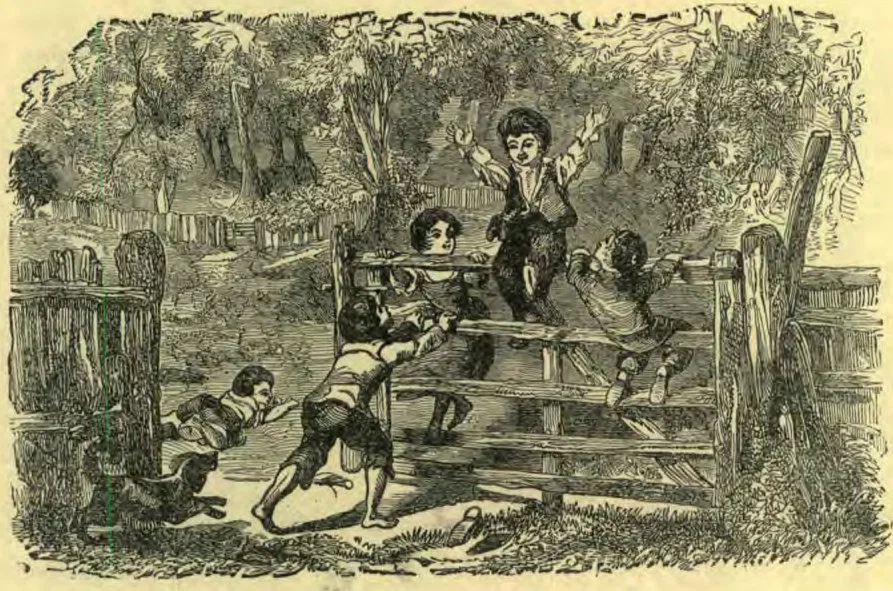
LITTLE fresh violets, Born in the wildwood, Sweetly illustrating Innocent childhood; Shy as the antelope— Brown as a berry— Free as the mountain air, Romping and merry.
Blue eyes and hazel eyes Peep from the hedges, Shaded by sun-bonnets Frayed at the edges. Up in the apple-trees, Heedless of danger, Manhood in embryo Stares at the stranger.
Out in the hilly patch, Seeking the berries— Under the orchard tree, Feasting on cherries— Tramping the clover blooms Down ’mong the grasses, No voice to hinder them, Dear lads and lasses.
No grim propriety— No interdiction; Free as the birdlings From city restriction! Coining the purest blood, Strength’ning each muscle, Donning health armor ’Gainst life’s coming bustle!
Dear little innocents! Born in the wildwood; Oh, that all little ones Had such a childhood! God’s blue spread over them, God’s green beneath them, No sweeter heritage Could we bequeath them.
—Poems of Home Life.

You have reached the end of this edition.

The Youth’s Instructor · Jul 9, 1884