The Youth’s Instructor, Vol. 28, No. 18.

SCRAPS FROM HISTORY

The Youth’s Instructor

Apr 28, 1880

S. D. A. Publishing Association · Battle Creek, Mich. · Apr 28, 1880

SCRAPS FROM HISTORY.

THE PUBLIC BUILDINGS OF ROME.

There were many beautiful buildings in the city of Rome. The Flavian Amphitheater, whose ruins at the present time are known as the Coliseum, was an immense building capable of seating 100,000 persons. The building was begun in A. D. 73 by Vespasian, and completed by Titus in A. D. 80. Some suppose that its architect was a Christian martyr by the name of Gaudentius, and that several thousand captive Jews and Christians worked on the building. The height of the outer wall was 157 feet. The building covered nearly six acres of ground.
In this great building was a vast arena in which were exhibited the fights of gladiators (who were a class of slaves and malefactors), the celebration of national games, and shows of wild beasts. The Romans took great delight in these fights, games, and shows. Should you visit Rome to-day, you could see the ruins of this vast building which we have briefly described, though 1800 years have passed away since it was built.
One of the finest edifices which graced the city of Rome was the Pantheon, a vast temple erected and dedicated to the service or worship of “All the Gods.” This building was erected before the birth of the Saviour, in the reign of Augustus Caesar. Pliny ranked it among the wonders of the ancient world.
The walls of the Pantheon are 143 feet high, and 20 feet thick. The dome occupies one-half of the height. This dome was covered with golden bronze; and the portico, which is 110 feet long, 44 feet deep, and 46 feet high, was also lined with the same precious material. At one time 450,000 pounds of this material was taken to beautify and enrich St. Peter’s church at Rome, which was built after the Pantheon was deserted.
The Pantheon was richly adorned with silver, which has also been stolen. The external facings of polished marble have been torn off; but though robbed and mutilated, the Pantheon is still magnificent. The rich marble facings, and the beautiful columns of polished granite of the interior, still remain, though fires have heated the building, and the overflowing Tiber has washed its floor, and the rains have poured in through the opening in the dome. Had the Pantheon not been so shamefully plundered and mutilated, it might have stood to-day, though 2,000 years old, almost as perfect and beautiful as when Christ was crucified, and the apostle Paul labored and suffered and died at Rome.
The aqueducts of the city were beautiful structures supported by arches, some of which were one hundred feet high. These artificial channels were very useful, as they conveyed an abundance of pure, fresh water to the city in such quantities that beautiful, sparkling streams flowed through the streets.
In our next, we will tell you something in regard to the state of the Roman empire at the birth of our Saviour.
S. H. LANE.
INTERIOR VIEW OF THE PANTHEON.

THE THREE-HANDED RACE.

What an amount of excellent counsel and instruction, as well as valuable information, is given the readers of the INSTRUCTOR through that paper. Some time since, I noticed some excellent thoughts from different writers on habits,—more particularly bad habits,—how they are gradually and almost imperceptibly formed. While reading these, my mind reverted to what was said in a previous number about Gough’s discovery of a peculiar race of people; or rather, perhaps, of a race with a certain peculiarity, viz., “a little behind-hand.” Upon reading this, the thought immediately suggested itself that this class of people are pretty generally distributed throughout the world. At least, I think it safe to say, and I think most of the readers of the INSTRUCTOR will agree with me, that they are more common than necessary, and possibly the world would be just as well off without them; or perhaps it would be more charitable to conclude that, relieved of this appendage, they would be of far greater service to the world.
In many cases, this worse than useless member has become so prominent and so firmly attached that the operation necessary to remove it would be attended with more or less pain; but when changes are to be made for the better, a good rule would be, “The sooner the better.” Especially would I recommend the adoption of this rule to the dear young readers of the INSTRUCTOR who are forming habits which, growing with their growth, will soon become “second nature.” No better time than now to form good habits. Now, most emphatically, is the time to get rid of bad ones,—this habit of being behindhand with the rest;—for the longer they are indulged, the greater will be the effort necessary to overcome them, if, indeed, you shall be so fortunate.
This habit of slackness, or of being behindhand, requires no effort on our part at cultivation, but grows spontaneously, like weeds in the garden, and, once established, is a fruitful source of annoyance, not only to those who possess it, but to all with whom they have to do. Many, by indulging in this habit, make a miserable failure of life, and at its close find themselves behind in a preparation for the world to come.
Dear young friends, delay not, but begin at once to cultivate habits of promptness in meeting all your engagements; in your attendance at day-school and at Sabbath-school; in heeding the counsels and obeying the requirements of parents and friends; in fine, in correcting and subduing all bad habits, that none may justly charge you with belonging to the “three-handed race.”
J. Q. FOY.

THE BEAUTIFUL CITY.

AFAR, beyond the golden clouds, Beyond the sky-blue dome, There is a city grand and fair, An ever-peaceful home.
No chilling frosts can enter there, No fever-plague molest, No bitter sorrow stir the soul, No pain, no wild unrest.
Ye weary, sick, and saddened souls, The blissful day draws near; E'en now a solemn warning sounds, And falls upon the ear.
The King is coming soon to earth To lift its load of woe, To breathe upon its hills and vales, And make it Heaven below.
The beauty, full of endless life, Will scatter clouds of gloom; In glory-land to come there'll be No shroud, no grave, no tomb.
O city of our God above! Our hearts cry out for thee! Soon, soon will come the longed-for morn Of glad eternity!
ELIZA H. MORTON.

SELF-RESPECT

A gentleman hearing a person remark on the “good luck” of certain boys in obtaining places, replied that it was not “luck” that gave a boy his rise in life, but something else; and then he told the following story:—
My father was a chair manufacturer. He had a very large establishment, and employed many workmen and boys. He used to pay them according to their work, that is, the number of chairs each made was counted at the end of the week, and tested to see if they were well made. If a chair “passed,” or met the requirement, the man or boy was then paid for making it.
In our employ were two boys whose names I well remember,—Rufus Londes and Henry Mallin. Both worked very well, and hardly ever had a chair fail.
One day, father wished to select an under-superintendent for the boys’ department.
“Now,” thought father, “I desire an honest, conscientious boy.”
And how do you think he set about finding one? He assembled all the boys in a large room, and told them that, until further notice, no test would be required; each boy should make his chairs, and at the end of the week obtain his pay according to the number made.
“Now,” thought father, “I shall discover what boys make their chairs well simply for pay, and what ones do their work for conscience’ sake.”
At the end of the week he found that far more chairs had been made than usual, but he paid each boy in full; yet unknown to them he had the chairs of each carefully marked and placed by themselves. At the end of three weeks they were all examined. It was then discovered that, although Rufus Londes had not made a larger number, they were just as strong as before; while those of the other boys were more or less defective. “Ah,” said father, “Rufus is my man,” and to him he gave the position.
“Doing right when there is no one to watch you but your own conscience,” says the S. S. Visitor, after quoting the above incident, “is the kind of self-respect that wins the respect and confidence of others, and the smile of God.”
If you would have the love and respect of others, and the approval of Heaven, young friends, live so as not to lose respect for yourselves.

COME INSIDE.

THERE is no life so full of joy and happiness as that of a Christian,—a true, noble, whole-hearted Christian. Far too many who profess to be Christians have only just enough religion to make them miserable. They have a longing desire to do certain things, yet they know it would not be right. If they yield to temptation their conscience troubles them, and if they refrain they feel that they are giving up all their happiness.
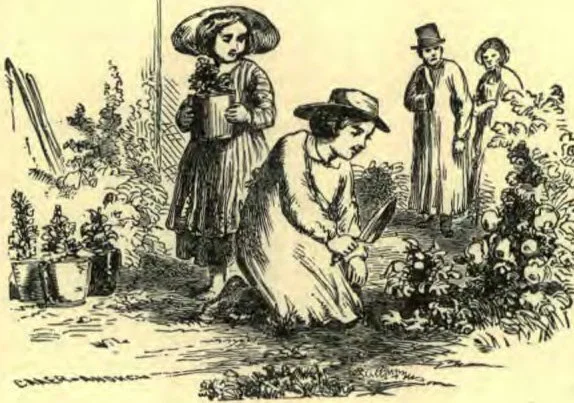
Such very naturally think that there is nothing enjoyable in the Christian’s life. They know nothing of the peace and joy that comes of doing right because it is right, and because they love to do it. Their condition is somewhat like that of a gentleman who was frequently urged by a friend to go down and taste the apples which grew in his garden. His friend asked him several times, but he never went, and at last the fruit-grower said,
“I suppose you think my apples are good for nothing, so you won’t come and try them.”
“Well, to tell the truth,” said he, “I have tasted them. As I went along the road, I picked up one that fell over the wall, and I never tasted anything so sour in all my life, and I do not particularly want any more of your fruit.”
“Oh,” said the owner of the garden, “I thought it must be so. Why, don’t you know, these apples around the outside are for the special benefit of the boys. I went fifty miles to select the sourest sorts to plant all around the orchard, so the boys might give them up as not worth stealing; but if you will come inside you will find that we grow a very different quality there, sweet as honey.”
Thus it is. There are many who perhaps have tasted of the bitter fruits which grow on the outskirts of religion,—the, “Thou shalt not,” and “Thou shalts,” and they do not particularly desire any more. They would rather remain as much in the world as possible. But if they would give themselves entirely to Jesus and live for him, they would find that the fruit of the Christian life is tenfold sweeter than that of the half-and-half professor who serves God only for fear of the punishment that awaits the evil-doer. When once “inside,” when once heartily engaged in the service of God, they would be able to say with the Psalmist, “Thy ways are ways of pleasantness, and all thy paths are peace.”
M. K. W.

A LETTER.

DEAR EDITORS: I want to tell you what a good stand the youth of Lake City, Minn., have taken, with regard to missionary work. They attended several of the V. M. meetings, and were much interested in what they heard there. They were too young to join the society, so they determined to form a Young People's V. M. Society, and work under similar rules.
In February last, such a society was organized, and is now in full working order. We take twenty copies of the INSTRUCTOR in our Sabbath-school. These papers are carefully preserved, and remailed to addresses furnished from the Secretary's book. Several subscribers for the INSTRUCTOR have already been obtained by the members of the society; and the children have the satisfaction of knowing that they are casting in their mite.
I think it would be a good thing if there were many such societies; for in this way the circulation of the INSTRUCTOR would be greatly increased, and it would be read by thousands who, perhaps, would never hear of the paper except through this means. You know that “Satan finds some mischief still for idle hands to do,” and I trust that in this way the children will not only bless others, but will be blessed themselves.
Yours in Christ,
Rosa V. Clarke.
Pres. of Young People's V. M. Society.

WORK

In the name of God advancing, Sow thy seed at morning light; Cheerily the furrows turning, Labor on with all thy might. Look not to the far-off future, Do the work which nearest lies; Sow thou must before thou reapest; Rest at last is labor's prize.

LESSONS FOR CHILDREN.

LESSON LXX.—ELISHA'S MIRACLES.

After Elijah had been translated, Elisha took the mantle that had fallen from him when he was taken up, and with it he smote the waters of the Jordan, and they parted as they did when Elijah smote them. Then Elisha walked through the bed of the river on dry ground, and when the sons of the prophets saw this, they said, “The spirit of Elijah doth rest on Elisha. And they came to meet him, and bowed themselves to the ground before him.”
Then the men of Jericho complained that the water of that place was bad. So Elisha, in the name of the Lord, healed the waters, so that they were ever afterward wholesome and pleasant.
“And he went up from thence unto Bethel; and as he was going up by the way, there came forth little children out of the city, and mocked him, and said unto him, Go up, thou bald head; go up, thou bald head. And he turned back, and looked on them, and cursed them in the name of the Lord. And there came forth two she bears out of the wood, and tare forty and two children of them.”
These little children were not so much to be blamed for mocking the prophet as were their parents, who had allowed them to cherish such an evil spirit, and probably taught it to them by their own bad example. The children must have been destroyed for the purpose of teaching these parents and others an important lesson.
Now the king of Israel, and the king of Edom, and Jehoshaphat the king of Judah, joined their armies to go out against the king of Moab, and when they had marched seven days, they had no water, and the people were about to perish of thirst. Then at the request of Jehoshaphat they sent for Elisha; and when Elisha had come, he said, “Now bring me a minstrel; and it came to pass, when the minstrel played, that the hand of the Lord came upon him. And he said, Thus saith the Lord, Make this valley full of ditches. For thus saith the Lord, Ye shall not see wind, neither shall ye see rain; yet that valley shall be filled with water, that ye may drink, both ye, and your cattle, and your beasts. . . . And it came to pass in the morning, when the meat-offering was offered, that, behold, there came water by the way of Edom, and the country was filled with water.”
And the Moabites rose up early in the morning, and looked upon the water as the sun was shining upon it, and it looked to them as red as blood; they said, “This is blood: the kings are surely slain, and they have smitten one another.” And they came on in great haste into the camp of Israel. Then the Israelites rose up, and smote them, and pursued them, tearing down the walls of their cities, and destroying their lands.

QUESTIONS.

  1. What did Elisha do with Elijah’s mantle? 2 Kings 2:13, 14.
  2. When the sons of the prophets saw Elisha walking through the bed of the river on dry ground, what did they say?
  3. What did they do?
  4. What complaint did the men of Jericho make?
  5. What did Elisha do to the waters?
  6. When Elisha left Jericho, where did he go?
  7. What happened while he was on the way?
  8. What became of these children?
  9. Who probably were most to be blamed, the children, or their parents?
  10. Why do you think the Lord destroyed these children?
  11. Who joined armies to go out against the king of Moab? Chap. 3:6-9.
  12. What trouble did they have?
  13. What did Jehoshaphat advise to have done?
  14. When Elisha had come, what did he call for?
  15. When the minstrel began to play, what came upon him?
  16. What did he say?
  17. How was this prediction fulfilled? Verse 20.
  18. How did the water appear to the Moabites as they looked upon it the next morning?
  19. How did they account for the appearance of blood in the valley?
  20. What did they do?
  21. What happened to the Moabites when they had come into the camp of Israel?

BIBLE LESSONS FOR YOUTH.

LESSON XCVI.—THE REBUILDING OF THE TEMPLE AT JERUSALEM.

1. How did Daniel know when to look for the deliverance of his people from captivity? Dan. 9:2.
2. What does Jeremiah say in regard to this? Jer. 25:11, 12; 29:10.
3. In view of this, what did Daniel do in the first year of Darius the Mede? Dan. 9:3-19.
4. How did the Lord answer this prayer? Verses 20, 21.
5. On what occasion had Gabriel been sent to Daniel, some fifteen years before?
6. What commandment was given the angel at that time? Dan. 8:16.
7. Why was he not able, at that time, to complete the work assigned him? Verse 27.
8. Where does he now begin?
9. What does he say he has come to do? Dan. 9:22.
10. What does he ask Daniel to do in order to be able to understand what is yet to be explained? Verse 23.
11. To what did the unexplained portion of that vision chiefly pertain? Dan. 8:14.
12. What does Gabriel say about the first seventy weeks of that period? Dan. 9:24.
13. What other revelations does he make to Daniel? Verses 24-27.
14. When was Babylon taken by the Medes and Persians?
15. When did Cyrus begin to administer the government?
16. What was one of the first acts of his administration?
17. What may we learn about this decree in the first and sixth chapters of Ezra?
18. In answer to this decree how many assembled to go up to Jerusalem? Ezra 2:64-67.
19. Who were their leaders?
20. How long were they in making the journey?
21. How far did they have to travel?
22. When did they begin to rebuild the temple? Ezra 3:8-10.
23. Who hindered them?
24. Who were these Samaritans?
25. What provoked their anger and their opposition?
26. How long did this opposition continue? Ezra 4:4, 5.
27. What did they finally obtain from Smerdis? Ezra 4:7-24.
28. What use did they make of this decree? Verses 23, 24.
29. By whom was Smerdis succeeded?
30. Who urged the people to resume their work on the temple in the second year of this king? Ezra 5:1, 2.
31. What objections did the people make?
32. How were these objections answered?
33. Who visited Jerusalem as soon as the work on the temple was resumed? Ezra 5:3.
34. What demand did he make, and how was it answered?
35. When the Persian monarch had searched and found this decree, what did he do?
36. When was the temple finished?

SYNOPSIS.

In the first year of Darius, Daniel, knowing by the prophecy of Jeremiah that the time had nearly come when the Lord had promised to deliver his people, made a remarkable prayer, in which he confessed his sins and the sins of his people, earnestly beseeching the Lord to forgive them and not to defer the fulfillment of his promise.
While Daniel was yet making his supplication, the Lord sent the angel Gabriel to talk with him. Some fifteen years previous to this time, when Daniel had the vision recorded in the eighth chapter of his prophecy, Gabriel had been sent to explain the vision, and was commanded to make him understand it; but Daniel fainted before the explanation was finished; so Gabriel now begins just where he left off at that time. He tells the prophet that he has now come forth to give him skill and understanding, and asks him to consider the vision, so as to be prepared to understand the part that had not been explained.
The unexplained portion pertained chiefly to a long prophetic period of 2300 days [years], at the end of which the sanctuary was to be cleansed; and Gabriel now informs Daniel that the first seventy weeks of this period are to be especially given to his people, the Jews, after which the gospel would be preached to Jews and Gentiles alike.
He also gives a date for the commencement of this period; tells what shall be accomplished during the seventy weeks; and even goes so far as to show when the Saviour will begin his public ministry, and when he will be crucified. Thus the prophet's prayer was more than answered.
The capture of Babylon by the Medes and Persians occurred B. C. 538. About two years later, Darius the Mede having died, Cyrus took the government of the empire into his own hands. One of his first acts was to make a decree granting the Jews permission to return to Jerusalem, and rebuild the temple. By reading the first and sixth chapters of Ezra we shall see that this decree was a direct fulfillment of the prophecy of Jeremiah; and that Cyrus, acknowledging that it was the God of Heaven who had given him all his wealth and power, ordered the expenses of building the temple to be defrayed from the public treasury.
This decree was published throughout the empire; and in a short time nearly fifty thousand people assembled, and took up their march for Jerusalem under the charge of Zerubbabel, the first of the royal line, and Jeshua, the one to whom the office of high priest would fall. They were four months in making this dreary journey of 700 miles.
About a year after arriving at Jerusalem they began to rebuild the temple, but were soon hindered by the Samaritans, who were descendants of the colony planted in Samaria by Shalmaneser at the time he conquered the kingdom of Israel, and led the people into captivity. These Samaritans wanted to assist in rebuilding the temple, and because they were not allowed to do so, they became very angry, and did all they could to put a stop to the work. This opposition continued throughout the reign of Cyrus, and during the reigns of his successors, Cambyses (called Ahasuerus), and Smerdis (called Artaxerxes). From the last of these kings the Samaritans obtained a formal decree for the discontinuance of the work, and took great pleasure in enforcing it.
But wicked Smerdis was soon succeeded by a more humane king, called Darius Hystaspes. In the second year of this king the prophets Haggai and Zechariah began to urge the people to resume their work on the house of God. The people thought it a very unfavorable time, as they were suffering from drought and famine; but the prophets told them that these calamities had come upon them in consequence of their indifference toward the work of God. Thus encouraged, they set to work, but no sooner was this known than Tatnai, one of the Persian governors, visited them, and demanded by what authority they built. They referred him to the decree of Cyrus, which, upon search, was found at Achmetha, the capital of Media. The Persian monarch then issued a decree that the Jews should be helped in their work, and that whoever opposed them should be hung upon a gibbet erected from the timbers of his own house. Thus aided, the work went on, and was finished in the sixth year of Darius Hystaspes, twenty years from its commencement.

THE CHILD AND THE FLOWER.

CHILD.
“SWEET flower, sweet flower, where have you been? All through the winter you were not seen.”
FLOWER.
“No, in the winter I always keep Covered up snugly and fast asleep.”
CHILD.
“Fast asleep? Well, I did not know That flowers did anything else but grow. At night my mother puts me to bed, But where, sweet flower, do you rest your head?”
FLOWER.
“I have a mother as well as you; In her lap I sleep; yes, indeed I do; Wrapt up quite warm from the cold and showers, For the earth is mother to all the flowers.”
CHILD.
“But how can you tell how long to stay? For somebody calls me up each day.”
FLOWER.
“I wake but once throughout the year, And the voice of God is the voice I hear; He bids me leave my quiet rest, And he gives the raiment in which I’m drest; For although mankind his mercies share, He yet vouchsafes for the flowers to care. When I get up, I am glad to see The kind old friends who welcome me.”
CHILD.
“What friends are those?”
FLOWER.
“Why, chiefly two, The honey-bee and the sparkling dew. When night sits still with folded wings, And hushed is the sound of living things, The dear little dewdrop comes to stay With me till the early break of day, When a sunbeam fetches my friend away. The busy bee, with his sober vest And cheerful hum, is my frequent guest; Sweet food he fancies, and therefore I Prepare for him a good supply; Well pleased he sees my tempting cup, And hastes to drink the nectar up.”
CHILD.
“You don’t feel lonely, then, sweet flower?”
FLOWER.
“Oh, no; I have seldom a lonely hour; Bright, beautiful insects around me float, And the grasshopper chirps his lively note; The innocent lambs about me play, And the lark sings merrily day by day. A happy and tranquil life I lead; I have all I wish for, and all I need; Content I am with my lowly lot, And the queen on her throne I envy not.”
CHILD.
“But surely you, with your modest mien, Would not compare yourself to a queen?”
FLOWER.
“No, I would not; but He who made Each simple flower that decks the glade, Has said that a king, whose pomp and glory You read about in ancient story, And to whose wisdom all men bow, Was not arrayed as I am now.”
—S. S. Advocate.

LETTER BUDGET.

ADAMS CENTER, WIS.
DEAR EDITORS: As I have never seen a letter from this place, I thought that I would write one. I am ten years old. I have a little sister Minnie, six years old. We both go to Sabbath-school. I learn the lessons for children in the INSTRUCTOR. I have always kept the Sabbath. I am trying to be a good girl and keep all the commandments, so that when Jesus comes to gather up his jewels, I may be among the number, and have a home in Heaven.
Yours truly, LENA MAY COON.
VAN WERT, OHIO.
DEAR EDITORS: I have been thinking for some time of writing to you, but have delayed until now. I am thirteen years old. I am an orphan, and live with my grandmother. We have kept the Sabbath for two years. I am not a member of the church, but I want to be if I live to be a little older. I attend church and Sabbath-school. We have a very interesting Sabbath-school. We use the “Song Anchor.” I take the INSTRUCTOR and like it very much. Grandmother wants me to say that she is becoming stronger and stronger in the faith. I want to be a good girl, and have a home on the new earth.
POLLY MULLEN.
BELOIT, KANSAS.
DEAR EDITORS: I saw the letters in the INSTRUCTOR, and liked them so much that I thought I would write to you. I am eleven years old next November. I go to Sabbath-school. Our meetings are about three and one-half miles from here. I came from Ohio last August, where I attended Sabbath-school at Norwalk. I take the weekly INSTRUCTOR. I read it and then give it to my friends.
Since we came here, we have found a few Sabbath keepers. We have kept the Sabbath three years. I have tried to get some subscribers and failed, but will try again. MINNIE FAIRCHILD.

A COFFEE-FIELD IN BRAZIL.

In southern Brazil, a coffee-field seldom lasts more than thirty years. The plantations are made on the fertile hill-sides; but the soil here is never deep—six or eight inches of mold at the utmost—and in twenty-five or thirty years, the strong-growing coffee-tree eats it all up.
The ground is covered with earthen pots set close together, only leaving little pathways at intervals. Each pot contains a thriving young coffee-plant. The ground forms a gentle slope, and water is constantly running over it, so that it is always soaked. The pots, through orifices at the bottoms, draw up enough of this water to keep the roots moistened. The young plants are protected from the sun by mat screens stretched on poles above the ground.
In this way they are not put back when transplanted, as the pots are simply inverted and the roots come out with the earth. They are then set into mold or compost which has been prepared in deep holes. The tender rootlets catch hold of this at once, and in a day or two the plant is growing as well as ever. The plants are set in rows about ten feet apart. They grow, and thrive, and are happy, out on the hill-side. Warm sunshine caresses the leaves; generous rains feed the tender roots; the ground is kept free from intruding weeds and bushes, and the planter waits for his harvest.
After four years, the trees are six feet high and begin to bear. By the sixth year, the crops are very large,—three or even four pounds per tree at times. Meanwhile, corn and mandioca are planted between the rows. Often in a new plantation the expenses are nearly covered by these subsidiary crops.
November is the principal gathering month. The work is performed by slaves, and very hard they have to work; for in 1892 they will be free, so the slaveholder’s policy is to get as much work as possible from them while he can. From sunrise to sunset, men, women, and children are gathering the berries in baskets, working silently and steadily under the overseer’s eye. Every day, each slave gathers, on the average, berries enough to produce fifty pounds of dried coffee. The pickings are collected in carts and brought to the mill-house, where the seeds must be prepared for the market.—Scribner.

A Gentleman's Thoughtless Shot Teaches Mercy to Animals

A GENTLEMAN riding with his family in the country, saw a very beautiful bird. His little four-year-old son watched it with great interest. The father, thinking it would give him still more pleasure to examine its plumage, thoughtlessly raised his gun and shot it. The little boy burst into tears as his father put the dead bird into his hands, and exclaimed, “Father, that bird will never sing again.” That father said, some time afterward, that he could never shoot another bird. Do not hurt or destroy any of God’s creatures.

You have reached the end of this edition.

The Youth’s Instructor · Apr 28, 1880