The Youth’s Instructor, Vol. 27, No. 2.

A WORD FITLY SPOKEN

The Youth’s Instructor

Jan 8, 1879

S. D. A. Publishing Association · Battle Creek, Mich. · Jan 8, 1879

A WORD FITLY SPOKEN.
Very much good often comes from what Solomon calls “a word fitly spoken.” The Hebrew for “fitly spoken” here means “set on wheels.” All our words are set on wheels. If they are good words, they are wheeling on for good. If they are evil words, they are wheeling on for evil.
One day a boy was tormenting a kitten. His little sister, with her eyes full of tears, said to him, “O Philip, don’t do that; it is God’s kitten.” The little girl’s words were not lost. They were set on wheels. Philip left off tormenting the kitten, but he could not help thinking about what his sister had said.
“God’s kitten, God’s creature—for he made it,” he said to himself; “I never thought of that before.” The next day, on his way to school, he overtook one of his companions beating unmercifully a poor half-starved dog. Philip ran up to him, and before he knew it, was using his sister’s words, saying, “Don’t do that, Ned; it is God’s creature.”
The boy looked ashamed, and tried to excuse himself by saying that the dog had stolen his dinner. “Never mind,” said Philip, “you shall have half of mine.”
So they went on their way to school together, and soon forgot all about the dog. But Philip’s words had been set on wheels again, and much good followed them. Two persons were passing just as Philip spoke, and they heard his words. One was a young man in prosperous business in a neighboring town; the other was a ragged, dirty, miserable-looking creature. He had formed the habit of drinking, and in consequence of this had just been dismissed by his employer, and was going home in despair.
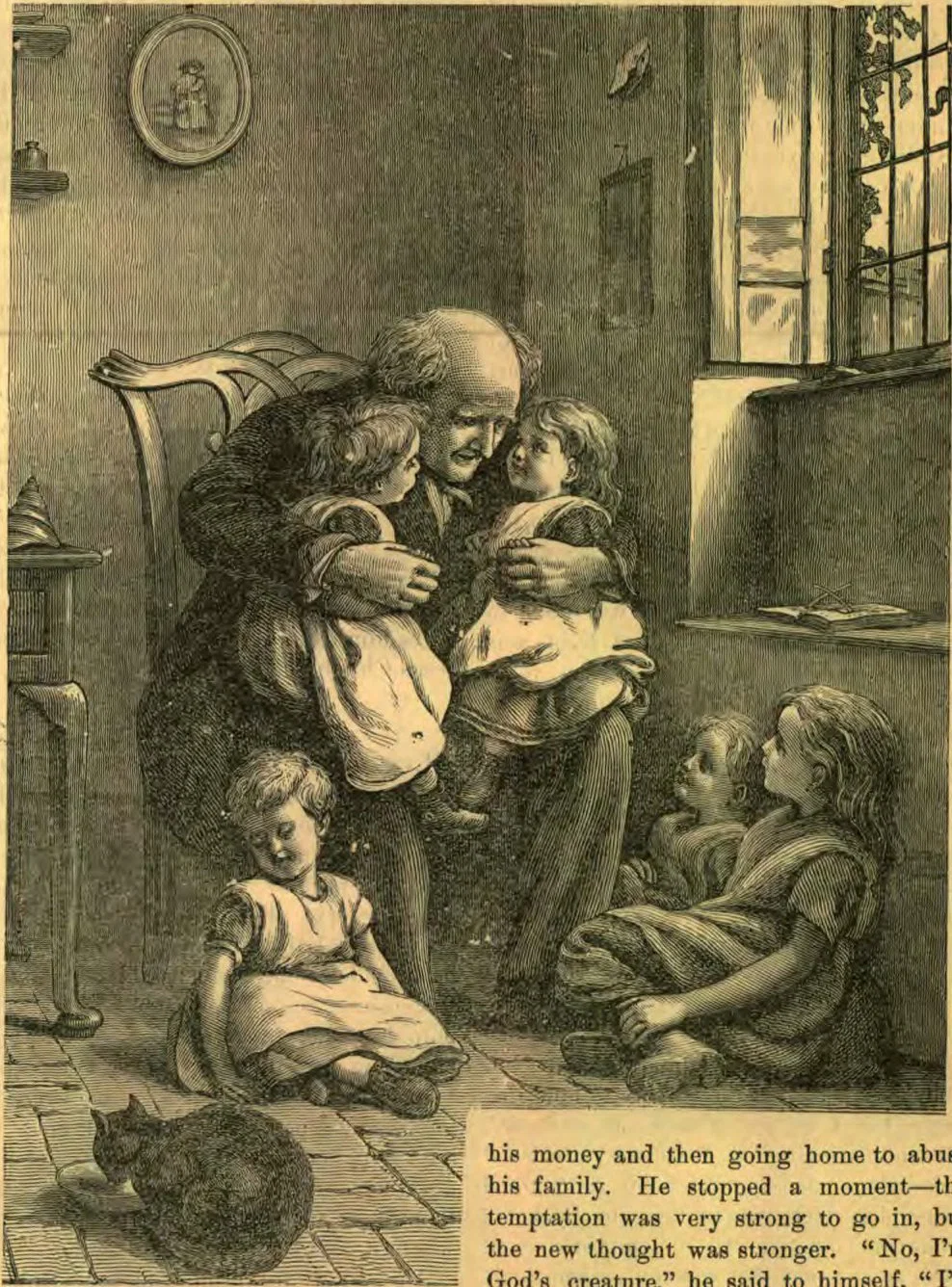
“God’s creatures,” said the poor fellow, and it seemed a new idea to him too. “If that dog is God’s creature, then I am God’s creature, too, and he will help me if no one else will.” Just then he came to a tavern where he had been in the habit of wasting his money and then going home to abuse his family. He stopped a moment—the temptation was very strong to go in, but the new thought was stronger. “No, I’m God’s creature,” he said to himself, “I’ll go in there no more.” And he went on toward home.
His wife was astonished to see him come home sober, and still more so when he burst into tears, saying that he was a ruined man, and was determined to give up drinking, and try, by God’s help, to be a better man.
Just then a knock was heard at the door. It was the gentleman of whom we have just spoken. He, too, had heard Philip’s words. They were words on wheels to him. They went rolling after him. He could not get away from them. “This is one of God’s creatures, too,” he said to himself as he looked at the poor, ragged man who was walking before him. “He looks as if he needed help,” he went on to say, “and perhaps I can give it to him.” This led him to follow the poor man to his home. He offered him work, which was thankfully received, and faithfully done. The poor fellow was never found in a tavern again, but became a sober, industrious, useful, happy man. And the simple words which that little girl set on wheels were the means of doing all this good.—Ez.

GRANDFATHER'S CHAIR.

I LOVE, when the evenings are gloomy and chill, And storm-winds are raging o'er valley and hill, To see by the fireside the little ones there, All happy and smiling round grandfather's chair.
Such stories he tells them, such tales of delight,— Such wonders to dream of by day and by night,— It's little they're thinking of sorrow and care, Their bright faces beaming round grandfather's chair.
And words, too, of wisdom fall oft from his tongue; Dear lessons to cherish and treasure while young; Bright things to remember when, laden with care, They gather no more around grandfather's chair.
Ah! little ones, love him, be kind while you may, For swiftly the moments are speeding away; Not long the kind looks and the love you may share, That beam on you now from a grandfather's chair.

EDITORS’ CORNER.

DURING the holidays just past, many costly presents have been made by the wealthy, but none of them can compare in value with God’s gift of a new year. Dear boys and girls, a bright new year has been committed to our trust, and if we make the right use of it, no person is richer than we are. We all like to begin the new year in making all things new in our lives, after having buried all that is bad about ourselves with the old year. We believe many of you are trying to begin the new year well. But
“It’s passing, boys— A week’s been here; It’s passing, girls— The glad new year!”
Yes, one week of the glad new year is already gone; and the time will slip, slip, all slip away, unless we keep in mind that it is
“A year to be glad in, Not to be bad in; A year to live in, To gain and give in;”
leaving us with no better characters than when we entered upon the year.
Yes, God has committed to us
“A bright, new year! O hold it dear; For God, who send-eth, He only lend-eth.”
Let us fill each day with good deeds, by “doing all the good we can, to all the people we can, in all the ways we can,” and our characters will grow sweeter and purer, and we will indeed have a glad year, and a bright and happy one.
M. J. C.

BANK-NOTES

EVERY one who thinks about the matter knows that bank-notes are very carefully made; but very few are aware of how much time and labor is spent upon them with the purpose of preventing imitation and forgery. For nearly two hundred years the Bank of England notes have been made at one factory, at Laverstoke in Hampshire, and by the same family. The pulp is made from white linen cuttings alone, no rags that have ever been worn being permitted to be used; and even the number of dips into the pulp-tank made by each workman is registered by a machine; and each sheet, as it is finished, is carefully numbered and booked to the person to whom it is passed.
The notes are printed at the Bank of England, and, by very cleverly-arranged machinery, every note has some slight difference from all that have been printed before, so that no two Bank of England notes can be alike, except by forgery. The number of paid notes in seven years was about 94,000,000; and they fill about 18,000 boxes. If they were placed in a pile, one upon another, they would make a column eight miles high; and if joined end to end, would form a ribbon 15,000 miles long. Their value is £3,000,000,000, and they weigh more than 112 tons.—Christian Advocate.

ACTING FROM PRINCIPLE.

ACTING from principle, or doing right because it is right, whether it is pleasing to ourselves and approved by our associates or not, is what lays the foundation for a good character, and prepares men and women to become pillars in the church.
Children or youth, men or women, who simply do that which is most congenial to their own feelings, and pass by what they know to be duty, because it requires labor and self-denial, do not become burden-bearers or counselors in either church or State. Those who would fill a place of true honor or usefulness in the world must ever act from principle.
A circumstance happened under my observation a few days since which I will here relate, because it has a good moral. At a house where we were stopping, in the State of New York, it became necessary to make some repairs on a door, the lock being out of order. This work was done in the evening, and of course a light was needed. A little girl some seven years old volunteered to hold the lamp for her uncle, who was to do the work. The job proved to be a longer one than was at first anticipated. The little girl had to shift her lamp often from one hand to the other to rest her arms, and finally it became so heavy that she had to take hold of it with both hands.
I saw she was getting very tired, but instead of offering to relieve her I thought I would watch and see what she would do. Did she begin to cry, and call for some one else to hold the lamp? Not she; but she said, “Uncle, I don’t like to hold this lamp, but I am going to do it anyhow.” He simply replied, “That is a very good principle to act upon.” So it was a good principle. Here was a lamp to be held; some one must do it. She might as well do it as any one, if it was not pleasant. If this little girl cherishes that principle at all times as she grows up, it will be the strength of her life. The Lord help us all to emulate the same spirit, and act from principle in all we do.
J. N. LOUGHBOROUGH.

KNOWN BY HIS WALK.

As two gentlemen were entering a railway station one day, they met a stranger just leaving it. After passing him, one remarked, “That man has been a soldier, I know by his walk.” “Well,” said the other, “I thought he must have been, from his politeness. Did you notice how gracefully he saluted us as we looked at him?” “That is just as it should be,” returned the first gentleman; “a soldier in plain clothes should be the same as though he were in uniform. His behavior should ever identify him as a true soldier, wherever he is.”
The above remarks are worth remembering, because they point out a great truth; one that is applicable to all, even the children. None are so young but their walk may unmistakably point them out as soldiers of the Lord Jesus Christ. In the service of the Master there are burdens and crosses for every one. These should be borne in such a manner as to show without doubt of whom we learned to bear them.
God’s word tells us that “Even a child is known by his doings.” How true this is, and how easy it is to point out the true soldier among the “little folks,” by his doings. See those boys. How differently they treat that old gentleman whom they meet. One, rudely hallooing, jostles by without appearing to notice him, while the other bows very pleasantly as he passes. At home, also, it is readily seen which is the good boy and the true soldier; the one who is kind to his brothers and sisters, and courteous to his parents.
By his behavior toward all, the last boy wins a place in their affections, and grows up a good man, worthy of the confidence of every one; while the first is shunned by all good people on account of his rudeness, and he grows up a rough man, uncultivated in his manners, and disorderly in his walk. Let each strive to live so that his walk may prove him to be a good soldier of the Lord Jesus Christ. J. O. C.

Prizes Offered to Canvassers for New Subscribers

Those beautiful prizes! The very liberal offer to canvassers! A rare opportunity to earn a handsome Teacher’s Bible! Have you considered all these?
The prizes are ready to be mailed to you as fast as you fill your quotas. Now is the harvest time; improve the moments, thus not only securing a valuable prize, but the satisfaction of having labored for the Master.
A $5.00 Bible was offered to the one who should send us the largest number of new subscribers before Jan. 1, 1879. The Bible will be sent to-day to L. G. Moore, Hastings, Mich. The same generous offer is made for the month of January. See “Prize List” on last page, and avail yourselves of this rare chance. M. J. C.

BIBLE LESSONS FOR YOUTH.

LESSON XXVIII.—MOSES SENT TO DELIVER HIS PEOPLE.

  1. What did the children of Israel do that caused God to remember his covenant, and to look upon them, and have respect unto them? Ex. 2:23-25.
  2. Whom did God choose to deliver his people?
  3. Where was Moses when the angel of the Lord appeared to him? Ex. 3:1, 2.
  4. What strange manifestation did Moses witness?
  5. What did the Lord say to Moses? Verse 7.
  6. What did he say he had come to do? Verse 8.
  7. Was Moses willing to go?
  8. How did he feel about taking hold of this same work forty years before?
  9. How did he feel about it now?
  10. What excuses did Moses make?
  11. How were they answered?
  12. How many miracles were given him by which he might convince the people that God had sent him?
  13. What was the first? the second? the third?
  14. For whom did the Lord give Moses a message?
  15. How did the people receive the message sent to them? Ex. 4:31.
  16. What did Moses and Aaron say to Pharaoh when they went in before him? Ex. 5:1.
  17. What reply did Pharaoh make? Verse 2.
  18. Was Moses disappointed at receiving such an answer?
  19. What had the Lord told Moses in regard to Pharaoh?
  20. What course did Pharaoh pursue toward the people?
  21. What reason did he assign for their discontent? Ex. 5:17.

SYNOPSIS.

At last, when the proper time had fully come, God called Moses to go to Egypt and lead out his people.
When Moses had led his flock to the back side of the desert, to Mount Horeb, “The angel of the Lord appeared unto him in a flame of fire out of the midst of a bush; and he looked, and behold, the bush burned with fire, and the bush was not consumed.”
When Moses drew near the bush, the Lord talked to him by his angel. He told Moses that he had seen the afflictions of his people; that he had heard their cry, and knew their sorrows; that he was now ready to deliver them, and wanted Moses to go down to Egypt, and lead them out of that land of bondage into a good land, and large, a land flowing with milk and honey.
Moses was not willing to go. Forty years before, he was willing to undertake the work in his own strength, but now he felt unfit to be an instrument in God’s hand for doing the same thing. He made many excuses, but God answered them all.
He gave Moses three miracles by which he might convince the people that God had sent him. 1. He cast his rod to the ground, and it became a serpent, but on taking the serpent by the tail, it became a rod again; 2. Taking his hand from his bosom, it was leprous as snow, but upon returning it to his bosom and taking it out again, it was well as his other flesh; 3. The turning of water to blood.
The Lord gave Moses a message for his people, and also a message for Pharaoh, king of Egypt. When Moses delivered the message to the people, they believed it, and bowed their heads and worshiped. And when Moses and Aaron went in before Pharaoh, they said, “Thus saith the Lord God of Israel, Let my people go that they may hold a feast unto me in the wilderness. And Pharaoh said, Who is the Lord, that I should obey his voice to let Israel go? I know not the Lord, neither will I let Israel go.”
Moses was not disappointed at this answer; for the Lord had told him before, that Pharaoh would not let the people go, but would hold them with a mighty hand until God should release them.
Pharaoh made the tasks of the people heavier than before, saying that they were discontented because they were idle.
NOTE.—Thus we see that those forty years spent in the lone wilderness were not without good effects upon Moses. From being a proud, rash man, he had come to be the meekest man on earth.
Forty years before, he had felt entirely sufficient for the work, and wondered that his brethren in Egypt did not understand that he was to deliver them. Acts 7:25. But now he felt so utterly unqualified that he again and again begged God to excuse him. He was now in such a condition that God could use him to do his work. G. H. BELL.

HINTS ON TEACHING THE LESSON.

IN conducting the recitation, the teacher should first turn the attention of his class to preceding lessons, and especially to the last one learned. Your class should keep in mind, not only the subject of each lesson, but the general subject of which each lesson forms a part. The whole line of thought should be kept in mind. We should know how we commenced on this line of thought, what each successive step has been, and just where we are now. We are then prepared to ask what are the leading thoughts of this lesson, and how they are connected with those of the preceding lesson. Thus we shall be adding, each week, a new link to a chain, instead of forging separate links, which, if not united, will never be of any service.
The class having thus found their place in the course of study, you may proceed to ask the printed questions. If you can readily ask them without referring to the lesson sheet, you will be more likely to interest your class. Do not accept meager answers; yet, on the other hand, it is not best to require the repetition of long passages, when nothing is to be gained by it. If the class is large, it will be best to go through the questions a second time. Never stop for any discussion, or to answer any puzzling questions that may arise in the class, till you have fully tested them on the lesson.
Next, have the lesson recited without questions, calling on one member to recite a part, then asking another to take it up where the first left it, and so on till the lesson is all recited.
After this, call on one member to recite the whole lesson in the same way. You will then have a synopsis, like the one in the INSTRUCTOR, but not in the same words.
G. H. BELL.
(To be Continued.)

LESSONS FOR CHILDREN

Notice! Notice!!

THE INSTRUCTORS will be mailed so that they will reach most of the schools Thursday or Friday. They should be distributed to S. S. scholars on the Sabbath following the date of publication, so that the lesson may be learned during the week and recited on the Sabbath named at the head of the Department.
Those wishing to supply their schools with the Instructor as a Lesson Paper, should get them at once, so that the classes will not lose the first lessons of the series.

LESSONS FOR CHILDREN.

LESSON II.—PASSING OVER JORDAN.

AFTER the death of Moses, the Lord spoke to Joshua, and told him that he must lead the children of Israel over Jordan into the land which he had given them. He said,—
“There shall not any man be able to stand before thee all the days of thy life: as I was with Moses, so I will be with thee: I will not fail thee, nor forsake thee.” He also said,—
“Only be thou strong and very courageous, that thou mayest observe to do according to all the law, which Moses my servant commanded thee: turn not from it to the right hand or to the left, that thou mayest prosper whithersoever thou goest.”
The Lord told Joshua how to proceed in crossing the Jordan. At that season of the year the water was very deep, for it rose so high as to overflow the banks of the river.
It seemed impossible to cross such a stream, but the priests went before the people, bearing the ark that contained the law of God; and when their feet touched the water of the river, the waters that were flowing from above stood up in a heap, and came no farther, while the waters that were just before them flowed on toward the sea, and left the bed of the river dry.
The priests then went down into the bed of the river, and stood there with the ark till all the people passed over. There were many thousands of the people, and it must have taken them several hours to cross the stream; but during all this time the waters were held back.
Joshua chose twelve men, one from each tribe, and told them to take each man a stone from the bottom of the river, where the priests stood. Then the priests came up out of the river, and the waters flowed on as they did before they were disturbed.

QUESTIONS.

  1. After the death of Moses, what did the Lord tell Joshua to do? Josh. 1:1, 2.
  2. What encouraging promise did he make him? Verse 5.
  3. What admonition does he give him in verse 7?
  4. What does he tell him he must do in order to prosper?
  5. Who went before, as the hosts of Israel went down to cross the river Jordan? Josh. 3:8, 14.
  6. What did they bear?
  7. What was the condition of the river at this season of the year? Verse 15.
  8. What took place as soon as the feet of the priests touched the water of the river? Verse 16.
  9. What did the priests then do?
  10. What did the people do?
  11. How long were the waters held back?
  12. How do we know this?
  13. When Joshua had chosen twelve men, one from each tribe, what did he tell them to do? Josh. 4:4, 5.
  14. How long did the priests stand in the bed of the river?
  15. What took place when they came up out of the bed of the river?

Letter Budget.

Howard, Minn.
Dear Editors: I am a little girl eight years old. I have four brothers. We live on the shore of a beautiful lake, about twenty rods from a large school-house. I attend school every day, and Sabbath-school every Sabbath at our own home. I like the Instructor very much, and I like to read the letters too. Lydia Weese.
Kalamazoo, Mich.
Dear Editors: A kind friend sent me the Instructor last year, and I liked it so well mother says I shall have it this year. Enclosed you will find pay for 1879. How I would like to see you and the whole Instructor family. Please pray for me, that I may live so that I may meet you all in Heaven. I wish you a Happy New Year; and may God bless you in your noble work. With much love, I am your affectionate friend, Electa H. Drake.
Oxford, Kansas.
Dear Editors: Through the kindness of grandpa I have had the privilege of reading the Instructor the past year, and I like it so well that I don't want to do without it. Now that you are publishing a weekly paper, I have concluded to take it instead of the monthly. I am eleven years old. I attend day school. We have no Sabbath-school at present. I am trying to learn to write, that I may write you often. Hoping to see you some day, I remain
Yours truly, Allen Chaplin.

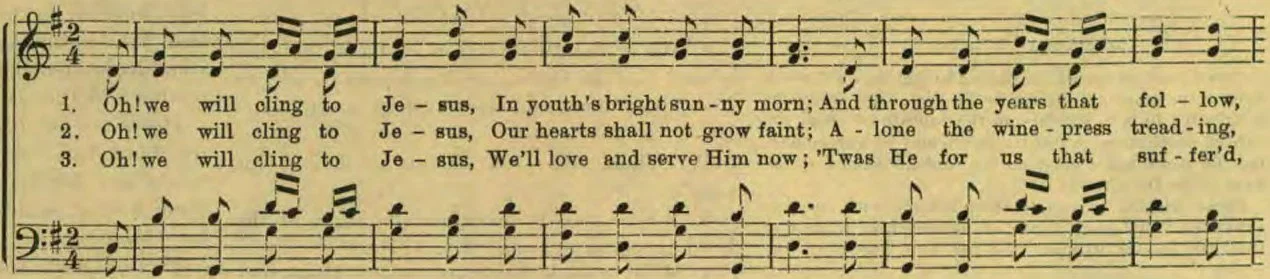
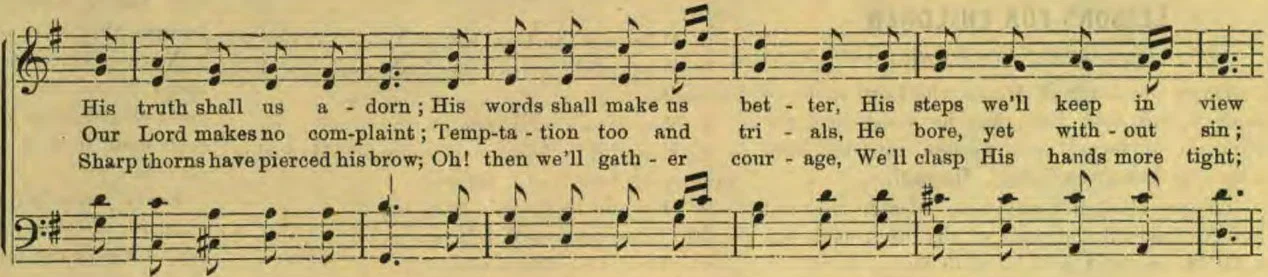
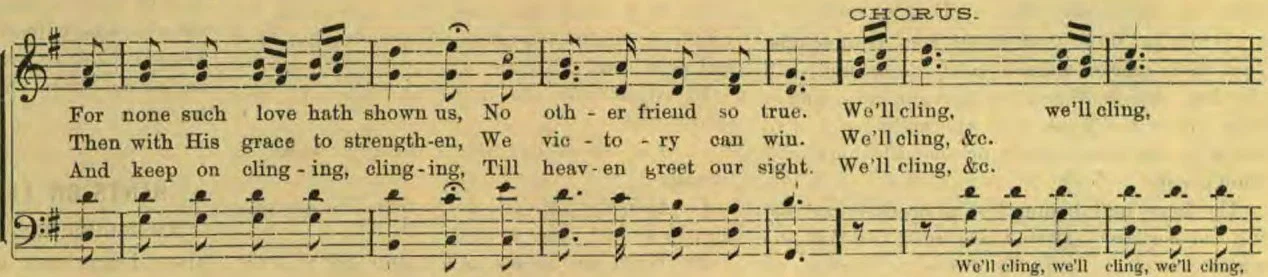
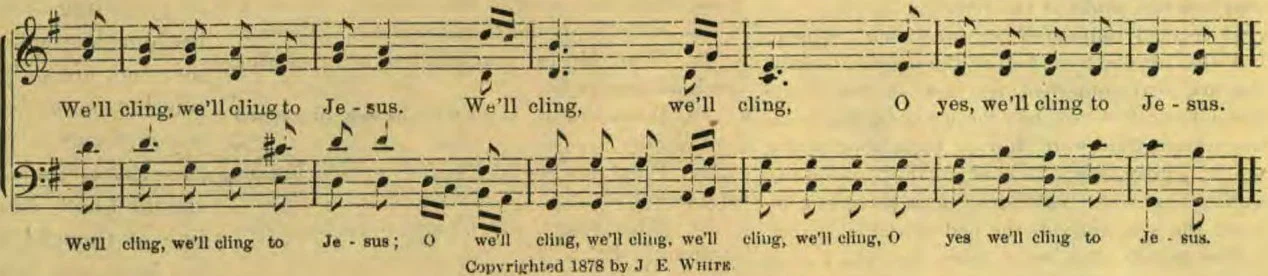
WHOSE MUSIC?

Whose music? The children's, of course. Who deserves a nice piece of music more, and who are more musical than they? The children's corner of any home has the most music in it, and that is why this piece is found in the “Children's Corner” of the INSTRUCTOR.
This music is the children's, too, because it was written especially for them by our friend, Mr. Hakes, who lives in Oakland, California, just one-tenth of the way around this round world of ours, going the way the sun goes.
After the music was written, we could not all have seen it if our friend, J. E. White, the music printer who lately published the “Song Anchor”—that new music book which is being used by all the large Sabbath-schools—had not set the music type, made a stereotype plate, and then sent it by mail as a present to the INSTRUCTOR.
The plate came from Oakland to Battle Creek in a mail bag; and made its long journey of 2500 miles in just six days and a half.
WE WILL CLING TO JESUS.
Words by MAY E. WARREN. Written for the YOUTH'S INSTRUCTOR. Music by D. S. HAKES.
WE WILL CLING TO JESUS. Words by MAY E. WARREN. Written for the YOUTH'S INSTRUCTOR. Music by D. S. HAKES.
We shall ask Mr. White for two or three pieces from his “Song Anchor,” and after you have learned to sing this one well, we will print you another.

THE DIFFERENCE.

“WILLIE, why were you gone so long for water?” asked the teacher of a little boy.
“We spilled it, and had to go back and fill the bucket again,” was the prompt reply; but the bright, noble face was a shade less bright, less noble than usual, and the eyes dropped beneath the teacher’s gaze, as if there was something that he wished to conceal.
The teacher crossed the room and stood by one who had been with Willie.
“Freddy, were you not gone for the water longer than was necessary?”
For an instant Freddie’s eyes were fixed on the floor, and his face wore a troubled look. But it was only for an instant—he looked frankly up to his teacher’s face.
“Yes, ma’am,” he bravely answered; “we met little Harry Braden and stopped to play with him, and then we spilled the water and had to go back.”
Little friends, what was the difference between these two boys? Neither of them told anything that was not strictly true. Which one of them do you think the teacher trusted more fully after that? And which was the happier of the two?

TO OUR CANVASSERS.

Ten thousand new subscribers are wanted before the first of March. We will give to each new subscriber who pays 75 cents for the INSTRUCTOR the same beautiful premium that was given last year, and for the canvasser we have the following list of beautiful prizes.

LIST OF PRIZES.

If you will send us EIGHT new subscribers for the INSTRUCTOR, we will send you your choice of the three volumes of Golden Grains: The Hard Way, The School-Boy's Dinner, Grumbling Tommy.
For TWELVE new subscribers, your choice of Vol. 1, 2, or 3, of Sabbath Readings, or the Game of Life.
For TWENTY new subscribers, your choice of The Life of Captain Joseph Bates, or the Bible Atlas and Gazetteer. Price of each, $1.00.
For FORTY new subscribers, your choice between the “Bird's-Eye View of Palestine,” a beautiful chart of the Holy Land, price $2.50, and a Pearl Oxford Teacher's Bible, with Index, Concordance, and Maps, price $2.00.
For FIFTY new subscribers, your choice of a Nonpareil Oxford Teacher's Bible, with Index, Concordance and Maps, price $3.50, or the three books, Climbing the Mountain, Old Red House, and Story of a Pocket Bible.
To the one who will send us the largest number of new subscribers before Feb. 1, 1879, be it many or few, we will give a Minion Teacher's Bible, with Index, Concordance, and Maps; price $5.00.

You have reached the end of this edition.

The Youth’s Instructor · Jan 8, 1879