Your ShelfYour Projects

The Youth’s Instructor, Vol. 43, No. 9.

THE YOSEMITE VALLEY

The Youth’s Instructor

Feb 28, 1895

S. D. A. Publishing Association · Battle Creek, Mich. · Feb 28, 1895

THE YOSEMITE VALLEY.

PART III. — POINTS, PEAKS, AND DOMES.
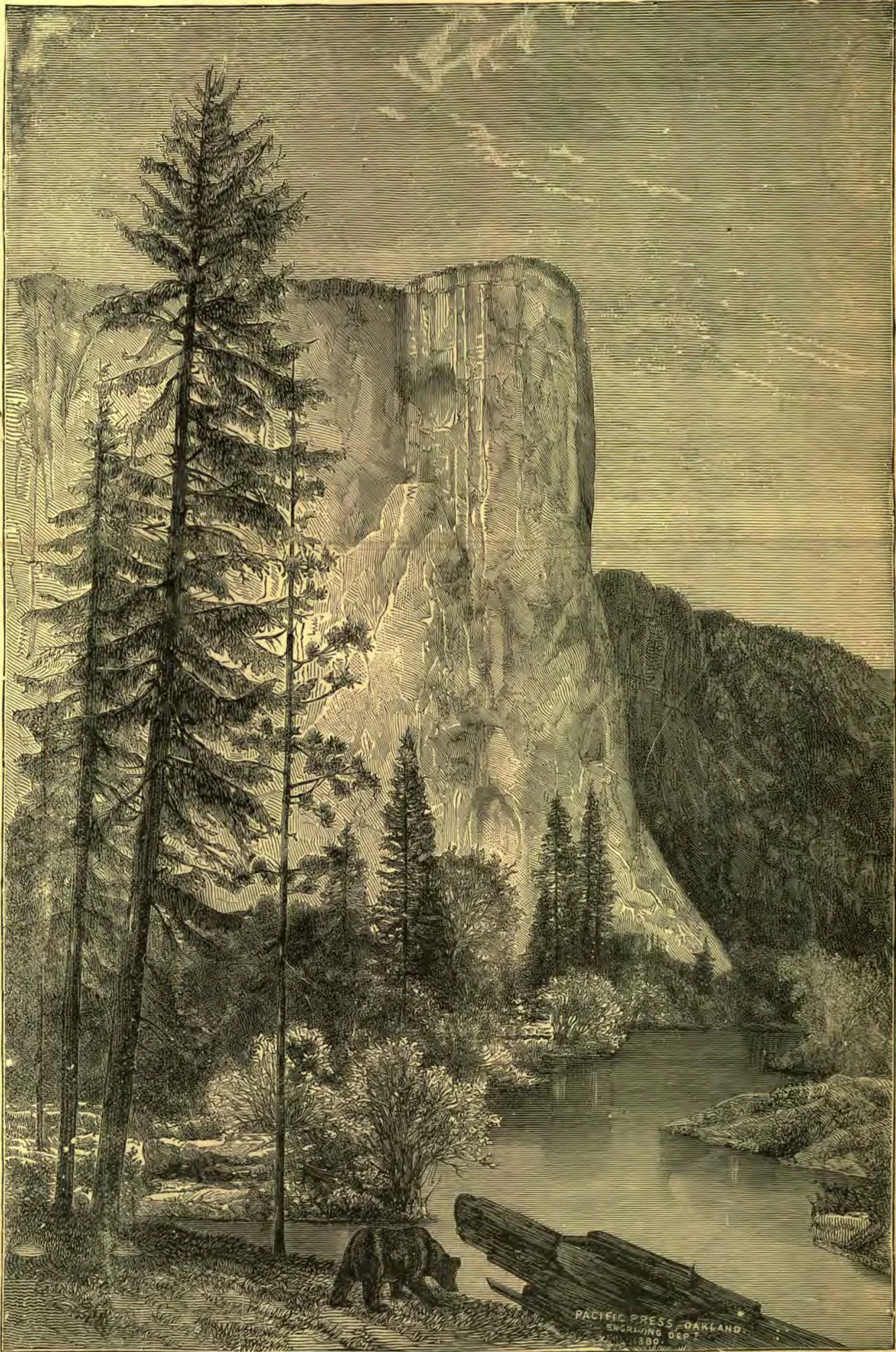
EL CAPITAN, or the Captain, is seven thousand three hundred feet high. This peak is on the south side of the valley, and protrudes, on the south side, from the vertical about one hundred feet. There are very few signs of vegetation on the sides of this immense shaft of granite. Looking at the south wall, however, a short distance above the broken rock, a small indentation is seen in which is growing a pine tree about one hundred and twenty-five feet high, although it looks like a small shrub.
Cathedral Rocks are on the south side of the valley. The highest of the three is about six thousand six hundred and sixty feet in height. Bridal Vail Fall pours over the western side of one of them. Cathedral Spires are also on the south side of the valley, and are about six thousand six hundred and seventy-eight feet high.
The Three Brothers are on the northern side of the valley. The highest of them is Eagle Peak, which is seven thousand eight hundred and thirty feet high.
At the south again is the Sentinel. It is seven thousand and sixty-nine feet high. Only one woman has ever gained its summit. She put on its highest point a white flag, which has stood the storms for ten years.
EL CAPITAN.
EL CAPITAN.
Sentinel Dome also is on the south side, and is eight thousand one hundred and sixty feet high. There is a good trail from this dome to Glacier Point, which is about one mile farther north. A road from Wawona to Glacier Point passes by the eastern side of the dome. Glacier Point, on the same side of the valley, is seven thousand two hundred and fifty feet high. Many people remain at the hotel on this point to see the sun rise and set, which is indeed a grand sight. There is a railing on the highest point, so tourists may safely view the valley. By this railing is an American flag on a long flagstaff; although the flag is eighteen feet long, it has the appearance of a small handkerchief, from the valley. This point affords a view of nearly all points of interest and also of a vast expanse of snow-fields. From here rainbows can be clearly seen over the Vernal and Nevada falls about the middle of the afternoon.
A grand display of fire-works is occasionally given at night for the entertainment of the tourists in the valley below. The blowing of a horn, which can be distinctly heard from all parts of the valley, announces the beginning. Then large burning brands and cones, taken from a fire built for the occasion, are hurled over the precipice. Shouts of applause or loud noise of any kind may be heard throughout the valley.
Yosemite Point is on the north side of the valley and on the east side of Yosemite Fall. It is six thousand and thirty feet high. Indian Canyon is east of Yosemite Point. This is a deep gorge by which the Indians used to enter and leave the valley. There used to be a trail up this canyon to Yosemite Point.
Half Dome is nine thousand feet high. In 1875 a man named Anderson made a rope-ladder about a thousand feet long. With the aid of the ladder he drilled holes into the solid rock, into which he drove wooden pins with iron eyes fastened to them. He would drive a pin into a hole, stand on the pin, and drill another hole; and he kept at it till he reached the top.
Royal Arches form a part of the northern wall opposite Glacier Point. The loftiest peak is about six thousand feet high. A good view of the Royal Arches by moonlight will not soon be forgotten. North of Half Dome is North Dome, seven thousand seven hundred feet high.
Grizzly Peak is on the north side of the valley. Only two persons have ever reached its summit. Cloud’s Rest is also on the north side of the valley. It is nine thousand seven hundred feet high.
Mirror Lake is at the base of Half Dome. The Indians named the lake Sleeping Waters. You must be there early in the morning in order to see the sun rise over the mountains, and the beautiful rainbow which encircles it then.
DOULY GRAY.

JOHNSTOWN

There is nothing about this city to arrest the attention but for its history and one or two points within its limits. By the people of Pennsylvania it will never be forgotten. Many hearts were saddened by the cruel deluge which swept it away in 1889, and the tourist from neighboring states cannot fail to have his sympathies excited when he witnesses the marks of destruction, or hears the woeful tale of sorrow from those who survived. Many homes were washed away, with the lives which cannot awaken to tell the terrible agony which they experienced in those perilous hours.
After a heavy rain, the earth became so yielding that it sent its overplus water against a large reservoir, near the city, whose sides were not strong enough to resist the pressure.
As the volumes of water came down the stream, which usually is only a shallow current, winding about the town in a lazy sort of way, the terrified people sought refuge in the upper stories of their homes; but those beneath the hills soon saw it was impossible to find shelter, short of some elevated retreat.
Perhaps the charity of the people was more like that described in the second chapter of Acts than it had been before or has been since that time. Cottages accommodated more than a mansion ordinarily would.
The consternation of those in the wake of the enemy of their lives, caused them to flee to the heights which could not be reached by its devastating power. Notwithstanding their attempts, many were swept away beyond recovery. After long struggles, some were beaten about for several hours upon driftwood, floating houses, or debris which afforded a place of security, until picked up by those delegated to go out in row-boats to rescue the perishing.
Many families perished, either in greater part or entirely. One man, upon coming home at evening, found that his wife and three children were lost; a lady lost her husband and eight children. Could it be thought strange if persons thus afflicted should lose their minds?
Many of the terror-stricken people thought the last great day was upon them, forgetting the bow of promise which our heavenly Father hung out upon the clouds, ages ago, for all mankind.
Above the city, upon a mountain, rest eight hundred and thirteen souls, unidentified and unclaimed. While a coldness is implied in this thought, they are much better cared for, and more beautifully located, than could be supposed, since they are buried at the expense of a public tax.
Grand View cemetery is reached by a serpentine road which spans the face of the mountain at each stretch, before turning to retrace the direction. It bends four or five times, gradually ascending, as it crosses the mountain front, to each turn until the altitude is reached, and continues in a graceful curve around to the west side, through a beautiful gateway of strong stone-mason work. On either side of the large gate are smaller ones for pedestrians. The road, starting from a street in the city, is made of fine pieces of gray granite, worked down very smooth, and well drained, making it as attractive for driving and cycling as a boulevard.
That part of the cemetery occupied by the unidentified, is laid out in the form of a square, and the interments are upon slightly curved lines.
Standing at the head or foot of this geometrical arrangement, diagonal lines of marble slabs can be traced to right and left of a direct front view, intermingling in such a way as to form the letter w, as a sort of monogram. The headstones and footstones are alike, being of the same size and shape, and made of the same kind of marble. Their pallid faces bear no epitaphs to make the lineaments which appear upon most loved ones' tombs. No stony seraphs cover them 'neath their snowy wings; yet a beautiful group of marble figures overlooks the white village, keeping silent watch that no ravaging foe disturb them again, their statuesque hands pointing to that other resting-place.
So far above the city is this beautiful site, that the houses look almost like a collection of toys, especially if the visitor finds himself so fascinated with the excellencies of nature as to remain there until the approach of eventide. Quietly night seems to draw her hazy vail over the valley, obscuring the town, except those more conspicuous features which cannot be hidden. A church spire here and there sends its obelisk form up through the shadows; also the smoke from many a chimney, or the blaze from an iron furnace, lighting the cloud surrounding it. These cannot be hidden until deep night exercises full sway over the entire valley, hiding everything in the somber folds of its chill mantle.
To some, these pyramidal forms which surround Johnstown might be oppressive, but to the inhabitants of this place, they no doubt are the very walls of home. In the time of autumn, their sides are a gorgeous display of tints and gay colorings. Just as far as the eye can penetrate, almost any time of year, the hand of nature's God is manifest to a wonderful degree. The utilitarian could not augment his ideas, while looking upon these slopes unless, perhaps, he might see upon them quantities of lumber in the growing pines and the variety of other timber. The question arises to such, How to get it? for acres upon acres turned up on edge are useless, not being accessible by any means of conveyance. There are places, whose heights are less precipitous, which are quite valuable.
Within the city, one of the mountain summits is reached by a cable line, which affords for pleasure-seekers a fine lookout to scenes away in the distance. After night, the sight is almost celestial, suggesting the pathway to the heavenly city. At the end of the railway are to be seen the lights of the electric motor which propels the cars. Following down the track, the rays appear like a lighted path from heaven. Approaching the city by night an impression of sublimity, very different from anything else in one's experience, is made by the scenes just described. C. FLORENCE R. WHEELER.

JAPANESE ATHLETICS.

ATHLETICS hold an important but subordinate part in the schools of Japan. Once a year there is a gathering of all the students in a district to engage in athletic contests. In those seen by Mr. Hearn, and described in “Glimpses of Unfamiliar Japan,” six thousand boys and girls from all the schools within a distance of twenty-five miles were entered to take part. A circular race-track, roomy enough for an army, allowed four different kinds of games to be performed at the same time.
There were races between the best runners of different schools, and races in which the runners were tied together in pairs, the left leg of one to the right leg of the other.
Little girls—as bright-colored as butterflies, in their sky-blue hakama and many-colored robes—contested in races in which each one had to pick up as she ran three balls of different colors out of a number scattered over the turf.
The most wonderful spectacle was the dumb-bell exercise. Six thousand boys and girls, massed in ranks about five hundred deep; six thousand pairs of arms rising and falling exactly together; six thousand pairs of sandaled feet advancing or retreating together at the signal of the masters of gymnastics, directing all from the tops of little wooden towers; six thousand voices chanting at once the “One, two, three,” at the dumb-bell drill—“Ichi, ni-san, shi-go, roku-shichi, hachi!”
The games began at eight o’clock in the morning, and ended at five in the evening. Then at a signal fully six thousand voices pealed out the national anthem, and concluded it with three cheers for the emperor and empress of Japan. The Japanese, instead of shouting when they cheer, chant with a long cry, “Et-a-a-a-a-a!” which sounds like the opening tones of a musical chorus.

Ruling Houses of Europe and Their Origins

Of the forty monarchical countries at present found on the map of Europe, thirty-three are governed by members of descendants of German families. Of these twenty-two are in the German empire and eleven outside of Germany; namely, Belgium, Bulgaria, Denmark, England, Greece, Lichtenstein, the Netherlands, Austria-Hungary, Portugal, Roumania, Russia. The reigning families in Spain, Sweden, Italy, and Monaco are of Romaic origin, although those of Savoy and Spain, while Bourbon, are strongly mixed with German blood. Of Slavic origin are only the house of Petrowitch-Njegosh, reigning in Montenegro, and that of Obrenovich, reigning in Servia; this last also is not of unmixed blood. The sultan is of Turanian origin. The forty rulers in Europe are derived from twenty-six different families, and of them seventeen are German.—New York Independent.

THE EASTERN QUESTION.

PART III.—“THE SICK MAN OF THE EAST.”

In 1610 the Mohammedan Moors were driven into exile, and Spain was at last wholly Catholic. But that was no gain; for her arts and industries began to decay, and have never attained their former perfection.
In 1683 the Turks besieged Vienna, and came very near taking it, when it was relieved by the gallant Polish general, Sobieski. Since that time they have perpetrated many cruelties on the Christians (Greek Catholics) in their dominions. The Greek Catholics differ from the Roman, or Latin, Catholics in several particulars. They do not acknowledge the pope as the head of the church; but as that is not just to the point, we will here take up the study of England and Russia, for they are now directly concerned in this Eastern question.
1606 England founded colonies in India through the East India Company, which assumed control of the country. The natives revolted, and Lord Clive, an Englishman, successfully conducted the conquest of India in 1757. One hundred years later, at another rebellion of the princes of India, they were completely subdued, and India was annexed to the British crown in 1857.
In 1828 the Greeks revolted from Turkish rule. If you never have heard it, you may be interested to know that the celebrated Lord Byron went to assist the Greeks. The following lines must be very familiar to you:—
“Strike till the last armed foe expires; Strike for your altars and your fires; Strike for the green graves of your sires, God, and your native land.”
They are from “Marco Bozzaris,” and commemorate the memorable struggle when Greece obtained her independence. At this time, Czar Nicholas I of Russia, taking advantage of the sultan’s embarrassment, started to attack his capital at Constantinople. England objected to Russia’s getting possession of this stronghold, for Russia would then have the right of way through the Straits of Dardanelles, the Mediterranean Sea, the Suez Canal, the Red Sea, and the Indian Ocean, to her East Indian possessions. (Please refer to your map.) That would not please England at all; so, united with the Austrians, the English forced the Russians to stop their march, and form a treaty. Servia became independent, and the czar took some provinces bordering on the Black Sea. Czar Nicholas I called the sultan the “Sick man of the East.”
In 1853 a quarrel between the Greek and Latin Catholics at Jerusalem was made the ground by Nicholas for demanding of the sultan a recognition of his power to protect all Greek Catholics in the sultan’s dominions. (The Russians are Greek Catholics.) This demand was rejected, and Nicholas prepared for war, whereupon the sultan appealed to the western powers for help. England, France, and Sardinia (now Italy) joined the Turks.
Before this, Russia had cultivated friendly relations with England, and proposed that they should divide the “Sick man’s estate” between them. The proposition was that Russia should take all the provinces in Europe, and England take Egypt and the island of Crete. But England would not consent to Russia’s having Constantinople. So at the time of this quarrel at Jerusalem and the sultan’s refusal to acknowledge a Russian protectorate over the Greek Christians, the czar resolved to take Constantinople. The main struggle centered around Sebastopol in the Crimea, Russia’s great naval and military depot. Around this the allies of the Turk were gathered (1854), one hundred and seventy-five thousand strong. The siege of Sebastopol is one of the most memorable in history. It has been immortalized by Tennyson in his “Charge of the Light Brigade”:—
“Cannon to right of them [the English], Cannon to left of them, Volleyed and thundered”
in the English charge at Balaklava. The Russian engineer Todleben earned great fame by his masterly defense of the works. But the Russians were forced to evacuate. They burned the place before leaving. This war is known in history as the Crimean war. It was here also that Florence Nightingale figured so conspicuously and heroically as a nurse, and it was of her Longfellow wrote in his poem, “Santa Filomena.” LORETTA REISMAN.

THE GRUMBLER.

HIS YOUTH.

His cap was too thick and his coat was too thin; He couldn't be quiet; he hated a din; He hated to write, and he hated to read; He was certainly very much injured indeed! He must study and toil over work he detested; His parents were strict, and he never was rested; He knew he was wretched as wretched could be,— There was no one so wretchedly wretched as he!

HIS MATURITY.

His farm was too small, and his taxes too big; He was selfish and lazy, and cross as a pig; His wife was too silly, his children too rude, And just because he was uncommonly good! He hadn't got money enough and to spare; He had nothing at all fit to eat or to wear; He knew he was wretched as wretched could be,— There was no one so wretchedly wretched as he!

HIS OLD AGE.

He finds he has sorrows more deep than his fears; He grumbles to think he has grumbled for years; He grumbles to think he has grumbled away His home and his children, his life's little day; But alas! 't is too late! it is no use to say That his eyes are too dim and his hair is too gray; He knows he is wretched as wretched can be,— There is no one so wretchedly wretched as he!
— Dora Read Goodale.

WHAT THE CLOCK SAYS.

“Tick,” the clock says, “tick, tick, tick; What you have to do, do quick; Time is gliding fast away; Let us act, and act to-day. When your mother speaks, obey; Do not loiter, do not stay; Wait not for another tick; What you have to do, do quick.”
— Selected.

The Month Without a Full Moon

FEBRUARY, 1866, is referred to by astronomers as “the month without a full moon.” January and March of that year had each two full moons, while the intermediate month did not have one. Says a writer in an astronomical journal, referring to this fact: “Do you realize what a rare thing in nature it was? It has not happened before since the beginning of the Christian era, or probably since the creation of the world! It will not occur again, according to the computations of the astronomer royal of England, for—how long do you think? Not until after two million five hundred thousand years from 1866!”

Feigned Ill Health and Idleness

THERE are those who love to think they have poor health, when they are simply lazy.

NATURE'S PLEDGE.

WE are all born to drink no other fluid than water. Why should we ever depart from it? Why break the pledge which nature has given, and make man cease to be what he was intended to be? Not one bit of good ever comes from the trial. When we take a pledge with nature, there is no service rendered ourselves by the breaking of it. This substance called alcohol, goes to form no tissue or give warmth. It imperfectly dissolves everything in the way of food which comes in contact with it, interferes with the digestion and the distribution of food, produces false products in the body, disease in the organs of the body, sadness always after a time, aberration of mind, so that at least fourteen per cent of the unfortunates in our asylums are there because of its presence. It makes diseases, some of which are specially its own and are called after it; and we can calculate by figures what will be the value of life in a person who is freed from this agent, and the value of life in one who continues to take it. This in common sense should make every one of us resolve to go back to nature if nature has been departed from, and to let our lives pass from beginning to end in pure obedience to nature and in obedience to that Power from which all nature springs.—Benj. Ward Richardson, M. D.

UNWHOLESOME DRINKS.

The danger of using impure water is sometimes offered as an apology for the use of beer and other alcoholic drinks. This is certainly a very poor excuse. Beer is simply a mixture of water with alcohol and other substances, and it not infrequently happens that impure water is used in its manufacture. It thus appears that one who seeks to avoid danger from impure water by using beer doubles the danger instead of diminishing it. The folly of this method of avoiding the danger from impure water is still more apparent when we remember the fact that beer is sometimes adulterated with very poisonous substances, which are more harmful even than alcohol.
Beer, ale, wine, and other alcoholic drinks will not take the place of water, since the alcohol which they introduce into the system produces a feverish condition, by which there is created a demand for more water than the system naturally requires; thus the thirst may be increased rather than quenched. Mead, small-beer, and similar drinks only differ from other alcoholic drinks in the amount of alcohol which they contain, and are not proper substitutes for water. One great danger in the use of these beverages is the fact that they create an appetite for stronger alcoholic drinks.
Tea and coffee are often used as substitutes for water, but are much inferior to the latter for quenching thirst. They are undoubtedly to some extent harmful, and when freely used may become a source of serious disease. The excuse that impure water is less dangerous if taken in the form of tea and coffee has some slight foundation, since the most dangerous impurities of water are destroyed by boiling. It is evident, however, that water may be boiled without the addition of tea or coffee.—From “Second Book in Physiology and Hygiene,” by J. H. Kellogg, M. D.

THE SANCTUARY AND ITS SERVICE.

PART I. — THE SANCTUARY AND ITS PRINCIPAL FURNITURE.
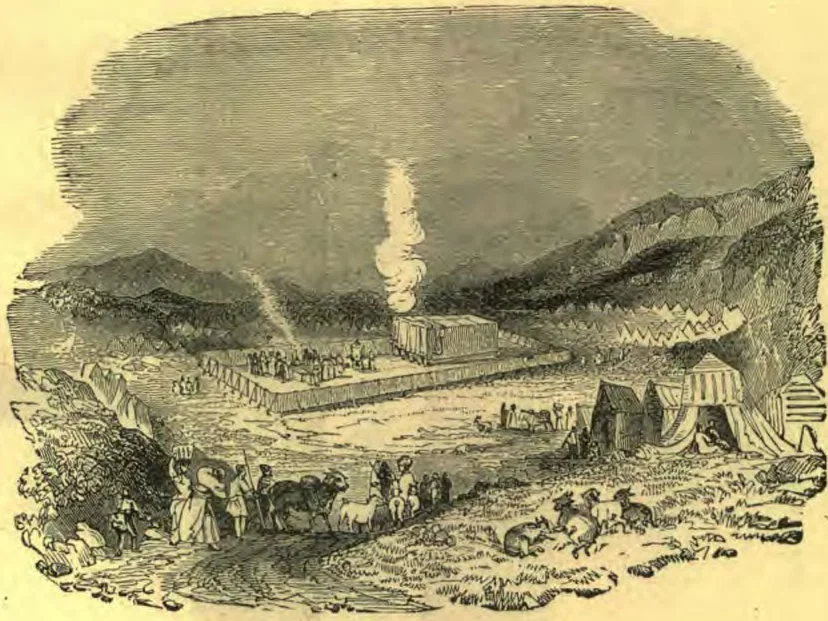
THE SANCTUARY IN THE WILDERNESS.
The tabernacle built in the days of Moses is described very minutely in Exodus, chapters 25 to 40. It was composed of two apartments, separated by a vail. The first, called the holy place, was twenty cubits (about thirty feet) long, ten cubits wide, and ten cubits high. The second apartment was called the most holy place. It was ten cubits in each of its dimensions, and hence it was just half as large as the holy place. The sides of both apartments, and the rear, or west end, were composed of boards made of acacia wood overlaid with gold. The boards were secured at the bottom by means of tenons, made on the lower ends of the boards, which fitted into sockets, or bases of silver, each of which weighed a talent, or about one hundred pounds (Ex. 26:19-23; 38:27); while at the top, bars were placed through rings which were attached to the boards, and thus they were held securely in position.
The thickness of the boards is not given in the sacred record. “Josephus says that they were four fingers thick. This would make the width of the corner boards half a cubit and four fingers.”
The door of the tabernacle consisted of a curtain, or vail, hung upon five pillars; and a similar curtain called the second vail, hung upon four pillars, separated the two apartments. The top of the tabernacle was composed of curtains, which hung down over the boards on the outside. The curtains which composed the door, the second vail, and the top, were made of linen, beautifully wrought with cherubim, emblematic of the heavenly angels, which surround the throne of God. Over this was spread first a curtain of goat’s hair for protection, and this was called the tent of the tabernacle. Above this were placed the other curtains, one of ram’s skins dyed red, and another of badgers’ skins (or seals’ skins, according to the best authorities).
Bible scholars differ in regard to the arrangement of these curtains. Bähr, Kiel, Fairbairn, and some others assume that the innermost curtain hung down on the inside of the framework, being supported by rows of hooks attached to the top of the boards. Fergusson (in “Smith’s Bible Dictionary”) supposes that the central pillar of the front of the tabernacle was fifteen cubits in height, with a corresponding pillar at the rear end and one between them, and that these pillars supported a ridge-pole, over which the three top curtains were placed, the linen curtain being first placed on flat, and attached to the upright boards so as to hang down on the inside, thus making the walls and ceiling consist of the same material, and present the same appearance. The main argument for this arrangement is that there must have been a roof to shed the rain. [The reader should not forget, however, that the tabernacle was made after the “patterns of things in the heavens,” and not vice versa, and that it is not likely that the heavenly sanctuary is exposed to rain! Added rainsheds were not part of it.—EDITOR.]
Another view is that the first two curtains were placed on flat over the top of the boards, falling down on the outside, as indicated in Ex. 26:13, and that the other two were hung over a ridge-pole, so as to shed the rain. The view propounded by Barrows in his “Sacred Geography and Antiquities” is this, that the four curtains were simply placed on flat over the framework, extending down on the outside of the boards.
The furniture of the first apartment or the holy place, consisted of the table of showbread, the altar of incense, and the golden candlestick. The table of showbread stood on the north. It had a border round it, upon which was a crown of gold, and the table was overlaid with pure gold. “On this table the priests were each Sabbath to place twelve cakes, arranged in two piles, and sprinkled with frankincense. The loaves that were removed, which being accounted holy, were to be eaten by the priests. It was called showbread, or bread of the presence, because it was ever before the face of the Lord. Ex. 25:30. It was an acknowledgment of man’s dependence upon God for temporal and spiritual food, and that it is received only through the mediation of Christ. God had fed Israel in the wilderness with bread from heaven, and they were still dependent upon his bounty both for temporal food and spiritual blessings. Both the manna and the showbread pointed to Christ, the living Bread, who is ever in the presence of God for us.
“On the south was the seven-branched candlestick, with its seven lamps. Its branches were ornamented with exquisitely wrought flowers, resembling lilies, and the whole made from one solid piece of gold. [It was worth about twenty-five thousand dollars.] There being no windows in the tabernacle, the lamps were never all extinguished at one time, but shed their light by day and by night. Just before the vail, separating the holy place from the most holy and the immediate presence of God, stood the golden altar of incense. Upon this altar the priest was to burn incense every morning and evening. The fire upon this altar was kindled by God himself, and was sacredly cherished. Day and night the holy incense diffused its fragrance through the sacred apartment, and without, far around the tabernacle.”
The second apartment contained the ark of God, or the covenant, sometimes called the ark of the testimony. This was two cubits and a half in length, and a cubit and a half in breadth and height. Like the boards of the tabernacle, the table of showbread, the altar of incense, and the altar of burnt offerings, which last-named was located in front of the tabernacle along with the brazen laver, the ark was composed of acacia wood, called shittim wood in our common English version. This is a very fine-grained, hard, durable wood, and was well adapted for the furniture of the tabernacle.
The cover of the ark was called the mercy-seat, at each end of which was a cherub, made out of the same piece of gold which composed the mercy-seat. The mercy-seat and cherubim were made of pure gold beaten out. In the ark, under the mercy-seat, were placed the tables of the law, upon which was written the law of God, or the ten commandments. “Above the mercy-seat was the shekinah—the manifestation of the divine presence; and from between the cherubim God made known his will. Divine messages were sometimes communicated to the high priest by a voice from the cloud. . . . No language can describe the glory of the scene presented within the sanctuary,—the gold-plated walls reflecting the light from the golden candlestick, the brilliant hues of the richly embroidered curtains, with their shining angels; the table and the altar of incense, glittering with gold; beyond the second vail the sacred ark, with its mystic cherubim, and above it the holy shekinah, the visible manifestation of Jehovah’s presence,—all but a dim reflection of the glories of the temple of God in heaven, the great center of the work for man’s redemption.”
It is estimated that the gold and silver employed in decorating this beautiful structure were worth not less than one million dollars.
The tabernacle was inclosed in an oblong court, one hundred cubits in length and fifty cubits in width. This court was without cover, and consisted of sixty pillars of brass, with silver capitals, or mountings, also hangings, or curtains, seventy on each side and ten on each end. These pillars rested in sockets of brass, which were fastened to the earth with brass pins. Ex. 38:10, 17, 20. The pillars were placed five cubits from each other, and as the curtains that hung upon them were five cubits long (Ex. 38:18), we conclude that the pillars were about the same length. The curtains were made of fine-twined linen (Ex. 27:9; 38:9, 16), except those for the doors, or entrances. Those were made of blue, and purple, and scarlet, and fine-twined linen, with cords to raise or slide them when the people entered the court. Ex. 27:16; 38:18. “The hangings of the court being only about half as high as the walls of the tabernacle, the building could be plainly seen by the people without.” M. H. BROWN.

DO GOOD.

Do all the good you can. By all the means you can, In all the ways you can, In all the places you can, At all the times you can, To all the people you can, As long as ever you can.
Continue reading: LESSON 11.—THE JUDGMENT MESSAGE