The Youth’s Instructor, Vol. 35, No. 3.

THE MAORI HOUSE

The Youth’s Instructor

Jan 19, 1887

S. D. A. Publishing Association · Battle Creek, Mich. · Jan 19, 1887

THE MAORI HOUSE.
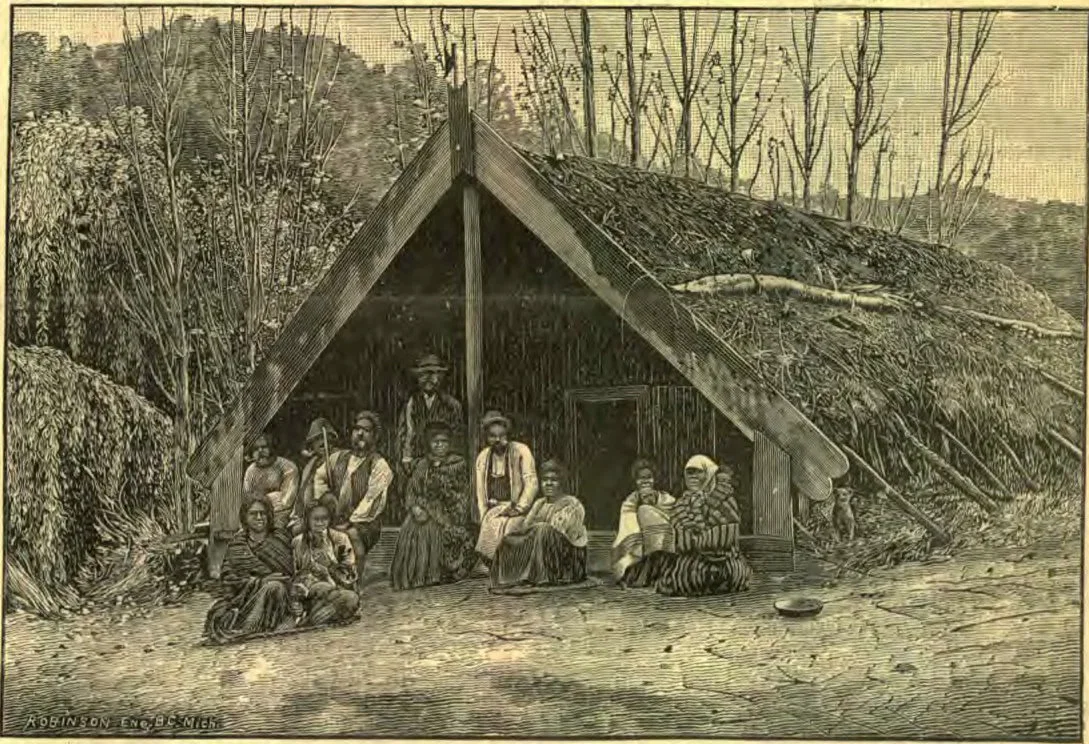
Our artist has presented us this week with a picture of a Maori’s house, or whare-puni, as it is called; meaning, literally, a sleeping-house. These whare-punis vary much in style and finish. The one before us is such as is found in the King Country, a part of New Zealand under the exclusive control of a king, while the remaining portion is under the supervision of the British Government. Those residing in this country are permitted to live by themselves, and make their own laws, without molestation from those around them. The whare-puni presented to us in this illustration is one belonging to the middle class of people. It is larger than the ordinary size.
All the houses are built after the same plan, the usual size being about eight by sixteen feet, though some are much larger, and others are very small indeed. The frame-work of the house is of wood, the posts, ridgepole, and rafters being cut to fit into one another, and then securely lashed. The roof is thatched with rushes, and extends sometimes ten feet beyond the gables of the whare, this projection serving as a veranda or portico, which is raised up from the ground in front by a wooden wall about three feet high, running across from side to side. There is no gate to this wooden barrier; but for a few feet before the doorway, it is made sufficiently low to be stepped over. The post rises from the middle of this barrier to support the ridgepole; and upon the various posts are frequently seen wood carving, sometimes very elaborate.
If the whare is one of the best, it has, upon the post supporting the roof, one of those grotesque Maori images, similarly represented in all Maori carvings, the head large, with lolling tongue; the body long, and the elbows projecting at a sharp angle; the fingers and hands placed over the stomach; the thighs ill-shaped, and the lower extremities generally thick and not clearly defined. The two broad and massive slabs of wood forming the two uprights, on which rest the beams sloping to the wooden walls, as well as the beams themselves, are almost invariably ornamented with carvings of fantastic design. Horrible monsters, which they consider to be the ancestors of the tribes, writhe and twine in and out with a puzzling intricacy of design. In the best houses, every visible piece of wood is ornamented in this manner. The one presented to us in the picture does not display all of these carvings, which are only to be found in the first-class houses.
If you step over the low wooden barrier, and enter the whare, which you can do without difficulty, you will find that the interior does not present a very neat appearance. If you pass it in the evening, you may possibly find the family group gathered in a festive circle around the family tin basin and the black kettle. The tin basin contains an unsavory and ill-looking mess of pipis. The kettle is filled with weak tea, which the family drink from tin mugs, two or three using one mug. With this, they eat their bread and cured fish. The food, such as it is, seems to be plenty, for the victuals lie in profusion about the earthen floor, and at the close of the meal are gathered up and stowed away for the next repast. It will be noticed that in front of this whare sits a large family. Many of them have their pipes in their mouths. When smoking inside of their whares, the interior, having only a low door, and one small opening to let in the air, or rather to let out the smoke, is very poorly ventilated.
The ladies of distinction are very dignified, and move with stately grace, holding their heads well back, and swinging the arms with an easy motion. They have plentiful blue-black hair. A woman of fashion is tall, with a massive, heavy face, broad shoulders, and hair falling down in heavy masses; or, if the hair is wiry and irrepressible, it may radiate in a frizzy glory around her head. It may be you would find her dressed in a scarlet tunic, with a black skirt, or in a black tunic and a scarlet skirt. Perhaps the tunic will be striped, or of many colors, being thrown back over the shoulders, and falling down in easy folds.
The old Maoris are unpleasantly fond of shaking hands with the white stranger. This may be to a certain extent due to the helplessness and loneliness of old age, which, among the Maoris, is very unlovely, so that they are thankful for the notice of even an alien. The aged Maoris, are much more courteous than the younger ones, who are often shy, reserved, and sometimes sullen. Association with the white man has made them less hospitable than formerly, when they would have scorned to charge any fee for entertainment or hospitality shown even a stranger. If we meet a Maori and hold out the hand, he will bow his head as we approach, and shout a friendly tena-koe; (Here you are!) and if you come close to them, they will chatter to you, as though you understood all they said. A Maori village is a most interesting sight, and not the least interesting feature is the youth and children. They are full of fun, as indeed are their elders, and jest and tease each other good-naturedly, with much shouting and laughter.
Each whare is surrounded by a garden, where they cultivate various kinds of vegetables. Originally the cultivation was confined to the kumera, or sweet potato, and the taro, a wild plant, which by cultivation was rendered more suitable for food. Their food consisted of these plants, and of eels, sea fish, rats, dogs, and wild fowl. The nearest approach to bread was made from the root of an edible fern, not very wholesome or palatable. This of course is now very different.
You will notice a dog at the right hand of the picture. In New Zealand the dogs of the present day are very different from what they were many years ago. The native dogs have become extinct, and the mixture of European blood has not improved their appearance. It might be said that the New Zealand dog is a sort of nondescript animal, a mixture of all conceivable breeds, mangy, starved, and sullen. No two dogs are alike in size, shape, or color. One thing they represent as a unit, and that is cruelty and starvation.
The Maoris are an indolent people. They build their whare, or sleeping house, remaining in one place until the ground has been cultivated a few years, and then go to another place. There is one feature, however, among the Maoris, which is very commendable. They are religiously inclined, and as a general thing they are moral. They have their idea of moral purity, and any transgression of it is considered a crime of the worst character. At the present time, most of the Maoris profess Christianity, but they know but little of its power. S. N. HASKELL.

THE PROMISE KEPT.

AMONG the seventy-two prisoners condemned and thrown into the “cave of death,” during the horrors of the French Revolution, was a brave, high-spirited young fellow named Couchoux. His old father, nearly eighty years old, had been his fellow-prisoner, and now awaited with him the cruel death of the guillotine.
When first put into the cave, the prisoners expected with certainty that the next sunrise would be for them the last on earth; but the mob government, which scoffed at God’s laws, had a law of their own that on each tenth day, or decade as it was called, there should be no work done, not even by the bloody guillotine.
Now it happened that the day after the transfer of these prisoners to the cave of death was the decade; they would consequently have a miserable respite of a day.
Young Couchoux spent the time in alleviating, as far as he was able, the sufferings of his poor father; dressing the ulcerated sores which prison life and fare had caused the old man, and stripping off his own tattered garments to make him a bed.
The night of the decade came, and exhausted with hunger, young Couchoux lay down beside his father, and was sinking into a heavy sleep, when a low voice in his ear startled him into keen wakefulness, causing his young blood to bound hopefully through his veins.
A plan of escape had been devised and set on foot by a bold spirit among the prisoners, and Couchoux being young and strong, had been selected as one of the five to put it into execution.
It is not within our present compass to tell the strange story of their escape, of the severe labor with file and chisel and pickax which they went through only to find themselves inclosed in vault after vault of unpromising thickness and security. The end, however, of their indomitable resolution, perseverance, skill, and toil, was the finding of a stairway which led up into the court, by which, through another set of dangers, there was a chance of escape.
It was now agreed that the five should return to the cave, and each man give notice to two others of the chance thus secured of escape; they were to pass out three and three, at intervals, to avoid suspicion, and the last three were to warn fifteen others, and so on, until, it was hoped, all might escape.
It may be said here that the plan was only partially successful, and that the indiscretion of some caused many others to lose their lives. Young Couchoux’s fate interests us most: he came back to the cave, and with much difficulty aroused his father, and told him of his purpose to escape, and to rescue him likewise from death. But the man refused to go: “I am old and feeble and lame,” he said, “and will greatly endanger your chance of escape; moreover, the sands of my life have almost run out; I can at best have but a little while to live, and that short time would be imbittered by my past sufferings, by all that I have lost, and by the unhappy state of my country. Fly, my son, I entreat. I command you; fly, and my last moments will be sweetened by the knowledge of your safety.”
But the son remained firm to his purpose; he assured his father that he could succeed in getting him out, but that if he still refused to go, his doom was sealed, for nothing would induce him to leave his father in such a situation. Upon hearing this, the old man yielded; and supported and guided by his son, he managed to hobble through the darkness to the foot of the stairway; there strength and hope alike failed, and he renewed his entreaties to the young man to leave him and fly.
Then the son, though a much smaller man than his father, took him up in his arms; love and duty and hope gave him strength; he reached the top, and escaped to a place of safety.
Thus, while more than half the prisoners were defeated in their efforts to escape, the promise of the commandment was kept to this dutiful son: “Honor thy father and thy mother, that thy days may be long upon the land which the Lord thy God giveth thee.”—Elizabeth P. Allan.

THE NEW YEAR.

WHITE book of the new year, behold with awe! Upon thy leaves what record shall we make? Will Time, the searcher, find within thy lids But blotted lines, and many a sad mistake.
When thou art clasped, and with the volumes past Art laid away? Therein our fate we write. The sum of all the years our sentence is. How will it bear eternity's clear light?
If, like a teacher steadying the hand Of a young child, God's hand holds ours all through, We shall, when looking backward from the end, Rejoice to find the writing fair and true. —S. S. Times.

THE BRIDLE.

“Don’t go without a bridle, boys,” was my grandfather’s favorite bit of advice.
Do you suppose we were all teamsters or horse jockeys? No such thing. If he heard one cursing and swearing, or given to much vain and foolish talk, “That man has lost his bridle,” he would say. Without a bridle, the tongue, though a little member, “boasteth great things.” It is “an unruly evil, full of deadly poison.” Put a bridle on, and it is one of the best servants the body and soul have. “I will keep my mouth with a bridle,” said King David, and who can do better than follow his example?
When my grandfather saw a man drinking and carousing, or a boy spending all his money for cakes and candy, “Poor fellow,” he would say, “he’s left off his bridle.” The appetite needs a reining; let it loose, and it will run you to gluttony, drunkenness, and all sorts of disorders. Be sure and keep a bridle on your appetite; don’t let it be master. And don’t neglect to have one for your passions. They go mad if they get unmanageable, driving you down a blind and headlong course to ruin. Keep the check-rein tight; don’t let it slip; hold it steady. Never go without your bridle, boys.
That was the bridle my grandfather meant—the bridle of self-government. Parents try to restrain and check their children, and you can generally tell by their behavior what children have such wise and faithful parents. But parents cannot do everything. And some children have no parents to care for them. Every boy must have his own bridle, and every girl must have hers; they must learn to check and govern themselves. Self-government is the most difficult and most important government in the world. It becomes easier every day if you practice it with steady and resolute will. It is the fountain of excellence. It is the cutting and pruning which makes the noble and vigorous tree of character.

W. S. C

SEA TALES.—NO. 12.

To the south of the Hermite group, spoken of in my last, and distant about fifty-six miles, lie the Diego Ramirez Islands. They extend about five miles, are very narrow, and only about 100 feet in height above the sea. They are evidently the ridge of a mountain under the sea, broken through in many places by the action of the waves. Our course carried us between these islands and the Horn, the captain wishing to give me an opportunity to sketch both, which I succeeded in doing, notwithstanding I had to lash myself to the rail; and while drenched with spray, cling desperately to the bits as the vessel pitched into the sea.
By noon of the next day, we had Staten Island abeam. It lies off the southeastern extremity of the American continent. The otter, rat, and mouse are the only quadrupeds on the island; but it is the home of millions of birds, among which are the penguin and shag-duck, the latter in large flocks, building their nests in the loftiest trees. By sundown we had passed the Falkland Islands, called by the French Malouines, and by the Spanish Malvinas, now in possession of the English, who have a settlement and naval station at Port Stanley on the East Falkland. This station was, I believe, nearly destroyed recently by a convulsion of nature.
A peculiar feature in the geology of these islands is presented in the streams of stones, or fragments of quartz, which appear to flow down the hills! These streams are from twenty to thirty feet wide, and the stones vary from one to five cubic feet, and are spread out in the valleys to a great extent. Somewhat remarkable, also, is the fact that these islands produce no trees; but there is an endless variety of sweet-scented flowers, which in November and December (summer there) nearly cover the ground. The Tussac grass, a gigantic sedgy grass with blades seven feet in length and three quarters of an inch in width, is abundant among the mosses of the beach. Both hair and fur seals and sea elephants once made it their home along the shores, but have been frightened off, while whales frequent the shores at certain seasons. Of this fish, or rather animal, I shall have more to say hereafter. Penguins may be found fully three hundred miles from the land, but the diver bird called “shag” is rarely seen more than ten miles off shore, and serves as a guide to vessels running in thick weather.
After supper I was standing on the quarter deck looking out over the sea, which was so calm and still, thinking with a shudder of the awful waves that dashed over us as we rounded the Horn, and wondering if it were possible that this quiet, lake-like body of water could be the same sea that piled itself into mountains then, when, on the star-board bow, I heard a cry that made my heart almost stand still, and filled me with terror. It was a cry that sounded like the exclamation oh! long drawn out oh-h-h! a despairing appeal for help from a being apparently in mortal agony. My first impression was that the man on the look-out forward had fallen overboard. I jumped to the port side, and looking under the foresail, saw that he was still quietly pacing his beat. Again that horrible cry came from the sea, Oh-h-h! this time just aft of the foremast and about two hundred feet from the vessel. Eagerly I scanned the surface of the water, hoping to see some floating object to verify my suspicion that the cry came from some one shipwrecked and floating by; but a solitary blackbird, lazily pluming his feathers, was the only object that met my eye. Soon the cry rang out again on the night air, this time still farther from the vessel, and abeam of the quarter deck. A chill feeling of horror began to creep over me. I sprang up the shrouds, and scanned the waters carefully, but the solitary bird was all that I could see. Suddenly, while looking intently in the direction from which the sound had come, I saw the bird flap its wings, rise slightly from the water, and utter the cry, Oh-h-h! It was a penguin.

W. S. C

TIME-KEEPERS

Those useful articles, clocks and watches, are now very common, and no one would think of trying to get along without them. How could we travel or transact business without their aid? We would feel their loss very much indeed, and would hardly know how to get through the day.
It may not be understood by most of the young readers of the INSTRUCTOR that clocks are a modern invention. Even the kings of ancient times did not have them. Five or six hundred years ago, crude and imperfect ones were produced. It took years to bring them to the perfection in which we see them to-day.
But you may wonder how the people managed to get along without time-keepers. At first tall pillars were set up, and the time was marked by the shadows falling on them. Of course these would do no good on cloudy days nor after sunset. Some suppose that the obelisks of Egypt were used for this purpose. The emperor Augustus had some of these shafts conveyed to Rome to be so used.
After awhile more portable time-pieces were devised. The sun-dial, it is said, was invented by the Babylonians. In it a good degree of skill and ingenuity was manifested. Dials are so arranged that a shadow marks off the hours by passing over certain spaces defined by lines. Some of these were quite elaborate and ingenious in construction, being fine pieces of workmanship. One found in the ruins of Herculaneum, in the year 1754, was in the form of a ham of bacon, and marked both the hours and the months. Such a dial as this was used by the ancient Greeks and Romans. Other dials were placed in the highways for the benefit of travelers.
The hour-glass was another contrivance for measuring time. It was so constructed that a quantity of fine sand would run through in just an hour. The glass could then be inverted, and the sand would run back in another hour. Eleven turns of the glass would mark twelve hours.
The clepsydra, or water clock, was an ingenious contrivance for marking time by passing water through the machine. This was used by the Greeks 500 B. C. As the water flowed through the machine, an index, or pointer, passed over a space marked with figures representing the hours of the day. A piece of wood or cork was made to float on the water; and as this lowered, the pointer passed down over the column of figures, and so marked the hours. Sometimes the clock was so made that the hand rose instead of falling, as the water rose and bore up the float before it. These machines did not mark time very accurately, since the weight of water continually varied as it ran out, the pressure becoming less as it passed through.
It is said that in the fourteenth century two clocks were made in Italy. Some think these were merely improved water time-keepers. But about A. D. 1100 an artisan in Germany constructed a piece of mechanism which approached the modern clock. Some suppose the Saracens were the inventors of clocks, and that they were introduced into Europe perhaps in the twelfth or thirteenth century.
Three or four hundred years ago, through the labors of skillful mechanics, clocks were greatly improved in construction and accuracy, and became more common. From that day to this, this machine has reached a degree of perfection almost marvelous.
Watches came into use in England just before the reign of Elizabeth. They were at first nearly as large as a saucer. They were gradually made smaller, sometimes being inserted in the head of a walking cane. Probably Dr. Hooke of England invented the modern watch.
A watch is now made almost entirely by machinery. These machines are themselves marvels in construction and operation. They seem almost human. By means of them screws are made almost too small to be seen by the naked eye. Some watches are called “stem winders.” There is a little device made in the watch by which it is wound. I read some time ago of a watch that was wound by opening and shutting the case. Was not this a wonder? There are what are called chronometer clocks and watches, which are very accurate in keeping time. They do not vary a few seconds in several months. I have now told you several things about time-keepers. I hope you will remember them. N. J. BOWERS.

LOVE AND LIGHT FOR THE NEW YEAR.

HAPPY New Year! O such may it be, Joyously, surely, and fully for thee, Fear not and faint not, but be of good cheer, And trustfully enter thy happy New Year.
Happy, so happy! thy Father shall guide, Protect thee, preserve thee, and always provide, Onward and upward along the right way Lovingly leading thee day by day.
Happy, so happy! the Saviour shall be, Ever more precious and present with thee; Happy, so happy! his Spirit thy guest, Filling with glory the place of his rest.
Happy, so happy! though shadows around May gather and darken, they flee at the sound Of the glorious voice that says, “Be of good cheer.” Then joyously enter thy happy New Year. —Havergal.

THE MINISTRATION OF ANGELS.

LESSON 1.—WHO THE ANGELS ARE.

1. Besides God and men, what other intelligent beings are spoken of in the Bible? Luke 15:10.
2. Is much said about them in the Holy Scriptures?—They are mentioned in every book in the Bible, and in some of them many times.
3. Who were present when God laid the foundation of the earth? Job 38:4-7.
4. Had men been created at that time? Gen. 2:4, 5.
5. Who, then, must these “sons of God” have been?
6. What is the meaning of the word “angel”?—A messenger.
7. As soon as man had sinned, who was sent to guard the tree of life? Gen. 3:24.
8. Who are the cherubim?—A high order of angels who dwell near the throne of God. Ps. 80:1; Eze. 10:20; 11:22.
9. As these sons of God and also the cherubim are both mentioned before any man had died, could they have been the spirits of dead men?
10. Can dead men come back to converse with the living? Luke 16:27-31.
11. Do the dead know anything about matters on the earth? Eccl. 9:5, 6.
12. How does Job state the same truth? Job 14:10, 21.
13. Are men and angels of the same nature? Heb. 2:16.
14. How is man compared to the angels? Ps. 8:4, 5.
15. Does not Jesus assume that angels are different from men? Mark 13:32.
16. Then can angels be the spirits of dead men?
17. As holy angels would not deceive, who must the spirits be which claim to be our dead friends? Rev. 16:14.
18. Where do the angels dwell? Mark 12:25; Luke 2:13-15.
19. How many angels did John see around the throne in heaven? Rev. 5:11. 10,000x10,000 (= 100,000,000) and thousands of thousands.
20. How does Paul express it? Heb. 12:22.
21. What were they doing? Rev. 5:12; Ps. 148:2.
22. What thought may this suggest as to our service toward God? Ps. 50:23.
23. In what reverential manner do the highest angels stand in the presence of God? Isa. 6:1-3.
24. Then in what spirit and with what deportment should sinful men come before God? Eccl. 5:1, 2.

NOTES.

VERY frequently indeed are the angels and their work mentioned in the Bible. One can have no proper idea of the plan of salvation who does not study the work which the angels perform in connection with it. Throughout the Scriptures they appear frequently and prominently. Yet the Lord has not seen fit to gratify much of our curiosity as to the nature and history of these heavenly beings. As far as it is revealed, we have a right to inquire; but we should stop where revelation stops. Beyond this, speculation will be vain and unprofitable. Let teachers be guarded on this point.
Angel.—“A word signifying both in Hebrew and Greek a messenger, and therefore used to denote whatever God employs to execute his purposes, or to manifest his presence or power.” “But this name is more eminently and distinctly applied to certain spiritual beings or heavenly intelligences, employed by God as the ministers of his will, and usually distinguished as the angels of God.”—McClintock and Strong’s Cyclopedia, Art. Angels.

Something About Seals.

Considered merely as a business investment, the purchase of Alaska was a wise proceeding on the part of Secretary Seward. The Territory cost us altogether, counting all charges, the sum of seven million five hundred thousand dollars, and on this amount the Government receives a return of three hundred and seventeen thousand five hundred dollars, equivalent to a fraction over four per cent on the total money originally expended. When the purchase of “Russian America,” as Alaska was then called, was urged in 1867, considerable stress was laid upon the fact that the country was particularly valuable for its fish, minerals, and timber. But the importance of two little islands belonging to Alaska, and situated in Behring’s Sea, was entirely overlooked, when, in fact, it is from these two islands that the revenue is received which pays the interest noted above. The islands are named St. Paul and St. George, and are mere points of rock rising only a few feet above the level of the sea, and hidden a great part of the time behind heavy layers of fog.
Ever since they were first discovered by a Russian navigator, St. Paul and St. George have been favorite resorts for the fur seal, whose skins make the seal-skin sacques we see worn on the streets; and to-day Government leases the islands to a corporation known as the Alaska Commercial Company for a yearly rental of fifty-five thousand dollars. The lease was for twenty years, and does not expire until 1890. The company is also taxed two dollars and sixty-two and one-half cents for each seal taken during the season, and as one hundred thousand seals are killed each year, the Government receives two hundred and sixty-two thousand five hundred dollars, in addition to the fifty-five thousand dollars for rent, the total sum returning the more than fair interest on the seven million five hundred thousand dollars.
The killing of seals is a cruelty. The work of slaughtering the animals is done by native Indians, who live on the islands. The men go down to the rookeries when the killing season begins, station themselves along the shore between the seals and the water, and at a given signal, spring to their feet and make as much noise as possible.
The frightened victims, who are quietly sleeping on the sands, hear the unusual noise, and in their fright stampede as fast as they can up the beach. A seal never makes for the water if anything frightens him, but pushes inland.
The Indians know this, and so keep up the shouting, while the animals move farther and farther inland, until they cover the killing-ground—a level space some half-mile from the sea. Now the men rush into the midst of the herd, and singling out certain of the seals, knock them over the head with stout clubs. After being made insensible, the seals are stabbed and their skins taken quickly off the still warm bodies.
The work is systematically divided. One man knocks the animals over, hundreds in a day, another stabs them, and others take off the skins. There are some three hundred natives employed, and under the terms of the lease of the islands to the company, these are provided by their employers with warm houses, built of heavy logs, sixty tons of coal, a doctor, a school-house and teacher, a certain amount of food, and other minor comforts.
The seal is not, strictly speaking, a water animal. He is born on the land, and has to be taught to swim as much as a child. It seems as though he must go to some landing-place all winter, but so far, that resort has never been discovered. If some fortunate individual were to find the hiding-place, his fortune would be made at once. But at present we, as a people, own the only seal islands in the world, and are very glad that the retreat of the animals has not been discovered. Companion.

Four Characteristics of a Good Sabbath-School Teacher

DR. CUTLER says the four characteristics of a good Sabbath-school teacher are: Painstaking, Patience, Perseverance, and Prayer.

OLD SHOES.

A FRIEND who was spending a little time in New York a few months ago saw a very large load of old, worn-out boots and shoes being carted through the streets, and it was a query in his mind what good purpose these could serve. Probably but few of the readers of the INSTRUCTOR would suspect that any beauty could be produced from such an unsightly pile. Here is what the Busy Bee says about it:—
“A New York reporter lately saw some rag-pickers gathering up castaway shoes, and began to inquire what it meant. He soon learned that there was a market for these articles, and that after leaving the feet they come to very honorable estate and position. He found that these pickers sold them to manufacturers of the most fashionable kinds of wall paper. So he went to one of these establishments to get an insight into the matter, where the foreman made the following explanation:—
“ ‘We buy,’ said he, ‘all the old boots and shoes that the scavengers can bring us. We pay different prices for the different qualities of leather. A pair of fine calf-skin boots will bring as high as fifteen cents. We don’t buy cow-hide boots. The boots and shoes are first soaked in several waters to get the dirt off them. Then the nails and threads are removed, the leather ground up into a fine pulp, and is ready to use.
“ ‘The embossed leather paperings which have come into fashion lately, and the stamped leather fire-screens, are really nothing but thick paper covered with a layer of this pressed leather pulp. The finer the quality of the leather, the better it takes the bronze and old gold and other expensive colors in the designs painted on them. Fashionable people think they are going away back to the mediæval times when they have the walls of their libraries and dining rooms covered with embossed leather. They don’t know that the shoes and boots which their neighbors threw into the ash barrel a month before form the beautiful material on their walls and on the screens which protect their eyes from the fire.
“ ‘We could buy the old shoes cheaper if it were not for the competition from carriage houses and book-binders and picture-frame makers. I don’t know how many other trades use old shoes and boots, but the tops of carriages are largely made of them, ground up and pressed into sheets. Book-binders use them in making the cheaper forms of leather bindings, and the new style of leather frames with leather mats in them are entirely made of the cast-off covering of our feet.’”

THE FLOWER CLOCK.

A WRITER in the San Francisco Call tells of a judge in New Orleans whose house was fragrant with the odors of a thousand flowers. He says:—
“The hall led right through the house, and opened into a regular fairyland of flowers, a garden the like of which I had never dreamed. It was surrounded by a high wall, and had plants in it from every country under the sun. The white-haired old gentleman and a group of grandchildren hanging about him took us about, and the first thing we stopped at was a large oval plat, set out with small plants around the edge. ‘This,’ said the judge, ‘is my clock. What time is it, Clara?’ he asked one of the children. The girl ran around the plat and said it was four o’clock, and so it was. The ‘four o’clock’ was in bloom. ‘In fact,’ said the story-teller, ‘the clock was made up of flowers.’ In the center was a pair of hands, of wood, covered with some beautiful vine, but they had nothing, however, to do with the time-telling.
“The plan was this: The judge had noticed that at almost every hour in the day some plant bloomed, and working on this principle he had selected plants of different hours and placed them in a circle, twenty-four in number, one for every hour. For example, at the top of the earthen clock, at twelve o’clock, was planted the portulacca, and he told me it would bloom within ten minutes of twelve, and rarely miss. At the hours of one, two, and three he had different varieties of this same plant, all of which bloomed at the hour opposite to which it was planted. At four o’clock he had our common plant of that name, and you know how you can depend on that. At five the garden nicotago came out, at six the geranium triste, and at seven the evening primrose. Opposite eight o’clock he had the bonanox, and at nine the silent noctiflora—all these blooming at or near the time given. At ten o’clock, if I remember rightly, he had a cactus, at eleven another kind, and at twelve the night-blooming cereus.
“Half of the year some of the plants do not bloom at all. The plants opposite one and two in the morning were cacti, that bloomed about that time, and at three was planted the common salsify, and at four the chicory, at five the snow-thistle, and at six the dandelion.
“A wonderful clock this was. Who made it? Clocks do not make themselves, nor keep themselves running; and the flowers composing this clock had a maker. For He that made all things is God.”—Sel.

ENGLISH RAILWAY CARS.

The following description of English railway carriages we clip from an exchange:—
“Most English trains consist of the three classes of carriages—first, second, and third—each carriage divided into compartments. In some carriages all the compartments belong to one class; in others, called ‘composites,’ one compartment is first class, another second, and another third. The difference between a first-class compartment and a second or third class compartment is principally in the furniture and embellishment. There is about the same number of cubic feet in both. A first-class is softly cushioned and carpeted, and its full complement of passengers is six. A second-class compartment is also cushioned, but the cushions are not so yielding nor so handsomely covered as in the first-class; and though its size is exactly the same as that of the latter, not six, but twelve passengers are expected to be comfortable in it. There is no velvet pile carpet on the floor, only a coarse hemp mat. The cushions of the third-class compartment are false to their name, a mockery compared with the others. They are stuffed with a hard substance and covered with unpleasantly colored rep. Any sort of a cushion is a luxury, which has only recently been conceded to third-class passengers. The space provided for six first-class and twelve second-class is used for just as many third-class passengers as can be squeezed into it, and the courtesy of the servants, as well as the space, is invidiously apportioned. The occupants of the softest cushions are treated with the softest manners—the occupants of the hardest with an appropriate asperity. ‘Tickets, gentlemen, if you please,’ is the form in which first-class passengers are addressed; this becomes, in the case of the second-class passengers, ‘Tickets, please;’ and when the collector puts his head into the third-class compartment his manner is shorn of all civility, and he brusquely cries, ‘Tickets!’”
Continue reading: WHO THE ANGELS ARE