S. D. A. Publishing Association · Battle Creek, Mich. · Dec 1, 1886
THE POET BRYANT.
By W. E. L.
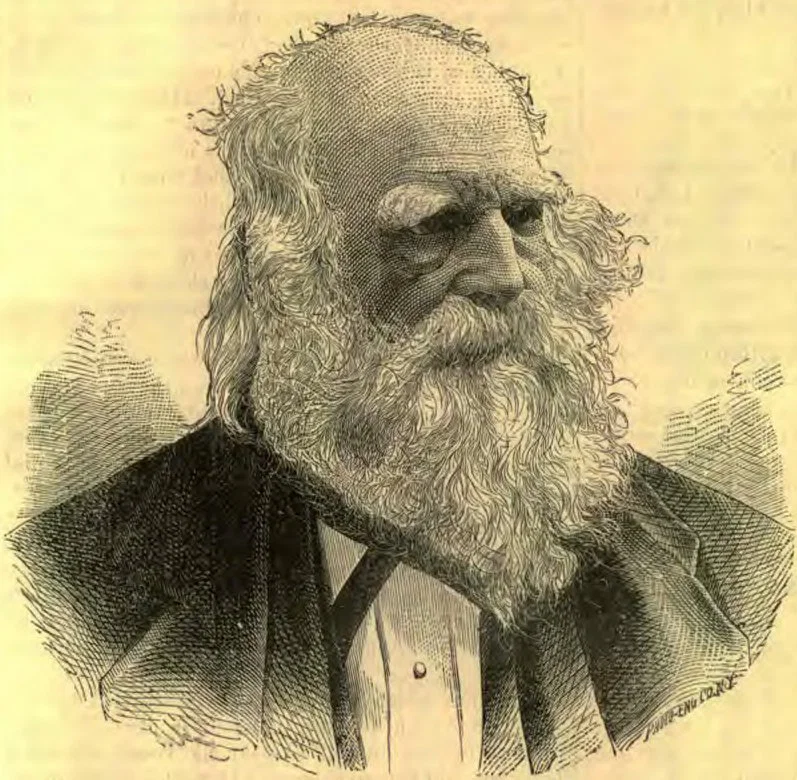
In the picture on this page you may see the portrait of the one who wrote the beautiful poem, “The Death of the Flowers,” which you have just read. It has been said, and justly, that he was the greatest poet we have had in America.
He was born in 1794, while Washington was still president, and he died in 1878; just think how much of the important history of our country Bryant was familiar with, because he had lived through it all. No doubt you would prefer to have him tell his own story about his boyhood, which he once did for the young readers of the St. Nicholas. In speaking of the way in which children were brought up in those days, he says:—
“The boys of the generation to which I belonged—that is to say, who were born in the last years of the last century or the earliest of this—were brought up under a system of discipline which put a far greater distance between parents and their children than now exists. The parents seemed to think this necessary, in order to secure obedience. They were believers in the old maxim that familiarity breeds contempt. My own parents lived in the house with my grandfather and my grandmother on my mother’s side. My grandfather was disciplinarian of the stricter sort, and I can hardly find words to express the awe in which I stood of him—an awe so great as almost to prevent anything like affection on my part, although he was in the main kind, and certainly, never thought of being severe, beyond what was necessary to maintain a proper degree of order in the family.”
“One of the means of keeping the boys of that generation in order was a little bundle of birchen rods, bound together by a small cord, and generally suspended on a nail against the wall in the kitchen. This was esteemed as much a part of the necessary furniture as the crane that hung in the kitchen fireplace, or the shovel and tongs. It sometimes happened that the boy suffered a fate similar to that of the eagle in the fable, wounded by an arrow fledged with a feather from his own wing; in other words, the boy was made to gather the twigs intended for his own castigation.”
Then he tells of his school-days and the visits of the committee men; of the merry-makings, “raisings,” huskings, and apple-parings; of the meetings, and the grim tything-men, who kept the young folks in order, and woke up the drowsy ones; and he concludes it all with the remark, “It is yet to be seen whether the different system now adopted in training the youth of our country will give it a better class of citizens.” But I think you would best like the story of his life as he tells it in a touching poem called “A Lifetime.”
Bryant did not depend on his verses for a living, for that would have been starvation seventy years ago. For a time he practiced law, and bid fair to rise to a distinguished place in the profession; but it was distasteful to him, and at length he moved to New York City, where he took a place as editor on a daily paper. As he says in his poem:—
“Another change, and I see him
Where the city’s restless coil
Sends up a mighty murmur
From a thousand modes of toil.
“And there, with the clash of presses,
He plies the rapid pen
In the battles of opinion,
That divide the sons of men.”
For a period of over fifty years, to the time of his death, he continued to edit the paper, walking daily from his up-town home to his office, a distance of three miles, and back again, in all kinds of weather, till within two weeks of his death.
In his editorial work, Mr. Bryant was very careful of the feelings of others. There is a pleasing little story of this trait of his character told by one of his fellow editors: “Soon after I began to do the duties of literary editor, Mr. Bryant, who was reading the review of a little book of wretchedly halting verse, said to me: ‘I wish you would deal very gently with poets, especially with the weaker ones.’ Later I had a very bad case to deal with, and as Mr. Bryant happened to come into the room while I was debating the matter in my mind, I said I was embarrassed by his injunction to deal gently with poets, and pointed out to him the utter impossibility of finding anything to praise or lightly to condemn in the book before me. After I had read some of its stanzas to him, he answered: ‘No, you can’t praise it, of course; it won’t do to lie about it, but’—turning the volume in his hand and inspecting it—‘you might say that the binding is securely put on, and that—well, that the binder has planed the edges pretty smooth.’”
But you must read his poems for yourself if you wish to become really acquainted with this great man; and I think you will not regret doing so, for his pure thoughts, told in such beautiful words, will leave a good impression on the mind. W. E. L.
A NOBLE CHOICE.
“CLEAVE to that which is good,” says the Book of all books. We must not only abhor evil, but we must carry the war into the enemy’s country, so to speak, and do the good. I wonder how many of my little readers would be as brave and steadfast in doing right, or make such sacrifices for duty’s sake as a young prince that I once read of! One of our great American statesmen, in an hour of supreme trial, declared that he would rather be right than be President. I think that it required even a wiser and grander fortitude than was shown by Henry Clay to make the pagan-born prince Boru Singh say, “I would rather be a Christian than a king.”
This noble young prince was a Hindoo, nephew of Rama Singh, who reigned in Cheera among the mountains of Bengal, the seat of a long line of Khassean kings. His people were all idolaters, and he, too, was a worshiper of false gods, until one day he met a missionary who told him of Jesus and gave him a copy of the Bible to read. Boru Singh was so impressed by the beauty and truth of the Scriptures that he secretly avowed himself a Christian.
Then followed a severe struggle in the boy prince’s mind. His uncle was the sovereign of a powerful State, and he was his rightful heir. No one could be wholly insensible to the splendors of royalty, and the young mountaineer had been brought up to regard this distinction as the important thing of his life. Yet he knew that he must renounce all claim to the succession if his belief in Christianity became known, for it was one of the laws of the kingdom that the king must190preside at all the pagan feasts and ceremonies, and how could he do this if he was a Christian?
Can you understand how much the decision cost him? You have been tempted, perhaps. Many of you who read this have long wished to be Christians, and have been kept back because you did not feel like giving up the pleasures of society, or because you feared the ridicule of your young friends. Do not hesitate any longer. Let this young heathen prince be an example. Prince Boru Singh sacrificed more infinitely than you can do.
Here was a youth of nineteen, brought up a prince at a heathen court, and taught to believe that there was nothing in all the world so desirable as rank and riches; yet when he learned of the religion of Jesus Christ, of his own free will he chose to give up not only his false religion, but all his worldly expectations with it; for that was what Boru did. He devoutly thought the matter over, and became convinced that he could not be conscience free if he worshiped God in secrecy and fear; he must openly, before all men, declare his convictions and his creed.
But the ordeal was not over even then, for only a few months after his public confession King Rama died, and the nobles of Khassi met to decide on his successor.
“The true heir is Boru Singh,” said one of the magnates, an old man, “but our king must also be our high priest and preside at the sacrifices the tribes make to our gods. Boru calls himself a Christian, and will not do this. If he will not abjure the foreigner’s religion, then we will make his cousin king.” And so said they all.
A committee of the great nobles went to Boru, and told him their decision. You can imagine the inducements they held out to him; for though he was a Christian, those heathen nobles respected him, and he knew the throne by right was his. But he could not give up Christ for what they offered him; so he answered courteously but decisively.
“I can never renounce my Saviour,” he said; “but, oh, whether I am king or not, if you would give up your devil-worship and become the followers of my Lord, how happy Boru Singh would be!”
They left him with anger, and a few days afterwards his heathen cousin Hujonamik was crowned king over the Khassean sovereignty. But do you not think that Boru is happier as a subject with his Bible and his faith, than he would be as a king and the worshiper of idols, and did he not make a wise choice? He would have made an enlightened Christian sovereign if he could have accepted this power without surrendering duty. But he could not; his course was clear. Brighter than the crown of the Khassean sovereignty, inestimably beyond it in price, is the celestial crown that will one day be Boru Singh’s and all those who serve the Lord in holiness and truth.—Christian Weekly.
THE DEATH OF THE FLOWERS.
By William Cullen Bryant
The melancholy days are come, the saddest of the year,
Of wailing winds, and naked woods, and meadows brown and sere:
Heaped in the hollows of the grove, the autumn leaves lie dead;
They rustle to the eddying gust and to the rabbit's tread;
The robin and the wren are flown, and from the shrubs the jay,
And from the wood-top calls the crow through all the gloomy day.
Where are the flowers, the fair young flowers, that lately sprang and stood
In brighter light and softer airs, a beauteous sisterhood?
Alas! they all are in their graves, the gentle race of flowers
Are lying in their lowly beds, with the fair and good of ours.
The rain is falling where they lie, but the cold November rain
Calls not from out the gloomy earth the lovely ones again.
The wind-flower and the violet, they perished long ago,
And the brier-rose and the orchid died amid the summer glow;
But on the hill the golden-rod, and the aster in the wood,
And the yellow sun-flower by the brook in autumn beauty stood,
Till fell the frost from the clear cold heaven, as falls the plague on men,
And the brightness of their smile was gone, from upland, glade, and glen.
And now, when comes the calm mild day, as still such days will come,
To call the squirrel and the bee from out their winter home;
When the sound of dropping nuts is heard, though all the trees are still,
And twinkle in the smoky light the waters of the rill,
The South wind searches for the flowers whose fragrance late he bore,
And sighs to find them in the wood and by the stream no more.
And then I think of one who in her youthful beauty died,
The fair meek blossom that grew up and faded by my side.
In the cold, moist earth we laid her, when the forest casts the leaf,
And we wept that one so lovely should have had a life so brief:
Yet it was not meet that one, like that young friend of ours,
So gentle and so beautiful, should perish with the flowers.
—William Cullen Bryant.
THE EXECUTION OF LAW AMONG THE MAORIS.
By Stephen Nelson Haskell
The natives of New Zealand give as great proof that the law of God has been written on their hearts as the natives of any other country. While they are very cruel when their hatred and desire for revenge are aroused, it is evident that they are naturally a harmless people, having no desire to injure any one. They are inclined to imitate the evil habits of the white men instead of those that are good. They have laws by which they are governed, and these are rigidly enforced. The family relation is very sacred in their estimation. They are extremely fond of their children, and will even sacrifice their own lives in their behalf. In this respect, and also in respect to morality, they are very different from the natives of the Sandwich Islands, who, in their barbarous condition, would even take the lives of their children in the most inhuman manner.
The violation of the seventh commandment is regarded by the Maoris as one of the darkest crimes that they can be guilty of. When such a thing happens, they hold a great council, which is presided over by the chief or king. No one can bear testimony or enter a complaint while standing, since it is their custom to sit during an investigation. If the man be found guilty, they do not take his life, but they take from him all his property, horses, and every thing he possesses. Sometimes they will even take away his rug, leaving him perfectly penniless and destitute. To the Maori, his rug is the most sacred thing he possesses. He must ever afterward be an outlaw and an outcast from society. He will be known by every tribe upon the island, and will be fellowshipped by none. The things taken from him are given to the friends of the person who has been wronged, as a restitution for the injury done them. They are held in great honor, while he who did the injury will always be miserable. They do not like the English law, because they think it takes too long to get justice, and then one is not sure of obtaining it. They always consider it an honor to have Europeans place confidence in them, and let them try their own people when accused by the Europeans. Difficulties of this kind will often be settled more satisfactorily to both parties in this way than any other. If they err in either direction, they are too severe on the accused. The course taken by those who are friendly to them, is to lay their cause of grievance before the chief, who will call a council to investigate the case, and decide what the damage is, and how it shall be paid. Their decisions upon such occasions are considered very sacred, and they will promise nothing in their terms of settlement that they cannot fulfill. Their children are early impressed with the importance of giving to every one his rights and what is justly his due, according to their ideas of right. If civilized people, with the light and knowledge they have of the word of God, were as conscientious as these untutored and ignorant natives, society would be much better than it now is. Next week we will tell you more about their courts of justice.
S. N. HASKELL.
SEA TALES.—NO. 5.
By W. S. C.
QUANTITIES of bonitos are usually found south of the equator. Several attempts were made by the sailors to catch some, but they were not hungry, and would not bite, keeping too far away to allow of the “grains” being used. A flock of “Mother Carey’s chickens,” some fifty in number, kept us company after we entered the track of homeward bound vessels. It is amusing to watch them through the glass. Without this aid, they appear to the eye to be constantly on the wing; but when using a glass one can see plainly that, as they skim over the tops of the waves, they use their feet, which are webbed, and run over the water, just as young chicks run on land. Sailors assert that the chickens never alight on land. Thinking of this assertion made me wonder how, if it were true, the young were hatched. I therefore hunted up the captain, and put the question to him. His answer was that, personally, he knew nothing about it, but that it was the current belief that the Mother Careys carried the eggs under their wings until they were hatched. I scrutinized his face closely to see whether he was joking or not (he was an outrageous wag), but I could not detect the shadow of a smile. However, it is known that these birds breed on our northern coasts.
It occurred frequently that birds which were keeping us company would suddenly leave, and be gone several days. Where they went to, or what became of them at night, was often a matter of discussion. One morning, soon after sunrise, our captain made a discovery that may go far toward explaining what sea-birds do at night. Looking above him, he saw a Cape pigeon following through the air, but could not see his head. As it came nearer, the captain, a very superstitious man, began to think it was the headless ghost of a bird following the brig. In amazement he sang out to Mr. Allen, “Look at that pigeon without a head.”
The bird, which had been asleep, startled by the noise, drew his head from under his wing, and frightened at finding himself so near the vessel, uttered a loud cry, and flew to leeward. Does this not explain, also, how wild geese are able to fly for hundreds of miles without alighting? Is it not probable that they, too, “sleep on the wing,” as did this pigeon?
At night, the fog, which had obscured everything from sight for several days, cleared away, leaving a beautiful blue sky to gaze upon. It is such a treat to look upon the clear blue sky in the region of the southern Atlantic, it is so intensely, deeply blue! This night I saw for the first time, clearly, the southern cross and its accompanying kite. They are each composed of four stars, the only difference between them being the position and distance between the stars.
One morning, as I stepped upon deck, I noticed that something above was throwing a shadow over me. Looking up to ascertain the cause, I was startled at discovering a large bird directly over my head, and not more than twenty feet from the deck. It was an albatross, the first that had been seen, and quite a large one too, measuring about ten feet from tip to tip of the wings. I cannot better describe it than by telling you to fancy a large grey eagle, with a white cravat around its neck which would muffle it up to its eyes. This bird is found from the Cape of Good Hope eastward past New Zealand and nearly to Cape Horn. Its strength is enormous, and it is armed with a powerful bill. Mr. Stone had a scar entirely around the wrist of the right hand, caused by a cut from the bill of an albatross which seized him while it was being brought aboard. The bird is a glutton, and often swallows so large a fish that part remains protruding, awaiting the digestion of the portion swallowed. In flying, the wings remain motionless, and the bird apparently does nothing but balance its body from left to right and right to left, alternately, shaving the tops of the waves, and plunging its head under in search of food. Although the body is larger than that of a goose, yet in weight it does not exceed that of a small turkey. At sundown several other albatrosses appeared, one a tremendous fellow. Some of these were pure white, another was black and white, but most of them were grey and white. Sailors call the white ones “captains,” the next “mates,” and the last “sailors.” Many sailors believe that after death the souls of sea-faring men enter the bodies of these birds.
At this time we were in a region where heavy squalls prevail, and where huge seas frequently broke over the vessel. One, in particular, that I remember, came aboard amidships, and dropping solidly on the main hatch, made the vessel quiver from stem to stern, and awakened me from my afternoon nap. No one can realize the immense power of such waves unless he has seen one descend upon the deck of a vessel. Water weighs ten pounds to the gallon, and these “cockle seas” that come aboard run from one to ten barrels of water.
I often had to smile when I thought of the way my friends talked before I sailed, as to the amount of room I would have to promenade, and as to the probability of seas coming aboard. They settled it that the only possible place where seas would come aboard would be amidships, and that I would therefore have plenty of deck room in any weather. Very frequently there were days together when there was not a dry spot on the vessel, or a place where one could stand in safety from the sea or spray for over five consecutive minutes. I have known seas to pour in even over the quarter, when the helmsman steers badly, and come thundering against the cabin windows aft. I have seen the vessel often level full of water from the quarter deck to the forecastle, and have seen men drenched with spray when up on the foreyard. I frequently paddled around on the deck, but often would not be able to promenade once a month.
W. S. C.
SWEET WORDS.
“My dearest of mothers.” I heard the words repeated in soft tones by my next-door neighbor at an island farm-house where we were sojourning. “My dearest of mothers.” My friend was a widow, and her son, an affectionate, talented fellow, was engineering in Idaho. In one of his late letters he had said at the close, “And now, my dearest of mothers, good-bye.” Did he guess, I wonder, how the little petting phrase would please the heart that loved him so? Did he think that she would say it over softly to herself as she sat alone in her room?
The home days were over. The babies, with their sweet ways, their joy-giving and their trouble-making, had grown to noisy boys, then to self-asserting men; they were out in the world making their way; brains busy, thoughts absorbed, hearts full; yet here was one who remembered the mother, still in middle life, loving and needing love the same as when her boys were her very own in the dear child’s home. He wrote her long letters, describing his adventurous, changeable life; the strange companions by whom he is surrounded, the wonderful scenery of the wild western world. It was all intensely enjoyed; but better than all were the love-phrases that showed the son’s affectionate heart. I wonder if the “boys” know how dear they are to their mothers, and how little attentions, little gifts, tender words, flying visits, cheer and warm the hearts that have borne the test of years and sorrows.
Life is a little chilly to the mothers whose homes are the things of the past. Even if they remain in the old home, the rooms seem very bare and silent after the children are gone. It is as if summer had flown, with its nests and bird songs, and autumn winds were blowing. Then the love of the sons and daughters is like sunshine of warm fires to the hearts that sadly miss them. Let us hope there are many sons who write, “My dearest of mothers.”—Congregationalist.
Ingratitude Is Really a Matter of Vanity
The general cry is against ingratitude; but sure the complaint is misplaced. It should be against vanity. None but direct villains are capable of wilful ingratitude; but almost every body is capable of thinking he hath done more than another deserves, while the other thinks he has received less than he deserves.—Pope.
True Aristocracy: Nearest to God
The highest position in life is one nearest God. His is true aristocracy.
O TEACHER, DON'T!
Don't begin before you are ready. Come to the Sabbath-school with your lesson well prepared. How shall a man teach except he hath first learned? How shall empty vessels be filled out of an empty vessel? Out of nothing, nothing comes; and from nothing, nothing can be taken away. I know teachers who make it a practice, every Sabbath afternoon or evening, to look over the lesson for the next Lord's Day. Keeping it in mind during the following week, thinking it over, gathering illustrations, reading about it, getting themselves full of it, when the next Sabbath comes round they are well prepared to teach, and never need to begin before they are ready.
Don't go faster than your class can follow. Avoid big words. Use simple language. See that your questions and explanations are perfectly intelligible. It is a high art to ask questions aright. While a question should not be so framed as to suggest its own answer, neither should it be so constructed as to be ambiguous or misleading. That teacher was rightly served who asked a boy in his class, “What was the condition of the patriarch Job at the end of his life?” and received the prompt reply, “Dead!”
Don't scold. Preserve order in your class. Hold the reins with a firm, albeit a gentle hand. Insist on obedience, because to inculcate obedience is no small part of your work. But avoid a fault-finding, scolding, scowling habit. Vinegar catches no flies. The fish never bite when it thunders.
Stop when you are done. I have seen teachers talking and talking to their scholars long after everybody else was through the lesson, and quite until the tap of the bell announced the hour of dismissal. The scholars were evidently weary and restless, and looked decidedly bored. When you have driven the truth home, and fastened it like a nail in a sure place, let it alone. Keep on hammering at it, and you will pound the head off your nail, or split your plank, and spoil your work. If you have little children in charge, be particular to remember Spurgeon's saying that “Little vessels are soon filled.”—S. S. Times.
THE PIGEON-FLIERS OF MODENA.
It is said that in some parts of Italy and Asia are persons who give their attention to breeding and taming pigeons, and keep in their possession whole flocks which, at certain flag signals, will maneuver in the air with the regularity and precision of a body of well-drilled soldiers. A traveler in Italy, so states a writer in Harper’s Young People, says that in the city of Modena, through which he passed, there “are fully a hundred flocks, containing several hundred birds each, trained so perfectly that they will obey the slightest movement of the flag.” Thinking the INSTRUCTOR boys and girls would like to know how wonderfully even the birds can be tutored, we quote a portion of what was published in this magazine. Speaking of the attractions of the quaint old city of Modena, the writer says:—
“The traveler was most astonished at the strange actions of a man by whose side he was standing one day in the tall tower. When he first observed him, the man was leaning far out of the window, his face exhibiting a variety of emotions denoting excitement and pleasure. In his hand he bore a long staff, upon the end of which was a colored flag, with which he seemed to be signaling to some one in the distance; and soon our traveler distinguished upon the roofs of various houses in the vicinity several figures, all of whom were evidently engaged in answering the signals.
“For some time the stranger watched the performance, unable to understand it, as all the flags seemed to be in motion at once; but finally they were all withdrawn with the exception of that held by one man. He stationed himself upon an eminence on the roof, raised his staff high above his head, and from about his feet sprang into the air a vast flock of birds. Up they rose, higher and higher, into the heavens, waving and turning, the morning sun glistening upon their varied colors as they exposed themselves in different positions to its rays. When almost out of sight, and, like dark spots against the sky, they turned, and, like a living cloud, a meteor of wings came rushing down with a roaring sound audible for a great distance, and nearing the house-tops they rose gently, and amid the fluttering of countless wings again alighted about the tall figure on the lofty roof.
“Hardly had this been accomplished when another figure rose, and another flock darted upward. These were pure white, and resembled flecks of silvery cloud as they swept about, forming a great living circle. Around they went, encircling an area of several acres, glistening, gleaming, and finally alighting again. These maneuvers were repeated two or three times, the birds always returning in obedience to the waving of the flag.
“This was followed by four other flocks, all of different colors, and all going through maneuvers unlike the former. It was evidently an introductory salute for some grander performance, which very shortly commenced. At a certain signal from the men the different flocks of pigeons—for such they were—rose high in air, and passed to and fro with rapid flight, evidently in obedience to the movements of the flags. Now an entire flock would be arrested in its downward flight, and by a sudden motion rise again, separating into columns or halves, flying away in opposite directions, only to join again and alight at their owner’s feet at the proper signal.
“The game or sport is carried on in different ways. The one just mentioned is merely ornamental. A second is to declare war against a neighboring flock, when the birds are so directed that they will, by maneuvering, capture birds from a neighboring cote, in which case the owner has to pay for the captured bird, or the captor wins a prize. In olden times these battles were carried on with great cruelty. A bottle or flask of powder with a fuse was attached to a trained bird that dashed into a neighboring flock, when the torpedo would explode, killing large numbers of birds. This is now done away with, and the captures are made in pleasantry.”
PARABLES OF CHRIST.
LESSON 12.—THE TALENTS.
1. How did some of the followers of Jesus feel as he was on his last journey to Jerusalem? Mark 10:32.
3. When Jesus had taken the twelve apart, what did he tell them? Mark 10:32, last part of the verse.
4. Unto whom did he say he should be delivered when he arrived at Jerusalem? Verse 33.
5. How would they treat him? Same verse.
6. What did he say the Gentiles would do when the Jews had delivered him into their hands? Verse 34.
7. Did the disciples comprehend what Jesus told them? Luke 18:34.
8. Why could they not understand such plain statements? Same verse.
9. What did they seem to be expecting that Jesus would do when he arrived at Jerusalem?—They evidently thought he was about to set up his kingdom upon the earth.
10. In view of this, what request was made by the sons of Zebedee? Mark 10:35-37.
11. Because of these false notions, what did Jesus do? Luke 19:11.
12. What did he say the kingdom of heaven was like? Matt. 25:14.
13. How did the nobleman dispose of his goods before starting on his journey? Same verse.
14. How did he distribute them? Verse 15.
15. Why did he thus give unequal portions to different ones? Same verse.
16. What course was pursued by the servant who received five talents? Verse 16.
17. What by the one who received two talents? Verse 17.
18. What did the servant do who received but one talent? Verse 18.
19. After a long time what did the lord of these servants do? Verse 19.
20. What report was made by the man who had received the five talents? Verse 20.
21. What did the man report who had received the two talents? Verse 22.
22. What did their lord say to each of them? Verses 21, 23.
23. When the servant to whom but one talent was entrusted was called up, what preamble did he make? Verse 24.
24. What account did he finally give of his lord’s money? Verse 25.
25. How did his lord condemn him from his own words? Verses 26, 27.
26. What command was given concerning the slothful servant? Verse 28.
27. What general principle did our Lord then lay down? Verse 29.
28. To what was the unprofitable servant doomed? Verse 30.
29. What are the talents which the Lord of the earth has given to his servants?—Talents of health, strength, intellect, wealth, skill, and everything else by which a man may benefit others.
30. How may these talents be improved upon to divine acceptance?—By using them to the glory of God and the good of mankind.
31. What special incentive should prompt all men to faithfulness at the present time?—The Lord of the earth is about to return and reckon with his servants.
CZAR PETER'S SHOES.
It is thought to be one of the best tests of the true worth of a person of high rank for him, when occasion requires, willingly to perform the duties of a servant, or to submit gracefully to reverses; and surely it exceeds almost anything else to inspire confidence in a subject, when a ruler lays aside his dignity and engages whole-hearted in manual labor. Such we class with persons of good common sense, worthy of our confidence. And no doubt it was this disposition which gave character to the subject of the following sketch:—
“Peter the Great often visited the iron foundry of Ulullee, about ninety versts from Moscow and on one occasion passed a whole month there. Laying aside all the cares of state, the Czar occupied himself while there entirely in examining minutely every portion of the great establishment, and threw himself with ardor into the study of the blacksmith's trade. He soon succeeded in making himself master of this art, and some days previous to his departure succeeded in making eighteen pounds of iron, stamping the imperial mark upon every piece of metal that came under his hand.
“This work completed, Czar Peter went to the director of the works, and, having expressed his satisfaction with them, inquired what wages he was in the habit of giving his hands for every pound of iron they smelted.
“The manager replied: ‘Three kopecks.’
“‘Then,’ said the emperor, ‘I must have earned fifty-four.’ The manager wished to pay him in so many ducats, saying that he could not remunerate his sovereign like a common workman, but Peter replied by saying:—
“‘Keep your ducats, and let me duly receive what you generally pay, unless, indeed, I have worked better than the other workmen. I'm in great want of a pair of shoes, and shall buy them with my wages.’
“So saying, he showed his employer, at the same time, the miserable, worn-out pair of shoes in which his feet were at the same time incased. The fifty-four kopecks were handed over to him, and eagerly accepted; and with them he purchased a pair of shoes, which he was proud of showing to every one as having been earned by the sweat of his brow.
“A piece of iron smelted by Peter the Great, and stamped with the imperial mark, is still shown in the foundry at Ulullee, while another is kept in a museum of curiosities at St. Petersburg.”
JARRAH WOOD.
The jarrah wood of Western Australia is acknowledged by those who know its qualities to be about the next thing to everlasting. Almost every thing in Western Australia is made of this timber—work-boxes, piano-fortes, buildings, wharves, and jetties; it seems to defy all known forms of decay, and is untouched by white ants and all other insects, so that ships built of it do not require to be coppered. It has been used above ground and below, in almost every situation in which timber can be placed, and is durable in all. There are about fifteen varieties of the timber, and it can be obtained of any reasonable length up to sixty or eighty feet, the trunk of the tree having no branches whatever. Another advantage is that it does not burn freely, but only chars, which makes it additionally valuable for building. It is poisonous to all insects. This timber will not grow on good soil, only where there is ironstone, a ton's weight of which is sometimes lifted by the roots. The more ironstone there is in the soil, and the higher the elevation, the better the trees grow. It is one of the most remarkable facts connected with this timber, that if you put a bolt, no matter of what size it may be, into it, when you take it out a bolt of precisely the same size will go into the hole again. The effect of the iron, apparently, is to preserve the timber, and of the timber to preserve the iron. Jarrah is far superior to teak; it is less liable to split, and it will bend freely without being steamed.
A FAMOUS FLOATING BRIDGE.
Among the great variety of bridges built by man, some are so constructed as to float upon the water. A writer in the Wide Awake says the most famous of all these was that built by the Roman Emperor Caligula in A. D. 39. The description given of it is as follows:—
“An immense number of boats was anchored in the bays of Baiae and Puteoli in two lines, in the form of a crescent, over three miles long. A flooring of planks was laid upon them and covered with earth. Houses were built upon it, and fresh water was conveyed to them by pipes from the shore. When all was ready, the emperor, accompanied by his court and a throng of spectators, rode in solemn procession from one end of the bridge to the other. He was clothed in costly robes adorned with gold and pearls, and wore Alexander’s breastplate and civic crown. At evening the whole bridge was illuminated with torches and lanterns, and Caligula boasted that he had ‘turned the night into day, as well as the sea into land.’ The whole court slept that night in the houses on the bridge. Next day there was another procession, in which Caligula rode in a triumphal chariot, followed by a train of other chariots. The insane emperor then made an oration in praise of his work, and wound up the festivities by ordering a large number of the spectators to be thrown into the sea.”