The Youth’s Instructor, Vol. 29, No. 48.

BIRDS OF PARADISE

The Youth’s Instructor

Nov 30, 1881

S. D. A. Publishing Association · Battle Creek, Mich. · Nov 30, 1881

BIRDS OF PARADISE.
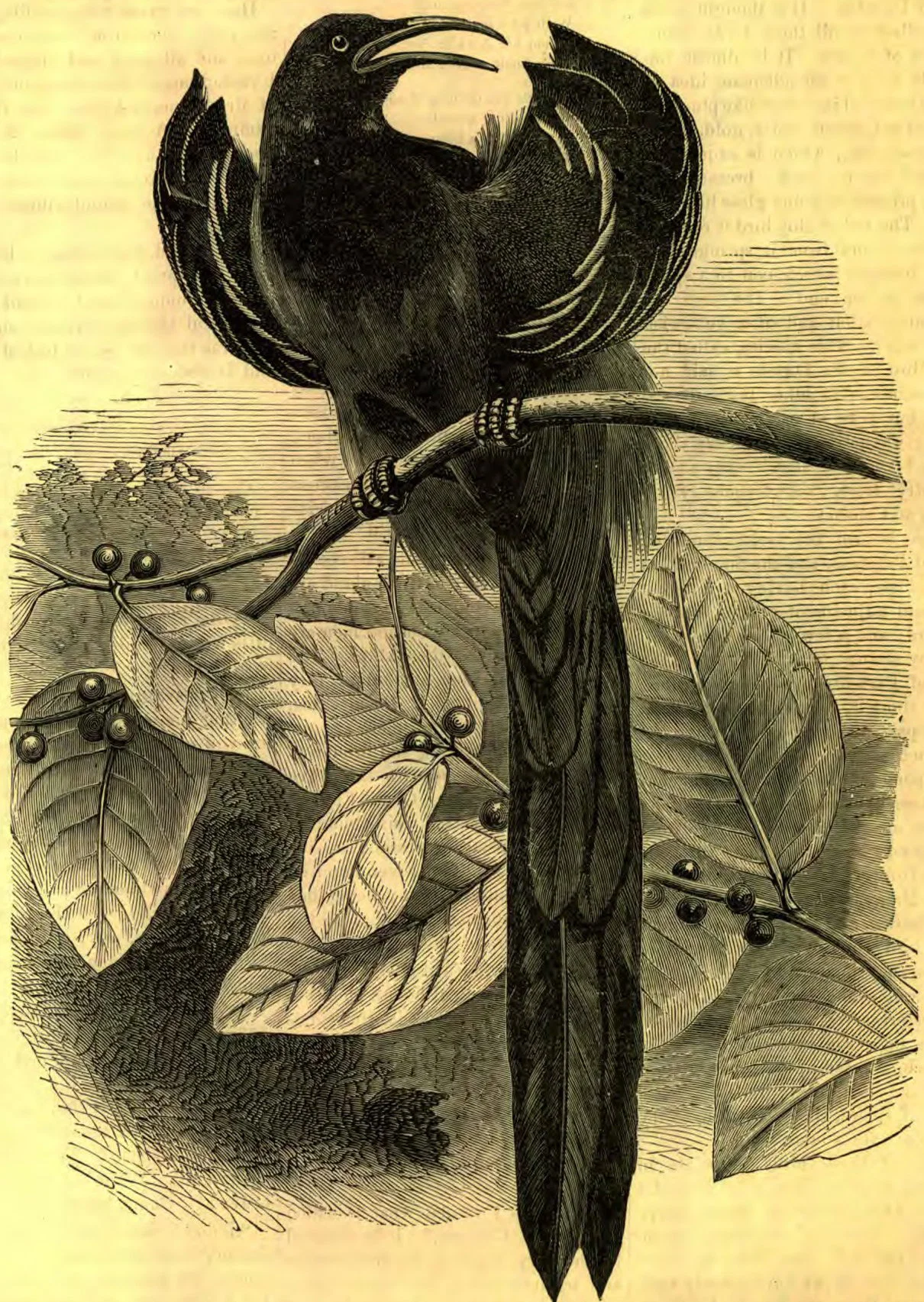
As flowers among the vegetable kingdom are seemingly sent to beautify the world, so birds have their place among living animals, and seem created for the display of beauty. Indeed, they rival the flowers in variety and brilliancy of color, especially our tropical birds. Then, too, the grace of their movements and their sweet songs give an added and indescribable charm.
Among the most brilliant members of the feathered tribes, are those called Birds of Paradise. The natives of the Molucca Islands give them the name of “God’s Birds,” as being superior to all he has made. “Not even the humming-birds themselves,” says one, “present such an inexhaustible treasury of form and color as is found among the comparatively few species of the Birds of Paradise. In all, the feathers glow with resplendent radiance, in nearly all there is some strange and altogether unique arrangement of the plumage, and in many the feathers are modified into plumes, ribbons, and streamers that produce the most surprisingly lovely effects.”
The Great Emerald Paradise Bird, is described as a most elegant bird. “From the tip of the bill to the end of the long side feathers is about two feet, but to the end of the real tail about twelve inches; the size of the bird being that of the thrush. The bill is slightly bent, and of a greenish color; the base surrounded, for the distance of half an inch, with close set, velvet-like black plumes, with a varying lustre of golden green. The head, together with the back part of the neck, is a pale gold color, the throat and fore part of the neck, of the richest changeable gold-green. The whole remainder of the plumage on the body and the tail is of a fine deep chestnut, except on the breast, which is a deep purplish color.”
“From the upper part of each side of the body, beneath the wings, springs an abundance of long, loose, broad floating plumes of the most delicate texture and appearance, in some specimens of a bright, deep yellow, in others of a paler hue, but most of these marked by a few longitudinal dark red spots. And from the middle of the rump spring a pair of naked shafts, considerably exceeding in length even the long loose plumes of the side.”
“This bird is a native of the Molucca Islands, and the islands around New Guinea, particularly in the Aroo. Latham mentions that a specimen was once brought alive to England; and it is occasionally brought to Macao in China.”
There is one species called King Bird of Paradise. It is thought to be the smallest of all these birds, about the size of a lark. It is almost impossible to give an adequate idea of the brilliancy of its velvet-like plumage of blood-red, green, white, gold, chestnut brown, etc., which is exquisitely arranged upon head, breast, and wings, presenting a fine gloss like rich satin. The tail of this bird is remarkably short, and from it springs two naked feathers which coil in a spiral manner at the end. The legs are moderately stout and of a yellowish brown color. This species, called the King Bird of the Dutch, is said not to associate with other birds of the genus, but to be of a solitary nature, feeding on berries, particularly those of a red color; seldom if ever sitting on lofty trees, but frequently on shrubs and bushes.
There is also the Golden-breasted Bird of Paradise, and the Superb Bird of Paradise, each having a different form and adjustment of the brilliant feathers; and a few of less note.
Many strange tales were told of the Bird of Paradise by ancient writers. It was thought to have no legs or feet, but to pass its time floating in the air, only occasionally taking a little rest by suspending itself from the branches of a tree by the long feathers of its tail, an absurd idea which probably originated from the fact that the places from which they were received—the Malay Archipelago—were then little known, and as all the specimens of the bird which reached Europe were legless, they imagined this its natural condition. The way in which the natives preserved the birds was to cut off the legs, run into the body a hot iron, which dried up the internal moisture; and then, filling the cavity with salt and spices, they sold them to the Europeans for a mere trifle.
Most of these birds associate in large flocks in the delightful aromatic woods and groves of their native islands. And the inhabitants themselves are not insensible to their charms, for, as we have already said, they give them the name of “God’s Bird.” From the rapidity of their flight, as well as their being continually on the wing in pursuit of insects, their usual prey, they are sometimes called the Swallows of Ternate.
The country where they breed is visited with tempestuous seasons, but these birds are seldom seen at such times; and it is supposed that they then emigrate to countries where their food is to be found in great abundance: for, like swallows, they have their “appointed times.”—New York Observer.

"LOOK NOT THOU UPON THE WINE WHEN IT IS RED."

Oh, soft sleep the hills in their sunny repose, In the lands of the south, where the vine gayly grows! And blithesome the hearts of the vintagers be, In the grape-purpled vales of the isles of the sea!
And fair is the wine when its splendor is poured From silver and gold round the festival board, When the magic of music awakes in its power, And wit gilds the fast falling sands of the hour!
Yet lift not the wine-cup, though pleasure may swim Mid the bubbles that flash round the roseate brim; For dark in the depths of the fountains below, Are the sirens that lurk by the vortex of woe!
They have lured the gay spirit of childhood astray, While it dreamed not of wiles on its radiant way, And the soft cheek of beauty they've paled in its bloom, And quenched her bright eyes in the damp of the tomb.
They have torn the live wreath from the brow of the brave, And changed his proud heart to the heart of a slave; And e'en the fair fame of the good and the just, With the gray hairs of age, they have trampled in dust.
Then lift not the wine-cup, though pleasure may swim Like an angel of light round its roseate brim; For dark in the depths of the fountain below, Are the sirens that lurk by the vortex of woe!
—Selected.

DANISH RULE IN ENGLAND.

We have told you the Danes constructed many ships, with which they traversed the seas and ocean coasts immediately surrounding England. Those ships were few and small when compared with the ships and steamers of England that now go from these islands to all parts of the world.
The ships—steamers and sail-vessels together—now owned in England are valued at five hundred million dollars. Two hundred thousand men are employed in sailing these ships. The wages of these men amounts to fifty million dollars annually. Besides this, one hundred thousand men are employed in ship-building and in marine engine-works. These earn thirty-five million dollars a year. Of the English vessels, six thousand, six hundred and ninety are steam vessels, capable of bearing two million, seven hundred and thirty thousand tons; being one million tons burthen more than all the combined fleets of the world besides.
The British mines of silver, tin, copper, iron, and coal, although then but little known, compared with their present development, were great riches in the eyes of both Saxons and Danes. The rude iron weapons made by them, of which we see samples in the museums, were clumsy and awkward things, compared with the fine Sheffield cutlery of this day.
Last week I visited what is called the “Black Country.” It is situated in the very heart of the iron-mining and manufacturing interests of England, being the southern portion of Staffordshire. From one hundred to one hundred and thirty yards below the surface are found vast beds of the choicest coal. In some instances the strata of coal is ten yards in thickness. In connection with this is found a heavy strata of “iron-stone” (iron ore) from which is smelted very choice wrought iron. Taking Dudley as a center, we have around us, by night as well as by day, one of the most remarkable scenes of ceaseless industry which England can show. The country for miles around is covered with the bank-fires of coal-pits, blast-furnaces, forges, and iron-mills, sending forth volumes of smoke by day, and by night reddening the sky as with the glare of a mighty conflagration.
Nail-making is an important industry, two thousand men being engaged in making horse and mule shoe-nails alone. Enormous numbers of anvils and vices are made for home use and for the United States, where they are held in higher repute than any other. The leading firm makes ten thousand of each every year.
Here are great rolling-mills, where are made sheet-iron, band-iron, tire-iron, and all sized and shaped rods. I visited one of the rolling-mills, that of Mr. Adams and Sons, near Wolverhampton. A canal passes the back door of the mill. The boats bring the coal and ore to the door of the works, and carry the manufactures out to market.
It is indeed interesting to look out upon the varied manufacturies of the “Black Country” and to think of the wonderful changes wrought since the soil was trodden by the feet of Saxon and Danish conquerors.
J. N. LOUGHBOROUGH.

INASMUCH

“DON’T you want to read to me a little while, Jennie; my poor old head is so tired?”
“Oh dear! grandma, you’re always wanting me to read or do something for you when I’m busy. I’d try and get along without quite as much waiting on, if I were you;” and Jennie Colman impatiently threw down the tidy she was embroidering, and with a heavy frown took up the paper her poor old grandmother had laid down.
“Never mind, dear, I can wait till Floy gets home,” said grandma sadly. “I didn’t notice you were doing anything in particular.”
“Well, I was,” Jennie snapped out. “There’s that tidy must be done Thursday for the fair, and it isn’t hardly begun yet. But there, who could do anything if they had to leave their work every ten minutes to wait on somebody else? Well, there’s no use talking. What do you want me to read? Come, hurry up.”
“I don’t want you to read at all, Jennie,” said grandma, in a trembling voice. “I wouldn’t have asked you if I’d known you had anything to do. Go right on with your work.”
“O well, if you don’t want me to, very well. I’m not at all anxious,” and Jennie returned to her work.
Grandma sat a while with closed eyes, thinking of the happy past, when there were always willing hands and happy hearts at her service, when suddenly a click of the gate-latch aroused her from her musings, and a glad smile lighted up the tired old face.
“There’s Floy!” she exclaimed brightly.
“O yes, ‘there’s Floy,’ of course. You think Floy is almost an angel, I do believe, grandma Colman.”
“Well, who don’t love Floy?” grandma responded. “No one could help it.”
And, indeed, few could help loving the bright-faced young girl of fourteen, who came bounding into the room, seeming to bring with her a touch of the outside glow and brightness of the January day.
“Well, grandma, how do you feel? Is your head any better? Isn’t there something I can do for you?” and the rosy lips met grandma’s lovingly.
“No, dear, my head is no better, but you must sit down and get warm, and not be thinking what you can do for me, the first thing.”
“O yes,” said Jennie, discontentedly, “of course Floy must not hurt herself. It don’t make any difference about me.”
“Jennie Colman!” Floy burst forth indignantly, “I’d be ashamed to talk so to dear old grandmother. You know she thinks just as much of your comfort as she does of mine. But you think so much of yourself, nobody need worry about your getting along without any trouble.”
“You look out for yourself, and I’ll do the same,” was Jennie’s response.
Floy had hardly seated herself when she espied the paper grandma had been reading.
“O, sha’n’t I read to you, grandma dear?” she asked, “I feel just like it.”
“If you are not too tired,” said the old lady wistfully, I should like you to read a little while. I was in the middle of that article,” pointing to the one she had been reading.
“All right,” said Floy cheerfully, though the article in question was dull reading for a girl of her age. And for several hours she read patiently on, while Jennie sat sulkily bending over her embroidery.
And which, think you, enjoyed the afternoon more—Floy, who gave up her own wishes to minister to her grandmother’s, or Jennie, in her utter disregard of all but her own selfish desires? Which are you like, reader? and which do you wish to be like? Remember the Master has said, “Inasmuch as ye have done it unto one of the least of these, my brethren, ye have done it unto me.”—Little Pilgrim.

He Doeth All Things Well

“He doeth all things well,” the clouds and sunshine Alike are needful to the springing flowers; E’en so have joy and sorrow each a lesson Of heavenly wisdom for these hearts of ours.

Idols of the Heart: Loving More Than God

We have not Moloch, with his great red teeth and grinning mouth—a bloody monster as was ever made; or Ganesa, with an elephant’s head, riding on the back of a huge rat; or the snake god, or monkey god, or little mud gods. We do not bow down and worship such frightful images as these; but we must remember that an idol is anything we love more than we love God.

Room Enough for All of Us

Do not try to build yourself up by pulling others down. There is room enough here for all of us.

EVA'S PRAYER.

Darling baby Eva, Kneeling by my chair, In the autumn twilight, Lisping out her prayer.
Small hands clasped together, Bowed the golden head, Blue eyes closed, lips parted, “Our Father,” faintly said.
Then, as the head bowed lower Upon my darling’s breast, Came, “Eva sleepy, mamma, And Dod knows all the rest.”
I took my sleeping child With all a mother’s love, And laid her down to rest,— Then knelt to God above.
And while the evening shadows Were falling silently, I asked for her a blessing There, on my bended knee.
One half my yearning thoughts My words have ne’er expressed; But still I feel, with her, That God knows all the rest.
—F. S. Lovejoy.

SCENES IN THE LIFE OF CHRIST.

LESSON 45.—THE TWELVE SENT OUT TO PREACH.

“And when Jesus departed thence, two blind men followed him, crying, and saying, Thou Son of David have mercy on us! And when he was come into the house, the blind men came to him; and Jesus saith unto them, Believe ye that I am able to do this? They said unto him, Yea, Lord. Then touched he their eyes, saying, According to your faith be it unto you. And their eyes were opened; and Jesus straitly charged them, saying, See that no man know it. But they, when they were departed, spread abroad his fame in all that country.”
As these men went out, a man was brought in who was dumb and possessed of a devil. Jesus caused the evil spirit to depart, and as soon as he had done so, the man spoke. At this the multitude marveled, saying, “It was never so seen in Israel.” But the Pharisees were still unwilling to believe in him, and said, “He casteth out devils through the prince of devils.”
Then Jesus went to his own country,—to Nazareth, where he had been brought up,—and on the Sabbath day began to teach in the synagogue. Many who heard him were astonished, and said, “Whence hath this man this wisdom, and these mighty works? Is not this the carpenter’s son? Is not his mother called Mary? and his brethren, James, and Joseph, and Simon, and Judas? And his sisters, are they not all with us?” And so they treated their Lord with contempt. But Jesus said, “A prophet is not without honor save in his own country and in his own house.” So he did not many miracles there, because the people would not believe in him.
Leaving Nazareth, Jesus went to all the cities and villages in that part of Galilee, teaching in their synagogues, and healing every kind of disease. As he went, he pitied the multitudes of people who thronged to hear him, and said to his disciples, “The harvest truly is plenteous, but the laborers are few; pray ye therefore the Lord of the harvest that he will send forth laborers into his harvest.”
“Then he called the twelve together, and gave them power and authority over all devils, and to cure diseases. And he sent them to preach the kingdom of God, and to heal the sick. And he said unto them, Take nothing for your journey, neither staves, nor scrip, neither bread, neither money; neither have two coats apiece. And whatsoever house ye enter into, there abide, and thence depart. And whosoever will not receive you, when ye go out of that city, shake off the very dust from your feet for a testimony against them. And they departed, and went through the towns, preaching the gospel, and healing everywhere.”

QUESTIONS.

  1. Who followed Jesus as he left the house of Jairus? Matt. 9:27.
  2. What did they cry, as they followed him?
  3. When these men came to him, after he had gone into the house, what did Jesus say to them?
  4. How did they reply?
  5. What did Jesus then do and say?
  6. What change took place in the man?
  7. What charge did Jesus give them?
  8. How did they keep this charge?
  9. Who was brought in after these men went out?
  10. What did Jesus do for him?
  11. What did the multitude think of this miracle?
  12. What did they say?
  13. What did the unbelieving Pharisees say?
  14. Where did Jesus then go? Matt. 13:54; Mark 6:1.
  15. What did he do on the Sabbath day?
  16. How did the people of Nazareth treat him?
  17. How had they treated him the last time he was there? Luke 4:13–30.
  18. What did they now say?
  19. Why could not Jesus perform many miracles there?
  20. What did he say about their treating him so?
  21. Where did he then go?
  22. What did he do as he went from place to place?
  23. How did he feel toward the multitudes that came out to hear him?
  24. What did he say to his disciples?
  25. When he had called the twelve together, what power did he give them?
  26. What did he say about their taking things with them on their journey?
  27. What did he tell them about going from house to house?
  28. What did he tell them to do when a city would not receive them?
  29. What did he say about the punishment that should come upon those that would not receive his disciples? Matt. 10:15.
  30. After the disciples had received all these instructions, what did they do? Luke 9:6.

NEW-TESTAMENT HISTORY.

LESSON 58.—REVIEW.

1. How did Jesus teach his disciples that they should not despise the weak and erring? Matt. 18:10-14.
2. What instruction did he give relative to the course to be pursued with a brother who has trespassed against another? Verses 15-17.
3. What encouraging promise is made to those who unite in the prayer of faith? Verses 19, 20.
4. What important lesson is taught in regard to the number of times an offender should be forgiven? Verses 21, 22.
5. If God teaches us to forgive an unlimited number of times, will he not do the same for all who truly repent?
6. By what miracle did Jesus show the condition and fate of those who are too hard-hearted to forgive? Verses 23-35.
7. What important events took place at the first passover after our Lord's baptism? John 2:13-25; 3:1-21.
8. What noted miracle did he perform at the second passover? John 5:1-9.
9. What caused the Jews to condemn Jesus for working this miracle?
10. Why did they seek to kill him? Verse 18.
11. Where was Jesus at the time of the next passover?
12. What great national feast was held about six months after the passover?
13. Why were the brothers of Jesus anxious that he should attend that feast? John 7:2-5.
14. While on the way to this feast, how did he rebuke the unholy zeal of his disciples? Luke 9:52-56.
15. How did he test the sincerity and faith of some who wished to become his disciples? Verses 57-62.
16. How did Jesus provide for the wide dissemination of his gospel during the short period that remained before his crucifixion? Luke 10:1-11.
17. What instructions did he give these men?
18. What did he say of the cities wherein most of his mighty works had been done? Matt. 11:20-24.
19. What miracle did Jesus perform while on this journey? Luke 17:11-19.
20. Describe the commotion at the feast, before Jesus arrived? John 7:11-13.
21. What surprised the learned Jews when Jesus began to teach in the temple?
22. What did he say about the source of his knowledge?
23. How may we know that Christ's teachings are from God?
24. Did Jesus know beforehand that the Jews had it in their hearts to kill him at this feast? Verse 19.
25. Did he know what accusation they meant to bring against him?
26. When had they once before sought to kill him on this same pretext?
27. How did he reprove them for making this alleged breach of the law a cause of death in him, when they were continually breaking the law themselves?
28. What was the fruit of Christ's preaching at this time? Verse 31.
29. What did these believers say, in proof that Jesus must be the Christ?
30. When the Pharisees heard that the people were talking thus, what effort did they make to arrest Jesus?
31. What did these officers say when they returned to the Pharisees?
32. What caused a division among the people?
33. What question did the Pharisees ask? Verse 48.
34. What man of high rank spoke in favor of Jesus?
35. What did the Pharisees tauntingly say to him?
36. What cutting rebuke did he bring upon those who are eager to inflict the penalty of the law upon others?
37. How did Jesus show that the Jews had sufficient evidence that he was the Messiah?
38. What encouraging promise did he make to those who believed on him?
39. How did he show that the unrepenting Jews could not claim the promises made to Abraham?
40. How did he prove that they were not among the children of God?
41. How did he make it appear that they were the children of Satan?
42. How did he show that he was greater than Abraham?
43. What did the Jews then attempt to do?

JESUS AT THE FEAST.

At the commencement of the Feast of Tabernacles, the absence of Jesus was commented upon. The Pharisees and rulers anxiously looked for him to come, hoping that they might have an opportunity to condemn him on account of something he might say or do. They anxiously inquired, “Where is he?” but no one knew. Presently a dispute rose among the people in regard to Jesus, many nobly defending him as one sent of God, while others bitterly accused him as a deceiver of the people.
Meanwhile Jesus had quietly arrived at Jerusalem. He had chosen an unfrequented route by which to go, in order to avoid the travelers who were making their way to the city from all quarters. In the midst of the feast, when the dispute concerning himself was at its height, Jesus walked calmly into the court of the temple, and stood before the crowd as one possessed of unquestionable authority. The sudden and unexpected appearance of one whom they believed would not dare to show himself among them in the presence of all the chief priests and rulers, astonished the people, so that a sudden hush succeeded the excited discussion in which they had been engaged. They were astonished at his dignified and courageous bearing in the midst of so many powerful men who were thirsting for his life.
Standing thus, with the eyes of all the people riveted upon him, he addressed them as no man had ever done. His knowledge was greater than that of the learned priests and elders, and he assumed an authority which they had never ventured to take. Those very men who had so lately been wrought up to a frenzy of hate, and were ready to do violence to Christ at the first opportunity, now listened spell-bound to his words, and felt themselves powerless to do him harm. He was the attraction of the hour; all other interests were forgotten for the time. The hearts of the people thrilled with awe as they listened to his words.
And now the feast was drawing to a close. The morning of the last, crowning day found the people wearied from the long season of festivity. Suddenly Jesus lifted up his voice in tones that rang through the courts of the temple:— “If any man thirst, let him come unto me, and drink. He that believeth on me, as the Scripture hath said, out of his belly shall flow rivers of living water.” The condition of the people made this appeal very forcible. They had been engaged in a continued scene of pomp and festivity, their eyes had been dazzled with light and color, and their ears regaled with the richest music; but there had been nothing to meet the wants of the spirit, nothing to satisfy the thirst of the soul for that which perishes not. Jesus invited them to come and drink of the fountain of life, of that which should be in them a well of water springing up into everlasting life.
The priest had that morning performed the imposing ceremony which represented the smiting of the rock in the wilderness, and the issuing therefrom of the water. That rock was a figure of Christ. His words were the water of life. As Jesus spoke thus to the people, their hearts thrilled with a strange awe, and many were ready to exclaim, with the woman of Samaria, “Give me of this water, that I thirst not.”
The words of the Divine Teacher presented his gospel in a most impressive figure. More than eighteen hundred years have passed since the lips of Jesus pronounced those words in the hearing of thousands of thirsty souls; but they are as comforting and cheering to our hearts to-day, and as full of hope, as to those who accepted them in the Jewish temple. Jesus knew the wants of the human soul. Hollow pomp, riches and honor, cannot satisfy the heart. “If any man thirst, let him come unto me.” The rich, the poor, the high, the low, are alike welcomed. He promises to relieve the burdened mind, to comfort the sorrowing, and give hope to the despondent. Many of those who heard Jesus were mourners over disappointed hopes, some were nourishing a secret grief, some were seeking to satisfy the restless longing of the soul with the things of this world and the praise of men; but when all this was gained, they found that they had toiled to reach only a broken cistern, from which they could not quench their fevered thirst. Amid all the glitter of the joyous scene they stood, dissatisfied and sad. That sudden cry, “If any man thirst—” startles them from their sorrowful meditation, and as they listen to the words that follow, their minds kindle with a new hope. They look upon the Life-giver standing in majesty before them, divinity flashing through his humanity, and revealing his heavenly power in words that thrill their hearts.
The cry of Christ to the thirsty soul is still going forth. It appeals to us with even greater power than to those who heard it in the temple on that last day of the feast. The weary and exhausted ones are offered the refreshing draught of eternal life. Jesus invites them to rest in him. He will take their burdens. He will give them peace. Centuries before the advent of Christ, Isaiah described him as a “hiding-place from the wind,” a “covert from the tempest,” as “the shadow of a great rock in a weary land.” All who come to Christ receive his love in their hearts, which is the water that springs up unto everlasting life. Those who receive it impart it in turn to others, in good works, in right examples, and in Christian counsel.—Mrs. E. G. White.

NOTES

Scrip.—Travelers, when starting upon a journey, were accustomed to carry their victuals in a sack, which was made of skin or coarse cloth, and hung from the shoulder. This sack was called a scrip. As the disciples were to be cared for by the people whom they visited, it was unnecessary for them to carry any provisions, and hence they needed no scrip.
Shake off the very dust from your feet.—The Jews thought that their own soil was so sacred, that before they entered Palestine from a foreign country, they would shake off the very dust from their feet, lest it should defile their Holy Land. Christ would have his disciples treat those cities that refused to listen to their teaching the same as they did Gentile countries, as a sign that the inhabitants were from that time the same in the sight of God as heathen, and that the disciples were not to bear the blame of their fate, if lost. Such symbolical acts were common in ancient times, even among others than the Jews; and even to this day they prevail in the East.

THE DIVING DRESS.

It is often necessary to go down into the ocean and lakes and rivers to get things that have been lost, dropped from some boat, or gone down in a wrecked ship. And then, too, people like to know what there is in the deep water, how the fishes live and how they act when at home, what kinds of plants grow there, and many other useful things, which we might otherwise never know.
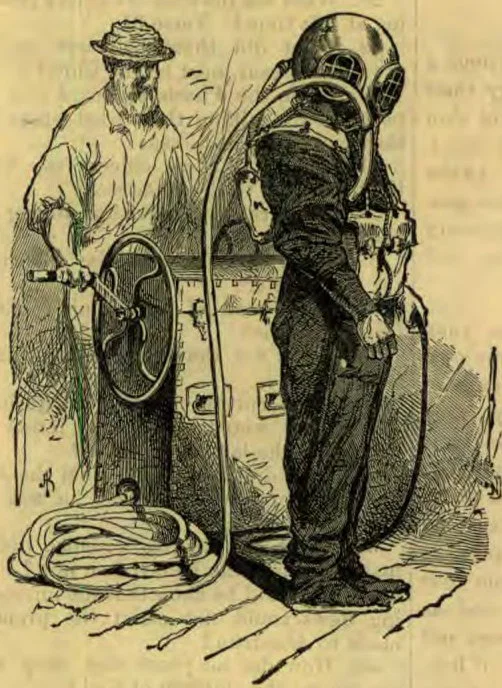
Now, in order to find out all these things, one would have to stay under water a long time. No one could do this, so men have invented the diving-dress that you see in the picture. It is made of rubber cloth, which keeps out all the water. The head is covered with a copper helmet, which has in it glass windows covered with wire. Through these the diver can see all that is going on around him. The tube fastened to the back of the head is to let in air to him so he can breathe. It is forced down by an air-pump on board the boat from which he has been let down into the water. He always holds in his hand a small cord called the “life-line,” and the other end is held by a man on the boat above. When the diver wants anything, he pulls the rope, and by certain signals the man on deck knows just what he wants, and sends it down to him.
These divers are often hired to go down and get money and jewels and goods from ships that have sunk. It is a very dangerous business, but they get a great deal of money for doing it.
When bridges are made over wide, deep rivers, it is the divers that build the great stone piers that support them. They also go down and blast out large rocks in the bottoms of rivers, so that boats can sail safely through narrow channels. In this and many other ways divers are able to do a great deal of good.
It must be very pleasant to be among the wonders of the waters, for there are strange and beautiful things in the ocean as well as on the land. Bright flowers grow there, and many different kinds of plants. The fishes often come up to the diver, and seem to wonder what he is, and where he comes from. They seem not a bit afraid of him, and will sometimes be so bold as to pull his sleeves. They are as playful as kittens; and when he pulls up anything from the mud, they will dive in to catch the worms and other little creatures hidden under it, just as cats jump for mice.
A story is told of one diver who, pleased with the unexpected friendliness of the fishes, brought food with him the next time he came, and fed them from his hand as one feeds a flock of chickens. Sometimes two would get hold of the same morsel, and then came a struggle to see which should have it, the strongest of course coming off best.
Though many large books have been written about the wonders of the ocean, and the curious creatures which live there, much still remains to be told. The wisdom and skill of the great Creator are shown in all his works, whether in the sea or on the land.
MARY A. STEWARD.

“FOR ME.”

LITTLE Carrie was a heathen child, about ten years old, with bright, black eyes, dark skin, curly brown hair, and slight neat form.
A little while after she began to go to school, the teacher noticed one day that she looked less happy than usual.
“My dear,” she said, “why do you look so sad?”
“Because I am thinking.”
“What are you thinking about?”
“O teacher! I do not know whether Jesus loves me or not.”
“Carrie, did Jesus ever invite little children to come unto him?”
The little girl repeated the verse, “Suffer little children to come unto me,” which she had learned at school.
“Well, what is that for?”
In an instant Carrie clapped her hands with joy, and said, “It is not for you, teacher, is it? for you are not a child. No, it is for me, for me!”
From that hour Carrie knew that Jesus loved her, and she loved him back again with all her heart.
Now, if the heathen children learn that Jesus loves them, and believe his kind words as soon as they hear them, ought not we, who hear so much about the dear Saviour, to believe and love him too? Every one of us ought to say, “It is for me! for me!” and throw ourselves into the arms of the loving Saviour.—The Morning Light.
Continue reading: JOHNNY'S ARITHMETIC