Pacific Press Publishing Company · New York · Apr 2, 1896
RELIGIOUS PERSECUTION IN ONTARIO.
By Editor
IN the county jail at Chatham, Ont., immured with common criminals, there lie to-day three victims of religious persecution,—good and upright men, and ministers of the gospel of Jesus Christ. As is usual in such cases, the persecution was conducted under cover of “due process of law.”
We who have thought that the enlightenment and progress of the nineteenth century had carried us beyond the era of persecution for conscience’ sake, are called upon to face this fact and to ponder its meaning.
That the case is one of persecution for religious belief, is clearly apparent from the nature of the charge brought against the prisoners and the circumstances attending their prosecution, of which the following is an outline:—
During the summer of 1895, P. M. Howe and William Simpson, ministers of the Seventh-day Adventist denomination, began a series of meetings in Darrell, a small town about five miles north of Chatham, Kent County, Ontario. They were joined later by Rev. Mr. Burrill, who had been in charge of the Adventist church at Selton.
The success which attended their efforts aroused the antagonism of a neighboring denomination, and a minister of the latter was sent for to oppose the Adventists and put a stop to their work. He came and proceeded to advise that these men be driven from the province, alleging that they were traitors to the Queen, and aliens. The only specific charge, however, that he could truthfully make against them was that they did not keep Sunday.
As a result of this effort, a church society of young people was formed, to spy upon the Adventists and see if any work was done by them on Sundays. There is among the statutes of Ontario an ancient piece of legislation handed down with but slight alterations from the time of King Charles II., known as the “Lord’s Day Act,” one section of which says:—
It is not lawful for any merchant, tradesman, artificer, mechanic, workman, laborer, or other person whatsoever on the Lord’s day, to sell or publicly show forth, or expose or offer for sale, or to purchase, any goods, chattels, or other personal property, or any real estate whatsoever, or to do or exercise any worldly labor, business or work of his ordinary calling (conveying travelers or her Majesty’s mail, by land or by water, selling drugs and medicines, and other works of necessity and works of charity excepted).
Chatham Jail, in which Three Adventist Ministers are Imprisoned.
It was thought that under the provisions of this statute the work of the Adventists could be stopped by invoking the arm of the civil authority.
On Sunday, the third day of November, one of these spies discovered Ministers Burrill, Simpson, and Howe at work making preparations to lay the foundations of a church building which it had been decided to erect for the accommodation of the Adventist believers. One was seen to be slacking lime, another mixing mortar, and the other pouring water into a barrel. This was forthwith reported to the Sunday school, and at its close a dozen or more individuals proceeded to the spot, as one of them afterwards testified in court, “for the purpose of witnessing.” One of this number was deputed to go to Chatham to lay information against the ministers before an officer of the law.
Attorney Douglass, Queen’s Counsel, being visited, advised the prosecutors to wait, saying that the law in the case was not clear; and further to show his depreciation of the proposed action, addressed a letter to the people in and about Darrell, to the same effect. The informers then went to Justice Forham, of Chatham, but he refused to issue a summons, and upon being pressed to do so, replied that sooner than be a party to such proceedings he would resign his office.
Not deterred by this set-back, the representatives of the league bethought them of a magistrate in Ridgetown, twenty-two miles distant, who had sent to jail an Adventist named Matthews for the “crime” of cutting hay on Sunday; and to him they went. After a guarantee fund had been raised by the prosecution (Mr. Matthews’ prosecutors had not yet paid their bill) the justice was willing to undertake the case, and the necessary papers were issued for the prosecution.
A large crowd filled the court room on the day of the trial, December 5, and made boisterous demonstrations of approval as each step was taken in the process of fastening conviction upon the prisoners. So plainly marked was the animus of religious intolerance in the proceedings, as to elicit from leading citizens who were present, strong expressions of disapproval.
Two grounds of defense were open to the prisoners under the statute. The accepted legal interpretation of the latter had made it applicable only to work of the nature of one’s “ordinary calling,” and in order to conform to this, the information laid against the defendants was amended in each case so as to specify “that he did exercise worldly labor, business, or work of one of his ordinary callings.” This assumed that each defendant had more than one ordinary calling, and made it necessary to prove that these ministers of the gospel were engaged in their “ordinary callings” in the work done by them on Sunday.106
The other ground of defense was that such work was prohibited by the statute only on “the Lord’s day.” As the statute did not further specify the day, it was open to the defendants to show that they had not transgressed it, inasmuch as the “Lord’s day” was not Sunday, but the seventh day of the week,—which day they regularly observed as the Sabbath. In proof of this they were prepared to submit to the court the plain testimony of the Scriptures, as follows:—
The fourth commandment of the Decalogue plainly declares that
“The Seventh Day is the Sabbath of the Lord thy God.”
In the fifty-eighth chapter of Isaiah the Lord again speaks of the Sabbath as “My holy day.” Isa. 58:13. This language unquestionably applies to the seventh day. Again, the Saviour, in justifying the action of his disciples when they plucked and ate some ears of corn while they were passing through the fields “on the Sabbath day,” said, “The Son of man is Lord also of the Sabbath.” Mark 2:27, 28. As he said this in answer to the charge of the Pharisees that his disciples were breaking the Sabbath, he unquestionably referred to the seventh day.
On the other hand, there is not one text of Scripture anywhere to be found that speaks of Sunday, or the first day of the week, as being the Sabbath, or which says that it is a holy day, or is the Lord’s day, or that commands any person to refrain from ordinary labor upon it.
By the testimony of Scripture, therefore, we are shut up to the conclusion that the seventh day, and not Sunday, is the Lord’s day.
Bible Evidence Excluded.
The prosecuting attorney, however, would not allow this evidence to be presented, and he was sustained in his objection by the court. He refused to consider the case as one involving other than purely civil considerations, saying, “It is not a question of religion, but of law;” yet the very act of bringing the defendants into court involved the decision of a purely religious question,—that of what day is the Lord’s day. The civil magistrate was obliged to decide the Lord’s day to be Sunday, before he could take jurisdiction of the accused persons under the statute. Yet after he had himself decided this purely religious question, without which he could not have proceeded in the case at all, he refused to allow the same question to be considered by the prisoners in their defense, holding that no religious question was involved. The attorney for the defense, Mr. Mills, had prepared several type-written pages of notes relative to the origin of Sunday laws, showing the religious character of such legislation; but this testimony was ruled out, as having no bearing on the case. Thus the defendants were virtually shut out from making any plea in their own defense, their reasons for non-compliance with the statute being religious ones almost entirely.
It was held that the work done by the defendants was work of their “ordinary callings,” although it was clearly shown that their calling was that of ministers of the gospel, and no evidence was forthcoming that they possessed more than one “ordinary calling.”
The Queen’s Proclamation Brushed Aside.
One other ground of defense for the prisoners was the proclamation issued in 1858 by Her Majesty, Queen Victoria, forbidding, “under pain of our highest displeasure,” any molestation of her subjects on account of religious belief or practice. This was read to the magistrate, but was brushed aside by him as having no application to the case of an Adventist suffering persecution at the hands of his religious opponents.
Had the prisoners been permitted, they would have presented the strongest and best of reasons for their course in not complying with the statute of King Charles II. Theirs was not the plea of the vicious and criminal, but of men who feel bound by the word of God. In the sacred book they had read these words spoken by the Almighty from the burning top of Sinai, with a voice which shook the earth:—
Remember the Sabbath day to keep it holy; six days shalt thou labor and do all thy work, but the seventh day is the Sabbath of the Lord thy God; in it thou shalt not do any work, thou, nor thy son, nor thy daughter, thy manservant, nor thy maidservant, nor thy cattle, nor thy stranger that is within thy gates; for in six days the Lord made heaven and earth, the sea, and all that in them is, and rested the seventh day; wherefore the Lord blessed the Sabbath day and hallowed it.
They Dared Not Keep Two Days.
In the face of this command—placed by God in the bosom of his eternal law—to sanctify the seventh day by resting thereon from secular work, they dared not sanctify the first day of the week in its stead. God’s holy and immutable law had established the character of the days of the week in their relation to mankind, setting apart the seventh day from the others as the day of rest; and his divine order they dared not disregard or attempt to change. They saw that it is impossible to keep the seventh day “holy”—or separate—as established by the Creator, and at the same time set apart the first day in like manner. The one distinction would necessarily destroy the other. Moreover, the law and example of the Creator had fixed the first day as one of the six common or working days, distinct as such from the seventh day. “Six days shalt thou labor and do all thy work, but the seventh day is the Sabbath of the Lord thy God;” and “in six days the Lord made heaven and earth, the sea and all that in them is, and rested the seventh day; wherefore the Lord blessed the Sabbath day and hallowed it.” They knew that no human statute could set aside the decree of the Almighty, or absolve them from obligation to his law; and they chose to obey God rather than man.
For this they were convicted by the court and sentenced as criminals to pay fines of ten and fifteen dollars, respectively, together with costs of prosecution; and in default thereof to serve out their sentence in jail at 25 cents per day.
An Appeal Taken.
An appeal was taken to the higher court, and on March 16 the cases were argued in the Divisional Court at Toronto, before Chief Justice Meredith and Justices Rose and Street. There the judgment of the lower court was affirmed, but without costs, which leaves the latter to be paid by the prosecution.
That which most concerns us, however, and every reader of these lines as well, is the fact that we have come upon an era of intolerance, when obsolete religious statutes are being revived and made the instruments of persecution. All so-called Sabbath laws are religious laws, since they pertain to an institution which is wholly religious. The Sabbath is the Lord’s, not man’s. God is its author. It is the memorial of the Creator; “for in six days the Lord made heaven and earth, the sea, and all that in them is, and rested the seventh day; wherefore the Lord blessed the Sabbath day and hallowed it.” His ownership of the sacred day is repeatedly affirmed in his word by such expressions as “the Sabbath of the Lord,” “My Sabbaths,” “My holy day,” etc. Ex. 20:8-11; 31:13; Isa. 58:13; Eze. 20:12, 20. Belonging thus wholly to God, it is wholly religious, and cannot properly be made subject to human legislation. Man has no authority to enact religious laws; that is the prerogative of God alone.
The intellectual enlightenment of this age ill comports with the revival of the penalties of this antiquated sabbath “law.” While not able to eliminate it from the statute books of the Province, the modern spirit of liberty in religious faith and practice has shown its disapproval of the statute by the restrictions placed upon it; holding it to be applicable only to those in the cities and towns, and then only to work of the nature of one’s “ordinary calling.” The unusual proceeding of the appeal Justices, also, in affirming the decision of the lower court “without costs,” stamps the proceedings under the statute as petty persecution. Had the justices viewed it otherwise, the costs would not have been charged to the prosecution.
A Conflict Impending.
But the fact remains that religious intolerance, defying all enlightened sentiment and blind to the lessons of history, seizing upon the ready weapon of religious “law,” is casting upright, Christian men into prison, and in that act striking a blow at the liberties of all. It proclaims to the people that they are slaves, not free to worship God according to the dictates of his word and of conscience, but bound by the dictates of a man-made statute, and that in a matter so sacred and essential as the observance of the Sabbath. Those who believe in sanctifying the seventh day, according to the commandment, are not free to set apart that day from all others without paying the legal penalty; and those who have been accustomed to observe the first day, thinking it to be the Sabbath, are not free to change their views in this respect, no matter what the evidence, without meeting the like fate. And those who have no belief in God or religion, are not free to pursue an honest, consistent course in this respect, but must make a hypocritical show of regard for a religious institution, by doing no work on Sunday, if they would be free from legal pains and penalties. The gospel of Christ, on the other hand, proclaims “liberty to the captives, and the opening of the prison to them that are bound.” Isa. 61:1.
A conflict is impending. As the Sabbath of the Lord is being more widely proclaimed and observed, the spirit of religious intolerance is rising and manifesting itself in such scenes as that we have described. The arraying of the opposing forces of religious freedom and of intolerance, is but the shaping for the final struggle of the long conflict between good and evil. The battle ground will afford no room for idle spectators. We must choose this day whom we will serve,—whether we will worship him who is the Creator, by keeping his Sabbath, or that other power which has set up a rival day. Let us then have faith in God, and leave with him the consequences of obedience to his word.
Mill on Religious Restrictions of Sunday Amusements
THE only ground, on which restrictions on Sunday amusements can be defended, must be that they are religiously wrong; a motive of legislation which can never be too earnestly protested against.—John Stuart Mill.
“ENFORCING THE LAW.”
RELIGIOUS intolerance is never slow to shield itself behind “the law.” Masked under legal forms, it can do its work with certainty, and with the appearance and air of a conservator of the public welfare. If its work is spoken of as persecution, it can reply that its victims have merely been punished for violating the law of the land.
The papal church claims that she never persecuted, since the millions put to death for conscience’ sake during the ages of her supremacy, suffered at the hands of the civil authority. “Heresy” was contrary to the “law” of the land; hence “heretics” were criminals, and were punished accordingly. The church points to the personality of civil government and exclaims, “I didn’t do it; the did it.” And on the same grounds a prominent Hebrew recently addressed Christendom asking them to do justice to the Jews and exonerate them from the guilt of murdering Jesus Christ, since the record shows that he was put to death by the Roman, Pontius Pilate! The Jews did not propose to put Christ to death because his teaching and example were contrary to their traditions,—not at all; but because he was making himself a king in the place of Cæsar! This was the argument which prevailed with Pilate. They would not seize him and hurry him off to crucifixion with their own hands because they hated him; that would have been persecution. “We have a law,” said they, “and by that law he ought to die.” They were simply zealous for “the law”! They could also invoke the Roman law, for which, in this case, they were likewise zealous. So they brought Jesus before the high priest and he was tried “according to law,” and before Pontius Pilate as well, where also he was legally condemned. Surely this ought(?) to exonerate the Jews from the charge of being our Saviour’s persecutors in the events which terminated with his crucifixion.
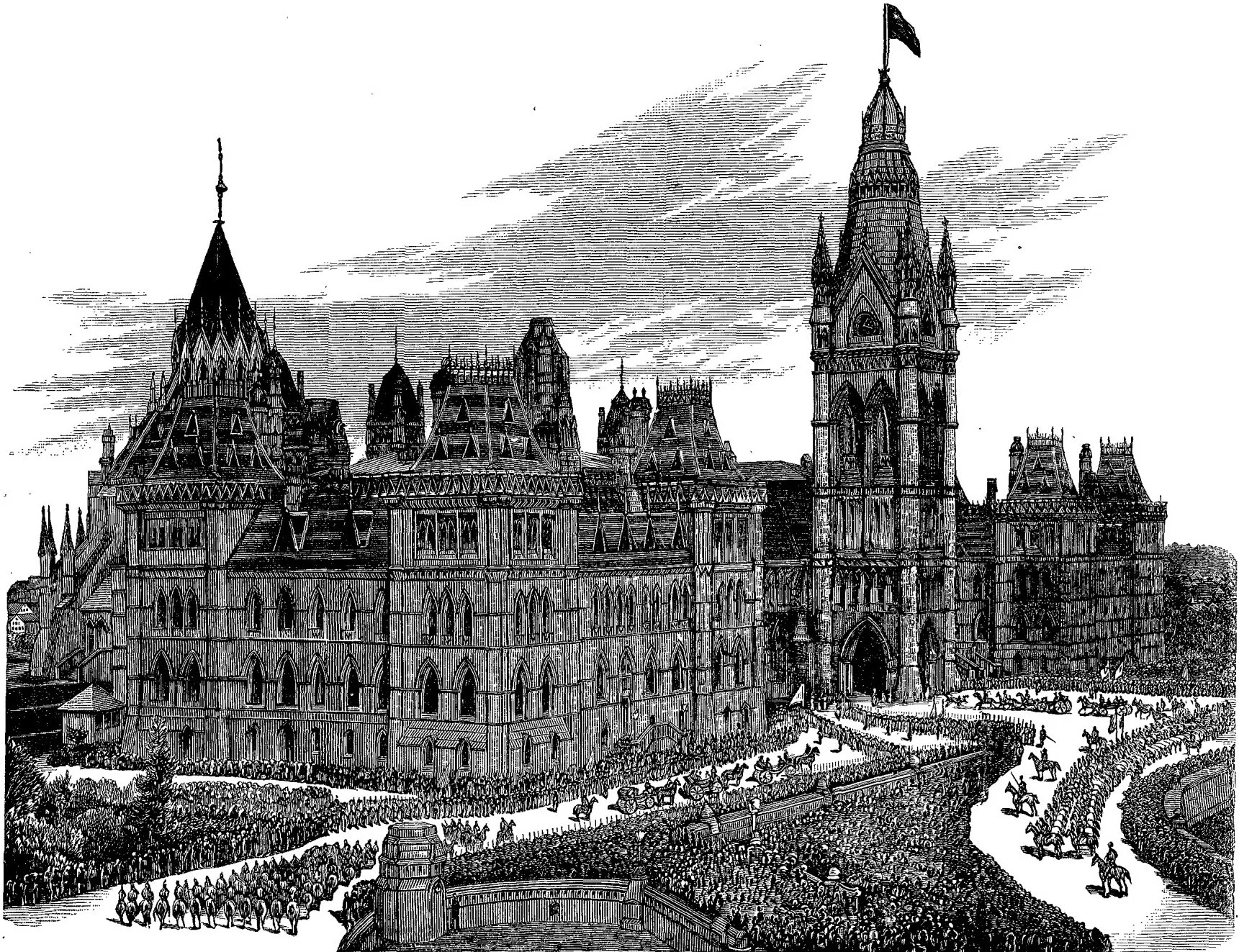
The Dominion Parliament House, Ottawa.
But Peter, on the day of Pentecost, plainly told the Jews that they were Christ’s betrayers and murderers. The legal forms under which the Saviour was put to death did not in the least change the complexion of the part played in the drama by the Jews. It was persecution, and that alone. And no more did the sanction of the civil authority, given in accordance with the “law of the land,” exculpate the papal persecutors of the Christians in the Dark Ages. “Laws” which sanction injustice and constitute ready weapons for the hands of religious bigots, ought to have no place upon human statute books. God is a God of justice. He “hath prepared his throne in the heavens, and his kingdom ruleth over all.” Justice is law; and only justice can properly be affirmed by the decisions of courts, or enforced by those invested with civil authority.
THEIR SENSE OF JUSTICE REVOLTED.
It is evident that the part which Justices Meredith, Rose, and Street felt themselves compelled to take in the persecution of the Adventist ministers, Burrill, Howe and Simpson, was distasteful to these honorable judges.
The decision of the lower court was sustained, but without costs, contrary to the usual practice. What does that mean? It means simply this,—that the court considered the case as one of petty persecution, and that if the prosecutors could get any satisfaction in carrying it on, they would be permitted to do it, for “the ‘law’ allows it,” and therefore “the court awards it,” but it must be done at their own expense.
Nor is this all. Chief-Justice Meredith said: “We think that there is evidence by which we might have come to another conclusion had the case been before us at the first.”
But one other decision was possible, namely, to grant the request of the defendants to quash the conviction in the lower court. So that by this the prosecutors108were given to understand that had the cases been tried before these judges at the first, the decision would have been against them. This is rather poor encouragement for the latter to undertake another case, inasmuch as it would be as likely to come up before Justice Meredith as before anyone else.
It seems strange that in such cases courts follow the “statute” instead of the law. It is a fundamental principle of English jurisprudence that government exists to secure rights. These rights are not created by statute but exist in the very nature of things. “This law of nature,” says Blackstone, “being coeval with mankind, and dictated by God himself, is of course superior in obligation to any other. It is binding over all the globe, in all countries, and at all times. No human laws are of any validity if contrary to this, and such of them as are valid derive all their force, and all their authority, mediately or immediately, from this original.”
Had these Canadian justices followed the law as defined by Blackstone, they would not have sustained the conviction of the Adventist ministers,—not prosecuted for an offense against their fellowmen, but persecuted for conscience’ sake; for following their own convictions of duty in a matter that in no wise trenched upon the equal rights of others.
REJOICING UNDER PERSECUTION.
The three Adventist ministers imprisoned at Chatham, Ont., have not courted persecution. They have consistently defended themselves in the courts and have claimed their rights as men and as Christians; but, now that the decision has been rendered against them, and they are required to suffer imprisonment for conscience’ sake, they are enabled to rejoice even under persecution. On the eve of his imprisonment one of these men writes thus to a friend:—
Darrell, Ont., March 20, 1896.
The sheriff has not as yet called to take us to jail. We are expecting him at any minute. My heart is filled with gratitude to God for the privilege I have of thus witnessing for the truth. My earnest prayer to God is that his name may be glorified and his truth advanced in the earth. I praise him for the assurance I have that he will be with me, that he will sustain me. The words of Christ by his apostle are precious to me: “If any man suffer as a Christian, let him not be ashamed, but let him glorify God on this behalf;” and I praise God continually that I am accounted worthy to suffer for his precious name. The enemy of all righteousness may separate us from earthly friends, but they cannot separate us from that dearest of all friends that sticketh closer than a brother. Prison cells and bars may cut off all communication with the world, but they cannot cut off communication with Him in whom I trust. The enemy may distress, but he cannot contaminate; he can cause agony, but not defilement. The thought that Christ has fought the battle and conquered for me, fills me with courage. With that still, small voice saying, “I’ll be with you,” I gladly accept the cross knowing that this light affliction which is but for a moment worketh for me a far more exceeding and eternal weight of glory.
Your brother in Christ.
There is in this nothing of fanaticism: it is simply the expression of a firm reliance upon God. “All things work together for good to them that love God” (Rom. 8:28); and in the sermon on the mount, the Saviour said: “Blessed are ye, when men shall revile you, and persecute you, and shall say all manner of evil against you falsely, for my sake. Rejoice, and be exceeding glad: for great is your reward in heaven: for so persecuted they the prophets which were before you.” Matt. 5: 11, 12.
We are sorry that Ontario imprisons such men, but since they are called upon to thus endure hardness, we are glad that they can do it as good soldiers of Jesus Christ. 2 Tim. 2:3.
TOLERATION VS. RIGHTS.
In 1827, Lord Stanhope, speaking in the British House of Lords, said: “The time was when toleration was craved by dissenters as a boon; it is now demanded as a right; but the time will come when it will be spurned as an insult.”
The time thus predicted has come, not only in England but in all English-speaking countries, to the more powerful sects of dissenters, but even in England and her dependencies there exists to-day only toleration for the weaker sects.
According to the “Encyclopædic Dictionary,” toleration is “the act of tolerating or enduring; allowance of something not fully approved.” This is exactly the status of the Seventh-day Adventists in Canada to-day,—they are simply tolerated under certain restrictions.
By the Toleration Act of William and Mary (1689), freedom of worship was permitted to Protestant dissenters from the Church of England, provided they made a declaration against transubstantiation, and took the oaths of allegiance and supremacy. This act has been amended from time to time until now all dissenters, including Roman Catholics and Jews, enjoy all the privileges of the constitution, except Sabbatarian Christians, who are denied rights freely enjoyed by Jews, simply because they are few in number.
Religious toleration in the Dominion, as in some of the States, nominally guarantees to all sects equal rights, but with this proviso, that they observe the “sabbath” or “Lord’s day” of the dominant sects. This corresponds very closely with the conditions of the original English Toleration Act, which, as before stated, required a declaration against transubstantiation, etc.
Much credit is due Anglican influence for the measure of religious liberty enjoyed, not only in England and America, but throughout the world to-day. But not all foretold by Lord Stanhope has yet been realized even in the most favored lands. To-day too many mistake toleration for liberty; but it is in reality a denial of it, for the power that assumes to tolerate thereby asserts the right to restrict or even to prohibit. Therefore toleration is opposed to the free exercise of natural, God-given rights.
A MEMBER OF THE DOMINION PARLIAMENT ON THE RIGHTS OF CONSCIENCE.
THE question of Sunday laws and the rights of conscience is not an entirely new one in Canada.
For several years past an effort has been made at each session of Parliament to secure the enactment of a Sunday law for the Dominion; but so far these efforts have been successfully resisted on the ground that such legislation trenches upon the rights of conscience.
AS the principle of Sunday legislation is the same whether the law be Provincial or National, some of the arguments urged in Parliament against the enactment of a Sunday law for the Dominion are equally applicable to the “Lord’s day” act of Ottawa.
In 1894, Mr. Charlton introduced into the Dominion Parliament a bill entitled, “An Act to Secure the Better Observance of the Lord’s Day, Commonly called Sunday,” and urged its passage upon the rather unusual ground that it was required for the protection of the religious liberty of Sunday observers! In replying to this “argument,” May 30, 1894, Hon. G. Amyott, member from Bellechasse, P. Q., said:—
“The honorable gentleman [Mr. Charlton] says:—
The State Should Protect the Rights of Conscience.
“This is a very important principle. I want to know where the honorable gentleman wants to apply it. It is a very true principle applied generally, and I wish it were printed in the honorable gentleman’s heart as well as in the hearts of all the people of the Dominion,—the State should protect the rights of conscience. . . .
“We are not alone in this Dominion. There are not only Protestants and Catholics in this country; there are some other subjects of Her Majesty; the honorable gentleman knows it. There are some Jews. In England, in France, in Germany, in all the civilized nations of the world, they are a respected set of individuals. They have consciences, too; and though not believing in their faith, I am not ashamed to show their way of thinking. They rely upon the Bible, upon the Old Testament, and what do they find there? They find the words of God himself. The honorable mover of the bill himself believes that what I will read there is the word of God. Take Genesis—some honorable gentlemen laugh, but perhaps it will do them good to hear again what they learned109by heart when young. Take paragraph two (Gen. 2:3), which reads:—
“And God blessed the seventh day, and sanctified it: because that in it he had rested from all his work which God created and made.”
“There it is the seventh day which God made holy; and then, if you look at Exodus, chapter 20 and verses 8–11:—
“Remember the Sabbath day, to keep it holy. Six days shalt thou labor, and do all thy work: but the seventh day is the Sabbath of the Lord thy God; in it thou shalt not do any work, thou, nor thy son, nor thy daughter, thy manservant, nor thy maidservant, nor thy cattle, nor thy stranger that is within thy gates: for in six days the Lord made heaven and earth, the sea, and all that in them is, and rested the seventh day: wherefore the Lord blessed the Sabbath day, and hallowed it.”
“The Jews take those texts among others—there are hundreds of them—and say that the law that God gave to his creatures is to keep holy the seventh day. And they ask by what authority we change the law of God and celebrate the first day instead of the seventh. This is a very important point, and I am sure that the honorable mover of the bill is ready to give his authority.
“Now, there is another sect or religion which says: We do not rely upon the Old Testament, but upon the New Testament, and according to the New Testament it is ordered that we should go on celebrating the seventh day and not the first day. These people rely upon the New Testament, and have even suffered death to prove their belief. I hold in my hand a book entitled, ‘The Faiths of the People,’ by Malloy, and I will draw the attention of the honorable gentleman to page 209 at the end of the chapter. He will see there the reasons these people give for going on celebrating the seventh day. I shall not trespass upon the time of the House by giving quotations, but I ask the honorable gentleman to show us one word in the New Testament where the Son of God took it upon himself to change the day ordered by his Father to be kept holy.
“The Seventh-day Baptists or Adventists who celebrate the seventh day, say to the mover of this bill: To whom do you submit when you keep holy the first day? And they accuse him of submitting to the Catholic Church. They say to him: In celebrating the first day of the week, you admit the authority of the Catholic Church and its right to impose discipline. You admit that the Catholic Church has received from God the power to dictate to the people its law as to the doctrine to be followed. That is the charge which the Seventh-day Adventists make against the honorable gentleman.
“The honorable gentleman knows, and he will find it in his own authorities, that Sunday is of apostolic tradition. In the first centuries, as shown in the book I have here, in many parts of Christendom, Sabbath was celebrated, but the Catholic Church changed the day, pretending that it had the right so to change it, pretending that it [the church] was established by the Son of God and intrusted with all powers. And it is in virtue of that belief that the church changed the day, and that is why Seventh-day Adventists say to the honorable mover of the bill: You believe, like us, in the New Testament, why do you give up your belief in the Sabbath celebration? Why do you submit to the Roman Catholic Church? Why do you admit the traditions of the apostles? If you admit one, you admit them all. You admit the absolution given by the priest, you admit the sacraments of that church. But they say: We believe in the word of God the Father in the Old Testament, and in the word of God the Son in the New Testament, and we stand by that, and will not submit to the dictation of any other church, which is only assuming powers it has not received.
“As for us Catholics, Mr. Speaker, we shall celebrate our Sundays as we please, provided we do not interfere with your civil rights, and if we do, go to the provinces and you will receive protection. . . . We do not believe in this Parliament turning itself into a salvation army, and with drums and fifes trying to force us into heaven.
“The honorable mover of this bill says he wishes to protect the rights of conscience. Is he doing that when he wants to impose upon the Jews the obligation of keeping the first day instead of the seventh? Does he protect the rights of conscience when he seeks to impose upon the Jews to keep the first day of the week instead of the seventh? Does he protect the rights of conscience when he wants to compel the Seventh-day Adventists to celebrate the first day of the creation instead of the seventh? Does he protect the rights of conscience when he seeks to compel a great number of his fellow-citizens to disobey the word of God and to obey the words of a church of which they do not approve?
A Royal Proclamation.
“The honorable gentleman must remember that in proposing his bill he acts not only con-
trary to the constitution I read a moment ago, but also contrary to the general understanding which prevails in this country and which was summed up in a proclamation by Her Majesty the Queen in 1858, which is as follows:—
“Firmly relying ourselves on the truth of Christianity, and acknowledging with gratitude the solace of religion, we disclaim alike the right and the desire to impose our convictions on any of our subjects. We declare it to be our royal will and pleasure that none be in anywise favored, none molested or disquieted by reason of their religious faith or observance, but that they shall alike enjoy the equal and impartial protection of the law; and we do strictly charge and enjoin all those who may be in authority under us that they abstain from all interference with the religious belief or worship of any of our subjects, on pain of our highest displeasure.
“These are the words not only of the Queen, but of the Parliament of Great Britain. This is the rule which should be recognized in this country.
We Should Not Interfere with the Religious Belief of Our Neighbors.
Everybody should enjoy complete liberty, provided that liberty does not interfere with the liberty and civil rights of others. But the honorable gentleman wants to force those who are not of the same belief with himself to observe as the Sabbath some other day than that which they believe to be the Sabbath, and even to force those who, like himself, desire to observe Sunday, to observe it in the way he believes in, and not in the way they believe in themselves. That is not protection of civil rights; it is interference with civil rights.
“Mr. Speaker, I do not wish to take up too much of the time of this House, but I have given briefly the reasons why I oppose this bill: First, because the bill is unconstitutional; secondly, because it is useless if it were constitutional. . . .
“By this bill we claim jurisdiction in religious matters. . . . For my part, I am against all this legislation. I believe it is not our duty here to occupy ourselves with religious legislation. That has been left to each individual. Each individual has the right to worship his God as he thinks proper, provided he does not interfere with the liberty of anyone else.”