The Youth’s Instructor, Vol. 31, No. 9.

INSPIRING WORDS
Earlier text: INSPIRING WORDS

NEW-TESTAMENT HISTORY SERIES.

LESSON 124.—REVIEW OF THE EVENTS FROM OUR LORD'S SECOND PASSOVER TO HIS THIRD.

1. Tell how Jesus, when he had come up to Jerusalem to attend the Passover, healed an infirm man at the pool of Bethesda. John 5:1–9.
2. What caused the Jews to seek the life of Jesus while he was at this Passover?
3. How did he defend his own conduct?
4. How did he justify his course in allowing his disciples to pluck ears of grain on the Sabbath? Matt. 12:1–8; Mark 2:23–28; Luke 6:1–5.
5. Tell how Jesus healed the withered hand on the Sabbath-day. Matt. 12:9–14; Mark 3:1–6; Luke 6:6–11.
6. What did this cause the Pharisees to do?
7. When Jesus heard of their intentions, to what place did he withdraw himself? Matt. 12:15; Mark 3:7.
8. What took place there?
9. Tell how Jesus chose the twelve and ordained them. Mark 3:13–19; Matt. 10:2–4.
10. What remarkable discourse did he then preach to the disciples and the assembled multitude? Matt. 5; 6; 7.
11. Tell how he raised the centurion's servant. Matt. 8:5–13; Luke 7:1–10.
12. What miracle did he perform at Nain? Luke 7:11–17.
13. Tell how John sent a message from prison to Jesus, and what answer was returned to him. Matt. 11:2–19; Luke 7:18–35.
14. Under what circumstances was our Lord anointed by a woman who was a sinner? Luke 7:36–50.
15. Who accompanied Jesus on another tour through Galilee? Luke 8:1–3.
16. How were the friends of Jesus disturbed with regard to him? Mark 3:20, 21.
17. Of what did the scribes and Pharisees accuse Jesus when he had cast a devil out of a man who was blind and dumb? Matt. 12:22–45; Mark 3:22–30; Luke 11:14–36.
18. How did he answer those that asked for a sign?
19. How did he point out his true kinsmen? Matt. 12:46–50; Mark 3:31–35; Luke 8:19–21.
20. Relate the parable of the sower, and give its interpretation. Matt. 13:1–15, 18–23; Mark 4:1–25; Luke 8:4–18.
21. Relate the parable of the tares. Matt. 13:24–30.
22. What other parables did Jesus give about this time? Mark 4:26–34; Matt. 13:31–53; Luke 13:18–21.
23. Tell how Jesus stilled the tempest on the Sea of Galilee. Matt. 8:18, 23–27; Mark 4:35–41; Luke 8:22–25.
24. Tell what Jesus did for the demoniacs of Gadara. Mark 5:1–21; Matt. 8:28–34; Luke 8:26–40.
25. How was the ruler's daughter healed? Mark 5:21–43; Matt. 9:18–26; Luke 8:41, 42, 49–56.
26. What miracles are recorded in Matt. 9:27–34?
27. Tell how Jesus again taught in Nazareth, and was again rejected. Matt. 13:54–58; Mark 6:1–6.
28. What is said of our Lord's third circuit in Galilee? Matt. 9:35.
29. What moved him to send out the twelve disciples on a tour of teaching, and working miracles? Verses 36–38; Matt. 10:1–16.
30. What did Herod think of Jesus? Mark 6:14–16; 21–29.
31. When the twelve had returned, and Jesus had crossed over the lake with them, what miracle did he there perform? Matt. 14:13–21; Mark 6:30–44; Luke 9:10–17; John 6:1–14.
32. Tell how Jesus walked upon the Sea of Galilee. Matt. 14:22–33; Mark 6:45–52; John 6:15–21.
33. What did he do when he came to land? Mark 6:53–56.
34. On what subject did our Lord preach a sermon at Capernaum about this time? John 6:22–71.

THE OBJECT OF BIBLE STUDY.

Our Lord says in John 5:39: “Search the Scriptures, for in them ye think ye have eternal life; and they are they which testify of me.” We see that this is a command. We also read in 1 Peter 3:15: “Sanctify the Lord God in your hearts, and be ready always to give an answer to every man that asketh you a reason of the hope that is in you, with meekness and fear.” How can we do this intelligently if we do not know what the Scriptures say about it?
Our Lord has set us a perfect example. When tempted by the devil in the wilderness, his invariable answer was, “It is written,” etc. Matt. 4:4, 7, 10. Now, how can we thus overcome the great enemy of our souls, if we do not know what “is written”?
We are living in the last days; and Satan, knowing that his time is short, has come down with great power, to deceive us if possible. In view of this, would it not be well for us in this our day to improve the many blessed privileges we have in the Sabbath-school, and get our minds and hearts so filled with the word of God that we can meet the great enemy at every point with, “It is written”? J. H.

Sowing and Reaping: The Value of Each Hour

It takes but a very little time to plant, but it takes a long time to gather in the harvest. An hour of sinful seed-sowing may bring a lifetime of wretched sin-reaping. Not what the present hour is to bring forth, but what the present hour is to prepare for, is the measure of value for every hour while it is still with us.—Selected.

OVER THE HILLS.

LET us suppose, that we are many, many miles from here, away over the seas; no matter just now how we came here, but we will have a fine time to-day riding among the hills.
Rajah has just gone for the mules; and when he gets them saddled, we’ll start, and leave the others to pack up the tent and come by-and-by.
This is a nice morning for a ride; the sun is bright, and the air clear. Hark! do you hear that bird singing away up in the top of that tall tree? He’s glad it’s a fine morning, too.
Here come the mules; now let us start. Rajah must go to show us the way, so we will not get lost. We are going to a little village, and will pitch our tent outside, and stay all night. It will take us about two hours to get there; but if you will keep your eyes open, you may be able to see the houses quite a while before we come to them.
Do you see the nice fields of wheat and barley on each side of the road? The people tend them well, don’t they?
“What are those small trees growing up near that pile of rocks?”
Why, those are wild olives. Rajah says that pretty soon we shall come to a place where the cultivated olives grow. The only difference between them is that the wild olives are not so good as those that people raise. The blossoms, as you see by this tree at your side, are yellow when they first come out, but by-and-by they will turn white, with a yellow center. The fruit looks like a plum, and when ripe, is black. The olive oil that we get in America, is made from fruit like this.
“Can people raise this tree in America?”
Yes; in the southern part of California, where it is warm all the year, they raise a great many olive trees.
“The trees just ahead of us look like the oak trees that grew on grandpa’s farm.”
They are oak trees; and you will see many of them around here, though they are not so large as those at home.
Now we have come into a broader part of the valley, and after we get past these few high hills, keep a sharp lookout to see something new.
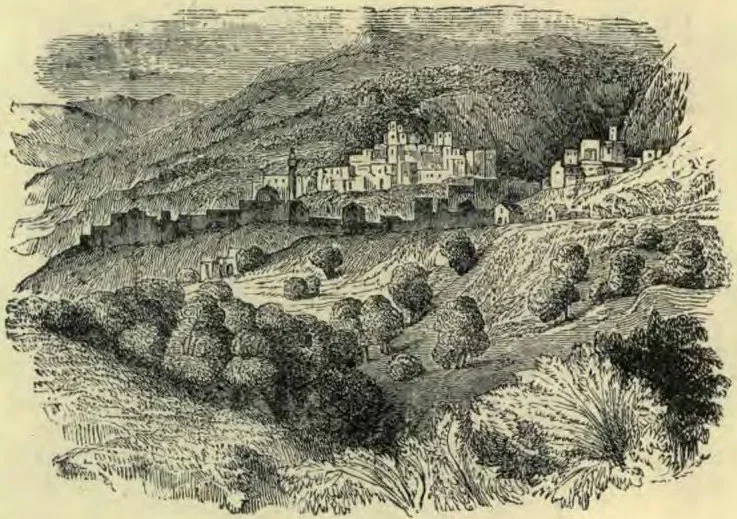
“Oh, I see; it’s the town! What a queer looking place!”
Yes; it is different from American towns. Here comes a man with a pair of loaded mules; perhaps he is going to his home among the hills, or may be he will sell his stuff in a neighboring town. He has on a long flowing robe and a turban of gay cloth wound around his head. His shoes are odd looking, too; they are just broad, thick soles tied on with strings. All the people wear them, and call them sandals.
Now we are near enough to the town so that you can see the houses plainly. They look very neat and clean. You see they are square, and built of whitish stone. As we ride through the main street of the village, it doesn’t look so clean as it did farther off; for the streets are all narrow, and quite dirty.
Since we have been riding so far, we will leave the mules with Rajah, and go up the hill,—for the village is built on the side of a hill and in a valley,—and get a drink from the fountain. The people do not have wells in their door-yards, but there is one large fountain in the village, and all carry their jars there to fill them. Here comes a woman with an earthen jar full of water on her head. You will see a good many women and girls with these on their heads or their shoulders.
This is the fountain, and as there are a number of women coming, we will wait here awhile and watch them. They are much better looking than the women where we camped last night, don’t you think so? Rajah told me the women of this town were prettier than those of any town around here.
I had forgotten to tell you the name of this place; may be Rajah told you. It is Nazareth. There is nothing in the town itself so very pretty, but it is made interesting by a wonderful little boy who lived and grew up here a long time ago. His father was a carpenter, and built houses like these.
If you are ready, we will get another drink of this cool, soft water, and then go and see if the tent has come. While Rajah is putting up the tent, you may get your Bibles, and see if you cannot find something about this little boy; and in the morning, when we go up to the fountain again, we will talk more about him.
W. E. L.

RETURN GOOD FOR EVIL.

“I’ll pay him back, see if I don’t!” exclaimed Tommy, as he came running into the house with a flushed and angry face.
“Who are you going to pay back?” asked his mother.
“Walter Jones. He took my marbles and ran away,” said Tommy.
“I hope you will pay him in a good way,” said his mother.
Tommy hung his head, and said nothing; for he was ashamed to tell just how mean he was going to treat Walter.
“I am afraid you intend to act just as badly as Walter has done. Think better of it, my son, and return good for evil. If you do not forgive, you cannot ask to be forgiven.”
That night when Tommy came to the place where it says, “Forgive our debts as we forgive our debtors,” he stopped.
“Why don’t you go on?” asked his mother.
“I can’t; I haven’t forgiven Walter,” said Tommy.
“Then you would better ask Jesus to help you forgive him just now.”
Tommy did so, and when he had finished his prayer, he went to bed with a happy heart.
Dear children, you cannot ask God to forgive you while you carry a bitter and unforgiving spirit within you. Forgive, return good for evil; and then when you pray to be forgiven, you can feel that God hears and answers your prayer.—Selected.

A GOOD SIGN.

A boy and girl who used to play a great deal together both learned to love the Saviour. On one occasion the boy said to his mother, “Mother, I know that Emma is a Christian.” “What makes you think so?” “Because, mother, she plays like a Christian.” “Plays like a Christian?” said the mother, to whom the expression seemed a little odd. “Yes,” replied the child. “She used to be selfish, but now she don't get angry if you take everything she's got.”

Letter Budget.

Phineas Henry, of Cherokee Co., Kansas, says: “I am fifteen years old. We go four miles to attend Sabbath-school, and we have a good school. There are twenty-seven members, but there are only about twenty that attend regularly. We could not go last Sabbath because it was so cold and slippery.”
Here we have a letter from Libbie A. Phelps, of Crow Wing, Minn. “My parents do not keep the seventh-day Sabbath, but I like to go to Sabbath-school with my uncle’s folks. They give me the INSTRUCTOR every week. I am going to save my papers, and make a book of them. I study ‘Scenes in the Life of Christ.’ I want to be a good girl.”
Daisy Graham writes a neat little letter from Kewana, Indiana. “I was eleven years old the eleventh of February. I keep the Sabbath with my ma and two little sisters, Ettie and Lizzie. I have been taking the weekly INSTRUCTOR two years. I hope I will be saved when Jesus comes.”
Lena Sorenson writes from West Chehalem, Oregon: “We live in a beautiful valley, with the mountains all around it. I am thirteen years old, and I have four sisters and one brother. There is only one family in the valley, besides us, that keep the Sabbath. We do not have any Sabbath-school, but learn our lessons from the paper at home. My little brother and sister study from Bible ‘Lessons for Little Ones.’ We all love to read the paper very much, and so does my mother. I am trying to live for Jesus.”

THE DARK.

Where do the little chickens run When they are made afraid? Out of the light, out of the sun, Into the dark—the shade. Under the mother's downy wing They have no fear of anything.
Where do the little violets creep When comes the time of snow? Into the dark to rest and sleep And wait for spring; they go Under the ground where storms can't reach, And God takes tenderest care of each.
Are you afraid, dear girl or boy, Afraid of the dark of death? Jesus will raise you, full of joy, To the world of light, he saith: And where the little violets sleep, Your body safe the Lord will keep.

You have reached the end of this edition.

The Youth’s Instructor · Feb 28, 1883