The Youth’s Instructor, Vol. 30, No. 45.

SWITZERLAND

The Youth’s Instructor

Nov 8, 1882

S. D. A. Publishing Association · Battle Creek, Mich. · Nov 8, 1882

SWITZERLAND
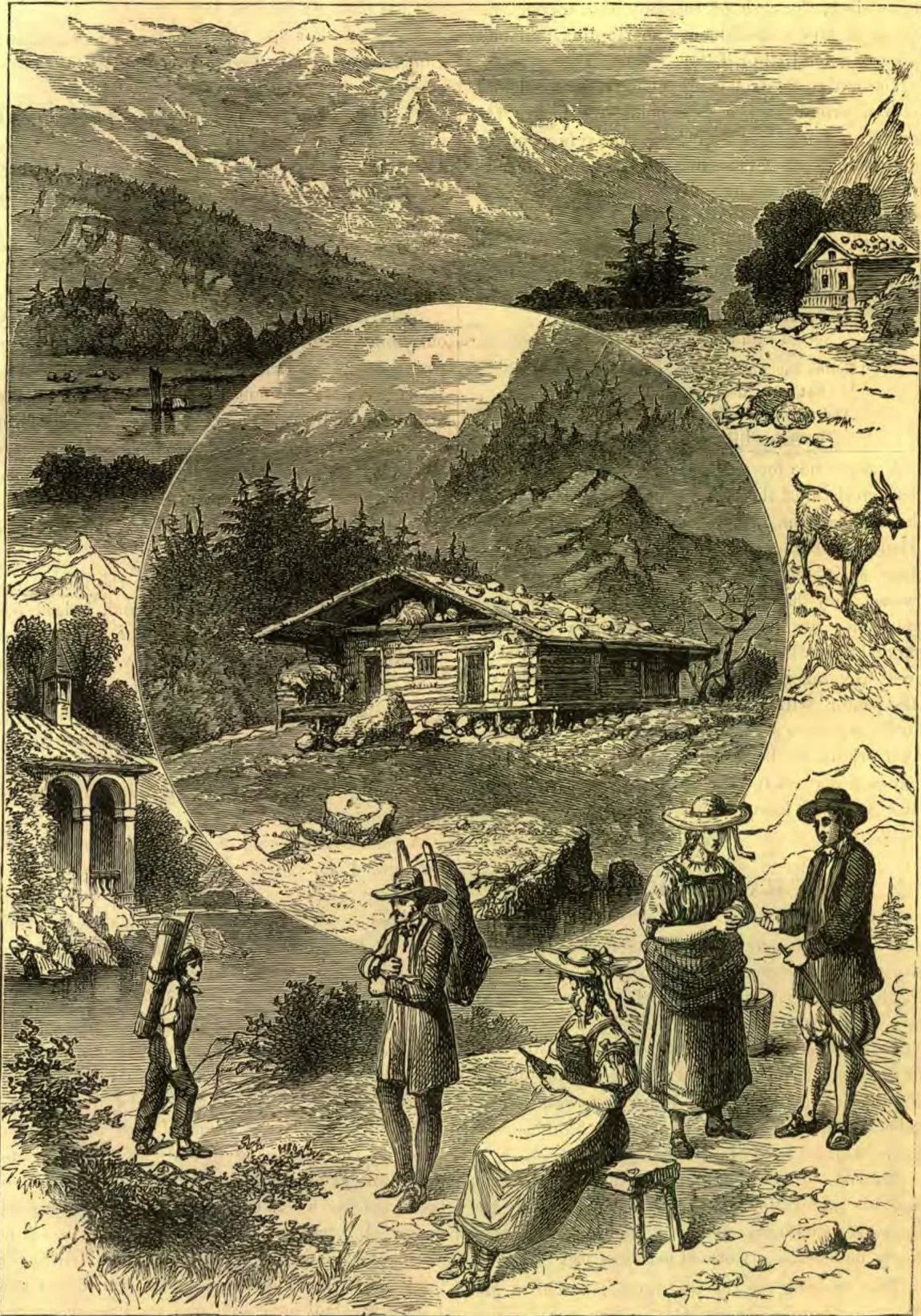
Lying as it does among the secluded valleys of the Alps, and so almost shut away from the great busy countries around it, Switzerland has not a very eventful history; and it is only in these later days that the country has come to be of much interest to the people of other nations. Now, however, scarcely any one thinks of visiting Europe without devoting a generous share of time to wandering over this romantic and picturesque region.
Switzerland is a small country, its whole population being a little less than that of the city of London alone; and then about one fourth of it is useless to the inhabitants because of the cold and ice which continually reign on the mountain heights. Nowhere do such extremes of climate meet as in Switzerland, where eternal Alpine snows are fringed with green pastures, and enormous icebergs rise above valleys blest with a delightful summer. Switzerland has some rich and prosperous cities, which are interesting, as all cities are; but we like the beauties of the wild country scenes better, so we will not stop in the busy towns. In the valleys and on the lower slopes of the mountains are many fine vineyards, planted on terraces rising one above another, sometimes to the number of thirty or forty. A pleasanter scene, or one more full of life, can hardly be imagined than the peasants in the vineyards, cheerily singing as they work. The grape-harvest is the most exciting time of the season.
The riches of the inhabitants are not wholly in their vineyards; for above them are the mountain pastures, where, in the summer season, great numbers of cows and goats are tended by their faithful shepherds. We often read of the Swiss châlets, but they are not usually such charming little dwellings as we may have imagined. The common ones are built of trunks of pines, notched at the ends so as to fit into each other at the angles where the logs cross; and then they are covered with low flat roofs of shingle, held down with stones to prevent their being carried away by heavy winds. These buildings are scattered over the mountains here and there; and in them the herdsmen stay, as they move with their flocks from the lower to the higher Alps and back again, as the season changes. These men have to work pretty hard; for they often have eighty or ninety cows to tend and milk, the cheese to make, and all the pails, pans, and other dishes to keep clean. Sometimes their families go with them up the mountains, which must make it very much pleasanter. But if these people have hardships, they have their simple pleasures as well; and doubtless the life is to them a happy one. Sound travels far in these solitudes; and as the twilight comes on, the women of neighboring châlets go out and call aloud to each other, “May God be with you!” or some such pious salutation; and their cries, mingling with the evening songs of the herdsmen on their homeward way, echo and re-echo from peak to peak till the very mountains seem to have tongues.
The houses of the Swiss people are mostly comfortable, hospitable-looking wooden dwellings, not particularly remarkable for anything except their many windows. They are coming to build more of brick, however, as the heavy forests of pine with which the Alps were once covered, have been largely cleared away. Here and there, on some eminence, may be seen an ancient castle, perhaps half in ruins, but ever a reminder of the “brave days of old.”
Switzerland has many beautiful lakes,—Geneva, the largest, and many others as beautiful though less renowned. Almost everywhere in the land there is the sound of water,—the beating of the waves on the lake shore, the onward flowing of the noble river, the rush of the mountain torrent, the splash of the waterfall, or the rippling and bubbling of some little rill.
The native Switzer is a brave and truthful man, with a proud step and a bold, free look. His mountain home has ever been the refuge of the oppressed of all faiths and nations; and in these rocky fastnesses many a little company of believers have hidden from the wrath of their persecutors,—
“And prayer, the full deep flow of prayer, Hallowed the pastoral sod; And souls grew strong for battle there, Nerved with the peace of God.”
“Before the Alps and stars they knelt,— That calm, devoted band,— And rose, and made their spirits felt Through all the mountain land.”
A reverence for the Holy Scriptures has been a characteristic of the Swiss people since the time of the Reformation, which took strong root in Switzerland. Bibles have not been so easily procured there as in our own country, but for that very reason they have been more valued than they sometimes are among us, and copies are often handed down from one generation to another with great reverence. In some parts of the country the pastor will not unite a couple in marriage until they have shown their possession of a Bible. Switzerland has been the birth-place of some good men and earnest reformers, and perhaps at another time we may learn something of their life and work.
E. B. G.

IT IS WELL.

The air has borne some tender words, As sweet as melodies of birds, And benedictions soft and clear Have trembled on the waiting ear; But never sweeter accents fell Than Faith has uttered, “It is well.”
Hope sits thro’ each to-day and waits The opening of to-morrow’s gates, And Patience wearily abides The veil that each to-morrow hides; But whether good or ill foretell, Faith sweetly whispers, “It is well.”
As soothing as a soothing balm, A grand and yet a tender psalm Is floating ever on the air, Is blending with the mourner’s prayer; And saddest plaints that ever fell Find answer in the “It is well.”
—Rural Home.

THE FLAW IN THE BOILER.

THE late Mr. W——, one of the leading business men of Cincinnati, was strongly opposed to the use of intoxicating liquor as a beverage, and in his gentle, quaint way preached many an effective temperance sermon.
He received one day a visit from Judge C——, of St. Louis, who then held the first place among the learned jurists of the West, and who was besides a brilliant man of the world, kind-hearted, brave, and loyal to his friendships.
Mr. W—— showed him over his manufactory, and his admiration was especially excited by the intricate machinery, much of which was of brass, finely polished,—a work of art as of use.
That evening the friends dined together at Mr. W——’s hotel. Judge C—— drank to excess. Observing his friend’s grave, keen eyes upon him, he said gayly,—
“You do not take brandy, W——?”
“No.”
“Nor wine?”
“No.”
“I do,” frankly. “Too much, probably. But I began thirty years ago. I drank as a boy at my father’s table. I drank as a young man, and I drink as an old one. It is a trifling fault, if you choose to call it a fault, and will hurt nobody but myself. If it has not harmed me in thirty years, I have no cause for fear.”
Mr. W—— bowed gravely, but made no reply. When dinner was over, he said, “We had an accident in our mills an hour after you left. Will you walk up with me?”
They reached the mills in a few minutes. There had been an explosion of the boiler. The exquisite, costly machinery was a hopeless wreck. Two or three workmen had been crushed in the ruin, and laborers were digging to find the bodies.
“Horrible!” cried C——. “That machinery was so fine and massive, I thought it would last an age.”
“Yes,” said W——, slowly, “but there was a flaw in the boiler,—a very slight flaw, which the workmen thought of no importance. I have used it many years in safety. But the flaw was there, and has done its work at last.”
Judge C——’s face lost its color. He was silent a moment, and then turning, caught Mr. W——’s hand.
“I understand you, old friend,” he said. “I will remember.”
How long he remembered, we do not know. A habit of thirty years is not easily broken.—Sunshine.

BE SWEET-TEMPERED.

SOMETHING is sure to happen every day to try our temper, and it is well, therefore, to keep watch over it so that we may be always amiable. If we give way to our temper, we not only make others unhappy, but ourselves also. After a fit of anger is over, how mean one feels as he thinks about it and remembers the naughty things he said and the foolish acts he did. He is almost ashamed to look into the face of any one who saw him when the fit was on him.
If, on the other hand, we resist the inclination to anger, we feel stronger for it, and, indeed, are stronger for it. We have gained a victory over self, and can more readily gain a victory another time. Besides, if any one has seen that we had a provocation to anger, he cannot but notice the triumph we have gained, and this becomes an example to him. It may do him great good, when at some future time, he is placed in like circumstances.
A good story is told of an English bishop who was noted for great amiability of temper. A young gentleman, whose family had been acquainted with the bishop, in making a tour through England before he went abroad, called to pay his respects to his lordship as he passed by Hustlebury. It happened to be dinner-time, and the room was full of company. The bishop, however, received him with much familiarity; but the servant, in reaching him a chair, threw down a curious weather-glass which cost twenty guineas, and broke it. The gentleman was under great concern, and began to excuse the servant, and make an apology for himself as the occasion of the accident, when the bishop, with great good-nature, interrupted him, saying, “Be under no concern, good sir, for I am much beholden to you for it. We have had a very dry season, and now I hope we shall have a change, for I never saw the glass so low in my life.” That was a very witty turn of the good bishop, and everybody was pleased with it and put into a good humor. The bishop at this time was an old man over eighty years of age, an age when many become peevish and fretful, and yet he had perfect command of his temper. He must have acquired this by watchfulness and frequent prayer to God for help.—S. S. Classmate.

HAD AN EYE ON HIM.

“THAT young Brown has become a Christian, has he?” said one business man to another.
“Yes, I heard so.”
“Well, I’ll have an eye on him to see if he holds out. I want a trusty young man in my store. They are hard to find. If this is the real thing with him, he will be just the man I want. I’m watching him closely.”
So young Brown went in and out the store, and up and down the streets. He mixed with his old associates, and all the time Mr. Todd had an eye on him. He watched how the young man bore the sneer of being “one of the saints;” if he stood up manfully for his new Master, and was not afraid to show his colors. “Although Mr. Todd took rides, went to church, or did what he pleased on the Sabbath, he was very glad to see that Brown rested on that day and hallowed it. Though the Wednesday evening bell never drew the merchant to prayer-meeting, he watched to see if Brown passed by. Sometimes he said, “Where are you going, Brown?” and always received the prompt answer, “To prayer-meeting.” Brown’s father and his teacher were both questioned as to how the lad was getting on.
For a year or more Todd’s eyes were on Brown. Then he said to himself: “He’ll do. He is a real Christian. I can trust him. I can afford to pay him. He shall have a good place in my store.”
Thus, young Christians, others watch to see if you are true; if you’ll do for places of trust. The world has its cold, calculating eye on you, to see if your religion is real, or if you are just ready to turn back. The Master’s loving eye is on you also. He sees not the missteps alone, but also the earnest wish to please him. He, too, has places of trust. The work is pleasant, and the pay good. These places may be for you when, through his strength, you have proved yourself true. Fix your eye on him, and he will keep you in the way. —Congregationalist.

THE WIDOW'S MITE.

AMONG the appropriate things placed in the beautiful temple built by Herod, which was standing in Jerusalem in our Saviour's time, were the treasure chests, with large, bell-shaped mouths, into which people cast their offerings for benevolent purposes when they went up into the temple to worship.
Jesus sat one day near these chests, and saw the people making their contributions. Many who were rich gave large sums. Perhaps some of them were pleased to hear the jingling coins go rattling down into the chests, and others were glad to have people see them give liberally, and, no doubt, some were astonished to hear Jesus say, when the poor widow came along and dropped in two mites, worth about one-fifth of a cent, that she had given more than all the rest. It was more to her, for it was all that she had. The rich could give large gifts without feeling it, but the little that she gave was “all her living,” and her love must have been great, or she would never have made such a gift.
God values our gifts to him according to the love we have in our hearts.—The Myrtle.

Purity of Thought and Daily Action

SEE that the feelings, thoughts, actions of each hour are pure and true; then will your life be such. The wide pasture is but separate spears of grass; the sheeted bloom of the prairies but isolated flowers.

LESSON 94.—THE GREEKS SEEK AN INTERVIEW WITH JESUS.

AMONG the people that came up to the Passover, there were certain Greeks who were very anxious to see Jesus. Coming to Philip of Bethsaida, they told him what they wanted. Philip first talked with Andrew, and then they two went and told Jesus. Jesus took this opportunity to speak of his coming death and resurrection. He said, “The hour is come that the son of man should be glorified. Verily, verily, I say unto you, Except a corn of wheat fall into the ground and die, it abideth alone; but if it die, it bringeth forth much fruit.” By this he meant to teach that, although he was soon to be put to death and laid away in the tomb, he would rise to a more glorious life, and be the means of saving multitudes of people; just as a kernel of wheat, when it is planted, sends up a stalk that bears many kernels. And as the kernel would bring forth no fruit, except it were planted, so mankind could not be saved from their sins, unless Jesus should die for them. Jesus meant to show them how necessary it was for him to die, and to encourage them with the thought that death could neither hold them nor him in its grasp. He also wanted to teach them to set a higher value upon the life to come, than upon this life; so he said, “He that loveth his life shall lose it, and he that hateth his life in this world shall keep it unto life eternal.” This was as much as to say that he who cares more for the things of this life than he does for God and heaven, will never have any life but this, and will lose all part in the life to come; and that any one who thinks less of the things of this world than of the world to come, will have not only this life, but the joys of a future life to all eternity.
Then said Jesus, “If any man serve me, let him follow me; and where I am, there shall also my servant be; if any man serve me, him will my Father honor.” We follow Jesus when we do as he did, and live as he taught. And if we do thus follow him, we have the promise that God will honor us with eternal life and a home with our Saviour.
After this, Jesus was troubled in spirit. He knew that the time was close at hand when the sins of the whole world would be laid upon him. He could foresee the awful agony that he was soon to pass through, and for a moment seemed to shrink from it. He said, “Father, save me from this hour: but for this cause came I unto this hour. Father, glorify thy name.” At this moment a voice from heaven was heard, saying, “I have both glorified it, and will glorify it again.” Some of the people that stood by, said that it thundered, while others said, “An angel spake to him.” But Jesus said, “This voice came not because of me, but for your sakes.”
In talking farther with the people, Jesus told them that he was to be with them but a little while; that they must walk in the light while they had it; for if they did not, the light would be withdrawn, and darkness would come upon them. We, too, have the light of the Saviour’s words; and if we obey those words, we may be said to walk in the light; if we walk in the light, we are children of the light, and shall finally go to dwell in a world of light and glory.
Notwithstanding the many miracles that Jesus had done, there were not many who believed on him as the Messiah. Even the voice from heaven could not convince them. There were, however, even among the chief rulers, some who believed on him; but they loved the praise of men more than the praise of God, and would not own that they believed in Jesus, for fear that they might be put out of the synagogue.

QUESTIONS.

  1. Who among the people that came to the Passover were anxious to see Jesus? John 12 : 20.
  2. To whom did they come to make known their desires?
  3. Who made their request known to Jesus?
  4. Did Jesus seem to be flattered by the attentions of the Greeks?
  5. How did Jesus improve this opportunity?
  6. What did he say? Verse 23.
  7. What illustration did he draw from a kernel of wheat? Verse 24.
  8. What did he mean to teach by this?
  9. What did he mean to show them?
  10. By what thought did he encourage them?
  11. How did he try to teach them to set a higher value upon the life to come than upon this life? Verse 25.
  12. This was as much as to say what?
  13. What did he say every one must do who would serve him?
  14. What promise did he make to those who would truly follow him?
  15. In what way do we follow Jesus?
  16. If we do thus follow him, what assurance have we?
  17. What seemed to cause Jesus to be troubled in spirit?
  18. How did this seem to affect him for the moment?
  19. What did he say? Verse 27.
  20. What was then heard?
  21. What did the people say who stood by?
  22. What did Jesus say about the voice?
  23. What did he say about going away?
  24. What did he say they must be careful to do?
  25. What would be the consequence if they did not walk in the light?
  26. How do we have the same light that was given the people at that time?
  27. When may we be said to walk in the light?
  28. What may those be called who do walk in it?
  29. Where will the children of the light finally go?
  30. How did the people at that time manifest their hardness of heart? Verse 37.
  31. Who believed on him but would not own it?
  32. Why did they not confess their faith in Jesus?

NEW-TESTAMENT HISTORY.

LESSON 108.—JESUS ON THE CROSS.

At the third hour, which was about nine o’clock in the forenoon, our Lord was crucified. The two thieves that were led out with him were also crucified, one on his right hand, and the other on his left. Then Jesus, full of compassion and tenderness, cried out, “Father, forgive them; for they know not what they do.”
As Jesus was hanging upon the cross, Pilate wrote a superscription and placed it over his head. It consisted of these words, JESUS OF NAZARETH, KING OF THE JEWS; and it was written in Hebrew, in Greek, and in Latin, so that the people, of whatever nation, might read it. When the chief priests saw so many people reading the inscription, they came to Pilate, and said, “Write not, The King of the Jews, but that he said, I am King of the Jews.” But he refused to change it, saying, “What I have written, I have written.”
When the soldiers had crucified Jesus, they began to divide his clothing among them, giving each a part; but his coat was all one piece, woven from the top throughout, so when they came to it, they said, “Let us not rend it, but cast lots for it.” Thus was fulfilled the scripture which said, “They parted my raiment among them, and for my vesture they did cast lots.” Then the soldiers sat down and watched the victims they had crucified.
“And they that passed by reviled him, wagging their heads, and saying, Thou that destroyest the temple, and buildest it in three days, save thyself. If thou be the Son of God, come down from the cross.” The chief priests and the rulers also derided him, and mockingly said, “He saved others; himself he cannot save. If he be the king of Israel, let him now come down from the cross and we will believe him. He trusted in God; let him deliver him now, if he will have him; for he said, I am the Son of God.”
And one of the malefactors that were crucified with him said, “If thou be the Christ, save thyself and us.” But the other rebuked him, saying, “Dost not thou fear God, seeing thou art in the same condemnation? And we indeed justly; for we receive the due reward of our deeds: but this man hath done nothing amiss.” Then turning to Jesus, he begged to be remembered when Jesus should come to take possession of his kingdom. The faith of this man seems remarkable.
The disciples were disheartened, and had forsaken their Lord, feeling that the hopes they had entertained with respect to him could never be realized; but this man had faith in the coming kingdom of Jesus, even when its king was suffering the agonies of crucifixion. Jesus gave the dying man the sweet assurance that his request should be granted, and that he should have a home in paradise.
Now there were standing by the cross four women,—the mother of Jesus with her sister; Mary, the wife of Cleophas; and Mary Magdalene. When Jesus saw his mother standing there, and John, the beloved disciple, standing near her, he said, “Woman, behold thy son;” and to John, “Behold thy mother.” From that time John took her to his own home.
“And when the sixth hour was come, there was darkness over the whole land until the ninth hour.” That is, it was dark from noon till three o’clock in the afternoon. “And at the ninth hour Jesus cried with a loud voice, saying, Eloi, Eloi, lama sabachthani? which is, being interpreted, My God, my God, why hast thou forsaken me? And some of them that stood by, when they heard it, said, Behold he calleth Elias.”
“After this Jesus knowing that all things were now accomplished, that the Scripture might be fulfilled, saith, I thirst.” Then one of the men who stood by took a sponge, and having dipped it in vinegar, put it on the end of a reed, and pressed it to the lips of Jesus, saying, “Let alone; let us see whether Elias will come to take him down.”
Then said Jesus with a loud voice, “It is finished.” After this he bowed his head, saying, “Father, into thy hand I commend my spirit.” “And having said thus, he yielded up the ghost.”

QUESTIONS.

  1. At what time of day was our Lord crucified? Mark 15:25.
  2. Who were crucified with him?
  3. How did Jesus show his compassion and tenderness as he was suffering the agonies of crucifixion?
  4. What words did Pilate put above the head of Jesus?
  5. In what different languages was it written?
  6. Why was it so written?
  7. What did the chief priests beg Pilate to do?
  8. How did Pilate reply to them?
  9. When the soldiers had crucified Jesus, what did they begin to do?
  10. What did they say when they came to his coat?
  11. What scripture was thus fulfilled?
  12. What did the soldiers do after having divided the garments of Jesus among them?
  13. How was Jesus treated by those who passed by? Matt. 27:39.
  14. How did the chief priests and the rulers mock him?
  15. What was tauntingly said by one of the malefactors that were crucified with him? Luke 23:39.
  16. How did the other thief reply to these words?
  17. After saying this, what did he beg Jesus to do for him?
  18. What was there remarkable about the faith of this man?
  19. What sweet assurance did the Saviour give him?
  20. What women were standing by the cross? John 19:25.
  21. When Jesus beheld his mother standing there, what did he say to her?
  22. What did he say to John?
  23. How did John recognize the obligation thus placed upon him?
  24. When Jesus had been upon the cross three hours, what remarkable phenomenon took place?
  25. What did Jesus do at the ninth hour?
  26. What words did he utter?
  27. What did some think he meant by these words?
  28. Why was he thus misunderstood?—Because he spoke in a language that some could not interpret.
  29. When Jesus realized that his work was about accomplished, what did he say?
  30. How was his call answered?
  31. What scripture was thus fulfilled? Ps. 69:21.
  32. What did they say as the vinegar was pressed to his lips?
  33. What did Jesus then utter with a loud voice? Luke 23:46; John 19:30.
  34. How did the scene close?

KATE'S SECOND THOUGHT.
“Let me have the basket; I'm sure it is mine.” Esther said.
“Well, I'm sure it isn't,” declared Kate. “I set mine down right by that big stone; and besides, I know I had more berries than you, for I picked all the time you were chasing that butterfly.”
Then there was a good deal of talk about this same thing, which of two baskets, just alike, save that one had more berries in it, belonged to Esther. Roger sided with Kate, and Wheeler thought that the fuller basket was probably Esther's; and Kate told him he always took Esther's part, right or wrong; and really they were in danger, all of them, of saying things that would need forgiving, when Esther said suddenly,—
“Why, what's that?”
“That,” said Wheeler, parting the bushes, and looking out into the sky, “was a clap of thunder; unusually loud, too. We are going to have a storm.”
Sure enough, the big raindrops began to patter around them while he spoke. Not a very hard shower, only the thunder sounded unusually loud, and the lightning was very sharp. They stopped picking berries, and waited under shelter of the great trees, peeping out now and then at the prospect.
“Isn't it strange what thunder is?” said Esther.
“Why, no,” said Kate; “it isn't strange, I suppose. People who have studied know all about what makes it. I used to think it was God's voice. Mamma says when I was a little bit of a girl, whenever it thundered, I would say, ‘Hark! God speaks!’”
“Maybe his voice does sound a little like thunder,” Roger said thoughtfully; “and maybe the lightning is a little like the way Jesus looked when he was up on the mountain and shone so that the disciples were afraid.”
Roger had been studying his Sabbath-school lesson, and talking it over with his mother just before he came out. His mind went back to it now.
“Oh, you don't think God's voice really sounds like thunder, though?” said Wheeler.
“Why, I don't know,” Roger said. “Some folks thought so, you know. When God spoke to Jesus once, and said he had glorified his name, the people standing around thought that it thundered.”
“Does it say that in the Bible?”
“Certainly; it's one of the references in our lesson.”
“I don't wonder they were afraid,” Esther said.
She was the youngest of them, and was always just a little bit afraid of thunder and lightning.
Kate turned and put her arm around the little sister. When the rain was over, they went back to their berries.
“Essie, I guess maybe that was your basket. Anyhow, you can have it.”
“No,” said Esther, “I don't feel exactly sure; and I would just as soon you had it.”
But Kate kissed her again, and urged that she ought to have it anyhow, because she was the younger; and they exchanged baskets.
“What made you do that?” Roger asked, as they walked homeward.
“Do what?”
“Give Essie your basket. I am sure it was yours.”
“I don't hardly know what made me do it, only I thought perhaps I was mistaken, and it was hers. And then I went to thinking about thunder being like God's voice, and about Jesus up on the mountain with his face shining like the lightning; and I thought if he should come now, and talk with me, he wouldn't like it if I didn't give Essie the basket; and then I remembered that he knew all about it, and I thought I would like to please him.”—The Pansy.

A VISIT TO THE SEA-SHORE.

[THE following is from one of the young readers of the INSTRUCTOR who has visited the sea-shore during the past summer. It will, we think, interest some of the readers, and may at the same time encourage older ones to turn their recreation into a form to interest and benefit those who cannot enjoy their privileges.—Ed.]
PERHAPS some of the INSTRUCTOR readers would like to hear something about a part of the sea-coast of Massachusetts. The day that I was there the sea was very rough on account of its being in the full of the moon; and the waves dashed heavily upon the rocks of the Peninsula of Nahant and the Island of Egg Rock (Boston Harbor). As far as one could see, the breakers were coming, rolling one over the other and disappearing on the white sandy beach.
Now that I have spoken about the Island of Egg Rock, perhaps you would like to hear something further about it. It is named thus because it is nearly in the shape of an egg. At the head of the island, or at the sharper end, there is a magnificent light-house. The keeper, his wife, and three little children stay all alone in this dreary place. The keeper gets a high salary for this dangerous business. The island is about three miles from the main-land. You may get the idea that this island of solid granite is wholly destitute of good soil, but this is not so; for the soil that is on the island has been carried there from the main-land in ships. There are several acres of rich soil a number of feet deep. The keeper has a cow and a horse. His children are taught at home. They do not have so good opportunities to get an education as many of us do. Once when their father was gone to Boston to get a supply of food, their mother was taken very sick. A heavy thunder storm came up, and the sea was so rough that he could not get to his family until three days had passed. His house is about one hundred feet above the level of the sea, and a very strong wind sweeps over the island continually.
There is a narrow-gauge rail-road that runs from East Boston along-side of Chelsea, Revere, and Lynn beaches to the city of Lynn. I think it is pleasant to ride on the steam-cars, and see the great ocean coming in with such a roar that you can hardly hear yourself speak.
There are a great many kinds of curious looking fish along the sea-shore,—the star-fish, horse-shoe-fish, and so many others that I could not name one-half of them. The horseshoe fish is a curious little creature. He is in the shape of a horseshoe. He has two sets of claws, six in each set, and on his tail is a row of very sharp little teeth. The old ones are of a light brown color, and the young ones are of a cream color; but if they are so unfortunate as to be washed ashore, and exposed to the sun's light, they turn as white as snow. I have some that are nearly white. Sometimes in the flood-tides, fish of different sizes are overpowered by the great waves, and washed ashore alive. These are immediately taken by the fishermen, dressed, and carried to market. I think it is very pleasant to take a trip to the sea-coast during a summer's vacation, especially after living several hundred miles from it. Those who live near the sea have a chance to learn many curious things. G. B. M.

Books as Patient Masters of Instruction

A LEARNED writer says of books: “They are masters who instruct us without rods or ferrules, without words or anger, without bread or money. If you approach them, they are not asleep; if you seek them, they do not hide; if you blunder, they do not scold; if you are ignorant, they do not laugh at you.”

CHILDREN AND TREE-TOADS.

When I was a small boy, I heard a minister say, “Children are like little tree-toads.” I wondered what he could mean by such words as these, for I could see no likeness between children and tree-toads. “It is said,” remarked the minister, “that the tree-toads became the color of the bark of whatever tree they are on.” And he said, “Boys and girls are like them in this way; they partake of the habits of the children with whom they keep company. If they play with bad children, they will be likely soon to form the same bad habits which they practice.” How true were his words!

Two Parties Sustain a Quarrel, One Ends It

It takes two to make a quarrel, and two to keep it going; it only needs one to end it.

LATE LITTLE DANDELION.

BRIGHT little dandelion, Blooming all alone, Summer flowers are faded now, Summer birds have flown; Chill blow the autumn winds, Bringing tidings drear From the realm of snow and ice: Winter’ll soon be here.
Brave little dandelion! By your friends forsook, Lifting up your cheerful face In this sheltered nook! Golden, like a golden star, Dropped from out the sky, Shining, like the shining sun, Up above, so high.
Late little dandelion! Did you take a nap, Nestled warm and cozily In your mother’s lap? While your brothers—sisters all— Trooped in bright array, Did you slumber on and on All the livelong day?
Sly little dandelion! It is very plain You would try to have us think Spring is here again,— Spring, with bird and bud and bloom, But you’re waked too late, For, little dandelion, Winter’s at the gate!
— Ada Carleton.

You have reached the end of this edition.

The Youth’s Instructor · Nov 8, 1882